
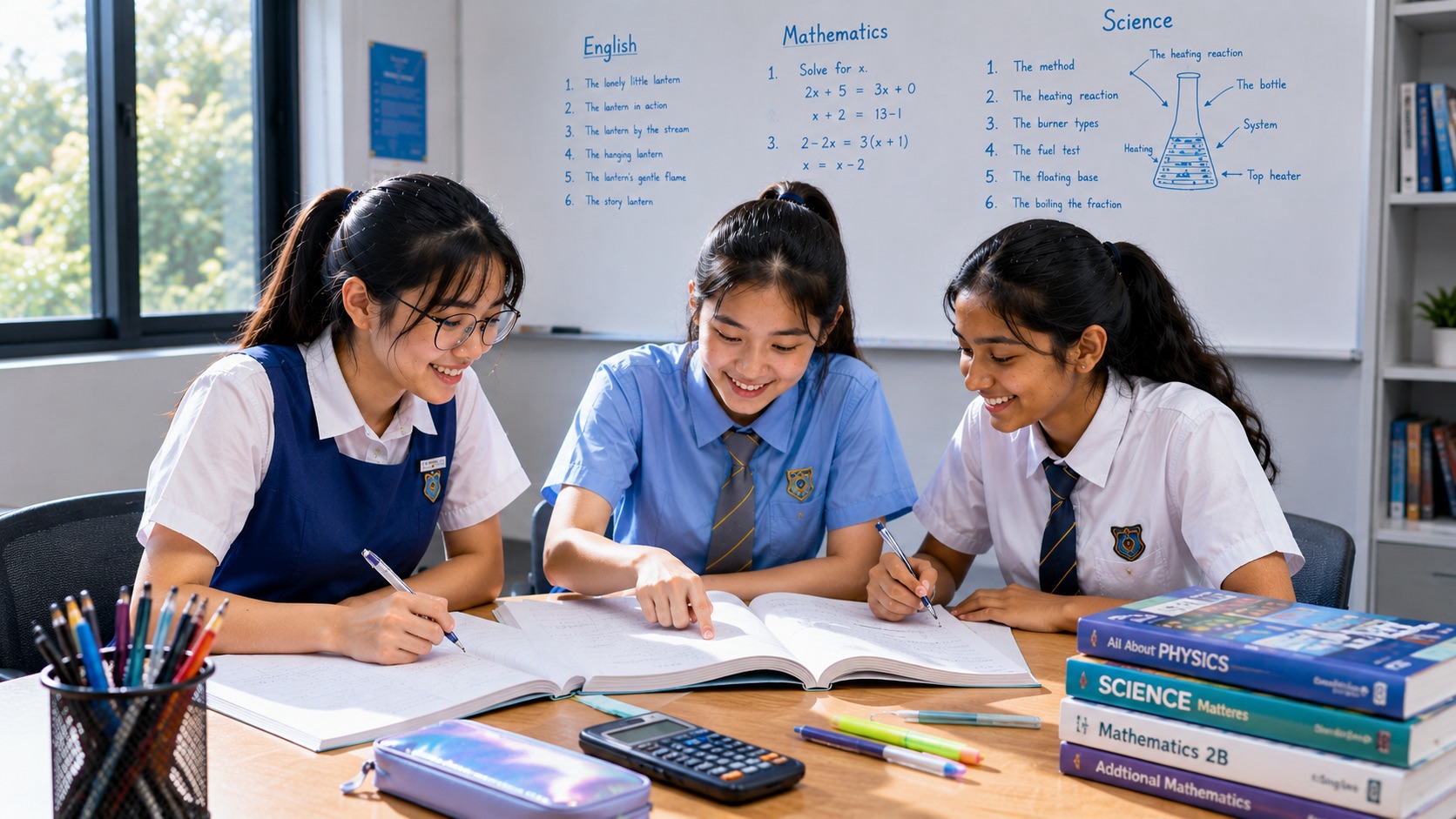
Secondary 2 Mathematics: The Year Methods Must Connect
Secondary 1 teaches a student that Mathematics has changed language. Secondary 2 asks a harder question: can the student connect that language into a system?
By the second year of secondary school, individual techniques are no longer enough. Algebra appears inside geometry. Ratio appears inside scale and rate. Graphs become relationships rather than pictures. Statistics requires interpretation rather than mere calculation. Word problems stop announcing the chapter they belong to.
This is often the year when a student who has survived on imitation begins to feel the strain. The learner may still be able to expand a bracket, solve an equation or calculate a percentage when the topic is named. But an examination does not always tell the student which tool to use. The student has to decide.
That decision is the heart of Secondary 2 Mathematics.
This guide is designed as a self-contained learning environment for students, parents and teachers. It explains the mathematics, the common failure modes, the diagnostic logic, the examination system and the habits that prepare a learner for upper-secondary Mathematics.
Choose Your Reading Route
Secondary 2 Has Suddenly Become Hard
Start with why the second year feels different, then read the chapters on algebra, proportional reasoning and transfer.
The Student Knows the Methods but Cannot Choose Them
Go to method selection and mixed problems and error analysis.
Marks Are Falling Despite Practice
Read why repetition can fail, the error map and the repair cycle.
Preparing for Upper Secondary
Begin at the upper-secondary bridge and continue to examination and independent-learning chapters.
Complete Route
Read all 25 chapters in order if you want the full Secondary 2 operating system: concept, representation, connection, diagnosis, repair, examination performance and progression.
Expandable Contents
Part I — Why Secondary 2 Is Different
Part II — Connected Mathematical Systems
Part III — Thinking and Diagnosis
Part IV — Repair and Integration
Part V — Performance and Independence
1. The Year Methods Must Connect
A Secondary 2 student can know many correct methods and still be mathematically fragile. The reason is simple: methods are useful only when the learner recognises the structure that calls for them.
Consider two questions. In the first, a student is told to solve 3x + 7 = 25. In the second, the student reads that a taxi charges a fixed fee of $7 plus $3 per kilometre and a passenger paid $25. The algebra is essentially the same. The cognitive task is not.
In the first question the equation has already been built. In the second, the student must decide what x means, identify the fixed and variable quantities, express the relationship and only then solve. The second question tests representation before procedure.
This distinction becomes increasingly important in Secondary 2 because mathematics begins to behave less like a set of labelled compartments. One chapter may contain rate, algebra and graph interpretation. A geometry problem may depend on ratio. A statistics problem may require careful percentage reasoning. A real-world context may need several representations before the calculation becomes obvious.
The learner therefore needs a higher-level routine: identify the structure, choose a representation, select a method, execute accurately, then verify.
That routine is more durable than any particular trick. It is also closely aligned with Singapore’s mathematics framework, where problem solving sits at the centre and mathematical concepts, skills, processes, metacognition and attitudes work together around it.
Secondary 2 is a good year to make that framework visible to the student. The learner should understand that the curriculum is not asking for a larger collection of tricks. It is asking for increasingly connected reasoning.
2. Why the Second Year Feels Different
Secondary 1 contains a large transition cost. Students meet algebraic notation, negative numbers, more abstract geometry and denser mathematical language. By Secondary 2, many students feel that they should already be comfortable. Yet this is often when weaknesses become more visible.
The reason is dependency. Mathematical knowledge is cumulative. A weak sign convention does not stay inside one chapter. It enters algebraic expansion, equation solving, substitution and coordinate work. Weak ratio understanding reappears in percentages, scale, speed, maps and similar figures. Weak fraction control returns in algebraic manipulation and probability.
As topics connect, old weaknesses acquire more opportunities to cause failure.
There is also less surface guidance. A student may have been successful when homework sets announced “Linear Equations Exercise 6A.” The chapter title gives away the method. A mixed revision paper removes that cue. The student must determine whether the relationship should be represented algebraically, proportionally, geometrically or graphically.
That is why performance can fall even while classroom comprehension appears stable. During teaching, the method is activated externally. During assessment, activation must come from the learner.
Another change is the increased density of notation. Indices, algebraic fractions, equations, inequalities, coordinate representations and geometric relationships can compress many ideas into a small space. A learner who reads Mathematics casually can miss a negative sign, a bracket, an exponent or a unit and thereby change the entire meaning.
Finally, the psychological cost of error changes. A student who has accumulated several months of confusion may begin to avoid questions that look unfamiliar. Avoidance reduces practice precisely where more deliberate practice is needed. Confidence then becomes entangled with competence.
The repair is not motivational language alone. The student needs successful evidence that a difficult-looking question can be decomposed into understandable relationships. Confidence built from method is more stable than confidence built from reassurance.
3. Arithmetic Still Runs Underneath Everything
Secondary students sometimes assume that arithmetic is elementary and therefore no longer relevant. In practice, arithmetic is the infrastructure that lets higher-level reasoning run without overload.
Imagine solving an equation that contains fractions. The algebraic strategy may be perfectly understood, but if common denominators are unreliable, the student must manage the concept and the arithmetic at the same time. Working memory becomes crowded. Error risk rises.
The same problem appears with percentages. A learner who does not automatically recognise 0.25, 25% and one quarter as equivalent representations must spend extra effort converting before reasoning can begin.
Number sense also acts as a safety system. If a calculator displays 468 after multiplying 19.5 by 2.4, estimation should object because 20 × 2.4 is about 48. A student without estimation habits may accept a mistyped result simply because the calculator produced it.
Signed numbers are another hidden dependency. A learner may know that −4 × −3 = 12 yet still struggle with 7 − (−5), −2³ and 3 − 2(−4). These are not all the same sign situation. The learner must distinguish negative numbers from subtraction operations and understand the scope of an exponent.
Units form part of arithmetic meaning. A speed of 72 km/h can be converted to 20 m/s because both distance and time units change systematically. A square-unit conversion must account for dimension: 1 m² equals 10,000 cm², not 100 cm².
The goal is not arithmetic speed for its own sake. It is reliability. When basic numerical relationships are stable, the learner can devote attention to representation and reasoning.
Arithmetic infrastructure check
- Estimate 39.7 × 5.1 before calculating.
- Explain why dividing by 0.2 makes a positive number five times as large.
- Compare −4.08 and −4.8 on a number line.
- Convert 2.5 m² to cm² and explain why the factor is squared.
- Express 3/8 as a decimal and percentage.
4. Algebra Becomes a Working Language
In Secondary 1, algebra may feel like a new chapter. By Secondary 2, it becomes a language used throughout Mathematics.
An algebraic expression is a compressed relationship. If a rectangle has width x and length x + 5, its perimeter can be written as 2x + 2(x + 5), which simplifies to 4x + 10. The geometry has been compressed into a symbolic statement.
Students who see only symbols often rush into manipulation. Stronger students first ask what the symbols represent. If x is a length, x must satisfy physical constraints. If an expression represents money, units matter. If x counts objects, a non-integer solution may require interpretation.
Expansion and factorisation are best understood as transformations between equivalent forms. Expanding 3(x + 4) to 3x + 12 reveals terms. Factorising 3x + 12 to 3(x + 4) reveals a common structure. Neither operation changes the value of the expression.
This concept of equivalence is more important than memorising isolated procedures. It explains why simplification is legal and why some apparent shortcuts are not.
For example, a student may incorrectly cancel the 3 in (3x + 6)/3x. Cancellation is valid for common factors, not terms separated by addition. If the numerator is factorised to 3(x + 2), the structure becomes clearer: 3(x + 2)/(3x) = (x + 2)/x, subject to the domain restriction x ≠ 0.
The student should therefore learn to inspect structure before manipulating. What are the terms? What are the factors? Which operations bind most tightly? Where do brackets define a group?
Algebra becomes easier when it is treated as meaning-preserving rewriting rather than symbol shuffling.
5. Equations, Identities and Equivalence
An equation asserts that two expressions have the same value under particular conditions. An identity is true for every admissible value of its variable. The distinction matters because the student must know what kind of mathematical statement is being handled.
Take 3x + 4 = 19. This equation is true only when x = 5. By contrast, 3(x + 4) = 3x + 12 is an identity: both sides have the same value for every x.
When solving equations, each step should preserve the solution set. Adding, subtracting, multiplying or dividing both sides by the same appropriate quantity maintains equality. The familiar phrase “move it across and change the sign” is a shortcut description, not the mathematical reason.
This becomes critical as equations grow more complicated. If the learner understands balance, fractions and brackets can be handled systematically. If the learner relies on moving symbols, each new layer increases the chance of an unjustified change.
Verification should be part of equation solving. Substitute the solution into the original equation, not only the last simplified line. A correct substitution tests the entire chain.
Inequalities introduce another important distinction. Multiplying or dividing both sides by a negative number reverses the inequality sign. This is not an arbitrary rule. On the number line, multiplying by a negative reverses order. If 2 < 5, then −2 > −5.
Students should connect symbolic solutions to number-line representations. x ≥ 3 means 3 is included and all values to its right are allowed. The notation, graph and verbal phrase “at least 3” are three representations of the same relationship.
6. Indices and Powers
Indices compress repeated multiplication. That compression makes them powerful and also makes careless rule use dangerous.
Students often memorise rules such as aᵐ × aⁿ = aᵐ⁺ⁿ. The rule is valid because multiplying repeated factors combines the counts of the same base. For example, a³ × a² = (a × a × a)(a × a) = a⁵.
The same reasoning explains division: aᵐ ÷ aⁿ = aᵐ⁻ⁿ, when the expression is defined. Negative indices emerge naturally. If a² ÷ a⁵ = a⁻³, cancellation also gives 1/a³, so a⁻³ = 1/a³.
Zero indices can be understood rather than memorised. For non-zero a, a³ ÷ a³ = 1. Using the index rule gives a³⁻³ = a⁰. Therefore a⁰ = 1.
A frequent error is applying multiplication rules to addition. a² + a³ cannot be simplified to a⁵ because the expression is a sum, not a product. The student must attend to the operation before applying a rule.
Another trap is the scope of the exponent. −3² means −(3²) = −9 under standard convention, while (−3)² = 9. The brackets change the base.
Scientific notation further connects powers to place value. Writing 6.2 × 10⁵ means 620,000, while 6.2 × 10⁻⁵ means 0.000062. The sign of the exponent describes scaling, not whether the number itself is positive or negative.
Index laws become much easier to retain when each rule is tied to structure. The question to ask is not “which formula do I remember?” but “what multiplication or division pattern is being compressed here?”
7. Ratio, Rate, Percentage and Scale
One of the most useful Secondary 2 connections is to see ratio, rate, percentage and scale as forms of multiplicative comparison.
If two quantities are in the ratio 3:5, scaling both by the same factor preserves the relationship. If a map uses a scale of 1:50,000, one unit on the map corresponds to 50,000 of the same units in reality. If a machine produces 120 items in 3 hours, the average rate is 40 items per hour.
The arithmetic differs, but the reasoning is about how one quantity changes relative to another.
Percentage is also multiplicative. A 15% increase multiplies by 1.15. A 15% decrease multiplies by 0.85. Two successive changes therefore compose through multiplication, not addition.
Suppose a price rises by 20% and then falls by 20%. Starting from $100, the first change gives $120. The second gives $96. The final price is lower than the original because the second percentage is calculated on a different base.
Reverse percentage exposes whether a student understands the base. If $68 is 85% of the original amount, the original is 68 ÷ 0.85 = 80. Adding 15% of 68 would answer a different question.
Speed and other rates require unit awareness. 90 km/h equals 25 m/s because 90 kilometres is 90,000 metres and one hour is 3,600 seconds. The conversion should make dimensional sense.
Scale in geometry adds another layer. If all lengths are multiplied by k, corresponding areas are multiplied by k² and volumes by k³. This relationship connects ratio, geometry and indices.
A strong student begins to see these as one family rather than four chapters. That connected view reduces memorisation and improves transfer.
8. Graphs as Relationships
A graph is not merely a picture of data. It is a representation of how quantities relate.
For a linear relationship such as y = 2x + 3, the gradient 2 tells us how much y changes for each unit increase in x. The intercept 3 tells us the value of y when x = 0. These are structural features, not decorative labels.
A student who plots points mechanically can still miss the meaning. If the graph represents taxi cost against distance, the gradient may represent cost per kilometre and the intercept may represent the fixed starting charge.
This is a powerful connection between algebra and real-world modelling. The equation and the graph describe the same relationship in different languages.
Students should practise moving both ways. Given an equation, predict the graph’s behaviour. Given a graph, describe the relationship. Given a context, decide what the gradient and intercept mean.
Scale choice also matters. A graph can visually exaggerate or compress differences depending on its axes. Mathematical literacy includes noticing whether the scale begins at zero, whether intervals are consistent and whether the plotted range hides important behaviour.
Coordinates should be interpreted as ordered pairs. The point (3, 7) is not interchangeable with (7, 3). The first coordinate locates horizontal position; the second locates vertical position.
Graph questions often test several layers at once: arithmetic, substitution, coordinates, scale reading, interpretation and sometimes modelling. This makes them excellent diagnostic tools.
The core habit is to ask what each visual feature means mathematically. A line, curve, intercept or steepness is carrying information.
9. Geometry as Argument
Geometry becomes much more reliable when students stop treating diagrams as pictures and start treating them as collections of justified relationships.
If two lines are parallel, certain angle relationships follow. If a triangle is isosceles, base angles are equal. If a polygon has a known number of sides, its interior-angle sum follows a general relationship. These are not visual impressions; they are consequences of properties.
The learner should therefore annotate diagrams with known information and write reasons beside key steps. “Angle ABC = 65°” is stronger when accompanied by “alternate angles, AB ∥ CD.”
This habit prevents a common failure: assuming something from appearance. Diagrams may not be drawn to scale. A line that looks perpendicular need not be perpendicular unless marked or proven. Two lengths that look equal are not equal merely because they appear so.
Geometry also links to algebra. If angles in a triangle are x, 2x and 3x, the geometric fact that the angles sum to 180° creates the equation x + 2x + 3x = 180. Solving gives x = 30.
The question therefore requires both a geometric relationship and algebraic execution. This is exactly the kind of connection Secondary 2 increasingly demands.
Measurement adds dimensional reasoning. Perimeter measures length, area measures two-dimensional extent and volume measures three-dimensional capacity. Their units should reflect that difference.
When a shape is enlarged by a linear scale factor, area and volume do not increase by the same factor. The student who connects scale to powers can derive the relationship rather than memorise it.
Strong geometry is therefore a combination of visualisation, property knowledge, algebraic representation and logical justification.
10. Statistics as Evidence
Statistics asks a different kind of mathematical question: what can data reasonably tell us?
Calculating a mean is easy once the procedure is known. Interpreting whether the mean is a useful summary requires judgement.
Suppose five salaries are $2,500, $2,700, $2,800, $3,000 and $50,000. The mean is heavily influenced by the highest value. The median may better represent the centre of the typical salaries. This does not make the mean “wrong.” It means different summaries answer different questions.
Spread matters too. Two classes can have the same mean yet very different consistency. Looking only at centre hides variation.
Graphs also need critical reading. A bar chart with a vertical axis beginning at 95 instead of zero can make a small difference look enormous. A pie chart can be visually persuasive even when categories are poorly chosen. A small sample can create unstable percentages.
Students should develop four questions: What was measured? How was it represented? What conclusion is supported? What conclusion would go beyond the evidence?
This habit connects school Mathematics with everyday life. News, social media, advertising, sport and public discussion all use data. Statistical literacy is therefore part of citizenship as well as examination preparation.
In examinations, interpretation questions often reveal whether the learner can move from number back to meaning. A calculated statistic is not always the final answer. Sometimes the task is to compare, justify or evaluate.
Statistics teaches an important mathematical discipline: evidence has limits. A careful student learns not only to calculate but also to avoid claiming more than the data supports.
11. Mathematical Modelling
Mathematical modelling is the process of representing a real or described situation using mathematical relationships, working with those relationships, and then interpreting the result back in context.
This is harder than routine calculation because the student must decide what matters.
Consider a phone plan charging $12 per month plus $0.08 per message beyond an included allowance. If a bill is $18.40, how many chargeable messages were sent? The learner must recognise a fixed component and a variable component.
Let m be the number of chargeable messages. Then 12 + 0.08m = 18.40. So 0.08m = 6.40 and m = 80.
The equation is simple once it exists. Building it is the real modelling work.
Good modelling begins by identifying quantities and units. What is fixed? What varies? What is known? What is unknown? Which quantities are linked?
The next step is choosing a representation. A table may suit a rate problem. A diagram may suit geometry. An equation may suit an unknown relationship. A graph may reveal how two variables change together.
Then the model is solved or analysed. Finally, the result is interpreted. If the algebra produces 80.5 messages, the learner must notice that half a message is impossible and revisit assumptions or rounding.
Models are simplifications. They are useful when their assumptions match the situation closely enough. This is why verification includes asking whether the answer makes sense in context, not merely whether the arithmetic is internally consistent.
Students who become comfortable with modelling are much less threatened by unfamiliar word problems because they have a process for turning stories into structure.
12. Choosing the Method
One of the biggest differences between homework and examinations is that homework is often organised by method while examinations are organised by questions.
A worksheet titled “Percentage Increase” tells the learner what to do before the first question is read. A mixed examination removes that support.
Method selection should therefore be trained explicitly.
Before solving, ask three questions. What is the final quantity being requested? What relationships are given? Which representation exposes those relationships most clearly?
If the problem describes a constant rate, a table or linear equation may help. If it describes parts of a whole, ratio or fraction representation may be natural. If lengths and angles interact, a diagram should be annotated. If repeated change is involved, multiplicative factors may be more useful than additive differences.
Students should also learn to reject methods. If the question asks for percentage increase, simply subtracting gives absolute change, not relative change. If the graph is nonlinear, treating the gradient as constant may be invalid. If a diagram is not to scale, measuring it with a ruler may be meaningless.
A powerful exercise is classification without solving. Give ten mixed questions and ask the student to identify the likely structure and first move. This separates recognition from calculation.
Another useful exercise is multiple methods. A ratio question might be solved using units, fractions or algebra. Comparing methods helps the learner see underlying equivalence.
Method choice becomes more reliable when students understand why a technique works rather than where it appeared in the textbook.
13. Why Repetition Can Fail
Practice is essential in Mathematics, but not all repetition produces the same learning.
If a student completes twenty nearly identical questions immediately after watching a worked example, the set may build procedural fluency. That is useful. But it can also create an illusion of mastery because the method is already activated and the surface form remains constant.
Real mastery requires variation and delay.
After initial fluency is established, change the numbers, wording, representation and context. Mix the topic with others. Revisit it after several days. Ask the learner to explain why the method applies.
Repetition also fails when errors are repeated without diagnosis. If the student expands −2(x + 3) incorrectly five times, another twenty expansions may merely reinforce an unstable sign model.
A better loop is attempt, diagnose, explain, repair, retest and transfer.
Attempt independently. Diagnose the first invalid step. Explain what principle should apply. Repair with a small targeted set. Retest after a delay. Transfer to a different-looking problem.
This approach makes practice adaptive. The next task is chosen because of what happened in the previous task.
Students should therefore measure progress by changing error patterns, not pages completed. If the same misconception survives across fifty questions, volume is not evidence of improvement.
Hard work becomes more powerful when feedback changes behaviour.
14. Build an Error Map
An error map turns a marked paper into a diagnostic document.
Instead of writing “careless” beside every wrong answer, classify the mechanism.
| Error type | What it means | Typical response |
|---|---|---|
| Concept | The underlying idea is misunderstood | Rebuild with simpler examples and representations |
| Procedure | The idea may be understood but execution is unstable | Slow down steps, practise targeted sequence |
| Representation | Words, diagram or context were translated wrongly | Train modelling before calculation |
| Notation | Signs, brackets, indices or units changed meaning | Make structure explicit and audit each line |
| Selection | The student chose an inappropriate method | Use mixed classification tasks |
| Timing | Knowledge was inaccessible within paper constraints | Train pacing, skipping and re-entry |
| Attention | A local slip occurred despite stable knowledge | Use targeted checks and cleaner working |
The map becomes more useful when frequency is recorded. One sign error may be noise. Seven sign errors across three topics suggest a structural weakness.
Patterns across time matter too. If percentage-base errors recur in every test, the problem has not been repaired even if one worksheet was completed successfully.
The error map should lead to action. Select one or two high-leverage mechanisms and build targeted practice around them. Then retest using mixed questions.
The student should participate in the mapping. Naming an error changes the learner’s relationship to it. “I am bad at Math” becomes “I often choose the wrong percentage base.” The second statement is specific enough to repair.
15. Find the First Broken Link
Many wrong answers contain several errors, but only one happened first.
Suppose a student solves a geometry problem using the wrong angle relationship, then performs flawless algebra on the resulting equation and obtains a wrong final answer. The algebra does not need repair. The first broken link is geometric property selection.
In another case, a student represents a word problem correctly but makes repeated negative-number errors while solving. The modelling is sound; signed arithmetic is the first broken link.
This principle prevents overteaching. Without it, teachers may reteach an entire chapter because one prerequisite failed.
A practical diagnostic sequence is to simplify the question. Remove the context. Replace variables with numbers. Reduce the number of steps. If the student still fails, the weakness lies lower in the chain.
Then rebuild upward. Once the prerequisite is stable, reintroduce the original complexity.
This process resembles debugging. The goal is not to complain that the system produced the wrong output. The goal is to locate the earliest instruction that stopped preserving the intended relationship.
Secondary 2 is an ideal stage to teach students this habit explicitly. They can begin asking themselves, “Where did my solution first stop being valid?”
That question is far more useful than “Why am I careless?”
16. The Repair Cycle
A repair cycle should be small enough to complete and strong enough to change behaviour.
Step one is isolate. Choose the mechanism, not the entire subject. “Algebra” is too broad. “Negative sign before a bracket” is repairable.
Step two is reconstruct. Explain the idea using a representation that makes meaning visible. For a negative bracket, numeric examples can show that subtracting a grouped amount affects every term inside it.
Step three is stabilise. Use a small set of focused examples. Require clear working and verbal explanation.
Step four is vary. Change coefficients, locations of negative signs and surrounding operations. The learner must recognise the same principle in different forms.
Step five is delay. Return after several days without announcing the topic. This tests retention rather than immediate imitation.
Step six is integrate. Place the repaired skill inside a mixed problem. A sign rule that works only on a worksheet labelled “negative brackets” is not yet operational.
Step seven is record. Update the error map. Did the mechanism disappear, reduce or persist?
This cycle can be applied to percentage bases, equation modelling, unit conversion, geometry reasons, index laws, graph interpretation and examination timing.
The important point is that repair ends with transfer, not with a corrected answer.
17. Mixed Problems and Error Analysis
Case A: Algebra and Perimeter
A rectangle has length 2x + 5 cm and width x − 1 cm. Its perimeter is 44 cm. Find x.
Use 2[(2x + 5) + (x − 1)] = 44. Inside the bracket, 3x + 4. So 6x + 8 = 44, giving 6x = 36 and x = 6.
The question combines geometry and algebra. A student who writes (2x + 5)(x − 1) has confused perimeter with area. The first broken link is geometric interpretation, not equation solving.
Case B: Scale and Area
Two similar shapes have a linear scale factor of 3 from the smaller to the larger. The smaller area is 12 cm². The larger area is 12 × 3² = 108 cm².
A student who answers 36 cm² has applied the linear scale directly to area. The arithmetic is correct for the wrong relationship.
Case C: Percentage and Reverse Reasoning
After a 20% discount, a bag costs $72. The original price is 72 ÷ 0.8 = $90.
Adding 20% of 72 gives $86.40 and reveals that the student used the discounted price as the percentage base.
Case D: Graph Interpretation
A linear cost graph passes through (0, 5) and (10, 25). The gradient is (25 − 5)/(10 − 0) = 2. The relationship is y = 2x + 5.
If x represents hours and y represents dollars, the graph may describe a $5 fixed charge plus $2 per hour. The mathematics is more informative when the gradient and intercept are interpreted.
Case E: Indices
Simplify a⁵ ÷ a². The result is a³ for appropriate non-zero a because five repeated factors divided by two common factors leaves three.
A student who writes a²·⁵ has confused division of powers with division of exponents. The index law must be tied back to repeated multiplication.
What mixed cases are testing
They are testing whether the learner can recognise structure without a chapter label. Correct execution after method selection is only part of the job.
18. What Good Tuition Should Do
Good tuition should make the student less dependent on tuition over time.
That sounds paradoxical, but it is the logical goal. The tutor initially supplies structure, explanation, diagnosis and feedback. As the learner improves, more of those functions should move inside the student.
A useful lesson often begins with a diagnostic question rather than a lecture. What does the student already understand? Where does the first error appear? Which representation would make the relationship visible?
Then the teacher explains the concept in a way that connects to prior knowledge. A new index rule can be derived from repeated multiplication. A graph can be connected to an equation. Scale can be connected to ratio and powers.
Worked examples should expose thinking, not merely steps. The tutor can model questions such as: What is invariant? What is changing? Which information is structural? What should the answer approximately look like?
Guidance should then fade. The next question should contain less prompting. The learner should be asked to select the method and explain why.
Small-group teaching can create opportunities for students to compare methods. One learner may solve a ratio question using unitary reasoning while another uses algebra. Discussing the relationship between the methods can deepen understanding.
Tuition should also use marked school work as evidence. If the same error appears repeatedly, the programme should respond. Generic lesson plans are less useful than teaching that adapts to the learner’s actual failure mechanisms.
Finally, tuition should prepare for independence by teaching self-checking, error logging, spaced review, mixed practice and examination management.
The strongest outcome is not that a student can reproduce the tutor’s method. It is that the student can enter an unfamiliar question and construct a valid method independently.
19. The Student Who Understands but Cannot Finish
Secondary 2 examinations begin to reveal whether a learner can manage Mathematics under finite time.
Some students understand the content yet lose substantial marks because they work in an inefficient sequence. They may spend too long on one difficult part, overcheck early answers, write excessive working for simple items or fail to return to skipped questions.
The solution is not “rush.” It is resource management.
Use marks as a rough indication of expected effort. Develop a skip rule. If no productive step has appeared after a reasonable interval, preserve the work, mark the question visibly and move on.
Re-entry should be designed. Leave a note such as “need equation from ratio” or “check angle property.” This reduces the mental cost of returning later.
Checking should be selective. High-value checks include signs, brackets, units, copied values, calculator entries, reasonableness and whether the final answer addresses the requested quantity.
Students should also practise recovery after difficulty. One hard question should not affect the next five. A short routine—stop, mark, move, reset—can be trained during timed practice.
Full papers are useful only after sufficient content has been learned. Before that stage, timed mixed sections can train the same performance skills without testing large amounts of untaught material.
Performance is a skill layer built on knowledge. It cannot replace understanding, but it determines how much understanding becomes visible on the script.
20. The Upper-Secondary Bridge
Secondary 2 is strategically important because the next phase expects greater abstraction and independence.
For students continuing toward G3 Mathematics, algebra becomes more demanding, graphs carry more information, geometry connects with trigonometric ideas and multi-step application becomes more common. Students on G2 pathways also require increasingly connected mathematical understanding suited to the syllabus and assessment demands of that course.
From the 2027 Singapore-Cambridge Secondary Education Certificate, SEAB lists G3 Mathematics under subject code K310 and G2 Mathematics under K210, with 4052 and 4045 respectively shown as reference codes for the earlier examination system. The naming changes, but foundational mathematical competencies remain central.
Secondary 2 should therefore consolidate several assets before the transition.
- Reliable signed-number and fraction control.
- Algebraic manipulation based on equivalence rather than memorised movement.
- Ability to model simple contexts with equations and graphs.
- Proportional reasoning across ratio, percentage, rate and scale.
- Geometry based on properties and justification.
- Data interpretation rather than calculation alone.
- Independent method selection in mixed questions.
- Visible working and deliberate verification.
Students considering Additional Mathematics later should pay particular attention to algebra. Additional Mathematics is not simply “harder sums.” It relies heavily on symbolic fluency and function-like thinking. Weak algebraic foundations create unnecessary friction.
Acceleration should not replace consolidation. A student who races into advanced content while basic equivalence, fractions and signs remain unstable is building height before structure.
The better goal is readiness: when a new upper-secondary topic appears, does the student possess the prerequisite language and habits to learn it efficiently?
21. Examination Performance
Examination performance begins before the paper. It begins with the way practice is organised.
If all practice is chapter-based, the student is not practising method selection. If all work is untimed, the student is not practising pacing. If every correction is immediately shown, the student is not practising recovery.
A good examination cycle contains four kinds of work: focused concept practice, mixed transfer practice, timed sections and full-paper rehearsal when appropriate.
During the paper, begin by reading the command precisely. “Find,” “show,” “explain,” “estimate,” “hence” and “give a reason” require different outputs.
Next, protect accessible marks. Do not allow one difficult question to consume disproportionate time. Preserve unfinished work and return.
Working should be legible enough to support method marks where applicable and, equally important, to support self-correction. A cluttered page increases the chance that signs, copied values and units are lost.
Calculator use should be deliberate. Estimate first when possible. Enter brackets carefully. Keep enough intermediate precision if later steps depend on the result. Round according to the question’s requirements.
At the end, perform targeted checks rather than rereading passively. Look for unanswered parts, missing units, impossible values, copied-number errors, suspicious magnitudes and equations that can be verified by substitution.
After marking, calculate not only the score but the loss profile. How many marks were lost through concept, selection, execution, notation, attention or timing? That profile should influence the next week of preparation.
End-of-paper audit
- Every question attempted or deliberately marked for return?
- Units present where required?
- Negative signs and brackets checked?
- Calculator results reasonable?
- Probabilities between 0 and 1?
- Lengths, areas and times physically sensible?
- Final answers actually answer the stated question?
22. A Twelve-Week Improvement Architecture
A twelve-week cycle allows enough time to diagnose, rebuild, stabilise, transfer and retest.
Weeks 1–2: Evidence and Diagnosis
Review recent scripts. Build an error map. Run short prerequisite checks. Identify the two highest-leverage broken links rather than attacking every weakness at once.
Weeks 3–4: Reconstruct Concepts
Use diagrams, number lines, tables, algebraic representations and explanations to rebuild meaning. Require the learner to explain why each procedure is valid.
Weeks 5–6: Stabilise Procedures
Use focused practice to build reliable execution. Track error frequency. Do not advance merely because a worksheet was completed.
Weeks 7–8: Transfer
Vary contexts and representations. Mix topics. Ask students to choose and justify methods without chapter labels.
Weeks 9–10: Timed Integration
Use timed mixed sections. Train pacing, skipping, re-entry and targeted checking.
Weeks 11–12: Retest and Replan
Return to the original diagnostic categories. Measure whether the targeted mechanisms changed. Use the evidence to design the next cycle.
| Phase | Question | Evidence |
|---|---|---|
| Diagnosis | What fails first? | Specific mechanisms identified |
| Reconstruction | Does the idea make sense? | Learner explains and represents |
| Stabilisation | Can it be executed reliably? | Error frequency falls |
| Transfer | Can it be recognised elsewhere? | Success on varied mixed questions |
| Performance | Can it survive time pressure? | More complete and accurate timed work |
The purpose of the cycle is not to promise a particular score after twelve weeks. It is to create a measurable process in which teaching responds to evidence.
23. What Parents Should Watch
A parent does not need to become a secondary Mathematics tutor to recognise useful signs.
Watch whether the child can explain recent learning without copying from notes. Explanation exposes whether the concept exists beyond the page.
Watch whether homework success depends on having an example beside the question. If the learner can imitate but not transfer, the problem is not effort alone.
Watch recurring error categories. A one-off arithmetic slip is different from repeated percentage-base errors or chronic failure to finish papers.
Watch the child’s response when stuck. Does the learner reread, annotate, draw, estimate or try a simpler case? Or does unfamiliarity immediately become surrender?
Watch workload critically. More pages are not automatically better. Ask what has changed: Which error is less frequent? Which method can now be chosen independently? Which topic remains unstable after delay?
Watch time use. A child who studies for long hours may still use inefficient methods, switch frequently between tasks or practise only comfortable questions.
Use conversations with teachers or tutors to seek mechanisms. “Needs more practice” is less useful than “the student understands linear equations but struggles to model word problems without prompts.”
Finally, preserve a sustainable routine. Sleep, attention and emotional regulation affect working memory and decision making. A mathematically sound plan that exhausts the learner is poorly designed.
24. What Students Should Do Independently
Independent learning is not the absence of teaching. It is the ability to perform more of the learning cycle without external control.
Begin with retrieval. Before opening notes, write what you remember about yesterday’s topic. Then compare. The gap is useful information.
When solving, show enough working to make mistakes visible. Mental shortcuts are efficient only when they are reliable. If a topic is unstable, externalise more steps.
When wrong, locate the first invalid step before reading a full solution. Ask whether the error was concept, procedure, representation, notation, selection or attention.
Keep a compact error log. Review it weekly. Choose practice from the log rather than only from what feels comfortable.
Use spaced review. Revisit a topic after a few days and again after a few weeks. Memory that survives delay is more useful than immediate familiarity.
Mix topics once initial fluency is secure. Method selection is a skill and needs practice.
Build a stuck routine: identify the final demand, list known and unknown quantities, choose a representation, recall relevant relationships, try a simpler case, estimate, and if necessary move temporarily and return later.
Use estimation routinely. A calculator is excellent at arithmetic and terrible at noticing that you entered the wrong expression.
Finally, explain Mathematics aloud. If you can explain why a method works, when it applies and how to check it, the knowledge is more connected than if you can only reproduce steps silently.
A 40-minute independent session
- 5 minutes: retrieval from memory.
- 15 minutes: focused work on one current weakness.
- 10 minutes: mixed questions without chapter labels.
- 5 minutes: delayed retest of an older error.
- 5 minutes: update error log and choose next review date.
25. The Connected Mathematics Operating System
By the end of Secondary 2, Mathematics should begin to look less like a shelf of chapters and more like a connected system.
Numbers provide quantity, magnitude, sign and scale.
Algebra compresses relationships and allows them to be transformed without losing meaning.
Ratio and rate describe multiplicative relationships between quantities.
Graphs make relationships visible.
Geometry turns spatial properties into justified chains of reasoning.
Statistics turns data into evidence while reminding us that evidence has limits.
Modelling connects the mathematical system to situations outside the textbook.
Across all of them, the student needs the same deeper habits: identify structure, choose a representation, preserve relationships, execute accurately, communicate clearly and verify.
These habits explain why Secondary 2 matters so much. The year is not simply preparation for a harder syllabus. It is where mathematical methods should begin to become organised knowledge.
A student who leaves Secondary 2 with connected knowledge is better prepared for whatever upper-secondary pathway follows because new topics have somewhere to attach.
The aim is not to know every future technique early. The aim is to have a mathematical system strong enough to learn the next technique properly.
Reference Notes
- Singapore Examinations and Assessment Board — 2027 SEC G3 syllabuses for school candidates.
- Singapore Examinations and Assessment Board — 2027 SEC G2 syllabuses for school candidates.
- SEAB K310 G3 Mathematics syllabus for 2027.
- Singapore Ministry of Education — Mathematics education.
Continue through eduKateYishun Mathematics
Secondary Mathematics Directory · Mathematics Tuition & Learning Hub · The Library
Role in the Secondary 2 Mathematics system: this page focuses on moving from methods to connected mathematical reasoning. For the complete year-level route, return to Secondary 2 Mathematics Tuition in Yishun | From Procedures to Connected Mathematical Thinking.
Leave a Reply