
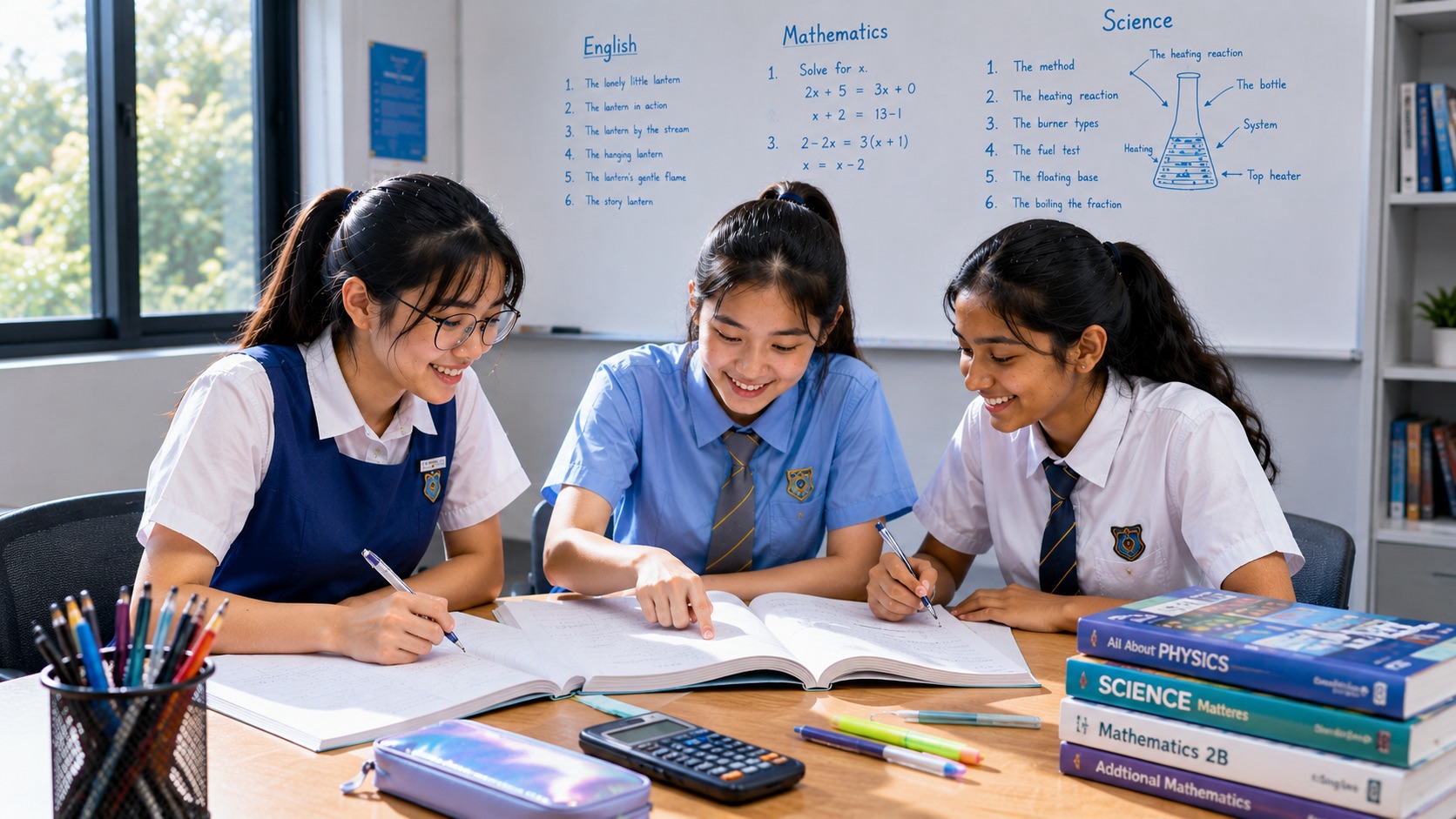
Secondary 2 Mathematics is the year the subject begins to connect itself together. Number work feeds algebra. Algebra feeds graphs. Ratio and percentage begin appearing inside modelling. Geometry asks for more than property recall. Statistics and probability require interpretation as well as calculation. A learner who revises only by chapter can therefore look fluent in familiar exercises and still become uncertain when a test combines ideas.
This eduKateYishun page is the main Secondary 2 Mathematics understanding-and-recovery owner. It does not establish a current physical Yishun centre, class size, timetable, fee or vacancy. Its purpose is to help families distinguish a procedure that is known from a relationship that can be recognised, represented and transferred independently. For specialist Mathematics explanations and progression, use BTT’s Secondary Mathematics Learning Hub; return here with fresh work.
The worked situations below are constructed instructional examples, not official examination questions or identifiable student cases. Use the learner’s actual school sequence and Mathematics subject level. A topic not yet taught is not evidence of a forgotten foundation, and G1, G2 or G3 should not be used as a label for the whole learner.
1. Why Secondary 2 is a hinge year
Secondary 1 introduces a new mathematical language. Secondary 2 increasingly expects the learner to use it with less guidance. Expressions become more complicated, equations have more moving parts, graphs must be interpreted, geometry combines properties and algebra, and word problems are less likely to announce the method directly.
This can create the impression that the learner suddenly became weak. Often the difficulty is accumulated friction: a shaky fraction habit meets algebra, a weak algebra habit meets a graph equation, or an uncertain percentage base appears inside a multi-step context. That possibility should be tested against actual work rather than assumed from a mark.
2. Diagnose the first weak connection
Read a solution from the beginning and identify the first unsupported decision. Separate meaning, procedure, representation, method selection, execution, retrieval and transfer. A learner who forms the correct equation and then makes an arithmetic error has already demonstrated modelling that should be preserved.
Support level belongs in the evidence. A correct solution after “use ratio” is not the same as independently recognising a proportional relationship. A tutor reading the instruction aloud is different from supplying the equation. Record the support without treating it as failure; the next task can test whether one layer can now be removed.
When a cause is uncertain, compare nearby tasks. If direct percentage succeeds but reverse percentage fails, investigate the reference whole. If a graph is plotted correctly from a supplied table but the learner cannot form the table from an equation, the missing connection is different from plotting.
3. Learn Mathematics as connected systems
One useful map has five systems: quantity, symbol, representation, relationship and reasoning. Quantity includes number, fraction, percentage, ratio, rate and measure. Symbol includes variables, expressions, equations and formulae. Representation includes words, tables, graphs and diagrams. Relationship includes equality, proportionality, change and geometric constraints. Reasoning asks why a method is valid and how a result can be checked.
The map is useful only when it predicts actual work. Ratio can support scale reasoning. Percentage expresses multiplicative change. Algebra can express geometric constraints. A table can reveal a graph pattern. These are meaningful connections when the learner can use them on a problem, not merely recite that “everything connects”.
4. Number sense remains an internal checking system
Secondary 2 learners still need to predict sign and approximate magnitude. Multiplying a positive quantity by 0.4 produces a smaller positive quantity. If a calculator-heavy result differs by an order of magnitude from an estimate, investigate the entry before continuing.
Directed numbers remain important in substitution and coordinates. −7 − (−3) = −4 because subtracting a negative adds three. If this arithmetic is secure but the same operation fails after x = −7 is substituted into an expression, the notation rather than the number rule may be the first weakness.
5. Ratio, rate and percentage: identify the reference
If A:B = 5:7 and A + B = 96, twelve ratio units represent 96. One unit is eight, so A = 40 and B = 56. If B alone is known as 56, divide by seven to recover the same unit value. The relationship is fixed while the information supplied changes.
A 15% increase uses multiplier 1.15; a 15% decrease uses 0.85. If a discounted price of $102 represents 85% of the original, then 0.85P = 102 and P = 120. Check forward: 15% of 120 is 18, leaving 102.
Average rate needs the whole journey or process. Travelling 60 km at 30 km/h and another 60 km at 60 km/h takes two hours plus one hour. The average speed is therefore 120/3 = 40 km/h, not the arithmetic mean 45 km/h. Equal distance does not imply equal time.
6. Algebra as structure
In 6x + 18, the shared factor is six, so the expression can be written 6(x + 3). In 4a + 3a − 5, like terms combine to 7a − 5. In 3(x + 4), multiplication distributes to give 3x + 12. The operations follow structure rather than surface appearance.
Checking can run backwards. Expand a factorised expression to see whether the original returns. Substitute a simple value into two expressions that are claimed to be equivalent. One disagreeing value disproves a proposed identity, although one agreeing value cannot prove equality for every input.
7. Equations and equivalence
Solve 5x − 7 = 3x + 11. Subtract 3x from both sides to obtain 2x − 7 = 11, then add seven and divide by two: x = 9. The original equation checks because both sides equal 38.
For (x + 2)/5 = 3, multiply the whole equation by five to obtain x + 2 = 15 and x = 13. The fraction bar groups the numerator. x + 2/5 is a different expression.
Where simultaneous equations have been introduced, use their structure. For x + y = 11 and x − y = 3, adding the equations eliminates y and gives 2x = 14, so x = 7 and y = 4. Elimination works because the opposite y-terms sum to zero.
8. Formulae and rearrangement
A formula expresses a relationship among quantities. From A = lw, w = A/l when l is nonzero. From P = 2l + 2w, subtract 2l and divide by two to obtain w = (P − 2l)/2 = P/2 − l.
Grouping matters. Dividing P − 2l by two must affect both terms. Units offer another check: area divided by length gives length, so an answer with area units for w should be challenged.
9. Patterns and generalisation
For the arithmetic sequence 5, 8, 11, 14 under a constant-increase rule, the nth term is 3n + 2 when n starts at one. Check n = 1 and n = 4. The algebra makes a long-distance prediction possible without writing every intermediate term.
A finite list does not by itself prove how all later terms continue; the continuation rule matters. This distinction prevents a learner from treating every visible pattern as if it uniquely determines an infinite sequence.
10. Graphs as relationships
A line through (2,7) and (6,19) has gradient (19 − 7)/(6 − 2) = 3. Substituting a point into y = 3x + c gives c = 1, so the line is y = 3x + 1. The gradient describes change per unit x; the intercept describes the output when x = 0.
Constant gradient is not the same as direct proportion. y = 3x + 1 does not pass through the origin. Dividing y by x at one point includes the fixed starting amount and therefore does not generally give the gradient.
Read axes and scale before interpreting shape. A flat distance-time segment means distance is unchanged; a flat speed-time segment means speed is constant. The graph must be interpreted through the variable on the axis.
11. Geometry as a system of constraints
Transfer useful information from the text onto the diagram: equal sides, parallel lines, right angles, known angles and the unknown. Distinguish what is stated from what the drawing merely looks like.
An isosceles triangle has equal base angles (x + 10)° and vertex angle 50°. Then 2(x + 10) + 50 = 180, so x = 55 and the base angles are 65° each. The variable value is not automatically the angle requested.
A right triangle with legs 9 and 12 has hypotenuse 15. If the hypotenuse is 13 and one shorter side is five, the other side is 12. Identify which side is opposite the right angle before arranging the squares.
12. Measurement, scale and dimension
Length, area and volume are different kinds of quantity. If corresponding lengths in similar figures double, the area becomes four times as large because two dimensions are scaled. A length factor should not be applied unchanged to area.
Unit conversion also depends on dimension. One metre is 100 centimetres, while one square metre is 10,000 square centimetres. Writing the desired unit before calculating helps reveal a mismatch.
13. Statistics and interpretation
For 4,5,6 and 1,5,9, the mean is five in both sets but the ranges are two and eight. Equal means do not imply equal spread. Statistical conclusions should state exactly what the chosen summary supports.
Six observations with mean 15 have total 90. If five known values total 70, the sixth is 20. If a new observation is added, both total and count change. If an observation is replaced, the count stays fixed.
14. Probability and the sampling model
A bag with three red, five blue and two green counters gives P(red) = 3/10 if every individual counter is equally likely to be selected. “Not blue” includes five counters and therefore has probability 1/2.
In a two-stage experiment, state whether selection is with or without replacement. After a red is removed from a bag containing three red and two blue counters, the next conditional probability of red is 2/4 = 1/2, not the original 3/5.
15. Representation as a problem-solving tool
A difficult problem can become manageable when represented differently. Words can become an equation, a sequence can become a table, geometric prose can become labelled marks, and a probability question can become a tree or list of outcomes.
Producing many representations is not the objective by itself. Choose the one that exposes the relevant relationship. Independence grows when the learner can decide which representation is useful rather than waiting for the tutor to choose it.
16. Method selection
A chapter heading supplies a method cue. A mixed question removes it. Before solving, identify the target, given information, important condition, useful representation and relationship that connects known to unknown.
A method-only exercise can ask for the proposed first relationship without calculation. Then solve selected items to see whether the plan was valid. Naming a topic such as “ratio” is not enough if the learner has compared the wrong quantities.
17. Retrieval and memory
Open notes can make a method feel familiar without making it retrievable. Use short closed-book questions from previously taught material. Correct the principle, close the model and try again. Return later with a changed item.
Record whether the result was independent, lightly prompted or model-dependent. These categories answer different questions about what the learner can currently retrieve.
18. Practice with a defined job
Decide whether the set is meant to build concept, procedure, representation, selection, fluency, retrieval or transfer. Asking every worksheet to do everything makes the feedback less interpretable.
More questions are not automatically better. If the same invalid rule appears repeatedly, pause and repair the rule. Then use a changed question to test whether the next attempt actually changed.
19. Mixed practice and transfer
Focused work is useful while a method is new. Once reasonably secure, mix it with already-taught alternatives. Change surface features deliberately: numbers, context, unknown position, graph scale, diagram orientation or representation.
Ask what remains mathematically the same. A fixed starting amount plus constant rate can appear in savings, a constructed hire problem or a linear graph. The contexts differ; the underlying relationship can remain.
20. Error architecture and checking
A sign error, wrong operation, copied value, unit error, graph-scale mistake, formula error and wrong final target are different events. “Careless” is too broad unless it leads to a specific mechanism that can be tested.
Use checks that match the risk: estimation for magnitude, substitution for equation solutions, units for measurement, expansion for factorisation, another representation for a graph or table. A check should provide independent information, not simply repeat the same mistake more carefully.
21. An illustrative twelve-week connected-thinking plan
Weeks 1–2: collect recent work and map number, algebra, graph and geometry dependencies already taught. Weeks 3–4: repair active algebra and proportional reasoning. Weeks 5–6: connect algebra to tables and graphs. Weeks 7–8: integrate geometry, measurement and representation.
Weeks 9–10: work with statistics, probability and contextual interpretation. Weeks 11–12: use mixed recognition, changed transfer and delayed retrieval. This is a planning framework, not a promised recovery duration; the evidence should alter the order when necessary.
22. Parent dashboard
Parents can observe whether the learner can name a difficulty specifically, explain a method without the model open, solve a changed question later, estimate unreasonable answers, translate among representations and begin without an adult announcing the method.
These observations complement marks; they do not guarantee the next score. Keep task difficulty and support level visible when comparing two pieces of work.
23. What useful Secondary 2 Mathematics tuition should do
Useful tuition makes mathematical decisions visible. A small-group lesson can include retrieval, diagnosis, focused explanation, guided practice, variation, independent attempt, feedback and delayed revisit. The support should decrease as the learner becomes able to supply the decisions.
For intake, group fit, homework and progress-review design, use the Secondary 2 support-programme guide. This page’s job is different: explain connected mathematical thinking and provide a return point for fresh evidence.
24. Mixed Secondary 2 workshop
Attempt these without topic headings: a price of $240 increases by 12%; after a 15% discount an item costs $102—find the original; solve 4x − 7 = 2x + 13; given A = lw, make w the subject and find w when A = 54 and l = 9; the sequence 7,11,15,19 has constant difference four—write the nth term.
Continue: find the gradient through (1,5) and (5,17); two adjacent angles forming a straight angle are (2x + 20)° and (4x − 8)°—find x and the angles; six values have mean 15 and five known values are 8,12,14,17,19—find the sixth; a bag has three red, five blue and two green counters—find P(not blue).
The answers are $268.80; $120; x = 10; w = A/l and w = 6; nth term 4n + 3; gradient 3; x = 28 with angles 76° and 104°; sixth value 20; and probability 1/2. The review should identify the relationship behind each answer.
25. Worked connection cases
Case A · Ratio, fraction and percentage need the same reference whole
A quantity divided in ratio 2:3 gives first part 2/5 of the total, or 40%. If the first part is 60, one ratio unit is 30 and the total is 150. But the first part as a percentage of the second is 2/3 × 100%, not 40%. The denominator changes with the comparison.
Case B · Algebra and geometry return to the requested angle
An isosceles triangle has equal base angles (x + 10)° and vertex 50°. The equation gives x = 55, but the base angles are 65°. The geometry determines the equation, algebra solves it and substitution returns the value to the geometric quantity.
Case C · Same perimeter, different area
A 6 by 8 rectangle has perimeter 28 and area 48. A 5 by 9 rectangle also has perimeter 28 but area 45. Equal perimeter does not force equal area. Construction provides a counterexample to an overgeneralised rule.
Case D · Constant difference does not imply direct proportion
A linear table with x = 0,1,2,3 and y = 5,8,11,14 follows y = 3x + 5. It has constant first differences but not constant ratio y/x and does not pass through the origin. Direct proportion would be y = 3x.
Case E · Mean creates a total relationship
Five values with mean 12 have total 60. If four known values total 43, the fifth is 17. Replacing a value changes the total while keeping count fixed; adding a value changes both. The state of the dataset determines the calculation.
Case F · Equivalent probability requires an equivalent sampling model
A bag with three red and five blue counters gives probability 3/8 of red. A bag with six red and ten blue also gives 3/8 under uniform counter selection. But if one of two bags is chosen with equal probability before selecting a counter, counting all physical counters together may no longer describe equal outcomes.
26. Fresh transfer questions
Two quantities are in ratio 4:5 and the smaller is 32—find the larger and the smaller quantity’s fraction of the total. A rectangle has width w, length w + 3 and perimeter 34—find its area. A linear rule has y = 4 when x = 0 and y = 14 when x = 5—find y when x = 8. Four observations have mean nine; a fifth observation of 14 is added—find the new mean.
The answers are larger 40 and smaller fraction 4/9; rectangle width seven, length ten and area 70; linear rule y = 2x + 4 so y = 20; and new mean ten. Record which connection was recognised independently.
27. Handoff into Secondary 3
Keep a compact handover: secure relationships, a small number of unresolved dependencies, useful representations, personal checking routines and the strongest prompt still required. Remove resolved errors so Secondary 3 begins from the current learner rather than an archive of every past mistake.
Use BTT’s specialist Mathematics route for fuller teaching, Student Diagnostics when the first failure remains uncertain and Examination Performance when knowledge appears sound but paper conditions disrupt it. Return from every handoff to fresh mixed Mathematics.
Part II · From Procedures to Connected Mathematical Thinking
This extended section preserves the newer Secondary 2 cleanup content and adds a connected-thinking layer around it. The page’s job is not to become another generic tuition article. It explains how separate procedures begin to form a mathematical network before upper-secondary Mathematics raises the abstraction and transfer demands.
Connected Thinking 1: Connected Mathematics begins with dependencies
Connection. number sense, fractions, ratio, algebra, graphs, geometry and data support one another. Secondary 2 is the right stage to make these links visible because upper-secondary work will increasingly assume that earlier ideas can be retrieved and combined without being retaught chapter by chapter.
Common disconnect. revising topics as unrelated boxes. When that happens, a learner can appear to know several chapters while still being unable to use them together. The issue is not always missing content; it may be missing connections.
Diagnostic move. map which prerequisite each current topic depends on. Keep the numbers manageable so the relationship itself remains visible. The tutor should identify the first point where the student’s representation or reasoning diverges from a workable route.
Practice design. use one repair inside at least two later topics. Direct practice establishes the idea, then mixed and changed contexts make the learner select it. The method should eventually work when the topic heading disappears.
Transfer goal. make one foundation improvement improve several chapters. This is what turns Secondary 2 from a collection of procedures into connected mathematical thinking.
Connected Thinking 2: Number structure before symbolic speed
Connection. place value, factors, multiples and signed-number sense make later algebra more stable. Secondary 2 is the right stage to make these links visible because upper-secondary work will increasingly assume that earlier ideas can be retrieved and combined without being retaught chapter by chapter.
Common disconnect. trying to accelerate into algebra while arithmetic structure is fragile. When that happens, a learner can appear to know several chapters while still being unable to use them together. The issue is not always missing content; it may be missing connections.
Diagnostic move. use small-number contrasts and estimation. Keep the numbers manageable so the relationship itself remains visible. The tutor should identify the first point where the student’s representation or reasoning diverges from a workable route.
Practice design. embed the same structure inside algebraic expressions. Direct practice establishes the idea, then mixed and changed contexts make the learner select it. The method should eventually work when the topic heading disappears.
Transfer goal. reduce working-memory load. This is what turns Secondary 2 from a collection of procedures into connected mathematical thinking.
Connected Thinking 3: Fractions as reusable quantities
Connection. fractions act as numbers, operators and relationships across the curriculum. Secondary 2 is the right stage to make these links visible because upper-secondary work will increasingly assume that earlier ideas can be retrieved and combined without being retaught chapter by chapter.
Common disconnect. treating fractions as a finished Primary topic. When that happens, a learner can appear to know several chapters while still being unable to use them together. The issue is not always missing content; it may be missing connections.
Diagnostic move. retrieve equivalence and operations briefly. Keep the numbers manageable so the relationship itself remains visible. The tutor should identify the first point where the student’s representation or reasoning diverges from a workable route.
Practice design. connect fractions directly to equations, ratio and probability. Direct practice establishes the idea, then mixed and changed contexts make the learner select it. The method should eventually work when the topic heading disappears.
Transfer goal. keep fraction knowledge active under new notation. This is what turns Secondary 2 from a collection of procedures into connected mathematical thinking.
Connected Thinking 4: Ratio as multiplicative thinking
Connection. ratio expresses a scale relationship rather than a fixed difference. Secondary 2 is the right stage to make these links visible because upper-secondary work will increasingly assume that earlier ideas can be retrieved and combined without being retaught chapter by chapter.
Common disconnect. adding the same amount to both ratio terms. When that happens, a learner can appear to know several chapters while still being unable to use them together. The issue is not always missing content; it may be missing connections.
Diagnostic move. identify one unit and common scale factor. Keep the numbers manageable so the relationship itself remains visible. The tutor should identify the first point where the student’s representation or reasoning diverges from a workable route.
Practice design. move among bars, tables and equations. Direct practice establishes the idea, then mixed and changed contexts make the learner select it. The method should eventually work when the topic heading disappears.
Transfer goal. prepare for similarity, rate and percentage. This is what turns Secondary 2 from a collection of procedures into connected mathematical thinking.
Connected Thinking 5: Percentage as relative comparison
Connection. every percentage is measured against a reference quantity. Secondary 2 is the right stage to make these links visible because upper-secondary work will increasingly assume that earlier ideas can be retrieved and combined without being retaught chapter by chapter.
Common disconnect. using whichever number appears nearest as the base. When that happens, a learner can appear to know several chapters while still being unable to use them together. The issue is not always missing content; it may be missing connections.
Diagnostic move. label what represents 100% before calculating. Keep the numbers manageable so the relationship itself remains visible. The tutor should identify the first point where the student’s representation or reasoning diverges from a workable route.
Practice design. contrast forward, change and reverse percentage. Direct practice establishes the idea, then mixed and changed contexts make the learner select it. The method should eventually work when the topic heading disappears.
Transfer goal. make percentage reasoning portable. This is what turns Secondary 2 from a collection of procedures into connected mathematical thinking.
Connected Thinking 6: Signed numbers as a shared dependency
Connection. negative values appear in algebra, coordinates and graphs. Secondary 2 is the right stage to make these links visible because upper-secondary work will increasingly assume that earlier ideas can be retrieved and combined without being retaught chapter by chapter.
Common disconnect. learning sign rules only on isolated integer worksheets. When that happens, a learner can appear to know several chapters while still being unable to use them together. The issue is not always missing content; it may be missing connections.
Diagnostic move. use number-line meaning and bracketed substitution. Keep the numbers manageable so the relationship itself remains visible. The tutor should identify the first point where the student’s representation or reasoning diverges from a workable route.
Practice design. embed signed values across representations. Direct practice establishes the idea, then mixed and changed contexts make the learner select it. The method should eventually work when the topic heading disappears.
Transfer goal. reduce repeated sign leakage. This is what turns Secondary 2 from a collection of procedures into connected mathematical thinking.
Connected Thinking 7: Algebraic notation as language
Connection. symbols compress quantitative relationships. Secondary 2 is the right stage to make these links visible because upper-secondary work will increasingly assume that earlier ideas can be retrieved and combined without being retaught chapter by chapter.
Common disconnect. manipulating letters without understanding what they represent. When that happens, a learner can appear to know several chapters while still being unable to use them together. The issue is not always missing content; it may be missing connections.
Diagnostic move. read expressions aloud and identify terms, coefficients and operations. Keep the numbers manageable so the relationship itself remains visible. The tutor should identify the first point where the student’s representation or reasoning diverges from a workable route.
Practice design. translate words to symbols and symbols to words. Direct practice establishes the idea, then mixed and changed contexts make the learner select it. The method should eventually work when the topic heading disappears.
Transfer goal. make algebra reconstructable. This is what turns Secondary 2 from a collection of procedures into connected mathematical thinking.
Connected Thinking 8: Like-term classification
Connection. terms combine only when their variable structure matches. Secondary 2 is the right stage to make these links visible because upper-secondary work will increasingly assume that earlier ideas can be retrieved and combined without being retaught chapter by chapter.
Common disconnect. adding coefficients before deciding whether terms are alike. When that happens, a learner can appear to know several chapters while still being unable to use them together. The issue is not always missing content; it may be missing connections.
Diagnostic move. mark variable parts first. Keep the numbers manageable so the relationship itself remains visible. The tutor should identify the first point where the student’s representation or reasoning diverges from a workable route.
Practice design. use x, y, x² and constants in contrast sets. Direct practice establishes the idea, then mixed and changed contexts make the learner select it. The method should eventually work when the topic heading disappears.
Transfer goal. build reliable simplification. This is what turns Secondary 2 from a collection of procedures into connected mathematical thinking.
Connected Thinking 9: Brackets as grouped quantities
Connection. a multiplier applies to the complete expression inside a bracket. Secondary 2 is the right stage to make these links visible because upper-secondary work will increasingly assume that earlier ideas can be retrieved and combined without being retaught chapter by chapter.
Common disconnect. distributing to only the first term. When that happens, a learner can appear to know several chapters while still being unable to use them together. The issue is not always missing content; it may be missing connections.
Diagnostic move. use area or grouping models temporarily. Keep the numbers manageable so the relationship itself remains visible. The tutor should identify the first point where the student’s representation or reasoning diverges from a workable route.
Practice design. fade into symbolic expansion. Direct practice establishes the idea, then mixed and changed contexts make the learner select it. The method should eventually work when the topic heading disappears.
Transfer goal. prepare for factorisation and equations. This is what turns Secondary 2 from a collection of procedures into connected mathematical thinking.
Connected Thinking 10: Equations as preserved equality
Connection. solving means transforming both sides while keeping them equal. Secondary 2 is the right stage to make these links visible because upper-secondary work will increasingly assume that earlier ideas can be retrieved and combined without being retaught chapter by chapter.
Common disconnect. using move-and-change-sign as an unexplained trick. When that happens, a learner can appear to know several chapters while still being unable to use them together. The issue is not always missing content; it may be missing connections.
Diagnostic move. identify inverse operations on both sides. Keep the numbers manageable so the relationship itself remains visible. The tutor should identify the first point where the student’s representation or reasoning diverges from a workable route.
Practice design. check solutions by substitution. Direct practice establishes the idea, then mixed and changed contexts make the learner select it. The method should eventually work when the topic heading disappears.
Transfer goal. make equation solving dependable. This is what turns Secondary 2 from a collection of procedures into connected mathematical thinking.
Connected Thinking 11: Word-to-equation translation
Connection. verbal comparisons must become explicit mathematical relationships. Secondary 2 is the right stage to make these links visible because upper-secondary work will increasingly assume that earlier ideas can be retrieved and combined without being retaught chapter by chapter.
Common disconnect. keyword hunting. When that happens, a learner can appear to know several chapters while still being unable to use them together. The issue is not always missing content; it may be missing connections.
Diagnostic move. define the unknown and restate the relationship. Keep the numbers manageable so the relationship itself remains visible. The tutor should identify the first point where the student’s representation or reasoning diverges from a workable route.
Practice design. practise equation construction before solving. Direct practice establishes the idea, then mixed and changed contexts make the learner select it. The method should eventually work when the topic heading disappears.
Transfer goal. separate reading weakness from algebra weakness. This is what turns Secondary 2 from a collection of procedures into connected mathematical thinking.
Connected Thinking 12: Formula flexibility
Connection. formulae are equations with named quantities. Secondary 2 is the right stage to make these links visible because upper-secondary work will increasingly assume that earlier ideas can be retrieved and combined without being retaught chapter by chapter.
Common disconnect. memorising multiple rearranged forms. When that happens, a learner can appear to know several chapters while still being unable to use them together. The issue is not always missing content; it may be missing connections.
Diagnostic move. identify the target variable and reverse surrounding operations. Keep the numbers manageable so the relationship itself remains visible. The tutor should identify the first point where the student’s representation or reasoning diverges from a workable route.
Practice design. check with simple compatible values. Direct practice establishes the idea, then mixed and changed contexts make the learner select it. The method should eventually work when the topic heading disappears.
Transfer goal. prepare for upper-secondary modelling. This is what turns Secondary 2 from a collection of procedures into connected mathematical thinking.
Connected Thinking 13: Tables as relationship maps
Connection. tables reveal how one quantity changes with another. Secondary 2 is the right stage to make these links visible because upper-secondary work will increasingly assume that earlier ideas can be retrieved and combined without being retaught chapter by chapter.
Common disconnect. treating tables as data storage only. When that happens, a learner can appear to know several chapters while still being unable to use them together. The issue is not always missing content; it may be missing connections.
Diagnostic move. label columns and inspect change patterns. Keep the numbers manageable so the relationship itself remains visible. The tutor should identify the first point where the student’s representation or reasoning diverges from a workable route.
Practice design. translate table to rule and graph where appropriate. Direct practice establishes the idea, then mixed and changed contexts make the learner select it. The method should eventually work when the topic heading disappears.
Transfer goal. build representational flexibility. This is what turns Secondary 2 from a collection of procedures into connected mathematical thinking.
Connected Thinking 14: Graphs as compressed relationships
Connection. axes, scale and shape encode quantitative information. Secondary 2 is the right stage to make these links visible because upper-secondary work will increasingly assume that earlier ideas can be retrieved and combined without being retaught chapter by chapter.
Common disconnect. describing graphs visually without reading axes. When that happens, a learner can appear to know several chapters while still being unable to use them together. The issue is not always missing content; it may be missing connections.
Diagnostic move. state axis variables, units and interval sizes first. Keep the numbers manageable so the relationship itself remains visible. The tutor should identify the first point where the student’s representation or reasoning diverges from a workable route.
Practice design. extract points and compare with a rule or table. Direct practice establishes the idea, then mixed and changed contexts make the learner select it. The method should eventually work when the topic heading disappears.
Transfer goal. develop graph literacy. This is what turns Secondary 2 from a collection of procedures into connected mathematical thinking.
Connected Thinking 15: Coordinates connect number and space
Connection. ordered pairs combine signed-number reasoning with position. Secondary 2 is the right stage to make these links visible because upper-secondary work will increasingly assume that earlier ideas can be retrieved and combined without being retaught chapter by chapter.
Common disconnect. reversing x and y or ignoring negative signs. When that happens, a learner can appear to know several chapters while still being unable to use them together. The issue is not always missing content; it may be missing connections.
Diagnostic move. move horizontal first, vertical second. Keep the numbers manageable so the relationship itself remains visible. The tutor should identify the first point where the student’s representation or reasoning diverges from a workable route.
Practice design. connect coordinates to graph patterns. Direct practice establishes the idea, then mixed and changed contexts make the learner select it. The method should eventually work when the topic heading disappears.
Transfer goal. prepare for later geometry and functions. This is what turns Secondary 2 from a collection of procedures into connected mathematical thinking.
Connected Thinking 16: Geometry as evidence
Connection. properties justify conclusions; appearance does not. Secondary 2 is the right stage to make these links visible because upper-secondary work will increasingly assume that earlier ideas can be retrieved and combined without being retaught chapter by chapter.
Common disconnect. trusting diagrams because they look familiar. When that happens, a learner can appear to know several chapters while still being unable to use them together. The issue is not always missing content; it may be missing connections.
Diagnostic move. mark givens and deductions separately. Keep the numbers manageable so the relationship itself remains visible. The tutor should identify the first point where the student’s representation or reasoning diverges from a workable route.
Practice design. write short fact-property-conclusion chains. Direct practice establishes the idea, then mixed and changed contexts make the learner select it. The method should eventually work when the topic heading disappears.
Transfer goal. make geometry robust under rotation. This is what turns Secondary 2 from a collection of procedures into connected mathematical thinking.
Connected Thinking 17: Angles as structured relationships
Connection. straight lines, points and triangles use different total relationships. Secondary 2 is the right stage to make these links visible because upper-secondary work will increasingly assume that earlier ideas can be retrieved and combined without being retaught chapter by chapter.
Common disconnect. applying 180 or 360 automatically. When that happens, a learner can appear to know several chapters while still being unable to use them together. The issue is not always missing content; it may be missing connections.
Diagnostic move. name the geometric structure before calculation. Keep the numbers manageable so the relationship itself remains visible. The tutor should identify the first point where the student’s representation or reasoning diverges from a workable route.
Practice design. mix angle contexts deliberately. Direct practice establishes the idea, then mixed and changed contexts make the learner select it. The method should eventually work when the topic heading disappears.
Transfer goal. strengthen method selection. This is what turns Secondary 2 from a collection of procedures into connected mathematical thinking.
Connected Thinking 18: Mensuration by measured attribute
Connection. perimeter, area and volume answer different physical questions. Secondary 2 is the right stage to make these links visible because upper-secondary work will increasingly assume that earlier ideas can be retrieved and combined without being retaught chapter by chapter.
Common disconnect. choosing formulas based only on visible dimensions. When that happens, a learner can appear to know several chapters while still being unable to use them together. The issue is not always missing content; it may be missing connections.
Diagnostic move. name the attribute and expected unit before calculating. Keep the numbers manageable so the relationship itself remains visible. The tutor should identify the first point where the student’s representation or reasoning diverges from a workable route.
Practice design. contrast same dimensions under different targets. Direct practice establishes the idea, then mixed and changed contexts make the learner select it. The method should eventually work when the topic heading disappears.
Transfer goal. build dimensional reasoning. This is what turns Secondary 2 from a collection of procedures into connected mathematical thinking.
Connected Thinking 19: Measurement units as part of the number
Connection. units determine what quantities can be compared or combined. Secondary 2 is the right stage to make these links visible because upper-secondary work will increasingly assume that earlier ideas can be retrieved and combined without being retaught chapter by chapter.
Common disconnect. adding values with incompatible units. When that happens, a learner can appear to know several chapters while still being unable to use them together. The issue is not always missing content; it may be missing connections.
Diagnostic move. align units before arithmetic. Keep the numbers manageable so the relationship itself remains visible. The tutor should identify the first point where the student’s representation or reasoning diverges from a workable route.
Practice design. estimate converted magnitude. Direct practice establishes the idea, then mixed and changed contexts make the learner select it. The method should eventually work when the topic heading disappears.
Transfer goal. reduce hidden unit errors. This is what turns Secondary 2 from a collection of procedures into connected mathematical thinking.
Connected Thinking 20: Rate as a two-quantity relationship
Connection. rates connect different units such as distance and time. Secondary 2 is the right stage to make these links visible because upper-secondary work will increasingly assume that earlier ideas can be retrieved and combined without being retaught chapter by chapter.
Common disconnect. dropping the compound unit. When that happens, a learner can appear to know several chapters while still being unable to use them together. The issue is not always missing content; it may be missing connections.
Diagnostic move. write numerator and denominator quantities explicitly. Keep the numbers manageable so the relationship itself remains visible. The tutor should identify the first point where the student’s representation or reasoning diverges from a workable route.
Practice design. use tables or unitary reasoning before formula compression. Direct practice establishes the idea, then mixed and changed contexts make the learner select it. The method should eventually work when the topic heading disappears.
Transfer goal. support speed and other applications. This is what turns Secondary 2 from a collection of procedures into connected mathematical thinking.
Part III · Representations, Memory and Transfer
Secondary 2 becomes powerful when procedures stop living in isolation. This part develops the learning machinery that makes connections durable: data interpretation, probability structure, command-word control, retrieval, spacing, mixed recognition, error logging and the handover into upper secondary.
Connected Thinking 21: Statistics begins with organisation
Connection. data must be ordered, labelled and understood before a summary is computed. The teaching aim is to make the relationship visible enough that the student can recognise it later when the wording, numbers or representation changes.
Common disconnect. pressing calculator functions before reading the dataset. This can produce apparently unrelated mistakes across several chapters even when one underlying process is unstable.
Diagnostic move. identify categories, sample size and units first. The first independent attempt should remain visible so the tutor can tell whether the difficulty belongs to concept, representation, selection or execution.
Practice design. compare mean, median, mode and range on small datasets. Start close to the repaired example, then widen variation and reduce cues. Use mixed practice only after the method itself is reasonably secure.
Transfer goal. make statistics interpretive rather than procedural. Connected Mathematics is demonstrated by successful movement between contexts, not by repeated success on one familiar page.
Connected Thinking 22: Mean as a reversible relationship
Connection. mean, total and count can each become the unknown. The teaching aim is to make the relationship visible enough that the student can recognise it later when the wording, numbers or representation changes.
Common disconnect. knowing only mean = total ÷ count. This can produce apparently unrelated mistakes across several chapters even when one underlying process is unstable.
Diagnostic move. write total = mean × count alongside the usual formula. The first independent attempt should remain visible so the tutor can tell whether the difficulty belongs to concept, representation, selection or execution.
Practice design. solve forward and reverse questions. Start close to the repaired example, then widen variation and reduce cues. Use mixed practice only after the method itself is reasonably secure.
Transfer goal. prepare for missing-value and combined-group work. Connected Mathematics is demonstrated by successful movement between contexts, not by repeated success on one familiar page.
Connected Thinking 23: Median as positional information
Connection. median depends on order rather than total. The teaching aim is to make the relationship visible enough that the student can recognise it later when the wording, numbers or representation changes.
Common disconnect. calculating before arranging values. This can produce apparently unrelated mistakes across several chapters even when one underlying process is unstable.
Diagnostic move. sort the dataset first and identify the central position or pair. The first independent attempt should remain visible so the tutor can tell whether the difficulty belongs to concept, representation, selection or execution.
Practice design. contrast odd and even sample sizes. Start close to the repaired example, then widen variation and reduce cues. Use mixed practice only after the method itself is reasonably secure.
Transfer goal. clarify what median actually measures. Connected Mathematics is demonstrated by successful movement between contexts, not by repeated success on one familiar page.
Connected Thinking 24: Range as spread signal
Connection. range compares largest and smallest values. The teaching aim is to make the relationship visible enough that the student can recognise it later when the wording, numbers or representation changes.
Common disconnect. using number of items as the range. This can produce apparently unrelated mistakes across several chapters even when one underlying process is unstable.
Diagnostic move. identify extremes before calculation. The first independent attempt should remain visible so the tutor can tell whether the difficulty belongs to concept, representation, selection or execution.
Practice design. compare datasets with equal centres and different spread. Start close to the repaired example, then widen variation and reduce cues. Use mixed practice only after the method itself is reasonably secure.
Transfer goal. build early statistical judgement. Connected Mathematics is demonstrated by successful movement between contexts, not by repeated success on one familiar page.
Connected Thinking 25: Probability begins with sample space
Connection. probability depends on what outcomes are possible. The teaching aim is to make the relationship visible enough that the student can recognise it later when the wording, numbers or representation changes.
Common disconnect. guessing denominators. This can produce apparently unrelated mistakes across several chapters even when one underlying process is unstable.
Diagnostic move. list, table or draw the outcomes explicitly. The first independent attempt should remain visible so the tutor can tell whether the difficulty belongs to concept, representation, selection or execution.
Practice design. identify favourable outcomes only after the sample space exists. Start close to the repaired example, then widen variation and reduce cues. Use mixed practice only after the method itself is reasonably secure.
Transfer goal. make probability systematic. Connected Mathematics is demonstrated by successful movement between contexts, not by repeated success on one familiar page.
Connected Thinking 26: Complement reasoning
Connection. an event and its complement exhaust the sample space. The teaching aim is to make the relationship visible enough that the student can recognise it later when the wording, numbers or representation changes.
Common disconnect. confusing ‘not A’ with one named alternative. This can produce apparently unrelated mistakes across several chapters even when one underlying process is unstable.
Diagnostic move. write all non-A outcomes explicitly. The first independent attempt should remain visible so the tutor can tell whether the difficulty belongs to concept, representation, selection or execution.
Practice design. check probabilities sum to one. Start close to the repaired example, then widen variation and reduce cues. Use mixed practice only after the method itself is reasonably secure.
Transfer goal. build a reliable verification habit. Connected Mathematics is demonstrated by successful movement between contexts, not by repeated success on one familiar page.
Connected Thinking 27: Replacement changes the next stage
Connection. sampling with and without replacement creates different second-step probabilities. The teaching aim is to make the relationship visible enough that the student can recognise it later when the wording, numbers or representation changes.
Common disconnect. keeping branch probabilities unchanged automatically. This can produce apparently unrelated mistakes across several chapters even when one underlying process is unstable.
Diagnostic move. update counts after each outcome. The first independent attempt should remain visible so the tutor can tell whether the difficulty belongs to concept, representation, selection or execution.
Practice design. contrast paired tree diagrams where taught. Start close to the repaired example, then widen variation and reduce cues. Use mixed practice only after the method itself is reasonably secure.
Transfer goal. prepare for upper-secondary sequential probability. Connected Mathematics is demonstrated by successful movement between contexts, not by repeated success on one familiar page.
Connected Thinking 28: Command words control output
Connection. solve, simplify, evaluate, state, explain and hence require different final forms. The teaching aim is to make the relationship visible enough that the student can recognise it later when the wording, numbers or representation changes.
Common disconnect. performing valid calculations that answer the wrong instruction. This can produce apparently unrelated mistakes across several chapters even when one underlying process is unstable.
Diagnostic move. translate the command word into an action before working. The first independent attempt should remain visible so the tutor can tell whether the difficulty belongs to concept, representation, selection or execution.
Practice design. use the same expression under different commands. Start close to the repaired example, then widen variation and reduce cues. Use mixed practice only after the method itself is reasonably secure.
Transfer goal. align working with task. Connected Mathematics is demonstrated by successful movement between contexts, not by repeated success on one familiar page.
Connected Thinking 29: Intermediate results need names
Connection. multi-step problems contain temporary quantities with specific meanings. The teaching aim is to make the relationship visible enough that the student can recognise it later when the wording, numbers or representation changes.
Common disconnect. carrying bare numbers into later steps. This can produce apparently unrelated mistakes across several chapters even when one underlying process is unstable.
Diagnostic move. write a short label or unit beside each intermediate value. The first independent attempt should remain visible so the tutor can tell whether the difficulty belongs to concept, representation, selection or execution.
Practice design. use labels to choose the next operation. Start close to the repaired example, then widen variation and reduce cues. Use mixed practice only after the method itself is reasonably secure.
Transfer goal. reduce state drift. Connected Mathematics is demonstrated by successful movement between contexts, not by repeated success on one familiar page.
Connected Thinking 30: Representation switching
Connection. one relationship can be expressed through several mathematical forms. The teaching aim is to make the relationship visible enough that the student can recognise it later when the wording, numbers or representation changes.
Common disconnect. treating a new representation as a new topic. This can produce apparently unrelated mistakes across several chapters even when one underlying process is unstable.
Diagnostic move. move deliberately among words, tables, equations, diagrams and graphs. The first independent attempt should remain visible so the tutor can tell whether the difficulty belongs to concept, representation, selection or execution.
Practice design. ask which form makes the target easiest to see. Start close to the repaired example, then widen variation and reduce cues. Use mixed practice only after the method itself is reasonably secure.
Transfer goal. build flexibility. Connected Mathematics is demonstrated by successful movement between contexts, not by repeated success on one familiar page.
Connected Thinking 31: Estimation as independent evidence
Connection. approximation can reveal impossible signs, magnitudes or units. The teaching aim is to make the relationship visible enough that the student can recognise it later when the wording, numbers or representation changes.
Common disconnect. accepting exact-looking outputs without plausibility checks. This can produce apparently unrelated mistakes across several chapters even when one underlying process is unstable.
Diagnostic move. predict a reasonable range first. The first independent attempt should remain visible so the tutor can tell whether the difficulty belongs to concept, representation, selection or execution.
Practice design. compare exact answers with the prediction. Start close to the repaired example, then widen variation and reduce cues. Use mixed practice only after the method itself is reasonably secure.
Transfer goal. add an error-detection layer. Connected Mathematics is demonstrated by successful movement between contexts, not by repeated success on one familiar page.
Connected Thinking 32: Inverse operations as checks
Connection. many processes can be verified by reversing them. The teaching aim is to make the relationship visible enough that the student can recognise it later when the wording, numbers or representation changes.
Common disconnect. checking by repeating the same direction. This can produce apparently unrelated mistakes across several chapters even when one underlying process is unstable.
Diagnostic move. use addition/subtraction, multiplication/division or substitution pairs. The first independent attempt should remain visible so the tutor can tell whether the difficulty belongs to concept, representation, selection or execution.
Practice design. choose the inverse appropriate to the task. Start close to the repaired example, then widen variation and reduce cues. Use mixed practice only after the method itself is reasonably secure.
Transfer goal. make checks more independent. Connected Mathematics is demonstrated by successful movement between contexts, not by repeated success on one familiar page.
Connected Thinking 33: Retrieval before review
Connection. knowledge must be produced without notes to become available in new work. The teaching aim is to make the relationship visible enough that the student can recognise it later when the wording, numbers or representation changes.
Common disconnect. rereading notes as the only revision. This can produce apparently unrelated mistakes across several chapters even when one underlying process is unstable.
Diagnostic move. attempt a short prompt before opening the source. The first independent attempt should remain visible so the tutor can tell whether the difficulty belongs to concept, representation, selection or execution.
Practice design. review only the missing part and retrieve again later. Start close to the repaired example, then widen variation and reduce cues. Use mixed practice only after the method itself is reasonably secure.
Transfer goal. make revision evidence-led. Connected Mathematics is demonstrated by successful movement between contexts, not by repeated success on one familiar page.
Connected Thinking 34: Spacing after repair
Connection. a corrected method should return after some forgetting. The teaching aim is to make the relationship visible enough that the student can recognise it later when the wording, numbers or representation changes.
Common disconnect. doing many repetitions in one sitting and none later. This can produce apparently unrelated mistakes across several chapters even when one underlying process is unstable.
Diagnostic move. schedule brief delayed prompts. The first independent attempt should remain visible so the tutor can tell whether the difficulty belongs to concept, representation, selection or execution.
Practice design. increase the interval after successful retrieval. Start close to the repaired example, then widen variation and reduce cues. Use mixed practice only after the method itself is reasonably secure.
Transfer goal. strengthen retention. Connected Mathematics is demonstrated by successful movement between contexts, not by repeated success on one familiar page.
Connected Thinking 35: Interleaving after fluency
Connection. method selection requires mixed practice once direct execution is stable. The teaching aim is to make the relationship visible enough that the student can recognise it later when the wording, numbers or representation changes.
Common disconnect. keeping topics blocked until assessment week. This can produce apparently unrelated mistakes across several chapters even when one underlying process is unstable.
Diagnostic move. mix methods students genuinely confuse. The first independent attempt should remain visible so the tutor can tell whether the difficulty belongs to concept, representation, selection or execution.
Practice design. ask for the first line or representation before full solving. Start close to the repaired example, then widen variation and reduce cues. Use mixed practice only after the method itself is reasonably secure.
Transfer goal. train recognition. Connected Mathematics is demonstrated by successful movement between contexts, not by repeated success on one familiar page.
Connected Thinking 36: Contrast cases define boundaries
Connection. understanding includes knowing when a method does not apply. The teaching aim is to make the relationship visible enough that the student can recognise it later when the wording, numbers or representation changes.
Common disconnect. memorising a rule without conditions. This can produce apparently unrelated mistakes across several chapters even when one underlying process is unstable.
Diagnostic move. place a valid and invalid case side by side. The first independent attempt should remain visible so the tutor can tell whether the difficulty belongs to concept, representation, selection or execution.
Practice design. state the feature that changes the method. Start close to the repaired example, then widen variation and reduce cues. Use mixed practice only after the method itself is reasonably secure.
Transfer goal. reduce overgeneralisation. Connected Mathematics is demonstrated by successful movement between contexts, not by repeated success on one familiar page.
Connected Thinking 37: Worked examples should fade
Connection. models are scaffolds, not permanent companions. The teaching aim is to make the relationship visible enough that the student can recognise it later when the wording, numbers or representation changes.
Common disconnect. keeping a full solution beside every attempt. This can produce apparently unrelated mistakes across several chapters even when one underlying process is unstable.
Diagnostic move. remove one step, then several, then all method cues. The first independent attempt should remain visible so the tutor can tell whether the difficulty belongs to concept, representation, selection or execution.
Practice design. finish with a fresh changed problem. Start close to the repaired example, then widen variation and reduce cues. Use mixed practice only after the method itself is reasonably secure.
Transfer goal. measure independence. Connected Mathematics is demonstrated by successful movement between contexts, not by repeated success on one familiar page.
Connected Thinking 38: Prompt strength should be tracked
Connection. help can hide which decisions are still external. The teaching aim is to make the relationship visible enough that the student can recognise it later when the wording, numbers or representation changes.
Common disconnect. calling guided completion independent. This can produce apparently unrelated mistakes across several chapters even when one underlying process is unstable.
Diagnostic move. record whether the tutor supplied topic, representation, formula or first line. The first independent attempt should remain visible so the tutor can tell whether the difficulty belongs to concept, representation, selection or execution.
Practice design. offer a lighter prompt next time. Start close to the repaired example, then widen variation and reduce cues. Use mixed practice only after the method itself is reasonably secure.
Transfer goal. make scaffold reduction deliberate. Connected Mathematics is demonstrated by successful movement between contexts, not by repeated success on one familiar page.
Connected Thinking 39: Error logs should store mechanisms
Connection. a useful log captures recurring causes rather than every wrong answer. The teaching aim is to make the relationship visible enough that the student can recognise it later when the wording, numbers or representation changes.
Common disconnect. copying entire questions into a correction book. This can produce apparently unrelated mistakes across several chapters even when one underlying process is unstable.
Diagnostic move. write the first weak decision and one prevention cue. The first independent attempt should remain visible so the tutor can tell whether the difficulty belongs to concept, representation, selection or execution.
Practice design. retrieve prevention cues before mixed work. Start close to the repaired example, then widen variation and reduce cues. Use mixed practice only after the method itself is reasonably secure.
Transfer goal. turn past mistakes into future control. Connected Mathematics is demonstrated by successful movement between contexts, not by repeated success on one familiar page.
Connected Thinking 40: Secondary 3 readiness is connected readiness
Connection. upper secondary assumes several foundations can operate together. The teaching aim is to make the relationship visible enough that the student can recognise it later when the wording, numbers or representation changes.
Common disconnect. racing ahead while current connections remain fragile. This can produce apparently unrelated mistakes across several chapters even when one underlying process is unstable.
Diagnostic move. use a mixed audit of algebra, proportion, graph, geometry and data skills. The first independent attempt should remain visible so the tutor can tell whether the difficulty belongs to concept, representation, selection or execution.
Practice design. record both method selection and support needed. Start close to the repaired example, then widen variation and reduce cues. Use mixed practice only after the method itself is reasonably secure.
Transfer goal. enter Secondary 3 with a current map. Connected Mathematics is demonstrated by successful movement between contexts, not by repeated success on one familiar page.
Part IV · Connected Secondary 2 Practice Bank
These original problems are intentionally varied. They are not official assessment questions and should not all be assigned at once. Select the items that match the learner’s current school work, hide the worked route during the first attempt, and record the first unsupported decision.
Practice 1: Integer order
Task. Order -9, -2, 0 and 6 from least to greatest.
Worked route. Use a number line: -9, -2, 0, 6. If the learner compares only visible digits, return to position and direction.
Transfer. Change -9 to -1 and ask which negative value is greater. Use the result diagnostically: a correct answer after a heavy prompt is different from a correct answer that begins independently.
Practice 2: Subtracting a negative
Task. Evaluate 7-(-5).
Worked route. Subtracting negative five is equivalent to adding five, so the result is 12.
Transfer. Contrast with 7-5=2 to expose the sign change. Use the result diagnostically: a correct answer after a heavy prompt is different from a correct answer that begins independently.
Practice 3: Fraction comparison
Task. Compare 5/6 and 7/9.
Worked route. Use common denominator 18: 15/18 and 14/18, so 5/6 is larger.
Transfer. Ask why comparing 6 and 9 alone is unsafe. Use the result diagnostically: a correct answer after a heavy prompt is different from a correct answer that begins independently.
Practice 4: Fraction equation
Task. Solve x/4=9.
Worked route. Multiply both sides by 4: x=36.
Transfer. Change to x/5+2=8, giving x=30. Use the result diagnostically: a correct answer after a heavy prompt is different from a correct answer that begins independently.
Practice 5: Ratio scaling
Task. A:B=3:7 and A=15. Find B.
Worked route. Scale factor 5 gives B=35.
Transfer. Reverse the known quantity: if B=42, A=18. Use the result diagnostically: a correct answer after a heavy prompt is different from a correct answer that begins independently.
Practice 6: Ratio total
Task. A:B=2:5 and total=42.
Worked route. Seven units make 42, so one unit is 6; A=12, B=30.
Transfer. Check by simplifying 12:30 to 2:5. Use the result diagnostically: a correct answer after a heavy prompt is different from a correct answer that begins independently.
Practice 7: Percentage of quantity
Task. Find 35% of 80.
Worked route. 30%=24 and 5%=4, so 28.
Transfer. Use decimal multiplier 0.35 as another representation. Use the result diagnostically: a correct answer after a heavy prompt is different from a correct answer that begins independently.
Practice 8: Percentage change
Task. A value rises from 60 to 75.
Worked route. Increase 15 divided by original 60 gives 25%.
Transfer. Reverse direction from 75 to 60 gives 20% decrease. Use the result diagnostically: a correct answer after a heavy prompt is different from a correct answer that begins independently.
Practice 9: Reverse percentage
Task. A final value 72 represents 80% of the original.
Worked route. Original=72/0.8=90.
Transfer. Check forward by taking 20% off 90. Use the result diagnostically: a correct answer after a heavy prompt is different from a correct answer that begins independently.
Practice 10: Like terms
Task. Simplify 6x+3x-4+7.
Worked route. 9x+3.
Transfer. Change 3x to 3y; unlike terms no longer combine. Use the result diagnostically: a correct answer after a heavy prompt is different from a correct answer that begins independently.
Practice 11: Expansion
Task. Expand 4(x+3).
Worked route. 4x+12.
Transfer. Use -2(x-5) next to test sign control. Use the result diagnostically: a correct answer after a heavy prompt is different from a correct answer that begins independently.
Practice 12: Common factor
Task. Factorise 8x+12 by common factor.
Worked route. 4(2x+3).
Transfer. Expand to verify. Use the result diagnostically: a correct answer after a heavy prompt is different from a correct answer that begins independently.
Practice 13: Substitution
Task. If x=-4, evaluate 3x+5.
Worked route. 3(-4)+5=-7.
Transfer. Change to x²+3 and preserve brackets. Use the result diagnostically: a correct answer after a heavy prompt is different from a correct answer that begins independently.
Practice 14: One-step equation
Task. Solve 5x=35.
Worked route. x=7.
Transfer. Check by substitution. Use the result diagnostically: a correct answer after a heavy prompt is different from a correct answer that begins independently.
Practice 15: Two-step equation
Task. Solve 4x+3=27.
Worked route. 4x=24, x=6.
Transfer. Change +3 to -3. Use the result diagnostically: a correct answer after a heavy prompt is different from a correct answer that begins independently.
Practice 16: Bracket equation
Task. Solve 3(x+2)=24.
Worked route. x+2=8, so x=6.
Transfer. Compare division-first and expansion routes. Use the result diagnostically: a correct answer after a heavy prompt is different from a correct answer that begins independently.
Practice 17: Word equation
Task. Three more than twice a number is 17.
Worked route. 2x+3=17, so x=7.
Transfer. Contrast with three times the number plus two. Use the result diagnostically: a correct answer after a heavy prompt is different from a correct answer that begins independently.
Practice 18: Coordinate reading
Task. Describe P(-3,5).
Worked route. Three units left, five units up.
Transfer. Change y sign and identify what moved. Use the result diagnostically: a correct answer after a heavy prompt is different from a correct answer that begins independently.
Practice 19: Linear table
Task. For y=2x+1, find y at x=0,1,2.
Worked route. 1,3,5.
Transfer. Ask what constant change appears. Use the result diagnostically: a correct answer after a heavy prompt is different from a correct answer that begins independently.
Practice 20: Graph scale
Task. A vertical axis rises by 5 per small square.
Worked route. Four squares represent 20 units.
Transfer. Change scale to 2 per square without changing height. Use the result diagnostically: a correct answer after a heavy prompt is different from a correct answer that begins independently.
Practice 21: Triangle angle sum
Task. Angles are 48° and 67°. Find third.
Worked route. 65°.
Transfer. Rotate diagram and repeat. Use the result diagnostically: a correct answer after a heavy prompt is different from a correct answer that begins independently.
Practice 22: Isosceles triangle
Task. Vertex angle is 40°. Find equal base angles.
Worked route. 70° each.
Transfer. Ask which property justifies equality. Use the result diagnostically: a correct answer after a heavy prompt is different from a correct answer that begins independently.
Practice 23: Straight line
Task. Adjacent angles are x and 125°. Find x.
Worked route. 55°.
Transfer. Change 125 to 112. Use the result diagnostically: a correct answer after a heavy prompt is different from a correct answer that begins independently.
Practice 24: Perimeter
Task. Rectangle 9 cm by 5 cm.
Worked route. Perimeter 28 cm.
Transfer. Contrast with area 45 cm². Use the result diagnostically: a correct answer after a heavy prompt is different from a correct answer that begins independently.
Practice 25: Area
Task. Rectangle 12 cm by 7 cm.
Worked route. Area 84 cm².
Transfer. Ask why square units are required. Use the result diagnostically: a correct answer after a heavy prompt is different from a correct answer that begins independently.
Practice 26: Unit conversion
Task. Convert 2.6 m to cm.
Worked route. 260 cm.
Transfer. Ask whether numerical value should grow or shrink. Use the result diagnostically: a correct answer after a heavy prompt is different from a correct answer that begins independently.
Practice 27: Mean
Task. Find mean of 4,6,8,10.
Worked route. 7.
Transfer. Reverse: four values mean 7 implies total 28. Use the result diagnostically: a correct answer after a heavy prompt is different from a correct answer that begins independently.
Practice 28: Missing value from mean
Task. Four values have mean 9; three total 25.
Worked route. Required total 36, missing 11.
Transfer. Check reconstructed mean. Use the result diagnostically: a correct answer after a heavy prompt is different from a correct answer that begins independently.
Practice 29: Median
Task. Find median of 2,4,7,9,20.
Worked route. 7.
Transfer. Use an even-sized set next. Use the result diagnostically: a correct answer after a heavy prompt is different from a correct answer that begins independently.
Practice 30: Probability
Task. Bag has 3 red and 2 blue, equal chance.
Worked route. P(red)=3/5.
Transfer. Add one green and rebuild sample space. Use the result diagnostically: a correct answer after a heavy prompt is different from a correct answer that begins independently.
Practice 31: Complement
Task. If P(A)=0.42, find P(not A).
Worked route. 0.58.
Transfer. Explain why complements sum to one. Use the result diagnostically: a correct answer after a heavy prompt is different from a correct answer that begins independently.
Practice 32: Representation choice
Task. Three equal groups of x plus five form a total.
Worked route. Possible equation 3x+5; bar model can show same relationship.
Transfer. Ask which is more efficient for solving. Use the result diagnostically: a correct answer after a heavy prompt is different from a correct answer that begins independently.
Practice 33: Intermediate label
Task. Five packs contain eight items each; seven removed.
Worked route. First total=40 items, then remaining=33 items.
Transfer. Labels prevent 40 becoming the final answer. Use the result diagnostically: a correct answer after a heavy prompt is different from a correct answer that begins independently.
Practice 34: Estimation
Task. Estimate 19.8×5.1.
Worked route. About 20×5=100.
Transfer. Use estimate to reject implausible exact output. Use the result diagnostically: a correct answer after a heavy prompt is different from a correct answer that begins independently.
Practice 35: Checking equation
Task. Check x=6 in 3x+2=20.
Worked route. 18+2=20, so valid.
Transfer. Explain why substitution is independent evidence. Use the result diagnostically: a correct answer after a heavy prompt is different from a correct answer that begins independently.
Practice 36: Error analysis
Task. Student writes 3(x+4)=3x+4.
Worked route. Second term was not multiplied; correct 3x+12.
Transfer. Ask learner to identify first wrong line. Use the result diagnostically: a correct answer after a heavy prompt is different from a correct answer that begins independently.
Practice 37: Command word
Task. Difference between simplify and solve.
Worked route. Simplify rewrites an expression; solve finds value satisfying an equation.
Transfer. Use same symbols in two different instructions. Use the result diagnostically: a correct answer after a heavy prompt is different from a correct answer that begins independently.
Practice 38: Mixed selection
Task. Place ratio, percentage and equation questions together.
Worked route. Student writes first representation only before solving.
Transfer. Record whether topic recognition needs a prompt. Use the result diagnostically: a correct answer after a heavy prompt is different from a correct answer that begins independently.
Practice 39: Delayed transfer
Task. Retest a repaired skill after three days.
Worked route. Original model stays hidden; changed surface is used.
Transfer. Move to maintenance only if recognition survives. Use the result diagnostically: a correct answer after a heavy prompt is different from a correct answer that begins independently.
Practice 40: Self-diagnosis
Task. Ask student to choose highest-value correction after a mixed set.
Worked route. Compare with tutor’s choice.
Transfer. Convergence indicates better metacognitive judgement. Use the result diagnostically: a correct answer after a heavy prompt is different from a correct answer that begins independently.
Part V · Secondary 2 Connected-Thinking Casebook
These cases are fictional diagnostic examples. They illustrate how similar-looking marks can arise from different disconnected relationships and therefore require different repairs.
Case 1 · Good procedures, weak connections
A fictional student completes algebra and percentage worksheets accurately but cannot recognise that a reverse-percentage problem can be written as an equation. The individual procedures are present; the bridge between them is missing.
The tutor places a percentage model beside an algebraic equation, asks what quantity represents 100%, and translates the same relationship both ways. A later mixed question removes the labels. Progress is shown when the learner chooses either representation independently.
The teaching record should note the first unsupported decision, the scaffold used, and what happened on a changed problem after the scaffold was reduced. That makes progress visible without turning the fictional case into a promise about time or grades.
Case 2 · Fractions disappear inside algebra
The student adds and multiplies fractions correctly on a fraction worksheet but freezes at x/3+2=7. The difficulty is not necessarily fraction arithmetic or equation solving alone; it is coordinating them.
The tutor solves a numeric inverse-operation example first, then a simple fraction equation, and finally returns to the original form. The prerequisite is repaired inside the current context rather than through a long detour.
Case 3 · Ratio becomes additive
A learner knows that 3:5 means a comparison but scales 3 to 12 by adding 9, then adds 9 to 5 and writes 14. The learner preserved an additive difference rather than a multiplicative ratio.
A ratio table shows 3→12 is a factor of 4, so 5→20. The next task gives the second quantity instead. The repair is complete when the student searches for a common factor automatically.
Case 4 · Percentage reference drift
The student calculates percentage changes using whichever number appears last. A rise from 80 to 100 and a fall from 100 to 80 are both called 25%.
The tutor writes ‘reference = original quantity’ before calculation and contrasts the two directions. The learner then creates another example where equal absolute changes produce unequal percentage changes.
Case 5 · Algebra notation is being read visually
A learner writes 4x as 4+x and x² as 2x. The symbols are being treated as shapes rather than compressed operations.
Expressions are read aloud and matched to simple quantity stories. The learner builds three examples and one non-example for each notation. Later the same symbols appear inside equations with no special reminder.
Case 6 · Negative signs leak across topics
Sign errors appear in integer arithmetic, substitution and coordinates. The learner seems weak in several chapters.
The tutor clusters the errors under one signed-number dependency, uses a short number-line and multiplication review, and then embeds the repair inside algebra and graph work. One repair begins supporting several topics.
Case 7 · Geometry is really a diagram-reading problem
The student knows angle facts but selects the wrong relationship when a diagram is rotated. Visual orientation, not property knowledge, is controlling the method.
The tutor marks only given and derived facts, then redraws the same structure in multiple orientations. The student explains which property survives the rotation.
Case 8 · Graph plotting without graph meaning
The learner can plot coordinates accurately but cannot explain a horizontal segment or what a scale interval represents.
The tutor reads axes and units before points, then asks the learner to translate one graph segment into words and a small table. Graphing becomes a relationship rather than drawing.
Case 9 · Mean works only forward
The learner can find a mean but cannot solve a missing-value question. The formula exists in only one direction.
The tutor writes mean×count=total and uses that relationship in both directions. A later problem changes the number of values to test transfer.
Case 10 · Probability denominator is guessed
The student writes probabilities using numbers that look relevant without constructing the sample space.
The tutor requires a list, table or simple tree before any fraction. Once the outcome structure is visible, favourable-over-total becomes meaningful.
Case 11 · Homework looks strong because the method is announced
Every exercise sits under a chapter heading. The student rarely makes method-selection errors at home but does on tests.
The tutor adds a small mixed block to each homework set and asks for the first line before full solving. Recognition becomes part of practice rather than something tested only at school.
Case 12 · Correct work is too slow
The learner reaches accurate answers but reconstructs routine algebra every time. Mixed assessments become unfinished.
A short retrieval deck targets high-frequency transformations. Timing is introduced after retrieval improves. Speed grows from availability rather than pressure.
Case 13 · Fast work has predictable leaks
The learner finishes early but repeatedly drops units and signs. Telling the student to slow down has not helped.
The tutor installs two high-risk checks exactly where the errors occur. The learner remains efficient while control improves.
Case 14 · Strong student needs depth
Routine Secondary 2 questions are too easy, but moving straight into later-year content would create unnecessary scope expansion.
The tutor uses construction, reverse problems, multiple representations and counterexamples. The student deepens structure without abandoning current curriculum coherence.
Case 15 · Low mark creates global panic
A test result falls. The family assumes all Mathematics has deteriorated, but analysis shows one algebraic dependency and several unfinished questions.
Secure topics move to maintenance. Algebra receives targeted repair and timing is diagnosed separately. The revision plan becomes smaller and more credible.
Case 16 · Tutor support is invisible
The student produces correct work during tuition because the tutor names the topic and sketches the first representation. At home the start disappears.
The tutor records those prompts and fades them one at a time. Fresh exit tasks measure whether the learner can generate the starting question independently.
Case 17 · Notes are excellent, retrieval is weak
The student’s notebook is organised and familiar, yet older methods are hard to produce without looking.
The lesson begins with brief closed-book retrieval. Notes are opened only to repair missing pieces, then closed again before a fresh attempt.
Case 18 · Secondary 3 transition is treated as acceleration
The family wants to begin later-year chapters immediately, but current mixed work shows fragile algebra and proportional reasoning.
The tutor explains that readiness is not simply earlier exposure. The programme strengthens the dependencies upper secondary will assume, then uses depth and transfer as extension.
Part VI · Secondary 2 Decision Guide
Why does Secondary 2 feel harder even when the chapters look familiar?
Because familiar ideas are increasingly combined, represented more abstractly and expected to be selected with less prompting. The challenge often lies in coordination, not entirely new arithmetic. A student may know fractions and algebra separately but struggle when a fraction appears inside an equation.
Should tuition start Secondary 3 topics early?
Only when current foundations are secure and there is a clear reason. Depth can come from reverse problems, mixed representation, explanation and construction within Secondary 2. Premature acceleration can hide dependencies that upper secondary will later assume are stable.
How can a parent tell whether algebra is genuinely understood?
Give a changed problem without the worked example visible. Ask what the variable represents, why terms can be combined, what operation is being undone, and how the final answer can be checked. Understanding should survive a change in surface form.
What if the student knows the method but cannot recognise it?
That is a selection problem. Add mixed practice after direct execution is secure. Ask for the first line, representation or method name before solving. This isolates recognition from calculation.
What if a child says every mistake is careless?
Look for recurrence. Repeated sign loss, wrong units, reference errors or scale mistakes are predictable control failures. Build a short prevention routine at the high-risk point instead of repeating ‘be careful’.
How should strong topics be revised?
Move them into maintenance. Retrieve them briefly and periodically, then use the saved time on active repairs. A successful programme becomes more selective as evidence improves.
How should weak topics be repaired?
Find the first unstable dependency, use clear representations and manageable numbers, practise directly, then reconnect the repair to current Secondary 2 work quickly. Avoid restarting broad lower-secondary content without evidence.
What is the role of school homework?
School homework shows current expectations and provides authentic evidence. Tuition should use it diagnostically while avoiding the trap of simply completing every question for the student.
How much homework should tuition add?
Enough to retrieve, repair and transfer the target without crowding out schoolwork, rest and other subjects. A small set with clear purpose can be more useful than a large repetitive set.
When should timing be introduced?
After the relevant method is accurate enough untimed. Then use short timed sections to identify whether delays come from reading, method selection, retrieval, manipulation, calculator use or checking.
How do mixed questions help?
They remove the chapter cue. The learner must decide which relationship applies. Mixed work should begin with deliberate contrasts and widen gradually so errors remain diagnosable.
What does good small-group tuition add?
It gives each learner independent attempt time, lets students compare methods, and allows differentiated follow-up based on actual errors. A small number alone does not guarantee differentiation.
How should parents read a lower test mark?
Compare the paper with earlier work. Determine whether the issue is new content, mixed-question selection, time, a repeated prerequisite or a one-off difficult paper. Use the mark as evidence, not a permanent label.
How should parents read a higher test mark?
Identify what changed. Was retrieval stronger, method selection more accurate, timing better or a repeated error eliminated? Move secure topics to maintenance instead of assuming more of the same volume is required.
Does a calculator make students weaker?
Not automatically. The important question is whether the learner can estimate, write the mathematical expression clearly, enter it accurately and reject implausible outputs. Technology should execute a plan rather than create it.
Why are units so important?
Units tell us what a number measures and whether quantities can be combined. They help distinguish length, area, volume and rates, and they often expose a wrong method before the final answer is submitted.
How can a student check equations?
Substitute the solution into the original equation. The original is the strongest reference because it tests whether the value satisfies the condition that was actually given.
How can a student check percentage?
Name the reference quantity again, estimate the size of the change and, for reverse problems, apply the percentage forward to the recovered original value.
How can a student check geometry?
Use angle sums, known properties, size relationships and units. Do not rely on the drawing looking right unless the problem states or marks the relevant property.
What is the most important Secondary 2 outcome?
A connected mathematical system: the learner can retrieve foundations, recognise relationships in mixed work, move among representations, check personal risks and enter Secondary 3 with fewer hidden dependencies.
Part VII · Connected Revision Cycles
A four-week algebra connection cycle
Week 1 diagnoses notation, like terms, brackets and equations. Week 2 repairs the weakest layer with direct practice. Week 3 embeds it inside graphs or geometry. Week 4 uses mixed delayed questions and removes method labels.
The cycle is illustrative rather than a guarantee. School sequence, subject level and the learner’s evidence determine pacing. The important feature is the repeated movement from direct understanding to mixed transfer and delayed retesting.
A four-week proportional reasoning cycle
Week 1 revisits fractions, ratio units and percentage reference. Week 2 contrasts additive and multiplicative change. Week 3 connects ratio, rate and percentage. Week 4 uses reverse and mixed problems.
A four-week graph connection cycle
Week 1 secures coordinates and scales. Week 2 moves between tables and graphs. Week 3 introduces or consolidates rules and intercept language where taught. Week 4 interprets mixed graphs without headings.
A four-week geometry connection cycle
Week 1 audits angle properties and mensuration. Week 2 repairs diagram reading. Week 3 combines geometry with algebra. Week 4 rotates diagrams and adds mixed representation.
A four-week data cycle
Week 1 organises data and retrieves mean/median/range. Week 2 uses reverse mean questions. Week 3 reads tables and graph scales. Week 4 combines statistical calculation with short interpretation.
A four-week probability cycle
Week 1 builds sample spaces. Week 2 contrasts event and complement. Week 3 uses organised sequential representations where taught. Week 4 changes replacement conditions and retests after delay.
A four-week independence cycle
Week 1 records prompts. Week 2 fades topic cues. Week 3 removes representation cues. Week 4 uses a fresh mixed set and records the strongest support still needed.
A four-week readiness cycle
Week 1 builds the Secondary 3 dependency map. Week 2 repairs the highest-connectivity gap. Week 3 connects it to current school work. Week 4 runs a mixed independent audit and creates the handover card.
A final Secondary 2 mixed audit
Select eight questions from already-taught content and remove every topic heading. Include number or algebra, proportional reasoning, graph or coordinate work, geometry or measurement, and data or probability where appropriate. Before solving, require the learner to write only the target and first representation. This reveals whether the connected system can identify itself without the worksheet doing the classification.
After the audit, classify each result as Independent, Light Prompt or Model Dependent. Do not collapse these states into a single percentage. The support state determines what happens next: independent work moves to maintenance, light prompts become retrieval targets, and model-dependent work returns to the prerequisite or representation that still needs rebuilding.
The Secondary 3 handover card
Keep one page with secure algebraic foundations, proportional reasoning, graph-reading habits, geometry/measurement control, data/probability readiness, recurrent error risks, useful checking routines and the strongest tutor prompt still needed. Remove resolved weaknesses rather than carrying them forward forever.
The most valuable Secondary 2 outcome is not early exposure to every later chapter. It is a learner whose current mathematics is connected strongly enough that new upper-secondary content has somewhere stable to attach. The student can retrieve, recognise, represent, calculate, interpret, check and recover with less external control.
Closing connected-thinking principle
Procedures matter, but procedures become powerful only when the learner knows how they connect. Fractions support algebra and probability. Ratio supports percentage and scale. Algebra supports graphs and geometry. Units support measurement and rates. Retrieval and checking support all of them. Secondary 2 is the ideal year to make those connections visible before upper-secondary Mathematics increases the density of the network.
Use the preserved page as a reference library, not a worksheet to complete in order. Locate the current disconnect, repair it, test transfer, then return to school Mathematics and see whether the connection now holds.
Part VIII · Connected Reasoning Studios
These studios make the network explicit. Each begins with two familiar ideas and asks the learner to move between them. Use them selectively after the relevant content has been taught.
Studio 1 · Additive versus multiplicative change
Compare “five more than x” with “five times x”. Write x+5 and 5x, then test x=2 and x=10. The expressions behave differently because one adds a fixed quantity and the other scales.
Use a fresh word pair such as “three less” versus “one third of”. The learner should identify the relationship before symbols appear.
After the direct attempt, change one surface feature and remove one cue. The tutor should record whether the learner can reconstruct the connection independently. This is the transfer evidence that determines whether the idea moves to maintenance or remains active.
Studio 2 · Fraction to decimal to percentage
Start with 3/4. Convert to 0.75 and 75%. Place all three on the same number line position or bar model.
Then begin with 40% and move backwards to 0.4 and 2/5. Bidirectional translation strengthens the network.
Studio 3 · Ratio to fraction of total
For A:B=2:3, the total contains five ratio units. A is 2/5 of the combined amount and B is 3/5.
Scale the total to 80 and find 32 and 48. The proportions remain unchanged.
Studio 4 · Ratio to percentage
Continue the 2:3 ratio: A is 40% of the combined total and B is 60%.
Change to 1:4 and ask for percentage composition. The learner links ratio units to percentage parts.
Studio 5 · Percentage to multiplier
A 12% increase corresponds to multiplier 1.12; a 12% decrease corresponds to 0.88.
Use 25% and 5% next. The multiplier stores both the original and the change in one number.
Studio 6 · Reverse percentage through algebra
If 80% of x is 64, write 0.8x=64 and solve x=80.
Use a unitary method as a second representation, then compare efficiency.
Studio 7 · Mean to equation
Four values have mean 9 and three total 25. Let missing value be x: (25+x)/4=9, so x=11.
The same problem can be solved through total=mean×count. Compare representations.
Studio 8 · Geometry to algebra
An isosceles triangle has base angles x and vertex angle 40°. Then 2x+40=180, so x=70.
Rotate the triangle and repeat. The equation is generated by properties, not picture orientation.
Studio 9 · Coordinate to distance
Points with equal y-coordinate form a horizontal segment. From x=-3 to x=5, the length is 8 units.
This links signed numbers to spatial measurement. A vertical version uses equal x-coordinate.
Studio 10 · Table to linear rule
Values x=0,1,2 give y=3,5,7. The constant change is +2 and y=2x+3.
Check x=4 gives 11. The table reveals the rule rather than merely storing outputs.
Studio 11 · Rule to graph
For y=2x+3, generate several points and plot them. The graph visualises the same relationship.
Ask what the y-value is when x=0 and connect it to the vertical-axis crossing where taught.
Studio 12 · Graph to words
A line rises steadily as x increases. Read axes and units before describing the change.
Replace the context from cost against quantity to distance against time; the same visual structure carries different meaning.
Studio 13 · Measurement to equation
A rectangle has perimeter 30 and length 9. Since 2(L+W)=30, L+W=15 and W=6.
This connects a familiar geometric formula with equation solving.
Studio 14 · Area to scale
A rectangle 3 by 5 has area 15. Doubling each length produces 6 by 10 with area 60, four times as large.
The example shows why area does not scale linearly with length.
Studio 15 · Probability to fraction structure
Three red and two blue equally likely counters give probability 3/5 for red.
Relate numerator to favourable outcomes and denominator to total sample space.
Studio 16 · Probability to complement
If P(red)=3/5, then P(not red)=2/5.
Add another non-red colour and show that the complement can contain several categories.
Studio 17 · Integer to substitution
If x=-4, then 3x+5=-12+5=-7. The signed-number skill operates inside algebra.
A later item uses x² to test bracket discipline around the negative value.
Studio 18 · Fraction to ratio
A fraction 2/5 can describe two selected parts out of five total; a ratio 2:3 can describe selected to unselected parts in that same partition.
Clarify that fraction and ratio are related representations but not interchangeable in every context.
Studio 19 · Units to rate
120 km in 2 hours gives 60 km/h. The quotient unit records both distance and time.
Convert to another compatible rate only when unit relationships are known.
Studio 20 · Error to dependency
A wrong trig answer caused by algebraic rearrangement belongs first to algebra repair, not to another trig formula drill.
Ask the learner to locate the earliest wrong line before naming the chapter.
Studio 21 · Retrieval to transfer
Retrieve one algebraic rule from memory, then use it inside geometry or graphs.
This proves that knowledge can move beyond its original worksheet context.
Studio 22 · Worked example to independent task
Study one complete model, close it, then solve a changed problem with one cue removed.
Repeat until the learner can generate the representation and method without the model.
Studio 23 · Counterexample to rule boundary
Test the statement “a larger denominator means a smaller fraction” with 3/4 and 1/2. It fails as a universal rule.
State the safe condition: for unit fractions of the same whole, more equal parts means a smaller single part.
Studio 24 · Construction from target
Create an equation whose solution is x=6, a ratio equivalent to 3:5, and a dataset with mean 8.
Construction reverses ordinary problem solving and tests control of structure.
Studio 25 · Mixed final synthesis
Give one question that combines two already-taught ideas, such as percentage and algebra or geometry and equations. Ask the learner to identify both layers before solving.
The aim is not to make the question artificially difficult. It is to show that connected thinking means seeing how familiar relationships cooperate.
Final connected-thinking checklist
Can the learner identify which earlier idea a new question depends on? Can they translate among words, symbols, tables, graphs and diagrams? Can they distinguish additive from multiplicative relationships? Can they preserve reference quantities, signs and units? Can they explain why a method applies and name a check that could catch an error?
If the answer is increasingly yes across fresh mixed work, Secondary 2 has done more than cover procedures. It has built a connected system that upper-secondary Mathematics can extend.
Final handover
Keep the handover compact: secure foundations, active dependencies, personal checking routines and the strongest prompt still required. Let later school work update the map. The student should enter Secondary 3 with fewer hidden gaps and a reliable way to rebuild anything that becomes uncertain.
Part IX · Parent, Tutor and Student Decision Layer
How do I know whether a problem is conceptual or procedural?
Ask the learner to explain the relationship using simple numbers or a diagram. If the idea is unclear even before calculation, the issue is conceptual. If the relationship is clear but execution fails, the procedure needs repair. This distinction prevents repeated explanation of a concept the student already understands.
Use a fresh example to test the conclusion rather than relying on one remembered case. The decision should remain open to revision when new evidence appears.
How do I know whether a problem is representation-based?
If the student can solve after a useful diagram, table or equation is supplied but cannot create that representation independently, the missing decision belongs to representation. The next practice should fade that cue gradually.
How do I know whether a problem is retrieval-based?
If the learner recognises the method immediately after seeing notes but cannot produce it cold, access is fragile. Use spaced closed-book retrieval rather than more passive review.
How do I know whether a problem is selection-based?
If direct chapter questions are correct but mixed questions start with the wrong method, method selection is the bottleneck. Use contrast sets and first-line drills.
How do I know whether a problem is time-based?
Compare untimed and timed performance. If the mathematics is secure untimed but unfinished under pressure, observe where time is spent. Slow reading, slow retrieval and overchecking need different responses.
What if the student understands but writes unclear working?
Treat communication as a support for reasoning. Label key steps, keep transformations visible and attach units. The aim is not decorative working; it is an auditable solution that can be checked and corrected.
What if the student uses a different correct method from the tutor?
Preserve valid reasoning. Compare efficiency and clarity, but do not force one method simply because it appears in a model answer. Flexibility is evidence of connected understanding.
What if the student keeps forgetting formulae?
First decide whether the formula should be retrieved from memory at this stage. If yes, connect symbols to meaning and use spaced retrieval. A formula understood as a relationship is easier to reconstruct than a string of letters.
What if geometry is accurate only on familiar diagrams?
Rotate or redraw the figure while preserving markings and properties. Ask the student to identify what remains invariant. This shifts recognition from visual prototype to mathematical evidence.
What if graph questions feel like a separate subject?
Move through one relationship in a table, equation and graph. Ask what each representation makes easier to see. The graph is another language for the same quantitative relationship.
What if percentages are repeatedly wrong?
Identify which of the four intents is active: find a percentage, find percentage change, find a new value, or recover the original. Then name the reference quantity before calculating.
What if ratio and fraction are confused?
Use a concrete partition. A fraction can describe selected parts out of a whole; a ratio can compare selected to unselected or one group to another. Show where the representations connect and where the reference differs.
What if data questions are treated as button pressing?
Ask what the statistic describes and what it can hide. Compare two datasets with the same mean but different spread. Interpretation should accompany calculation.
What if probability answers look random?
Make the sample space explicit. List, table or tree the possible outcomes before counting favourable cases. The denominator should come from the model, not intuition.
What if parents want more work because marks are low?
Start with diagnosis. More volume helps only if it trains the missing mechanism. A shorter targeted repair plus delayed retest may be more effective than another large generic worksheet.
What if the child resists revision?
Make the task bounded and purposeful. Show the specific error being repaired, choose a small number of questions and state the stopping point. Revision feels less endless when the learner can see what success changes.
What if the child is doing well and wants harder material?
Increase complexity through variation, construction, reverse problems and mixed representations before assuming the only extension is later-year content. Depth supports future transfer.
How should a tutor end a Secondary 2 lesson?
Use one fresh exit question, record the strongest prompt needed, identify one home-practice purpose and schedule a delayed retrieval. The next lesson should begin from that evidence.
How should a parent end a homework session?
Ask one short question: what did you learn to notice or check? Avoid converting every session into a complete re-teaching conversation. Useful home support preserves ownership.
What should Secondary 3 receive from Secondary 2?
A current map rather than a pile of notes: secure prerequisites, active risks, preferred representations, checking routines and evidence of what the learner can now do independently.
The Secondary 2 learning conversation
A useful progress conversation can be short. The learner identifies one relationship that is now secure, one mechanism still being repaired and one check that has become more automatic. The tutor adds the strongest prompt still required and the date of the next delayed retest. The parent receives one practical support action rather than a second teaching programme.
This shared language keeps the system coherent. Everyone knows what is being trained and what evidence will show that the repair worked. Broad labels such as weak, careless or not confident are replaced by decisions that can actually change.
Final connected-thinking standard
The final Secondary 2 learner does not need every future chapter in advance. They need reliable foundations and a way to connect them. A new question should trigger a search for relationships, not a search for a memorised page. The learner can move between representations, retrieve prerequisites, check units and signs, and recover after a wrong first attempt.
That connected system is the bridge into upper secondary. New content can be added without recreating the learning process from the beginning, because the student already knows how to identify, represent, practise, verify and revisit mathematical relationships.
Part X · Final Connected Review
Final review 1 · Find the shared dependency
Choose three recent errors from different topics and ask whether one prerequisite appears in all of them. A sign problem may link algebra, coordinates and graphs; a proportional problem may link ratio, percentage and similarity. The review is successful when the student can identify a common cause instead of treating every wrong question as unrelated.
Use a changed example to confirm the decision. If performance remains stable, move the skill toward maintenance; if not, reopen the smallest prerequisite or representation that still appears fragile.
Final review 2 · Test a method without the chapter name
Take one secure topic and place it inside a mixed set. Ask the learner to write only the first representation or equation. This reveals whether the method is available from the structure of the question rather than from the worksheet title.
Final review 3 · Reverse the direction
Turn a forward problem into a reverse problem. If the learner can find 25% of a quantity, ask for the original from a final percentage. If the learner can scale a ratio forward, give the second part and scale backward. Reverse work reveals whether the relationship is genuinely two-way.
Final review 4 · Change the representation
Present the same relationship as a table, equation and graph where appropriate. Ask what remains invariant and what each representation makes easier to see. This develops the flexibility upper-secondary Mathematics will expect.
Final review 5 · Delay the retest
Wait several days before returning to a repaired mechanism. Remove the worked example and use new numbers. Durable learning is shown by reconstruction after forgetting begins, not by immediate repetition.
Final review 6 · Check the check
Ask whether the chosen verification method could actually catch the likely error. Substituting an equation solution can catch manipulation errors; a unit check can catch dimensional mistakes; estimation can catch order-of-magnitude problems. Checking should be diagnostic, not ceremonial.
Final review 7 · Update the handover card
Remove resolved weaknesses, add only new repeated patterns and lower the review frequency of secure skills. A handover card should become shorter as the learner improves. If it only grows, the system is recording history rather than current learning.
Final review 8 · Student chooses the next target
Give the learner two or three pieces of evidence and ask which mechanism deserves the next lesson. Compare their choice with the tutor’s. Increasing agreement shows that the student is learning to manage revision rather than merely receive it.
Final Secondary 2 handover statement
The learner should enter Secondary 3 with a connected map rather than a stack of isolated procedures. Number structure supports algebra; ratio and fractions support percentage and probability; algebra supports graphs and geometry; units support measurement and rates; retrieval and checking support all of them. The page has done its job when these connections are increasingly visible to the student, not only to the tutor.
Keep the final plan selective. Maintain what is secure, repair what still blocks several topics, and let fresh school evidence update the map. Connected thinking is not a finished checklist. It is a way of organising new Mathematics so that the learner can recognise familiar structures when the surface changes.
Connected Thinking Exit Audit
Run one final mixed audit with six short questions from already-taught Secondary 2 content. Remove every chapter heading. Ask the learner to state the target, choose the first representation and identify one likely check before full working. The purpose is to observe whether the connected system can activate itself without the worksheet doing the classification.
Include at least one problem where two familiar topics cooperate, such as a percentage relationship expressed through an equation, a geometry property that produces an algebraic unknown, or a data question that requires a fraction or ratio. Keep the numbers moderate so the diagnostic focus remains on connection rather than arithmetic load.
After the audit, record each item as Independent, Light Prompt or Model Dependent. An independent item moves toward maintenance. A light-prompt item becomes a retrieval target. A model-dependent item returns to the smallest missing prerequisite or representation. This support map is more informative than another raw percentage because it tells the tutor what to remove next.
What connected mastery looks like
Connected mastery does not mean every topic is effortless. It means that a new problem can be decomposed into familiar relationships. The learner notices when fractions are operating inside algebra, when ratio is hiding inside scale, when units are warning that two quantities cannot yet be combined, or when a graph is another representation of a table and rule already understood.
The learner also becomes better at recovery. If the first route fails, they can return to the target, change representation, retrieve a prerequisite or test a simpler case. Uncertainty becomes local and actionable instead of turning into a global judgement that the whole subject is impossible.
For parents and tutors, the final sign of success is selectivity. Strong topics receive lighter review, weak connections become more specific, and the amount of prompting decreases. The programme does not need to grow forever. It should become smaller and sharper as the mathematical network becomes more reliable.
Closing note for Secondary 2
Use school materials and official cohort documents for scope, but use this page to decide how the learning itself should be organised. The transition to upper secondary is strongest when procedures are no longer isolated: they are linked through representations, retrieval, method selection, checking and delayed transfer.
That is the connected-thinking standard this preserved page now owns inside eduKateYishun.
Final Safety Margin: Connected Thinking in Daily Work
Connected thinking should also appear in ordinary homework, not only special revision sessions. A student working on algebra can be asked which fraction, ratio or signed-number skill the question depends on. A geometry question can be linked to equation solving. A data question can be linked to fractions and percentages. These brief prompts keep the network active without adding another full worksheet.
The same principle applies to correction. When a mistake is found, ask whether it is local to the current topic or whether it reveals a dependency that may appear elsewhere. A sign error inside algebra may deserve a signed-number repair; a graph error caused by scale reading may need representation practice rather than more graph plotting. The useful question is always: what other parts of Mathematics does this mechanism support?
Over time, the student should become able to answer that question themselves. They begin to see that Mathematics is not a stack of disconnected chapters but a system of reusable ideas. That perspective makes later learning more efficient because new content can attach to structures already understood.
Keep the final review practical and selective. Retrieve a few strong connections, repair the one or two that still fail under variation, and let secure knowledge move into maintenance. When the network survives mixed work after a delay, Secondary 2 has provided the foundation upper-secondary Mathematics needs.
The final learner routine is concise: identify the relationship, choose the representation, retrieve the prerequisite, work with controlled signs and units, interpret the answer and apply one meaningful check. If the first route fails, change representation or revisit the prerequisite rather than repeating the same unsuccessful step.
That routine should survive ordinary homework, school tests and fresh mixed questions with progressively less tutor prompting. When it does, the connected-thinking system has become part of the learner’s own Mathematics rather than a structure imposed from outside.
26. Connected-thinking laboratory: how Secondary 2 topics support one another
Secondary 2 becomes more manageable when the learner can see that several topics are different views of the same mathematical relationships. Fractions, ratios, percentages and rates all involve comparison. Algebra compresses those relationships. Graphs display them. Geometry turns properties into constraints that often generate equations. Statistics and probability add another form of interpretation. The following original laboratories are designed to make those links visible without pretending that every topic is identical.
Lab 1 · Ratio to percentage
If red:blue = 3:5, there are eight ratio units altogether. Red therefore represents 3/8 of the combined total, or 37.5%. Blue represents 62.5%. The calculation connects ratio units to fraction and percentage. If the total doubles while the ratio stays fixed, the percentages do not change because the underlying proportion is unchanged.
Change the ratio to 2:3. The first part is 2/5 = 40% of the total. Ask the learner to move both directions: ratio to percentage and percentage back to ratio in simple cases. This is connected thinking, not a new formula.
Lab 2 · Percentage to algebra
Suppose 20% of x is 18. Where this algebraic form is appropriate, write 0.2x = 18 and solve x = 90. A unitary method reaches the same result: 10% is 9, so 100% is 90. Compare the routes rather than insisting on one method. The learner sees that algebra can compress a proportional relationship already understood numerically.
Reverse the unknown: if x increases by 20% to 108, then 1.2x = 108 and x = 90. The reference quantity matters. This laboratory is useful only after forward percentage is secure.
Lab 3 · Fractions inside equations
Solve x/4 + 3 = 8. Subtract 3 to get x/4 = 5, then multiply by 4 to get x = 20. The equation does not require a new fraction trick. It uses the same inverse relationship between multiplication and division that the learner already knows.
If the student understands one-step equations with whole numbers but freezes when a fraction bar appears, the programme has located a translation issue. Repair the fraction meaning, then return immediately to algebra.
Lab 4 · Algebra inside geometry
An isosceles triangle has equal base angles x+15 and a vertex angle of 50 degrees. Then 2(x+15)+50 = 180, so 2x+80 = 180, x = 50, and the base angles are 65 degrees. The geometry creates the equation; algebra executes it.
A student who knows the triangle property but cannot solve the equation needs algebra repair. A student who solves equations well but fails to identify the equal angles needs geometry repair. One question separates the layers.
Lab 5 · Table to graph to rule
A table shows x-values 0, 1, 2, 3 and y-values 2, 5, 8, 11. The y-value increases by 3 whenever x increases by 1. A simple rule is y = 3x + 2. Plotting the pairs gives a straight-line pattern. The table, rule and graph are three representations of one relationship.
Ask the learner to start from a different representation next time: give the rule first, or a graph with clear points. Translation in several directions reduces dependence on one familiar format.
Lab 6 · Mean to total to missing value
Five values have mean 12, so their total is 60. If four known values total 47, the missing value is 13. The key relationship is total = mean × number of values. The missing-value question is not a separate topic; it is the same definition used in reverse.
A learner who can calculate mean forward but cannot reconstruct total has procedural knowledge without a connected fact family. Secondary 2 is an ideal year to repair that before statistics becomes denser.
27. Connected-thinking error cases
Case A: correct procedure, wrong reference. A student calculates 15% correctly but uses the final price as the base when the question asks for percentage change from the original. The arithmetic is preserved; the repair targets reference quantity.
Case B: graphing is accurate, algebra is not. A student plots points from a supplied table correctly but cannot generate the table from y = 2x – 3. The graph skill is secure; substitution and rule interpretation need repair.
Case C: geometry appears weak, equation solving is weak. The diagram and properties are interpreted correctly, but the learner cannot solve the resulting equation. More angle worksheets will not address the first broken mechanism.
Case D: ratio appears weak, additive thinking is intruding. The student turns 3:5 into 9:11 after the first term triples. The learner preserved a difference instead of a scale factor. The repair is multiplicative comparison, not ratio notation alone.
28. A four-week connected-thinking cycle
Week 1: identify one high-connectivity weakness from real school work. Repair it directly and keep secure topics on light retrieval. Week 2: connect the repaired idea to one neighbouring topic. A fraction repair may move into equations; a ratio repair may move into percentage.
Week 3: mix the connected topics without chapter headings and ask for the first mathematical relationship before full solving. Week 4: return after a delay, remove the original model and compare support levels. If the learner succeeds, move the skill toward maintenance.
This cycle is illustrative. The purpose is not to force every connection into four weeks, but to ensure that a repair does not remain trapped inside the exact worksheet where it was taught.
29. Parent and tutor decision guide
When a Secondary 2 learner says several topics are difficult, ask whether the same prerequisite appears in all of them. Fractions, signed numbers, algebra or proportional reasoning often have high connectivity. A targeted repair can therefore reduce the apparent number of separate weaknesses.
Parents should also look for decreasing prompt dependence. Does the learner still need the chapter named? Does someone else draw the model? Can they explain the first line? Independence should become more visible as connected thinking improves.
Tutors should allow strong topics to move into maintenance. A connected programme becomes more selective, not more crowded, as the learner grows stronger.
30. Final Secondary 2 connected-thinking handoff
Before Secondary 3, run one fresh mixed audit. Include already-taught algebra, proportional reasoning, graph, geometry and data work. Remove headings. Ask the student to state the target, choose a representation and write the first mathematical relationship. Record the strongest prompt still required.
The handoff is successful when the learner increasingly sees Mathematics as a connected system rather than a stack of recently completed chapters. New upper-secondary work can then attach to relationships that are retrievable, interpretable and independently usable.
31. Ten connected-thinking transfer prompts
Prompt 1: turn a ratio into a percentage of the total. Prompt 2: turn a percentage statement into an equation. Prompt 3: turn a mean into a total. Prompt 4: turn a geometry property into an equation. Prompt 5: turn a table into a graph rule. These tasks test whether the learner can move between representations rather than remain trapped in one chapter format.
Prompt 6: identify a sign error that appears inside algebra but originates in integer control. Prompt 7: identify a unit error that appears inside mensuration but originates in measurement discipline. Prompt 8: identify a graph error caused by scale reading rather than plotting. Prompt 9: identify a probability error caused by a missing sample-space outcome. Prompt 10: reverse the unknown in a familiar problem and rebuild the method.
Use only a few prompts at a time. The point is not to create another list to memorise. The point is to make connections explicit enough that the learner begins noticing them without prompting.
32. A Secondary 2 self-diagnosis routine
After a mixed set, ask the learner three questions. Which question was hardest to start? Which one had the first wrong line? Which one took too long despite being correct? These three questions often reveal different mechanisms: method selection, execution and fluency.
Next, ask what earlier idea each difficulty depended on. A graph may depend on substitution. A similarity problem may depend on ratio. A statistics question may depend on fraction or percentage interpretation. The learner begins building their own dependency map.
Finally, choose one action: repair, retrieve, mix or time. Repair if the relationship is wrong. Retrieve if it is known but unavailable. Mix if the method is known but not recognised. Time if the method is accurate but too slow. This makes revision decisions concrete.
33. What a strong Secondary 2 page should leave behind
The learner should leave with fewer disconnected procedures and more connected relationships. Fractions support algebra. Ratio supports percentage and scale. Algebra supports graphs and geometry. Data summaries support interpretation. Probability begins from a structured sample space. Units and estimation protect applied questions. These links reduce the feeling that every new topic is a separate beginning.
The tutor should also leave with a smaller active-repair list. Successful topics move to maintenance. Repeated error mechanisms remain visible. Prompt dependence is tracked honestly. The next lesson begins from evidence rather than from the next page in a workbook.
The parent should be able to describe the current learning state simply: what is secure, what is being repaired, and what the next independent test will be. That clarity is the practical value of connected mathematical thinking.
34. Final delayed-transfer check
Several days after the last connected-thinking lesson, give one algebraic, one proportional, one graph or geometry, and one data question from content already taught. Do not show the earlier worked examples. Ask the learner to identify the target and choose the first representation before solving.
If the learner can reconstruct the relationship independently, move that connection into maintenance. If not, inspect which layer failed: prerequisite, representation, method selection or execution. A delayed failure is useful evidence because it shows where the original teaching still depended on fresh memory.
Secondary 2 is complete when these connections remain available after the page, model and tutor prompt have disappeared. That is the bridge into upper-secondary Mathematics.
35. Final Secondary 2 connected-thinking checklist
Can the student recognise multiplicative structure? Ratio, percentage, rate and scale should no longer feel like unrelated chapters. The learner should be able to identify the reference quantity, scale factor or unit rate before calculating.
Can the student translate between representations? A relationship should be expressible as words, a table, an equation, a graph or a diagram when appropriate. The learner does not need to use every representation every time, but should be able to move when one form becomes unclear.
Can the student carry algebra across topics? Like terms, expansion, equations and substitution should remain usable inside geometry, graphs and formulae. If algebra collapses only when embedded elsewhere, the transfer layer still needs work.
Can the student explain the first weak link? A useful answer is specific: wrong percentage reference, lost negative sign, wrong graph scale, unlike terms combined, or method selected before reading the target. Vague language such as careless should gradually be replaced by mechanism language.
Can the student check independently? The learner should have a small repertoire: inverse operations, substitution, estimation, unit checks, ratio verification, angle sums and graph-scale rereading. Checking should be matched to the likely error, not performed mechanically everywhere.
Can the student retrieve older knowledge? A short delayed prompt should bring back secure methods without reopening full notes. If retrieval is slow, spaced practice should continue even when conceptual understanding is strong.
Can the student handle mixed work? Chapter headings should become less necessary. Method selection itself is now part of the Mathematics. Mixed accuracy may initially fall, but the learner should increasingly identify which relationship belongs.
Can the student recover? After a wrong start, the learner should be able to return to the target, rewrite the givens, choose another representation or ask a precise question. Recovery is part of independent thinking.
36. Closing connected-thinking standard
Secondary 2 has done its deeper job when the subject stops feeling like a sequence of recently completed procedures and starts feeling like a connected mathematical language. The learner can recognise shared structures, move between representations, retrieve prerequisites and diagnose where a solution went wrong.
That connected system is what Secondary 3 needs. It reduces the cost of new learning because upper-secondary topics can attach to relationships that are already available rather than reopening every foundation from the beginning.
37. Secondary 2 final bridge into upper-secondary Mathematics
Before the year closes, give the learner one mixed task that deliberately combines two already-taught ideas. A graph may require algebraic substitution. A geometry question may require an equation. A percentage question may require ratio reasoning. The numbers should remain manageable enough that the connection, rather than computational difficulty, is the main demand.
Ask the learner to name both component skills before solving. This makes the dependency visible. If the student knows both skills separately but cannot coordinate them, practise the bridge rather than reteaching each skill from the beginning. Coordination is itself a learning target.
Then repeat with a different pairing. The objective is not to create as many combinations as possible. It is to teach the learner that new upper-secondary questions are often built by combining familiar relationships. Recognising those components reduces the sense that every mixed problem is entirely new.
The final review should therefore contain both a topic map and a connection map. The topic map says what is known. The connection map says which ideas the learner can combine independently. Secondary 3 will place increasing value on the second map.
Carry forward only the active risks. Secure relationships move into spaced maintenance. Fragile connections remain visible. Current school work continues to update the map. In this way, revision becomes more selective as the student becomes more capable.
The finished page is therefore not simply a longer Secondary 2 guide. It is a reference for connected mathematical thinking: how to diagnose, link, transfer, retrieve and hand off the foundations that upper-secondary Mathematics will assume are ready.
38. Final delayed connection test
One week after the main revision cycle, choose three connected tasks from material already taught and remove the earlier examples. Ask the learner to identify the common relationship before calculating. The student might connect ratio to percentage, algebra to graphing, or mean to total. If the connection is recognised independently after the delay, the programme has evidence that the learning is not being carried only by fresh memory.
If one connection disappears, compare the new attempt with the earlier successful work. Determine whether the missing piece is retrieval, representation or method selection. Rebuild only that piece and schedule another short retest. This keeps the revision loop efficient and prevents one delayed failure from turning into a full restart.
That delayed connection test is the final handoff into Secondary 3: secure ideas remain available, their relationships are increasingly visible, and the learner knows how to locate the first broken link when a more demanding question combines several parts of the system.
The final measure is whether these connections remain usable when the page title, worked example and tutor cue are absent. If the learner can still recognise the relationship, choose a representation, execute accurately and check the result, the idea can move into maintenance. If not, the failure identifies the exact bridge that needs another repair. Secondary 2 therefore ends not with a claim that everything is mastered, but with a much clearer mathematical map for the upper-secondary work ahead.
That map should stay alive: secure connections receive light retrieval, fragile ones remain visible, and current school work keeps testing whether the learner can use them independently. This is the final Secondary 2 standard—connected knowledge that can be recognised, transferred and repaired without restarting the subject from the beginning.
When that happens consistently on delayed mixed work, Secondary 3 can build forward from a genuinely connected foundation rather than a temporary collection of recent procedures.
Leave a Reply