
Ownership note: this retained eduKateYishun “Punggol Maths Tuition Centre Additional Maths” URL is historical search continuity, not a current Punggol centre owner. Present-day Punggol Additional Mathematics decisions belong with eduKatePunggol Additional Mathematics; specialist A-Math teaching and examination depth belongs with Bukit Timah Tutor Additional Mathematics. Preserve this page for its learning-system analysis rather than treating it as a competing service route.
Families searching for a Punggol Maths Tuition Centre for Additional Maths, an Additional Mathematics tutor in Punggol or small-group A-Math tuition are usually looking for a programme that can do two things well: make difficult symbolic ideas understandable and then make them reliable under examination conditions. Additional Mathematics is demanding because algebra, functions, quadratics, polynomials, coordinate geometry, trigonometry and calculus depend on one another. Weak foundations travel forward.
Strong A-Math tuition should therefore emphasise algebra mastery, quadratics, functions, polynomials, trigonometry, coordinate geometry, calculus, mixed-topic practice, error analysis, method recognition and examination control. A student may know a method perfectly when the chapter title is visible and still fail when the same method is hidden inside a mixed question. The real test is whether the learner can recognise the structure before the tutor supplies the first step.
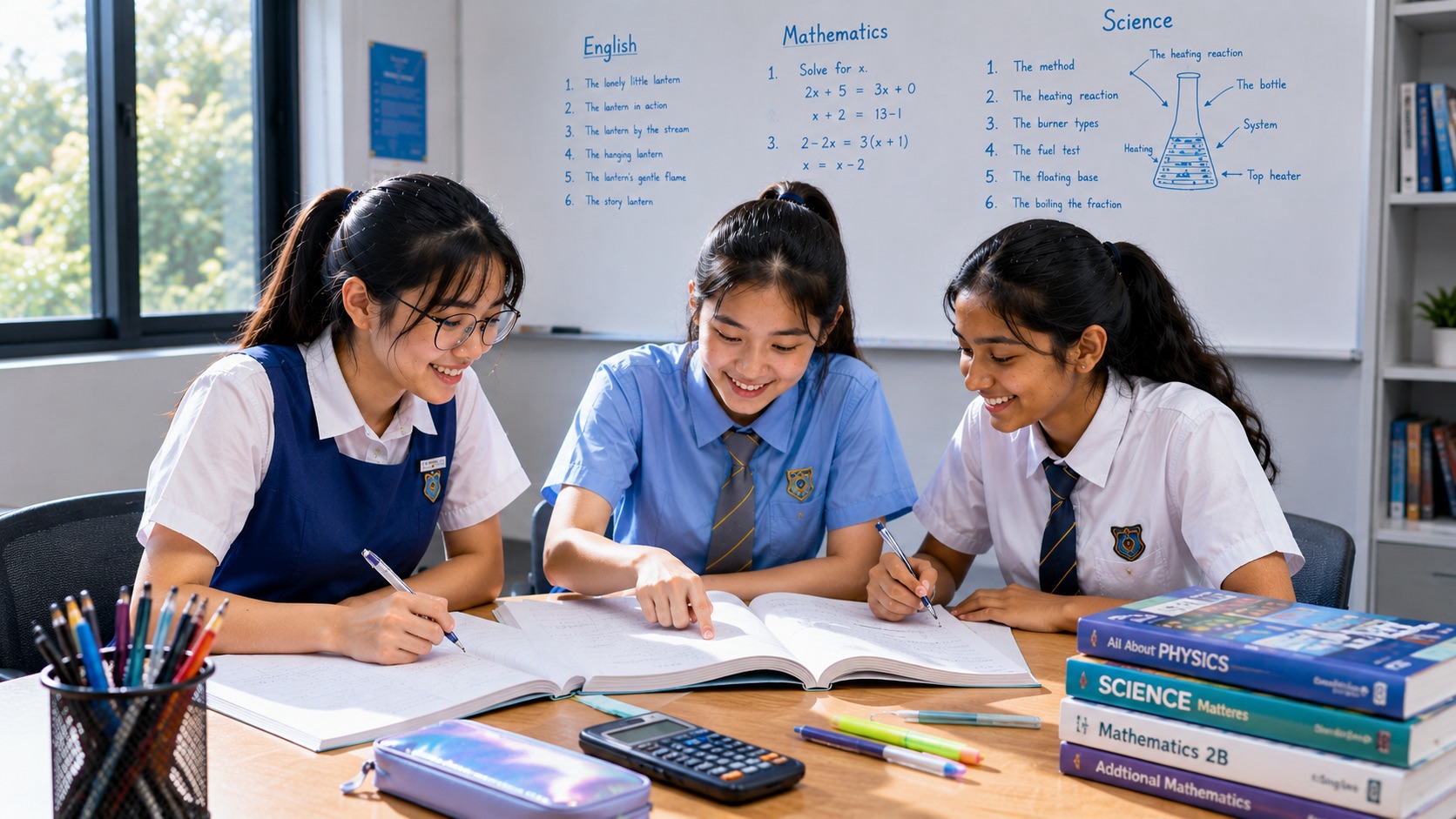
In a three-student tutorial, that distinction is easy to observe. One student may understand the concept but lose signs, another may manipulate accurately but choose methods slowly, and a third may know the method yet organise working so poorly that errors are hard to find. The useful loop is Read → Diagnose → Prioritise → Repair → Practise → Connect → Perform → Review. A good tuition centre should use that loop repeatedly until the student can run more of it independently.
Additional Mathematics Is a Connected System
A-Math becomes much easier when students stop seeing every chapter as a separate island. Algebra supports quadratics and polynomials. Functions connect equations and graphs. Trigonometry combines geometry and identities. Calculus depends on algebraic fluency and function sense.
The teaching should therefore connect chapters deliberately rather than only march through them one at a time.
Algebraic Fluency Has the Highest Transfer Value
Expansion, factorisation, algebraic fractions, indices, substitution and rearrangement should become reliable. When these basic manipulations are slow, every later topic becomes cognitively expensive.
Fluency should be maintained through short mixed retrieval while most lesson time remains available for deeper reasoning.
Quadratics Should Be Taught Across Representations
A quadratic can appear as an expression, equation, function or graph. Students should know what each form reveals and how to move among them.
- factorised form can reveal roots;
- completed-square form can reveal turning-point structure;
- expanded form reveals coefficients;
- the graph shows how the relationship behaves visually.
Functions Should Make Input-Output Relationships Explicit
Function notation can initially feel abstract. It becomes more manageable when students see it as a compact way to describe a rule connecting inputs and outputs. This understanding supports graph interpretation and later calculus.
Polynomials Need Structural Reading
Before performing long algebraic manipulation, students should inspect what conditions are given. Factor and remainder relationships can turn a long-looking problem into a short algebraic statement.
Coordinate Geometry Connects Algebra and Space
Gradient, midpoint, distance and line equations are geometric relationships represented algebraically. Students should be comfortable moving between diagram and equation.
Trigonometry Needs Structure Before Formula
Label the diagram or inspect the identity before selecting a formula. Ask which angle is relevant, which quantities are known and which relationship connects them.
Calculus Should Be Taught Through Meaning
Differentiation describes rate of change and gradient. Integration describes accumulation and recovery. Students who understand these ideas are more likely to remember the rules and apply them appropriately.
Method Recognition Can Be Trained
Contrast practice is especially useful. Put two similar-looking questions side by side and ask why they require different methods. This helps students learn the boundaries between techniques.
Error Logs Should Track Causes
- sign errors;
- factorisation errors;
- method-recognition errors;
- formula or identity recall errors;
- graph or diagram interpretation errors;
- notation errors;
- time-management errors.
After several weeks, the student should be able to describe personal error patterns rather than simply say “A-Math is hard”.
A Three-Student A-Math Lesson
- Retrieval: one high-transfer algebraic prerequisite.
- Cold problem: reveal method recognition.
- Diagnosis: identify the first weak link.
- Repair: reteach the missing structure.
- Focused practice: stabilise the method.
- Contrast: compare with a nearby method.
- Mixed transfer: remove chapter labels.
- Review: update the error map.
The Independence Test
Change the numbers, wording or representation. Delay the retest. Mix the topic with another chapter. Remove the hint. Ask the student to explain why the chosen method fits.
If performance remains stable, the learning is becoming transferable.
How Parents Can Read an A-Math Test
- Are algebraic slips recurring?
- Are unfamiliar questions left blank?
- Are methods known but selected slowly?
- Does working become unreadable?
- Are graph and trigonometry diagrams interpreted carefully?
- Can corrections be completed independently?
Strong Students Need Structural Depth
Extension can involve deriving a result, finding another method, explaining why a shortcut works, identifying hidden assumptions or changing one condition and predicting the result.
Students Who Are Behind Need Algebraic Triage
When several topics are weak, prioritise expansion, factorisation, equations, fractions, indices and rearrangement. These skills have wide transfer value across the subject.
Questions Parents Can Ask an A-Math Tuition Centre
- How do you distinguish algebra errors from concept errors?
- How do you teach method recognition?
- How do you track recurring mistakes?
- When do you introduce mixed-topic practice?
- How do you prepare students for timed examination work?
- How do you reduce prompting over time?
The Real Goal of a Punggol Additional Mathematics Tuition Centre
A good tuition centre should build students who can read symbolic structure, select methods, manipulate accurately, connect algebra to graphs and geometry, and recover when the first route fails.
The strongest result is not a student who needs the tutor beside every solution. It is a student who increasingly knows what to do next. Properly taught kids shine a bright light into the future.
Leave a Reply