
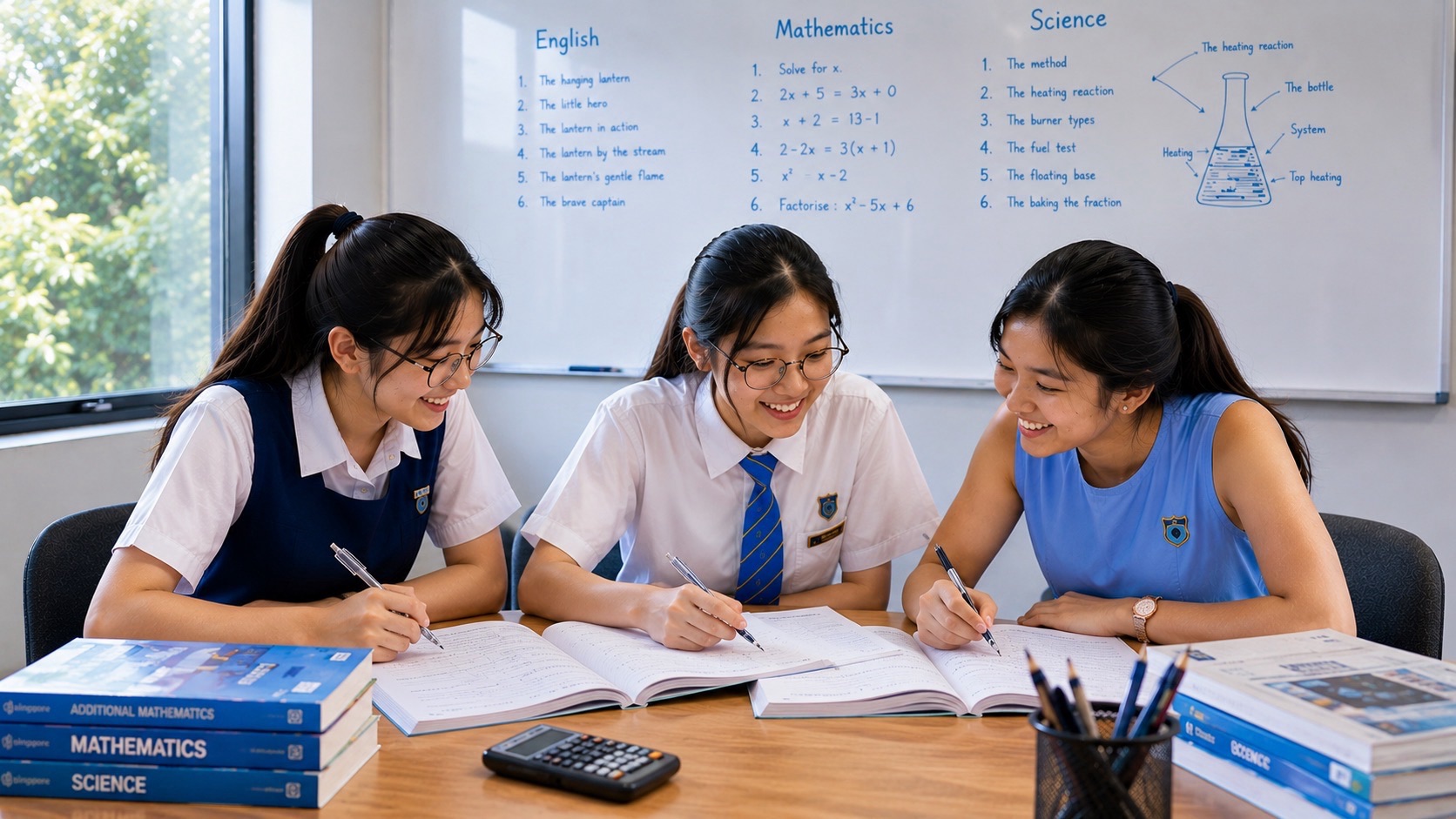
Lower Secondary Mathematics Exam Revision: How to Use Past Papers Properly
Past papers are among the most useful resources in Mathematics revision, and among the easiest to misuse.
A student can complete paper after paper, accumulate pages of corrections and still make the same mistakes in the next examination. The problem is usually not effort. It is that the papers were treated as worksheets instead of diagnostic instruments.
For Secondary 1 and Secondary 2 students, examination revision should not be a race to finish the largest possible number of papers. The real job is to use each paper to reveal what the learner can retrieve, what the learner can select, what breaks under time pressure, and what has to be repaired before the next attempt.
This article is a complete rewrite of the legacy page previously at this URL. The old class-update material has been removed. Its new job is to provide a full Lower Secondary Mathematics past-paper and examination-revision operating system, linked into the wider eduKateYishun Mathematics ecosystem.
Choose Your Reading Route
My Child Does Many Papers but Marks Stay Flat
Start with why past papers can fail, then read the error-map and repair chapters.
The Student Cannot Finish on Time
Go to timing, skip-and-return and paper control.
The Student Understands Lessons but Struggles in Exams
Read transfer, mixed practice and unfamiliar questions.
I Need a Full Revision Programme
Read all 25 chapters in order. The sequence moves from diagnosis to repair, transfer, timed performance and long-term consolidation.
Expandable Contents
Part I — Use Past Papers as Evidence
Part II — Repair Before Repeating
Part III — Build the Connected Mathematics System
Part IV — Turn Knowledge into Exam Performance
Part V — Build the Revision System
1. A Past Paper Is a Measurement Instrument
The most useful way to think about a past paper is not as a set of questions but as a measurement instrument.
It measures whether the student can retrieve knowledge without prompts, select methods without chapter labels, manage notation, sustain concentration, allocate time and check answers under realistic conditions.
That makes a paper fundamentally different from a chapter worksheet. A worksheet often tells the student what kind of method is active. A paper removes that cue.
Suppose a student can solve ten percentage questions correctly on a worksheet but fails a percentage problem inside a mixed paper. The problem may not be percentage calculation. The student may have failed to recognise that percentage was the appropriate structure.
Past papers therefore measure selection as well as execution.
This is why the score alone is insufficient. Two students can receive the same mark for completely different reasons. One has concept gaps. Another has timing problems. Another knows the methods but misreads representations. Another loses marks through notation.
The paper becomes useful only when the marks are converted into mechanisms.
2. Why Paper Volume Can Fail
Completing many papers creates a strong feeling of work. That feeling can be misleading.
If a student makes the same sign error in five papers and each correction consists only of copying the correct answer, the underlying process has not changed.
If a student repeatedly leaves word problems blank, another full paper may simply reproduce the same failure. The learner needs modelling practice before another measurement.
If a student cannot finish, more full papers may build fatigue without teaching pacing. Short timed sections may be more efficient.
The correct sequence is usually paper, diagnose, repair, retest, then paper again.
A paper should create the next training decision.
3. The First Diagnostic Paper
The first diagnostic paper should be completed under conditions realistic enough to reveal actual behaviour.
Do not provide hints. Do not stop the clock to explain. Do not allow the student to check notes between questions.
The purpose is not to create stress. It is to observe the system honestly.
Record more than wrong answers. Note where the student pauses for a long time, which questions are skipped, whether working becomes less organised later in the paper, whether calculator use is efficient, and whether checking occurs at all.
Afterwards, mark by mechanism. A wrong answer may still show a correct method with an arithmetic slip. Another may show a wrong model but flawless calculation. Those deserve different responses.
4. Separate Knowledge from Performance
A student who performs poorly in a paper may still know much of the Mathematics.
To separate knowledge from performance, take one failed question and remove the time pressure. Ask the student to solve it again.
If the learner succeeds immediately, the problem may be timing, stress, reading or selection rather than conceptual knowledge.
If the learner still fails, simplify the question. Remove the context. Replace variables with simpler numbers. Reduce the number of steps.
The point at which the student starts succeeding reveals the level of the weakness.
This prevents a common mistake in revision: reteaching an entire topic when only one layer is unstable.
5. Build the Error Map
| Error type | What it means | Revision response |
|---|---|---|
| Concept | The idea itself is misunderstood | Rebuild with simpler representations |
| Procedure | The idea is known but execution is unstable | Focused fluency work |
| Representation | The situation was translated wrongly | Model before calculating |
| Selection | The wrong method was chosen | Mixed classification practice |
| Notation | Signs, brackets, indices or units changed meaning | Externalise structure |
| Attention | A local slip occurred despite stable knowledge | Targeted checking |
| Timing | The paper could not be completed effectively | Pacing and skip-return training |
Frequency matters. One sign error may be noise. Six sign errors across several topics are evidence.
Keep the map short enough to use. The purpose is to choose the next task, not to create paperwork.
6. Find the First Broken Link
A long wrong solution may contain several mistakes, but there is always a first point where the mathematics stops being valid.
If the student chooses the wrong geometry relationship and then performs the algebra perfectly, geometry failed first.
If the model is correct but a negative sign is lost while solving, notation failed first.
If the correct answer is reached but the unit is inappropriate, interpretation failed at the end.
Repair the earliest failure. Later errors often disappear automatically once the first one is corrected.
7. The Repair Cycle
- Isolate: name the weakness narrowly.
- Explain: rebuild the meaning.
- Practise: stabilise with a small focused set.
- Vary: change numbers, notation or context.
- Delay: retest after several days.
- Integrate: put the skill back inside a mixed problem.
A correction is not complete when the student can copy a worked solution. It is complete when the same principle is selected and executed later in a different-looking problem.
8. Transfer Before Another Full Paper
After repairing a weakness, do not immediately assume that the student can use it in an examination.
Transfer is the ability to recognise the same structure under a different surface form.
Change the numbers first. Then change orientation. Then change wording. Then change context. Finally remove the topic label and place the question among several other topics.
If the student still identifies the method, the repair has begun to generalise.
Only then should another full paper be used to measure whether the skill survives inside a larger system.
9. Retrieval and Spaced Review
Examinations require knowledge to be retrieved, not recognised on a page of notes.
Before rereading, ask the student to reconstruct the method from memory. Solve one representative question cold. Then compare with the reference.
Return after time has passed. A topic repaired on Monday should appear again later in the week and again in a mixed set after one or two weeks.
Spacing is especially important in Lower Secondary Mathematics because new topics arrive while older ones remain prerequisites.
10. Algebra as Examination Infrastructure
Algebra appears across a Lower Secondary paper because it is a language for relationships.
Expansion, factorisation, simplification and equation solving should be understood through equivalence. The form changes; the meaning must remain valid.
Consider 3(2x − 5) = 4x + 7. Expanding gives 6x − 15 = 4x + 7. Subtracting 4x from both sides gives 2x − 15 = 7. Adding 15 gives 2x = 22, so x = 11.
The student should understand why each step preserves equality rather than relying entirely on movement slogans.
Verification is cheap: substitute the solution into the original equation.
For the broader progression, use the Secondary 1 Mathematics guide and Secondary 2 Mathematics guide.
11. Ratio, Percentage, Rate and Scale
These topics belong to one multiplicative family.
If a quantity increases from 80 to 100, the absolute change is 20 but the percentage increase is 25% because the reference quantity is 80.
A 20% increase followed by a 20% decrease does not return to the original value. Starting from 100 gives 120 and then 96.
Rates compare quantities with different units. Scale connects representation with reality. Similar figures extend scale into geometry.
Students who see these as connected ideas have fewer isolated rules to memorise.
12. Graphs and Coordinates
Graphs test representation, scale reading and interpretation simultaneously.
For a straight line y = mx + c, the gradient m describes rate of change and c the vertical intercept.
In context, those values may have meaning. A cost graph can use gradient as unit cost and intercept as a fixed charge.
Students should inspect axes before reading values. Many graph errors begin with a scale misread rather than an algebra error.
Gradient calculation also requires consistent subtraction order. If the numerator uses y₂ − y₁, the denominator must use x₂ − x₁.
13. Geometry and Measurement
Geometry questions should be treated as evidence chains.
Annotate parallel lines, equal sides, right angles, known measures and relevant lengths. Do not assume the drawing is to scale.
Measurement requires dimensional awareness. Perimeter uses length units, area uses square units and volume uses cubic units.
Scale factors therefore behave differently. A linear factor k produces area factor k² and volume factor k³.
These relationships often appear in past papers because they reveal whether students understand dimensions rather than merely remember formulas.
14. Mixed Practice and Method Selection
Blocked practice builds fluency. Mixed practice builds selection.
Both are necessary.
Once a student has stabilised a method, mix it with others. Ask the learner to classify before solving: What is the target? What relationship is present? Which representation could expose it?
A useful mixed set might contain algebra, ratio, graph interpretation, geometry and statistics.
That forces the student to perform the same decision an examination demands.
15. Statistics and Probability
Statistics asks what data can reasonably tell us. Probability organises uncertainty.
The mean, median and mode answer different questions. A large outlier can pull the mean. The median may better describe a typical value in a skewed set.
Probability values must lie between 0 and 1 inclusive. That gives students a powerful boundary check.
Students should choose representations deliberately. A table, list or tree diagram can reduce working-memory load when several events are involved.
16. Unfamiliar Questions and Modelling
Unfamiliar questions often produce blanks because students search memory for an identical example.
A better routine is to build the Mathematics from the situation.
Identify known and unknown quantities. Decide what varies and what stays fixed. Choose a representation: table, diagram, equation or graph.
Then solve and interpret.
A mathematically correct answer may still require contextual judgement. A result of 2.6 buses, for example, cannot be reported without interpretation.
17. Worked Error Cases
Case A — Expansion
Simplify 4(x − 3) − 2(x + 5). Correctly: 4x − 12 − 2x − 10 = 2x − 22.
If the student obtains 2x − 2, inspect distribution of the negative factor before assigning more general algebra.
Case B — Percentage
A price rises from $120 to $150. Increase = $30. Percentage increase = 30/120 × 100% = 25%.
Dividing by 150 uses the wrong reference base.
Case C — Gradient
Points (2,5) and (6,17) give gradient (17 − 5)/(6 − 2) = 12/4 = 3.
Reversing only one subtraction order changes the sign incorrectly.
Case D — Similar Figures
Linear scale factor is 3. If smaller area is 8 cm², larger area is 8 × 9 = 72 cm².
Multiplying by 3 reveals confusion between linear and area scale.
Case E — Probability
If the probability of an event is 0.35, the probability of its complement is 0.65.
A result above 1 would be immediately impossible and should trigger a check.
18. Timing
Timing should be trained gradually.
First establish accurate untimed work. Then compare efficient methods. Then introduce timed mixed sections. Only after enough topics are ready should full papers dominate revision.
Marks provide a rough guide to expected effort. A small-mark item should not consume a disproportionate share of the paper.
Students should also notice slow correct answers. A method that is accurate but takes too long may need greater fluency or a more efficient representation.
19. Skip-and-Return
One difficult question should not control the entire paper.
Use a skip rule. If no productive step appears after a reasonable interval, preserve the working, mark the question visibly and move on.
Leave a re-entry cue: “need equation,” “check angle property,” or “return after graph.”
This turns skipping from surrender into resource management.
20. Checking Architecture
“Check your work” is too vague. Students need specific checks.
- Estimate: is the magnitude sensible?
- Substitute: does an equation solution satisfy the original?
- Units: is the dimension correct?
- Geometry: is the length or angle plausible?
- Probability: is the value between 0 and 1?
- Completeness: are all sub-parts answered?
Checking is strongest when it uses a different route from the original solution.
21. Paper Control
Paper control combines reading, selection, pacing, recovery and checking.
Read the command precisely. Identify the target. Extract relevant information. Choose a representation. Select the method. Execute clearly. Check plausibility. Move when the expected return on time becomes too low.
After the paper, classify every significant loss by mechanism.
For a full examination-performance framework, continue to How to Score Well in Secondary Mathematics.
22. A Six-Week Examination Architecture
Week 1 — Diagnose
Complete one realistic paper. Build the error map. Identify the two highest-leverage weaknesses.
Week 2 — Repair
Use focused practice on the selected weaknesses. Retest them after a delay.
Week 3 — Transfer
Change wording, representation and context. Mix the repaired skills with other topics.
Week 4 — Timed Sections
Train pacing, skip-and-return and checking.
Week 5 — Full Paper
Measure whether the repaired mechanisms survive under full-paper conditions.
Week 6 — Consolidate
Return to persistent errors. Reduce unnecessary novelty. Preserve sleep and routine.
23. What Parents Should Watch
Parents do not need to supervise every question. Watch the revision system.
- Are the same errors repeating?
- Can the student explain why a method applies?
- Can repaired skills still be used after several days?
- Is timed completion improving?
- Does the student have a skip-return routine?
- Is revision becoming more mixed as the examination approaches?
- Is sleep being protected?
Ask what changed because of the last paper. If the answer is only “we did another paper,” the feedback loop is incomplete.
24. What Students Should Do Independently
- Retrieve before rereading.
- Classify the first broken link before looking at the full solution.
- Keep a compact error log.
- Schedule delayed retests.
- Mix topics once fluency is stable.
- Estimate before trusting calculator output.
- Use a skip-return system in timed work.
- Check with specific methods rather than rereading passively.
A 60-minute examination-revision session
- 10 minutes: retrieve older concepts.
- 15 minutes: targeted repair from the error map.
- 20 minutes: timed mixed section.
- 10 minutes: first-broken-link correction.
- 5 minutes: schedule delayed retests.
25. The Past-Paper Operating System
Past papers become powerful when they are placed inside a learning cycle.
Measure. Complete a realistic paper.
Classify. Convert lost marks into mechanisms.
Repair. Fix the first broken links.
Transfer. Vary the repaired skill.
Retrieve. Revisit after time has passed.
Integrate. Put the skill inside mixed timed work.
Measure again. Use the next paper to see whether the system changed.
That cycle is more valuable than the number of papers completed.
Continue Through the eduKateYishun Mathematics Library
- Secondary 1 Mathematics — From Arithmetic to Algebraic Thinking
- Secondary 2 Mathematics — From Methods to Connected Reasoning
- Lower Secondary Mathematics for IP and High-Progress Schools
- Secondary 3 Mathematics — Build the System Before SEC
- Secondary 4 Mathematics — From Revision to Examination Control
- Secondary 3 Mathematics Study System
- How to Score Well in Secondary Mathematics
- How to Rebuild Mathematics Confidence
- Secondary Mathematics in Singapore — G1, G2, G3 and the SEC Pathway
- Secondary Mathematics Directory
- Mathematics Tuition & Learning Hub
- The Library
Past Papers Are Measurement Tools Before They Are Revision Tools
A Lower Secondary Mathematics past paper shows what the student can currently retrieve, recognise and execute under integrated conditions. Its first job is diagnosis. The second job is rehearsal. It becomes poor revision when students repeatedly complete papers without changing the mechanisms behind their mistakes.
Mark by Error Family
- concept gap
- method not recognised
- wrong representation
- algebraic or arithmetic execution error
- misread condition
- insufficient working
- timing or unfinished section
Two students with the same score can need completely different revision.
Do Not Redo the Whole Paper Immediately
Choose the high-value errors and leave the paper format. Re-teach the concept, practise a few related questions and return to the original error after a delay. Immediate correction can reflect memory of the mark scheme rather than learning.
Use Mixed Mini-Sets Between Papers
After repair, create a mixed set containing the repaired skill plus unrelated topics. The student must recognise when the repaired method applies. This is a stronger transfer test than ten near-identical questions.
Track Time by Section
Students should record where time is being spent rather than only whether the paper finished. A single slow algebra question can create rushing later. Section timing reveals where the bottleneck begins.
Use Past Papers to Build Checking Routines
Identify which checking action catches the most marks. Perhaps it is substituting solutions back, checking graph scales, reviewing negative signs or estimating magnitude. Rehearse that check until it becomes part of the paper routine.
Lower Secondary Is Still a Learning Stage
End-of-year revision should not turn Secondary 1 or 2 into a permanent examination factory. Students are still building algebra, geometry, graphs, statistics and reasoning foundations that later Mathematics will depend on.
Use papers selectively and keep concept teaching active.
A Two-Paper Revision Cycle
Paper one establishes the baseline. The next several sessions repair the largest error families. Mixed mini-sets test transfer. Paper two then measures whether the error profile changed. The score matters, but the disappearance of recurring mistakes matters more.
What to Do When the Score Does Not Improve
Check whether the paper difficulty changed, whether old errors disappeared but new topics became limiting, or whether timing is now the main bottleneck. A flat score can hide real process improvement.
The Final Past-Paper Principle
Use a past paper to discover what to teach next, not merely to generate another mark. Diagnose, repair, delay, transfer and re-measure. That cycle turns past papers into learning rather than repetition.
Use Past Papers to Build Topic Connections
After marking, group questions by the ideas they combine. A graph question may also require algebra. A geometry question may depend on ratio. A statistics question may require careful reading. This shows students that examination Mathematics is interconnected.
A Past-Paper Portfolio
Keep the first paper, one middle paper and one later paper. Compare error categories, timing and working quality. Students often focus on total marks and miss the fact that recurring mistakes have disappeared.
Past Papers Should Not Replace Textbook Learning
If a topic is not understood, return to explanation, examples and focused practice. A past paper assumes a degree of integration. It is a poor place to learn a concept from scratch.
The Final Week Before Lower Secondary Exams
Use selected mixed questions, error logs and one realistic rehearsal rather than continuous full papers. Protect sleep and stop adding new resources. The final week should stabilise what has already been learned.
The Student Should Own the Review
After marking, ask the student to name the two most expensive error families and choose the next repair. This builds the revision independence needed in upper Secondary.
Build a Revision Map from Several Papers
One paper can be noisy. Three papers reveal patterns. Create a table of recurring error types across several scripts. If algebraic manipulation appears repeatedly, it deserves direct attention. If every error is different, the issue may be general checking or question reading rather than one topic.
Past Papers and Confidence
Students can misuse papers as repeated judgement. Reframe them as controlled experiments. The goal is to learn what fails under current conditions and then change the conditions through teaching and practice.
Confidence becomes more stable when the student can see error categories shrink across papers.
Past Papers and Question Reading
Some lower-Secondary losses begin before Mathematics starts. Students misread “hence,” overlook a condition or answer only part of a multi-part prompt. Include question-reading errors in the diagnostic rather than labeling them all careless.
Past Papers and Working Quality
Clean working reduces mistakes and makes partial reasoning visible. Encourage one transformation per line where complexity is high, clear labels on graphs and diagrams, and enough notation that the student can inspect the route later.
A Final Lower-Secondary Paper Routine
- attempt under realistic but not excessive pressure
- mark and classify errors
- repair the top two mechanisms
- reattempt selected questions after a delay
- test the repaired skill in a fresh mixed set
- use the next paper only after the repair has had a chance to stabilise
That cycle protects learning from becoming a sequence of marks with no change between them.
A Past Paper Should Change the Next Week
After marking, the student should be able to say exactly what the next week will contain because of the paper. Perhaps two algebra sessions, one graph-reading drill and one timed mini-section. If the revision plan looks identical before and after the paper, the diagnostic value has been wasted.
Use Old Errors as Retrieval Material
Weeks later, reattempt selected old errors without warning. This checks whether the correction survived beyond the original review. A repaired mistake should eventually become an easy question.
Compare Process, Not Only Scores
A later paper may have a similar score but cleaner working, fewer repeated errors and better completion. Those process improvements matter because they often precede a larger score movement.
The Final Lower-Secondary Revision Standard
Past papers are useful when they make future practice more intelligent. The student should know what failed, why it failed, what was changed and whether the repair survived a fresh context.
Past Papers Should Change the Next Lesson
Lower Secondary students often complete past papers too early or too passively. A paper is useful only when the review changes what happens next. The student should identify which topics failed because of missing knowledge, which methods were not recognised, which errors were purely execution, and where time or checking broke down.
This prevents the common pattern of paper, mark, disappointment, next paper.
Use Section-Level Practice Before Full Papers
Students who are still learning current topics may gain more from twenty-minute mixed sections than from repeated complete papers. Short sections make it easier to isolate the decision process and give feedback while attention remains fresh.
A Three-Column Paper Review
- What went wrong?
- Why did it go wrong?
- What specific practice changes it?
For example, “wrong operation” is not enough. The student might write: “I treated a multiplicative comparison as additive because I did not identify the ratio structure. Next: complete five mixed comparison questions and explain the relationship before calculating.”
Re-attempt After a Delay
Correcting immediately with the solution visible can create an illusion of mastery. Close the notes and return to selected errors a day or several days later. A delayed re-attempt shows whether the method was actually learned.
Build Exam Stamina Gradually
Lower Secondary students may not yet need constant full-paper simulation. Increase timed duration progressively: short sets, half papers, then full papers closer to major assessments. Stamina should be trained rather than assumed.
The Durable Past-Paper Principle
Past papers are not a curriculum. They are a diagnostic and rehearsal tool. Learn the Mathematics first, use papers to reveal integration and timing, repair the errors, then test whether the repair survives on fresh work.
The Final Lower-Secondary Revision Rule
Students should finish a past-paper cycle with fewer repeated errors and better method recognition, not simply a larger pile of completed scripts. If the same mistakes keep returning, stop measuring and return to teaching.
When the student can solve fresh mixed questions after a delay and explain why the chosen method fits, the revision has transferred beyond the original paper.
A Past Paper Needs a Stopping Rule
Students should not continue past papers indefinitely once the same error pattern is obvious. Stop measuring and repair the mechanism. If three papers show the same algebraic weakness, the next useful task is not a fourth paper; it is targeted algebra followed by a fresh mixed check.
This stopping rule protects time and prevents students from confusing exposure with improvement.
Use Success to Reduce Practice Volume
When a topic remains accurate across several delayed, mixed tasks, reduce its practice frequency. Maintenance is enough. Revision time should migrate toward skills that still fail under new conditions.
The Student Should Learn to Predict the Next Error
Before starting a fresh past-paper section, ask which error is most likely to occur. After the section, compare prediction with reality. This builds metacognitive accuracy and turns the error log into a forward-looking tool rather than a history of mistakes.
Over time, students become better at noticing risk before marks are lost.
Parents Should Ask What the Paper Taught
After a practice paper, a useful question is not “What mark did you get?” alone. Ask what error repeated, what was repaired and what will be tested next. This keeps attention on the learning cycle rather than turning every practice paper into a verdict.
Past papers become powerful when the student can explain how one paper changed the next week of revision.
That is when past papers become useful evidence of learning rather than just repeated exposure to examination formatting.
That habit turns past-paper review into a transferable study skill the student can use in later Secondary Mathematics, where papers become harder but the same cycle—attempt, diagnose, repair, delay and retest—continues to work.
Leave a Reply