
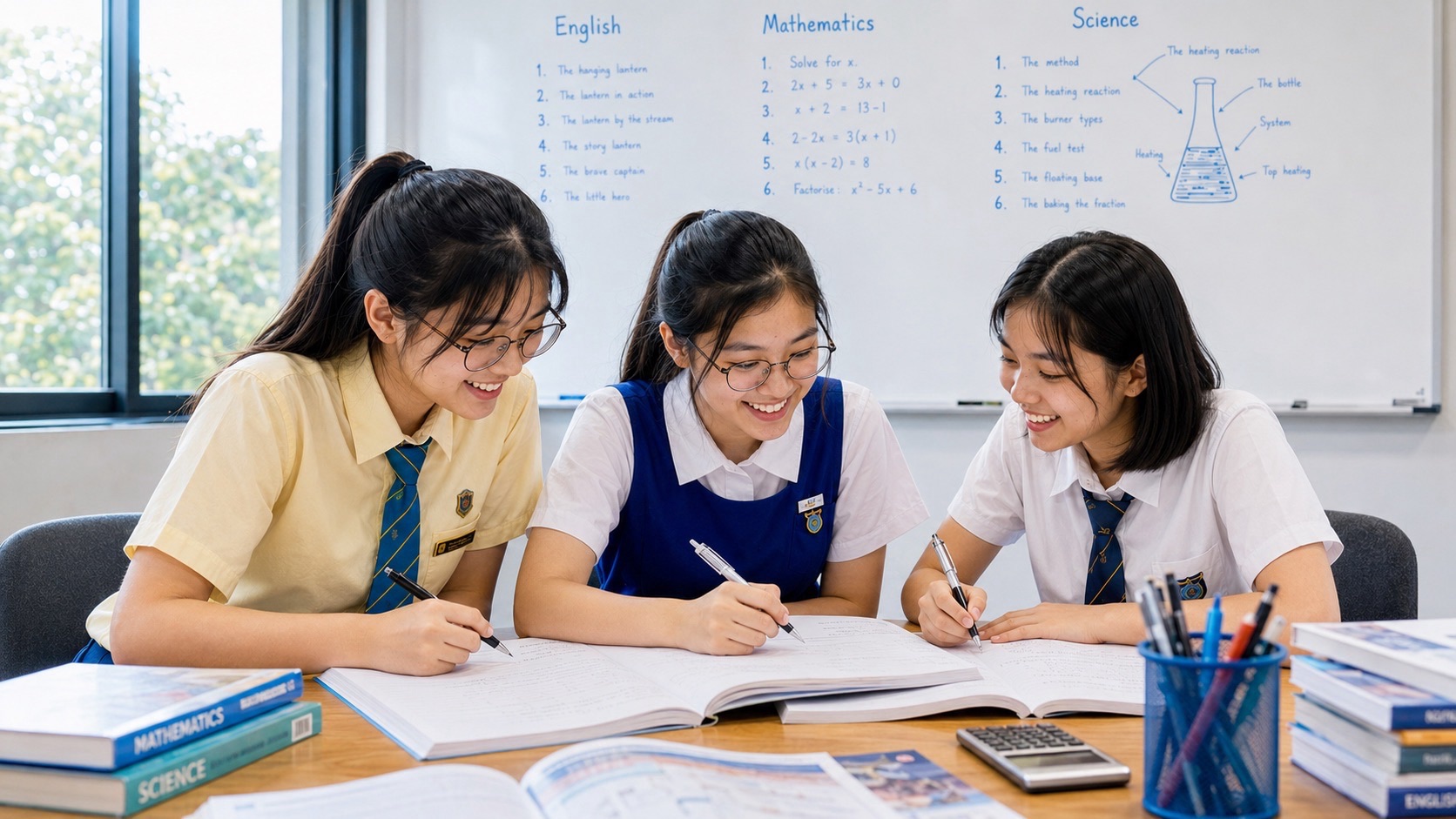
For Yishun parents whose child enters secondary school through Posting Group 2 (PG2) and eventually takes G2 Science (Chemistry, Biology), the official 2027 Singapore–Cambridge Secondary Education Certificate (SEC) syllabus is SEAB K225. It has four compulsory papers: Chemistry Papers 3 and 4, and Biology Papers 5 and 6. Each science contributes exactly half of the subject grade through a 20% multiple-choice paper and 30% structured paper. Physics Papers 1 and 2 are not part of K225. Start with the official 2027 SEAB K225 syllabus and confirm the child’s eventual school-registered subject level and combination.
This guide helps parents understand K225’s Chemistry and Biology content, the calculation and scientific-language skills that support both, and what to practise when a student knows facts but struggles to use them in unfamiliar situations. It follows the eduKate Clementi reference by giving direct facts first and working backwards from the actual error in a child’s answer. PG2 is a school Posting Group, whereas G2 is an individual subject level. Paper details and topic boundaries here are verified against the 2027 document. The eventual 2028 syllabus should be checked again when published, and parents must not assume an older examination code or a different Science combination is interchangeable.
- Correct code: 2027 SEC G2 Science (Chemistry, Biology) K225, older reference 5107.
- Chemistry: Paper 3 multiple choice, 20 marks (20%), plus Paper 4 structured, 30 marks (30%), in one 1-hour-15-minute session.
- Biology: Paper 5 multiple choice, 20 marks (20%), plus Paper 6 structured, 30 marks (30%), in a second 1-hour-15-minute session.
- Structured questions: each Paper 4 or 6 includes compulsory Section A (22 marks) and Section B (8 marks), where candidates answer one of two structured questions.
- Chemistry content: matter, particles and bonding; reactions, calculations, acids and qualitative analysis; organic chemistry and air quality.
- Biology content: cells, movement of substances, biological molecules, human nutrition, circulation, respiration, infectious disease, and flowering plants.
- Next move for parents: ask for a school-marked chemistry calculation and a Biology explanation, check the first incorrect step and make a short targeted practice plan.
1. K225 is a distinct pairing, not just a generic “Science” label
SEAB’s shared 2027 G2 Science PDF lists three options. K223 is Physics–Chemistry, K224 is Physics–Biology, and K225 is Chemistry–Biology. All three have four papers and a similar mark structure, but their registered science disciplines differ. Choosing K225 means preparing Chemistry and Biology, not revising Physics merely because a workbook uses the term “combined Science”.
Full Subject-Based Banding (FSBB, or Full SBB) uses Posting Groups to guide Secondary 1 admission and usual starting subject levels. Eligible students may offer particular subjects at different G levels according to their school’s arrangements. That flexibility is valuable, but it does not mean a parent can infer the child’s final-year science code from PSLE alone. Ask the school when upper-secondary combinations are offered, what it actually provides and which subject levels apply.
A child starting Secondary 1 in 2027 is still at the beginning of secondary education. The SEAB K225 2027 document describes what graduates taking that year’s national examination must know, not an instruction to teach every upper-secondary topic during the next school holiday. For lower-secondary pupils, begin with current classroom Science and recover any gaps in reading, numerical relationships and basic investigations.
2. Four papers: the precise 2027 K225 examination scheme
| Paper | Format | Contribution to K225 |
|---|---|---|
| 3 — Chemistry MCQ | 20 compulsory multiple-choice questions, 20 marks. A periodic table is included with the paper. | 20% overall; taken with Paper 4 in one 75-minute session. |
| 4 — Chemistry Structured | 30 marks: Section A compulsory 22, including an eight-mark final question; Section B one of two eight-mark questions. A periodic table is provided. | 30% overall. |
| 5 — Biology MCQ | 20 compulsory multiple-choice questions, 20 marks. | 20% overall; taken with Paper 6 in a separate 75-minute session. |
| 6 — Biology Structured | 30 marks: Section A compulsory 22, including an eight-mark final question; Section B one of two eight-mark questions. | 30% overall. |
SEAB advises no more than 30 minutes on a 20-mark MCQ paper, because the 30-mark structured component shares the same 75-minute sitting. Students must learn to choose the right Section B option and leave time for multi-step answers. The full K225 examination comprises two science sessions, not one long paper covering every branch of science.
There is no separately examined physical practical paper in the published 2027 K225 scheme. Experimental skills and investigations are assessed through the theory papers, so supervised laboratory learning and the ability to explain apparatus, data and methods remain important. Parents should not eliminate practical understanding from revision just because the final scheme contains only written questions.
3. The three assessment objectives and what they mean at home
SEAB assigns approximately 45% of theory marks to knowledge and understanding, 45% to handling information and problem-solving, and 10% to experimental skills and investigations. This division explains why a student can memorise an entire chapter yet perform poorly on an unfamiliar graph or structured-response question. The ability to apply knowledge is assessed on a scale comparable to factual understanding.
A parent does not need to be an expert chemist or biologist to ask a useful question. After the child explains a process, ask “What evidence would show that?”, “Why does the next step follow?”, or “Which part of the diagram supports your answer?” If the explanation depends only on memorised vocabulary, a change in the question’s setting may reveal the gap.
Practice should therefore alternate retrieve a fact, interpret a new example, explain a mechanism and check evidence. Avoid dedicating the whole week to repeating identical question formats. A child who answers a known question perfectly while receiving cues has not yet demonstrated independent transfer.
4. The Chemistry syllabus is organised into three main sections
SEAB groups K225 Chemistry into Matter—Structures and Properties, Chemical Reactions, and Chemistry in a Sustainable World. The nine named topics are Experimental Chemistry; Particulate Nature of Matter; Chemical Bonding and Structure; Chemical Calculations; Acid–Base Chemistry; Qualitative Analysis; Patterns in the Periodic Table; Organic Chemistry; and Maintaining Air Quality.
These topic headings should be treated as an accurate map, not an invitation to improvise G3-only depth. The official PDF supplies the specific learning outcomes. Ask the school which concepts are being introduced in the current term and how it sequences the work. A student who is struggling to recognise an element and a compound may need help with the particle model before attempting unfamiliar organic reaction questions.
5. Experimental Chemistry: observe, choose a method, interpret
Chemistry is a science of evidence. Students need to understand how substances are measured and separated and why different techniques serve different purposes. The syllabus includes relevant physical separation and analytical techniques, and structured questions may show unfamiliar apparatus while assessing only the general investigative skills required at G2.
Original conceptual example: a fictional clean mixture contains sand and salt. The salt is soluble in water but the sand is not. A suitable conceptual plan is to dissolve the salt, separate the sand by filtration and recover salt from the solution by an appropriate supervised method. Ask why filtration alone does not recover dissolved salt from water. The purpose is to connect properties of substances to the chosen method, not simply memorise the sequence.
Do not attempt unsupervised heating, solvent use or chemical testing in the home. The official syllabus’s practical guidelines and school laboratory rules should govern actual experiments. Parents can build understanding through diagrams, questions, safe observations and school-approved materials.
6. Matter: cells and molecules do not work at the same scale
The Chemistry Particulate Nature of Matter topic examines how a particle model explains observable properties of matter. In Biology, cells are living structures that contain a complex arrangement of molecules and organelles. These are not interchangeable scales. A student may know that water is made of molecules and that living tissue contains cells, but should also understand the relationship between the microscopic model and an observable process.
Ask what level of organisation a particular diagram represents: atoms, molecules, cells, tissues or organs. If a student draws molecules as though they were individual body cells, the representation is fundamentally mistaken. Clear models and labels make the difference visible.
Students should be careful about what a model can and cannot show. A simplified diagram is not a photograph; particles are not necessarily drawn to scale, and arrows may represent movement rather than an actual visible line. The child should be able to explain the intended meaning of each symbol.
7. Chemical bonding and structures
K225 includes chemical bonding and structure within its specified scope. Students should recognise how the composition and arrangements of particles influence properties. Do not teach a fixed statement such as “all substances with this one type of bonding behave identically” without attention to the relevant conditions and syllabus distinctions.
When a student struggles with a chemical formula, ask first whether they understand the represented atoms and proportions. In a drawing of a compound, count the correct elements and their numbers; in a question involving bonding, identify the type of explanation required. Precise formula notation is essential. A mistaken subscript changes the chemical species represented.
A parent can support basic formula reading without needing specialised materials. Ask a learner to tell you what H₂O represents, or why CO and CO₂ are distinct formulas. Then compare this with the child’s schoolwork to ensure the explanation is consistent with the level being taught.
8. Chemical calculations: Mathematics must serve chemical meaning
Some Chemistry difficulties originate in fractions, proportionality and units rather than chemical facts. K225 includes chemical calculations that use the relationships between formulas, chemical equations and specified quantities. The first question should be what the calculation represents; the second should be which relationship or ratio is relevant.
Original practice: in the balanced equation 2H₂ + O₂ → 2H₂O, the coefficient ratio of hydrogen to oxygen is 2:1 for the represented species. Ask the child to count the atoms on each side before applying the ratio. If the student changes the subscript in H₂O to force a balance, they have altered the substance rather than balanced the equation.
When a calculation gives an implausible result, have the child identify the unit, the molar or ratio relationship actually used and the assumption about quantities. A learner who can multiply but cannot choose the correct relationship needs conceptual explanation, not an even larger arithmetic worksheet.
9. Acids, bases and qualitative analysis
Acid–Base Chemistry and Qualitative Analysis ask students to connect observations with chemical reasoning. The question may provide a test, condition or observed change, then ask which conclusion follows. A memorised observation can be useful, but only when the test has been correctly identified and the inference is justified.
The syllabus includes notes for qualitative analysis. Ask the student to locate a given test result and determine what it supports. A precipitate, colour change or gas test has significance under particular conditions. “There was a colour change, so the substance is definitely X” may be an overstatement if other possibilities are not excluded.
Laboratory safety is important because some reagents are corrosive or otherwise hazardous. Avoid performing unsupervised acid or gas tests at home. Teacher-supervised experiments and written analysis provide the appropriate learning experience.
10. Patterns in the Periodic Table
The 2027 Chemistry MCQ and structured papers include a periodic table. It is a tool that helps students reason about elements and patterns, not a substitute for chemical understanding. The child should locate an element, understand what the relevant data represent, and use syllabus knowledge to make an appropriate comparison or prediction.
When a student selects an answer from the wrong element group or misreads a symbol, correct the process of finding the information. Teach them to check the element’s identity and the quantity actually requested. Memorising every entry is not the starting priority when the paper itself supplies a table.
11. Organic chemistry and maintaining air quality
The final Chemistry cluster connects substances, reactions and wider environmental consequences. Topics include Organic Chemistry and Maintaining Air Quality. Parents should help children differentiate a scientifically supported mechanism from an unsupported broad claim such as “all chemicals are harmful” or “one new product always fixes pollution”.
In an air-quality exercise, identify a pollutant or source specified by the question, the relevant chemical or environmental process, and the consequence. If discussing a solution, ask what mechanism reduces the problem and what limitations may apply. Avoid inventing pollution measurements for Yishun or treating a single local observation as proof of a long-term trend.
12. Biology: eight examinable topics across three themes
Biology is organised under Cells and the Chemistry of Life, The Human Body—Maintaining Life, and Living Together—Plants and Animals. The eight named topics are: Cell Structure and Organisation; Movement of Substances; Biological Molecules; Nutrition in Humans; Transport in Humans; Respiration in Humans; Infectious Diseases in Humans; and Nutrition and Transport in Flowering Plants.
Students should think about relationships between living structures and functions. A diagram of a leaf, a heart or a cell is evidence of understanding only if the learner knows why the parts matter. Biological terminology is essential, but rote definitions without explanation are unreliable when the examiner changes the context.
13. Cell structure: identify the organisation and function
Cells are fundamental units of living systems. Some biological structures are visible with school laboratory equipment; others are represented in schematic diagrams. Students should be able to identify specified cell structures and explain what each does, as required by the syllabus. Ask why an organelle is relevant to a particular function rather than only requesting its name.
At home, draw two simple labelled cell diagrams based on the school’s current work and ask the student to identify important similarities and differences. Use the precise features taught at G2; avoid adding decorative structures from a more advanced Biology textbook. Accuracy and clarity matter more than artistic shading.
14. Movement of substances: diffusion, osmosis and concentration
Biology’s Movement of Substances topic links to the Chemistry particle model but adds the behaviour of living membranes and cellular conditions. Diffusion and osmosis are related concepts but not synonyms. Students should explain the role of concentration differences and the partially permeable membrane in osmosis, where the syllabus calls for it.
Original reasoning task: two otherwise comparable samples of plant tissue are placed in different solutions under supervised conditions. Ask what the student expects to change, what variable was altered and which observable result would support the explanation. Do not invent the outcome without knowing the concentrations and methods. The important skill is linking a model to an observation.
When a pupil says “water moves from high to low concentration”, ask them to specify the concentration of what and the role of the membrane. Ambiguous language can hide a real misunderstanding.
15. Biological molecules and enzymes: a natural bridge to Chemistry
Biological Molecules includes carbohydrates, proteins, fats and enzymes. Students study how these contribute to life processes, how food tests give evidence and how enzymes operate under particular conditions. A Chemistry–Biology combination can be especially coherent here: Chemistry describes substances and reactions, while Biology asks how molecular properties contribute to functions in living systems.
For enzymes, teach specificity, the role of the active site and the effects of temperature and pH. If a student can say “enzymes denature” but cannot explain why that changes reaction rate, request a simple labelled mechanism. The learning goal is to connect the term to the effect on molecular function.
For food tests, use school laboratory diagrams rather than unsupervised home reagents. Students should know which observation supports which conclusion and should avoid claiming that a negative result proves the complete absence of a nutrient under all possible testing conditions.
16. Human nutrition: distinguish ingestion, digestion, absorption and assimilation
The official syllabus requires understanding of the human digestive system and the different processes involved in obtaining and using nutrients. A learner may memorise a list of organs while confusing the actual roles of digestion and absorption. Ask them to trace a food component through a relevant process using a labelled diagram.
Diagnostic question: Does the stomach absorb all the nutrients needed by the body? Students should not answer by guessing from the size or prominence of the stomach in a drawing. They should use the taught digestive structures and their actual functions to explain where digestion, absorption and assimilation occur according to the syllabus.
Nutrition also involves biological regulation and specified health contexts. The fact that a topic appears in a school syllabus does not make a student or parent qualified to diagnose a medical condition. Keep educational explanations separate from personal clinical advice.
17. Transport in humans: connect vessel structure to function
The circulatory system supports movement of substances in the body. Students need to know relevant blood vessels, the heart’s role, components of blood and their functions. Arteries, veins and capillaries differ in structure and use; a correct explanation identifies the specific feature that makes a function possible.
For example, capillaries’ thin walls support exchange between blood and surrounding tissues. A response that simply says “capillaries carry blood” is too general when the question asks for an adaptation. Teach feature → function → mechanism as a useful explanation structure.
When a pupil struggles with a heart diagram, ensure they understand its labels and blood-flow direction before adding unfamiliar detail. A neatly coloured diagram is not proof of understanding if arrows are reversed.
18. Respiration in humans: air movement is not cellular respiration
SEAB distinguishes human gas exchange from cellular respiration. Breathing ventilates the lungs. Gas exchange occurs across relevant respiratory surfaces. Cellular respiration involves processes in cells that release energy from substances such as glucose. These related events should not be collapsed into one vague statement.
A student should be able to identify relevant structures, including alveoli, and explain how their features support exchange. The syllabus also distinguishes aerobic and anaerobic respiration in humans. Ask for the conditions and outcomes rather than teach slogans such as “anaerobic means not breathing”.
Where questions discuss smoking or other health risks, parents should use accurate educational information. Do not turn the topic into moralising or medical judgement about individuals. Scientific explanations are most useful when they describe mechanisms clearly and responsibly.
19. Infectious disease: distinguish a pathogen from a symptom
The published Biology section includes infectious disease, focusing on examples such as influenza and pneumococcal disease, transmission, prevention and antibiotic resistance. Students need to distinguish bacteria and viruses, understand the role of pathogens and explain why an intervention may or may not address the cause.
Do not teach that antibiotics treat viral illness. The official syllabus expressly distinguishes their action against bacteria and notes that misuse and overuse can accelerate antibiotic resistance. Home practice can involve explaining how a preventative measure interrupts a possible transmission route, without advising a family to start or stop medication.
20. Flowering plants: photosynthesis and transport
Plant Biology includes leaf structure, photosynthesis, transpiration and translocation. Students should recognise what moves, where, and why the processes matter. Water movement and the distribution of organic nutrients are related but different functions. Photosynthesis and cellular respiration also have distinct roles.
For a school-approved, safe observation, a child could examine a plant in natural light and note a change over time, recording what was actually measured. However, visible growth by itself does not establish exactly which process caused the change. To make a defensible conclusion about a factor such as light, the investigation must control competing variables and compare appropriate conditions.
21. Biology and Chemistry together: when the combination makes sense
Chemistry–Biology can suit a student interested in molecules, reactions, health, living systems or environmental science. The overlap between chemical reactions and biological molecules may make some ideas easier to connect, but it does not remove the need to learn two full sets of subject content. A student who loves Biology may still need targeted help with equations and chemical analysis.
Conversely, a student who enjoys Chemistry should not assume Biology is simply a second form of Chemistry. Diagram interpretation, systems, structure–function relationships and precise verbal explanations matter. Compare the child’s independent performance across the two subjects before choosing this combination. Ask the school whether K225 is actually available and how the timetable works.
22. What Paper 6 needs beyond memorised Biology paragraphs
Paper 6 contains compulsory structured questions and a Section B choice. Many prompts involve familiar concepts in unfamiliar contexts, requiring students to identify relevant evidence and explain the mechanism. A student who copies all remembered textbook facts may miss the question and waste time.
Use the sequence command word → relevant evidence → concept → linked explanation. If a question asks why a plant’s leaves have a particular adaptation, identify the adaptation, state the specific function and explain how the structure helps the process. If a question shows a data table, check whether the student is required to describe a pattern, infer a cause or evaluate a method. Those are not the same task.
23. How to use Paper 4’s qualitative analysis questions
Chemistry Paper 4 may present test observations, equations or chemical changes. Start by listing what is actually known from the information given. Then determine which chemical concepts allow a conclusion. A student’s phrase “it proves X” is too strong when the evidence supports only a possibility; encourage precise judgement.
For calculations, show essential working and use appropriate units. For reaction equations, confirm symbols and balance before applying ratios. For explanatory answers, use the exact relevant property or process rather than a generic statement. The best practice is to inspect a short set of errors and repair the common underlying move.
24. The importance of scientific investigations and experimental honesty
SEAB’s general practical and investigation objectives include planning techniques, apparatus selection, recording observations, reading scales, completing tables, drawing graphs, interpreting results, identifying limitations and proposing improvements. These are tested in theory papers even though the 2027 K225 does not contain a separate practical exam.
Original fictional experiment: a student tests whether temperature changes the rate of a particular enzyme reaction. They must decide what temperature range to vary, which other conditions such as pH should remain controlled, how the outcome will be measured and how many observations are needed. The experiment’s actual results should never be made up merely to match an expected graph.
If two trials give different results, ask what could explain the variation and how the design could be improved. Avoid writing “human error” without specifying a plausible source, such as inconsistent timing or a poorly controlled condition. Honest uncertainty is good scientific practice.
25. A parent-friendly error-diagnosis table
| Issue in marked work | Possible cause | Useful next action |
|---|---|---|
| Correct chemical concept but wrong numerical answer | Ratio, unit or formula application mistake. | Rebuild the relationship and check it with a simple example. |
| Can name cell parts but cannot explain function | Weak structure–function connection. | Make an annotated diagram and explain one feature at a time. |
| Incorrect conclusions from qualitative tests | Observation and inference confused. | Record the test conditions and what each result justifies. |
| Osmosis confused with other transport | Membrane and movement model unclear. | Compare accurate definitions and a clear diagram. |
| Weak graph interpretation | Axes or evidence overlooked. | Describe the pattern first, then give a cautious conclusion. |
| MCQ takes too long | Overchecking or poor pacing. | Practise the 75-minute shared session and reserve time for structured work. |
| Can copy model answers but not explain unfamiliar questions | Memorisation without transfer. | Ask for independent reasoning on a related but new task. |
26. Eight weeks of targeted Science practice
- Week 1: confirm the actual G2 Science combination and review one Chemistry and one Biology task without prompts.
- Week 2: revisit particles, chemical formulae and the accuracy of scientific vocabulary.
- Week 3: work through chemical calculations and reaction equations using checked ratios and units.
- Week 4: interpret experimental chemistry or qualitative analysis observations from the school’s taught scope.
- Week 5: connect cell structure, movement of substances and biological molecules.
- Week 6: practise a human system or plant process as a cause-and-effect explanation, with diagrams.
- Week 7: complete MCQ and structured questions with explicit attention to command words and evidence.
- Week 8: repeat comparable unfamiliar questions and decide what has become independent and what still needs support.
These activities form a model family plan, not an official SEAB eight-week revision course or a promised grade outcome. If the child is only in Secondary 1 or 2, use the current school topics at the appropriate level. Nearer the registered SEC year, add full-paper timing and selection practice while protecting sleep, CCAs and a manageable daily routine.
27. Choosing between the three G2 Science pairings
Ask whether the child is most engaged by living systems, chemical behaviour, physical models, calculations or experiments, then examine actual marked work. K225 combines Chemistry and Biology; K224 substitutes Physics for Chemistry; K223 substitutes Physics for Biology. Each requires structured explanation and scientific reasoning, and none can be declared universally easier for all students.
Check which combinations the school offers, any eligibility considerations, the workload with other electives, and the implications for the child’s interests. The title “G2 Science” alone should not drive the decision. Pathways to JC, polytechnic or ITE involve complete subject combinations and future admission requirements; an individual K225 entry does not guarantee or rule out an entire career.
28. If Science results deteriorate, look at the first broken step
A low score can conceal different problems. One child lacks vocabulary, another misreads the numerical relationship, another struggles to turn observation into explanation and another runs out of time. Examine at least two pieces of marked work and ask the student to talk through their reasoning before deciding whether more tuition is required.
School remedial support and deliberate short practice may suffice. If a misconception persists, a tutor should explain the exact incorrect move and check the learner on a fresh item, not simply give a pile of identical worksheets. The Clementi small-group teaching model illustrates the value of close feedback; it does not confirm the availability of a particular Yishun Science class or guarantee a result.
29. Yishun parent options and linked articles
Yishun, Khatib and northern Singapore families should assess school fit, actual Science offerings, the child’s subject levels, commute, CCA and rest. Use MOE SchoolFinder for current school context, then confirm upper-secondary pairings directly. Historic school cut-offs do not guarantee admission or a particular Science subject.
Connected eduKate Yishun reading includes Secondary 3 G2 Science (Chemistry, Biology), Secondary 4 G2 Science (Chemistry, Biology), G2 Science combination choices, G2 structured-question preparation, and the wider G2 Science components guide.
30. Frequently asked questions
Does K225 include any Physics examination paper?
No. K225 includes Chemistry Papers 3 and 4 and Biology Papers 5 and 6. Physics belongs to K223 or K224 combinations.
How much is Biology worth?
Biology’s 20-mark MCQ contributes 20%, while the 30-mark structured paper contributes 30%, making 50% overall.
What is the Section B choice in Paper 6?
Two structured questions of eight marks are offered, and candidates answer one. Paper 6 Section A is compulsory and worth 22 marks.
Does the lack of a practical exam remove the need for laboratory learning?
No. Experimental skills are explicitly assessed in theory papers and school practical work develops that understanding.
Will the periodic table be provided?
Yes, SEAB’s 2027 scheme specifies a periodic table printed with Chemistry Papers 3 and 4 for K225.
Are these paper specifications final for 2028?
No. This is a guide to the official 2027 K225 scheme. Check the relevant 2028 syllabus when available.
31. Official syllabus and further reading
- SEAB official 2027 G2 Science (Chemistry, Biology) K225 syllabus PDF
- SEAB 2027 G2 school-candidate syllabus directory
- SEAB SEC subject-level and certification overview
- MOE SchoolFinder
- Yishun G2 Science Physics–Biology K224 guide
- Yishun G2 Science Physics–Chemistry K223 guide
Editorial verification: 20 November 2026. K225 paper numbers, weightings and topic headings are grounded in SEAB’s published 2027 K223/K224/K225 shared specification. All teaching cases are original and do not represent past examination questions. The student’s subject level, school combination and 2028 examination syllabus must be verified independently.