
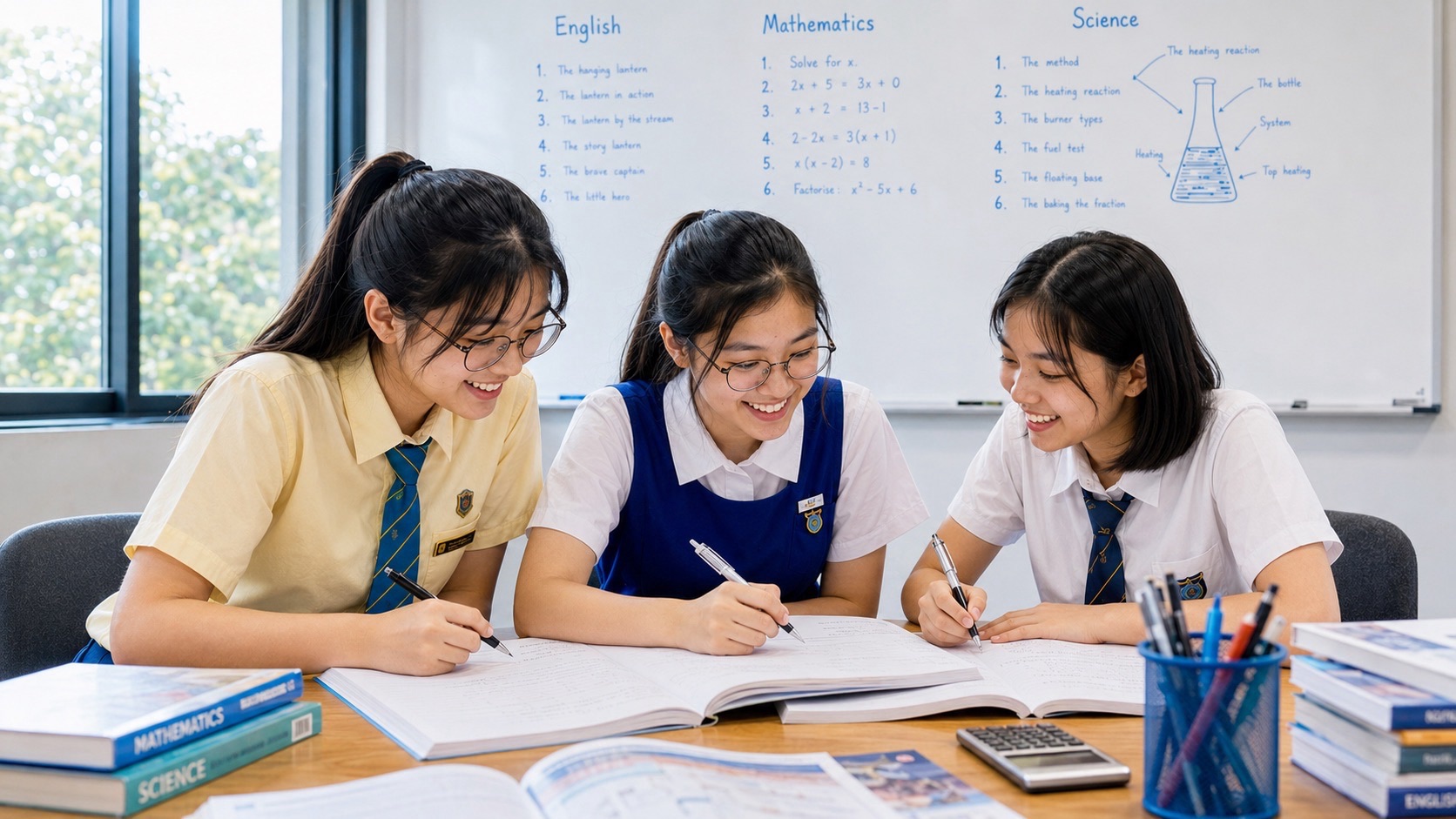
For Yishun parents whose child enters secondary school through Posting Group 2 (PG2) and later studies G2 Science (Physics, Biology), the correct 2027 Singapore–Cambridge Secondary Education Certificate (SEC) syllabus is SEAB K224. Candidates sit Physics Papers 1 and 2 and Biology Papers 5 and 6; they do not sit Chemistry Papers 3 and 4 for K224. Each science contributes 50% of the combined subject result. The official 2027 SEAB K224 syllabus PDF explains the learning outcomes, paper timings and allowed resources. Check this code against your child’s actual school registration before buying practice books.
This guide translates the Physics–Biology combination into a realistic parent plan. It explains the four papers, thirteen Physics topics and eight Biology topics, plus what to do if a child memorises definitions yet loses marks in calculations or explanations. It follows the eduKate Clementi small-group teaching reference by giving useful information promptly, diagnosing the first incorrect reasoning step and checking independent improvement. PG2 is for school posting; G2 is the level of an individual subject. The requirements here are verified for the 2027 SEC. A student sitting SEC in 2028 or later must consult SEAB’s examination-year syllabus when it is published.
- Official match: 2027 G2 Science (Physics, Biology), syllabus K224; older reference 5106.
- Physics: Paper 1 (20 MCQs, 20 marks, 20%) and Paper 2 (30 structured marks, 30%) taken together in 1 hour 15 minutes.
- Biology: Paper 5 (20 MCQs, 20 marks, 20%) and Paper 6 (30 structured marks, 30%) taken together in a different 1-hour-15-minute session.
- Both structured papers: Section A compulsory 22 marks, including an eight-mark final question; Section B choose one of two eight-mark structured questions.
- Physics: measurement, mechanics, thermal physics, waves, electricity and magnetism, and radioactivity.
- Biology: cell structure, movement of substances, biological molecules, human nutrition and transport, respiration, infectious disease, and flowering plants.
- First action: confirm K224 with the school, then review one Physics calculation, one biological process explanation and one graph interpretation from independent work.
1. The first parent decision: confirm K224 rather than another G2 Science combination
SEAB publishes one shared 2027 document covering three distinct G2 Science registrations. K223 is Physics–Chemistry, K224 is Physics–Biology, and K225 is Chemistry–Biology. Each has two named sciences, but candidates take different paper numbers. A workbook advertising simply “G2 Science” may include some relevant general skills while omitting a needed topic or supplying questions from the wrong combination. Ask the school which code the candidate will actually register for when subject combinations are finalised.
Under Full Subject-Based Banding, Posting Groups guide Secondary 1 admission and the usual initial subject level for most subjects. Eligible pupils can take subjects at different G levels according to official criteria and school arrangements. PG2 is not a promise that the child will always take every subject at G2. A student’s English, Mathematics and Science levels may not all be the same. Confirm each on the timetable rather than infer a permanent track from one label.
For a child entering Secondary 1 in 2027, the final SEC examination will normally still be several years away. The school’s present Science curriculum is the right immediate learning sequence. The 2027 K224 PDF is the long-range destination and a reliable way to identify what upper-secondary Physics–Biology entails; it is not an instruction to rush through all thirteen Physics and eight Biology topics in the first term.
2. The four papers, marks and timing in the official 2027 scheme
| Paper | 2027 K224 assessment | Practical family implication |
|---|---|---|
| 1 — Physics Multiple Choice | 20 compulsory MCQs, 20 marks, 20% of total. | Recognise concepts, select correct relationships and reject plausible distractors. |
| 2 — Physics Structured | 30 marks, 30% of total; compulsory Section A (22) and a choice of one Section B question (8). | Show working, label diagrams, use units and explain physical relationships. |
| 5 — Biology Multiple Choice | 20 compulsory MCQs, 20 marks, 20% of total. | Understand process diagrams and select conclusions supported by the wording. |
| 6 — Biology Structured | 30 marks, 30% of total; compulsory Section A (22) and one of two Section B questions (8). | Explain cause and effect, interpret investigations and organise precise scientific answers. |
Physics Papers 1 and 2 are completed in one 75-minute session, and Biology Papers 5 and 6 in another 75-minute session. SEAB advises candidates not to spend more than 30 minutes on either MCQ paper. That leaves time for the structured component and checking, but students should practise pacing rather than calculate a rigid average time for every question.
There is no separate laboratory practical paper in the published K224 2027 assessment scheme. Experimental skills are still assessed in written questions: apparatus, observations, scales, tables, graph plotting, variables, conclusions and possible improvements. A parent should not confuse “no separate practical sitting” with “no experimental understanding required”.
3. What the three official assessment objectives demand
SEAB assigns approximately 45% of theory marks to knowledge with understanding, about 45% to handling information and solving problems, and around 10% to experimental skills and investigations. These percentages describe the objectives of the papers, not a schedule requiring exactly 45 minutes of memorisation for every 45 minutes of problem-solving.
A question can combine several objectives. For example, a graph about a falling object may require identifying the meaning of a quantity, calculating a value and explaining why the pattern changes. A Biology investigation may ask the child to name a process, interpret a table and suggest a reasonable improvement. Teaching those activities separately at first is helpful, but independent performance ultimately requires combining them.
Ask the student to classify a marked mistake: unknown concept, misread question, wrong operation, unsupported inference, or incomplete communication. That classification leads to a different correction. More MCQ drilling will not automatically teach a child who has misunderstood the physical meaning of a gradient.
4. Physics content map: thirteen topics across six sections
The Physics section contains six broad areas. Measurement covers physical quantities, units and measurement. Newtonian Mechanics covers kinematics, force and pressure, dynamics, and energy. Thermal Physics covers the kinetic particle model of matter and thermal processes. Waves covers general wave properties and the electromagnetic spectrum. Electricity and Magnetism covers electric charge and current, direct-current circuits, and practical electricity. Radioactivity covers the final named topic.
Parents can use these headings as a checklist, but every heading contains specific learning outcomes. For example, “energy” is not permission to assume a student must master every possible advanced equation. Use the published PDF and the school’s current scheme of work to decide which relationships and applications are required at G2, and which are extension material.
5. Measurement: accuracy begins before the formula
Physics uses measurements with defined units. Distance, time, mass, current and temperature have different meanings even when their numerical values look similar. The student should know which instrument is appropriate and whether a reported value has sensible precision. An expression such as “speed = 5” is incomplete without a relevant unit in a calculation answer where one is required.
At home, ask the learner to describe a measurement before finding its value: What quantity are we trying to measure? What instrument or data source supplies it? How should it be reported? If a child reads a scale incorrectly, teach the scale and units before assigning a new formula worksheet. Estimating an approximate answer is also useful for detecting misplaced decimals or unit conversions.
6. Kinematics: a worked relationship that a parent can check
Original teaching example: A fictional cyclist travels 360 metres in 60 seconds. Their average speed over the interval is distance ÷ time, so 360 m ÷ 60 s = 6 m/s. If the same distance is travelled in 90 seconds, the average speed becomes 4 m/s. Ask the child to explain why increasing the travel time reduces the average speed for a fixed distance. This shows whether they understand a proportion rather than merely remember which calculator buttons to press.
Next draw a simple distance–time graph with labelled axes. A graph’s gradient has meaning only in relation to its variables and units. A horizontal section on a distance–time graph is not equivalent to a horizontal section on a speed–time graph. These distinctions are especially important when the question contains a diagram or table that differs from the examples in the textbook.
7. Forces, pressure, dynamics and energy
Students should understand what a force can do, how motion and interactions are described and why appropriate physical models matter. Common mistakes include treating mass and weight as identical, assuming motion always means a net unbalanced force, or copying an equation without defining its quantities. A learner may calculate correctly yet give an irrelevant explanation.
Ask which object is being considered, which forces act, what the question supplies and what the final answer represents. When an energy question describes a change, identify the forms of energy involved and the system boundary. Precise language prevents students from claiming energy has simply disappeared when it has been transferred or transformed.
Physical contexts should remain safe. A school experiment involving motion, measurement or low-voltage components is useful; unsupervised high-speed objects, hazardous equipment or household mains electricity are not appropriate home practice.
8. Thermal physics, waves and electrical systems
The kinetic particle model explains properties of matter through microscopic behaviour. A student should distinguish heat transfer from temperature and explain how observations relate to a model, rather than write “particles become hot” in every answer. For waves, the distinction between a medium’s particles and the transfer of energy is central. A wave may transfer energy without transferring the material overall in the way a travelling object does.
For electricity, begin with a labelled circuit and a complete conductive path. Ask what happens when a switch is open and which measurements a meter could provide in a suitable circuit. The syllabus also includes practical electricity, so safe handling and context matter. Use the school’s low-voltage kits and supervised lessons; never suggest testing household socket wiring as a learning exercise.
9. Radioactivity and responsible scientific understanding
Radioactivity is part of the official Physics content, and it can feel unfamiliar to younger learners. Teach the terminology, the evidence described by the syllabus, and relevant uses or safety considerations at the required depth. Do not rely on dramatic internet videos as proof of particular effects, and do not encourage collecting or experimenting with radioactive substances.
Parents can ask the child to separate a scientific definition from a claim about risk. A term such as “radiation” covers several physical phenomena; accurate questions and context matter. Where health or safety is involved, rely on the approved school material and reliable scientific sources, not speculation.
10. Biology content map: eight specified topics
The Biology section of the official K224/K225 shared document groups its material into Cells and the Chemistry of Life, The Human Body—Maintaining Life, and Living Together—Plants and Animals. The eight named topics are: cell structure and organisation; movement of substances; biological molecules; nutrition in humans; transport in humans; respiration in humans; infectious diseases in humans; and nutrition and transport in flowering plants.
This list is more useful than treating Biology as “memorising organs”. Each topic contributes to a broader question: how do structures and processes work together to sustain living systems? Students should connect features with functions and observations with explanations. The original document explicitly prioritises understanding and application over collecting large quantities of disconnected factual material.
11. Cell structure and organisation: make diagrams explain something
Students need to recognise relevant cell structures and their functions and understand how cells, tissues, organs and systems are organised. A clear labelled diagram helps, but a diagram copied beautifully without understanding what the parts do is incomplete.
Ask the child to explain how a feature helps the cell or organism carry out a task. Different cells have different structures because they perform different roles. A short question such as “Why is this feature present?” can reveal whether a label has been memorised without function. Encourage accurately proportioned diagrams using the school’s own learning outcomes, rather than imaginative details not observed or specified.
12. Movement of substances: diffusion and osmosis
These topics introduce relationships between particle movement, concentration differences and cell membranes. Students often use diffusion and osmosis interchangeably. They are related but not identical; osmosis refers specifically to the net movement of water through a partially permeable membrane in the defined conditions.
Use a simple labelled drawing of two regions with differing concentrations to discuss net movement. Ask why the direction makes sense and what role a partially permeable membrane plays where relevant. In a plant-cell osmosis scenario, have the learner predict the change before comparing it with observations. Avoid turning the task into a rule memorised without a mechanism.
13. Biological molecules and enzymes: structure affects function
The Biology syllabus covers carbohydrates, fats, proteins and enzymes. Students should connect the kinds of molecules with their roles in living systems and distinguish laboratory indicators from the biological substances being tested. The document includes food tests, but practical chemicals such as Benedict’s solution or Biuret reagent belong in properly supervised school laboratory lessons.
The enzyme section includes the active-site concept, enzyme specificity and the effects of temperature and pH on reaction rate. A student might correctly recall that high temperatures can denature some enzymes but still fail to explain why a change in active-site shape affects binding and function. Ask for the causal mechanism, not just the final keyword.
Original reasoning question: If two comparable enzyme trials differ only in temperature, which variable was deliberately changed? Which observable outcome should be measured? What other conditions should remain similar? The exact expected pattern depends on the enzyme and test conditions; do not invent a result. This trains experimental design and Biology content together.
14. Human nutrition and transport: a connected system
Human nutrition covers the digestive system, physical and chemical digestion, absorption and assimilation, plus specified related biological control concepts. The student should explain the difference between breaking down food and using the absorbed substances. Naming organs in order is a starting skill; understanding how processes work is the deeper goal.
Human transport covers the circulatory system, the heart, blood vessels and blood’s roles. Ask how vessel structure relates to function rather than simply listing “artery, vein, capillary”. For example, capillaries support exchange because of their small scale and thin walls; a correct answer should match the specific feature requested by the question.
For family learning, distinguish scientific syllabus knowledge from personal medical advice. A textbook question about blood glucose control or circulation does not authorise diagnosing a relative’s health condition from their symptoms. Direct personal health concerns to a qualified professional, while using the official school material for examination preparation.
15. Human respiration: breathing and cellular respiration are different
Students need to understand the respiratory structures, gas exchange at alveoli, and aerobic and anaerobic cellular respiration. A common misconception is describing breathing and cellular respiration as the same process. Breathing is ventilation: movement of air into and out of the lungs. Cellular respiration refers to reactions in cells that release energy from substances such as glucose.
Ask the child to give one sentence explaining each process, then show how gas exchange supports the oxygen needs of cells. If a question asks why the lungs have many alveoli, the answer should connect their structure to efficient exchange, not simply state that lungs are important. Causal connections earn more useful understanding than disconnected organ names.
16. Infectious disease: pathogens, prevention and accurate claims
The official Biology syllabus includes infectious diseases, using influenza and pneumococcal disease as specified examples, alongside basic transmission, prevention, immunity and antibiotic resistance. Teach the distinction between viruses and bacteria and the principle that antibiotics act against susceptible bacteria rather than viruses. Avoid giving medical-treatment instructions as if a school syllabus were an individual diagnosis.
Students may be asked to explain why misuse or overuse of antibiotics encourages resistant bacteria, or how certain preventive measures reduce transmission. They should construct an evidence-based explanation of the mechanism, not a moral judgement about people who become ill. For real health issues, use current public-health and clinical advice in addition to whatever the examination requires.
17. Plants: photosynthesis, transpiration and translocation
Nutrition and transport in flowering plants is not simply one diagram. The syllabus covers leaf structure, photosynthesis, transpiration and translocation, including how plant structures support the movement of substances and use of light energy. Students may mix up transport of water with transport of sugars or confuse photosynthesis with respiration.
Use two short comparison sentences: photosynthesis allows suitable plant cells to use light energy to produce organic compounds under the necessary conditions; respiration releases usable energy in cells from breakdown of organic substances. Both processes are part of living plant systems. The details and expected chemical equations should match the official syllabus and teacher guidance.
A safe observation can involve watching a healthy potted plant over time without deliberately damaging it. If practising experiments, the school should supervise any specialised apparatus or chemical reagents. Children should distinguish what was observed from what is inferred about internal transport.
18. Science questions are often reading-comprehension questions too
In both Physics and Biology, a child can know the content yet miss the assessment because of a command word. “State” may need a concise fact; “describe” normally asks what occurs or the pattern shown; “explain” requires a reason; “calculate” requires a mathematical method and appropriate units; “suggest” asks the learner to apply known principles to unfamiliar information.
At home, mark one science explanation and ask whether it actually contains a causal link. The sentence “the plant has more leaves” may describe an observation but not explain a mechanism. A longer answer repeating the same description does not repair the omission. Teach students to move from claim → evidence → biological or physical reason.
19. Graphs and investigations: why the 10% matters
SEAB explicitly expects students to read apparatus scales, complete tables, plot graphs, determine gradients or intercepts, interpret findings, identify possible errors and suggest appropriate safety or procedural changes. These skills can be examined even without a separate laboratory paper. Students benefit from authentic supervised laboratory work and careful discussion of data.
Original table exercise: Imagine a plant-related investigation records heights of 5, 7 and 9 cm over three equally spaced observation dates. The child can describe that the recorded height increased in this small dataset, but should not assert that the treatment caused the growth unless the study design provides appropriate comparisons. Ask about units, dates, repeated measurements and alternative explanations. The values are invented and not SEAB data.
For Physics, an incorrect choice of scale may produce a misleading gradient. For Biology, a conclusion may go beyond the limited sample. In both subjects, teach the student to say exactly what the evidence shows before drawing a wider inference.
20. The eight-mark structured choice: make a deliberate selection
Physics Paper 2 and Biology Paper 6 each include a Section B with two structured questions worth eight marks, of which the student answers one. Before choosing, read the whole question, identify the required concepts and decide where the learner can provide the strongest complete response. Do not automatically choose the first question or the one with the shortest printed stem.
The compulsory Section A also contains a final eight-mark question. Students should not overlook it after spending too long on MCQs. Practise finding how many distinct tasks a multi-part question contains: a calculation, a diagram, an explanation and perhaps an inference from data. Each must be answered according to its own command word.
21. A diagnostic table for Physics–Biology families
| Visible error | Possible underlying issue | Useful targeted action |
|---|---|---|
| Correct Physics formula, wrong result | Units, substitution or calculator entry. | Write each quantity with units, estimate and check arithmetic. |
| Knows the Biology term but cannot explain it | Function and mechanism not understood. | Describe the process in steps with an annotated diagram. |
| Diffusion and osmosis confused | Concept boundaries unclear. | Compare the definitions and draw the role of the membrane. |
| Graph conclusion unsupported | Axis reading or evidence selection weak. | State the pattern and identify the actual plotted values. |
| Biology answer lists organ names only | Structure not linked to function. | Ask how each named feature helps the stated process. |
| Finishes MCQs but not structured questions | Time planning or overchecking early items. | Practise the shared 75-minute session and transition to structured work. |
22. A manageable eight-week plan
- Week 1: verify the actual Science level and combination. Review a marked Physics calculation and Biology explanation without hints.
- Week 2: repair units and simple movement calculations; explain why each formula applies.
- Week 3: practise force, energy and graphs from the school’s current topics.
- Week 4: explain one thermal, wave or circuit concept using a labelled model.
- Week 5: practise cell structure, diffusion/osmosis and biological molecules at the current class level.
- Week 6: connect human nutrition, transport, respiration or plant processes using cause-and-effect explanations.
- Week 7: interpret a data table or experimental diagram and practise choosing a structured response.
- Week 8: retry comparable unfamiliar questions and review whether the original misconception has actually disappeared.
This plan is educational guidance, not an official eight-week MOE sequence and not a guarantee of a mark. A Secondary 1 student should use only the topics taught in school and build the underlying reading and Mathematics skills. For a graduating K224 candidate, add appropriately timed full-paper practice and question choice strategy. Leave room for CCAs, sleep and family life.
23. If the child is failing: what should a Yishun parent do first?
Begin with the marked answer rather than comparing the child with a sibling or school ranking. Ask whether the obstacle is unfamiliar vocabulary, a misunderstood model, a weak calculation, incorrect data reading or missing explanation. Speak with the school teacher about the next unit and what foundational knowledge must be repaired before it. A child may make substantial progress through targeted school support and calm home discussion without private tuition.
When additional help is appropriate, ask any tutor to identify the exact error, teach the missing relationship and then check a new independent task. An explanation delivered by the adult is not proof of pupil mastery. The Clementi small-group model is useful here because it treats precision as more important than worksheet volume; it does not confirm that a particular Yishun class or place is available.
24. Choosing K224, K223 or K225: make the school decision carefully
Students may prefer K224 because Physics and living systems both interest them, but preference is only part of a good subject choice. Compare actual school offerings, strength in calculations and diagrams, willingness to learn Biology processes, workload and other subject combinations. K223 includes Chemistry rather than Biology; K225 includes Chemistry rather than Physics. None is a universal “best” or “easiest” combination.
Future JC, polytechnic or ITE options depend on the complete subject combination, achieved grades, subject levels and the official admission rules at application time. A G2 Science choice is not an unconditional guarantee of admission or a permanent barrier. Ask a school counsellor to verify the relevant course requirements as the child approaches the decision point.
25. Yishun school fit and linked reading
Families in Yishun, Khatib and northern Singapore should confirm the school’s actual subject combination and level policy, not infer K224 availability from an estate name. Compare commute, CCA, Science support and general fit through MOE SchoolFinder and direct enquiries. A shorter journey can protect time for reading and steady revision, but the family’s real route and constraints should decide.
For the eduKate Yishun learning library, see Secondary 3 G2 Science (Physics, Biology), Secondary 4 G2 Science (Physics, Biology), how to choose upper-secondary G2 Science combinations and G2 Science structured-response techniques. The broader parent guide to G2 Science contrasts all three codes.
26. Frequently asked questions
Does G2 K224 include a Chemistry paper?
No. K224 has Physics Papers 1 and 2 and Biology Papers 5 and 6. A candidate registered for K223 or K225 follows a different pairing.
Is Biology half the K224 grade?
Yes. Biology MCQ is 20% and Biology structured 30%, making 50%. Physics contributes the other 50%.
Is the Biology structured question compulsory in full?
Section A is compulsory; Section B offers two eight-mark questions and the candidate chooses one. Read the actual paper instructions.
Is there a laboratory practical examination?
No separate practical paper is listed for 2027 K224. Experimental and investigative reasoning is nevertheless assessed within the theory papers.
Should parents assume a PG2 child always studies K224?
No. PG2 is for admission and usual initial subject levels. The school determines the actual Science subject level and combination available to the learner.
Will the 2027 PDF definitely apply unchanged in 2028?
No. Download the official 2028 document and verify examination-year requirements when available.
27. Official sources and parent next steps
- SEAB official 2027 G2 Science (Physics, Biology) K224 syllabus PDF
- SEAB 2027 G2 syllabuses for school candidates
- SEAB SEC examination and grading overview
- MOE: PSLE, Posting Groups and Full Subject-Based Banding
- MOE SchoolFinder
- eduKate Yishun learning library
Editorial verification: 20 November 2026. The paper pairing, marks, weighting and topic headings are from the official 2027 SEAB K224/K223/K225 syllabus. Home examples and practice schedules are original suggestions, not SEC examination questions. Always verify 2028 updates and the child’s actual school allocation.