
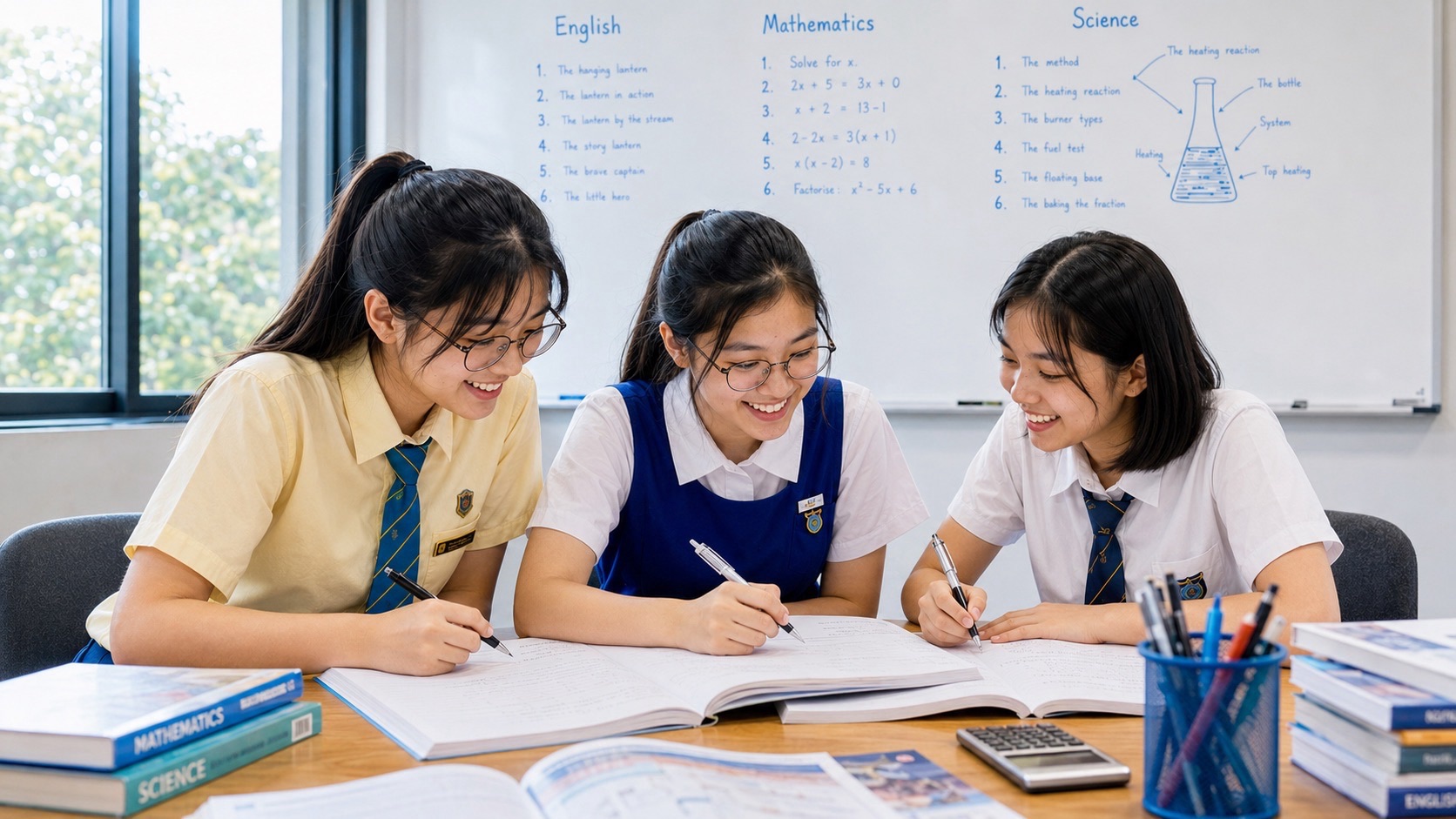
For Yishun parents of a child who enters secondary school through Posting Group 2 (PG2) and later takes G2 Science (Physics, Chemistry), the correct Singapore–Cambridge Secondary Education Certificate (SEC) syllabus for 2027 is SEAB K223. It is one combined Science subject with four compulsory papers: Physics Paper 1 MCQ (20%) and Paper 2 structured (30%), plus Chemistry Paper 3 MCQ (20%) and Paper 4 structured (30%). Each science’s two papers are taken in one 1-hour-15-minute session. Parents should read the official 2027 G2 Science syllabus before selecting schoolwork supplements.
This Yishun guide explains the exact K223 component structure, the Physics and Chemistry topics, practical investigation skills tested in writing, and a realistic plan for a learner preparing from Secondary 1 towards upper-secondary SEC. It follows the eduKate Clementi teaching reference in offering parents an immediate answer and a precise way to identify weaknesses. PG2 is a school posting category, not a permanent description of every G-level subject. K223 is specifically Physics with Chemistry; the different G2 combinations K224 and K225 assess different pairings. The format here is verified for 2027; use the official 2028 syllabus when that examination year is published.
- Correct 2027 subject: G2 Science (Physics, Chemistry) K223, older reference 5105.
- Physics: Paper 1 has 20 multiple-choice questions, 20 marks, 20%; Paper 2 has 30 structured marks, 30%.
- Chemistry: Paper 3 has 20 multiple-choice questions, 20 marks, 20%; Paper 4 has 30 structured marks, 30%.
- Time: one 1-hour-15-minute session for Physics 1+2 and another for Chemistry 3+4; SEAB advises no more than 30 minutes for each 20-mark MCQ component.
- Structured-paper pattern: compulsory Section A 22 marks and Section B 8 marks with a choice of one of two questions.
- Scientific skills: knowledge, interpretation, calculations, experimental methods and evidence-based explanations.
- First parent action: check the child’s actual Science G level and later registered combination, then inspect a Physics calculation and Chemistry reasoning answer.
1. Why K223 is not simply “G2 Science”
The 2027 SEAB G2 Science syllabus is a shared document for three distinct combinations. K223 includes Physics and Chemistry; K224 includes Physics and Biology; K225 includes Chemistry and Biology. They share an examination framework but require different sets of papers. A student’s workbooks, online lessons and final paper practice must match the school-registered code. Merely seeing the words “combined science” on a cover is not enough.
Under Full Subject-Based Banding (FSBB or Full SBB), Posting Groups help with Secondary 1 school placement and the usual starting levels of most subjects. Students may be eligible to take individual subjects at different G levels according to the school’s arrangements. A child posted in PG2 does not automatically sit K223, and the eventual upper-secondary Science combination must be confirmed with the school. If the child studies a permitted G3 Science subject, the applicable G3 document will be different.
Students entering Secondary 1 in 2027 are generally at the start of their secondary education, not sitting the graduating SEC immediately. Build foundations in lower-secondary Science and ask the receiving school when upper-secondary combinations are selected. An early low mark should guide the next lesson, not be used to predict the child’s final pathway.
2. The four compulsory papers: the official K223 2027 scheme
| Paper | Question form | Marks and result weighting |
|---|---|---|
| Paper 1: Physics MCQ | 20 compulsory multiple-choice questions. | 20 marks, 20%; taken with Paper 2 in one 75-minute session. |
| Paper 2: Physics Structured | Section A 22 marks, compulsory, including a final 8-mark question; Section B 8 marks, choose one of two questions. | 30 marks, 30%. |
| Paper 3: Chemistry MCQ | 20 compulsory multiple-choice questions. A periodic table is printed with the paper. | 20 marks, 20%; taken with Paper 4 in another 75-minute session. |
| Paper 4: Chemistry Structured | Section A 22 marks, compulsory, including a final 8-mark question; Section B 8 marks, choose one of two questions. A periodic table is printed. | 30 marks, 30%. |
The Physics papers contribute 50% overall and the Chemistry papers contribute 50%. The two 75-minute sessions are not one continuous two-and-a-half-hour paper, nor are the individual MCQ questions allocated 75 minutes each. SEAB advises spending no more than 30 minutes on each 20-question MCQ component, leaving sufficient time for structured responses and checking.
There is no separate practical examination paper in the published 2027 K223 scheme. However, experimental skills and investigations are tested through the theory papers. Laboratory experience at school remains important because students learn what apparatus, measurements, uncertainties and observations actually mean. Do not confuse “no separate practical paper” with “experiments do not matter”.
3. What kind of scientific thinking earns marks?
SEAB’s assessment objectives assign approximately 45% of theory marks to knowledge and understanding, 45% to handling information and solving problems, and 10% to experimental skills and investigations. These are broad assessment proportions, not separate chapters or an exact study timetable. A question may require several of these skills together.
Scientific understanding includes accurate concepts and vocabulary, correct units, use of instruments, and knowledge of scientific relationships. Problem-solving includes interpreting a new graph, choosing a method, doing a calculation and explaining why a result follows. Experimental reasoning includes methods, tables, scales, conclusions, limitations and safe procedures.
Parents can ask the child to identify which operation a question needs: state, describe, explain, calculate, compare, suggest or evaluate. A pupil who is asked to explain a process cannot gain all the meaning needed by repeating a single term. A pupil asked to state a fact may not need a long unrelated paragraph. Matching response to command helps accuracy.
4. Physics strand: quantities and measurement
The official Physics content begins with measurement. Students study physical quantities, units, appropriate instruments and the role of precise observations. A number has no scientific meaning unless it is linked to what was measured. A distance in metres, a time in seconds and a temperature in degrees Celsius must not be confused even when they happen to share the same numerical value.
At home, practise reading labels from a simple school graph or discussing what a ruler measures. Ask whether a 30 cm measurement means length or an area; ask why a digital stopwatch and a measuring cylinder produce different types of information. Use age-appropriate, safe equipment rather than improvised experiments involving electricity, dangerous chemicals or heat.
5. Physics strand: motion, force and energy
The Newtonian Mechanics section includes kinematics, force and pressure, dynamics and energy. Students need to connect diagrams and equations with actual physical relationships. Motion describes change in position over time; a force can affect motion or deformation; energy is tracked through interactions and transformations. These ideas are linked but cannot be substituted for one another in an explanation.
Original worked example: a fictional cyclist travels 240 m in 40 s. Average speed is distance divided by time, so it is 6 m/s. If the cyclist covers the same distance in 80 s, the average speed is 3 m/s. Ask the child to explain why doubling time halves average speed when distance stays fixed. The exercise is simple by design; it checks whether a formula expresses a relationship rather than serving as a button sequence.
A common error is treating mass and weight as interchangeable. Another is assuming that a moving object must always be accelerating. When a misconception recurs, start with an accurate model or diagram before returning to calculations. Check which quantities the syllabus defines for the student’s level and use the official units.
6. Physics strand: thermal processes, waves and electricity
The K223 Physics section also includes the kinetic particle model of matter, thermal processes, general wave properties, the electromagnetic spectrum, electrical charge and current, direct-current circuits, practical electricity and radioactivity. Parents should use the detailed SEAB learning outcomes to identify the correct scope, not assume that a broad topic title means every advanced formula will be examined.
For heat and particle ideas, ask the learner to describe what changes at the microscopic level when a substance changes state. For waves, ask what a wave can transfer and how its properties are represented. For a simple circuit diagram, ask the pupil to trace the closed path and identify components. These are conceptual checks that reveal whether technical vocabulary is being used meaningfully.
Electrical safety is essential. Parents should not ask children to experiment on household mains wiring or disassemble appliances. Low-voltage, school-approved circuits under appropriate supervision are the responsible route. Similarly, radioactivity should be taught from approved curriculum materials rather than through unsafe demonstrations or contact with unknown sources.
7. Physics graphs and units: a frequent source of avoidable errors
Students may perform a calculation correctly yet read the wrong axis or omit a unit. Begin by reading a graph’s title, horizontal and vertical quantities, scale and units. A straight line on a distance–time graph and a straight line on a speed–time graph do not necessarily mean the same physical event.
For a simple distance–time plot, the gradient can represent speed in the appropriate context. Ask the learner to read two points, calculate the change in distance over the change in time and explain the units. A graph should be understood visually before equations are applied. This practice helps Science, Mathematics and Geography simultaneously.
8. Chemistry strand: experimental methods and separation
The Chemistry section begins with Experimental Chemistry, including choice of apparatus, measuring quantities and methods of separating or analysing mixtures. The official 2027 syllabus includes techniques such as filtration, crystallisation or evaporation, distillation and paper chromatography, subject to the detailed learning outcomes. Ask why a particular method is suitable for the substances, not just for the name of the apparatus.
Original conceptual scenario: imagine a mixture of clean sand and table salt. Salt dissolves in water, while sand does not. That difference suggests a separation route using dissolution and filtration, followed by recovering dissolved salt using an appropriate supervised method. Ask the learner what each step separates and why. This is an educational idea, not a recommendation to run unsupervised heating experiments at home.
Chromatography also illustrates the importance of careful observation and comparison. A diagram of separated spots provides evidence about the sample under defined conditions; the child must not infer more than the pattern supports. For an experimental-method question, include the relevant control and safety consideration when requested.
9. Chemistry strand: particles, atoms and bonding
The Particulate Nature of Matter and Chemical Bonding and Structure topics help students explain observable properties using microscopic models. A solid, liquid and gas differ in particle arrangement and behaviour; substances have properties linked to their constituent particles and how these interact. A particle diagram is a simplified model, not a photograph of atoms.
Ask the child to explain why a model uses certain symbols and what it leaves out. When discussing a chemical formula, distinguish the identity and ratio of elements from the appearance of a substance. Incorrectly copying a small subscript can change the chemical identity represented by a formula, so precision matters.
Teach a progression from atoms and elements to compounds and the bonding structures in the syllabus. Do not attempt to teach every kind of bonding at once. Use the school’s current lesson order and verify understanding through a diagram and one short explanation.
10. Chemistry strand: calculations and equations
Chemical Calculations require disciplined use of formulae, relative quantities and balanced equations in the forms specified by K223. Students need the relevant Mathematics foundations—ratios, multiplication, rearrangement, units—while also understanding what chemical quantities represent. A child who can do the arithmetic but cannot interpret the reaction may still be unable to solve an unfamiliar problem.
Original equation check: the balanced reaction 2H₂ + O₂ → 2H₂O indicates a 2:1:2 ratio of the represented molecules or chemical amounts. It does not mean that every laboratory reaction will immediately produce the predicted amount under any conditions. Ask why the number of hydrogen and oxygen atoms must balance on the two sides. The exercise tests conservation of matter before numerical complexity.
When a calculated quantity is wrong, check the first step: was the chemical formula correct, the equation balanced, the needed ratio selected and the unit handled? Fixing the first wrong assumption is more valuable than redoing an entire page with a memorised method.
11. Chemistry strand: acids, qualitative analysis and periodic patterns
K223 also covers Acid–Base Chemistry, Qualitative Analysis and Patterns in the Periodic Table. Students learn how reactions and observations help identify substances, and how periodic patterns can support predictions. Parents should not assume that remembering a colour or gas name is sufficient. The child needs to connect the observation to the specified test and the conditions under which a conclusion is justified.
For qualitative analysis, focus on selecting the correct evidence from the provided test results. Ask what was observed, what is inferred and whether an alternative explanation remains possible. The official syllabus provides relevant notes and a periodic table for the Chemistry papers. Students should learn how to use these resources rather than rely on copying long disconnected lists.
Because some tests involve corrosive or hazardous chemicals, all practical experiments belong in supervised, properly equipped school environments. The parent can support safe learning through labelled diagrams and discussion of experimental outcomes, without attempting unsafe chemistry at home.
12. Chemistry strand: organic chemistry and air quality
The Chemistry in a Sustainable World section includes Organic Chemistry and Maintaining Air Quality. Students consider properties and uses of chemical substances, reactions and impacts on the environment. Strong answers link a scientific mechanism to the stated consequence instead of making generic claims that chemicals are simply “good” or “bad”.
An air-quality question may ask students to identify a relevant pollutant, source or effect as defined by the syllabus. Answer with the appropriate specific relationship. If the pupil cannot connect cause and effect, ask them to draw a simple chain from a process or emission to a scientifically supported consequence. Avoid inventing local air-quality figures or implying one short observation describes the whole of Yishun.
13. The structured-paper decision: 22 compulsory marks and 8 chosen marks
Both Physics Paper 2 and Chemistry Paper 4 contain Section A worth 22 marks and Section B worth 8 marks. Section A questions are compulsory, with the last carrying 8 marks. Section B gives two eight-mark structured questions and candidates answer only one. They must still use the time available in the shared 75-minute session sensibly.
A student should read both Section B options before choosing. The correct selection is the question whose terms, data and reasoning the candidate can handle most securely—not always the one with the shortest introductory sentence. Practise scanning requirements and identifying necessary topics, but do not waste excessive time deciding after sufficient information is available.
14. How practical Science is assessed without a practical exam
The official 2027 G2 Science theory papers allocate around 10% of assessment marks to experimental skills and investigations. Questions may require choosing apparatus, identifying variables, interpreting tables and graphs, reporting observations, suggesting improvements or discussing likely sources of error. The knowledge and skills come from real school laboratory learning, even when the final assessment is on paper.
A parent-friendly illustration can use a harmless fictional investigation of how a toy car’s travel distance changes with the slope of a ramp. Ask which factor is intentionally changed, what must be measured and which factors should remain similar. Discuss why repeated observations could be useful and why a single result may be insufficient. Avoid turning this into a claim about a real school practical or a compulsory K223 experiment.
When the pupil writes “human error” as a universal limitation, ask for something concrete. Did the student read a scale from the wrong angle? Was the starting position inconsistent? Was a measurement instrument unsuitable? A useful suggested improvement addresses a specific weakness in the method.
15. Translate the marks into a useful revision plan
Because Physics and Chemistry each account for 50% of K223, neglecting either science creates a ceiling on overall performance. However, revision time need not be rigidly divided 50:50 each week. If Chemistry understanding is secure while Physics calculations are unstable, a few weeks of extra Physics focus may be sensible. Reassess using comparable independent tasks rather than intuition.
Do not buy every available G2 Science workbook. Select material aligned to K223 and its examination year, then choose tasks according to the child’s error pattern. For a new Secondary 1 pupil, begin with the actual lower-secondary Science programme, including reading and numerical foundations. Full timed papers are more appropriate when the student has been taught the relevant upper-secondary topics.
16. A diagnostic chart for common G2 K223 mistakes
| Visible mistake | Possible underlying cause | Better first response |
|---|---|---|
| Physics answer has wrong units | Quantity misunderstood or conversion missed. | Write what is measured before applying the formula. |
| Graph conclusion is unsupported | Axes, scale or evidence not read carefully. | State the pattern and cite the relevant data points. |
| Chemistry equation is unbalanced | Conservation or formula notation misunderstood. | Count atoms on both sides and check the formulas. |
| Qualitative analysis conclusion too certain | Observation confused with inference. | Identify the test evidence and its limitation. |
| Structured explanation has no causal link | Keywords memorised without a mechanism. | Add a reason connecting the scientific model to the result. |
| Student rushes MCQ and leaves 8-mark question | Weak time allocation or difficult topic. | Practise the 75-minute paired-paper routine and decision strategy. |
17. Eight weeks to diagnose, recover and build readiness
- Week 1: confirm the current Science level and later registered combination, then examine a marked Physics and Chemistry task.
- Week 2: repair measurement, units, mathematical relationships and one recurring Physics misconception.
- Week 3: practise motion, force or energy questions drawn from the school’s taught scope.
- Week 4: interpret thermal, wave or electrical diagrams and explain one unfamiliar situation.
- Week 5: practise particle models and chemical formulae, distinguishing elements, compounds and mixtures.
- Week 6: use balanced equations, separation concepts or acid–base evidence as appropriate to current lessons.
- Week 7: work through experimental method, data interpretation and one structured 8-mark-style response.
- Week 8: repeat comparable independent questions and decide which weakness still requires feedback.
This is an illustrative family routine, not an official MOE eight-week syllabus or promised grade increase. The school’s term plan determines the correct learning order. A 2027 Secondary 1 entrant should not be pushed through all upper-secondary Chemistry and Physics content immediately. The best pace is one that allows comprehension, school commitments, CCAs and sufficient rest.
18. How to support a child who says Science is too hard
Ask which part creates the difficulty. Does the child understand the concept but struggle with the English wording? Can they describe a graph but not calculate its gradient? Can they memorise a chemical test but cannot explain what the result proves? The underlying issue should determine the response.
School remedial lessons, carefully selected practice and short discussion may be enough. When a persistent misunderstanding needs extra teaching, a suitable tutor should inspect the child’s actual explanation or working and then check transfer using a new question. This is the same principle used by the Clementi small-group Mathematics reference: correct the first wrong reasoning step instead of simply increasing the workload.
Do not promise that extra tuition automatically secures an improvement or a G3 subject-level move. Official subject-level criteria and school arrangements determine changes, and children’s progress varies. The useful measure is whether the learner now explains and solves unfamiliar tasks with greater independence.
19. Yishun choices: schools, combinations and future pathways
For Yishun and Khatib families, compare school fit, actual subject-level arrangements, Science combinations, commute and CCAs. Use MOE SchoolFinder and ask the receiving school when K223, K224 or K225 choices are made. A school’s national ranking, past posting score or online description alone does not confirm availability of a particular combination.
Future pathways such as JC, polytechnic or ITE depend on the student’s complete registered subjects, grades and programme-specific entry criteria at the relevant time. One G2 Science code does not answer the whole question. If a child has a particular career interest, ask the school counsellor for current route information and verify the eventual course requirements.
Related eduKate Yishun reading includes K223 subject-code and papers guide, Secondary 3 G2 Physics–Chemistry, Secondary 4 G2 Physics–Chemistry, PSLE Science to Secondary 1 G2 and the broader G2 Science subject-combinations parent guide.
20. Frequently asked questions
Does a K223 candidate sit a Biology paper?
No. K223 includes Physics papers 1 and 2, and Chemistry papers 3 and 4. Biology belongs to the K224 or K225 combinations.
How many MCQs are tested?
Twenty compulsory Physics MCQs and twenty compulsory Chemistry MCQs, each paper worth 20% of the overall subject.
Is each science a separate SEC subject?
No. K223 is one combined G2 Science subject with four papers and two equally weighted scientific components.
Is there a physical practical SEC paper?
Not as a separate paper in the published 2027 K223 scheme. Experimental skills are assessed in theory papers and practical learning remains important in school.
Do students get a periodic table?
The official syllabus specifies a periodic table printed with Chemistry Papers 3 and 4. Students should learn to use it, not simply memorise isolated values.
Can a PG2 child take a different Science level?
Where eligible and supported by the school’s approved arrangements, individual subject levels can differ from the posting group. Confirm the child’s current allocation and actual combination.
Does this article establish the 2028 paper format?
No. It explains the verified 2027 specification. Check SEAB’s 2028 syllabus and the school’s actual examination registration when available.
21. Official references and next learning steps
- SEAB official 2027 G2 Science K223, K224, K225 syllabus PDF
- SEAB 2027 G2 school-candidate syllabus directory
- SEAB SEC overview
- MOE SchoolFinder
- eduKateSG detailed K223 examination strategy
- eduKate Yishun learning library
Editorial verification: 19 November 2026 using the official 2027 SEAB K223–K225 G2 Science syllabus. All worked examples and practice contexts are original illustrations, not SEAB examination questions. The child’s eventual examination-year syllabus, subject offering, laboratory requirements and progression criteria must be checked with SEAB, MOE and the school.