
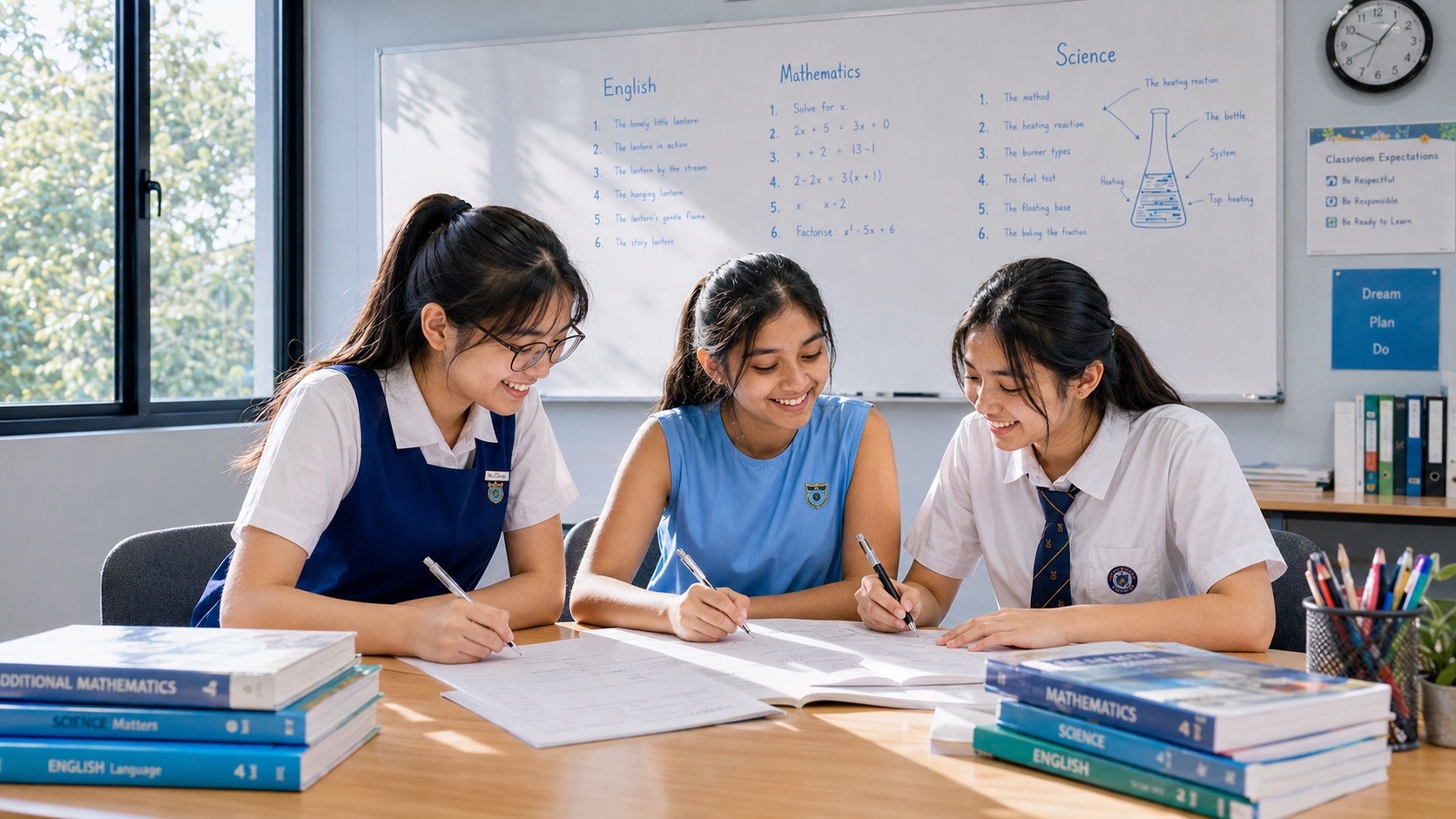
Secondary 1 G2 Literature in English helps students read stories, poems and plays closely, understand different viewpoints, and explain their own interpretations using evidence. G2 describes the subject level at which a child studies Literature under Full Subject-Based Banding. It is not a permanent label for the child. The subject asks students to notice how a writer creates meaning: what a character chooses, how a scene changes, and why particular words matter. MOE’s published Literature teaching syllabus provides the broad learning framework; the school’s current programme identifies the texts and tasks for Secondary 1.
For parents, the most useful starting point is the school’s reading list, curriculum outline and assessment notice. Secondary 1 Literature assessments are school assessments, not a national SEAB Literature examination. Different schools can choose different texts and organise learning differently across the lower-secondary years. For example, Yishun Secondary School’s 2026 Secondary 1 G2/G3 outline includes Wonder and local and global poetry. That is a dated example of one school’s programme, not a compulsory national book list. At home, begin with understanding the assigned text before adding model answers or extra revision material.
- Main learning: understand the text, notice the writer’s choices, and support an interpretation with relevant evidence.
- Genres: prose, poetry and drama belong to the lower-secondary learning journey; check which are taught this year.
- G2: a subject level, distinct from a Posting Group or the child’s level in English Language.
- Assessment: follow the current school notice for texts, question types, permitted materials and timing.
- Home support: read a manageable section, discuss one interesting detail, and practise one clear explanation.
- Later choices: discuss subject-level progression and upper-secondary offerings with the school.
- Practice below: all miniature stories, poems, dramatic scenes and model responses are original teaching examples, not official examination material.
eduKate Yishun · Secondary 1 G2 Literature in English
Find your next learning step
Choose the part that matches your question, or read the guide in order. The examples support discussion with your child and the school.
Understand the subject · Explore worked examples · Study and check · Try the diagnostic · Parent questions
Contents
Chapters 1–7
- Understand G2 Literature and its place beside English Language
- Read the curriculum map without turning it into a national book list
- Build understanding before collecting literary techniques
- Explain character through choices and contradictions
- Notice how setting and language create atmosphere
- Read a poem through its movement, not a hunt for devices
- Read drama as action that an audience can see and hear
Chapters 8–14
- Build a response that links a claim, evidence and explanation
- Prepare for the school's task and use feedback precisely
- Use a manageable weekly reading and writing routine
- Help without replacing the child's interpretation
- Try a short diagnostic and discuss the answers
- Discuss progression and later SEC choices at the right stage
- Questions parents often ask
A useful distinction is between learning to communicate effectively in English and studying what a literary text makes possible. English Language develops language skills across different purposes and situations. Literature gives sustained attention to created worlds, voices and experiences. The subjects support each other, but doing well in one does not automatically answer every question in the other.
A student might understand every word in a paragraph yet struggle to explain why it feels tense. Another might notice an interesting contradiction in a character but need help expressing that insight clearly. Both have something to build on. Look at the particular task before deciding that a child is simply good or weak at Literature.
Orchid Park Secondary School’s Full SBB guidance explains that Posting Groups concern admission and initial subject placement, while subjects can be studied at different levels. A child’s G2 Literature lessons should therefore be understood on their own terms. The subject level is information for planning learning, not a prediction of personality, intelligence or future interests.
At the beginning of term, ask your child to show you one lesson activity and one completed response. Can they explain what the class was investigating? Can they find the relevant page? Can they describe the teacher’s feedback? These questions reveal more than asking whether Literature is easy. They also help a parent understand the course without trying to reproduce the teacher’s lesson at home.
CHAPTER 2 OF 14
2. Read the curriculum map without turning it into a national book list
MOE’s 2019 teaching syllabus covers both lower and upper secondary. Its lower-secondary genre framework includes prose, poetry and drama across the course. It should not be treated as a requirement to finish every genre, text or learning outcome in the first term of Secondary 1. The syllabus’s older course labels also need to be read alongside today’s Full SBB arrangements.
A current school example helps make the distinction clear. Pei Hwa Secondary School’s current curriculum page explicitly references the 2019 Literature syllabus and describes studying the three genres across Secondary 1 and 2. Broad curriculum coverage and an individual school’s yearly reading sequence are different kinds of information.
Keep three documents together: the current book list, the curriculum outline and the next assessment notice. The book list tells you what to obtain. The outline shows the learning sequence. The assessment notice identifies the immediate preparation task. If these appear inconsistent, check with the teacher before buying another edition or revising the wrong chapters.
Reading beyond the assigned text can be enjoyable, but it serves a different purpose from completing this week’s school reading. A child who has fallen behind needs a realistic route back into the current text. A child who is ready for more can explore another story or poem without assuming that extra reading becomes examinable material. Ask about the purpose of the activity first.
On a first reading, help your child work out who is present, what is happening and what changes. These are simple questions with an important purpose: they establish the situation that later analysis must explain. A list of metaphors cannot compensate for misunderstanding who spoke or why a character left the room.
Try a three-part reading note. In the first part, record the event in one sentence. In the second, identify a detail that seems significant. In the third, write a question. For example: “A student returns to an empty classroom. She checks the desk before calling her friend. Is she looking for something, or checking whether anyone has noticed?” The question keeps the reading open without pretending uncertainty is a mistake.
Read in meaningful sections. A scene, a short chapter or a complete short poem usually offers a clearer stopping point than an arbitrary page count. After reading, close the book briefly and retell the main development. Then reopen it to correct errors. This distinguishes what the child remembers from what the text actually says.
When vocabulary interrupts understanding, choose words that matter to the situation. If a character “hesitates”, the pause may affect the interpretation of a decision. If an unfamiliar object merely supplies background, a quick explanation may be enough. Avoid turning every reading session into a long dictionary exercise.
On a second reading, ask what you noticed because you already knew the ending. A quiet detail may become more significant. This teaches a useful habit: an interpretation can improve when more evidence becomes available. The aim is not to produce a perfect opinion immediately, but to read carefully enough to revise an early impression.
Read this original miniature scene, written for this guide:
Nadia reached the classroom before everyone else. She checked her presentation cards, then lowered them to her lap. When the door opened, she was already smiling. “I haven’t really prepared,” she said. Under the table, her thumb pressed the corner of the first card flat.
What impression do we form of Nadia? “She is nervous” is plausible, but it becomes useful only when the student explains the evidence. Her prepared cards conflict with her claim that she has barely prepared. Hiding them may suggest that she wants to appear effortless, or fears being judged for trying hard. Pressing the card supplies another small sign of tension.
The text does not tell us that Nadia always lies or that every classmate is unkind. Those would be much larger claims. A careful response keeps its scale proportionate: in this moment, Nadia appears concerned about how others will see her preparation. The words “appears” and “may suggest” can express a reasoned inference without turning it into a certainty.
Ask your child to separate an action from a trait. The action is hiding the cards. A possible trait or state is self-consciousness. The explanation connects the two. This prevents a common pattern in which students attach an adjective to a quotation but leave the reader to work out the relationship.
Characters can also have mixed motives. Nadia might be proud of her work and embarrassed by that pride. A stronger reading can hold both possibilities together when the evidence supports them. Literature becomes more interesting when a student can explain a tension within a person instead of forcing every character into a single positive or negative label.
Setting includes where and when events happen. Atmosphere is the feeling created around those events. They are connected, but they are not interchangeable. An empty classroom could feel peaceful, lonely, threatening or full of possibility, depending on how it is presented.
Compare these two original sentences: “Morning light spread across the empty desks.” “The last strip of light stopped at the locked classroom door.” Both mention light and a classroom. The first gives a sense of openness through “spread”. The second brings attention to a boundary through “stopped” and “locked”. A student should explain that difference rather than merely identify the shared setting.
Choose a small amount of evidence. It is often easier to explain one precise verb than to paste an entire paragraph into an answer. Ask: what does this word make us picture? What feeling or expectation does that picture create here? How does it connect to the character’s situation?
Be cautious about automatic symbolic meanings. Rain does not always mean sadness, and darkness does not always mean evil. In a story about a drought, rain may bring relief. In another scene, it may hide a conversation or delay a journey. Context decides which interpretation is convincing.
A helpful exercise is to change one word and discuss the effect. Replace “crept” with “strode”, or “whispered” with “announced”. The event may remain similar, while the impression changes. Then return to the writer’s actual choice. This activity makes analysis concrete: the student is comparing possible effects, not searching for an impressive phrase about the reader’s emotions.
This original poem was written for practice:
At the classroom door
my question waits,
folded small inside my hand.
The bell scatters everyone.
I open my fingers.
One quiet word stays.
Start with the situation. Someone has a question but has not yet asked it. The classroom empties, and the speaker remains with a word. The poem does not identify the precise question. A response should acknowledge that gap instead of inventing a detailed explanation about a particular examination or family problem.
Next, follow the change. The opening presents the question as waiting and folded away. Later, the speaker opens their fingers. That action may suggest increasing readiness to speak, even though the final line preserves uncertainty. The poem can be read as a small movement towards expression rather than a complete triumph over fear.
Now examine a choice. Reading the question as an unspoken thought, the image makes it seem like a small object that can be held or concealed. A reader might also imagine a written question on folded paper. Either interpretation should explain the contrast between concealment and opening. The adjective “quiet” also contrasts with the bell and the dispersing class. The explanation matters more than naming a technique and stopping there.
Read the poem aloud twice. First, move quickly through it. Then pause at each line ending. Does the separation of “I open my fingers” make that action stand out? Discuss the effect you hear, while remembering that line breaks and punctuation can work together in different ways. There is no need to insist on one theatrical performance.
A supported alternative is that the final word remains unspoken, so the ending still feels hesitant. Both readings must account for the opening hand and the remaining word. The discipline lies in explaining the whole pattern. “Any answer is correct” would remove that discipline; “only one emotional response is allowed” would remove the openness that makes reading worthwhile.
Keep the speaker separate from the real writer. A poem’s “I” is a voice within the poem; it need not be an account of the author’s own day. Start with what that voice notices and how it speaks. If a lesson supplies reliable contextual information about the writer, use it where it clarifies a detail, but continue to test the interpretation against the poem. This distinction helps students avoid statements such as “the poet must have been bullied” when the words establish only a fictional speaker’s hesitation.
Drama asks the reader to imagine a performance. Dialogue matters, but so do pauses, movement, entrances, exits and stage directions. A character’s words may say one thing while the visible action suggests another. Read this original short scene:
LEAH: You can take the last chair.
RAVI: Are you sure?
Leah pushes the chair towards him. She keeps one hand on its back.
LEAH: Of course.
Neither sits.
The offer sounds generous. However, Leah’s hand remains on the chair, and neither person sits. An audience might sense awkwardness or reluctance. The stage direction gives us evidence that the dialogue alone would not provide. A response that quotes only “Of course” may miss the central tension.
Try two performances. In the first, Leah smiles warmly and keeps her hand on the chair to steady it. In the second, she grips it and speaks sharply. Discuss which choices the written scene permits and which require additional invention. Performance can test an interpretation, but an actor’s added gesture is not automatically evidence from the script.
Distinguish the audience from a character. An audience may see both people’s hesitation while each character is uncertain about the other’s intentions. That difference can create humour, discomfort or suspense. Ask who knows what at this point in the scene.
When writing, connect the theatrical detail to its effect: “The direction that neither person sits leaves the offer unresolved, making the exchange feel uncomfortable.” This is more useful than saying only that the scene contains stage directions. At home, a short reading with two voices can make dramatic choices easier to notice without turning revision into an elaborate production.
A literary response should help another reader understand an interpretation. A practical sequence is to answer the question, select a relevant detail, explain how it supports the answer, and connect that explanation to the question’s focus. These are thinking moves, not a compulsory national paragraph formula.
Consider the question: “How does the miniature scene present Nadia’s concern about others’ opinions?” A weak answer might say: “Nadia is nervous. The evidence is her cards. This makes the reader interested.” The answer names a feeling, but the evidence is vague and the final sentence does not explain the concern.
A stronger original response would be: “Nadia seems anxious to make her preparation look effortless. She hides her presentation cards before claiming that she has barely prepared. The contrast between her actions and her words suggests that she is managing the impression she gives her classmates. Her attention to the card under the table further hints that the calm smile does not show everything she feels.”
Notice what this response does not need: a long retelling, an unrelated moral, or several technical terms. It stays with the question and explains the contrast. A student could reach a different judgement, but would need equally relevant support.
Quotation should be accurate and selective. If your child cannot remember exact wording, they should not invent quotation marks around an approximation. During practice, reopen the text and check. When a task permits paraphrase, make it faithful and distinguish it from a direct quotation.
Improve one sentence at a time. Ask the child to underline their claim, circle the evidence and point to the explanatory link. If the explanation is missing, add it before polishing vocabulary. If the evidence does not fit, replace it. Clear reasoning is easier to develop when the repair is specific, rather than an instruction to “write more”.
Pay attention to the question’s direction. “What impression do you form?” asks for an interpretation of the person or situation. “How is tension created?” draws attention to the choices that produce that effect. A comparison asks the student to connect two things directly. For example, explaining Nadia’s public smile and private handling of the card together is more useful than writing two unrelated descriptions. Before writing, have the child finish the sentence, “This question wants me to explain …” in their own words. If that sentence is unclear, resolve it before choosing quotations.
Assessment preparation begins with the current school notice. Confirm the text or passages covered, question types, time available and whether any materials are permitted. Do not assume that a friend’s school uses the same format. A published outline from an earlier year can help explain a course, but the current teacher’s instructions govern the next assessment.
Yishun Secondary School’s English and Literature outlines page links the 2026 Secondary 1 plan used above. That plan includes passage-based work and seen poetry among its assessment activities. This illustrates the value of finding the actual school document; it does not establish a national timetable or weighting for every G2 Literature class.
After a marked response, identify the first point at which the answer became less convincing. Did the student misunderstand the scene? Choose evidence unrelated to the question? Quote accurately but fail to explain? Make a sensible point that the wording obscured? Each problem needs a different next exercise.
If the issue is misunderstanding, reread and retell. If it is evidence selection, compare two possible details and choose the stronger one. If it is explanation, practise completing “This suggests … because …” in ordinary language. If it is organisation, plan the order of two points before writing another full answer.
Keep the corrected response beside the original. Progress becomes visible when a child can explain what changed and why. A higher mark can be encouraging, but the more reusable achievement is knowing how to improve the next unfamiliar question.
During timed practice, reserve a brief moment to decide the answer’s main point. A student who starts writing immediately may spend the available time retelling the passage. A small plan can name the interpretation and the two details that support it. After writing, check whether each paragraph actually answers the question. If your child frequently runs out of time, show the teacher a completed practice attempt and ask whether the difficulty is reading, deciding, explaining or recording ideas. “Work faster” does not identify which part needs support.
The following is an optional home routine, not an MOE homework requirement. Adapt its length to the school workload and the child’s reading pace. Begin with a few short, focused sessions that the family can sustain.
| Session | Main task | Useful evidence of progress |
|---|---|---|
| Read | Finish the assigned section and clarify the situation. | A brief, accurate retelling. |
| Notice | Select one action or language choice. | A note explaining why it matters. |
| Respond | Answer one focused question. | A claim supported by relevant evidence. |
| Review | Use feedback to revise the response. | A clear account of what improved. |
Keep the reading record small enough to use. For a longer text, record the chapter, a key development, one useful detail and a question. A beautifully decorated notebook that takes longer than the reading itself may not help the child return to the story.
Build vocabulary around distinctions. “Worried”, “embarrassed”, “resentful” and “uncertain” describe different states. Ask which fits the evidence best. Then practise the word in a sentence about the text. The aim is accurate expression, not a collection of sophisticated adjectives that could describe almost anyone.
Occasionally practise without notes so that your child learns what they can retrieve independently. Afterwards, check against the text. Keep the task narrow: one scene or one question is enough to reveal a gap. Repeating an entire paper is not always the most useful response to a single recurring difficulty.
At the end of a fortnight, choose a fresh, short passage for one familiar task. Can the student now identify a character’s possible motive without borrowing the previous answer? Can they explain a new word choice? Transfer matters because Literature continually presents details that a memorised paragraph cannot anticipate. Keep the old and new attempts together, and look for one improvement that the child can describe independently. That gives the next fortnight a practical focus.
Leave room for reading that is simply enjoyable. A child can finish a funny scene, feel surprised by a character or dislike an ending without converting every reaction into an examination paragraph. That voluntary response can become a starting point for discussion when the child is ready.
A parent does not need to have studied the same novel to be helpful. Ask the child to introduce the situation and show the passage that supports their view. You can ask a genuine question such as, “What made you think she was embarrassed?” This invites explanation without pretending to know the teacher’s expected answer.
If a child says, “I don’t know what to write,” reduce the demand. Ask them to choose between two plausible impressions and find one supporting detail. Let them explain it aloud before writing. A temporary prompt can help the child begin; gradually remove it so they practise making their own choices.
When reading itself is difficult, tell the teacher what you observe. Useful observations are concrete: losing track of speakers, needing every sentence explained, or understanding a discussion but struggling to record an answer. Ask which classroom supports and reading strategies would fit. Avoid diagnosing a learning condition from a single worksheet.
If the school permits an audiobook or another accessible format for reading support, use it with attention to the assigned text. A film adaptation can create different impressions because it makes its own choices about action, sound and appearance. Discuss those differences rather than treating the screen version as a substitute for checking the words being studied.
Respect the child’s personal boundaries. A story can raise questions about exclusion, loss or family conflict, but a student should not have to disclose private experiences to produce a thoughtful response. They can discuss the character’s situation and the text’s evidence.
Parents can also model changing their minds. “I first thought the offer was generous, but the final stage direction makes me less certain” is a useful reading habit. It shows that reconsidering an interpretation is part of careful thinking, not a failure to get the answer right immediately.
This original passage and the questions below are for practice. They are not a school test, a national marking scheme or a measure of a child’s suitability for G2 or G3.
Amir put two cups on the table. He moved the blue one to the empty chair, then returned it to the cupboard. Outside, footsteps passed his door and continued down the corridor. He stirred his tea long after the sugar had disappeared. When his phone lit up, he turned it face down.
Questions to try before reading the explanations
- What does Amir physically do with the blue cup?
- What might the movement of the cup suggest about his expectations?
- How does the detail about stirring the tea contribute to the scene?
- What is one possible interpretation of turning the phone face down?
- What important information remains unknown?
- Write a short response explaining how the passage creates a sense of uncertainty.
Explained responses
For the first question, Amir moves the blue cup towards the empty chair and then puts it back in the cupboard. This is directly stated. A child who changes that order may need to slow down and establish the literal sequence before making inferences.
For the second question, he may initially expect another person to join him, then reconsider. The two cups and empty chair support that possibility. The passage does not prove who the other person is or why they have not arrived. “His friend has cancelled” would require information we have not been given.
For the third question, continuing to stir after the sugar has dissolved suggests that Amir’s attention may be elsewhere. The unnecessary repetition can make him seem preoccupied or unsettled. The answer should explain the excess duration; saying simply that he is drinking tea misses the detail’s significance.
For the fourth question, turning the phone face down may suggest reluctance to read a message or answer someone. It could also express frustration or a wish to avoid distraction. A convincing answer presents a possibility and relates it to his earlier behaviour. It should not claim that the unseen message definitely contains particular news.
For the fifth question, we do not know whom he expects, what the phone shows or what has happened before the scene. Identifying these limits is part of reading accurately. Uncertainty can be something the writer creates, rather than a gap the student must fill with invented facts.
A possible response to the final question is: “The passage keeps Amir’s intentions unsettled. He prepares two cups but removes one, suggesting that his expectation of company has changed. The passing footsteps draw attention to someone who does not stop, while his decision to turn the phone over leaves its information hidden. Together, these details make the reader question whom he is waiting for and whether he wants contact.” Discuss which details your child’s version uses and whether each explanation follows from them.
Full SBB provides opportunities for eligible students to take Humanities at a more demanding level from Secondary 2, based on aptitude and interest. The published Humanities progression guidance includes Literature in English. Families should ask their own school how evidence of readiness is considered and what support accompanies a change. Do not assume that one result creates an automatic entitlement.
Useful evidence for that conversation includes independent reading, willingness to consider another interpretation, accurate use of evidence and the ability to respond to feedback. These are discussion points for parents, not a replacement for the school’s criteria. A child may be improving steadily without needing an immediate change of level.
Looking further ahead, SEAB’s 2027 G2 school-candidate list identifies Literature in English as K228 and Humanities (Social Studies, Literature in English) as K231. These are later national examination subjects, not Secondary 1 test codes. Availability and subject combinations must be checked with the school.
SEAB’s SEC transition guidance states that the SEC starts for graduating students from 2027. A child entering Secondary 1 in 2027 is not therefore taking the national Literature examination that year. When choosing an upper-secondary course later, consult the syllabus and school offer relevant to the child’s actual examination year.
For now, preserve both learning and interest. A child who can read closely, explain an interpretation and revise it responsibly is building a useful foundation. The next decision should follow evidence about that child’s learning, not anxiety about a code several years ahead.
Does Literature mean memorising model essays?
Model responses can show how a point is developed, but memorising one does not make it fit a new question. Ask your child to identify the response’s claim, evidence and explanation, then practise those moves on a different passage. The purpose is to understand how the reasoning works.
Can my child disagree with the teacher’s interpretation?
A student can ask whether another interpretation is supported, explain the evidence and listen to objections. The strongest discussion is specific and respectful. A personal preference alone is different from a reasoned reading, and the teacher may point to details that the child has overlooked.
Must every answer include a literary technique?
The question determines the task. When discussing language, accurate terminology can help, but naming a technique without explaining its effect is incomplete. A precise explanation in plain English is a better starting point than an uncertain technical label. Follow the teaching guidance for the particular question.
What if my child dislikes the assigned book?
Ask which part is difficult or unappealing. Unfamiliar vocabulary, slow reading, confusion about characters and disagreement with a character are different issues. The child can learn to understand and analyse a text without pretending it is a favourite. Keep some separate reading that they choose for enjoyment.
What should we do this week?
Find the current reading task and finish a manageable section. Ask your child to select one detail they can explain, then write a short response. Compare it with the teacher’s recent feedback and choose one improvement. End with a question to take back to class. A clear next step gives the family something practical to do while keeping the student responsible for their own developing voice.
Official sources and school examples
Curriculum and policy references checked on 15 November 2026. School examples describe the named school’s published programme; they do not establish universal texts, assessment arrangements or future subject offers. The teaching examples and suggested routines in this guide are original educational material.
- MOE: Literature in English Teaching and Learning Syllabus, lower and upper secondary, 2019.
- Pei Hwa Secondary School: English and English Literature curriculum.
- Yishun Secondary School: English and Literature curriculum outlines index.
- Yishun Secondary School: Secondary 1 G2/G3 Literature curriculum outline, 2026.
- Orchid Park Secondary School: Full Subject-Based Banding and Humanities progression.
- SEAB: 2027 G2 syllabuses for school candidates.
- SEAB: transition to the SEC from the 2027 graduating cohort.
Leave a Reply