
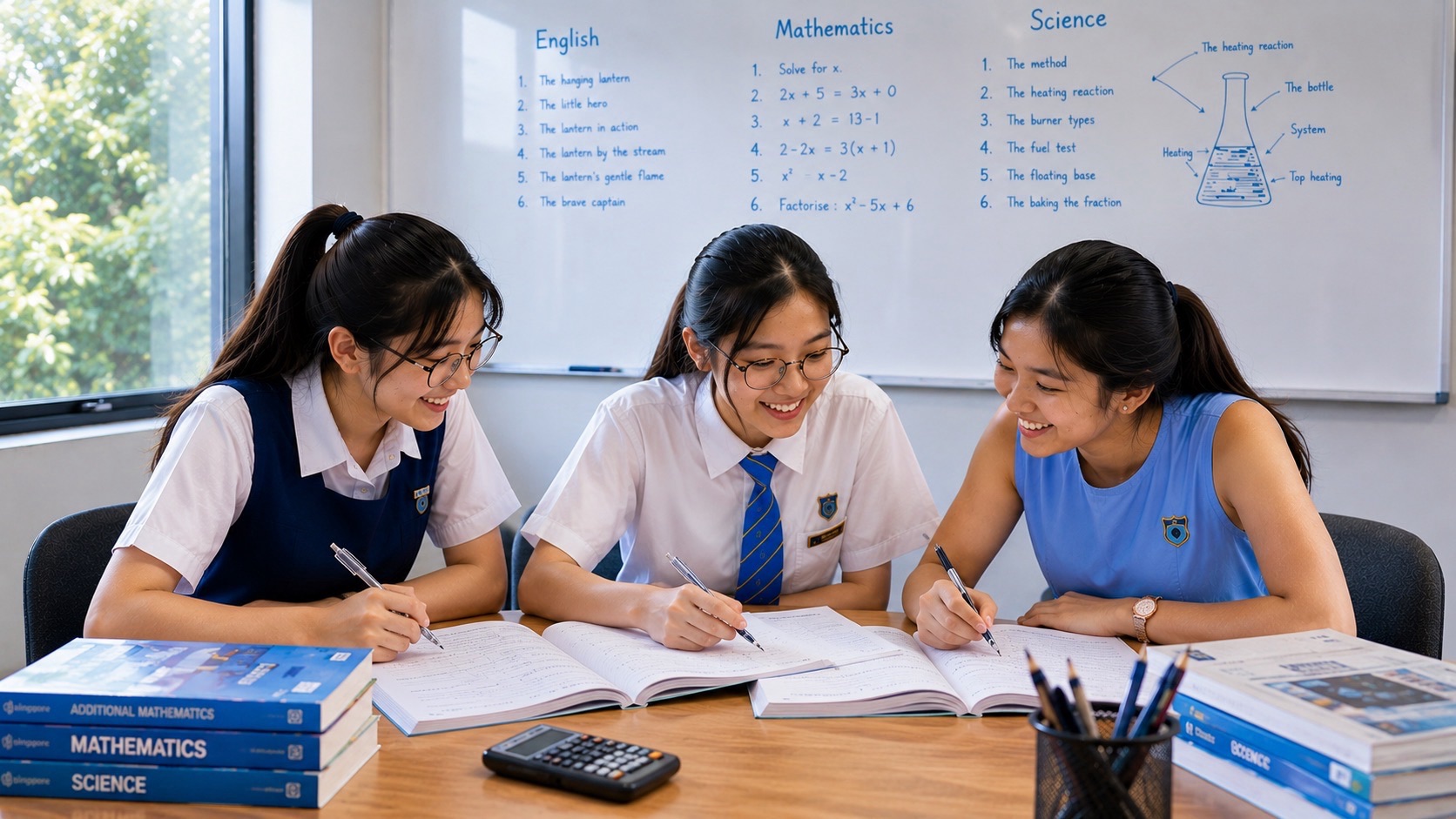
Secondary 1 G2 Mathematics is the first year of Mathematics at the G2 subject level under Singapore’s Full Subject-Based Banding system. Children learn to work confidently with numbers, use letters to express relationships, solve equations, reason about shapes and interpret data. The immediate goal is to understand the mathematics taught in school and show clear reasoning. G2 describes the level of this subject; it does not describe the whole child or require every other subject to be taken at G2.
Parents should start with the school’s current Mathematics outline, textbook and assessment information, then use the MOE teaching syllabus to understand the broader requirements. Secondary 1 school assessments are different from the later Singapore-Cambridge Secondary Education Certificate (SEC) examinations. This guide explains the subject, demonstrates important ideas through original examples, and shows how to identify a useful next step when a child is struggling, keeping pace or ready for more challenging work.
- Subject: Mathematics at G2 in Secondary 1, with learning across number and algebra, geometry and measurement, and data.
- Main transition: moving from obtaining an answer to explaining relationships, using symbols and checking a method.
- Learning priorities: secure arithmetic, careful handling of negative numbers, meaningful algebra, accurate units and readable working.
- School information: check the current topic sequence, assessment scope, calculator instructions and correction expectations.
- Parent support: use one recent piece of work to find the first uncertain step; practise that step before adding difficulty.
- Progression: discuss subject-level readiness and any bridging with the school; one mark does not settle the decision.
- Later examinations: SEC syllabus documents concern the examination year stated on them, not a national Secondary 1 paper.
- How to use this guide: read the examples, try the short diagnostic, and choose a manageable practice routine.
eduKate Yishun · Secondary 1 G2 Mathematics
Find your next learning step
Choose the part that matches your question, or read the guide in order. The examples support discussion with your child and the school.
Understand the subject · Explore worked examples · Study and check · Try the diagnostic · Parent questions
Contents
Chapters 1–7
- What G2 Mathematics means for a Secondary 1 child
- Reading the curriculum without confusing it with the SEC
- Making number work dependable before algebra becomes harder
- Understanding letters, expressions and brackets
- Solving equations as statements of equality
- Seeing the whole in ratio and percentage problems
- Using rates, speed and estimation sensibly
Chapters 8–14
- Giving reasons in angle and measurement questions
- Reading graphs and tables with care
- Finding the reason behind a wrong answer
- Building a realistic weekly practice routine
- Preparing for school assessments and reviewing results
- A short diagnostic with answers and next steps
- Questions parents often ask
A parent may see a Posting Group, a subject level and a class name on different documents. These serve different purposes. Under Full Subject-Based Banding, a child’s subjects can be taken at different levels. Read the Mathematics entry itself before buying books or comparing results. Orchid Park Secondary School’s Full SBB explanation provides a useful local introduction to the distinction between posting and subject learning.
In daily learning, the useful question is specific: what can the child explain and do independently? A pupil might calculate quickly but struggle to translate a sentence into an equation. Another might understand an equation but make errors when subtracting a negative number. Both pupils need help, but the teaching should begin in different places.
Consider the instruction “simplify 4a + 3a”. A child who writes 7a has produced a correct answer. Ask what the letter represents and why the terms can be combined. If the child explains that four groups of the same quantity plus three groups make seven groups, the understanding is more secure. If the explanation is simply “remove one letter”, a nearby question may reveal confusion.
This distinction changes how a parent responds to a disappointing worksheet. Instead of deciding that the entire subject is weak, locate a small piece of reasoning that needs repair. Keep the child’s successful work visible too. A sound diagram, a correct estimate or a sensible first equation is evidence of learning even when the final calculation is wrong.
G2 should therefore become a practical reference for choosing suitable work. It should never become a family shorthand for what the child can eventually achieve. The school’s teachers can explain the current expectations and whether a different subject level should be considered.
The MOE G2 and G3 Mathematics syllabuses contain separate content lists by level. The G2 Secondary One list includes number operations, ratio, percentage, rate and speed, algebraic expressions, linear equations, angle and triangle reasoning, measurement, and interpretation of data. Use the G2 section when checking requirements; a shared document also contains G3 material.
That subject map is different from a weekly school plan. For a local example, Yishun Secondary School publishes Mathematics content outlines. Its linked 2026 Secondary 1 G2 outline shows how one school arranges learning and assessment through the year. It is a 2026 school document, not a promise about another school’s sequence or the following year’s calendar.
The SEAB 2027 G2 syllabus list, meanwhile, identifies Mathematics as K210. This is a later national examination syllabus. It is not the code of a Secondary 1 national examination. MOE states that the SEC begins in 2027 for graduating cohorts. A child entering Secondary 1 in 2027 would ordinarily reach Secondary 4 in 2030; that is a cohort calculation, not a confirmed examination timetable for that child.
A useful reading order is therefore: current school instructions for this term, the MOE teaching syllabus for scope, and the relevant SEAB document when planning for the eventual examination year. Check the year on every downloaded file. A search result can display an old title even when a newer document is available, and a familiar subject name does not make two documents interchangeable.
Keep a short list of questions beside the school outline. Which topics are being assessed next? Which methods must be shown? When may a calculator be used? Which corrections remain incomplete? Those questions turn a broad syllabus into decisions that help the child this week.
Letters make arithmetic weaknesses more visible. If a child is unsure about negative numbers, the uncertainty will follow the child into substitution and equations. Begin with a few examples that reveal the reasoning, rather than a long page completed at speed.
For example, calculate −6 + 9. On a number line, begin at −6 and move nine units to the right, arriving at 3. Now compare −6 − 9: the starting point is unchanged, but the movement is to the left, ending at −15. Ask the child to describe the direction before calculating. This connects the symbol to an action and makes it easier to notice a sign error.
Next try 8 − (−3). Subtracting a negative quantity gives the same result as adding the corresponding positive quantity, so the answer is 11. Avoid treating every pair of minus signs as an automatic instruction to change everything nearby. The operation and the brackets matter. In −8 − 3, we subtract positive 3 from −8; the result is −11.
Fractions need the same care. To add 3/4 and 2/3, express both using twelfths: 9/12 + 8/12 = 17/12. The denominator identifies the size of each part. Adding the denominators would change that size without justification. A sketch of equal wholes divided into twelfths can make the mistake easier to see.
Prime factors also become useful when comparing numbers. Since 24 = 2³ × 3 and 36 = 2² × 3², their highest common factor is 12 and their lowest common multiple is 72. Ask a follow-up question: why must the common factor divide both numbers? The answer matters more than reciting a rule about choosing powers.
A practical home check takes only a few questions: one signed-number calculation, one fraction calculation and one explanation of a common factor. If the child needs support, reduce the number of ideas being handled at once. Rebuild one operation carefully, then reconnect it to the school task.
Algebra lets a student describe a relationship before every number is known. Suppose a notebook costs x dollars and a student buys four notebooks plus a pen costing two dollars. The total cost is 4x + 2 dollars. The expression preserves the relationship even when the notebook price changes.
If x = 3, substitute 3 into the expression: 4 × 3 + 2 = 14. If x = 5, the total is 22. The letter is not a decoration or a special kind of number. It stands for the quantity defined in the problem. Encourage the child to write that definition, especially when several quantities appear in a word problem.
Like terms can be combined because they refer to the same algebraic part. Thus 6x + 2x = 8x, while 6x + 2 cannot be reduced to 8x. A simple check is to substitute x = 4. The first expression becomes 32. The second becomes 26. A proposed simplification must preserve the value for every allowed value of the variable.
Brackets need attention to the whole group. In 3(x + 4), three copies of the bracket give 3x + 12. Writing 3x + 4 multiplies only part of the group. A useful teaching question is: if the bracket were a shopping bag containing one item costing x dollars and another costing four dollars, what would three identical bags contain?
Now simplify 5x − 2(x + 3). Expanding the second part gives 5x − 2x − 6, so the result is 3x − 6. Test x = 2 in both expressions. The original gives 10 − 10 = 0; the simplified form also gives 0. This check does not replace the algebraic explanation, but it can expose an error.
When practice becomes difficult, ask the child to mark the terms and identify the operation applied to each bracket. Keeping one transformation on each line is often more useful than trying to fit the entire solution into a single line.
An expression such as 3x + 4 describes a quantity. An equation such as 3x + 4 = 19 states that two quantities are equal. Solving the equation means finding the value of x that makes the statement true.
Subtract four from both sides to obtain 3x = 15. Divide both sides by three to obtain x = 5. Then substitute five into the original equation: 3 × 5 + 4 = 19. The check confirms that the proposed value satisfies the original statement.
The phrase “move it across and change the sign” can conceal what is happening. A child may imitate it successfully until brackets or several terms appear. Ask which operation is being performed on both sides. That question keeps the equality visible and gives the child a reason for each new line.
Equations are also useful for translating information. A school activity charges a fixed booking amount of eight dollars plus three dollars per participant. In an invented example, the total is thirty-five dollars. Let n be the number of participants. The relationship is 8 + 3n = 35. Subtract eight, then divide by three: n = 9. The answer should be written as nine participants, not just an unexplained numeral.
Check whether the answer fits the situation. Participant counts must be whole numbers. If a similar problem produces 9.4 participants, inspect the copied information, the relationship and the calculation before deciding how to respond. Rounding a result immediately can hide a mistaken equation.
For parents, the most revealing point is often before the first calculation. Can the child say what the unknown represents? Can the child identify the fixed amount and the changing amount? If those ideas are uncertain, solve a simpler version using a table of possible values, then return to the equation.
Ratio compares quantities; percentage compares a quantity with a chosen whole expressed as one hundred parts. Many errors occur because the child begins calculating before identifying that whole.
Suppose two teams share seventy practice cards in the ratio 2:5. The total is seven equal parts, so each part contains ten cards. The teams receive twenty and fifty cards. Check both conditions: the amounts add to seventy, and 20:50 simplifies to 2:5.
A common mistake is to treat the first team’s share as 2/5 of seventy. The five refers to the second team’s share, not the combined whole. Drawing seven equal boxes can help a child see why the first share is 2/7 of the total.
For percentage, consider an invented item reduced from eighty dollars to sixty-eight dollars. The decrease is twelve dollars. Divide by the original price: 12 ÷ 80 × 100% = 15%. Dividing by sixty-eight answers a different comparison. The phrase “percentage decrease” requires the starting amount as the reference.
Now reverse the situation. An item costs sixty-eight dollars after a fifteen per cent discount. The sale price is eighty-five per cent of the original, so the original price is 68 ÷ 0.85 = 80 dollars. Adding fifteen per cent of sixty-eight would use the wrong reference amount.
Percentage points describe a difference between percentages. If an invented participation rate rises from forty per cent to fifty per cent, the increase is ten percentage points. Relative to the original forty per cent, it is a twenty-five per cent increase. These statements describe different comparisons, so the words are part of the mathematics.
Before every calculation, ask: what is being compared, and what is the reference whole? A child who can answer those questions is less dependent on memorising surface patterns.
A rate compares quantities with different units. If six identical notebooks cost eighteen dollars, the unit price is three dollars per notebook. If a person covers six hundred metres in five minutes in an invented example, the average speed is one hundred and twenty metres per minute.
Average speed uses the total distance divided by the total elapsed time. It is not automatically the average of two displayed speeds. Imagine a model vehicle travels one kilometre at ten kilometres per hour and another kilometre at twenty kilometres per hour. The times are one tenth and one twentieth of an hour. The total distance is two kilometres and the total time is 0.15 hours, giving about 13.3 kilometres per hour.
The example shows why understanding the quantities matters. Taking the average of ten and twenty gives fifteen, but the vehicle spent longer travelling at the slower speed. A table with distance, speed and time makes the unequal time intervals visible.
Units should stay attached to the quantities. Converting seventy-two kilometres per hour to metres per second requires both conversions: 72 × 1,000 ÷ 3,600 = 20 metres per second. A calculator can perform the arithmetic, but the student must decide what should be multiplied and divided.
Estimation provides a useful check. For 19.8 × 5.1, approximate with 20 × 5 = 100 before calculating. The exact product is 100.98. A calculator display of 10.098 would conflict with the estimate and should prompt a check of the entry.
Keep full values during intermediate steps when appropriate and round at the point requested. Explain the difference between a rough estimate, a rounded final answer and an exact answer. They serve different purposes. School instructions determine the required precision in an assessment.
Geometry requires a student to connect a diagram with a valid relationship. A picture that looks balanced is not enough. The child must use the information supplied, such as parallel-line markings, right-angle symbols or stated side lengths.
For a triangle with two interior angles of forty-eight degrees and sixty-seven degrees, the third angle is 180 − 48 − 67 = 65 degrees. Include the reason: the interior angles of a triangle sum to 180 degrees. The reason explains why those numbers were combined in that way.
With parallel lines cut by a transversal, identify the relevant angle relationship before calculating. Corresponding angles are equal under the parallel-line condition. If the lines are not given as parallel, that equality cannot be assumed merely because the drawing appears that way.
Measurement brings another distinction: perimeter measures a boundary, area measures a surface, and volume measures space occupied. An invented rectangular display board measuring eighty centimetres by fifty centimetres has perimeter 260 centimetres and area 4,000 square centimetres. Both answers come from the same lengths, but they answer different questions.
For a trapezium with parallel sides of six and ten centimetres and perpendicular height of four centimetres, the area is (6 + 10) × 4 ÷ 2 = 32 square centimetres. The perpendicular height matters. A sloping side cannot be substituted just because it is another labelled length.
Unit conversion should reflect dimension. One square metre contains 10,000 square centimetres because one hundred centimetres is multiplied by one hundred centimetres. One cubic metre contains 1,000,000 cubic centimetres. Converting only by one hundred treats an area or volume as a length.
When a child chooses the wrong formula, ask what quantity the question requests and what each given measurement represents. That conversation often repairs more than asking the child to memorise the formula again.
A graph is an organised claim about data. Students should read its title, axes, units, scale and key before drawing a conclusion. A line moving upward does not reveal what increased until the quantities are identified.
Consider this invented record of books borrowed by three groups during the same week.
| Group | Books borrowed |
|---|---|
| A | 24 |
| B | 30 |
| C | 36 |
Group C borrowed twelve more books than Group A. It borrowed fifty per cent more, because 12 ÷ 24 × 100% = 50%. These are two useful descriptions of the same comparison. Neither statement tells us that every individual in C reads more than every individual in A.
If the groups contain different numbers of pupils, comparing totals may not answer a question about borrowing per pupil. If A has twelve pupils and C has eighteen pupils, each group borrowed an average of two books per pupil. Additional information changes the interpretation without changing the original totals.
A bar chart beginning its vertical scale near twenty-four can make the visual difference appear more dramatic than a chart beginning at zero. A student should explain how the scale affects the impression. Saying that the graph “looks wrong” is less useful than identifying the feature that can mislead.
Different representations support different questions. A line graph can show change over time; a bar chart can compare categories. Ask why a representation was chosen and what information it makes easy or difficult to see. If a pictogram uses one symbol for six books, half a symbol represents three books, not one book.
These exercises teach a valuable habit: distinguish what the data show from what a reader has assumed. A confident answer should remain within the evidence provided.
Before adding more practice, inspect one completed question. Ask the child to explain the work as written. Resist correcting the first line immediately; the explanation can reveal whether the difficulty concerns language, concepts, procedure or attention to the information.
A reading difficulty might appear when “increase by” is interpreted as “increase to”. A conceptual difficulty might appear when a ratio part is treated as the whole. A procedural difficulty might involve applying a correct rule inconsistently. A recording error might occur when the child copies twenty-seven as seventy-two. These possibilities require different responses.
Use a correction record with three entries: the first incorrect step, the reason it was incorrect, and a fresh question that checks the repaired idea. For example: “I changed 3(x + 2) to 3x + 2. The multiplier applies to both terms. I will check 4(y + 5) without looking at the answer.”
Do not count a copied model solution as proof that the idea is secure. Close the model and ask the child to solve a related question with different values. Later, mix that question with another topic so the child must identify the method independently.
Equally, avoid rebuilding everything after one difficult paper. Choose the error that appears most often or blocks the current lesson. If signed-number mistakes repeatedly damage algebra, focus there first. If the arithmetic is accurate but the child cannot form an equation, work with language and relationships.
A supportive parent response can be direct: “Your first equation matches the question. Let us inspect the sign on the next line.” This recognises actual evidence and gives the child a manageable action. It avoids making a general judgment from one answer.
The following is an adaptable home routine, not a school requirement or a promise of a particular score. Fit it around homework, travel, family commitments and the child’s other learning. A routine works best when the child can explain its purpose.
On the first practice occasion, revisit one idea from the current lesson. Ask for a brief explanation, then attempt two or three questions. If the explanation is uncertain, use a worked example with different numbers and discuss the meaning of each line.
On the next occasion, return to one previous correction without displaying the solution. Add one question from the current topic and one familiar question from an earlier topic. This gives a clearer picture than completing many nearly identical questions in succession.
Before the weekend ends, review the school outline and unfinished work together. Choose one priority for the following week. A priority such as “identify the original amount in percentage change” is easier to act on than “improve Mathematics”.
Use a simple stopping rule: finish when the agreed learning task is completed and checked. If the child becomes stuck repeatedly, record the point of uncertainty for the teacher. Extending the session indefinitely can turn a small learning problem into a struggle about compliance.
For a pupil who is keeping pace, deepen explanations and checking. For a pupil who is comfortably successful, vary the context or ask for another solution method. For a pupil rebuilding confidence, reduce the number of simultaneous demands while keeping the underlying idea meaningful.
Parents do not need to replace the Mathematics teacher. They can help organise materials, notice repeated patterns, ask the child to explain and make sure questions reach the teacher. If a method differs from the one remembered from school, ask the child to demonstrate the method currently taught before introducing another approach.
Use the school’s current notice to establish the tested topics, duration, allowed equipment and required answer format. A timetable or weighting published by another school is not a national rule. The linked Yishun Secondary outline is useful as an example of the information to look for, not as a substitute for your child’s own instructions.
Prepare in two stages. First, practise understanding and accuracy without pressure. Then complete a short mixed set within a reasonable time limit chosen to resemble the school task. Timing work before the methods are secure can reveal slowness without explaining its cause.
During a practice paper, encourage visible working. Write the equation before solving it, record a geometric reason where relevant, and include units. A final number alone gives little evidence about how the student reached it and makes checking harder.
After marking, separate the score from the information it provides. Identify questions the child could not start, questions with a sound method but inaccurate execution, and questions left incomplete. Each group suggests a different next step. Avoid assuming that every unanswered item reflects a lack of knowledge; time use and reading may also need attention.
Bring two or three representative questions to a teacher conversation. Ask what the teacher sees, which prerequisite should be repaired first and which school resources should be used. Evidence makes the discussion more productive than a general request for harder worksheets.
If the child is considering a change in subject level, discuss sustained readiness, the difference in learning demands and any bridging support with the school. Keep the child involved. The purpose is to find a suitable learning challenge while maintaining a manageable overall workload.
These original questions are a learning check, not a school placement test or a prediction of examination performance. Attempt them with working. Use the answers to decide what to revisit rather than to label the child.
- Calculate −4 + 11 − 3.
- Simplify 5a − 2(a + 4).
- Solve 4x + 7 = 31.
- Share eighty-four cards in the ratio 3:4.
- An invented item costs fifty-four dollars after a ten per cent discount. Find its original price.
- A model vehicle covers nine hundred metres in six minutes. Find its average speed in metres per minute.
- A triangle has angles of thirty-eight degrees and seventy-two degrees. Find the third angle and state the reason.
- Convert 0.6 square metres into square centimetres.
- Groups A and B borrow twenty and thirty books respectively. By what percentage does B’s total exceed A’s?
1. The answer is 4. Moving from −4 by adding eleven gives 7, then subtracting three gives 4. If the sign changed unexpectedly, revisit number-line movement and the order of the operations.
2. The answer is 3a − 8. Expanding gives 5a − 2a − 8. If the answer is 3a + 8, inspect how the subtraction applies to the bracket. Substitute a = 4 into both forms as an additional check.
3. Subtract seven from both sides: 4x = 24. Divide both sides by four: x = 6. Substitution gives 4 × 6 + 7 = 31. A correct answer without a clear method is a reason to practise recording the equality-preserving steps.
4. The shares are thirty-six and forty-eight cards. Seven parts represent eighty-four, so one part is twelve. Check the total and the simplified ratio. Using 3/4 of eighty-four confuses one share with the whole.
5. Fifty-four dollars is ninety per cent of the original price. Divide 54 by 0.9 to obtain sixty dollars. Adding ten per cent of fifty-four uses the discounted amount as the wrong reference.
6. The average speed is 900 ÷ 6 = 150 metres per minute. If the numerical answer is correct but the unit is missing or inconsistent, practise writing the units before calculating.
7. The third angle is seventy degrees because 180 − 38 − 72 = 70. The reason is the sum of the interior angles of a triangle. Distinguish a mathematical reason from a description such as “I subtracted”.
8. The answer is 6,000 square centimetres. Multiply 0.6 by 10,000. A result of sixty square centimetres indicates that a length-conversion factor was used for an area.
9. The difference is ten books, and 10 ÷ 20 × 100% = 50%. The reference is A’s total. This result concerns the group totals; it does not describe individual pupils without more information.
Choose one uncertain idea and create a nearby question. Change the values while keeping the relationship, then later change the context too. The aim is to see whether the child can recognise and use the repaired idea independently.
Is G2 Mathematics just Primary Mathematics repeated?
No. Familiar arithmetic supports more formal work with relationships, symbols and reasoning. A child may recognise the numbers while finding the way of expressing a solution unfamiliar. Begin with what the child understands and make the new representation explicit.
Should my child complete the whole textbook before school starts?
Use the school’s guidance and the child’s readiness. A useful start is to check essential number skills and introduce the meaning of variables, equations and units. Completing many pages without explanation can leave important uncertainties hidden. Depth on a suitable task can be more informative than a large page count.
Does every Secondary 1 G2 class follow the same weekly order?
No single weekly order should be inferred from this guide. The MOE teaching syllabus provides the reference scope, while the school gives the current sequence and assessment information. Use the latest outline for the school and cohort concerned.
Can my child take Mathematics at G3 later?
Subject-level flexibility exists under Full SBB, but a decision concerns the particular child and school review process. Ask what evidence of readiness is needed, what learning has to be bridged and how the child’s other subjects will be considered. Do not treat a score quoted by another school as an automatic offer.
Is Additional Mathematics part of this Secondary 1 course?
It is a separate later subject choice, not another name for the Mathematics described here. The SEAB G2 list separately identifies Mathematics and Additional Mathematics. Families should discuss later options and the school’s offerings at the appropriate stage. Secure current Mathematics gives the child a better basis for that conversation.
What should we do first tonight?
Choose one recent school question. Ask the child to explain the first step, identify the first point of uncertainty and complete a related example after discussing it. Write down one question for the teacher if needed. A precise next action is more helpful than deciding that the entire year must be repaired at once.
Official sources and scope
Source check: 15 November 2026. The explanations, invented scenarios and diagnostic questions in this article are original teaching material. School schedules, assessment instructions and future examination requirements should be checked against the current documents for the relevant cohort.
- MOE: G2 and G3 Mathematics syllabuses, including the G2 Secondary One content list.
- Yishun Secondary School: Mathematics content outlines.
- Yishun Secondary School: 2026 Secondary 1 G2 Mathematics outline, a school-specific example.
- Orchid Park Secondary School: Full Subject-Based Banding.
- SEAB: G2 syllabuses for the 2027 SEC examination.
- MOE: Full SBB and the introduction of SEC examinations from 2027.
Leave a Reply