
Federation ownership: this retained Punggol PSLE Mathematics page is a learning/search route on eduKateYishun, not proof of a current Yishun-operated Punggol centre, class, fee, timetable or vacancy. For Punggol-local family and tuition context, use eduKatePunggol. For specialist Mathematics progression, use BTT Primary Mathematics. eduKateYishun’s role here is diagnosis, recovery and learning continuity.
Families searching for a Punggol PSLE Math Tuition Centre, a Primary 6 Maths tutor in Punggol or PSLE Mathematics tuition are usually looking for a programme that can turn years of topic learning into reliable examination performance. By Primary 6, students are expected to connect fractions, ratio, percentage, rate, speed, geometry, measurement, data and multi-step problem solving without being told which chapter is being tested.
A strong PSLE Maths tuition centre should therefore combine diagnostic assessment, concept repair, bar models, heuristics, mixed-topic practice, timed sections, full-paper analysis, checking routines and independent transfer. The centre should not judge progress only by the number of worksheets completed. It should be able to explain why the child is losing marks and how the teaching plan is changing in response.
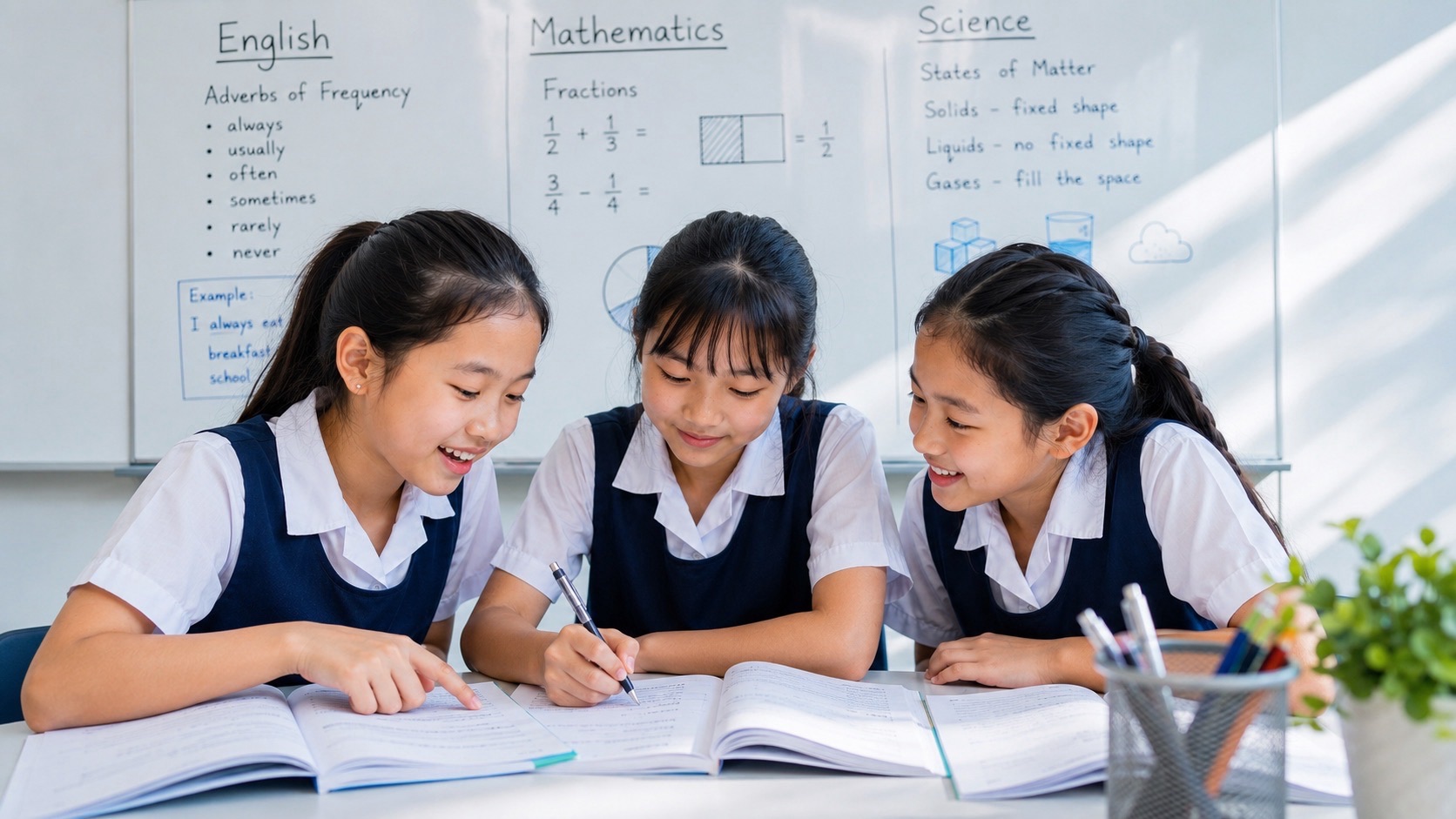
In a three-student tutorial, this can be highly specific. One child may need proportional reasoning repaired, another may need better diagram interpretation, and a third may know the Mathematics but lose marks through time and checking. The useful loop is Attempt → Diagnose → Repair → Mix → Time → Review → Retest. Small-group tuition matters when the small group changes the teaching.
What a Strong PSLE Maths Tuition Centre Should Diagnose
- concept misunderstanding;
- representation error;
- calculation weakness;
- method-recognition delay;
- unit mistakes;
- question-reading mistakes;
- time-management failure;
- checking failure.
These categories are more useful than simply saying a child is “weak in problem sums”.
Fractions, Ratio and Percentage Should Be Taught as a Family
These topics share proportional reasoning. Fractions describe part-whole relationships. Ratio compares relative quantities. Percentage expresses a part per hundred. Students become more flexible when they can move among these representations confidently.
Bar Models Should Reveal the Relationship
A useful bar model should make the story easier to reason about. The child should be able to explain what each segment represents, what is known, what changed and what can be found first.
Heuristics Should Be Chosen From Structure
Working backwards, finding an invariant, simplifying the problem, drawing a model and making a systematic list are tools. The student should learn why a particular tool fits rather than collecting heuristic names.
Geometry Needs Annotation Before Calculation
Students should mark relevant lengths, angles and properties before choosing formulas. A diagram should be treated as mathematical information rather than decoration.
Speed and Rate Need Unit Discipline
Distance, time and rate become much easier to manage when units are made consistent before calculation. Students should write the relationship first and calculate second.
Problem Sums Need a Reliable Start Routine
- Read once for the story.
- Read again for quantities and relationships.
- Underline the exact unknown.
- Choose a representation.
- Find one dependable first step.
- Label the intermediate result.
- Continue only when the next relationship is clear.
The child does not need to see the whole solution immediately. The child needs to know the next defensible step.
Topical Practice and Mixed Practice Have Different Jobs
Topical practice is useful while repairing a concept. Mixed practice is useful when testing whether the child can recognise the concept independently. A strong tuition centre should know when to switch between the two.
Timed Sections Can Diagnose Before Full Papers
If a student runs out of time, the cause may be slow arithmetic, slow method recognition, over-checking or poor question decisions. Timed sections can isolate the bottleneck before more full papers are assigned.
Full Papers Should Produce a New Plan
- Which error type cost the most marks?
- Which question consumed too much time?
- Which secure topic became unstable under pressure?
- Which mistake could checking have caught?
- Which correction requires a delayed retest?
Checking Should Be Personalised
One student may repeatedly lose units. Another may copy numbers wrongly. Another may misread the final line of long questions. Checking should target the mistakes the child is personally most likely to make.
A Three-Student PSLE Maths Lesson
- Retrieval: one high-transfer prerequisite.
- Cold mixed question: observe independent method choice.
- Diagnosis: identify the first weak link.
- Repair: reteach only what is unstable.
- Focused practice: stabilise the repair.
- Contrast: compare a nearby method.
- Timed transfer: practise realistic performance.
- Review: update the error map.
The Independence Test
Can the child solve after the worked example is removed? After several days? Inside a mixed set? Under a reasonable time limit? Can the child explain why the chosen method fits?
How Parents Can Judge a PSLE Maths Tuition Centre
- Can the tutor explain why your child is losing marks?
- Are repeated errors tracked?
- Is support reduced over time?
- Does the child attempt before the tutor demonstrates?
- Is mixed practice introduced once skills are stable?
- Are corrections retested later?
Strong Students Need Novelty, Not Just More Papers
High-performing pupils often gain more from unfamiliar problems, alternative methods and method comparison than from repeating familiar full papers.
Students Who Are Behind Need Priority Control
When time is limited, prioritise fraction sense, proportional reasoning, multiplication fluency, unit conversion and representation. These foundations influence many chapters at once.
The Real Goal of a Punggol PSLE Math Tuition Centre
A strong tuition centre should gradually transfer control from tutor to student. The learner should become more capable of diagnosing, representing, solving, checking and recovering independently.
That independence is a stronger definition of PSLE readiness than simply completing more papers. Properly taught kids shine a bright light into the future.
PSLE Mathematics learning route: Continue to the subject directory · related learning route. If you are choosing a current tuition service rather than using this free guide, use the Yishun Tuition Centre Hub and confirm current arrangements separately.
Continue through PSLE Mathematics: Mathematics Hub · Primary Mathematics directory · Examinations & Pathways · Diagnostics · Library
Leave a Reply