
Locality-status note: “Simei” in this retained title is a locality/search coordinate, not proof of a current physical branch, class, timetable, fee or vacancy. Use the Primary Mathematics Directory for the Yishun learning route and BTT Primary Mathematics for specialist Mathematics progression.
Families searching for a Simei Tutor for Primary Mathematics, Primary Maths tuition in Simei or small-group Primary Mathematics support are often looking for something more useful than another pile of worksheets. Primary Mathematics becomes difficult when a child can calculate but cannot decide what the question is really asking, cannot represent the relationship clearly, or cannot transfer a familiar method into a new-looking problem.
Strong Primary Mathematics tuition should therefore build number sense, place value, multiplication and division, fractions, decimals, percentage, ratio, bar models, heuristics, geometry, problem solving, mixed practice and independent checking. The teaching should adapt as the child grows: lower primary needs meaning and confidence; middle primary needs representation and strategy; upper primary needs integration, transfer and examination control.
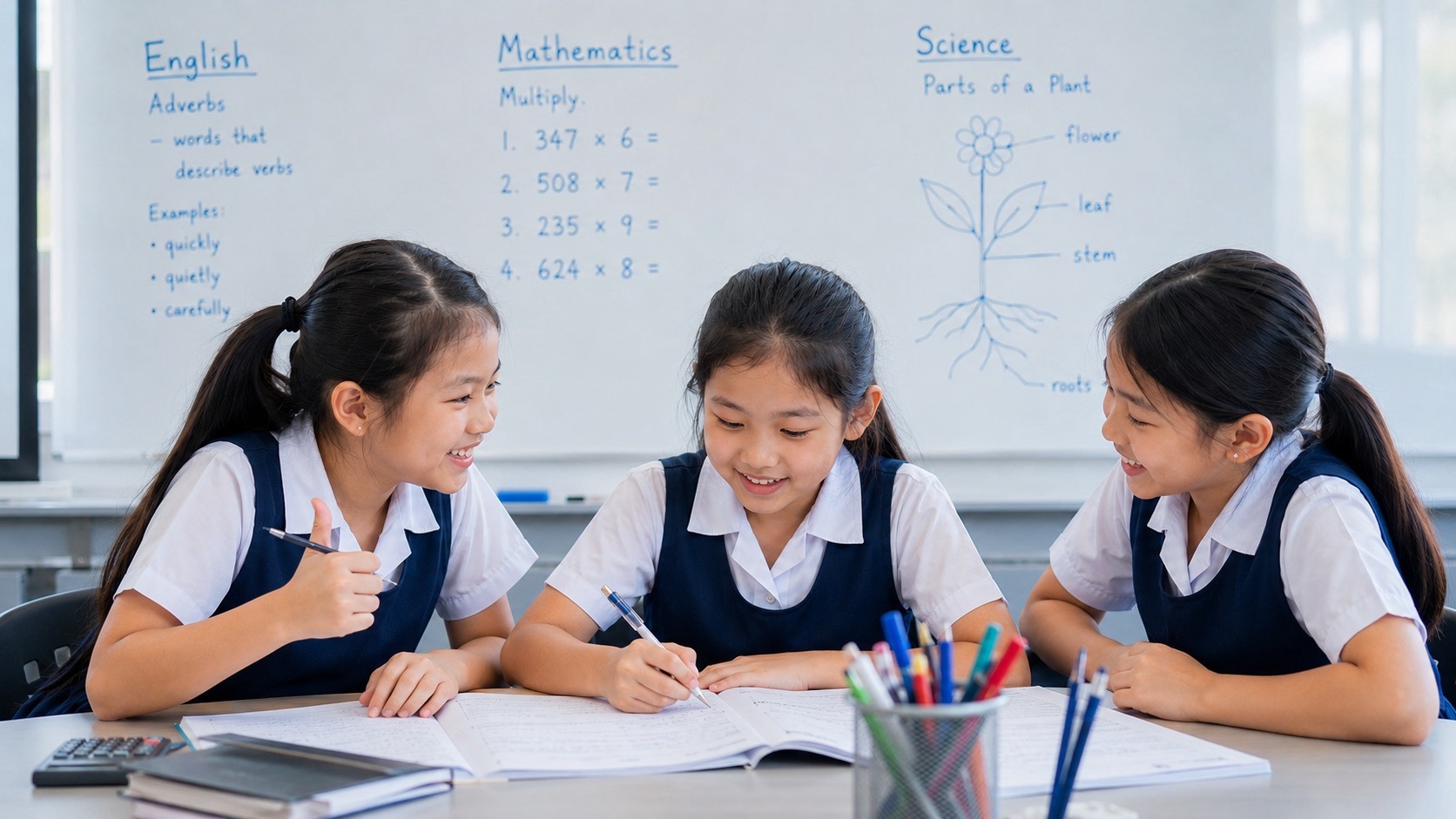
In a three-student tutorial, the first weak link becomes visible quickly. One child may know basic facts but misunderstand place value. Another may calculate well but avoid word problems. A third may understand the concept but lose marks because intermediate working is unclear. The useful loop is Read → Diagnose → Prioritise → Repair → Practise → Connect → Perform → Review.
Primary Mathematics Should Become More Connected Each Year
The curriculum may be divided into topics, but strong understanding is connected. Number sense supports fractions. Fractions support ratio and percentage. Multiplication and division support factors, rate and area. Representation supports word problems across every topic.
Number Sense Comes Before Speed
Young learners should understand quantity, place value and number relationships before being pushed for speed. Fluency matters, but fluency built on fragile understanding disappears when the question changes.
Multiplication and Division Should Be Linked
These operations are inverses. A child who understands the relationship between them develops more flexible problem solving and is better prepared for factors, multiples, fractions and rate.
Fractions Need a Clear Whole
Fraction difficulty often begins when the child loses track of the whole. Visual models, number lines and bar representations help make magnitude and equivalence visible before symbolic procedures become dominant.
Bar Models Should Explain Relationships
A bar model is useful when the child can explain what each part represents, which quantity is known, which is unknown and what can be found first. A neat diagram copied from the tutor is not yet independent reasoning.
Heuristics Should Be Chosen, Not Collected
Working backwards, making a list, finding a pattern, drawing a model and simplifying can all be useful. The important skill is recognising why a particular heuristic fits a particular structure.
Geometry Needs Careful Reading
Students should annotate diagrams, identify what is actually given and avoid assuming that a drawing is perfectly to scale. This habit grows in value from Primary 3 onward.
Word Problems Need a Stable Start Routine
- Read once for the situation.
- Identify the known quantities.
- Underline the exact unknown.
- State the relationship in simple words.
- Choose a representation.
- Calculate only when the structure is clear.
- Label the answer.
- Check whether it makes sense.
Mixed Practice Builds Method Choice
Topical practice is useful while a method is new. Mixed practice is useful when the child needs to recognise which method belongs. Once a skill is stable, remove the chapter label.
A Three-Student Primary Maths Lesson
- Retrieval: one prerequisite skill.
- Cold problem: observe independent thinking.
- Diagnosis: locate the first weak link.
- Repair: rebuild the missing idea.
- Focused practice: stabilise the method.
- Contrast: compare a nearby method.
- Transfer: solve a changed question alone.
- Review: decide the next learning priority.
The Independence Test
Change the numbers, wording or diagram. Delay the retest. Remove the tutor’s prompt. If the child can still recognise the structure and choose the method, the learning is becoming durable.
How Parents Can Read Primary Maths Work
- Are errors conceptual or computational?
- Does the child know methods but choose them poorly?
- Are word problems avoided?
- Are diagrams and models labelled clearly?
- Does mixed practice cause a large drop?
- Can the child begin independently?
The Real Goal of a Simei Tutor for Primary Mathematics
The goal is not permanent tutor dependence. It is a child who increasingly understands the relationship, chooses a representation, selects a method, calculates accurately and checks the result independently.
That is the kind of mathematical foundation that travels well from Primary 1 through PSLE and beyond. Properly taught kids shine a bright light into the future.
Primary Mathematics learning route: Continue to the subject directory · related learning route. If you are choosing a current tuition service rather than using this free guide, use the Yishun Tuition Centre Hub and confirm current arrangements separately.
Continue through Primary Mathematics: Mathematics Hub · Primary Mathematics directory · Diagnostics · Examinations · Library
Leave a Reply