
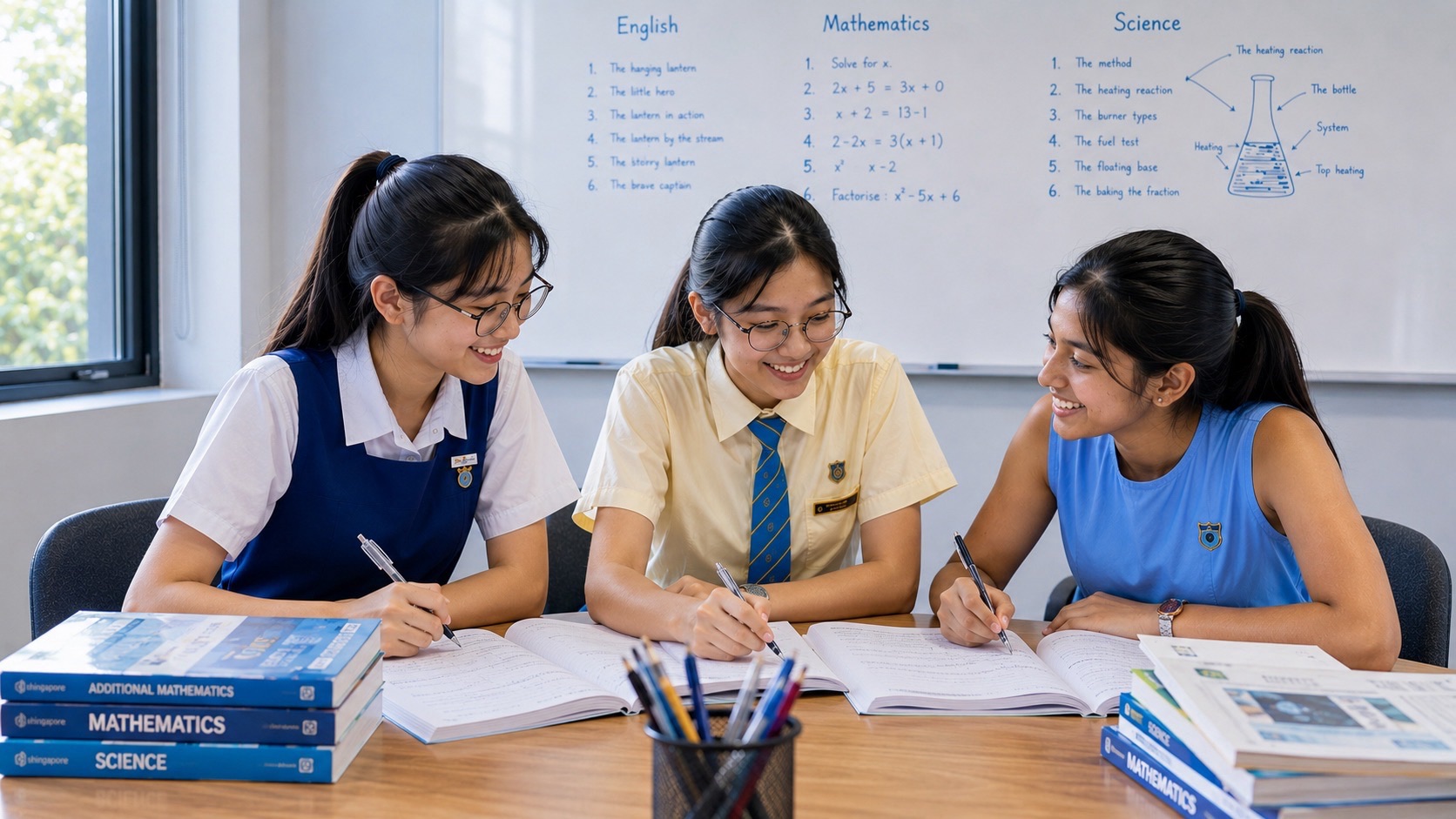
Yishun Secondary 4 English tuition should have one clear purpose: turn reading, writing, vocabulary, grammar, editing and oral communication into dependable examination performance. At this stage, students do not need another pile of generic worksheets. They need to know why marks are disappearing and what specific language behaviour will recover them.
Useful O-Level English preparation combines close reading, inference, situational writing, continuous writing, editing, oral communication and timed practice. In our three-student tutorials, the tutor can inspect the exact answer or paragraph where performance breaks down and distinguish a knowledge gap from a scope, evidence, organisation or time-management problem.
The examination year is therefore treated as a diagnosis-and-repair cycle rather than a marathon of undifferentiated practice.
Map the student’s English system
We classify skills as secure, unstable or weak. Secure skills receive spaced retrieval. Unstable skills receive mixed practice. Weak skills return to explicit teaching. This keeps revision proportional to need.
Comprehension: identify the job
Literal detail, inference, language effect and summary require different responses. Students learn to decode the command and answer at the correct scope before polishing wording.
Inference needs evidence
A plausible idea is not automatically a supported answer. We train students to locate the textual clue and explain the conclusion it justifies.
Vocabulary and language effect
Students examine connotation, imagery, contrast and register. They learn how language shapes meaning and apply the same precision to their own writing.
Editing systematically
Agreement, tense, word form, pronouns, prepositions, connectors and sentence boundaries are checked through a routine. The student should be able to explain why a correction is grammatical.
Situational writing
Role, audience, purpose, context and required information are mapped quickly. Tone and organisation follow from those decisions. The writing should work for the intended reader.
Continuous writing
We plan around one central idea. Narrative pieces require meaningful causality and consequence; argumentative and expository pieces require claims, reasons, examples and explanation. Details serve the whole.
Oral communication
Students develop viewpoints with reasons and concrete examples while remaining responsive to the prompt. The aim is structured thinking expressed naturally.
Use papers as evidence
Attempt, mark, classify, repair and retest. A corrected old answer is useful; a successful fresh question is stronger evidence that the skill has changed.
Prelims
Preliminary examinations reveal what survives pressure. We map recurring losses and prioritise repairs. The score describes one performance; the error pattern directs the next lesson.
Time management
Students practise efficient planning, sensible allocation of effort and recovery when a question becomes expensive. Examination technique is language skill operating under constraints.
Three students
Small groups preserve discussion while allowing close individual feedback. Students compare interpretations, defend choices and learn why one response is stronger without becoming dependent on one model wording.
The final weeks
Revision becomes increasingly retrieval-heavy, mixed and timed. We consolidate dependable habits and recurring repairs rather than collecting last-minute decorative phrases.
No responsible tutor can guarantee a grade. What we can build is a stronger process: read accurately, understand the task, reason from evidence, organise ideas, choose language deliberately and revise intelligently. Our Yishun Sec 4 English Tuition aims to make that process automatic enough to travel with the student into the examination hall.
Continue through Secondary English: Secondary 3–4 article index · Secondary English directory · English Hub · Diagnostics · Examinations · Library