
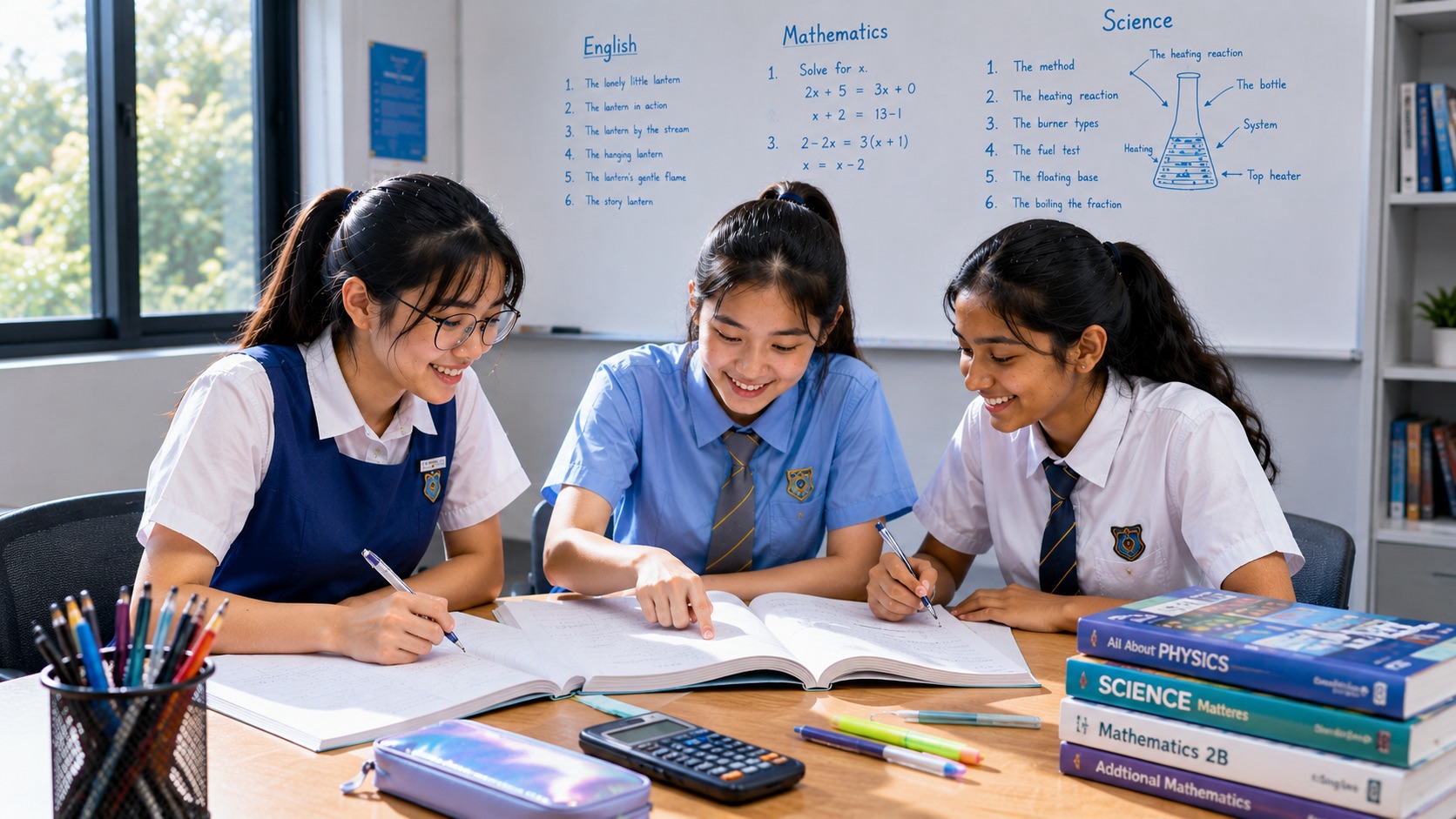
Yishun Secondary 3 English tuition becomes most useful when students stop treating English as a subject that improves through vague exposure alone. Upper-secondary comprehension, editing, situational writing, continuous writing and oral communication can be taught as observable skills: read closely, interpret evidence, control grammar, organise ideas and adapt language to purpose and audience.
Strong Secondary 3 English preparation commonly develops critical reading, vocabulary in context, grammar accuracy, essay structure, oral response and examination practice. At eduKate Yishun, our three-student tutorials connect those areas because the same language decisions recur across the paper.
The goal is not to memorise sophistication. It is to produce clarity deliberately.
Read before answering
Students identify literal meaning, implication, tone and purpose before constructing responses. They learn to separate evidence from assumption.
Question scope
We train students to notice whether a question asks what, why, how or what effect. Many incomplete answers contain correct information but answer only part of the task.
Inference
A strong inference combines a clue with a defensible conclusion. Students learn to explain the connection rather than leap from passage to guess.
Vocabulary
We develop nuance, connotation, register and collocation. Students reuse useful vocabulary in writing so passive recognition becomes active control.
Editing
Grammar is treated as a network of relationships: subject and verb, tense, word form, pronoun reference, preposition, connector and sentence boundary. Corrections have reasons.
Situational writing
Students establish role, audience, purpose and context, identify required content and choose an appropriate tone. Organisation is designed for the reader.
Continuous writing
A short plan identifies the central idea and paragraph jobs. Narrative details develop consequence; argumentative examples support claims. Style is useful when it clarifies or intensifies meaning.
Oral communication
Position, reason, example and connection provide a flexible structure. Students learn to develop answers without sounding rehearsed.
Why small groups
Three students allow close feedback and productive comparison. Learners can see how different answers vary in evidence, precision and relevance while the tutor still responds to individual weaknesses.
Models should disappear
We study why a model works, then change the task. Students must reconstruct the principle. Transfer is more important than imitation.
Error logs
We classify recurring weaknesses by scope, evidence, inference, vocabulary, grammar, organisation, development and time. Specific weaknesses can be trained.
Timed practice
Time is introduced once the underlying skill is sufficiently secure. Students learn efficient planning and checking so speed becomes the compression of a good process.
Preparing for Secondary 4
The best preparation is a student who can approach an unfamiliar text or prompt with a repeatable method. That foundation is more durable than a folder full of memorised responses.
Our Yishun Sec 3 English Tuition therefore works toward independent judgement: understand what is written, identify what is asked, support what you claim, organise what you mean and revise what does not work. Those habits are the bridge from ordinary classroom English to dependable examination English.
Continue through Secondary English: Secondary 3–4 article index · Secondary English directory · English Hub · Diagnostics · Examinations · Library