
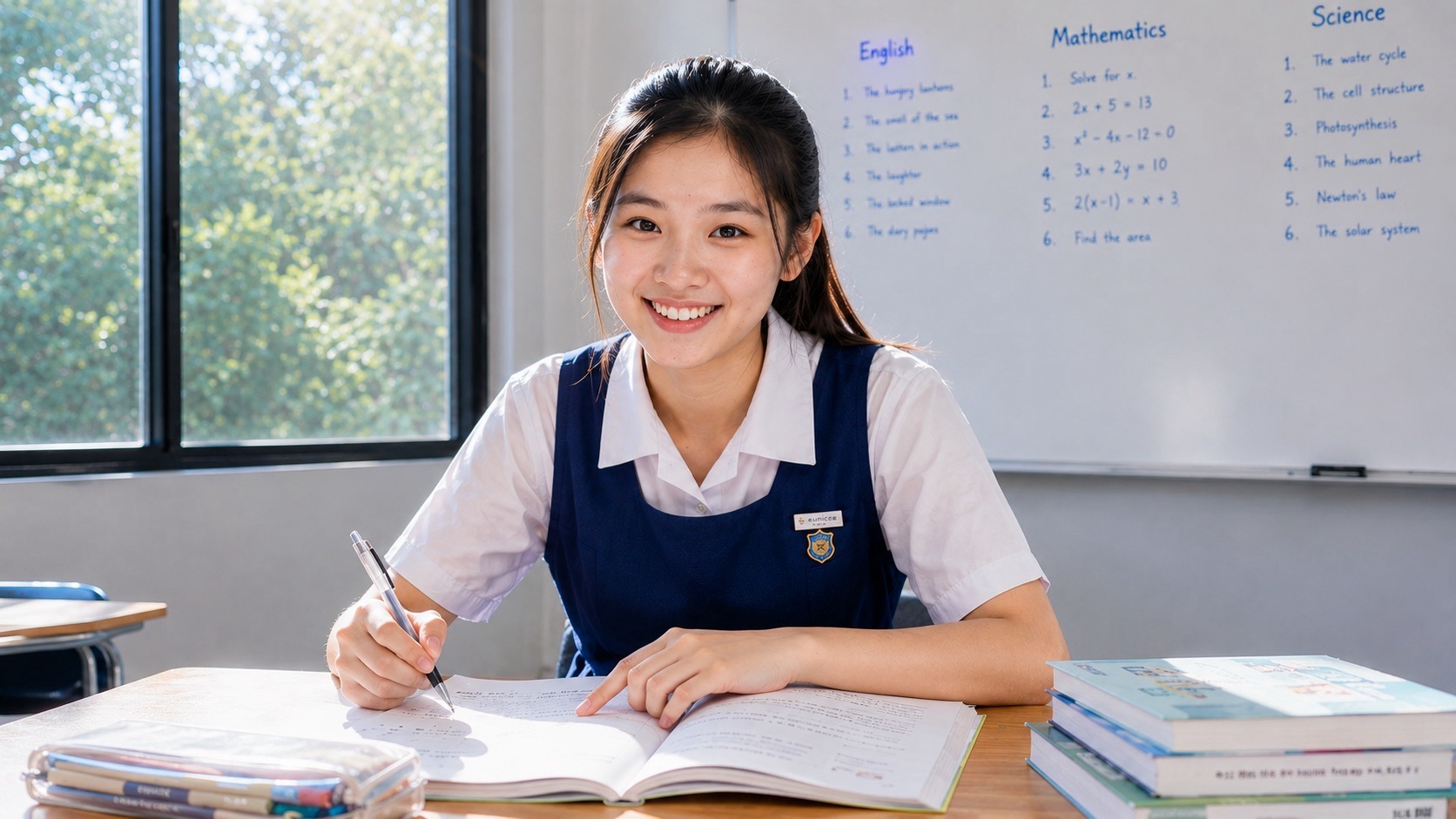
Yishun Maths Tutor for Secondary 3 is the supporting guide for dependency mapping at the upper-secondary transition. Its question is not simply which chapter is weak, but which earlier mathematical relationship is interrupting current Secondary 3 work. This page supports rather than replaces the main Secondary 3 Mathematics guide.
eduKateYishun provides this online understanding-and-recovery resource. The title does not establish a current physical Yishun class, fee, timetable or vacancy. For specialist Mathematics teaching, use BTT’s Secondary Mathematics Learning Hub. This body has been normalised into valid Gutenberg blocks so its content and structure can be audited reliably.
1. Map the dependency, not just the chapter
A graph problem can fail because of algebra. A geometry question can fail because the equation was formed incorrectly. A percentage problem can fail because the reference whole changes. Begin with the current question and identify what it depends on.
Preserve the learner’s correct work above the first unsupported line. A correct model followed by a sign error should not trigger a full restart of modelling.
2. Algebra is a common upper-secondary dependency
Solve 4x − 5 = 2x + 13. Subtract 2x and add 5 to obtain 2x = 18, so x = 9. Substitute into the original equation to check. The same equality control appears later inside coordinate geometry, mensuration and modelling.
For 3(x − 4), the valid expansion is 3x − 12. If the learner writes 3x − 4, compare both expressions at x = 5: the original gives 3 while the invalid expansion gives 11. The smaller contrast isolates distribution.
3. Graph errors can be algebra, scale or representation errors
A line through (0, 3) and (4, 11) has gradient 2 and equation y = 2x + 3. A learner who can plot supplied points but cannot generate them from the equation may need substitution rather than graph-drawing practice.
Read axes and scale before interpreting. If 0 to 40 spans eight equal intervals, each interval is 5. A correct-looking point can still be numerically misread when the scale is ignored.
4. Proportional reasoning should be repaired where it reappears
If A:B = 2:3 and total 50, five units represent 50, so A = 20 and B = 30. A is 40% of the whole. Ratio and percentage can therefore share one proportional dependency.
A 20% reduction means retaining 80% of the original. If the reduced value is 72, then 0.8P = 72 and P = 90. The reference whole is the key relationship.
5. Geometry can expose equation and interpretation gaps
Two straight-line angles are (2x + 20)° and (3x + 10)°. The property supplies 5x + 30 = 180, so x = 30 and the actual angles are 80° and 100°. A learner who reports 30° has solved the equation but not returned to the geometric quantity.
A right triangle with legs 6 and 8 has hypotenuse 10. If Pythagoras fails only after a negative or algebraic length is introduced, inspect the additional algebraic layer rather than assume the theorem itself was forgotten.
6. Use school papers to choose the next dependency
Group errors by first mechanism rather than page number. Three questions may fail because of signed substitution; another two may fail because of graph scale. Those clusters are more useful than saying five chapters are weak.
Do not force every error into one explanation. If the causes differ, keep them separate. The purpose of dependency mapping is to make revision smaller and more accurate.
7. Fresh dependency check
Solve 5x + 2 = 3x + 16. Find the equation of the line through (0, 3) and (4, 11). A:B = 2:3 and total 50; find both quantities. Five values have mean 14 and four known values total 52; find the fifth.
The answers are x = 7; y = 2x + 3; 20 and 30; and 18. Review whether equality, gradient/intercept, ratio-unit reasoning and mean-total reconstruction were selected independently.
8. Handoff into specialist teaching and back
Use BTT when the dependency requires fuller subject teaching. Use Student Diagnostics when the first failure remains uncertain. Return with a fresh question and record the strongest prompt still required.
Main year-level owner: Secondary 3 Mathematics Tuition in Yishun.