
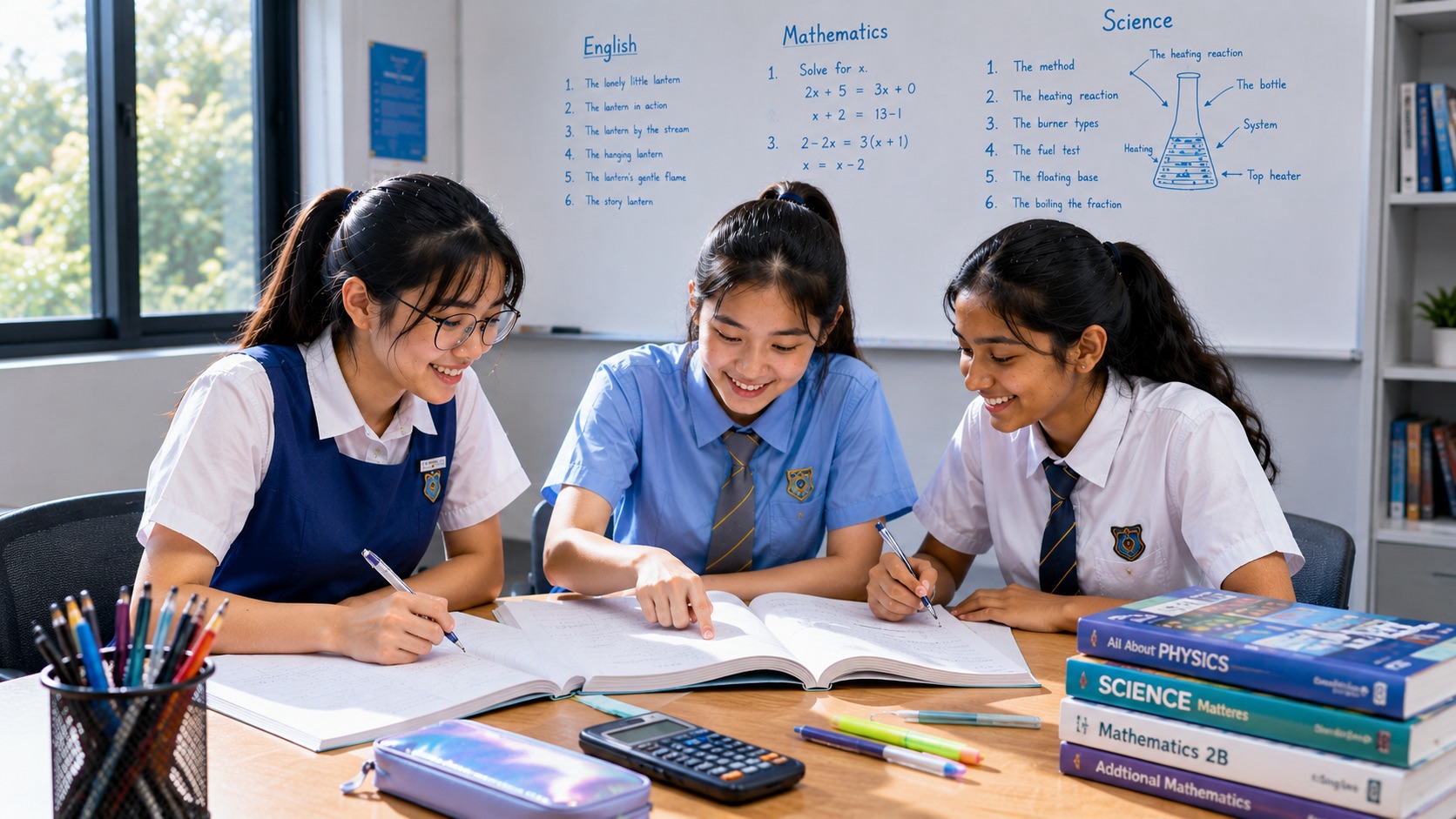
Yishun Maths Tutor for Secondary 2 is the tutor-level guide for turning connected Mathematics into independent problem solving. The page supports rather than replaces the main Secondary 2 Mathematics guide and the Secondary 2 centre-support guide.
eduKateYishun provides this online understanding-and-recovery resource. The title does not establish a current physical Yishun class, a three-student group, fee, timetable or vacancy. For specialist Mathematics teaching, use BTT’s Secondary Mathematics Learning Hub. This body has been rewritten into valid Gutenberg blocks; the earlier stray block closer has been removed.
1. Start with the learner’s own first line
A tutor needs to see how the learner begins before supplying a method. Use a short fresh question from taught content and record the target, chosen representation, first line and point where support becomes necessary.
Correctness after a method cue is different from independent method selection. The tutor should preserve both kinds of evidence and aim to reduce the cue on later work.
2. Algebra should become a dependable shared tool
Solve 5x − 7 = 18. Adding 7 gives 5x = 25 and x = 5. Substitute back to check. If the learner understands the equation but repeatedly loses negative signs, focus on sign control rather than restarting equation meaning.
Expand 3(x − 4) to 3x − 12. Factor 6x + 18 to 6(x + 3). Expansion and factorisation can check one another, giving the tutor a way to teach structure rather than isolated rules.
For (x − 2)/3 = 5, multiplying by 3 gives x − 2 = 15 and x = 17. The fraction bar groups the whole numerator. A tutor can use a numerical version such as (14 − 2)/3 to make the grouping visible before returning to symbols.
3. Connect ratio, percentage and rate
If A:B = 2:5 and total 63, seven ratio units represent 63, so A = 18 and B = 45. A is 2/7 of the total. Asking A as a fraction of B gives 2/5 instead. The tutor should make the reference quantity explicit.
After a 15% discount, a price is $102. The discounted price is 85% of the original, so original = 102/0.85 = $120. Adding 15% of 102 would use the wrong base.
4. Graphs are translation work as well as plotting work
For y = 2x + 1, the table x = 0,1,2 gives y = 1,3,5. If plotting is accurate from the table but generating the table fails, the first repair may be substitution rather than graph construction.
Read graph scales before values. If 0 to 30 spans six equal intervals, each interval is 5. A point four intervals above zero represents 20.
5. Geometry: tutor the property before the arithmetic
Mark given equal sides, parallel lines and right angles. Do not treat visual appearance as evidence. A rotated diagram should not change the reason.
An isosceles triangle has vertex angle 50°, so each equal base angle is 65°. If each base angle is written (x + 5)°, then x = 60. The tutor should distinguish solving the variable from answering the geometry question.
6. Use school papers as diagnostic samples
Classify the first lost decision: representation, algebra, graph scale, property, unit, interpretation or time. Several wrong questions may share a dependency, but do not force them into one explanation if their first failures differ.
After correction, use one changed question. If the relationship survives with less help, move it toward maintenance. If not, change the explanation or representation rather than merely repeat the same model.
7. Homework should test the tutor’s current hypothesis
If the hypothesis is weak method selection, include a mixed question without a chapter heading. If the hypothesis is fragile algebra, use a direct problem and a contextual problem containing the same transformation. If the method is already secure, reduce repetition.
8. Fresh tutor check
Solve 4x + 5 = 21. A:B = 3:5 and total 64; find both parts. For y = 3x − 2, find y when x = −2. Five values have mean 12 and four known values total 49; find the fifth.
The answers are x = 4; 24 and 40; y = −8; and 11. Record the strongest prompt required for each and retest only active mechanisms later.
9. The tutor should hand Secondary 3 a smaller support map
Keep secure algebra and proportion skills, active graph or geometry risks, useful checking routines and the strongest prompt still needed. Remove resolved weaknesses from intensive practice.
Use Student Diagnostics when the mechanism remains uncertain and return to the Secondary Mathematics directory for the wider route.
Continue through Secondary 2 Mathematics: Secondary 2 centre-support guide · Secondary Mathematics directory · Diagnostics · Examinations.