
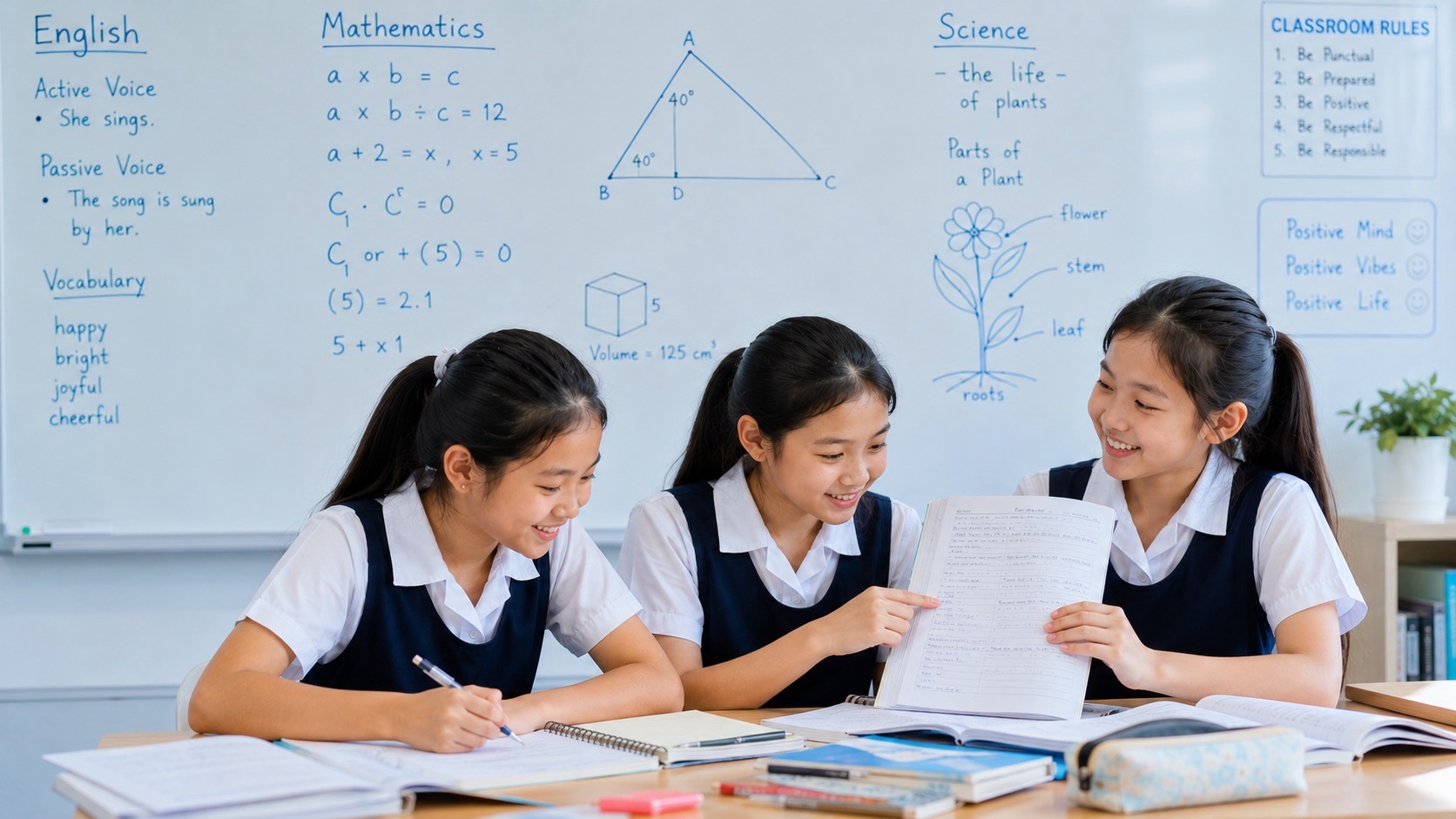
Families looking for Primary 2 English tuition in Ang Mo Kio are usually trying to strengthen a child’s reading, vocabulary, grammar, comprehension and writing before small gaps become large ones. At Primary 2, English tuition should not feel like premature PSLE drilling. The more useful job is to build fluent reading, accurate sentence construction, richer vocabulary, listening comprehension and the confidence to express an idea clearly.
Strong Primary English programmes commonly focus on phonics and reading fluency, vocabulary in context, grammar, comprehension strategies and guided writing. These skills work best as a connected language system. A child reads a word, understands it in a sentence, hears how it sounds, uses it in speech and eventually controls it in writing.
Our small-group tutorials use three students so the tutor can hear each child read, inspect each sentence and respond to the precise difficulty. The purpose is not to rush a seven- or eight-year-old toward complicated examination tricks. It is to make English increasingly understandable and usable.
Primary 2 is a bridge year
Primary 1 establishes early literacy habits. Primary 2 asks children to read longer passages, understand more vocabulary and produce increasingly complete written responses. Students begin to discover that recognising individual words is not the same as understanding a paragraph.
Reading fluency first
A child who spends too much attention decoding every word has less attention available for meaning. We therefore work on accurate, increasingly fluent reading while keeping comprehension active. The student should be able to tell us what happened, who did what, and which sentence supports the answer.
Vocabulary through context
Vocabulary lists have value, but words become durable when students meet them in meaningful sentences and use them. We teach meaning, word family, common collocations and context clues at an age-appropriate level. New vocabulary returns in later reading and writing so it is retrieved rather than merely copied.
Grammar as meaning
Nouns, verbs, adjectives, pronouns, tense and agreement are easier when children see what each choice does to a sentence. We use short examples, contrasts and correction tasks. Grammar becomes a tool for making meaning clear.
Build complete sentences
Primary 2 writing grows from the sentence. We teach children to answer who, did what, where, when, how or why as appropriate. A short complete sentence is stronger than a long sentence whose structure has collapsed.
From sentences to paragraphs
Once sentence control improves, students learn that sentences in a paragraph should belong together. One main idea can be developed with an action, detail, reason, feeling or consequence. This is the beginning of composition structure.
Comprehension: point to the evidence
We train children to return to the passage. For direct questions, locate the relevant information. For simple inference, combine clues with sensible reasoning. The habit of proving an answer from the text is established early.
Listening and oral language
English develops through listening and speaking as well as reading and writing. Students practise following instructions, retelling short events and answering in complete sentences. Oral language often reveals vocabulary or grammar gaps before they appear on paper.
Why three students helps
The tutor can listen to each learner, correct a misconception quickly and vary the level of support. Children also hear peers explain ideas and discover that there can be several good ways to phrase the same thought.
The lesson cycle
We retrieve an earlier skill, teach one clear idea, model it, practise together and then ask the student to use it independently. The independent attempt matters. Tuition should not create a child who writes only when an adult supplies every next word.
Corrections should teach
If a child writes an incorrect sentence, we do not simply replace it. We identify what changed: tense, agreement, word choice, punctuation or sentence completeness. Then the child applies the repair to a new sentence.
Reading at home
Short, regular reading is valuable. Parents can ask simple questions: What happened? Why did the character do that? Which word was new? What do you think happens next? The conversation turns reading into comprehension without making home feel like another classroom.
What progress looks like
Reading becomes smoother. The child needs fewer prompts. Answers become more complete. Vocabulary becomes more precise. Writing contains clearer sentences and more connected ideas. These behaviours are useful indicators because they show that the language system itself is strengthening.
Our Primary 2 English tuition for Ang Mo Kio learners is built around that foundation: read accurately, understand meaning, build vocabulary, construct clear sentences and gradually write with greater independence. The aim is not merely to complete this year’s worksheets. It is to give the child an English system strong enough to keep learning next year.
Continue through Primary English: Next: Primary 3 English Tuition Ang Mo Kio · Primary 1–3 article index · Primary English directory · English Hub · Diagnostics · Examinations · Library