
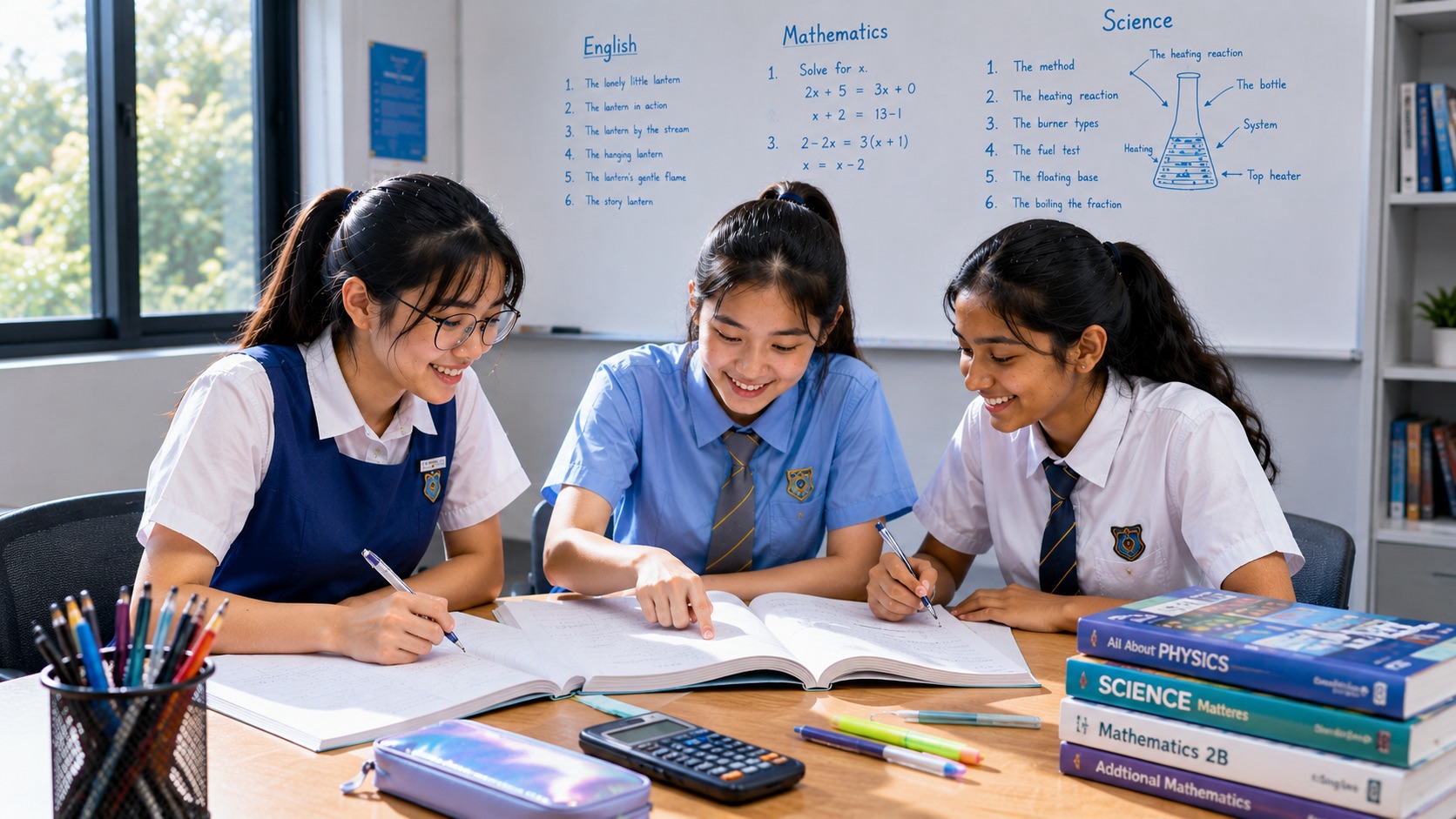
Families searching for English Tuition Sembawang Secondary 2, Secondary 2 English tuition Singapore, comprehension, summary, vocabulary, editing, situational writing, continuous writing, oral communication and lower-secondary English support are usually dealing with a consolidation problem rather than a beginner problem. By Secondary 2, students have already met many of the tools. The difficulty is using them consistently when the text becomes more nuanced, the writing task becomes less scaffolded and school assessments mix reading, language and writing without announcing exactly which strategy should be used.
Strong Secondary 2 English tuition in Sembawang should therefore convert familiarity into transfer. Current Secondary 2 programmes emphasise inferential comprehension, summary skills, vocabulary in context, grammar and editing, composition, situational writing and oral communication because these are the visible components. The deeper learning job is consolidation: can the student read for structure, distinguish evidence from interpretation, explain language effects, paraphrase accurately, build developed paragraphs and apply grammar even after the lesson label has disappeared?
This rebuilt guide is deliberately different from the Secondary 1 transition page. It focuses on the middle-lower-secondary year: strengthening inference, summary, paraphrase, language analysis, paragraph development, writing range, oral discussion, editing and mixed-task transfer so that upper-secondary work does not arrive on fragile foundations. Worked examples, practice tasks, error diagnosis, parent checkpoints and a terminal Teaching Guide show how tuition should help a student become more analytical without turning English into a collection of formulas.
Secondary 2 is the consolidation year
Secondary 1 teaches students how the secondary English world works. Secondary 2 asks whether those new habits can survive greater complexity. Passages become denser. Questions require more exact interpretation. Writing tasks may expect more developed ideas. Vocabulary becomes less literal and more contextual.
This is the year to find out whether skills are genuinely transferable or merely familiar.
Begin with a mixed diagnostic
Use one narrative passage, one informational or persuasive text, mixed language items, a summary or paraphrase task, one writing prompt and one oral discussion question. Avoid grouping every question by skill.
Then classify where the student breaks down.
- Recognition: does not identify the kind of reading or writing decision required.
- Evidence: finds the correct area but chooses a weak clue.
- Inference: conclusion is too broad, too narrow or unsupported.
- Language analysis: device is identified but effect is unexplained.
- Paraphrase: meaning changes while wording changes.
- Summary: examples and repetition are not filtered out.
- Paragraph development: point exists but explanation or example is thin.
- Editing: grammar rules are recognised only after correction is shown.
The goal is to find high-frequency mechanisms, not produce another overall grade.
Reading should begin with the writer’s job
Ask what the text is trying to do and how each paragraph contributes. A narrative may reveal character through action. An article may present a problem, then causes, examples and solutions. A speech may persuade using direct address and contrasts.
Students who see structure read more efficiently because they know what each paragraph is doing.
Paragraph mapping should become faster
Use short labels: introduces debate, gives example, challenges view, explains consequence, proposes solution. The note should take seconds.
A map supports comprehension, summary and later argumentative writing because students begin recognising how developed texts are organised.
Inference should use an evidence hierarchy
Not every clue is equally strong. Direct action may be stronger than vague atmosphere. Repeated behaviour may be stronger than one isolated word.
Worked inference example
Text: “Before the interview, Leon checked the folder three times, rewrote the first line of his notes and arrived twenty minutes early.” A strong inference is that Leon is anxious or determined to prepare carefully. All three actions support that. Saying he dislikes interviews may be possible but is less directly supported.
Teach students to choose the strongest evidence, not every available clue.
Distinguish evidence from explanation
Evidence is what the text gives. Explanation is what the evidence means. “He checked the folder three times” is evidence. “This suggests he was nervous about being unprepared” is interpretation.
Many weak answers contain only one half.
Language-effect analysis should follow a four-step route
Identify the key word or phrase, state its literal or associated meaning, explain the image/tone it creates, and connect that effect to the context.
Worked language-effect example
“The announcement sliced through the cheerful chatter.” “Sliced” suggests something sudden and sharp, so the announcement interrupts the mood abruptly and changes the atmosphere. Naming “metaphor” alone would not explain the effect.
Writers choose verbs for attitude
Compare “walked”, “strolled”, “marched”, “crept” and “staggered”. All involve movement, but each adds pace, mood or attitude.
Language analysis becomes easier when students understand that vocabulary choices carry more than dictionary meaning.
Tone should be inferred from patterns
One word can contribute to tone, but a reliable tone answer should usually consider several features: vocabulary, punctuation, sentence length, imagery and what the writer chooses to emphasise.
Instead of guessing “angry”, identify evidence that makes the tone critical, frustrated, admiring, humorous or concerned.
Vocabulary should include connotation
Persistent and stubborn may describe someone who refuses to give up, but one often sounds more positive than the other. Confident and arrogant differ in judgement.
Students should learn both denotation and connotation.
Use word families and collocations
From analyse come analysis and analytical. From persuade come persuasion and persuasive. Collocations such as “raise a concern”, “draw a conclusion” and “pose a question” make writing more natural.
Summary begins with selection
Before paraphrasing, decide which ideas belong. Students often try to compress every sentence and run out of space.
Identify the question focus, locate relevant points, remove examples and repeated details, then combine related ideas.
Worked summary example
Text says a school garden gives students practical science experience, provides vegetables for cooking lessons, encourages teamwork and requires ongoing maintenance. If the summary asks for benefits, maintenance is irrelevant. The student must select before writing.
Paraphrase should preserve the proposition
Students often replace individual words with synonyms and accidentally change meaning. Paraphrase can alter sentence structure while keeping the underlying proposition.
Worked paraphrase example
Original: “The new timetable reduced waiting time for students.” Paraphrase: “Students spent less time waiting after the timetable was changed.” The meaning survives even though the structure changes.
Compression requires generalisation
If a text lists buses, trains and bicycles, “different forms of transport” may compress them when the context allows. If it lists apples, bananas and oranges, “fruit” may work.
Generalisation should not become so broad that important meaning disappears.
Grammar should increasingly support text-level control
Secondary 2 students need more than isolated correctness. Pronoun reference, tense sequence and connectors affect paragraph coherence.
A sentence can be grammatically correct by itself and still be wrong in the paragraph because time or reference changes.
Worked editing example
“The committee met on Monday. They decide to postpone the event.” If the paragraph is a past recount, “decided” is required. Context controls the tense.
Sentence variety should be purposeful
Use coordination when ideas are equal, subordination when one depends on another, short sentences for emphasis and longer structures to express relationships.
A paragraph of long sentences can be as monotonous as a paragraph of short ones.
Editing should use an error taxonomy
- Agreement.
- Tense and aspect.
- Pronoun reference.
- Word form.
- Preposition or collocation.
- Sentence boundary.
- Punctuation.
- Spelling.
Students should know which class they commonly miss.
Situational Writing should become more flexible
Secondary 2 students should be able to adapt tone and organisation across email, proposal, speech, letter or other functional forms used by their school.
Begin with role, audience, purpose, context and required content. Then decide organisation and tone.
Worked situational plan
Task: write to the student council proposing a programme. Opening purpose → programme idea → reasons → benefits → practical considerations → request/next step → closing. A speech version would use more direct audience engagement.
Continuous Writing should broaden in range
Students should practise narrative, personal, reflective and discursive thinking according to school expectations. The value is not predicting an exam question; it is learning how ideas are organised differently.
Discursive paragraphs need development
A point alone is an assertion. Add explanation, example and implication.
Worked paragraph plan
Topic: Should schools reduce homework? Point: homework can support retrieval. Explanation: short practice after a delay strengthens learning. Example: vocabulary or Mathematics questions revisited several days later. Qualification: excessive repetitive homework may reduce value. Link: quality and purpose matter more than volume.
Examples should be relevant and explained
A student may provide a true example that does not prove the point. Always ask, “How does this example support what I just claimed?”
Counterarguments can begin in Secondary 2
Students can practise recognising that an issue has more than one reasonable perspective. A paragraph can acknowledge a concern before explaining why the main position still stands.
This prepares upper-secondary argument without turning every essay into debate club.
Narratives should develop consequence
The event itself is not the story. What does the character do because of it? What becomes harder? What choice follows?
Worked narrative plan
Situation: student is responsible for equipment. Change: friend asks to borrow it without permission. Response: student agrees. Consequence: item is damaged. Decision: student admits the truth. Resolution: repairs trust and changes future behaviour.
Reflection should be specific
Instead of generic morals, connect the reflection to the event. “I realised that helping a friend does not mean agreeing to every request” is more specific than “I learned to be responsible.”
Oral discussion should become more analytical
Use position → reason → example → qualification → connection. Students can begin comparing perspectives rather than giving only personal preference.
Worked oral example
Prompt: Is online learning always useful? “It is useful when students need flexible access to explanations or practice. For example, recorded lessons allow review. However, online learning can make concentration harder and may not suit discussion-based activities, so the best method depends on the task.”
Listening and viewing should include purpose and stance
Use short videos or talks. Ask for main claim, supporting examples, speaker attitude and one technique used to engage the audience.
This connects receptive and productive language skills.
Mixed practice should remove skill labels
Once a technique is stable, place it beside different question types. Let the student decide whether the task needs inference, effect analysis, summary or direct retrieval.
Method selection is part of English competence.
Spaced retrieval should include writing
Do not retrieve only vocabulary. Ask students to reconstruct a paragraph structure, summary process or editing checklist from memory after a delay.
Use school papers as diagnostic maps
Classify lost marks by mechanism. Several comprehension errors may all come from scope. Several writing comments may come from weak paragraph development.
Fix the repeated mechanism and retest it.
First-wrong-decision correction
Find the earliest point where the response goes wrong. A weak summary may fail during selection before paraphrasing. A weak essay may fail in the plan before grammar becomes relevant.
Repair early causes before polishing late symptoms.
Build a concise error ledger
Columns: task, first failure, mechanism, next-time cue, fresh retest. Example: “summary / included example / selection / underline focus first”.
Practice set: twelve Sec 2 consolidation tasks
- Label the function of five paragraphs in a short article.
- Rank three clues by strength for one inference.
- Separate evidence from interpretation in an answer.
- Explain the effect of “the announcement sliced through the chatter”.
- Compare the connotation of persistent and stubborn.
- Paraphrase a sentence by changing structure, not just synonyms.
- Select four relevant points for a focused summary.
- Correct a tense error using paragraph context.
- Plan a situational response for the student council.
- Build one developed discursive paragraph.
- Plan a narrative with a meaningful consequence.
- Give an oral response including a qualification.
Model responses
1. Examples: introduces issue, explains cause, gives evidence, considers alternative, proposes response.
2. Repeated actions or direct statements may carry more weight than vague atmosphere.
3. Evidence comes from the text; interpretation explains what it suggests.
4. “Sliced” suggests sudden sharp interruption and a rapid mood change.
5. Persistent often sounds admiring; stubborn can imply unreasonable refusal to change.
6. Preserve the proposition while rebuilding wording naturally.
7. Only points answering the summary focus belong.
8. The surrounding timeline determines the form.
9. Purpose → proposal → reasons → details → next step.
10. Point → explanation → example → qualification or implication → link.
11. Event → response → consequence → decision → resolution.
12. A developed response can recognise both benefit and limitation.
A six-week Secondary 2 consolidation cycle
Week 1: mixed diagnostic and text structure. Week 2: inference, language effect and vocabulary nuance. Week 3: summary, paraphrase and selection. Week 4: grammar, editing and situational writing. Week 5: discursive/narrative writing and oral. Week 6: mixed transfer, timed sections and delayed retests.
A 90-minute Sec 2 lesson rhythm
10 minutes: retrieval. 25 minutes: close reading. 20 minutes: summary or language control. 25 minutes: writing/oral transfer. 10 minutes: error diagnosis and fresh retest.
Small groups strengthen analytical discussion
Three students can compare interpretations and decide which is best supported. One may notice a stronger clue; another may explain language effect more precisely.
Alternative answers should be evaluated by evidence and relevance.
Parent checkpoints
- Can the student map paragraph functions quickly?
- Can stronger and weaker evidence be distinguished?
- Are inference answers restrained?
- Can language effect be explained beyond naming devices?
- Does vocabulary include connotation and collocation?
- Can summary points be selected before writing?
- Can meaning be paraphrased accurately?
- Does grammar stay coherent across paragraphs?
- Can situational tone adapt to reader?
- Do discursive paragraphs include explanation and examples?
- Do narratives build consequences?
- Can oral responses recognise nuance?
- Are mixed tasks handled without labels?
- Are corrections retested?
Frequently asked questions
Why is Secondary 2 important if there is no national examination that year?
Because it is the last full lower-secondary consolidation year before upper-secondary demands increase. Weak reading, summary and writing structures become more expensive later.
Should Sec 2 students start full O-Level papers?
Not as the main strategy. Build analytical reading, summary, writing control and mixed transfer first. Selected upper-secondary-style tasks can be introduced gradually where appropriate.
How can summary improve?
Separate selection from paraphrase. Identify relevant points first, remove examples and repetition, then compress meaning accurately.
How can language analysis improve?
Move from device label to word meaning, image/tone, contextual effect and reader impact.
How can writing become less repetitive?
Strengthen paragraph purpose, explanation, relevant examples and sentence relationships. Vocabulary alone cannot fix weak development.
How can parents judge progress?
Look for stronger independent interpretations, better point selection, clearer paragraph development and fewer repeated error mechanisms.
Teaching Guide
Teach Secondary 2 as a consolidation year. The student should stop seeing each lesson as a separate trick and start seeing reading, vocabulary, grammar, summary and writing as one language system.
Increase variation. Once a method is learned, change the genre, wording and context. Remove labels. Ask the student to identify what the task requires before applying a method.
Use error analysis to locate the first weak decision. A summary may fail at selection, an inference at evidence, and an essay at paragraph planning. Fix the mechanism rather than correcting only the finished product.
The destination is a learner ready for upper secondary: able to read analytically, compress meaning, explain language choices, develop ideas and transfer familiar skills into unfamiliar tasks with decreasing tutor support.
Build a termly Independence Test
Use one unseen narrative, one non-fiction text, a summary task, mixed language questions, one writing paragraph and one oral prompt. No hints during the first attempt.
Record where independence breaks: recognition, selection, execution, organisation or checking.
Progress should look like integration
The student begins using paragraph maps to support summary, vocabulary knowledge to improve writing, grammar awareness to strengthen comprehension answers and oral discussion to develop essay ideas.
Skills stop living in separate exercise books.
A final Secondary 2 readiness checklist
- Text structure can be mapped.
- Evidence can be ranked.
- Inference is controlled.
- Language effect is explained.
- Vocabulary includes nuance.
- Summary selection is disciplined.
- Paraphrase preserves meaning.
- Grammar supports paragraph coherence.
- Writing adapts to audience and purpose.
- Discursive paragraphs are developed.
- Narratives include consequence and reflection.
- Oral responses handle complexity.
- Mixed tasks can be recognised independently.
- Error repairs survive fresh retests.
When those foundations hold, Secondary 3 can focus on upper-secondary depth and examination architecture instead of rebuilding lower-secondary control.
Historical eduKate Sembawang photo archive
The original image sequence is preserved below.


Continue through Secondary 2 English: Secondary 1–2 article index · Secondary English directory · English by area & school · Diagnostics · Examinations · Library
Leave a Reply