
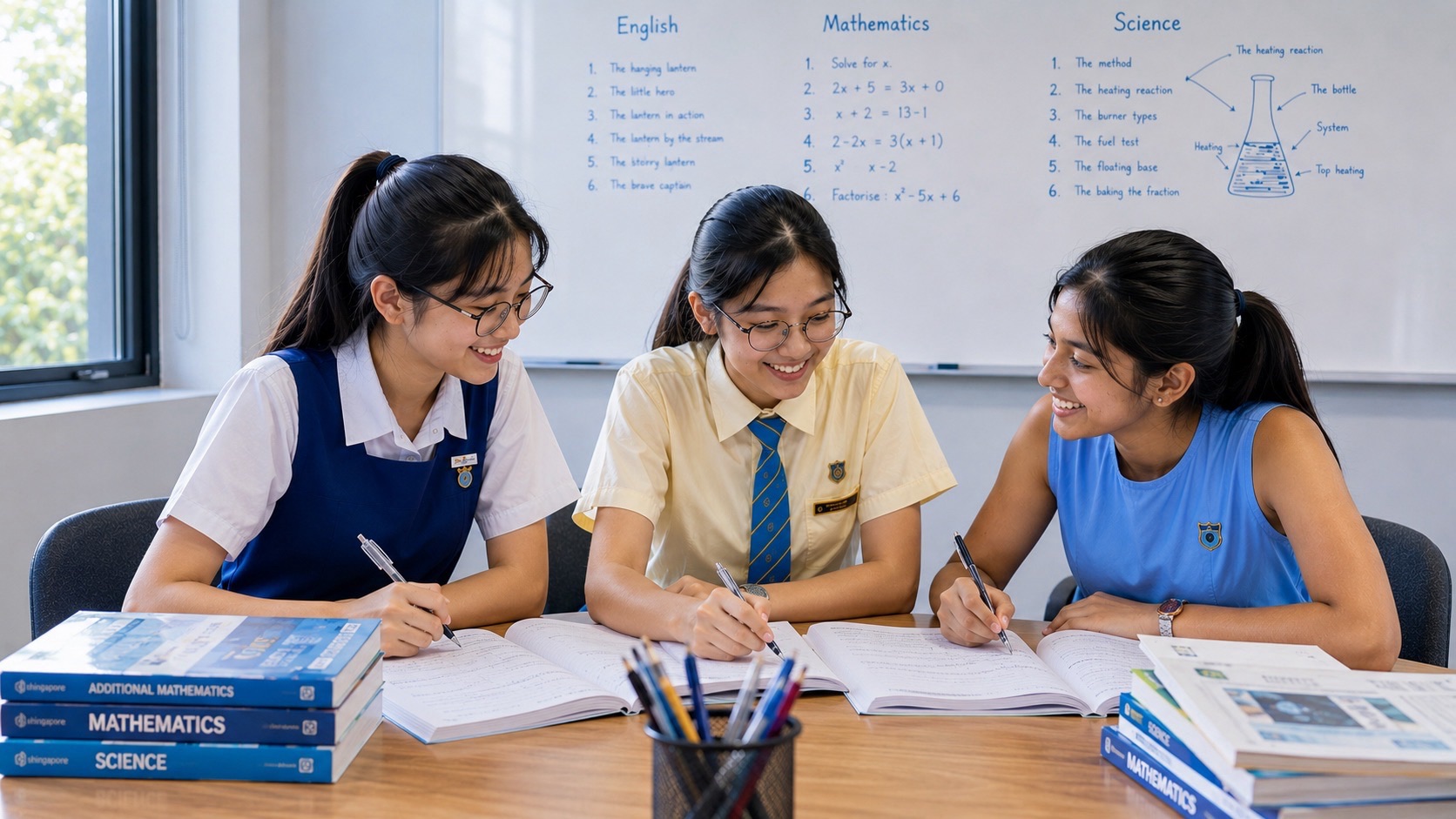
Families searching for English Tuition Sembawang Secondary 3, Secondary 3 English tuition Singapore, G3 English, upper-secondary writing, argumentative and discursive essays, situational writing, comprehension, summary, vocabulary, oral communication and exam preparation are usually entering the year when English changes from broad development into deliberate upper-secondary performance. Secondary 3 students are expected to read more critically, write with clearer positions, select evidence with greater discipline and sustain language control across longer tasks.
Strong Secondary 3 English tuition in Sembawang should therefore build an upper-secondary ramp rather than jump immediately into endless full examination papers. Current strong programmes emphasise comprehension, summary, situational writing, continuous writing, oral communication, editing, vocabulary and critical thinking because those are the visible components. The deeper learning job is architecture: can the student plan an argument, develop paragraphs, analyse language, compress information, adapt tone, manage a mixed paper and revise from evidence without depending on memorised essays?
This rebuilt guide is deliberately different from the lower-secondary consolidation page and the final-year execution page. It focuses on the Secondary 3 ramp: argumentative and discursive thinking, purposeful situational writing, comprehension analysis, summary, evidence, editing, vocabulary, oral interaction, timed sections and the gradual move from topic-by-topic learning to examination-shaped performance. For students following the G3 route, the national framework transitions to the Singapore-Cambridge Secondary Education Certificate from 2027, where English is listed as K300 with the earlier 1184 code shown for reference. Students should still follow their actual school-assigned subject level and current materials.
Secondary 3 is the year English becomes architecture
Lower-secondary students can sometimes succeed with individual skills that are not yet well connected. Upper secondary exposes those gaps. A student may have vocabulary but no paragraph logic. Another may understand texts but struggle to select evidence. Another may have ideas but no method for adapting tone or sustaining an argument.
Secondary 3 tuition should connect the parts into repeatable structures.
Confirm the learner’s actual subject route
Singapore’s secondary examination framework is changing, and students can take subjects at different levels. The school’s assigned English subject level, current syllabus and assessment materials should be the working reference.
A page labelled “Secondary 3 English” should therefore teach transferable language processes rather than assume every pupil is following one identical paper.
Begin with an upper-secondary diagnostic
Use one narrative/recount text, one non-narrative or persuasive text, a summary task, mixed language/editing items, one situational-writing prompt, one continuous-writing prompt and a short oral discussion.
Do not help during the first few minutes. Observe the starting process.
- Reading: does the student map structure or hunt keywords?
- Inference: are conclusions paid for by evidence?
- Language analysis: can effect be explained?
- Summary: can relevant points be selected and compressed?
- Writing: can a clear position and paragraph route be planned?
- Audience: can tone change with role and reader?
- Editing: can recurring language errors be located independently?
- Time: which stage consumes disproportionate minutes?
The result becomes the first revision map.
Argumentative writing begins with a defensible position
A strong position is neither vague nor absolute without reason. It answers the question and leaves room for development.
Worked thesis example
Question: “Technology has made young people less independent. Do you agree?” Weak position: “Technology is good and bad.” Stronger: “Technology can reduce independence when it replaces decision-making, but used deliberately it can also support self-directed learning; the effect depends on how it is used.”
The stronger position creates a route for paragraphs.
Discursive writing explores before concluding
Not every essay should sound like a courtroom speech. Discursive writing can examine several perspectives and weigh their strengths before reaching a considered view.
Students should learn what the task asks: argue a position, discuss perspectives, reflect personally or explain an issue.
Plan by claims, not decorative introductions
Before writing the opening, list the main claims. What are the two or three important reasons? What counterpoint matters? What conclusion follows?
Once the argument exists, the introduction can frame it.
A developed paragraph has an internal engine
Use claim → explanation → example/evidence → analysis → link. This is not a rigid acronym; it is the logic of development.
Worked paragraph plan
Claim: school-based volunteering can build responsibility. Explanation: pupils must coordinate tasks and respond to real needs. Example: organising a collection requires communication, deadlines and accountability. Analysis: these demands create consequences that ordinary classroom exercises may not simulate. Qualification: the activity matters only if pupils understand the purpose rather than treat it as a box to tick.
Examples must do analytical work
A true example is not automatically useful. After the example, explain how it proves the claim. This prevents essays from becoming lists of anecdotes.
World knowledge should be broad, flexible and accurate
Upper-secondary writing benefits from familiarity with technology, environment, health, education, work, community, media, culture and youth issues. Students do not need encyclopaedic knowledge.
They need enough concepts and examples to reason. Read quality explainers and discuss cause, consequence and trade-offs.
Do not memorise statistics without context
Unverified numbers can weaken an essay. If a student cannot remember the source or context, a precise causal example may be safer than an invented statistic.
Teach honesty in evidence.
Counterarguments should strengthen, not derail, the essay
A counterargument shows that the writer understands complexity. State the opposing concern fairly, then respond.
Worked counterargument
“Some argue that strict phone restrictions are necessary because notifications disrupt concentration. This concern is valid during direct instruction. However, a blanket ban may also remove useful tools for research or accessibility, so rules should distinguish learning use from distraction.”
Introductions should orient the reader
An introduction should establish the issue, clarify important terms if needed and present the direction. It does not need a dictionary quotation or dramatic historical statement.
Write the introduction after the plan is clear.
Conclusions should synthesise
A conclusion should not merely repeat the introduction sentence by sentence. Bring the reasoning together and state the implication.
Ask: after reading the essay, what should the reader now understand more clearly?
Situational Writing is strategic communication
Upper-secondary situational writing often involves a visual text and a specified role, audience, purpose and context. Students need to select information, adapt it and communicate effectively.
Do not copy stimulus points mechanically. Decide what the reader needs first.
Worked situational plan
Task: write to an organisation proposing a student initiative. Role and relationship → purpose → selected details from stimulus → reasons/benefits → practical considerations → desired action → closing.
Tone should be engineered from relationship
Formal does not mean stiff. Friendly does not mean careless. Tone comes from vocabulary, sentence structure, level of directness and conventions.
Compare “Send me the details soon” with “Could you please provide the details by Friday so that we can finalise the arrangements?” Same request, different relationship.
Continuous writing range should remain broad
Students need practice across argumentative, discursive, reflective, descriptive/personal and narrative forms as appropriate to school and syllabus demands.
The goal is flexibility, not guessing which question will appear.
Close reading should move beyond content
Upper-secondary comprehension asks what the writer means and how that meaning is constructed. Students should track structure, tone, viewpoint, imagery and development.
Map the passage before deep questions
Write a one-line purpose for each paragraph. This reduces repeated rereading and clarifies development.
For a narrative: context → conflict → reaction → turning point → reflection. For non-fiction: claim → reason → example → challenge → conclusion.
Inference answers should show a chain
Evidence → interpretation → answer. Each important claim should be supported.
Worked inference example
Text: “The manager smiled, but continued tapping the unsigned form with one finger and did not invite Joel to sit.” We may infer that the manager remains dissatisfied or expects the form to be dealt with. The smile alone is not enough to call the mood friendly; the other actions complicate it.
Language effect requires precision
Ask why this word rather than a neutral alternative. What image, tone or attitude does it create?
Worked effect example
“The criticism snowballed online.” “Snowballed” suggests the criticism grew rapidly as more reactions accumulated, creating a sense of escalating momentum.
Contrast creates meaning
Writers often place images or ideas beside one another to create irony, tension or emphasis. Students should notice shifts signalled by however, yet, despite, although and changes in tone.
Summary begins with the exact focus
Before selecting points, rewrite the summary question as a filter: “I need only reasons for…” or “I need benefits and difficulties of…”
Every point must pass the filter.
Separate selection, paraphrase and compression
Trying to perform all three simultaneously increases errors. First select. Then rewrite meaning. Then combine related points efficiently.
Worked summary move
Original: “Many students walked or cycled after the road was closed to cars, reducing congestion and making the area quieter.” Possible compressed point: “Restricting cars encouraged active travel and reduced traffic-related disturbance.”
Paraphrase should avoid thesaurus English
Changing every word can produce unnatural or inaccurate sentences. Change structure where useful. Keep technical or precise terms when necessary.
Editing should become diagnostic
Paper practice is not enough if the same language errors repeat. Build personal categories: agreement, tense, word form, articles, prepositions, sentence boundaries, pronouns, punctuation and spelling.
Track frequency.
Sentence control matters in argumentative writing
Complex ideas require controlled syntax. Teach students to write a clear main clause before adding qualifications.
One sentence should not carry every idea in the paragraph.
Use sentence combining for rhetorical control
Combine ideas according to meaning: concession, cause, result, condition or comparison.
Worked example
“Online resources are convenient. They can encourage shallow browsing.” → “Although online resources are convenient, they can encourage shallow browsing when students move rapidly between sources without evaluating them.”
Oral planned response needs structure without scripting
Students should plan a clear response, not memorise generic speeches. Use position → reasons → examples → qualification/implication.
Then practise speaking within time naturally.
Spoken interaction requires listening
Good oral candidates respond to the examiner’s actual question. They do not force a prepared paragraph into every prompt.
Practise follow-ups: “Why?”, “What about the opposite view?”, “Can you give another example?”
Listening skills support examination readiness
Use audio tasks that require main idea, detail, note-taking and speaker purpose. Teach recovery after a missed item.
One lost phrase should not derail the next minute.
Timed sections should begin before full papers dominate
Secondary 3 is ideal for timing one component at a time. Measure reading, planning, writing, summary and checking.
Find the bottleneck before the final year.
Time logs make “too slow” specific
A student may spend excessive time planning, rereading or crafting introductions. Record minutes. Then train the bottleneck.
Use mini-mocks for switching
Create a 45-minute set with editing, short comprehension, summary selection and one writing plan. Switching tasks reveals whether skills remain accessible without labels.
Use full papers periodically, not compulsively
A full paper should answer a question: can the student sustain performance? Is timing stable? Which mechanisms survive pressure?
Afterwards, repair before doing another full paper.
Build an upper-secondary error ledger
Columns: task, first failure, mechanism, prevention cue, fresh retest. Include writing failures such as weak thesis, undeveloped example and audience mismatch.
Use first-wrong-decision review
A weak essay may fail before sentence one if the position is vague. A weak summary may fail during selection. A comprehension answer may fail when the student misreads “how”.
Fix the earliest cause.
Practice set: twelve Secondary 3 ramp tasks
- Write a defensible thesis for a technology question.
- Plan three claims before writing an introduction.
- Develop one paragraph with claim, explanation, example and analysis.
- Write one fair counterargument and response.
- Adapt a request for a formal audience.
- Map five paragraphs of a non-fiction passage.
- Write an inference that considers contradictory clues.
- Explain the effect of “criticism snowballed”.
- Select points for a focused summary before paraphrasing.
- Rewrite one summary point concisely.
- Give a two-minute oral response with qualification.
- Time one writing plan and identify what consumed the minutes.
Model responses
1. A thesis should answer the question and signal the main reasoning, not merely say “there are pros and cons”.
2. Claims come before decorative opening sentences.
3. The example needs analysis explaining how it proves the claim.
4. Represent the opposing concern accurately before responding.
5. Formal tone uses respectful directness and reader-centred detail.
6. Labels might be introduces issue, explains cause, gives case, challenges view, concludes.
7. Weigh all relevant evidence rather than selecting only the clue that supports the first impression.
8. “Snowballed” suggests rapid growth through accumulation.
9. Only points matching the question focus are eligible.
10. Preserve meaning while reducing words and repetition.
11. Strong oral responses are organised but responsive.
12. Timing data should lead to a specific training target.
An eight-week Secondary 3 ramp cycle
Weeks 1–2: upper-secondary diagnostic, reading structure and language analysis. Weeks 3–4: argumentative/discursive architecture and situational writing. Week 5: summary and paraphrase. Week 6: oral/listening and editing. Week 7: timed component sections. Week 8: mixed mini-mock, correction and fresh retests.
A 90-minute Sec 3 lesson rhythm
10 minutes: retrieval. 25 minutes: comprehension/analysis. 20 minutes: summary or editing. 25 minutes: writing/oral transfer. 10 minutes: timed retest and error ledger.
Small groups improve argument quality
Three students can challenge one another’s claims and examples. One may identify an unstated assumption. Another may offer a counterexample.
The tutor can keep discussion evidence-based and ensure each student produces independent writing.
Parent checkpoints
- Can the student state a clear position?
- Are essay plans built from claims?
- Do examples receive analysis?
- Can counterarguments be handled fairly?
- Does situational writing adapt to audience?
- Can passage structure be mapped?
- Are inferences evidence-bound?
- Can language effects be explained precisely?
- Is summary selection disciplined?
- Can meaning be paraphrased concisely?
- Are personal editing patterns tracked?
- Can oral responses handle follow-ups?
- Has component timing been measured?
- Do corrections survive fresh retests?
Frequently asked questions
Should Secondary 3 students start doing full national-exam papers?
Selected full papers can be useful, but component mastery and upper-secondary architecture should come first. Timed sections often provide clearer learning during the ramp year.
How can argumentative writing improve?
Build a defensible position, organise claims, explain examples and engage fairly with counterarguments. Vocabulary cannot compensate for weak reasoning.
How can summary improve?
Separate selection, paraphrase and compression. Most weak summaries fail because these three jobs are attempted simultaneously.
How can comprehension improve?
Map passage structure, read question scope carefully, use evidence chains and explain language choices in context.
How can oral improve?
Build flexible knowledge and practise both planned response and follow-up interaction. Avoid memorised speeches.
What is a good sign of Sec 4 readiness?
The student can handle mixed upper-secondary tasks independently, complete timed sections with stable quality and use error evidence to guide revision.
Teaching Guide
Teach Secondary 3 as the construction year for upper-secondary English. Reasoning and structure should become explicit. Students need to see how thesis, paragraph, evidence, analysis, summary and tone are built.
Use current national-exam architecture as a direction, not as an excuse to turn every lesson into a mock examination. Build one mechanism deeply, then place it under increasing variation and time.
Make error review causal. Ask where the response first became weak and what cue would change the next attempt. Retest the mechanism on fresh material.
The destination is a learner who enters Secondary 4 with established architecture: can plan, analyse, summarise, communicate for audience, speak flexibly and work under moderate time without losing the underlying method.
Build a termly Independence Test
Use an unseen comprehension set, summary, editing task, writing plan and oral prompt with no hints during the first attempt. Add a modest time limit after methods are stable.
Record where independence breaks and what requires final-year priority.
Progress should look like stability under variation
A student is not ready merely because one familiar essay went well. Stronger evidence is success across different topics, genres and texts, with reasoning remaining visible.
Variation is the bridge from tuition performance to examination performance.
A final Secondary 3 readiness checklist
- Can build a defensible thesis.
- Plans essays by claims.
- Develops examples analytically.
- Handles counterarguments.
- Adapts situational tone.
- Maps comprehension structure.
- Uses evidence for inference.
- Explains language effect.
- Selects summary points accurately.
- Paraphrases without distortion.
- Tracks editing patterns.
- Handles oral follow-up.
- Completes timed sections with stable method.
- Uses error ledgers and fresh retests.
Those foundations allow Secondary 4 to focus on examination execution and refinement rather than emergency reconstruction.
Historical eduKate Sembawang photo archive
The original image sequence is preserved below.


Leave a Reply