
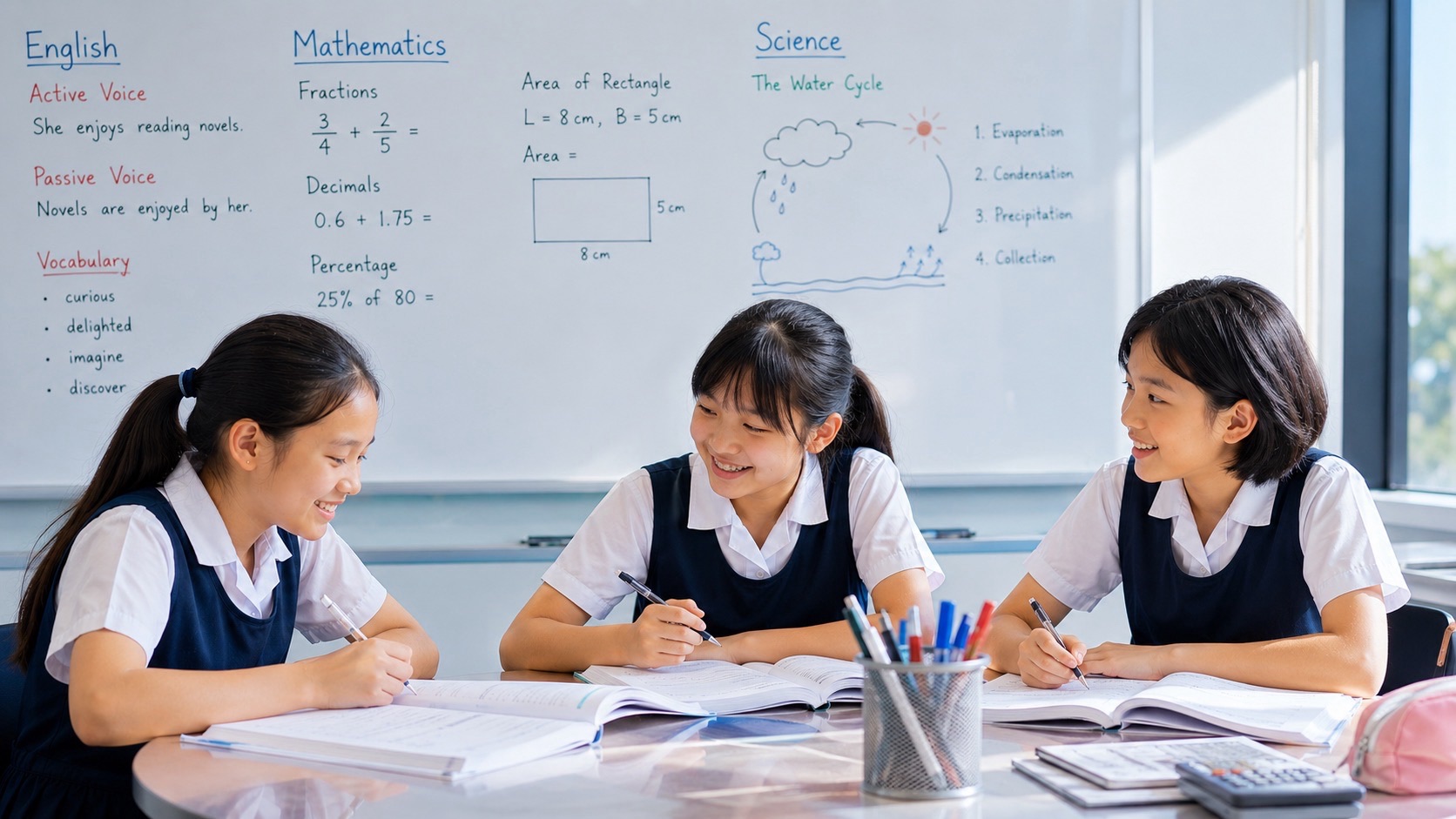
Primary 4 Science is where facts begin to become systems
Primary 4 is an important transition year. Pupils are no longer only naming objects and recalling simple facts. They are beginning to organise observations into systems: matter has properties, light behaves in predictable ways, heat moves, living things depend on structures and environments, and investigations need fair comparisons if the results are to mean anything.
This guide gives the historical Sengkang Primary 4 Science route a distinct role inside the eduKate Science ecosystem: a Foundations Laboratory. Its job is to build the scientific habits that later Primary 5 and Primary 6 work depend on—observation, classification, explanation, comparison, simple experimental design, diagram reading and transfer.
The examples below are original instructional cases. They are not official examination questions or marking schemes. The page is designed to work as a bridge into the Primary 5 inquiry, open-ended-answering and tutor-diagnosis guides already in the eduKate Science library.
Choose a reading route
Contents · Chapters 1–5
Contents · Chapters 6–10
Contents · Chapters 11–15
Contents · Chapters 16–20
Contents · Chapters 21–25
1. Observation before explanation
A good Primary 4 Science answer often begins with a simple discipline: say what was observed before explaining why it happened. “The ice became smaller” is an observation. “The ice melted because it gained heat from warmer surroundings” is an explanation. “The shadow became longer” is an observation. “The light source moved lower relative to the object” may be part of an explanation.
This distinction matters because pupils sometimes jump straight to a remembered fact and ignore what the question actually shows. Training observation first gives later explanation something solid to stand on.
A useful home or tuition exercise is to present a simple event and ask for two sentences: one beginning with “I observe…” and one beginning with “This may be because…”. The wording can later become more natural, but the thinking separation is useful.
2. Classification is a rule, not a pile
Classification means grouping using a stated feature or rule. A pile of “things that look similar” is not yet a scientific classification.
Objects can be grouped by whether they are magnetic, transparent, waterproof, living, non-living, solid, liquid or gas. Organisms can be grouped by body covering, habitat or life-cycle features. The classification depends on the purpose.
One object can belong to different groups under different rules. A metal spoon is solid, opaque, hard and usually a conductor of heat. No single label tells us everything about it.
A strong classification answer names the rule: “I grouped these materials by whether light passes through them.” The rule makes the grouping inspectable.
3. Compare on one feature at a time
Primary pupils often know many true facts but mix them in a comparison. “A fish has scales but a bird can fly” uses two different features. A stronger comparison uses the same basis: “A fish has scales whereas a bird has feathers.”
The same rule works for materials: “Glass is transparent whereas cardboard is opaque.” It works for states of matter: “A liquid has a fixed volume but takes the shape of its container, whereas a solid has both a fixed shape and volume.”
Paired comparisons prepare pupils for more complex Primary 5 and 6 reasoning because the same feature is kept visible across both sides.
4. Properties help us predict
Science becomes useful when properties support predictions. If a material is waterproof, it may be suitable for a raincoat. If it is transparent, it may be suitable for a window. If it is a good conductor of heat, it may transfer heat quickly.
The important step is to connect property to function. “Metal is used for a cooking pot because metal is metal” explains nothing. “Many metals conduct heat well, allowing heat to move from the stove to the food” states the useful relationship.
Choice questions become easier when the pupil asks, “What job must the material do, and which property supports that job?”
5. Scientific words should make differences clearer
Words such as transparent, translucent, opaque, conductor, insulator, evaporation and condensation matter because they distinguish relationships precisely.
Vocabulary should therefore be taught with contrast. Transparent allows most light to pass through clearly. Translucent allows some light through but not a clear image. Opaque blocks light from passing through.
A pupil who memorises definitions but cannot sort new examples has recognition without transfer. Always add an unfamiliar object and ask the child to classify it using the property rather than the memorised example.
6. Matter: solids, liquids and gases
States of matter can be organised around shape, volume and ability to flow or spread. Solids have a fixed shape and volume under ordinary conditions. Liquids have a fixed volume but take the shape of their container. Gases spread to fill available space and do not have a fixed shape or volume.
Pupils should apply the model rather than rely on appearance. Flour is made of many tiny solid particles even though it can be poured. Sponge is solid even though it contains air spaces. Water vapour is a gas even though visible mist is made of tiny liquid droplets.
These boundary examples help prevent “if it pours, it must be liquid” misconceptions.
7. Changes of state
Melting, freezing, evaporation and condensation should be taught as changes between states, not as four unrelated vocabulary words.
Melting changes solid to liquid. Freezing changes liquid to solid. Evaporation changes liquid to gas. Condensation changes gas to liquid.
A useful diagram places solid, liquid and gas as nodes with arrows showing the processes between them. The pupil should be able to follow the arrow both ways and explain what condition drives the change.
Changed-condition practice matters. Ice in a warm room melts. Water placed in a freezer freezes. Water on a plate can evaporate at room temperature; boiling is not required for evaporation.
8. Light: source, path and shadow
Light questions become easier when pupils identify the source, the path of light and any object blocking the path.
A shadow forms when an opaque object blocks light. The size and position of the shadow depend on the relative positions of source, object and screen.
Do not teach shadows as black shapes that “belong” to objects. Teach them as regions receiving less direct light because the path is blocked.
Transparent, translucent and opaque materials can then be understood through what happens to light, connecting classification with light behaviour.
9. Heat: hotter, cooler and transfer
Heat flows from a hotter object or region to a cooler one. The temperature of each object may change as energy is transferred.
Pupils should distinguish temperature from heat. Temperature tells us how hot or cold something is. Heat transfer describes energy moving because of a temperature difference.
Materials differ in how readily they transfer heat. This helps explain why a metal spoon in hot soup warms quickly while a wooden handle may remain cooler for longer.
The useful reasoning is property → heat transfer → function.
10. Materials and their useful properties
Material-choice questions are small engineering problems. The child must identify the job, then choose a property that supports the job.
A raincoat should resist water. A window should allow light through. A saucepan body should transfer heat efficiently. A pot handle should reduce heat transfer to the hand. A helmet shell should be strong enough for its protective role.
No material is “best” in every situation. The best choice depends on the required properties and constraints.
This is an early form of systems reasoning: function determines which property matters.
11. Plant structures and functions
Plant parts should be learned through what they do. Roots anchor the plant and absorb water and mineral nutrients. Stems support and transport. Leaves are important sites for food production. Flowers are involved in reproduction.
A function question becomes easier when the child asks what happens if the structure is damaged. Damaged roots can reduce water uptake. Damaged leaves can reduce the plant’s ability to make food. Damaged stems can affect support or transport.
This structure → function → consequence pattern prepares pupils for the deeper transport and photosynthesis work of Primary 5 and 6.
12. Animal structures and survival
Animal structures also connect to functions. Wings support flight, fins support movement through water, thick fur can reduce heat loss, and different mouthparts suit different feeding methods.
Avoid purpose language such as “the animal grew fur because it wanted to stay warm”. Instead, explain how the feature affects survival under the environment shown.
Comparison questions should use the same basis: body covering with body covering, movement structure with movement structure, feeding structure with feeding structure.
13. Life cycles as sequences
Life cycles should be understood as ordered sequences with recurring stages. A butterfly and a frog have different stages, but both show change over time and reproduction leading to a new generation.
Sequence words matter: before, after, next, later. Pupils should be able to reorder scrambled stages and explain why one cannot come before another.
Changed-condition questions can ask what happens if a stage is interrupted—for example, if eggs fail to hatch or larvae lack sufficient food.
14. Habitats and environmental fit
A habitat provides organisms with environmental conditions and resources. Pupils should connect structures and behaviours to these conditions.
An aquatic organism may have structures that support movement or gas exchange in water. A desert plant may reduce water loss. A nocturnal animal may avoid daytime heat.
The key reasoning pattern is environment → challenge → helpful feature or behaviour.
Not every feature should be described as an adaptation without evidence. The question should connect the feature to a survival or reproduction advantage.
15. Systems thinking begins with connections
By Primary 4, Science becomes easier when pupils stop treating chapters as isolated fact lists. Water changes state. Heat affects those changes. Materials influence heat transfer. Light affects shadows and later becomes essential in photosynthesis. Plant structures connect to transport and reproduction.
These are early systems. The child should begin asking, “What connects this idea to something I already know?”
A Science library can support this by linking articles according to scientific jobs rather than keeping every year level in a sealed box.
16. Fair comparisons
A fair comparison tries to make the intended difference clear. If pupils want to know whether a material keeps water warm longer, they should use equal starting volumes, similar starting temperatures, comparable containers except for the material being tested, and the same observation period.
Changing several things at once creates several possible explanations. The result becomes harder to interpret.
Primary 4 pupils do not need advanced experimental vocabulary to understand the logic. They need to see why a comparison is or is not meaningful.
17. What changed, what was measured, what stayed comparable
This three-question routine prepares pupils directly for Primary 5 inquiry.
- Changed: what factor was deliberately different?
- Measured: what outcome was observed or recorded?
- Comparable: what relevant conditions were kept the same?
For shadow size, distance between source and object might change while screen position and object size remain comparable. For heat loss, container material might change while starting temperature and volume stay comparable.
The same logic later becomes the language of variables and fair tests.
18. Tables, diagrams and simple data
A table organises evidence. A diagram represents relationships. Both must be read before they are explained.
Read headings and units first. If a table shows water temperature every five minutes, compare equal time points. If a diagram uses arrows, decide whether the arrows represent movement, sequence or labels.
One useful habit is to translate between forms: turn a table into a sentence, turn a diagram into a sequence, or sketch a simple diagram from a paragraph.
This representation flexibility becomes increasingly important in P5 and P6.
19. Same result, different cause
A wet surface can come from spilling, leaking or condensation. A plant can droop because soil is dry, roots are damaged or water loss is high. A shadow can become larger because the object moved closer to the light source or because the geometry of the setup changed another way.
The visible result does not automatically identify the cause. Pupils should use the conditions given in the question.
This is an early version of evidence-based reasoning: ask which explanation best fits the available information.
20. Changed-condition questions
Changed-condition questions are the bridge from knowing to using. A familiar setup changes in one important way, and the pupil must decide which part of the explanation still applies.
A transparent sheet is replaced with an opaque one. A warm object is moved into a colder room. A plant with healthy roots is replaced by one with damaged roots. A light source moves closer to an object.
A useful prompt is: “What stayed the same? What changed? Which part of the old answer must change?”
21. Foundations laboratory: 12 mixed cases
These are original practice cases. Attempt each before opening the answer.
Case 1. A wet patch appears under a cold cup. State an observation without explaining it.
Case 1 answer
Water droplets or a wet patch are present on or below the outside of the cup.
Case 2. A material lets light through but objects behind it look blurry. How should it be classified?
Case 2 answer
Translucent, because some light passes through but a clear image is not seen.
Case 3. Two cups start with equal volumes of hot water. One is metal and one is foam. What should be kept comparable if testing cooling?
Case 3 answer
Starting temperature, volume of water, observation time and surrounding conditions should be comparable while container material is the intended difference.
Case 4. Powder can be poured. Does that automatically make it a liquid?
Case 4 answer
No. A powder is made of many small solid particles even though the collection can flow or be poured.
Case 5. A shadow becomes larger when an object moves closer to a lamp. What changed?
Case 5 answer
The distance between the light source and the object changed, altering the geometry of the blocked light.
Case 6. Why is metal often used for the base of a saucepan?
Case 6 answer
Many metals conduct heat well, allowing heat to transfer efficiently from the heat source to the food.
Case 7. A plant’s roots are badly damaged. Name one likely direct effect.
Case 7 answer
Water absorption can be reduced, so less water reaches other parts of the plant.
Case 8. A frog and butterfly have different life cycles. What do both cycles still share?
Case 8 answer
Both involve ordered stages of development and reproduction leading to a new generation.
Case 9. One plant is taller after a week. Does that prove it grew more?
Case 9 answer
Not unless starting heights are known. Growth requires comparing change, not only final height.
Case 10. A wooden handle remains cooler than a metal spoon in hot soup. What property helps explain this?
Case 10 answer
Wood transfers heat less readily than metal under the situation, so the handle warms more slowly.
Case 11. A pupil says a cactus has small leaves because it “doesn’t like water”. Improve the explanation.
Case 11 answer
Reduced leaf area can reduce water loss, which is advantageous in a dry environment.
Case 12. A cup cools faster in moving air than still air. Is “the fan makes it cold” a complete explanation?
Case 12 answer
No. Moving air can increase heat transfer from the warmer cup to the surroundings, causing it to cool more quickly under the compared conditions.
22. Wrong-answer laboratory
Wrong answers become useful when pupils ask why they looked attractive.
Wrong: “Powder is liquid because it pours.” Attractive because both can flow. Repair: classification uses particle state and fixed-volume/shape properties, not pouring alone.
Wrong: “The bigger shadow belongs to the bigger object.” Attractive because size is visible. Repair: shadow size also depends on source-object-screen geometry.
Wrong: “All metal objects feel cold because they are colder.” Repair: materials can feel different at the same room temperature because they transfer heat from the hand at different rates.
Learning why a wrong answer makes sense is often more powerful than simply crossing it out.
23. Build a Primary 4 Science notebook
Instead of copying chapter summaries, organise a notebook around reusable scientific jobs.
- Observe: what changed or what can be measured?
- Classify: what rule separates the groups?
- Compare: what common feature is being compared?
- Explain: what process connects cause and result?
- Test: what changed, what was measured, what stayed comparable?
- Transfer: what stays true when the context changes?
Under each job, add examples from different topics. This makes the notebook a reasoning tool rather than a storage place for copied notes.
24. A weekly Science cycle
A useful Primary 4 cycle can be simple:
- Day 1: retrieve one concept from memory.
- Day 2: classify or compare unfamiliar examples.
- Day 3: explain one everyday phenomenon.
- Day 4: interpret one diagram or table.
- Day 5: solve one changed-condition question.
The exact days do not matter. The variation does. A child who only repeats direct recall questions is not practising the full set of Science behaviours needed later.
25. The road from P4 foundations to P5 inquiry
Primary 4 Science lays the floor for later inquiry. Observation becomes evidence. Classification becomes controlled comparison. Structure-function thinking becomes systems reasoning. Simple measurement becomes data interpretation. Changed-condition questions become transfer.
The strongest preparation for Primary 5 is therefore not rushing into harder worksheets. It is making these foundations reliable.
Inside the eduKate Science ecosystem, this page owns the foundation layer. From here, pupils can move into Primary 5 inquiry, open-ended answers and tutor diagnosis, then into Primary 6 transfer, revision and examination control.
A large educational library becomes useful when each article has a clear scientific job and links make the progression visible. That is the purpose of the routes below.
Continue through the eduKate Science ecosystem
- Primary 5 Science Observation & Inquiry Laboratory Sengkang
- Primary 5 Science Tuition in Yishun | Evidence and Clear Explanations
- Primary 5 Science Open-Ended Questions | Evidence, Variables and Explanations
- Primary 5 Science Tutor Yishun | Diagnose Misconceptions
- Primary 6 Science Transfer Laboratory Sengkang
- Primary 6 Science Tuition Yishun | PSLE Revision and Transfer
- Primary 6 Science Tutor Yishun | Marked Paper to Independent Reasoning
- Primary 6 Science Tuition Centre Yishun | Examination Control
- Science Tuition & Learning Hub
- Science Article Directory
- The Library | eduKateYishun Complete Estate Index
This is an eduKateYishun learning guide. Practice examples are original instructional material, not official MOE or SEAB examination questions, marking schemes or guarantees of results. Current curriculum documents and the learner’s school programme should be checked for the relevant year.
Leave a Reply