
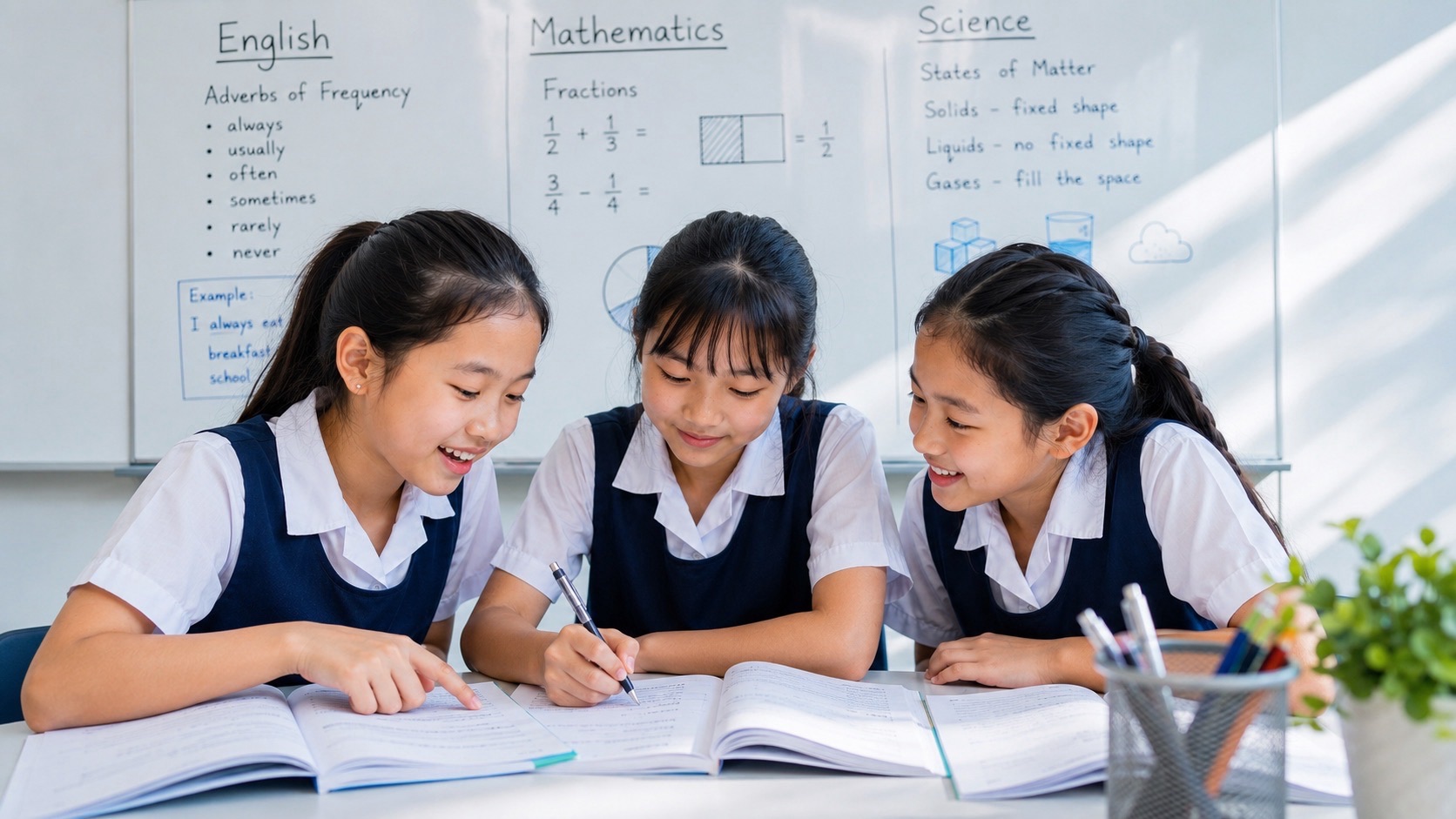
Primary 3 Science begins by teaching children how to notice
Primary 3 is the beginning of formal Science for many pupils. The most important early habit is not memorising a long list of facts. It is learning how to observe carefully, sort by a stated rule, compare fairly, describe patterns, ask what evidence supports an idea and explain simple relationships in clear language.
This page gives the historical Sengkang Primary 3 Science route a distinct role inside the eduKate Science ecosystem: a Discovery Laboratory. Its job is to build the first layer of scientific thinking so later Primary 4 foundations, Primary 5 inquiry and Primary 6 transfer have something stable to stand on.
The examples are original learning cases, not official MOE or SEAB questions or marking schemes. The emphasis is reader-first: observe, classify, compare, test, explain, then transfer the idea to a changed example.
Choose your route
Contents · Chapters 1–5
Contents · Chapters 6–10
Contents · Chapters 11–15
Contents · Chapters 16–20
Contents · Chapters 21–25
1. Observe before explaining
A seedling has two new leaves. That is an observation. “The plant is healthy” is an interpretation. A metal spoon feels cool. That is an observation. “The spoon is colder than the wooden spoon” may or may not be true unless temperature is measured.
Primary 3 pupils should learn to separate what they can directly see, hear, feel safely, count or measure from what they think the observation means.
A useful sentence pair is: “I observe…” followed by “I think this may mean…”. The first stays close to evidence; the second begins reasoning.
2. Describe what can be checked
“The plant looks better” is vague. “The plant has three more leaves than last week” can be checked. “The cup is hotter” is stronger when temperature is measured. “The shadow is bigger” becomes more useful when length or area is compared.
Scientific language does not need to be complicated. It needs to be precise enough that another person can understand what happened.
3. Classification needs a rule
Classification is grouping by a stated feature. A pupil can sort objects into magnetic and non-magnetic, transparent and opaque, living and non-living, or solid, liquid and gas.
The same object can belong to several different groups depending on the rule. A glass cup is solid, transparent and non-magnetic. Science classification is therefore not about discovering one permanent label. It is about using a clear rule for the question being asked.
4. Compare one feature at a time
“A bird has feathers while a fish swims” mixes two different features. A stronger comparison says, “A bird has feathers whereas a fish has scales.”
The same method works for materials: “Glass allows light through clearly, while cardboard blocks light.” It works for living things: “Both need water, but they obtain food differently.”
Keeping one basis at a time makes thinking easier to follow.
5. Patterns help us predict
If three ice cubes placed in warmer surroundings become smaller over time, the pupil can predict that another similar ice cube under similar conditions is likely to melt too. Prediction uses a known pattern, but the conditions should be considered.
A pattern is not a guarantee under every possible condition. Early Science can already teach this careful habit: “Based on what happened before, I predict…”
6. Living and non-living things
Living things grow, reproduce, respond to their surroundings and carry out life processes. Non-living things do not carry out these processes by themselves.
Movement alone is not enough. A toy car moves but is not alive. A plant may not move from place to place but is living.
Boundary examples help pupils avoid classifying by one visible feature only.
7. Plants as living systems
Roots, stems, leaves and flowers have different functions that support the whole plant. Roots absorb water and help anchor the plant. Stems support and transport. Leaves are important for food production. Flowers are involved in reproduction.
Ask what happens if one part is damaged. This turns names into relationships. Damaged roots can reduce water uptake. Damaged stems can affect support and transport.
8. Animals and useful structures
Animal structures can be linked to functions: wings to flight, fins to swimming, teeth to feeding, thick fur to reducing heat loss.
Avoid “because it wants to” explanations. Instead ask how the structure changes what the animal can do in its environment.
9. Life cycles and sequence
Life cycles are ordered stages. Eggs come before hatchlings; caterpillars come before pupae; young plants grow before producing new seeds.
Sequence words—before, after, next, later—help pupils reason about what can and cannot happen at a particular stage.
10. Habitats and needs
A habitat provides conditions and resources needed by organisms. Food, water, shelter, light, temperature and suitable surroundings can all matter.
The same organism may survive poorly if moved to an unsuitable habitat. The useful reasoning pattern is organism need → environmental condition → likely effect.
11. Solids, liquids and gases
Solids keep a fixed shape and volume under ordinary conditions. Liquids keep a fixed volume but take the shape of their container. Gases spread to fill the available space.
Do not classify only by whether something can be poured. Sand and rice can be poured, but each grain is solid.
12. Materials have different properties
Materials can differ in hardness, flexibility, transparency, water resistance, magnetism and how readily they transfer heat.
The important habit is to connect the property to the evidence used to identify it. “This material is transparent because I can see clearly through it.”
13. Property and purpose
A material is useful when its properties fit the job. Transparent glass suits windows. Waterproof material suits rain protection. A flexible material may suit a bendable joint.
Ask: “What job must this object do, and which property helps?” That turns memorised examples into design thinking.
14. Temperature and simple heat observations
Pupils can compare warmer and cooler objects safely and use thermometers to measure temperature. A warm object placed in cooler surroundings generally becomes cooler over time as heat is transferred away.
Feeling alone can mislead. Different materials at the same room temperature may feel different because they transfer heat from the hand at different rates.
15. Light and shadows
Light travels from a source. A shadow forms when an opaque object blocks part of that light.
Shadow size and position depend on the relative positions of light source, object and screen. Moving the object changes geometry, not the object’s actual size.
16. Ask one testable question
“Which paper towel is best?” is vague. “Which paper towel absorbs the greatest volume of water under the same test?” is more testable.
A testable question makes the changed factor and measured result clearer.
17. Change one important thing
If pupils want to compare how fast ice melts in two locations, they should change one intended condition while keeping important starting conditions comparable.
Changing cup material, ice size, location and starting temperature all at once makes it hard to know what caused a difference.
18. Measure or record the result
The outcome should be visible or measurable: time taken to melt, number of leaves, water absorbed, temperature after ten minutes, or whether an object is attracted by a magnet.
“It worked better” should be replaced by a defined result wherever possible.
19. Keep the comparison fair
A fair comparison keeps relevant conditions similar so the intended difference can be interpreted.
| Question | Changed | Measured | Kept comparable |
|---|---|---|---|
| Which towel absorbs more? | Towel type | Water absorbed | Piece size, water amount, method |
| Where does ice melt faster? | Location | Melting time | Ice size, container |
| Which material is magnetic? | Test object | Attraction | Same magnet and test distance |
20. Explain only what the evidence supports
If one tested paper towel absorbs more water than another, the result supports that comparison under the test conditions. It does not prove that brand is “best at everything”.
This early habit—do not claim more than the test shows—prepares pupils for later scientific inquiry.
21. Discovery laboratory: 12 mixed cases
Case 1. A toy car moves when pushed. Is movement alone evidence that it is living?
Case 1 answer
No. Non-living objects can move when an external force acts on them.
Case 2. A clear sheet lets you see an object sharply through it. How should it be classified?
Case 2 answer
Transparent.
Case 3. Rice can be poured. Is it a liquid?
Case 3 answer
No. The collection flows, but individual grains are solids.
Case 4. One seedling begins at 6 cm and ends at 10 cm; another begins at 9 cm and ends at 12 cm. Which grew more?
Case 4 answer
The first grew 4 cm; the second grew 3 cm. The first grew more.
Case 5. Why is a transparent material useful for a window?
Case 5 answer
It allows light through and lets people see clearly through it.
Case 6. A shadow becomes larger when an object moves closer to the lamp. Did the object itself become larger?
Case 6 answer
No. The change is in the light-source/object geometry, not the object’s real size.
Case 7. Two equal ice cubes are tested, but one is placed in a metal bowl and one in a foam cup. Can the result be attributed only to room location?
Case 7 answer
No. Container material is another difference that can affect heat transfer.
Case 8. A plant has damaged roots. What function is likely affected first?
Case 8 answer
Water and mineral uptake from the soil can be reduced.
Case 9. A metal spoon and wooden spoon are in the same room. The metal feels colder. Must its temperature be lower?
Case 9 answer
No. Metal can transfer heat from the hand more quickly, changing how cold it feels.
Case 10. A pupil groups bat, bird and butterfly together because they fly. Is that a valid classification?
Case 10 answer
Yes, if the stated rule is “animals that can fly”. A different biological classification may group them differently.
Case 11. One cup is “better at keeping water warm”. What measurement would make that claim clearer?
Case 11 answer
Measure water temperature after the same time from the same starting temperature and volume.
Case 12. A leaf has many holes eaten by insects. Name one plant function that may be affected.
Case 12 answer
Reduced healthy leaf area can reduce the plant’s ability to make food.
22. Wrong-answer laboratory
Wrong answers are especially useful in Primary 3 because they reveal the rule a pupil is using.
Wrong: “Anything that moves is living.” Repair: some non-living things move because something else acts on them.
Wrong: “Anything that pours is liquid.” Repair: collections of small solids can pour too.
Wrong: “The tallest plant grew the most.” Repair: compare change from starting height.
Wrong: “The biggest shadow means the object is biggest.” Repair: shadow size also depends on positions.
23. Build a Primary 3 Science notebook
A useful notebook can be organised around six recurring jobs:
- Observe: what can I see or measure?
- Classify: what rule separates the groups?
- Compare: what same feature am I comparing?
- Predict: what pattern suggests the next result?
- Test: what changes and what stays comparable?
- Explain: what process connects cause and result?
Add examples from living things, materials, light, heat and simple experiments. The notebook becomes a toolkit rather than a copied textbook.
24. A weekly discovery cycle
- Day 1: observe and describe one everyday phenomenon.
- Day 2: classify five unfamiliar examples using one rule.
- Day 3: compare two objects on one feature.
- Day 4: interpret one table or diagram.
- Day 5: answer one changed-condition question.
The cycle is short on purpose. Primary 3 Science should build habits through variety, not overload.
25. The bridge from P3 discovery to P4 foundations
Primary 3 discovery becomes Primary 4 foundations when pupils begin connecting observations into systems. Classification becomes property-and-function reasoning. Simple comparisons become fair tests. Life-cycle sequences become systems. Light and heat observations become controlled investigations.
The best preparation is therefore not racing ahead. It is making observation, comparison, classification and explanation reliable.
Inside the eduKate Science ecosystem, this page owns the discovery layer. The next step is the Primary 4 Foundations Laboratory, followed by Primary 5 inquiry and Primary 6 transfer and examination-control work.
Continue through the eduKate Science ecosystem
- Primary 4 Science Foundations Laboratory Sengkang
- Primary 5 Science Observation & Inquiry Laboratory Sengkang
- Primary 5 Science Tuition in Yishun | Evidence and Clear Explanations
- Primary 5 Science Open-Ended Questions
- Primary 6 Science Transfer Laboratory Sengkang
- Primary 6 Science Tuition Yishun | PSLE Revision and Transfer
- Primary 6 Science Tuition Centre Yishun | Examination Control
- Science Tuition & Learning Hub
- Science Article Directory
- The Library | eduKateYishun Complete Estate Index
This is an eduKateYishun learning guide. Practice examples are original instructional material, not official MOE or SEAB examination questions or marking schemes. Current curriculum documents and the learner’s school programme should be checked for the relevant year.
Leave a Reply