
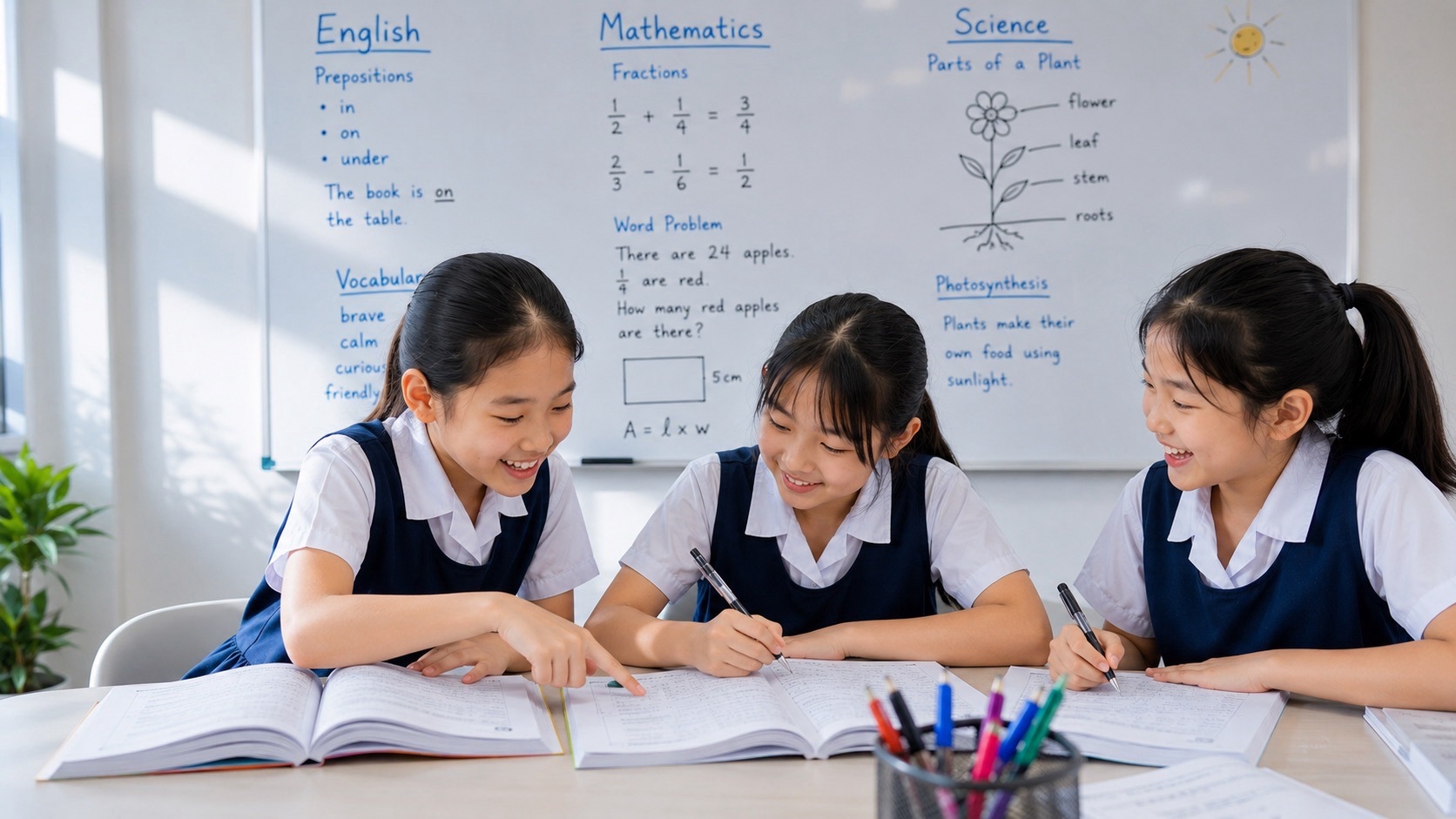
Primary 5 Science in Yishun is where knowing a concept has to become evidence-based explanation. Learners increasingly need to interpret open-ended questions, identify the relevant relationship, use variables and observations correctly, explain mechanisms and transfer an idea when the surface of the question changes.
This guide follows the whole Primary 5 Science year route: diagnose misconceptions, connect evidence to explanation and build independent reasoning across the year. Use the separate Primary 5 Open-Ended Questions page for question-specific evidence/variables work and the diagnostic route when the starting problem is a recurring misconception.
Choose the question you have today
Start with one question, not the whole book. This guide helps a Primary 5 learner select evidence, explain a scientific connection and try a changed question independently.
It is a focused, Standard-oriented learning casebook, not a complete textbook or an official examination paper. Match the examples to the learner’s school sequence and subject level. Chapter 2 explains the scope; Chapter 25 includes the Foundation and PSLE distinctions.
All learner situations, practice questions and numerical datasets are original illustrations. Model responses are teaching explanations, not official marking schemes or reports of actual pupil results.
Contents: open one part and choose a chapter
Chapters 1–5 · Find the first missing step
1. Start with the answer your child actually wrote
2. Know the P5 boundary before building a revision plan
3. Separate what you saw from what you think happened
Chapters 6–10 · Work with water and evidence
6. Water: keep the substance, state and location separate
7. Evaporation: compare the change, not just the final amount
8. Follow water through a cycle without losing it
9. Fair tests: make the comparison answerable
10. Tables, graphs and measurements: read what the numbers can say
Chapters 11–15 · Connect living systems
11. Plant transport: follow the substance, not the colour alone
12. Human systems: connect breathing, transport and use
13. Flowering plants: do not merge pollination and fertilisation
14. Seeds: arrival, germination and survival are different achievements
Chapters 16–20 · Trace circuits and repair answers
16. Electrical circuits: trace the connection before judging the picture
17. Series, parallel and switches: identify which path changes
18. Testing conductors: a result needs a working test
19. Multiple-choice questions: choose the relationship, not the familiar word
1. Start with the answer your child actually wrote
Imagine a cold bottle standing on a kitchen table. Its cap is closed. Its outside was wiped dry a few minutes ago. Now small drops of water cover the surface.
A child looks at the bottle and says, “Condensation.”
That is a useful beginning. It is not yet an explanation. Where was the water before it became a drop? What changed? Why did it appear outside rather than inside? Could the bottle have leaked? What observation would help us distinguish those possibilities?
These questions reveal something that a vocabulary test cannot. A student may recognise a scientific word without being able to use it to account for an event. Another student may understand the event but leave the important connection unwritten. A third may supply an excellent explanation for the wrong part of the question. Those are different difficulties. Giving all three children the same extra worksheet would leave the real differences untouched.
This guide begins with a smaller and more useful question than “Is my child good at Science?” It asks, “What can my child do independently, and where does the explanation stop?” The chapters that follow offer ways to answer that question through original cases, short investigations on paper, model explanations and fresh attempts. You do not need to read them all in order. Choose a reading route, complete one task, and use the result to decide what to read next.
A mark is an outcome, not a full account
Suppose a child loses two marks on a question about an electrical circuit. The number alone does not tell us whether the child misunderstood a component, missed a gap, confused the two battery terminals, misread a switch position or ran out of time. A useful discussion needs the question, the diagram and the child’s original response together. Looking only at the corrected answer hides the very evidence that would help us choose the next lesson.
Keep the first attempt. Ask the child to explain the reasoning without looking at the model. Listen for the first point at which the account becomes uncertain. Perhaps the child can trace the connection correctly but cannot write why the bulb does not light. That is a communication problem worth working on. Perhaps the child cannot trace a complete path at all. Sentence practice would then be premature; the circuit itself needs to be understood.
The purpose is not to attach a permanent label to the child. “Weak in application” can become another vague description if it does not lead to a specific action. “Can name the parts but cannot identify which two terminals are connected” is narrower, and therefore more useful. It suggests a small set of contrasting circuit examples rather than another chapter of definitions.
One useful conversation
Try this with an existing school question that has already been marked. First, ask the child to say what the question wanted, without answering it. Next, ask which observation, number or feature mattered most. Then ask for the scientific idea that connects that evidence to the answer. Finally, invite the child to write a new response without copying the correction.
Do not provide all four pieces while calling the attempt independent. There is nothing wrong with helping, but help changes what the result shows. A sentence completed after an adult supplies the concept is evidence of participation in a supported task. It is not the same as selecting the concept unaided. Recording the difference allows the next practice to be designed honestly.
A short note is enough: “Found the observation independently; needed help to name the source of the water.” That note gives tomorrow’s practice a clear purpose. The child needs another case in which the source must be distinguished from the place where water appears. The whole water topic does not necessarily need to be restarted.
Try the opening case
A sealed bottle contains cold water. The outside is dry at the start. Droplets later appear outside. Write two sentences explaining how this can happen. Then write one observation that would make a leak a more plausible explanation instead.
Open the explanation after your attempt
Water vapour in the surrounding air can cool at the cold bottle surface and change into liquid water. The droplets are therefore able to form outside even though the cap remains closed. A visible crack with liquid emerging through it would give specific evidence for a leak. Merely finding water outside does not, on its own, identify its source.
Notice what the explanation includes: the starting substance, its location, the relevant temperature condition and the change of state. “The bottle is cold, so condensation happens” points in the right direction but leaves the water’s source implicit. The stronger version makes the connection available to a reader who cannot inspect the child’s thoughts. The physical explanation is consistent with the US Geological Survey’s account of condensation. 3
The larger aim of Science tuition should be visible in small moments like this. The learner notices more, chooses evidence more carefully and explains a connection that was previously left hidden. A longer answer is not automatically better. An answer that says exactly what happened, why it happened and what the evidence permits is better. Begin with that difference, and the rest of the work becomes easier to organise.
2. Know the P5 boundary before building a revision plan
A useful revision plan needs two maps. One shows the material the child is expected to learn. The other shows what the child can presently do with it. The first prevents omissions. The second prevents unnecessary repetition. Neither map can replace the other: a complete list of topics is not evidence of understanding, and a confident performance on one favourite topic does not establish readiness across the year.
The MOE Primary Science syllabus, updated in January 2026, places reproduction, water, plant transport, human respiratory and circulatory systems, and electrical systems at P5. Photosynthesis is placed at P6. Standard and Foundation outcomes are not identical; for example, the listed electrical investigations include parallel bulbs for Standard but not Foundation. Use the child’s school sequence and subject level alongside the official document. 1
This guide concentrates on reasoning through those P5 areas. It occasionally recalls earlier ideas, such as the functions of roots or the distinction between a solid and a liquid. It also supplies a small amount of background when a connection needs it. Such a bridge is not a claim that every explanation in the guide is a separate P5 examination requirement. The school syllabus and the teaching example have different jobs.
Build a map that changes the next action
Draw five rows on a sheet of paper: water, plant transport, human systems, reproduction and electricity. Across the top, write “Explain an example”, “Read a diagram or table”, and “Answer a changed question”. Do not fill the cells with a general impression. Place a date and a short task reference in each cell only after the child has attempted something relevant.
For water, the evidence might be the bottle explanation from Chapter 1. For electricity, it might be a simple connection task. For reproduction, it might be an explanation distinguishing pollination from fertilisation. A blank cell means “not checked here”, not “cannot do it”. Keeping that distinction protects the child from conclusions based on missing information.
Use ordinary descriptions instead of a complicated scoring system. “Independent and explained”, “Correct after a hint”, “Incorrect but reason visible”, and “Not attempted” are enough for a family notebook. These are working descriptions for practice, not validated diagnostic categories. Their value comes from helping you choose the next task.
A starting check in five small questions
Attempt these without notes. There is no need to impose a time limit on the first attempt. Write enough to make the reasoning visible.
Water: A cold, sealed metal container becomes wet on the outside. State where the water may have come from and name the change involved.
Plant transport: A rooted plant is placed in coloured water. Later, colour is observed along particular pathways in the stem. What does this observation suggest, and what does it not establish about the transport of food?
Human systems: Explain why identifying the lungs does not, by itself, explain how oxygen reaches the leg muscles.
Reproduction: A pollen grain reaches the stigma of a suitable flower. Has fertilisation necessarily occurred at that moment? Explain the distinction.
Electricity: A battery, two wires and a bulb are present on a table. Why is the presence of these components insufficient to establish that the bulb will light?
Compare the five starting answers
For water, identify water vapour in the surrounding air and condensation at the cold surface. For the plant, the coloured pathway is evidence consistent with water transport through that region; it does not identify a food pathway merely because colour is visible. For the human body, oxygen enters the blood through gas exchange in the lungs and is carried to other parts by the circulation. The lungs and circulation have connected but different roles. 3 5 6 7
For reproduction, pollen transfer is pollination; fertilisation requires the male reproductive cell to fuse with an egg cell. Reaching the stigma is not the same event. For electricity, the components need appropriate connections forming a complete conducting path through the working bulb and the battery’s two terminals. Merely placing them near one another does not form that path. 8 9
Treat these as explanation guides, not official marking schemes. Different wording can express the same scientific relationship. Equally, the right topic word can appear in an answer whose relationship is wrong. Read the whole response before judging what it shows.
Let the result choose the chapter
A child who names the right topic but gives no causal connection should begin with Chapter 5. A child who has difficulty separating observations from conclusions should use Chapter 3. A child whose knowledge is sound but whose answers do not address the question should begin with Chapter 4. Topic-specific gaps can be taken directly to the relevant water, systems, reproduction or electricity chapter.
Avoid turning the starting check into another high-stakes test. Its purpose is to remove guesswork from the next study session. You may discover that one area needs teaching while another only needs a later independent retry. That is a better outcome than deciding in advance that every topic must receive the same amount of time.
At the end of the week, return to one previously uncertain cell with a changed example. The map should become a record of evidence, not a colourful display of intentions. When a child can select the relevant idea, explain it and use it in a different setting, the next step can become more demanding. When the same difficulty remains, make the teaching more precise rather than making the workload automatically larger.
3. Separate what you saw from what you think happened
“The plant is unhealthy because it did not get enough water.” That sentence contains a possible explanation. It does not tell us what was actually observed. Were the leaves drooping? Were they discoloured? Was the soil dry? Had the plant been moved? A scientific discussion becomes clearer when the observation is stated before the proposed cause.
An observation describes what was noticed or measured. An inference goes beyond that observation to suggest what it means. A conclusion answers a question using the available evidence. The boundaries can overlap in everyday speech, but separating the jobs is useful when writing an answer. It stops an attractive story from being mistaken for a recorded event.
The missing step in an apparently sensible answer
Consider an invented classroom case. Two similar potted plants begin a study with upright leaves. One week later, Plant A still has upright leaves while Plant B has drooping leaves. A pupil writes, “Plant B had less water, so its leaves drooped.” The explanation could be reasonable, but the description provided has not told us how much water either plant received.
A more careful response begins, “Plant B’s leaves were drooping after one week.” That is the observation. It might continue, “Reduced water supply is one possible explanation, but watering information and other conditions would need to be checked.” The second sentence makes a proposal without pretending that the proposal was directly seen.
Now add another fact: the two plants were the same type, began in comparable condition, stood in the same place and received the same measured amount of water. That does not prove that their internal water status was identical. However, it makes the simple claim “the pupil watered B less” inconsistent with the stated procedure. The correct response must change when the evidence changes.
Ask which alternative is genuinely confusable
A useful alternative is not any imaginable story. It is another explanation that could plausibly produce the observation. For droplets on a bottle, leakage and condensation are confusable because either could place water outside. For a dark bulb, an open switch and a loose contact are confusable because either could interrupt the circuit. For different germination counts, water availability and initial seed viability could both matter.
The next question is therefore not “How many possibilities can I list?” It is “What information would separate the two most relevant possibilities?” A visible break in the wire may settle a circuit question. Equal starting numbers of seeds may remove one comparison problem without removing differences in seed condition. A useful observation narrows the explanation; it does not merely add more description.
This is a reasoning practice, not a demand to challenge every straightforward question indefinitely. When a question explicitly states that all other relevant conditions were kept the same, use that information. Do not invent an unstated defect just to avoid answering. Careful reasoning respects the evidence supplied as well as the evidence missing.
The wet patch case
Here is an original paper exercise. A sealed, intact cold bottle is placed on a dry tray. After ten minutes, small droplets appear over its outside surface. No stream of water is seen leaving the cap. A student writes: “The tray proves that the bottle leaked.”
Explain why the conclusion is too strong. Then identify which detail in the description supports a different explanation. Finally, describe a change to the evidence that would make a leak worth investigating.
Open the evidence discussion
A wet tray establishes the presence of liquid water; it does not establish the water’s origin. The cold surface and the appearance of many small droplets are consistent with condensation of water vapour from the surrounding air. An observed stream emerging through a damaged cap seal or a crack would provide more specific evidence of leakage. In a real situation both processes could occur, so the task is to account for the stated observations rather than insist that one possibility can never coexist with another. 3
The answer becomes stronger when the evidence is attached to the explanation. “It might be condensation” names an alternative. “Droplets form across the cold outside surface, which is consistent with water vapour condensing there” explains why that alternative is relevant. The additional sentence is doing work; it is not simply making the response longer.
A habit for written answers
When a question asks for evidence, begin with something the reader can point to in the question: a number, a change, a comparison, a diagram feature or a recorded event. When it asks for an explanation, add the scientific relationship that makes that evidence meaningful. When the evidence supports only a limited conclusion, keep the limitation attached.
This habit can be practised in ordinary reading. “The advertisement says it is better” is an observation about a claim. “The product is better” is a conclusion that would require additional evidence. “The plant grew taller” describes a measurement. “The plant is healthier in every way” adds a much broader judgment. Learning to hear that extra step is useful well beyond a Science worksheet.
Before moving on, revisit one of your own earlier answers. Underline the observation once and the proposed explanation twice. An answer with no observable support may need evidence. An answer with only observations may need a connecting idea. Either way, you now have a specific revision to make.
4. Read the task before answering the topic
A Science question does not ask for everything a student knows about its subject. It asks for a particular response to particular information. A page containing a flower is not necessarily asking for the flower’s parts. A table about water may ask for a comparison rather than an explanation. A circuit diagram may ask which switch affects one bulb, not which arrangement looks familiar.
Begin by identifying the work the question assigns. What object or event is the answer about? Which conditions have been stated? What kind of response is requested? This small pause can prevent a knowledgeable answer from travelling in the wrong direction.
The command word is a guide, not a password
In this guide, “state” means giving the requested fact or decision directly. “Describe” means reporting the relevant feature, pattern or change. “Explain” means connecting an outcome to a scientific reason. “Compare” means relating the named things on the same basis. “Predict” means applying an idea or pattern to a situation whose outcome is not yet given. These are practical reading distinctions, not a claim that every school marks each word with an identical formula.
The rest of the sentence matters. “Describe the change in water level” and “Describe how to make the test fair” request different kinds of description. A child who memorises a fixed response to the word “describe” can still miss the actual task. Read the object of the instruction and the relevant condition together.
Consider two invented prompts. The first asks, “Which tray lost more water?” The second asks, “Explain why the water in one tray evaporated faster.” The first may be answered by comparing starting and final amounts. The second requires a relevant difference between the conditions and a scientific explanation. Writing “Tray A” for both does not meet both tasks. Writing a long evaporation explanation when only a tray name is required may be unnecessary.
Use three small marks on the question
One practical reading method is to circle the target, underline the condition and box the instruction. Use it selectively, not as a colouring ritual. In “Explain why Bulb B remains lit when Switch S is opened”, the target is Bulb B, the condition is the opened switch, and the instruction asks for a reason. The answer should trace a remaining complete path through B under that switch condition.
A student who instead explains why Bulb A goes out may understand part of the circuit yet still leave the requested job unfinished. The correction is not necessarily to reread the whole electricity chapter. It may be to practise keeping the target object visible while following a diagram.
Long questions also contain supporting information that should not all be repeated. If a table already names the plant species, the answer rarely needs a paragraph introducing plants. Use the details that establish the comparison or mechanism. Good selection is a form of understanding.
One table, three different tasks
The following numbers are invented for practice. Two identical open dishes each start with 50 millilitres of water. After the same period, Dish A contains 38 millilitres and Dish B contains 44 millilitres. Neither was spilled or refilled.
| Dish | Starting water | Final water | Water lost |
|---|---|---|---|
| A | 50 mL | 38 mL | 12 mL |
| B | 50 mL | 44 mL | 6 mL |
Answer these separately: Which dish lost more water? How much more did it lose? Does the table alone show that Dish A was at a higher temperature?
Check the task-specific responses
Dish A lost more water. It lost 6 millilitres more than Dish B, because 12 minus 6 equals 6. The table alone does not establish a temperature difference. Temperature is one possible influence on evaporation, but exposed surface area, air movement and other conditions could also affect the outcome. The numbers show a difference in water loss over the stated period; they do not uniquely identify its cause. 4
The second answer needs a comparison of losses, not a comparison of the final amounts without explanation. Here the arithmetic happens to give the same numerical difference because the starting amounts were equal. With unequal starting amounts, that shortcut could fail. The phrase “each starts with 50 millilitres” is therefore relevant, not decorative.
Check the answer against the request
Before leaving a response, read only the question and your final answer together. Does the answer identify the right object? Does it use the stated condition? Does it perform the requested job? If a comparison was requested, are both sides present? If a reason was requested, is the connection explicit?
This check is shorter than rereading every sentence on the page without a purpose. It also makes corrections more useful. Instead of “Read carefully”, the child can write, “I compared final amounts instead of amounts lost,” or “I explained the wrong bulb.” Each note identifies a repeatable reading mistake that can be tested with a new example.
The aim is not to make a child suspicious of every word. It is to make reading deliberate enough that the knowledge reaches the question it was meant to answer. Once the task is clear, the scientific explanation has a destination.
5. Build an explanation with a visible middle
Many incomplete Science answers contain a beginning and an ending but no middle. “The surface was cold, so droplets appeared.” “The switch was open, so the bulb went out.” “The food-carrying tubes were damaged, so the roots received less food.” These statements may point towards correct explanations, but the reader still needs the connection that links the condition to the result.
The missing middle is usually the most useful place to teach. What change occurred? What substance moved? Which path was interrupted? What relationship makes the outcome follow? A scientific term helps when it names that connection accurately. It cannot replace the connection entirely.
Condition, process, consequence
Use three questions while planning an explanation: What is different or relevant here? What process follows under that condition? What consequence does that process produce in the object named by the question? This is a writing scaffold created for the guide. It is not a universal marking formula, and it should become less visible as the child gains control.
For the cold bottle, the relevant condition is a surface cold enough for condensation. The process is surrounding water vapour changing into liquid at that surface. The consequence is the formation of droplets outside. For a simple open circuit, the gap interrupts the conducting path; current cannot continue through the bulb in that path, so the bulb does not light. 3 9
Some tasks require evidence as well. If two otherwise comparable dishes lose different amounts of water, the answer may need both the measured comparison and the reason. The numbers show what happened. The scientific idea explains why the stated difference in conditions can account for it. Neither part should silently do the other’s job.
Compare three responses
Original prompt: A working bulb is connected in a simple series circuit. A switch in that single path is opened. Explain why the bulb no longer lights.
Response A says, “Because of electricity.” Response B says, “The switch is open, so the bulb does not light.” Response C says, “Opening the switch breaks the complete conducting path. Current cannot flow through the bulb in that circuit, so it does not light.”
Response A names the domain but explains almost nothing. Response B repeats the condition and outcome. Response C supplies the missing relationship. It is not better because it contains more sentences. It is better because a reader can follow the causal connection. There may be equally good shorter versions, such as “The open switch breaks the circuit, so no current flows through the bulb.” 9
Name the substance instead of writing “it”
Ambiguous pronouns can hide a scientific error. “It loses heat and changes into water” leaves the reader wondering what “it” refers to. Air is a mixture, and saying the whole air changes into water would be incorrect. “Water vapour in the surrounding air cools and condenses into liquid water” makes the intended substance clear. 3
The same principle applies to transport. “It carries it around” is not enough when the question asks about oxygen, blood and the heart. Name the carrier, the transported substance and the destination. A child may initially need a longer sentence to keep those relationships separate. Later the wording can become more economical without losing meaning.
Practice: repair without decorating
Rewrite these original weak responses. Add only information needed to make the explanation work.
A: “There is water outside because the bottle is cold.”
B: “The seed went far because it has a wing.”
C: “The legs get oxygen because we breathe.”
Open the repaired explanations
For A, explain that surrounding water vapour condenses on the cold outside surface, forming liquid droplets. For B, the prompt needs enough context to identify wind dispersal; in that context, a wing-like structure can help a seed or fruit remain airborne and be carried by moving air. Avoid claiming that every winged seed always travels a great distance. For C, breathing brings air into the lungs; oxygen enters the blood there and is transported by the circulation to the leg muscles. 3 6 7 8
The second example is deliberately less determinate. Without a statement that wind acted on the seed, a complete answer should not invent a recorded journey. A useful response may say what the feature could help the seed do rather than pretend to know what actually happened. Explanation includes control of certainty as well as control of vocabulary.
Remove words that do not earn their place
Once the relationship is correct, trim repetition. A paragraph that says “the amount increased” four times is not more scientific than one precise comparison. Remove a phrase only after checking that the source, direction, condition and consequence remain clear. Shortening too early can recreate the missing middle.
The best next exercise is a changed case, not another copy of the repaired sentence. Move from a bottle to chilled spectacles, from an open switch to a disconnected wire, or from oxygen reaching a leg to digested food reaching another body part. Ask whether the learner can preserve the relationship while changing the surface details. That is where an explanation begins to become usable knowledge rather than remembered wording.
6. Water: keep the substance, state and location separate
A cold drink can generate several different changes at once. Ice may melt inside the cup. Water vapour may condense outside it. Some liquid water at an exposed surface may evaporate. Calling everything “the water cycle” does not tell us which change explains which observation. The first job is to locate the water and identify its state before and after the event.
Use a simple sentence while thinking: “The water begins as ___ at ___, and ends as ___ at ___.” The blanks force the source and destination into view. They also expose explanations that quietly move water through an intact wall or turn the entire surrounding air into liquid.
Four changes that are easy to mix up
Melting changes solid water into liquid water. Freezing changes liquid water into solid water. Evaporation changes liquid water into water vapour at a surface. Condensation changes water vapour into liquid water. The substance remains water, but its state changes. The visible appearance of a drop does not tell us, by itself, which previous state produced it. 3 4
Imagine a transparent, sealed container holding ice. The outside is dry at first. Later, liquid collects inside and droplets appear outside. The inside liquid can be explained by melting ice. The outside droplets can be explained by condensation from surrounding water vapour. The two explanations concern different water, different locations and different starting states. Saying that “the ice melted through the container” would join the observations with an unsupported pathway.
This is why a correct process name is only part of the answer. “Melting” is appropriate for the ice-to-liquid change inside. It does not explain why the outside becomes wet. A student needs to match the process to the exact observation rather than choose the most familiar word associated with a cold drink.
Water vapour is not the white cloud
The visible mist around a cold environment or a plume from hot water is not simply an image of invisible water vapour. Small liquid droplets can make a cloud or mist visible. For this guide, keep the essential distinction: gaseous water is water vapour, while visible droplets are liquid water. The terms name states, not whether the scene looks “watery”. 3
There is no need to handle boiling water to learn the distinction. Use a photograph, a teacher’s demonstration record or a written description. A scientific explanation should not require a child to create a burn risk at home. Observation and reasoning on paper can establish the conceptual difference before any supervised practical work is considered.
A two-location answer
Original question: A closed transparent box contains ice cubes. After some time, a pool of water is visible at the bottom inside the box. Small drops are also visible on the outside. Explain the two observations separately. Assume the box is intact and was initially dry outside.
Open the model response and its limits
Inside, the ice gains heat from warmer surroundings and melts into liquid water. Outside, water vapour in the surrounding air cools at the cold surface and condenses, producing liquid droplets. The answer uses two processes because the two observations have different starting states and locations. 3 4
The statement that the box is intact rules out an explanation that relies on water passing through a crack. In a different real situation, a damaged container might leak as well as collect condensation. Here, however, the answer should use the conditions supplied instead of importing a defect that the question has excluded.
Do not add an exact amount of water or a precise time for melting. Neither has been given. A complete explanation can identify a mechanism without inventing measurements. “After some time” allows a sequence; it does not license a claim that every ice cube has melted.
Turn a correction into a contrast
A useful practice pair changes the location of the observed liquid. In one question, water appears inside a sealed box containing ice. In another, water appears outside the same cold box. Ask the learner to explain why the answer changes. This is more revealing than requesting the definition of melting and condensation on separate lines.
Next, remove the ice. A dry metal container is chilled without putting liquid water inside it, then exposed to humid air. Could liquid droplets still appear outside? Yes, because the source for condensation can be surrounding water vapour rather than liquid inside the container. This changed case tests whether the learner has understood the source rather than merely memorised “ice means condensation”. 3
The final check for a water answer
Read each process sentence and ask three questions. Is the named starting state correct? Is the direction of change correct? Is the water in the right place? Many apparently small errors become obvious under this check. “The cold air melts” fails the substance and state tests. “Water evaporates into droplets” confuses the gaseous result of evaporation with liquid droplets. “Condensation makes ice” names the wrong final state.
These are not reasons to demand increasingly elaborate vocabulary. They are reasons to make a small set of words precise. Once the child can track the same substance through a change without losing its location, more complicated water questions become combinations of understandable steps rather than a collection of phrases to remember.
7. Evaporation: compare the change, not just the final amount
Two wet cloths hang in different places. One feels drier later. It is tempting to explain the difference immediately: perhaps one place was warmer, or more exposed to moving air. Before choosing a reason, check what was actually compared. Did the cloths begin with the same amount of water? Were they the same material and size? Were they observed after the same period?
Evaporation is the change of liquid water into water vapour at an exposed surface. Temperature, air movement, exposed surface area and the moisture conditions of the surrounding air can influence the process. The presence of sunlight is not a requirement for evaporation to occur. 4
The amount remaining can mislead
Consider this invented dataset. Dish A starts with 80 millilitres of water and ends with 62 millilitres after one hour. Dish B starts with 50 millilitres and ends with 40 millilitres after the same hour. No water was spilled, added or removed by another route.
Dish A has more water remaining. It also lost more water: 18 millilitres compared with 10. A response saying “B evaporated faster because it has less water left” confuses the final state with the amount of change. To compare water loss, calculate the difference between each dish’s own starting and final amounts first.
Now change the duration. Suppose A loses 18 millilitres in two hours while B loses 10 millilitres in one hour. The larger total loss no longer establishes the larger average loss per hour. A’s average is 9 millilitres per hour; B’s is 10. A pupil does not need an advanced theory of rates to notice that comparisons must use equal durations or account for the difference.
This arithmetic is useful because it protects the scientific interpretation. Numbers are not an optional decoration around the concept. They determine what the observation actually says. An accurate scientific explanation cannot rescue a comparison based on the wrong quantity.
One change that answers one question
Suppose we want to investigate how exposed surface area affects water loss. Use two containers designed to provide different exposed water surfaces while keeping the other relevant conditions as comparable as possible. Begin with equal measured amounts, observe over the same period and keep location, air movement and temperature comparable. The changed feature should be the one named in the question.
A real design may still have limitations. Containers with different shapes can also differ in depth and heat exchange. For a primary-level paper question, use the stated controlled conditions. For an actual investigation, record the relevant differences honestly rather than declaring a test perfect because it has two containers. The principle is to reduce competing explanations for the measured result.
Do not say that more surface area creates more water or turns every molecule into vapour instantly. A wider exposed surface can allow more water to evaporate over a given period under comparable conditions. The amount remaining still depends on the starting amount and the duration. A completely dry container cannot continue losing liquid water that is no longer present.
Worked comparison: three trays
The values below are invented. All three trays begin with 100 millilitres of water and remain under the same stated temperature and air conditions for the same period. The only intended difference is exposed surface area.
| Tray | Exposed surface area | Water remaining | Water lost |
|---|---|---|---|
| A | 40 cm² | 91 mL | 9 mL |
| B | 80 cm² | 83 mL | 17 mL |
| C | 120 cm² | 76 mL | 24 mL |
Describe the pattern. Explain why comparing A with C is useful. Then decide whether the results establish that doubling the surface area always doubles the water lost.
Open the comparison and explanation
In this dataset, larger exposed surface area is associated with greater water loss over the same period. Comparing A and C uses equal starting amounts and duration while changing the intended factor. The result is consistent with the role of exposed surface area in evaporation. 4
The results do not establish an exact doubling rule. A to B doubles the area but changes the measured loss from 9 to 17 millilitres, not 18. More importantly, three invented results under specified conditions cannot establish a universal numerical law. Describe the observed relationship without adding precision that the evidence does not support.
A complete response might read: “Tray C lost more water than Tray A over the same period. Its larger exposed water surface allowed more evaporation under the stated comparable conditions.” The numbers can be included when the question asks for supporting evidence: C lost 24 millilitres whereas A lost 9.
A fresh attempt
Two identical cloths receive equal measured amounts of water. One is folded into a thick bundle; the other is spread out. They are left under comparable conditions for the same period. Predict which would generally lose more water through evaporation and explain why. State one condition you would keep comparable in an actual test.
The useful idea is exposed surface, not the word “cloth”. An explanation that names the larger exposed wet surface shows transfer from dishes to fabric. A statement that the spread cloth is “bigger” is less precise, because both cloths have the same total material area. What differs is how much wet surface is exposed to the surrounding air.
That distinction is the heart of a good changed question. The setting changes while the relevant relationship remains. When the child can identify the relationship without relying on a familiar picture, the topic has become more portable.
8. Follow water through a cycle without losing it
A water-cycle diagram can become a memorised circle of arrows. The learner recites “evaporation, condensation, rain” but becomes uncertain when the arrows are rearranged or one stage is hidden. The solution is to read each arrow as a statement about a change, a movement or both.
Begin with a place where water is stored. Ask what can move it from that place, what state it is in during the movement and where it goes next. Not every arrow is a change of state. Rain falling is liquid water moving. Water flowing along the ground is also moving without necessarily changing state. Evaporation and condensation describe changes of state. 3 4
A cycle is not a promise that one drop follows one route
A simple diagram selects part of a larger system. It can help us follow important connections, but it does not show every possible path or the time spent in each place. Water can remain stored, move along different routes or repeat part of a journey. A primary-level answer should use the pathway specified by the question rather than assume that every particle completes an identical circle at the same speed.
The useful question is, “What must happen for water to move along this particular arrow?” If an arrow leads from liquid in a dish to water vapour in surrounding air, evaporation is relevant. If another leads from vapour to droplets on a cooler surface, condensation is relevant. If droplets run down a lid, the answer is about liquid movement, not another instance of evaporation.
The closed-container case
Imagine an intact, closed transparent container containing a small amount of water. It is used only as a paper model here. Over time, droplets appear on a cooler part of its inside surface. A pupil says, “New water was created inside the container.” Another says, “Some of the existing liquid became water vapour, and some vapour later condensed.”
The second account follows the same substance through different states and locations. It does not require water to be created. In an ideal closed model with no water entering or leaving, the total water remains within the boundary even though the amount visible in one place changes. The container boundary matters because it tells us what the system can exchange with its surroundings.
Do not confuse “closed to water” with “unaffected by the surroundings”. Heat can still be transferred through the container. A model can retain its water while changes in temperature influence where that water is found. The distinction helps explain why a sealed container need not look the same at every moment.
Question: where did the missing liquid go?
Original case: A sealed container begins with liquid water at the bottom and air above it. Later, the liquid level at the bottom is slightly lower and droplets are visible on the inner lid. Assume no leak or opening occurred. Explain why a lower bottom water level does not establish that water has left the container.
Open the boundary-based answer
Water may have changed location or state inside the container. Some liquid can evaporate into water vapour, and vapour can condense into droplets on the inner lid. Measuring only the water at the bottom ignores water elsewhere within the boundary. The observation therefore does not establish a loss of total water from the closed container. 3 4
An answer should not claim that every bit of missing bottom liquid is visible on the lid. Some may remain as water vapour or droplets elsewhere. The evidence permits an account of redistribution without giving a complete inventory of every location. This is a useful example of an explanation that is clear precisely because it avoids overclaiming.
Change the boundary and reconsider
Now imagine the lid is removed and the container stands in an open room. Water vapour can move into the wider surroundings. The earlier claim about all water remaining inside no longer follows. The process of evaporation has not changed its meaning; the system boundary has changed what can happen to the resulting vapour.
This kind of comparison is especially valuable because the pictures may look nearly identical. One small feature—a closed or open boundary—changes the appropriate conclusion. Students who answer from the general topic may miss it. Students who inspect the conditions have a way to notice why the answer must differ.
Use cycles to ask better questions
When reading a cycle diagram, check the source of the water, the state at each point and the meaning of every arrow. Ask whether the diagram is showing all water or only a selected route. Keep movement and change of state separate where the question needs that distinction.
You can practise with a drawn sequence of four boxes: “liquid in a dish”, “water vapour”, “drops on a cooler lid”, and “liquid returning to the dish”. Label the transitions in words. Then remove one label and explain it without looking. Finally, change the model by opening the lid. The reasoning should change at the point where water can cross the boundary, not everywhere indiscriminately.
The aim is not to make a larger diagram. It is to make each connection in the diagram mean something. A small model whose arrows can be explained is more useful than a beautiful cycle that the learner can only recite.
9. Fair tests: make the comparison answerable
An investigation begins with a question. The design should make it possible to answer that question with the observations collected. “We used two plants” is not a design principle. “We compared water loss from otherwise comparable plants under two specified conditions” is closer, because it identifies both the intended difference and the outcome.
For a straightforward comparison test, separate three jobs: the factor deliberately changed, the outcome measured and the relevant conditions kept comparable. These jobs are related, but they are not interchangeable. Time might be a controlled condition in one test and the quantity studied in another. The variable’s role comes from the question, not from its name.
Why “keep everything the same” is not enough
If absolutely everything were the same, including the factor being investigated, the test would not compare that factor. A useful instruction says which relevant things remain comparable while one intended factor changes. It should also identify how the outcome will be measured.
Suppose a student wants to compare water loss under moving and still air. A vague plan says, “Put one dish near a fan and one near the window.” That arrangement could change sunlight, temperature and air movement together. If the amounts lost differ, the result would be difficult to attribute specifically to the fan’s air movement.
A better paper design uses matching dishes, equal starting water amounts, equal exposed surfaces, the same observation duration and comparable surrounding temperature, with a defined difference in air movement. The design does not become perfect because it sounds tidy. It becomes more informative because it reduces competing explanations relevant to the question.
Controls protect the meaning of the outcome
Imagine an invented seed investigation. Group A contains 20 seeds on moist material. Group B contains 10 seeds on dry material. A week later, 16 seeds in A and 1 seed in B have germinated. The raw counts differ, but so do the starting numbers. The initial inequality complicates the comparison.
Using the same starting number removes that particular problem. Using seeds of the same type and comparable condition, a similar suitable temperature and the same observation period helps address others. If the intended factor is water availability, the other relevant differences should not be introduced casually.
There is a second issue: a fairer comparison does not turn one seed into a reliable representative of all seeds. Individual seeds can differ. Repeating a trial or using an appropriate group can reveal variation that a single observation hides. Repetition is useful, but it cannot repair a design that always changes two factors together. It would simply repeat the same ambiguity.
The control condition is not always “nothing”
A comparison condition should answer the question. In a materials test, a known conductor can help establish that the battery, bulb and connections are working. In a water-loss investigation, an uncovered dish might provide a comparison for a covered one. In a seed study, a suitable moist condition can provide a comparison for a dry condition.
The role depends on what needs to be distinguished. Calling an object “the control” without explaining what it checks can become another memorised label. Ask what result would be difficult to interpret without that comparison. The answer reveals why the condition belongs in the design.
Repair the investigation
Original proposal: “I will find out whether exposed surface area affects evaporation. I will put 100 millilitres of water in a wide dish outdoors and 50 millilitres in a narrow cup in an air-conditioned room. I will check the dish after one hour and the cup after two hours.”
Name three changes that would make the comparison more informative. Explain why measuring only the final water amounts would be inadequate.
Open the design review
Use equal starting water amounts, the same observation duration and comparable environmental conditions. The intended difference should concern exposed surface area rather than a mixture of surface area, location, temperature, air movement and starting quantity. Measure each container’s loss by subtracting its final amount from its own starting amount.
Final amounts alone do not isolate how much water was lost when starting amounts differ. Unequal durations further complicate a comparison of evaporation rate. Repairing these details makes the observed difference more relevant to the question. The scientific background is that evaporation is affected by conditions at the water surface and in the surrounding air; the specific critique follows from the proposed design. 4
In an actual investigation, container shape may introduce further differences. Acknowledge those limitations and improve what is practical rather than pretending that a primary-level model eliminates every source of variation. For the paper exercise, the central repair is to stop several intended conditions changing at once.
Write a conclusion that fits the design
After a well-controlled comparison, a useful conclusion names the tested factor, the measured outcome and the observed relationship under the tested conditions. After a confounded comparison, the honest conclusion is narrower: the arrangements produced different results, but the design did not isolate the intended cause.
That narrower conclusion is not a failure of Science. It is the correct interpretation of the evidence available. The next action is a better comparison. A child who can explain why a test does not answer its own question is doing important scientific work, even before the next experiment is performed.
10. Tables, graphs and measurements: read what the numbers can say
A table is a compressed account of an investigation. The headings identify what was measured, the units tell us the scale, and the rows show how observations relate to conditions or time. Reading only the largest number can miss nearly everything important.
Begin with the headings before the values. Are the entries amounts remaining, amounts lost, counts, lengths or time intervals? Does a higher value mean more of the process, or less time needed to complete it? The direction of the interpretation depends on the measured quantity.
Faster can produce a smaller number
Suppose a table records how long a fixed amount of water takes to evaporate under three stated arrangements. Shorter time means the fixed amount evaporated faster. In another table, the duration is fixed and the amount lost is recorded; larger loss means greater average evaporation over that duration. These two tables can describe the same general relationship with opposite-looking numerical directions.
Teach the child to translate the heading into a sentence: “This number tells me how long the process took,” or “This number tells me how much changed in the same time.” That sentence is often more useful than circling the maximum value.
Read the interval, not just the endpoint
Here is an invented record of water remaining in a dish. No water was added or spilled.
| Time | Water remaining |
|---|---|
| 0 minutes | 60 mL |
| 10 minutes | 55 mL |
| 20 minutes | 51 mL |
| 30 minutes | 48 mL |
The total loss over 30 minutes is 12 millilitres. The losses over the three ten-minute intervals are 5, 4 and 3 millilitres. The water amount decreases throughout, but the amount lost in each equal interval becomes smaller. A statement that the water amount “increases more slowly” would confuse the process with its measured remainder.
If these points were drawn on a graph of water remaining against time, the vertical position would fall. A graph of cumulative water lost would rise. The physical record is the same. The chosen vertical quantity changes what the line represents. This is why reading an axis label is a scientific act, not an administrative detail.
Do not create measurements between the measurements
The table gives observations every ten minutes. A straight line between two points may be used in a simple graph, but it does not prove that the amount changed at an exactly constant rate during every second of the interval. A prediction between measured points should be identified as an estimate based on the chosen interpretation.
The same caution applies outside the measured range. Extending a line indefinitely can produce an impossible result, such as a negative amount of water. A model must stop being used when its assumptions no longer fit. A dish cannot continue losing liquid from an empty supply in the same way it did earlier.
Variation is information
Now consider three repeated measurements of water loss for each of two arrangements. These values are invented.
| Arrangement | Trial 1 | Trial 2 | Trial 3 |
|---|---|---|---|
| A | 11 mL | 12 mL | 10 mL |
| B | 7 mL | 8 mL | 6 mL |
A shows greater loss than B in each listed trial. The variation within each row also matters: the result is not an identical machine-produced number on every attempt. A sensible conclusion can describe the consistent direction in these trials without claiming that A always loses exactly four millilitres more in every possible setting.
Now change B’s results to 10, 13 and 9 millilitres. The ranges overlap, and the difference is less clear. A confident universal statement would be harder to justify. More information about measurement precision, design and further trials would help. You do not need an advanced statistical test to recognise that near-overlapping results deserve more caution than a clean separation.
Practice: a conclusion with the right reach
Original task: In three trials, a plant treatment produces shoot lengths of 8, 9 and 8 centimetres. A comparison treatment produces 8, 8 and 9 centimetres. A student concludes, “The first treatment makes all plants grow taller.” Explain why that conclusion is not supported by the listed results.
Open the data discussion
The two sets of measurements are the same values in a different order. They do not show a consistent advantage for the first treatment. The claim also extends from a small set of observed plants to all plants, which the data cannot establish. A narrower description is that the listed shoot lengths are similar across the two treatments.
Even a real difference in shoot length would not, on its own, prove that every aspect of growth or plant health improved. The measured quantity defines what the evidence directly addresses. This example illustrates reasoning from the invented numbers; it is not a report of an actual plant study.
When reviewing a data answer, check the quantity, unit, comparison and scope. What was measured? Which values were compared? What pattern appears? How far can the conclusion travel? Those four checks turn a table from a collection of numbers into usable evidence.
11. Plant transport: follow the substance, not the colour alone
A coloured streak in a stem is an observation. “The plant has transport pathways” is an interpretation of that observation. “This coloured pathway carries food” is a more specific claim, and it does not follow merely because the streak is visible. Plant questions often become difficult when a child moves from the first statement to the third without checking what the experiment actually traced.
Begin with two distinct jobs. Water absorbed by roots can travel through water-carrying tissues to other parts of the plant. Food made in leaves can be transported to places where it is used or stored. Those are related transport functions, but a tracer introduced with water does not automatically reveal both. The detailed biology is described in OpenStax’s plant-transport chapter; here we use a simpler model focused on substance, pathway and destination. 5
What a coloured-water observation can show
Imagine a teacher’s demonstration record: a suitable cut stem stands in water containing a visible dye. Later, coloured regions are observed in the stem and leaf veins. The observation is consistent with the dyed water travelling through those regions. A student can use it to support an explanation of water transport.
The observation does not, by itself, prove that the entire stem carries water in the same way. Nor does it establish that food travels only through the coloured regions. The dye’s starting location matters. It was supplied in water. To investigate a different transported substance, a different source of evidence may be needed.
The reasoning is similar to tracking a bus route with a ticket stamped at particular stops. Evidence that a bus reached those stops says something about that journey. It does not establish that every vehicle uses the same route. The analogy is limited, but it helps separate “a pathway has been traced” from “all pathways have been identified”.
Roots do not collect ready-made plant food from soil
For the model used here, roots take up water and mineral nutrients; they are not collecting the sugars made by green leaves as though the soil were a plate of food. Food production and food transport are different jobs. The detailed photosynthesis topic belongs to the P6 map identified earlier, but this small bridge is needed to make sense of food moving from leaves to other parts. 1 5
Do not turn the bridge into a demand that the child memorise an advanced biochemical account. The useful P5 question is often simpler: Where is the transported material coming from? Which pathway carries it? Which part needs to receive it? Clear answers to those questions prevent several common reversals.
Another reversal is to assume that food must always move downward. A leaf can supply a developing part above it as well as a part below it, depending on the source and destination. For a school diagram, use the locations and pathway described rather than replacing them with the blanket rule “food goes down”. 5
The interrupted-pathway case
Original paper model: A plant has healthy leaves above a marked point on its stem. A question states that the food-carrying pathway at that point is interrupted, while the water-carrying pathway remains functioning. The roots lie below the interruption. Predict a direct effect on the supply of food from those leaves to the roots.
Open the pathway explanation
The interruption reduces or prevents food from those leaves travelling through the specified pathway to the roots. The explanation should name the food source, the interrupted route and the affected destination. It should not say that the leaves immediately receive no water, because the question explicitly states that the water-carrying pathway remains functioning. 5
Avoid jumping immediately to “the whole plant dies”. That may be a possible later outcome under some conditions, but the question asks for a direct effect on a particular supply route. The most defensible answer stays close to the stated mechanism. Later consequences would depend on factors such as the duration and extent of the interruption and other available resources.
This is a paper model, not an invitation to cut or damage plants. Use a diagram or prepared description for the reasoning task. Living material should be handled only under an appropriate teacher-led activity, with care for the plant and any tools involved.
A leaf is not a tiny human lung
Both plants and humans exchange gases, but the structures and transport arrangements are not identical. Similarity of function does not make the parts interchangeable. A plant does not need a human-style heart for water and food to move through it, and describing a leaf as a lung can obscure more than it clarifies if the comparison is taken literally.
Keep analogies attached to the feature they illuminate. “Both organisms move needed substances between places” is a useful comparison. “Their transport systems work in exactly the same way” is not. Chapter 15 develops this distinction through several system comparisons.
A changed question
A stem is supplied with clear water, while a separate food-tracing method is described as following material made in one leaf. The question asks which observations concern water movement and which concern food movement. Do not classify them by whether a line is coloured in the diagram. Classify them by the substance that the method follows.
This final change removes the familiar visual cue. The child must use the experimental method instead. That is the deeper purpose of the chapter: to make evidence depend on what was done and observed, not on the appearance of a remembered diagram. A good plant answer follows the substance all the way from its source to the place where the question needs it to arrive.
12. Human systems: connect breathing, transport and use
A diagram can show a pair of lungs, a heart and blood vessels without explaining how their jobs fit together. Naming the parts is necessary, but a systems question usually asks for more. How does a substance move from the outside world to a body part that needs it? Which structure performs each step? What is the difference between bringing air into the lungs and carrying oxygen to the legs?
Air enters the lungs during breathing. Oxygen moves from the air in the lungs into the blood, while carbon dioxide moves from the blood into the lungs to be breathed out. The heart pumps blood through vessels, allowing substances to be carried between the lungs and other body regions. These are complementary roles, not alternative names for the same process. 6 7
Follow one substance first
Start with oxygen. In a simple written route, place “surrounding air”, “lungs”, “blood” and “body parts” in order. Add a verb between each pair. Air is breathed into the lungs; oxygen enters the blood there; the circulation carries it to body parts. The verbs turn a list of labels into an account of movement.
Now follow carbon dioxide in the other direction. Body processes produce carbon dioxide, blood carries it towards the lungs, and it leaves the body in exhaled air. The two routes should not become a claim that the lungs manufacture oxygen by changing carbon dioxide into it. Gas exchange and transport are the relevant ideas. 6 7
A child who writes “oxygen travels in the windpipe to the legs” has connected the wrong transport route to the destination. The correction needs to distinguish airways from blood vessels. Repeating the names of both structures is not enough unless their different roles are made explicit.
Add food without confusing it with air
Food is taken into the digestive system and broken down. Digested nutrients can enter the circulation and be transported to parts of the body. Oxygen and digested nutrients do not enter through the same opening or undergo the same preparation, even though blood helps distribute both. 7 13
This is a useful place to ask a child to compare rather than merely recite. What is similar about the later transport? What differs about the source and route of entry? A precise comparison might say that blood carries both oxygen and digested nutrients, while oxygen enters the blood through the lungs and digested nutrients are absorbed through the digestive system. The answer names a shared function without collapsing the systems into one.
A question about active muscles
Original case: A passage states that working muscles need a greater supply of oxygen and nutrients than the same muscles at rest. It asks how the respiratory and circulatory systems help meet that demand. You are not asked to perform an exercise test; use the stated condition as a paper model.
Open the connected-systems response
The respiratory system brings air to the lungs, where oxygen can enter the blood. The circulatory system carries oxygen and nutrients to the muscles. Changes in breathing and blood circulation can help supply the increased demand described in the question. A strong answer identifies both acquisition and transport rather than saying only that “the lungs work harder”. 6 7
Do not invent a particular breathing rate, pulse value or medical conclusion. The question supplies a change in demand, not measured physiological data. This guide’s body examples teach school Science; they are not a way to diagnose a child’s health or prescribe exercise intensity.
What a model leaves out
A primary-level route deliberately leaves out many anatomical details. That does not make the route false; it makes it selective. The useful test is whether the simplified account preserves the relationship needed for the question. “The heart pumps blood” preserves an important function. “The heart pumps air down the blood vessels” does not.
Do not penalise a child for leaving out advanced structure that the task does not require. Equally, do not accept an incorrect relationship because it contains a technical word. “Alveoli”, for example, adds little when inserted into a sentence that still sends oxygen down the wrong route. The explanation should work before its vocabulary becomes more specialised.
A comparison task with an answer
Two pupils explain how oxygen reaches a hand. One writes, “The hand gets oxygen because it is near the air.” The other writes, “Oxygen from inhaled air enters the blood in the lungs and is carried by the circulation to the hand.” Which explanation accounts for the internal supply to the hand, and what does the other leave out?
The second gives the relevant acquisition and transport route. The first points only to the surrounding environment and omits the pathway supplying internal body tissues. A corrected version should not merely add the word “blood” at the end. It should state where oxygen enters the blood and where that blood carries it. 6 7
The broader lesson is that systems understanding lives in the connections. Labels tell us what parts are called. Functions tell us what they do. Routes explain how the work of one part makes the work of another possible. When a child can move among those three levels, the body diagram becomes a system rather than a page of names.
13. Flowering plants: do not merge pollination and fertilisation
A visitor lands on a flower. Pollen is moved. Later, seeds develop. A familiar story can make these events feel like a single step, but they are not the same process. Reproduction questions often test whether the learner can keep the sequence and the roles separate.
In a flowering-plant model, pollination is the transfer of pollen from an anther to a stigma. Fertilisation involves the fusion of a male reproductive cell with an egg cell. Pollination can make fertilisation possible, but recording pollen on a stigma is not the same as observing that fertilisation has occurred. 8
A flower diagram is a map of jobs
The anther produces pollen. The stigma receives pollen. The ovary contains ovules, within which egg cells occur. These labels become useful when connected to a process. A pupil who can label all three but sends pollen directly into a fully formed seed has lost the sequence the labels were meant to support. 8
Use ordinary process questions alongside naming questions. Where did the pollen begin? Where was it transferred? What must occur before a seed containing a new embryo develops through sexual reproduction? What changes after successful fertilisation? A diagram should allow the learner to follow those relationships rather than merely recognise positions.
In the usual flowering-plant model, fertilised ovules develop into seeds, while the ovary develops into the fruit surrounding or containing them. Botanical details vary, and some fruits involve other flower tissues or develop without fertilisation. For the worked tasks here, use the ordinary seed-forming model unless the passage supplies an exception. 8 12
Same species does not mean same plant
Self-pollination and cross-pollination are distinctions about where pollen travels relative to individual plants. Pollen may be transferred within a flower or between flowers on the same plant; transfer to a flower on another plant of the same species is cross-pollination. A question showing two flowers is therefore not enough, by itself, to decide whether the transfer crosses between individual plants. 8
Read the labels beneath the flowers. Two drawings may belong to the same plant. One drawing may represent a different individual of the same species. A child who answers from picture count instead of biological relationship can choose the wrong category even while remembering both definitions.
The species condition also matters. A pollen grain landing somewhere is not automatically useful pollen for successful reproduction in that flower. A paper question may specify compatibility or the same species. Use that information rather than assuming that any pollen transfer always leads to a seed.
The covered-flower investigation
Consider an original invented study. Comparable flowers are divided into two groups. Group A remains accessible to visiting insects. Group B is covered by a suitable mesh that prevents insect visits. The record says that other relevant conditions are kept comparable, and later reports fewer developed seeds in B.
What explanation is consistent with the result? What does the result fail to prove about every flower species? Why might the mesh itself need attention in a real investigation?
Open the investigation discussion
For a flower type that benefits from insect-carried pollen, preventing visits could reduce pollen transfer and thereby reduce opportunities for successful fertilisation and seed development. This is a possible mechanism consistent with the specified comparison, not a claim that all plants depend on insects. Some plants use other pollination routes or can self-pollinate. 8
In a real investigation, a cover might also affect temperature, light, air movement or physical contact. Those possible differences need consideration before attributing every outcome solely to insect access. The paper model states comparable conditions; the practical design would need to make that statement credible.
A strong answer does not say that insects “make the seeds” or fertilise flowers simply by touching petals. It identifies pollen transfer as the relevant contribution and keeps the later reproductive step distinct. The invented result is an opportunity to reason about a mechanism, not evidence from an actual field study.
A short sequence exercise
Arrange these descriptions into a plausible sequence for a typical seed-forming flowering plant: a new plant grows from a germinating seed; suitable pollen reaches a stigma; fertilisation occurs within an ovule; a seed develops and is later dispersed. Explain the connection between the second and third descriptions rather than listing only the order.
The sequence begins with pollen reaching the stigma, followed by fertilisation, seed development and dispersal, and then germination under suitable conditions. Pollen transfer enables later delivery of a male reproductive cell towards an egg; it is not itself their fusion. The time intervals and detailed structures are not needed to make the basic distinction. 8 12
Keep the question’s level of detail
A young learner does not need an encyclopaedia of reproductive exceptions before answering a simple flower question. The exceptions matter here only to prevent careless universal claims such as “every flower always becomes a fruit” or “every pollen grain makes a seed”. Use the stated model accurately, then limit the conclusion to what it supports.
When reviewing an answer, check the event, location and sequence. Was pollen transfer confused with cell fusion? Was an ovule confused with an ovary? Was a possible later outcome described as guaranteed? Repair the first mistaken relationship, then ask the child to explain a differently labelled flower diagram. That changed task will show whether the sequence has become clearer.
14. Seeds: arrival, germination and survival are different achievements
A seed can leave its parent plant without reaching a suitable place to grow. It can arrive somewhere suitable yet fail to germinate because it is no longer viable. It can germinate and later fail to survive. These distinctions matter because a question about one stage should not be answered with a claim about every later stage.
Seed dispersal concerns movement away from the source. Germination concerns the start of growth from the seed. Establishment concerns the young plant continuing to grow in its surroundings. Following the stages separately makes a life-cycle explanation more realistic and a data conclusion more precise.
Match a feature to the movement it can help
Wing-like or hairy structures can help some seeds or fruits remain in the air and be moved by wind. Hooks can attach some dispersal units to animals. Some fruits float and can be carried by water. Other plants release seeds through splitting or mechanical movement of the fruit. NParks provides local examples and learning resources for these routes. 11
The wording “can help” is important. A wing does not guarantee a particular distance. Wind conditions, release height and the surrounding obstacles also matter. A hooked fruit does not guarantee that a suitable animal passes by. An adaptation makes a route possible or more effective under relevant conditions; it does not write the entire outcome in advance.
When a question provides an unfamiliar seed, begin with the observed feature. Is there a structure likely to catch moving air, attach to a surface or support floating? Connect that feature to a plausible movement. Do not rely only on remembering the plant’s name. Conversely, do not infer a dispersal method from colour alone when the relevant structure has not been shown.
Germination needs conditions, not a slogan
For the ordinary classroom seeds considered here, water, oxygen and a suitable temperature are important for germination. The seed must also be capable of germinating; damaged, non-viable or dormant seeds may not behave like a simple textbook example. Light responses vary among species, so “all seeds require sunlight to germinate” is not a sound universal rule. 12
A seed’s stored food can support early growth before the young plant has a functioning set of green leaves. That does not mean the growing plant can remain healthy indefinitely without the resources needed later. The requirements of initial germination and continued growth should not be collapsed into one unqualified statement. 5 12
This distinction is useful when a pupil sees seeds germinating in darkness and concludes that plants never need light. The observation concerns an early stage under particular conditions. The conclusion extends to all later stages. The error is not in noticing germination; it is in allowing that observation to answer a much broader question.
Read a germination record
The following results are invented for practice. Each group contains 20 seeds of the same type from the same supplied batch. The observation period and suitable temperature are kept the same. Group A has moist material and access to air. Group B has dry material and access to air. The record reports 17 germinated seeds in A and 1 in B.
A cautious explanation is that the difference is consistent with water availability affecting germination under the described conditions. It is not proof that every seed in A must germinate, that every seed in B must be dead, or that the single germination in B should be erased. A real investigation would examine the procedure, residual moisture and seed variation rather than forcing the observations to match an idealised expectation. 12
Improve the question, not the result
Suppose a learner asks, “Which condition made the seeds grow better?” The word “better” is too broad for a count of germinated seeds. The record directly addresses how many seeds germinated during the period. It does not measure later leaf number, root length, survival or reproductive success.
A better question is, “Which group had more seeds germinate by the observation date?” The answer is A. A further question can ask why the stated water difference is relevant. Separating the measurement question from the explanation question helps the learner use both the numbers and the concept correctly.
Practice: the distant seed
Original case: A winged fruit is carried away from its parent and lands on a dry concrete surface. A pupil writes, “The wing guarantees that the seed will grow because it travelled far.” Explain two problems with the statement.
Open the stage-by-stage response
First, the wing can assist wind dispersal but does not guarantee a particular travel distance. Second, dispersal to a new location does not guarantee conditions suitable for germination and continued growth. The dry concrete location may not provide the resources and conditions the seed needs. The answer should distinguish movement from successful establishment. 11 12
Do not replace the original overclaim with another, such as “no seed can ever grow near concrete”. The stated problem is the absence of suitable conditions in this case, not a universal rule about every crack, surface or species. A precise answer is strong enough without becoming absolute.
Observe without collecting or damaging
Seed questions can be practised with official photographs, fallen material used with permission or descriptions supplied by a teacher. Do not taste unknown fruits, open unfamiliar pods near the face or remove living material from public plantings. There is no need to handle a potentially irritating or poisonous plant to understand the relationship between a structure and a dispersal route.
The chapter’s final check is a sentence with three parts: “This feature may help the seed move by ___; after arrival it still needs ___; the observation only shows ___.” Filling those blanks trains both biological understanding and control of evidence. The life cycle remains connected, but its stages no longer disappear into one optimistic claim.
15. Compare systems without pretending they are identical
A plant, a human body and an electrical circuit all contain connected parts. That similarity can help a child ask useful questions. What enters? What moves? Which part changes or uses it? What happens when one connection is interrupted? But a shared question does not mean that the systems work through the same mechanism.
The value of comparison lies in identifying a specific similarity and a specific difference. “They are both systems” is a starting label. “Both involve connected pathways, but blood transport and electric current are not the same process” preserves the relationship without turning an analogy into a false identity.
Compare on one basis at a time
Consider plants and humans as transport systems. Both move needed substances between places. Plants use transport tissues to distribute water and food; humans use blood and blood vessels, driven by the heart’s pumping action. The structures and driving mechanisms differ. A plant does not contain a hidden human heart simply because substances move through it. 5 7
Now compare the source of food. In the simplified green-plant model, food is made in photosynthetic parts and transported to other regions. Humans obtain food by eating, digest it and distribute absorbed nutrients. That comparison concerns source and preparation, not whether one organism is “more advanced”. It is useful because it prevents a child from describing roots as mouths or leaves as stomachs without qualification. 5 7
A third comparison concerns gases. Humans use lungs for gas exchange with the blood. Plants exchange gases through structures that are not human lungs. The broad need to exchange substances is shared, while the structures differ. A good answer chooses the level of comparison requested by the question rather than switching levels halfway through.
A model is a tool with a boundary
Teachers sometimes use roads, delivery services or water pipes to explain transport. Such models can make direction and connection easier to imagine. They can also create errors if the child assumes that every feature of the model belongs to the real system.
A delivery analogy may show why a destination depends on an available route. It does not show every detail of how plant water moves. A circulating-water analogy may illustrate continuity in a circuit. It does not make electricity a liquid that is poured into a bulb and used up there. Always ask, “Which relationship is the model helping us see, and which parts should not be carried across?”
A useful answer can name the boundary directly: “The model represents connected routes, not the detailed mechanism.” That sentence is not an admission that the model has failed. It is a statement of what the model was built to do.
Three interruptions, three explanations
Here are three original paper cases. In A, a stated food-transport route between leaves and roots is interrupted. In B, a simple series circuit has a gap in its only conducting path. In C, a water-cycle model is opened so that vapour can move into the room. All three involve a changed connection or boundary, but the appropriate explanations differ.
For A, identify the substance whose transport is affected and its destination. For B, identify the incomplete conducting path and the effect on current through the bulb. For C, identify the movement of water across the newly open boundary. Do not write “the system is broken” as the complete answer to all three.
Open the three distinct mechanisms
In A, food from the stated leaves cannot pass normally through the interrupted route towards the roots. In B, the gap prevents current through the bulb in the single-path circuit. In C, water vapour can leave the container for the wider surroundings, so water need not remain within the earlier closed boundary. 5 9 4
The shared pattern is that connections and boundaries influence what can move where. The mechanisms are different: transport of food, flow of electric charge and movement of water vapour. Naming the shared pattern helps organise thinking; naming the mechanism makes the scientific explanation correct.
Draw the relationship in words
A child who struggles with a dense diagram can first write a short route. For a plant: “source leaf → food-carrying pathway → destination”. For oxygen: “air → lungs → blood → body part”. For a simple circuit: “one battery terminal → conducting route through bulb → other terminal”. These are not interchangeable diagrams, but they share a useful reading discipline: follow the connection all the way to the named endpoint.
Then return to the original diagram. Which label corresponds to each part of the written route? Where is the relevant interruption or change? The written model should lead back to the evidence, not become a substitute for reading it.
Do not confuse a missing route with a missing resource
A system can fail to deliver something because the source is unavailable or because the route is interrupted. Those are different explanations. A plant may have no food supplied from a stated source, or the food may exist but not reach a destination. A circuit may lack a working energy source, or the source may be present while a connection is open. The same visible outcome does not always identify the same cause.
This distinction leads naturally to investigation. What would you inspect first to separate a source problem from a pathway problem? In a paper circuit, trace the connection and read the component assumptions. In a plant experiment, check what was supplied and what was interrupted. The best next observation is the one that distinguishes the explanations still consistent with the evidence.
Comparison is therefore more than a revision table. It teaches a child to recognise a useful pattern while preserving the differences that make Science precise. The aim is connected understanding, not one explanation stretched until it no longer fits any of the systems it was meant to describe.
16. Electrical circuits: trace the connection before judging the picture
A circuit can be drawn as a rectangle, a circle or a tangled-looking route and still contain the same electrical connections. The shape of the drawing is not the decisive feature. What matters is which terminals and components are connected by conducting paths.
For the simple battery-and-bulb model used here, the working bulb needs a complete conducting path through it between the battery’s two terminals. A gap in the only path prevents current through the bulb. These principles are introduced in the cited circuit references; the connection tasks below are original teaching examples. 9
The parts can be present without forming a circuit
Put the names “battery”, “wire”, “bulb” and “switch” on a page. Nothing about that list establishes a working circuit. Even a photograph containing all four would be insufficient without visible or stated connections. The question is not only what parts exist but how their conducting contacts are joined.
For a suitable small filament bulb used in a classroom kit, there are two separate electrical contacts. Connecting both wires to the same contact does not make the intended path through the filament. A child who counts two wires but ignores their endpoints has counted components without reading the connection.
In a paper diagram, trace from one battery terminal, through the bulb’s working route, and back to the other terminal. Mark any switch gap or disconnected endpoint encountered. Do not jump across an empty space because the lines look close together. Likewise, do not assume that crossing lines are joined unless the diagram’s connection convention indicates a junction.
Use a connection table when the drawing is confusing
Here is an original circuit described entirely in words. Assume the battery, bulb, wires and closed switch are working and suitable for one another.
| Connection | What is joined |
|---|---|
| 1 | Battery terminal P to one switch contact |
| 2 | Other switch contact to bulb contact X |
| 3 | Bulb contact Y to battery terminal Q |
| Switch condition | Closed |
There is a complete path through the bulb between the two battery terminals, so the bulb can light in this model. Opening the switch interrupts that single path. Moving the bulb to another place on the table without changing any connection would not, by itself, change the circuit’s topology. 9
The table is not a construction instruction for household equipment. All circuit activities in this guide can be completed on paper. Any practical work should use an appropriate low-voltage school kit under adult supervision. Never use sockets, mains electricity, chargers, damaged batteries or improvised connections, and never connect battery terminals directly together without the intended load.
A dark bulb does not identify one cause
An open switch can explain a dark bulb. So can a loose contact, a failed bulb or an unsuitable energy source. In a question that states all components are working, those assumptions narrow the explanation. In an actual investigation, the components and contacts need to be checked rather than assumed.
This distinction prevents two opposite mistakes. The first is inventing a damaged bulb when a paper question explicitly states that it works. The second is declaring a material an insulator in a real test without checking whether the rest of the circuit functions. Good reasoning uses the assumptions supplied and recognises those not supplied.
Practice: same arrangement or different arrangement?
Circuit A has a battery, a closed switch and one bulb in a single complete path. Circuit B uses the same components and connections, but the wires are drawn in a triangular outline and the bulb appears above the battery. A pupil predicts that B will be brighter because the bulb is drawn closer to the top of the page.
Explain why the prediction is unsupported. Then name a change that would genuinely affect whether the bulb has a complete path.
Open the connection-based answer
The two descriptions specify the same connections and components. The position of the drawing on the page does not establish a change in current or brightness. Opening the switch or disconnecting a wire in the only path would change circuit completeness and prevent current through the bulb in this model. 9
A valid answer should not claim that wire length never matters in any real circuit. The question says the connections and components are the same and changes only their representation. Advanced effects outside that model are not needed. The point is to distinguish a changed drawing from a changed electrical arrangement.
Explain the gap, not merely its appearance
“The wire is not touching” describes a feature. To explain the bulb’s state, connect that feature to the interrupted conducting path and the absence of current through the bulb. This is the missing-middle principle from Chapter 5 applied to electricity.
A useful final check is to cover the familiar outline and describe the route in words. Can the learner name where the path starts, what it passes through and where it returns? Can the learner identify the exact interruption when a switch opens? If so, the circuit is becoming a set of understandable relationships rather than a picture to recognise.
That skill also prepares the learner for unfamiliar layouts. The diagram may become wider, rotated or more crowded, but the question remains manageable: which connections exist under the stated conditions, and which complete paths pass through the component being asked about?
17. Series, parallel and switches: identify which path changes
Two bulbs can share one path, or they can sit on separate branches between the same pair of connection points. The difference matters when a component is disconnected. It also matters when comparing brightness, but brightness comparisons require clear assumptions about the bulbs and the energy source.
In a simple series circuit, the same current passes through components along the single path. Current is not used up by the first bulb so that a later identical bulb receives “the leftovers”. In a parallel arrangement, separate branches connect across the same pair of junctions, and an open branch need not interrupt another complete branch. 9 10
One path makes every interruption relevant
Imagine two working bulbs, A and B, connected in a single series path with a battery and a switch. Opening the switch breaks the path through both bulbs. Disconnecting A also breaks the only route through B. The explanation for B going out should trace that interrupted route, not claim that B has personally become damaged.
Now imagine A and B are on separate branches across the battery. Opening a switch in A’s branch can leave B’s branch complete. The outcome depends on the switch’s actual position. A switch placed in the shared connection before the branches split can affect both. Counting bulbs and switches is therefore insufficient; their relationships determine the result.
A parallel circuit in words
Use two junctions called P and Q. A battery supplies the circuit through a main switch M to P and returns from Q. Between P and Q are two separate branches. The first contains switch S and bulb A. The second contains bulb B without a branch switch. Assume all components work, and no other connections exist.
| Main switch M | Branch switch S | Bulb A | Bulb B |
|---|---|---|---|
| Closed | Closed | Lit | Lit |
| Closed | Open | Unlit | Lit |
| Open | Closed | Unlit | Unlit |
| Open | Open | Unlit | Unlit |
Each row follows from the specified complete paths. When M opens, the shared supply connection is interrupted. When only S opens, the A branch is interrupted while B still has a complete path. The table is an original logic exercise, not a record of a physical test. 10
Why “parallel bulbs stay on” is too vague
The phrase can be useful shorthand only when the relevant conditions are understood. A parallel bulb does not stay lit after its energy source is disconnected, its own branch opens or the shared return path is broken. The correct explanation names the remaining complete path under the particular change.
Ask the learner to complete this sentence: “Bulb B remains lit because the path from ___ through ___ to ___ is still complete.” The names matter less than the continuity. A student who cannot fill the route may be remembering a general rule without reading the actual circuit.
Brightness needs a fair comparison
For identical suitable filament bulbs and a battery treated as an ideal source, adding an identical bulb in series generally reduces the current through each compared with a single-bulb circuit, making each dimmer. Identical bulbs connected on separate parallel branches across the same ideal source each receive the same potential difference as a single bulb across that source. These comparisons assume the stated components and source behaviour. 9 10
Real batteries have limitations, bulb properties change with temperature, and other components may behave differently. A learner should not turn the classroom comparison into “parallel is always brighter in every circuit” or “adding batteries is always safe”. Use the specified model. Practical component ratings and supervision remain necessary, and no brightness task requires improvised experimentation.
The precise order of bulbs in a simple series drawing is not a reason for one identical bulb to receive more current. If a task reports unequal brightness, examine whether the bulbs are actually identical, whether the connections differ or whether another condition is supplied. Do not invent a rule that current weakens merely because it passes one bulb first.
Practice: choose the switch for a job
Original task: In the P–Q circuit described above, a pupil wants to turn A off while keeping B on. Which switch should be opened? Explain why opening the other switch would not meet the goal.
Open the switch-selection answer
Open S, the switch in A’s branch, while M remains closed. This breaks the path through A while leaving B’s branch connected across the supply. Opening M would interrupt the shared supply connection, so both bulbs would go out. The explanation identifies the location of the switch and its effect on the relevant paths. 10
A response saying only “S controls A” gives the right selection but does not explain the mechanism. A response saying “B is parallel, so nothing can affect it” is wrong because M and the shared return still matter. The successful answer is specific to the actual arrangement.
Change the position, then answer again
Move S from A’s branch to the shared return between Q and the battery. Do not change its name. Would opening S still turn off only A? No. The same label now belongs to a different connection, and opening it interrupts both complete routes. This changed case prevents the learner from memorising a switch letter instead of understanding its position.
Circuit reasoning becomes reliable when labels, layout and mechanism are kept separate. Labels identify parts. Layout shows connections. The mechanism explains what those connections permit. Read all three, and a complicated-looking circuit becomes a collection of paths that can be checked one at a time.
18. Testing conductors: a result needs a working test
A material is placed in a gap in a simple test circuit. The bulb does not light. A student concludes, “The material is definitely an electrical insulator.” That may be a reasonable conclusion under a properly functioning, appropriately sensitive test. It is not justified merely by the absence of light when the rest of the arrangement has not been checked.
The circuit might have another open connection. The battery might be exhausted. The bulb might not work. Contact with the material might be poor. The observation “bulb unlit” belongs to the entire test arrangement; identifying the material as the cause requires the other relevant possibilities to be addressed.
A known comparison makes the test interpretable
In a teacher-led low-voltage kit, a known suitable conductor can be used to check that the circuit functions before testing an unknown sample. A known insulator can provide a contrasting condition. The samples should be connected in the same intended place with comparable contact arrangements. The aim is to make the material difference, rather than a changed wire or contact, the meaningful comparison. 9
The paper version needs no equipment. State that the battery and bulb are working, identify the test gap and describe what happens when different materials occupy it. The learner can then reason from the stated assumptions. This is often the safer and clearer starting point before practical work.
Never test liquids, sockets, household appliances or unknown powered objects with an improvised circuit. The examples here concern specified dry classroom samples and suitable low-voltage components under supervision. The scientific job is classification within a controlled model, not experimentation with electrical hazards.
Do not confuse electrical and magnetic properties
A material’s attraction to a magnet does not answer whether it can conduct electricity. These are different properties. A pupil who has memorised “metals” as one undivided category may accidentally transfer a rule from magnetism to an electrical question.
The remedy is to name the property being tested and the observation used to test it. A magnet-attraction observation addresses magnetic behaviour. A functioning circuit test addresses electrical conduction under the test conditions. The same sample can be used in both activities, but the results answer different questions.
It is also important to identify what part of an object is being touched. An insulated wire may contain conducting metal inside while its outer covering prevents the intended electrical contact. Describing the whole object as “a wire” does not tell us which material completes the gap. Read the exposed contact points or the conditions stated in the question. 9
An original test record
A paper test uses one battery, one working bulb and a gap for a sample. A known conductor makes the bulb light before and after the sample tests. Sample A makes the bulb light. Sample B does not. All samples are stated to have suitable, comparable contacts.
What does the record support about A and B in this test? Why are the checks before and after useful? What additional information would be needed if the contacts had not been described?
Open the test interpretation
A allows sufficient current through the circuit for the bulb to light in the stated test. B does not do so under the stated conditions and can be treated as an insulator in the intended classroom classification. The known-conductor checks support the assumption that the rest of the circuit was functioning around the sample tests. 9
Without suitable contact information, B’s unlit result could reflect a poor connection rather than the bulk material’s property. The next useful check would examine or standardise the contacts rather than immediately changing the classification. A real instrument’s sensitivity also limits what an unlit bulb alone can establish about very small currents.
The correct response to a surprise
Suppose a sample expected to conduct does not light the bulb. Do not alter the recorded result to protect the expected answer. Record the observation, inspect the arrangement and identify what needs to be checked. A prediction and an observation are different entries in the notebook.
This principle has value beyond electricity. An unexpected seed count, water-loss result or plant observation should trigger a review of method and assumptions, not an automatic accusation that the child “did Science wrongly”. Some unexpected results arise from mistakes; others reveal an overlooked condition. The next investigation should distinguish those possibilities.
The final test of understanding is simple: can the child explain why the comparison condition is present? “Because the teacher said so” does not reveal its scientific job. “It helps show that the battery, bulb and remaining connections can work” does. A good investigation makes its own evidence easier to interpret.
19. Multiple-choice questions: choose the relationship, not the familiar word
A multiple-choice question can conceal several different kinds of error behind a single selected option. A pupil may know the concept but overlook a condition. Another may choose a scientifically true statement that does not explain the given event. Another may recognise a word from revision notes and stop reading before reaching the rest of the option.
A useful method is to decide what relationship the question needs before comparing the options. What happened? Which condition matters? What would a correct explanation need to connect? The options can then be tested against a provisional account rather than treated as four equally persuasive pieces of text.
True is not always relevant
Original question: A sealed cold container becomes wet outside. Which statement best explains the outside droplets?
A. Ice can melt when it gains heat. B. Water vapour in the surrounding air can condense on the cold surface. C. All cold objects release liquid water from inside. D. The whole surrounding air turns into water.
A is a true statement about melting, but the question concerns droplets outside the sealed container. B connects the source, condition and change that explain that observation. C invents a universal source inside cold objects. D confuses water vapour with the whole mixture of air. The correct selection is B for a reason that can be stated without mentioning the option letter. 3
That last test is valuable. Ask the child to cover the choices and explain the event. A correct letter with no account may have come from elimination or chance. A clear explanation gives better evidence of the idea being available for another task.
A second example: what was measured?
Original question: Two dishes start with 70 millilitres of water. After the same period, A contains 54 millilitres and B contains 60 millilitres. No water was lost except by evaporation. Which statement is supported?
A. B lost more water because its final amount is larger. B. A lost 16 millilitres and B lost 10 millilitres. C. A must have been placed in direct sunlight. D. B did not experience evaporation.
B is supported by subtraction from the equal starting amounts. A reverses the interpretation of the final quantities. C supplies a cause not established by the information. D is inconsistent with the stated decrease in B. The task combines arithmetic, quantity reading and control of inference; knowing the word “evaporation” alone does not settle it.
A third example: a whole option can fail at one clause
Original question: Pollen from an anther reaches the stigma of a suitable flower. Which statement is most accurate?
A. Pollination has occurred, so fertilisation is guaranteed. B. Fertilisation has occurred because pollen moved. C. Pollination has occurred, but this observation alone does not establish fertilisation. D. A seed must already be fully developed.
C preserves the distinction between pollen transfer and the later reproductive event. A begins correctly but adds an unsupported guarantee. This is a common structure in a distracting option: an acceptable first clause is followed by a mistaken second clause. Read the entire claim. 8
A fourth example: the switch label is not the mechanism
Use the P–Q parallel circuit from Chapter 17. Main switch M is closed, and S lies only in A’s branch. What happens when S opens?
A. Both bulbs remain lit because parallel circuits cannot be interrupted. B. A goes out and B remains lit because B still has a complete path. C. B goes out because it is the second bulb named. D. Both go out because every switch controls every bulb.
B follows the actual connections. Each other option replaces the diagram with a blanket rule or irrelevant ordering cue. A learner should be able to identify the path that supports B, not only remember that “parallel means separate”. 10
Use elimination as a scientific explanation
Crossing out an option is useful when the reason is specific. “Wrong” is less informative than “This explains melting inside, not condensation outside.” “Too long” is not a scientific reason. “It assumes temperature was the changed variable, which was not stated” is.
A short error record can therefore preserve both the chosen answer and the attraction of the wrong option. “I selected a true statement about the topic, but it did not explain this event” points to a reading skill that can be practised. “I need more Science” does not.
Change an answer only for a reason
During practice, a pupil may reconsider an option after noticing a missed condition or correcting arithmetic. That is a defensible reason to change. Switching simply because an answer “looks too obvious” does not add evidence. The useful question is what new observation or reasoning changed the decision.
After the task, compare the initial and final explanations. Did the revision correct a specific issue? Did it introduce an unsupported assumption? This review is more informative than adopting a universal rule to always keep or always change the first answer.
The aim is not to turn every multiple-choice question into an essay. During learning, explain enough to expose the selection process. As understanding becomes more secure, the reasoning can become quicker and less written. Accuracy should come from a relationship that can be checked, not from a feeling that one option sounds like Science.
20. Structured answers: a workshop in precise revision
A structured response needs to communicate the relevant reasoning in the space and form provided. The answer does not improve merely by becoming longer, and a short answer is not automatically incomplete. The question is whether it contains the relationship, evidence and qualification needed for this particular task.
The following workshop uses original questions and illustrative responses. The discussions are teaching explanations, not official examination marking schemes. Equivalent scientifically accurate wording may be suitable. Use the school’s feedback on an actual assessment when interpreting its marks.
Workshop A: add the missing source
Question: A dry, sealed metal box is cooled. Droplets later appear outside. Explain where the droplets came from.
Illustrative weak answer: “The box is cold and condensation happens.”
The answer identifies the relevant condition and process but does not state the source of the water. A useful revision is: “Water vapour in the surrounding air cools at the cold box surface and condenses into liquid droplets.” This names the substance, starting location and resulting state. 3
Do not expand it with an unrelated description of rain or the entire water cycle. The question concerns the droplets’ origin. A focused sentence can complete that job. After revising, ask the child to explain droplets on the outside of a cold bottle containing no liquid water. That variation checks whether the source is understood.
Workshop B: compare the same quantity
Question: Container A starts with 90 millilitres of water and ends with 74. Container B starts with 60 and ends with 47 after the same period. Which lost more water, and by how much?
Illustrative weak answer: “B lost more because 47 is less than 74.”
A lost 16 millilitres; B lost 13. A therefore lost 3 millilitres more. The original response compared final amounts instead of losses. The revision needs arithmetic and a named comparison, not a longer description of evaporation. These figures are invented for the exercise.
A good follow-up changes the starting amounts again. If the child can calculate each loss independently before comparing, the repair has addressed the underlying quantity error. Repeating exactly the same numbers would provide weaker evidence of that change.
Workshop C: identify the interrupted route
Question: A diagram states that a plant’s food-carrying pathway between upper leaves and lower roots is interrupted while its water-carrying pathway remains functional. Explain the direct effect on food supply to the roots.
Illustrative weak answer: “The plant cannot take in water, so it dies.”
The response contradicts a stated condition and jumps to a broad later consequence. A better response is: “Food from the upper leaves cannot travel normally through the interrupted pathway to the roots, so the roots receive less of that food.” The explanation stays with the affected substance, route and destination. 5
The correction should explicitly discuss the phrase “water-carrying pathway remains functional”. It is not a minor detail. It rules out the mechanism used in the weak answer. A learner who notices that condition has a way to reject the wrong explanation before writing it.
Workshop D: keep a partial event partial
Question: A photograph records pollen on a stigma. Does this alone establish that a seed has developed? Explain.
Illustrative weak answer: “Yes, because pollination is reproduction.”
A stronger response says that the photograph supports pollen transfer but does not establish later fertilisation and seed development. The answer must distinguish an event that can contribute to reproduction from proof that the whole sequence has completed. 8
This is the same evidence discipline used in the wet-bottle case. An observation can support one stage without proving every later stage. The scientific topic changes; the need to control the reach of the conclusion remains.
Workshop E: explain the unaffected bulb
Question: In a specified parallel circuit, a switch opens only A’s branch. B’s branch remains connected across the battery. Explain why B stays lit.
Illustrative weak answer: “Because A and B are different bulbs.”
A better response identifies the remaining complete conducting path through B and the battery. The difference in bulb names is irrelevant. The separate branch connection is what matters. If the switch were moved to a shared supply wire, the answer would change. 10
Ask the child to point to the remaining path while reading the revised sentence. A sentence that cannot be matched to the diagram may have been copied without full understanding. The physical relationship should remain available in both words and representation.
Review by meaning before editing grammar
Once a response is scientifically sound, check whether its wording is clear. Replace an ambiguous “it” with the named substance or object. Include units when reporting a measurement. Make comparisons explicit. Remove a contradictory final clause. These edits improve communication, but they should not disguise an unresolved concept error.
A neat answer can still be wrong. A rough first sentence can contain the right relationship and be worth developing. Keep the teaching sequence honest: understand the event, select the evidence, write the connection, then refine the expression. This sequence is a practical method for the workshop, not a demand that every child think in identical steps.
The final independent revision
Choose one workshop, close its explanation and write a response to a changed version. Replace the box with spectacles, the plant route with a differently labelled pathway, or the branch switch with a shared switch. Keep enough difference that the old sentence cannot be copied unchanged.
Record what the learner does without help. The aim is not to produce a notebook full of polished corrections. It is to make the next original answer more accurate. A correction has completed its immediate job only when it leads to a usable next attempt.
21. Diagnose the pattern without labelling the child
A wrong answer is a small piece of evidence about a task performed under particular conditions. It is not a complete description of the learner. The same child can reason carefully in one topic, rush a comparison in another and need language support in a third. A useful diagnosis remains close enough to the work that it can be checked with another task.
The four learner sketches below are fictional. They are not reports of actual pupils or claims about the results of a tuition programme. Their purpose is to show how similar marks can call for different next steps.
The child who remembers but does not connect
The first learner can define evaporation and condensation. Asked about droplets outside a cold box, the learner writes the word “condensation” and stops. When asked where the water began, the learner says it came through the box wall. The topic word was available, but the source and pathway were not secure.
The next lesson should contrast inside and outside water, as in Chapter 6. Ask the learner to identify the initial state and location before naming the process. A successful retry would use a changed cold object and explain the source independently. More definition cards alone would not directly test the missing relationship.
This is not a reason to abandon vocabulary. The definitions still matter. The lesson needs to connect them to events rather than assume that knowing the word guarantees knowing when and how it applies.
The child who understands but leaves the middle unwritten
The second learner gives a clear oral explanation of why an opened switch affects both series bulbs. The written answer says only, “The switch is open.” The concept may be more secure than the written response suggests, although the oral explanation should be checked without leading prompts.
The next task can focus on converting the explanation into one or two precise sentences. Ask for the condition, the interrupted path and the effect on current through the named bulb. Then use a disconnected wire instead of a switch and ask for an independent written response. The goal is not a memorised sentence beginning “This is because”. It is a visible scientific connection.
If the oral explanation was produced only after the adult supplied the missing idea, record that. The learner may need both concept teaching and writing support. Honest records are more useful than assigning the most flattering interpretation to every supported success.
The child who answers the wrong quantity
The third learner understands evaporation but compares final water amounts when the task asks about water lost. The error appears across different numbers and container types. This pattern points towards quantity reading and comparison rather than a complete absence of water knowledge.
The next practice should use unequal starting amounts. Ask the learner to calculate each change, label it with units and then compare. A table with “start”, “finish” and “change” can support the first attempt. Remove the prepared headings in a later question to check whether the learner now creates the necessary comparison independently.
The mistake is not adequately described as “careless” unless that word is unpacked. What exactly was overlooked? Which reading action would expose it next time? A useful correction produces an answer to both questions.
The child who succeeds only after hints
The fourth learner completes several questions accurately during a guided lesson. On a fresh question the next day, the learner cannot choose the relevant concept. The earlier work may have involved more support than the final page reveals.
The next step is to separate supported practice from independent checks. Let the teacher model one example, work through another with selective prompts and then offer a changed question without naming the topic. Record where support was needed. This is a practical way to inspect dependence on cues, not a claim that all learners must follow one rigid sequence.
A correct answer after a hint is still useful evidence: it shows what the hint enabled. It simply should not be counted as the same achievement as choosing the idea independently. The distinction protects both the learner and the teaching plan from false confidence.
Keep a small, actionable error record
Use a short record with five fields: task reference, original response, first broken connection, repair attempted and result of a changed retry. Add the date and whether help was given. Avoid copying an entire model answer into every row unless the full wording is needed for the repair.
For example: “Water comparison 3; compared final amounts; did not calculate each loss; used start–finish table; new unequal-start task correct without help.” That record is compact enough to use again. It also provides a teacher with more information than a general complaint that the child “keeps losing easy marks”.
Do not force every mistake into one category. A single answer may contain both a reading error and a concept error. Begin with the earliest issue that prevents a correct response, repair it, then inspect what remains. The aim is not an elegant classification system. It is a next lesson whose purpose can be explained.
22. An original mixed practice set
This set combines the guide’s main reasoning jobs. It is not a past PSLE paper, an official specimen or a prediction of future questions. All situations and numerical records are invented for practice. The questions can be completed entirely on paper; no practical experiment is required.
Begin without a time limit. Work alone for the first attempt and mark any question where a hint was needed. The answer panels explain the reasoning rather than assign official marks. A teacher can adapt the task selection to the learner’s subject level and taught sequence; the parallel-circuit item belongs to the Standard-oriented route in this guide.
Task 1: two observations at a cold container
A closed, intact container holds ice. It was dry outside when placed in a room. Later, liquid water is visible inside and droplets cover part of the outside. Explain the source and process for each observation. A pupil says that both observations prove water has passed through the container wall. Explain why the description does not support that claim.
Task 1: explanation
The inside liquid can come from ice melting as it gains heat. The outside droplets can come from water vapour in the surrounding air condensing on the cold surface. The stated intact boundary gives no evidence that water passed through the wall. Two visible collections of liquid do not have to share the same immediate source or process. 3 4
Check whether your answer distinguished location as well as process. Writing “melting and condensation” without attaching each to its observation leaves the relationship unclear. Writing that the entire air condensed also misidentifies the substance: water vapour is the relevant component of the air.
Task 2: unequal amounts and unequal times
Dish A starts with 72 millilitres and contains 54 millilitres after 90 minutes. Dish B starts with 48 millilitres and contains 34 millilitres after 60 minutes. Assume no spilling, addition or other loss. Calculate each loss. Which has the greater average loss per hour? Does the result establish that B was warmer?
Task 2: calculation and limit
A loses 18 millilitres in one and a half hours, which is an average of 12 millilitres per hour. B loses 14 millilitres in one hour, so its average is 14 millilitres per hour. B has the greater average loss per hour even though A has the greater total loss.
The result does not identify temperature as the cause. Other relevant conditions would need to be supplied or controlled. The calculation establishes a rate comparison for the given records, not an explanation of every difference between the arrangements. The physical background is evaporation; the numerical conclusion follows from the invented values. 4
Task 3: repair a seed test
A pupil wants to investigate water availability. Group A contains 20 seeds of Type X on moist material in a room. Group B contains 12 seeds of Type Y on dry material in a cooler place. The groups are checked on different days. Explain why the design does not isolate water availability, and propose a more informative comparison.
Task 3: design review
Seed type, starting number, temperature and observation duration differ as well as moisture. A difference in germination could therefore have several explanations. A better comparison uses the same seed type from a comparable batch, equal starting numbers, comparable suitable temperature, the same observation period and the intended difference in water availability.
The improved design should still recognise that individual seeds can vary. Repeated trials or an appropriate group help reveal that variation, but repeating the original confounded design would not remove its ambiguity. The relevant biological conditions are discussed in the seed reference; the design critique follows from the differences stated in this task. 12
Task 4: what did the tracer follow?
A teacher’s record states that a cut stem stood in dyed water. Later, coloured pathways were visible in the stem. A pupil concludes that the colour identifies every food-carrying pathway in the plant. Explain what the observation supports and why the pupil’s conclusion reaches too far.
Task 4: tracer interpretation
The dye was introduced with water, so its later location is evidence consistent with the route taken by that water. It does not automatically identify food transport, and it does not establish that every transport pathway has been mapped. The method determines what the observation can trace. 5
Your explanation should refer to the dye’s starting location, not merely state that the pupil is wrong. A useful correction is: “The observed colour follows the supplied dyed water; a separate source of evidence would be needed to identify food movement.” This preserves both what was learned and what remains unknown.
Task 5: repair a human-system explanation
A pupil writes, “The heart makes oxygen and sends air through blood vessels to the muscles.” Rewrite the explanation so that the roles of the lungs, blood and heart are clear. Keep it at a level appropriate to the question rather than adding detailed anatomy.
Task 5: connected-system response
Air is breathed into the lungs, where oxygen enters the blood. The heart pumps blood through vessels, and that circulation carries oxygen to the muscles. The heart is not described as manufacturing oxygen, and blood vessels are not treated as airways. 6 7
A complete answer distinguishes the substance from its carrier. “The heart sends it around” is ambiguous unless the preceding sentence clearly identifies blood and oxygen. Naming both makes the relationship easier to check and reduces the risk of confusing air movement with circulation.
Task 6: two flowers on one plant
Pollen moves from the anther of Flower A to the stigma of Flower B. The description states that both flowers are on the same individual plant. Is this cross-pollination between two plants? Does the observation alone establish that a seed has developed? Explain both decisions.
Task 6: relationships and sequence
It is not cross-pollination between two individual plants; the pollen movement described is within the same plant. The presence of two flowers does not establish two plants. The observation records pollen transfer, not proof that fertilisation and seed development have subsequently occurred. 8
The two parts of the question test different relationships. One concerns the identity of the plants involved in pollen transfer. The other concerns how far the reproductive sequence has progressed. A response can answer one correctly while leaving the other unfinished, so check both parts separately.
Task 7: one shared switch and one branch switch
A battery supplies two parallel branches through a main switch M. One branch contains bulb A. The other contains switch T and bulb B. Both branches return to the battery. All components work. M is closed and T is opened. Which bulb lights? What happens if M is then opened as well? Explain by tracing the paths.
Task 7: circuit paths
With M closed and T open, A has a complete path through the battery and lights, while B’s branch is interrupted and B does not light. Opening M then interrupts the shared supply connection, so A also goes out. B remains unlit. 10
Do not reuse the letter pattern from Chapter 17 without reading this arrangement. Here the branch switch is in B’s route. The same scientific principle applies, but the labels and affected bulb differ. Correct transfer preserves the relationship while allowing the answer’s names to change.
Task 8: a cumulative count is not a new count
The table shows invented cumulative numbers of germinated seeds. Each group began with 20 seeds.
| Observation day | Group A: total germinated so far | Group B: total germinated so far |
|---|---|---|
| 2 | 6 | 6 |
| 4 | 12 | 9 |
| 6 | 15 | 9 |
How many additional seeds germinated in each group between Day 2 and Day 4? What is the difference between the groups’ cumulative totals on Day 6? Does the table establish which group will have more surviving adult plants?
Task 8: interval and scope
Between Days 2 and 4, A adds 6 germinated seeds and B adds 3. On Day 6, the cumulative totals differ by 6, because 15 minus 9 equals 6. The table does not establish the number of surviving adult plants. It records germination up to Day 6, not all later growth and survival.
A common error is to treat the cumulative total of 12 as twelve new germinations during the interval. The heading says “so far”, so the earlier six are already included. Another error is to turn an early-stage advantage into a guaranteed later outcome. Both are errors of reading what the measurement represents.
Review the set without turning it into a verdict
For each task, identify whether the main difficulty concerned the concept, the requested quantity, the evidence, the wording or the selection of a route through a diagram. More than one can apply. Pick one specific repair before attempting another complete set.
A result from eight original questions is not a diagnosis of the child’s whole ability or an examination prediction. Its value is local and practical: it reveals which kinds of reasoning were available in this attempt. Preserve that modest but useful purpose, and the next lesson can be based on something more concrete than worry.
23. Check transfer after the familiar cues disappear
A pupil may answer the cold-bottle question well because the combination of “cold”, “bottle” and “droplets” has become familiar. To find out whether the relationship is usable, change the surface details while keeping the underlying process. Then change an important condition and see whether the answer changes appropriately.
Both kinds of change are needed. The first asks the learner to recognise the same relationship in a new setting. The second asks the learner not to apply a familiar explanation when its conditions no longer fit. Reliable understanding involves both recognition and restraint.
Case A: no water inside
Original transfer case: A dry stone is chilled and then placed in a humid room. Droplets appear on its surface. A pupil says condensation cannot explain the droplets because there was no water stored inside the stone.
The relevant source can be water vapour in the surrounding air, so the absence of liquid inside does not rule out condensation. The cold surface provides the relevant condition. The learner should preserve the source–condition–change relationship from the bottle case without requiring a bottle-shaped object. 3
Now remove the information that the stone was chilled and add a photograph showing a pipe dripping onto it. The best explanation for the recorded wetness should change. The familiar topic word does not outrank direct evidence of a different source. This paired change tests whether the child reads the new facts rather than recites the old answer.
Case B: the switch keeps its name but moves
A circuit’s switch S originally lies in one parallel branch. In a new diagram, S lies in a shared return connection. The label is unchanged. The effect of opening it is not.
The learner needs to follow the new connections. When a shared return is interrupted, both branch paths can become incomplete. Memorising “S turns off A” from the earlier question would fail. The transferable knowledge is about path continuity, not the letter S. 10
A useful explanation names the exact path affected. It should not merely announce that “the diagram is different”. Identify what changed in the relationship and why that changes the outcome.
Case C: more seeds arrive, but fewer begin to grow
Two invented dispersal methods are compared. Method A delivers 30 seeds to a location, of which 6 germinate by the observation date. Method B delivers 12 seeds, of which 8 germinate. Which method delivered more seeds? Which produced more observed germinations? Do the results establish a single method that is “better” in every respect?
A delivered more seeds; B had more germinations in the stated record. The broad judgment depends on the outcome being considered and on other conditions. The data do not allow delivery count and germination count to be treated as the same measure of success.
This case is useful because neither answer needs a new biological term. It needs the learner to keep two stages and two quantities separate. The same discipline will later help with more complicated experimental outcomes.
Case D: an explanation without enough evidence
A description says only: “Two plants were measured after a week. Plant A was taller.” It provides no starting heights, plant types, conditions or treatment. A pupil is asked to explain why A grew more.
The question itself contains an unsupported move. Being taller at the end does not establish having grown more. A might have started taller. The correct response is to request or identify the missing starting measurements before comparing growth. Even after growth is calculated, additional information would be needed to identify its cause.
This is not an invitation to reject every school question. Well-formed questions provide relevant assumptions, and those should be used. The exercise deliberately withholds them to show the difference between a supported comparison and a story that fills the gap.
Case E: the helpful diagram is incomplete
A simplified plant diagram shows one leaf, one root and a line between them. A pupil says that only the drawn leaf can ever supply food to the plant. The drawing does not establish that. It may represent a selected pathway rather than the whole organism.
Read the caption and the task. Does the diagram claim to show all parts, or does it illustrate one relationship? A model’s omissions should not automatically be treated as biological absences. The same principle applies to a body diagram showing only selected organs or a water-cycle diagram showing only selected routes.
Record what survived the change
After a transfer task, write a sentence naming the relationship the learner preserved. “Identified water vapour as the source without a bottle cue” is useful. “Correct again” is less informative. When the answer fails, note which old cue was followed instead of the new condition.
Repeat a selected task after a gap, using another changed case. The purpose is to inspect what remains available without the explanation directly in front of the learner. This is a practical check, not a promise that a particular gap guarantees lasting learning. Adjust the interval and difficulty to the learner’s school work and response.
The most encouraging result is not simply a correct answer in a new setting. It is an explanation of why the old principle applies—or why it does not. That is the point at which Science begins to feel less like guessing which chapter a question came from and more like choosing a relationship that fits the evidence.
24. A three-week plan that can be adjusted
A study plan should make the next session easier to choose, not create another document that the family must maintain. The example below uses six focused sessions across three weeks. It is an editable teaching plan, not a researched optimal dosage or a guarantee of improvement. Shorten, lengthen or rearrange it around the child’s school sequence, workload and concentration.
The plan alternates teaching with independent evidence. A supported lesson can introduce a relationship. A changed task can show whether the learner can select it without the same cues. A later revisit can reveal whether it remains available. These are different kinds of information, and the plan gives each a place.
Week 1: find and repair one specific difficulty
In the first session, use the starting check in Chapter 2 or two recently marked school questions. Keep the first responses. Identify one narrow difficulty: source confusion in condensation, final-amount confusion in water tables, an incomplete causal sentence or difficulty tracing a circuit. Do not diagnose the whole year from one mistake.
In the second session, teach that relationship using the relevant chapter. Work through one example aloud and then ask the child to attempt a contrasting case. Record the support provided. Finish with a short statement of what the learner now needs to try independently, rather than an ambitious list of every remaining topic.
A family might use twenty to thirty minutes for a focused session, but that is an illustrative scheduling choice, not a required prescription. A shorter session with one completed reasoning task can be more useful for planning than a longer session whose help and outcomes are not recorded clearly.
Week 2: change the case and add a second need
In the third session, return to the first relationship with changed details and without displaying the model response. Ask for an explanation, not just a final answer. If the same difficulty remains, narrow the teaching further. If the learner succeeds independently, choose a second area from the starting map.
The fourth session teaches the second area while briefly revisiting the first. Keep the revisit small enough that the new teaching still has attention. The aim is not to mix everything indiscriminately; it is to prevent a repaired idea from disappearing the moment the topic changes.
Week 3: combine and hand over
In the fifth session, select several questions from Chapter 22. Include one from each repaired area and one that checks a different representation, such as a table rather than a verbal explanation. Record help separately from independent work. Review only the errors that reveal something actionable.
In the sixth session, use one transfer case from Chapter 23 and prepare a short handover note. What can the child now explain? What remains uncertain? What did the changed questions reveal? Which next topic or skill should be taught? The note should be short enough for the child and another teacher to understand without reading the entire notebook.
| Stage | Main purpose | Evidence to keep | Decision afterwards |
|---|---|---|---|
| Week 1 | Identify and teach one relationship | First response and supported revision | Choose a changed independent check |
| Week 2 | Test transfer and address another need | New response with help recorded | Continue, narrow or move on |
| Week 3 | Mix tasks and plan the next step | Selected mixed answers and handover | Decide the next specific teaching job |
Set a completion criterion before the session
“Finish three worksheets” describes activity. “Explain the source of outside droplets in two different settings without a hint” describes an observable performance. The latter is more helpful when deciding whether to continue with that relationship or choose another need.
The criterion should be modest and appropriate to the child. It need not demand perfection across every possible case. A reasonable working criterion might be a correct explanation on two changed examples, with the conditions and source made explicit. If the learner succeeds only after a hint, record that and plan another independent check rather than declaring the work a failure or a complete success.
Make corrections smaller and more useful
After a wrong answer, write the smallest note that will improve the next attempt. “Compare each loss, not the final amounts” is useful. Copying a full page about evaporation may not address that error. “Trace B’s path after the switch opens” is useful. Rewriting every circuit definition may not be necessary.
Small corrections should not become superficial corrections. When the scientific idea itself is missing, teach it. The point is to match the size of the intervention to the actual gap, not to make every repair short regardless of need.
Let the plan change when the evidence changes
A child may progress more quickly in one area and need more time in another. The plan should respond. Move a session, reduce the number of tasks or ask the teacher to clarify an unresolved concept. Do not preserve the schedule at the expense of understanding.
At the end of three weeks, avoid comparing only the number of completed pages. Compare the first and later responses on related but changed tasks. Look for more accurate selection of evidence, a clearer middle in explanations and less dependence on prompts. Those observations can inform the next plan even when a school examination mark has not yet provided another broad measure.
25. What to ask of Science tuition—and what to do next
For a family considering Primary 5 Science tuition in Yishun, the most useful question is not whether a programme can promise a particular result. It is whether the teaching can identify a specific need, address it clearly and show what the child can do afterwards without the same support.
A discussion with a tutor becomes more productive when it begins with work rather than a general description. Bring a recent marked response, the original question, any relevant teacher feedback and a note about how the child completed the task. Explain whether the work was independent, timed, revised or heavily prompted. Those conditions change what an answer can tell the teacher.
This learning guide does not establish current centre addresses, fees, class availability or individual tutor assignments. Confirm those separately through eduKateYishun’s current centre information. The Science Tuition & Learning Hub provides the subject route, and The Library provides the wider collection.
Ask what the first lesson will investigate
A useful first-lesson discussion might ask whether the child is missing a concept, misreading the task, choosing the wrong measurement or leaving the causal connection unwritten. Ask how the tutor will distinguish those possibilities. A plan that only says “more practice” is difficult to evaluate until the purpose of that practice is clear.
The next question is how the teaching will be checked. Will the child attempt a changed example without the model answer? Will the tutor record the help given? Will the topic be revisited later? These questions do not require a complicated assessment system. They require a visible relationship between the identified need, the teaching and the evidence collected afterwards.
Keep the child’s explanation in the conversation
Parents and teachers can discuss a learner so efficiently that the learner’s own account disappears. Ask the child what the question wanted, where the answer became uncertain and what changed after the explanation. The response may reveal a misunderstanding that is not obvious from the final mark.
This is not a demand that children diagnose themselves perfectly. They may not yet know what they do not understand. Their account is one source of evidence alongside the written work and a teacher’s observation. Keeping all three in view makes it easier to avoid conclusions based on a single impression.
How this relates to PSLE preparation
The published Standard PSLE Science format for examinations from 2026 is one written paper with two booklets, lasting 1 hour 45 minutes. Booklet A contains 30 multiple-choice questions for 60 marks; Booklet B contains 10–11 structured questions for 40 marks. This is not the same as calling them two separate papers. Foundation has its own specification; check the document appropriate to the child’s subject level and examination year. 2
These details provide context, not a reason to turn every P5 session into a full examination rehearsal. The immediate work may be selecting evidence, understanding a pathway or writing a precise comparison. When those relationships are uncertain, rushing into more timed papers can make it harder to see where support is needed.
Timing practice becomes more informative when the learner already understands the task well enough for time allocation to be the issue being examined. A child who cannot explain a circuit without a timer needs concept work, not only a stricter timer. A child who can explain it accurately but spends too long rewriting may need a different kind of practice.
Should every answer contain keywords?
Scientific vocabulary matters when it identifies the right substance, process or relationship. It should be used accurately. However, inserting “condensation” into an explanation that says liquid passed through an intact wall does not repair the mechanism. The word and the relationship must agree. Use Chapter 5 to make that agreement visible.
A school may give guidance about expected terminology. Follow that guidance for the relevant task, but do not reduce understanding to a list of words that can be placed anywhere. A useful answer communicates meaning to a reader, not just recognition to a search for vocabulary.
Should a child memorise model answers?
A model can show what a complete explanation looks like. Copying it can also hide whether the learner can choose the idea independently. Use the model to examine the source, condition, process and consequence. Then close it and attempt a changed case.
When the learner can explain why the new wording differs while the principle remains, the model has served a teaching purpose. When the original sentence is reproduced despite changed conditions, return to the relationship rather than demanding more exact copying.
What happens when oral explanations are stronger than written ones?
Check that the oral account is genuinely the child’s own and not assembled from adult prompts. Then work on selecting the essential connection and expressing it clearly. A short written explanation can be built from the child’s accurate spoken account. Chapters 5 and 20 provide examples of this conversion.
Do not assume that the difference is only grammar. The oral discussion may allow gestures, shared context and questions that supply missing information. The written answer must make enough of that context explicit for a reader who was not present. That is a communication demand worth teaching directly.
What should Foundation learners use here?
Use the common reasoning chapters and the examples that match the learner’s taught outcomes, with a teacher selecting or simplifying tasks where needed. Do not treat the whole Standard-oriented casebook as a compulsory Foundation checklist. The earlier scope note identifies the parallel-circuit difference; the official syllabus remains the reference for subject-level boundaries. 1
Reducing reading load can help reveal the underlying reasoning without changing the scientific relationship. A shorter prompt, a labelled table or an oral rehearsal can be appropriate support. Record the support so that later independent progress is visible. Support is a teaching choice, not something that needs to be hidden.
What should a confident learner do next?
Do not automatically replace clear P5 understanding with a rush into every P6 topic. Ask for better explanations of unfamiliar cases, stronger evaluation of investigations and more careful limits on conclusions. A confident learner can be challenged by an ambiguous dataset or a changed system boundary without simply receiving more terminology.
The next topic should still have a purpose. It might extend a system, connect an earlier concept or prepare for the school’s next sequence. Moving on is useful when the learner can explain the current relationship and when the next step is more than a reward for finishing pages.
Finish with one independent explanation
Return to the opening cold object. This time, choose a different setting and explain where the droplets came from. Name the source, condition and change. Then state one piece of evidence that would make you consider another explanation.
That final sentence matters. It shows that an explanation is not a phrase held tightly regardless of what happens next. It is an account fitted to evidence, open to revision when the evidence changes. The same habit applies to a seed, a blood vessel, a table of measurements and a switched circuit.
Primary 5 Science becomes more manageable when its demands are separated and then connected deliberately: notice the event, read the task, select the evidence, identify the relationship, explain it and try again without the same cues. The work is not to make every answer long. It is to make the child’s next answer more accurate, more independent and easier to understand.
Sources and further reading
Sources checked for this reading edition on 15 September 2026. Official documents establish curriculum and examination boundaries. The other references support scientific background; their advanced detail is not automatically a Primary 5 requirement. Questions, datasets and teaching plans in this guide are original.
1. Ministry of Education. Primary Science Syllabus (2023), updated January 2026. Reference for P5/P6 placement and Standard/Foundation boundaries. This guide selects particular learning tasks; it is not a replacement for the official syllabus. Return to first citation ↑
2. Singapore Examinations and Assessment Board. PSLE Science: examination format for examinations from 2026. Reference for the Standard paper, booklets, duration and question allocation. Check the specification for the learner’s examination year and subject level. Return to first citation ↑
3. US Geological Survey. Condensation and the Water Cycle. Background on the change from water vapour to liquid water and condensation on a cold surface. Return to first citation ↑
4. US Geological Survey. Evaporation and the Water Cycle. Background on liquid water entering the atmosphere and conditions affecting evaporation. Return to first citation ↑
5. OpenStax. Biology 2e, §30.5: Transport of Water and Solutes in Plants. Biological background for distinguishing water transport from food transport. The chapter’s advanced detail is not presented as a P5 requirement. Return to first citation ↑
6. US National Heart, Lung, and Blood Institute. How the Lungs Work. Background for breathing and gas exchange. The educational cases here are not health assessments. Return to first citation ↑
7. US National Heart, Lung, and Blood Institute. How the Heart Works. Background for the heart, blood vessels and transport between body regions. Return to first citation ↑
8. OpenStax. Biology 2e, §32.2: Pollination and Fertilization. Biological background for separating pollen transfer, fertilisation and subsequent seed development. Return to first citation ↑
9. OpenStax. Physics, §19.2: Series Circuits. Background for complete conducting paths and components connected in one branch. No advanced circuit calculations are required here. Return to first citation ↑
10. OpenStax. Physics, §19.3: Parallel Circuits. Background for branch connections. The cases state ideal-source and component assumptions where these matter. Return to first citation ↑
11. National Parks Board. Seed dispersal for plant reproduction. A Singapore learning resource on seed dispersal. The fictional seed cases in this guide are not field observations. Return to first citation ↑
12. Food and Agriculture Organization of the United Nations. A Guide to Forest Seed Handling: seed biology. Background for seed development, stored food, dispersal and the conditions affecting germination. Return to first citation ↑
13. US National Institute of Diabetes and Digestive and Kidney Diseases. Your Digestive System & How It Works. Background for digestion, absorption and the transport of nutrients. Used for a school-level systems connection, not medical advice. Return to first citation ↑
Return to the reading routes · Science Tuition & Learning Hub · The Library
Owner role — Primary 5 Science: this is the main year-level route for evidence and clear explanations. Use Primary 5 Open-Ended Questions when the task is evidence, variables and explanation under question conditions, and the misconception and independent-reasoning route when diagnosis is the priority.
Owner graph: return to the Science Directory; use Student Diagnostics when evidence or explanation errors repeat; use Recovery Atlas when the weakness spans several Science processes; return to The Library for the next working route.
Leave a Reply