

Ownership note: this retained eduKateYishun URL keeps its historical Sengkang IP/IB English search role, while its useful learning job is analytical reading, discussion and writing across advanced school pathways. Present-day Sengkang English tuition and learner-runtime decisions belong with eduKateSengkang; deeper English language, literature and examination depth belongs with the SETC English Atlas. Keep this page as a Yishun learning/recovery companion rather than a competing Sengkang or English-specialist owner.
Sengkang English Tuition Centre IP IB keeps its original 2019 title, but this page is rebuilt for families searching for IP English tuition in Sengkang, Integrated Programme English tutor, IB English tuition, Language Arts support, critical reading, literary analysis, argumentative writing, oral discussion and small-group English tuition. The old version treated IP and IB as if they were interchangeable labels attached to one generic English class. They are not. A useful modern page must begin by separating pathways, then identify the English thinking skills that can transfer across them.
Strong Sengkang IP English tuition or IB English support should not be a disguised O-Level worksheet programme. IP English and Language Arts expectations vary by school, while the International Baccalaureate has its own programme structures and language-and-literature courses. What these pathways can share is a demanding core: students must read closely, interpret context, discuss ideas, support claims with evidence, write analytically, respond to unfamiliar texts and develop a voice that is precise rather than merely impressive.
The central learning job of this page is seminar questioning. A high-progress student does not improve only by receiving more model answers. The student improves when questions force better noticing: What exactly does the text do? Which evidence changes the interpretation? What assumption is hidden? What alternative reading is possible? How would a different audience respond? The tutorial loop is question → evidence → interpretation → challenge → revision → written argument → independent transfer.
50-second router: who is this page for?
This guide is useful if the student is in an Integrated Programme, preparing for an IB pathway, already studying IB language and literature, or simply working above ordinary worksheet level and needs stronger analytical English. It is especially relevant when the student can understand a text but struggles to say something interesting about it; writes fluent paragraphs that remain descriptive; participates in discussion but does not build on other viewpoints; or memorises literary devices without explaining why they matter.
It is less useful if the immediate problem is basic decoding, foundational grammar or a narrow examination component that needs urgent repair. Those are valid jobs, but they require a different page and a different teaching design. The purpose here is to develop the kind of reading, speaking and writing that survives unfamiliar texts, open questions and intellectually demanding classroom discussion.
IP and IB should not be collapsed into one syllabus
The Integrated Programme is a Singapore education pathway offered by selected schools. The exact English or Language Arts curriculum, text choices, internal assessments and pace can differ substantially from school to school. Some programmes foreground literature and seminar discussion; some combine language, media and argument; some move quickly into research, presentation and extended writing. There is therefore no single universal “IP English worksheet” that fits every student.
The International Baccalaureate is different again. At Diploma Programme level, studies in language and literature include courses such as Language A: Literature and Language A: Language and Literature. The IB describes these courses as developing critical interaction with literary and non-literary texts, awareness of context, written and oral expression and critical literacy. A tuition programme should know which course and school expectations actually apply before assigning work.
The overlap is not a shared exam paper. The overlap is a family of intellectual behaviours: close reading, interpretation, argument, comparison, contextual awareness, oral reasoning and reflection. Those are the transferable capabilities this page owns.
The real gap: fluent English can still be shallow English
High-progress students often sound strong. They read quickly, have broad vocabulary and can produce long answers. Yet the work may still plateau because fluency hides thin reasoning. A student writes that an image “creates tension” but cannot explain how. Another says a writer “uses emotive language” but cannot identify the emotional frame or audience effect. A third gives a confident opinion in discussion without testing whether the text supports it.
This is why advanced English tuition needs diagnosis. The question is not simply whether the student can speak or write. It is whether the student can move from observation to interpretation, interpretation to evidence, evidence to argument, and argument to qualification. At higher levels, the missing mark is often not a missing fact. It is a missing relationship.
Seminar questioning makes thinking visible
A seminar is valuable when it is more than taking turns to speak. The tutor should use questions that reveal how the student is building meaning. A useful sequence begins with something observable, then moves toward interpretation and challenge.
- Notice: Which word, image, structural choice or contrast stands out?
- Explain: What does that choice suggest?
- Support: Which evidence makes that interpretation plausible?
- Challenge: What alternative interpretation could another reader offer?
- Test: Which reading explains more of the text?
- Extend: How does context, audience or purpose change the meaning?
The student learns that interpretation is not free invention. It is a claim that must survive contact with evidence.
The questioning ladder
| Level | Tutor question | Student job |
|---|---|---|
| 1. Observation | What can you point to? | Notice accurately |
| 2. Interpretation | What might it mean? | Form a reading |
| 3. Evidence | What supports that? | Justify |
| 4. Alternative | What else could it mean? | Generate another model |
| 5. Evaluation | Which reading is stronger? | Compare evidence |
| 6. Transfer | Does the same idea work elsewhere? | Apply independently |
The ladder is deliberately simple. Its power comes from repetition. Over time, students begin asking these questions internally before the tutor speaks.
Close reading starts with description before interpretation
Advanced students sometimes jump too quickly to themes. They see rain and immediately write “sadness”; darkness becomes “evil”; a short sentence becomes “tension”. Close reading slows that reflex. First describe what is actually present: diction, syntax, image pattern, sound, repetition, contrast, point of view, paragraph movement, typography, visual framing or narrative distance.
Only then ask what the pattern does. A short sentence may create tension, but it may also create certainty, interruption, emphasis, comic timing or emotional numbness. The same technique can serve different purposes. The text, not the technique label, decides.
A tutor can train this with a two-column habit: what the text does and what that allows the reader to infer. This small separation reduces vague literary-device commentary.
Unseen texts should be treated as solvable systems
An unseen text feels difficult because the student lacks prior notes. That is precisely why it is useful. It reveals whether the reader has transferable habits. Instead of asking, “Have I seen this before?”, the learner can ask:
- Who is speaking or presenting?
- What situation is being constructed?
- What changes across the text?
- Which repeated patterns organise meaning?
- Where does tone shift?
- What is assumed about the audience?
- Which details resist my first interpretation?
The student then builds a reading from the text upward. This is more reliable than forcing a memorised theme onto unfamiliar material.
Literary and non-literary texts need different entry points
A poem, advertisement, speech, memoir, article, infographic and novel extract may all reward close reading, but they do not ask exactly the same questions. Literary reading often attends closely to voice, image, structure, character, ambiguity and form. Non-literary reading may foreground purpose, audience, framing, credibility, design, selection and persuasion.
The tutor should teach flexible entry rather than one universal annotation code. For a campaign poster, visual hierarchy may matter more than metaphor. For a monologue, voice and dramatic situation may dominate. For a commentary, argument structure and evidence quality may be central. The transferable skill is not using the same checklist every time; it is selecting the right lens.
Evidence selection is an act of judgement
Students often believe more quotations make an answer stronger. They can have the opposite effect. A paragraph with four loosely explained quotations may be weaker than one with a single decisive phrase unpacked carefully. Evidence should be chosen because it carries interpretive weight.
- Does this quotation directly support the claim?
- Which exact word or feature matters?
- Does another detail complicate the claim?
- Am I quoting because the passage looks important, or because I can explain it?
A good seminar habit is to ask students to defend why one piece of evidence deserves to survive when a paragraph is cut in half.
Analytical paragraphs need movement, not formula
Frameworks such as point-evidence-explanation can help beginners, but advanced writing becomes mechanical if the labels become the thinking. A strong analytical paragraph moves. It makes a claim, introduces evidence, notices something specific, interprets it, qualifies the interpretation where necessary and connects the insight to the larger argument.
The paragraph may spend more time on explanation than on quotation. It may compare two moments. It may acknowledge an apparent contradiction. It may end by refining the opening claim. What matters is logical development.
A useful editing question is: What changed in my reader’s understanding between the first sentence and the last? If the answer is “nothing”, the paragraph probably repeats rather than develops.
Argument should begin with a defensible claim
Students sometimes write thesis statements so broad that nothing could disprove them: “Power is important in the text.” A stronger claim takes a position about how, why or under what conditions something matters. It creates room for evidence and disagreement.
- Replace topic with relationship.
- Replace certainty with a precise degree where needed.
- Replace moral judgement with analysis.
- Replace “the author shows” with what the author’s choices make possible.
The tutor should ask whether the claim is specific enough to guide the paragraph but broad enough to require more than one sentence of support.
Counterarguments improve thinking when they are real
A token sentence beginning “However, some may disagree” adds little if the alternative is weak. Better analytical work asks what an intelligent reader could reasonably object to. Perhaps the evidence supports two motives. Perhaps a character’s behaviour changes. Perhaps a persuasive text works for one audience but alienates another.
Students can practise building the strongest alternative interpretation before returning to their own position. This forces the final claim to become more precise. The aim is not to make every conclusion uncertain. It is to earn confidence by testing the argument.
Synthesis means making texts speak to each other
Comparison is weak when it becomes two mini essays joined by “similarly” or “however”. Synthesis asks what becomes visible when the texts are placed together. One text may make another look more idealistic, more cynical, more intimate or more public. A shared theme may be handled through different forms, contexts or assumptions.
- What common question do both texts answer?
- Where do their answers diverge?
- Which formal choices produce that difference?
- What does the contrast reveal that either text alone hides?
This approach is useful in IP Language Arts, comparative literature and IB-style textual analysis because it turns comparison into inquiry.
Context should illuminate, not replace, the text
Background knowledge can deepen interpretation, but students sometimes use context as a substitute for reading. A paragraph becomes a history note with one quotation attached. A better sequence is: notice something in the text, ask what context helps explain it, then return to the textual effect.
Context can include historical moment, genre convention, medium, audience, cultural assumptions, publication situation or the reader’s own position. The tutor should ask what difference the context makes. If removing the contextual fact would not change the interpretation, it may be decorative rather than analytical.
Oral discussion is rehearsal for analytical writing
Students often speak more flexibly than they write. A small group can use that strength. Before drafting, ask the student to explain the claim aloud, respond to a challenge and revise the wording. The conversation reveals gaps that a polished paragraph can hide.
- Make one claim.
- Support it with evidence.
- Invite a challenge.
- Respond without repeating the original wording.
- State the revised claim.
Writing becomes the record of thinking that has already been tested orally.
Small groups should create productive disagreement
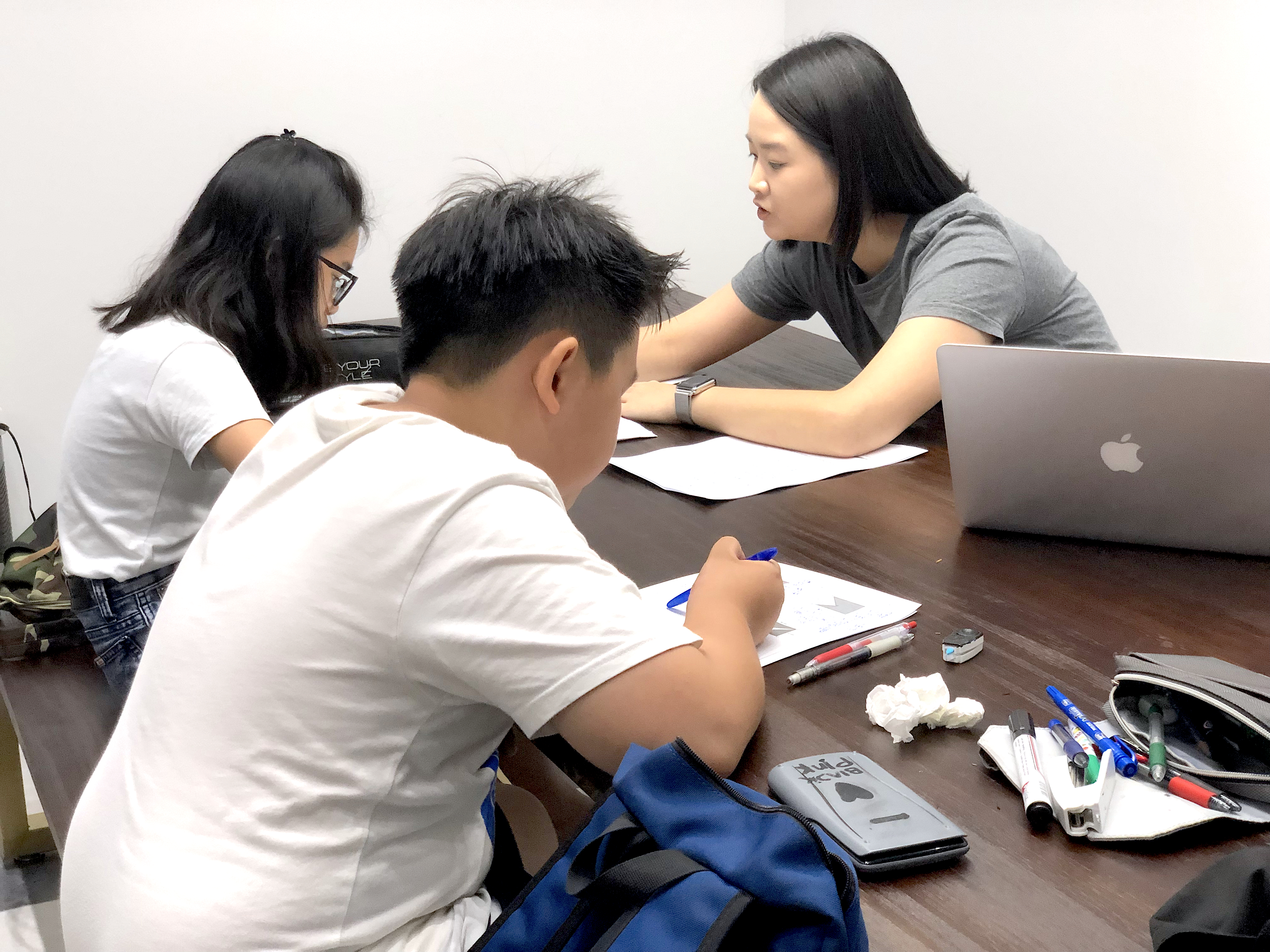
A small group of three is useful when students do not merely take turns giving the same answer. One student can present an interpretation, another can identify the strongest evidence for it, and the third can challenge the assumption. Roles can rotate. The tutor listens for reasoning rather than rewarding the fastest speaker.
Productive disagreement also teaches academic tone. Students learn to say, “That reading fits this detail, but it may not explain the shift in the final paragraph,” instead of treating disagreement as personal rejection. This matters in seminars, oral assessments, collaborative inquiry and mature writing.
Vocabulary should sharpen distinctions
Advanced vocabulary is useful when it makes a distinction the student actually needs. Words such as ambivalent, dismissive, elegiac, sardonic, conciliatory or provisional are not valuable because they sound sophisticated. They are valuable when they name a precise quality that “sad”, “angry” or “uncertain” cannot capture.
Tutors should therefore teach vocabulary through contrast, collocation and use. Compare “critical” with “cynical”; “nostalgic” with “sentimental”; “assertive” with “aggressive”. Then ask the student to defend the choice using textual evidence. Vocabulary becomes analytical equipment.
Grammar still matters at high levels
Analytical sophistication does not excuse unclear sentences. In fact, complex ideas place greater pressure on grammar. Students need control over clause structure, reference, tense, punctuation and sentence boundaries so that reasoning remains visible.
- Can the reader tell what each pronoun refers to?
- Does the subordinate clause attach to the intended idea?
- Does punctuation reveal the logical relationship?
- Has the sentence become so long that the main claim disappears?
Editing should protect thought. A simpler sentence is often better than an impressive sentence the writer cannot control.
Research and source judgement belong in advanced English
IP and IB students often encounter tasks that require independent research, contextual reading or source use. The English tutor should therefore teach source judgement, not merely provide background notes. Students can ask who produced a source, for what audience, with what evidence and with what possible limitation.
They should also distinguish quoting from integrating. A research paragraph is not a collage of external voices. The student’s argument remains in control: introduce the source because it serves a purpose, represent it accurately, then explain what the source changes in the argument.
Reflection should produce a next action
“I need to improve analysis” is too vague. Useful reflection names the decision that failed. Perhaps evidence was selected too quickly. Perhaps the student described technique but not effect. Perhaps the thesis was too broad. Perhaps discussion ideas never reached the essay.
A small reflection log can record: what I attempted, where the reasoning weakened, what repair I used, and what I will test next. The next tutorial should include that test. Reflection then becomes part of learning rather than a ceremonial paragraph written after an assignment.
The first tutorial should diagnose the thinking process
A useful first session does not need an enormous placement test. Give the student a short unfamiliar text, time to annotate, a few discussion questions and one analytical paragraph. Observe how the learner enters the task.
- What is noticed first?
- Does annotation record ideas or merely underline?
- Can the student explain why evidence matters?
- Does discussion change the interpretation?
- Can the student turn speech into writing?
- Can the student revise after feedback?
The goal is to locate the first weak link, not to attach a label to the student.
A six-week analytical repair cycle
A short cycle can be more useful than vague long-term promises. Week 1 establishes the baseline and one priority. Week 2 trains noticing and evidence. Week 3 develops interpretation and alternative readings. Week 4 converts discussion into analytical paragraphs. Week 5 introduces synthesis or comparative work. Week 6 uses a fresh text and reduced prompting to test transfer.
The exact sequence changes with the student, but the principle remains: teach one capability, apply it in several forms, then remove support. If performance collapses when the text changes, the learner has memorised the surface rather than internalised the method.
How small-group tuition should differ from a lecture
A small group should increase the number of visible decisions per lesson. The tutor can hear three interpretations, compare three pieces of evidence and ask students to respond to one another. This is very different from delivering a polished explanation while students copy notes.
There should also be quiet individual work. Seminar talk can create the illusion of mastery because students borrow one another’s ideas. A fresh paragraph written alone reveals whether the reasoning has become personal property.
What parents should ask about IP or IB English support
- Does the tutor know which programme and course the student actually follows?
- Is the tuition built around the school’s current tasks rather than a generic O-Level worksheet?
- How are unseen texts used?
- Does discussion lead to stronger writing?
- Are alternative interpretations welcomed when evidence supports them?
- How are research and source use taught?
- How does the tutor measure independent transfer?
The answer should describe a learning process, not simply promise “advanced materials”. Difficulty is useful only when the task develops a capability.
What progress looks like
- Annotations become selective and idea-rich.
- Students quote less but explain more.
- Claims become narrower and more defensible.
- Discussion responses build on or challenge prior points.
- Alternative readings are considered without losing direction.
- Comparative writing becomes genuinely comparative.
- Vocabulary names precise distinctions.
- Research sources are integrated rather than pasted.
- Feedback is converted into specific revision decisions.
- Fresh texts can be handled with fewer tutor prompts.
Common failure pattern: device spotting
Students can become very good at circling metaphors, repetition and rhetorical questions while remaining weak readers. The repair is to ban the technique label temporarily. Ask the student to describe what changed in the reader’s experience. Only after the effect is clear should the technical term return. This reverses the usual order and makes terminology serve interpretation.
Common failure pattern: theme dumping
A student memorises themes such as identity, power, conflict or belonging and inserts them into every answer. The repair is textual specificity. Ask what exact conflict, what form of power, whose identity, under what condition. Then require evidence that would not work equally well for a different text. A theme becomes useful only when it is made particular.
Common failure pattern: polished but empty introductions
Some introductions sound academic because they contain broad statements about humanity, society or literature. They may delay the actual argument. A stronger introduction establishes the interpretive problem, names the relationship being examined and gives the reader a clear direction. The tutor can ask students to remove every sentence that would fit ten unrelated essays.
Common failure pattern: discussion dependence
A student performs brilliantly after hearing peers but struggles on an unseen task alone. The solution is not to remove discussion. It is to pair discussion with independent reconstruction. After the seminar, close the notes and ask the student to write the argument from memory, using a new extract where possible. Independence must be tested deliberately.
Common failure pattern: over-writing
High-achieving students sometimes equate length with sophistication. They produce paragraphs with multiple claims, several quotations and long contextual detours. The tutor should practise compression: state the claim in one sentence, choose the strongest evidence, explain the mechanism and stop when the paragraph has done its job. Concision is a form of control.
A seminar exercise: the strongest objection
Give each student a claim about a text. Student A defends it. Student B must construct the strongest reasonable objection using evidence. Student C decides what evidence would settle the disagreement or whether the claim needs qualification. Then rotate roles. The exercise trains argument, listening, evidence selection and intellectual generosity.
A writing exercise: one quotation, three readings
Select one short quotation with genuine ambiguity. Ask the student to produce three plausible readings, each supported by a different feature of the language or context. Then rank the readings and explain the ranking. The point is not that every interpretation is equally valid. The point is that evidence determines which reading deserves confidence.
A synthesis exercise: same question, different text types
Pair a literary extract with a non-literary text that addresses a related issue: belonging, authority, memory, technology, consumption or public identity. Ask how form changes what can be said. A speech can address an audience directly; a poem may use ambiguity; an advertisement may compress argument into image and slogan. Students learn to compare choices, not just topics.
A revision exercise: cut thirty per cent
Take a completed analytical paragraph and require the student to remove thirty per cent of the words without weakening the reasoning. Redundant quotations, repeated claims and decorative phrases become visible. Then ask whether any explanation was cut too far. This develops sentence control and teaches the difference between complexity and clutter.
A transfer exercise: change the surface
After analysing a poem, give the student a short speech or advertisement that uses a related rhetorical move. After comparing two narratives, switch to two visual texts. The analytical question remains similar while the surface changes. If the student can select a new entry point and explain the new evidence, the method is becoming transferable.
How this page avoids cannibalising ordinary Secondary English tuition
This page is not the owner for general Secondary 1 transition, O-Level English examination strategy or PSLE English. Its job is narrower: IP/IB-oriented analytical English through seminar questioning, close reading, argument and synthesis. Students who need final-year O-Level timing, basic grammar repair or a Primary English foundation should be routed to the relevant level owner instead of forcing every English need into one page.
Frequently asked questions
Is IP English the same in every school?
No. Integrated Programme schools can differ in curriculum design, text selection, assessment and whether the subject is called English, Language Arts or another school-specific name. Tuition should begin with the student’s actual school tasks and rubrics rather than assume one national IP worksheet sequence.
Is IB English simply harder O-Level English?
No. IB language and literature courses have their own aims, texts and assessment structures. They include sustained critical interaction with literary and/or non-literary texts and value written and oral expression. The tutor should know the student’s exact course before designing support.
Should a strong student still study grammar?
Yes, but grammar should be taught as control rather than elementary drill. Complex analytical ideas require clear clause structure, accurate reference and disciplined punctuation. The student may not need hundreds of isolated grammar questions; they may need precise editing of their own sentences.
How much literature should tuition cover?
Enough to support the learner’s current programme, but tuition should not become a substitute for school teaching. It is often more valuable to strengthen analytical habits that work across texts: evidence selection, interpretation, comparison, contextual awareness and argument.
Can small-group tuition work for advanced students?
Yes, if the group is used for reasoning. Students should challenge interpretations, compare evidence and respond to one another. The tutor must still include independent writing so group intelligence does not hide individual gaps.
Teaching Guide: a reusable seminar-to-writing lesson
Step 1 — Cold read. Give students an unfamiliar text with no background lecture. Allow several minutes for quiet annotation. Ask them to mark only details they can explain, not every device they recognise.
Step 2 — First claim. Each student states one interpretation in a single sentence and identifies one piece of evidence. The tutor records differences rather than immediately deciding which answer is “correct”.
Step 3 — Seminar challenge. Students ask one another evidence questions: “Which word supports that?”, “What else could this mean?”, “Does the ending change your reading?” The tutor intervenes only when discussion becomes unsupported or repetitive.
Step 4 — Context injection. Introduce one useful contextual detail, genre convention or audience fact. Ask students whether it strengthens, weakens or complicates their first claims. Context earns its place by changing interpretation.
Step 5 — Analytical paragraph. Students write independently. Require one clear claim, selective evidence and explanation of how the textual choice produces meaning. Encourage qualification if the seminar revealed a genuine alternative.
Step 6 — Compression edit. Cut redundant phrasing and unnecessary quotation. Check whether each sentence advances the argument. Repair grammar where complexity has obscured meaning.
Step 7 — Transfer. Give a shorter fresh text of a different type. Use the same broad question but remove most tutor prompts. This is the independence test.
Step 8 — Reflection. Students record one decision they handled well and one decision they will test again: evidence selection, alternative interpretation, synthesis, sentence control or discussion response. The next lesson begins with that target.
A seminar question bank for independent practice
Students can use a compact question bank when the tutor is not present. The aim is not to answer every question every time. Choose the questions that expose the most useful uncertainty in the text.
- What is the text asking me to notice first?
- Which detail would I keep if I could quote only one line?
- What changes between the opening and the ending?
- Where does the voice become more certain, doubtful, intimate or distant?
- Which word carries more meaning than its dictionary definition suggests?
- What would a reader miss if this image, sentence or paragraph disappeared?
- What assumption about the audience does the text seem to make?
- Which part of my interpretation is observation, and which part is inference?
- What evidence would make me change my mind?
- What is the strongest alternative reading, not the easiest one to dismiss?
- How does form shape what can be said here?
- Can I state my final claim more precisely after answering these questions?
The question bank also gives parents and tutors a useful progress signal. Early on, students may need the questions supplied in order. Later, they should select the right question for the problem in front of them. The most important shift is from external prompting to internal self-questioning. When a learner begins to pause and ask, “What evidence would make me change my mind?” without being told, seminar habits have started becoming independent reading habits.
For homework, the student can choose two questions before annotating and two different questions after drafting. This creates a before-and-after record of how interpretation changes through evidence. Over several weeks, the tutor can notice which questions the student avoids. Avoidance is useful diagnostic information: a learner who never tests alternatives may be overconfident, while one who never commits to a final claim may need help deciding when the available evidence is already sufficient.
The deeper purpose of IP/IB English tutorials
The point of advanced English tuition is not to manufacture impressive vocabulary or pre-write interpretations for school texts. It is to help students become more capable readers and thinkers when the answer is not obvious.
A strong student should eventually be able to enter an unfamiliar text, notice what matters, ask a useful question, build an interpretation, test it against evidence, listen to a serious alternative, refine the claim and express the result with clarity. That sequence is valuable in IP classrooms, IB language-and-literature study, university seminars and any future work that depends on reading complicated material responsibly.
For families searching in Sengkang, the local label should remain secondary to that learning job. The useful question is not whether a page says “IP” or “IB” often enough. It is whether the student becomes increasingly able to think, speak and write without borrowing the tutor’s mind.
Related English guides and official references
- Small-group IP English tutorials in Yishun
- Secondary 1 English transition in Sengkang
- International Baccalaureate — Studies in Language and Literature
Historical image archive




















Leave a Reply