

Sengkang English Tuition Centre Sec 1 Sengkang Tutor keeps its original 2019 title, but this rebuilt page now owns a precise diagnostic job for families searching for Secondary 1 English tuition in Sengkang, Sec 1 English tutor, comprehension, vocabulary, grammar, sentence writing, paragraph writing, oral communication and lower-secondary school support. Secondary 1 students often experience the same mistake repeatedly without recognising that the errors belong to a pattern. One week the issue appears in comprehension, another week in homework, and another week in writing. Without a pattern system, every error looks new.
A strong Sec 1 English tuition programme should therefore build an error-pattern ledger. The student learns to name recurring error families, identify the first weak link, apply one targeted repair, prove it on fresh work, retest after delay and decide whether the pattern stays in Repair or moves to Maintain. The aim is not to collect mistakes. It is to reduce repeated mistakes by converting them into reusable learning rules.
This page owns one learning loop: notice → classify → diagnose → repair → fresh retest → delayed retest → maintain. It complements other Secondary 1 pages on feedback decoding, homework conversion, self-questioning, classroom note-making and long-text reading. Here, the central question is: how does a student stop treating every wrong answer as an isolated event and start seeing the small number of mechanisms that keep producing the errors?
Why Error Patterns Matter in Secondary 1
Secondary 1 is a transition year. The texts become denser, instructions less familiar and writing more independent. Students can therefore make many visible mistakes even when the number of underlying causes is small. A vague answer, a weak paragraph and an unclear oral response may all come from the same underlying problem: the student cannot make the reasoning explicit.
The Ledger Is Not a Punishment Book
The purpose is not to record every wrong answer forever. The ledger should contain only recurring, high-value patterns that can guide future action.
A good ledger is:
- small;
- specific;
- actionable;
- updated;
- linked to fresh proof.
The Seven Main Error Families
- task interpretation;
- evidence selection;
- inference and reasoning;
- vocabulary precision;
- grammar and sentence control;
- paragraph development and cohesion;
- self-checking and transfer.
Error Family 1: Task Interpretation
Visible errors include:
- answers wrong question;
- misses “two reasons”;
- uses wrong paragraph;
- gives evidence when explanation is required;
- uses wrong audience or purpose.
Task Interpretation Repair
Use:
command → target → quantity → boundary → output.
The student paraphrases the task before answering.
Error Family 2: Evidence Selection
Visible errors include:
- copies too much;
- chooses a weak clue;
- misses distributed evidence;
- uses outside knowledge instead of text evidence.
Evidence Repair
Use:
smallest complete evidence boundary.
The student marks where the evidence begins and ends.
Error Family 3: Inference and Reasoning
Visible errors include:
- repeats the clue;
- guesses;
- overstates certainty;
- gives example without explanation;
- fails to connect evidence to claim.
Reasoning Repair
Use:
clue → interpretation → why it fits → alternative check.
Error Family 4: Vocabulary Precision
Visible errors include:
- vague words;
- wrong synonym;
- unnatural collocation;
- register mismatch;
- definition known but usage wrong.
Vocabulary Repair
Record:
- exact meaning;
- part of speech;
- collocation;
- fresh sentence;
- register.
Error Family 5: Grammar and Sentence Control
Visible errors include:
- tense shift;
- subject-verb disagreement;
- unclear pronoun;
- run-on sentence;
- fragment;
- wrong word form.
Grammar Repair
Do not write “grammar” in the ledger. Name the family precisely:
tense / agreement / pronoun / boundary / word form.
Error Family 6: Paragraph Development and Cohesion
Visible errors include:
- point only;
- example without explanation;
- three unrelated ideas;
- mechanical connectors;
- paragraph drifts from the question.
Paragraph Repair
Use:
point → support → explanation → link.
Then check whether every sentence serves the paragraph job.
Error Family 7: Self-Checking and Transfer
Visible errors include:
- same correction repeats next week;
- student needs tutor to point out error;
- method works only on labelled worksheet;
- student cannot explain what changed.
Transfer Repair
Use:
correction → fresh task → delayed task → mixed task.
The Error-Pattern Ledger
| Date | Error family | First weak link | Repair rule | Fresh proof | Status |
|---|---|---|---|---|---|
| W1 | Inference | no evidence | clue first | 4/5 correct | Repair |
| W2 | Pronoun | unclear antecedent | repeat noun | fresh paragraph ✓ | Maintain |
First Weak Link
The visible error is not always the first cause.
Example:
Wrong inference → question misread → wrong evidence area → wrong answer.
The repair begins at question interpretation, not at inference wording.
The Error Chain
Use:
task → method → evidence → reasoning → expression → check.
Find the first broken step.
Do Not Label Everything “Careless”
“Careless” hides mechanisms. Ask:
- Was the instruction missed?
- Was the method forgotten?
- Was time pressure involved?
- Was the student overconfident?
- Was checking absent?
When Carelessness Is Real
If the student knows the method, recognises the error after one glance and repeats the same slip under low load, then attention habits may matter. Even then, the repair should be specific: one final pronoun check, one quantity-word circle or one tense pass.
Frequency Matters
A one-off mistake should not become a permanent ledger item.
Promote an error to the ledger when it:
- repeats;
- costs significant marks or clarity;
- appears across tasks;
- survives correction.
Severity Matters
A frequent minor spelling slip may be less urgent than a recurring task-scope error that invalidates an entire answer.
Repair Value Matters
Prioritise errors that are:
- recurring;
- high-cost;
- repairable;
- transferable across components.
The Priority Matrix
| Pattern | Frequency | Cost | Priority |
|---|---|---|---|
| Misses question scope | High | High | Immediate |
| Rare spelling slip | Low | Low | Monitor |
| Tense shift in every essay | High | Medium/High | Immediate |
One Active Repair at a Time
Students cannot consciously manage ten new correction rules while reading or writing.
Choose one or two active patterns per lesson.
The Personal Rule
Every active error becomes one short rule.
Examples:
- “Circle the number of points.”
- “Clue before inference.”
- “Name the pronoun referent.”
- “Explain the example.”
Repair the Original
First, the student corrects the original error and explains why.
Fresh Retest
Then use new material.
The student should not see the same sentence or passage.
Delayed Retest
Bring the pattern back after several days.
Delayed success is stronger evidence.
Mixed Retest
Finally, hide the error family inside mixed work.
The student must detect it without a label.
Moving From Repair to Maintain
A pattern can move to Maintain when the student can:
- recognise it;
- repair it;
- transfer it;
- repeat after delay;
- self-check without prompt.
Maintain Does Not Mean Ignore
Stable skills reappear periodically in mixed work.
Retired Patterns
Some patterns become so stable that they need only occasional observation.
Do not keep them on the active page forever.
Why the Ledger Should Shrink
A good ledger becomes smaller as patterns are repaired. If the ledger only grows, the system is recording errors rather than solving them.
Comprehension Error Patterns
Common families:
- scope;
- evidence;
- reference;
- inference;
- language effect;
- answer completeness.
Writing Error Patterns
Common families:
- task drift;
- weak paragraph job;
- thin explanation;
- weak cohesion;
- grammar under load;
- rushed ending.
Vocabulary Error Patterns
Common families:
- wrong context meaning;
- wrong word form;
- poor collocation;
- register mismatch;
- overuse of vague words.
Grammar Error Patterns
Common families:
- tense;
- agreement;
- sentence boundaries;
- pronoun reference;
- articles;
- prepositions.
Oral Error Patterns
Common families:
- one-sentence answer;
- generic example;
- repetition;
- weak follow-up;
- memorised response.
Homework Error Patterns
Common families:
- starts before reading instruction;
- asks for help too early;
- copies correction;
- does not retest;
- spends too long on one item.
Cross-Component Patterns
The most useful patterns often appear in several places.
Example:
Vagueness appears in comprehension answers, oral responses and essay claims.
One precision repair can therefore help three components.
Pattern Clustering
If several errors share one cause, cluster them.
Example:
- unclear pronoun in writing;
- reference error in comprehension;
- vague oral “they”.
Cluster:
reference clarity.
Do Not Over-Cluster
Different mechanisms should remain separate if the repair differs.
The Monthly Ledger Review
Once a month, ask:
- Which patterns disappeared?
- Which patterns repeat?
- Which errors changed form?
- Which skills need a harder retest?
Student-Led Error Review
The student should increasingly identify the pattern before the tutor comments.
Use the Sentence: “This belongs to…”
Example:
This belongs to the evidence family because I chose a clue that was too broad.
Small-Group Error Lab
Three students examine anonymised errors and classify them.
Then each finds one related error in their own work.
Do Not Compare Error Counts
The goal is diagnostic accuracy, not ranking.
A 90-Minute Error-Pattern Lesson
- 10 min: retrieve current active patterns.
- 15 min: review marked work.
- 15 min: classify error families.
- 15 min: identify first weak link.
- 15 min: repair original.
- 15 min: fresh retest.
- 5 min: ledger update.
Worked Case: “Inference” Error Is Actually Task Scope
The student misread “what does this phrase suggest?” as “what happened?”
The ledger records task interpretation, not inference.
Worked Case: Grammar Error Keeps Returning
The student corrects tense exercises accurately but shifts tense in writing.
The ledger changes from “tense rule” to “tense transfer under writing load”.
Worked Case: Paragraph Is Thin
The student has a point and example but no explanation.
The ledger rule becomes “after example, explain what it proves”.
Worked Case: Same Vocabulary Mistake Across Tasks
A vague word appears in writing and oral.
The repair becomes precision and collocation, not separate task-specific corrections.
Worked Case: Student Fixes Error Only When Tutor Marks It
The next retest removes location cues.
Detection becomes the active target.
Parent Reporting From the Ledger
Useful update:
Task-scope errors have moved to Maintain after three fresh retests. Pronoun reference remains active because it still appears in longer writing.
Green / Amber / Time-Sensitive
Parents can receive:
- Green: stable and independent;
- Amber: improving but still fragile;
- Time-sensitive: recurring high-cost pattern requiring current focus.
Do Not Report Every Mistake
Report the patterns that explain the mistakes.
What Parents Can Watch For
- The child names recurring error families.
- Corrections become more specific.
- Fresh retests follow corrections.
- The active error list becomes smaller.
- The student detects errors earlier.
- Adult prompting reduces.
What Not to Do
- Do not record every small slip.
- Do not label everything careless.
- Do not keep vague categories such as “grammar”.
- Do not consider copied correction as proof.
- Do not leave stable patterns in Repair forever.
A Twelve-Week Error-Pattern Build
Weeks 1–2: build first ledger and error families.
Weeks 3–4: first-weak-link diagnosis.
Weeks 5–6: targeted repairs and fresh retests.
Weeks 7–8: delayed and mixed retests.
Weeks 9–10: cross-component clustering.
Weeks 11–12: student-led ledger and maintenance decisions.
Frequently Asked Questions
How many errors should be tracked?
Only a small number of recurring, high-value patterns that can guide action.
Why not write every mistake down?
Because the ledger should help prioritise repair rather than become an archive of failures.
What is the first weak link?
The earliest step in the process where the method broke. Fixing it often prevents later errors in the chain.
When does an error move to Maintain?
When the student can detect and repair it on fresh and delayed work with little or no prompting.
What is the independence goal?
A student who can recognise recurring error families, choose the right repair and prove improvement without waiting for the tutor to diagnose everything first.
The Secondary 1 Error-Pattern Rule
Do not collect mistakes. Compress them into patterns, repair the pattern, and keep testing until the pattern stops returning.
Deep Practice: Error Frequency Versus Error Cost
Ask the student to compare two patterns: one frequent but low-cost, one less frequent but high-cost. A repeated minor spelling slip may be less urgent than occasionally misunderstanding a two-part question. The exercise teaches prioritisation. Students learn that improvement is not simply reducing the largest number of red marks; it is repairing the patterns that most affect meaning, marks and independence.
Deep Practice: Same Pattern, Different Surface
Prepare three tasks where the same underlying weakness appears differently. Reference clarity can appear as an unclear pronoun in writing, a “what does this refer to?” comprehension error and a vague oral response. The student identifies the shared mechanism and writes one rule that can repair all three. This develops transfer and prevents duplicated correction systems.
Deep Practice: Error Detection Without Location Cues
Once a student can repair an error after it is pointed out, remove the exact location cue. First mark the sentence, then the paragraph, then nothing. The student runs a personal risk check independently. This progression separates repair knowledge from detection skill and reveals whether self-editing is becoming genuine.
Deep Practice: Error Pattern After Delay
Two weeks after an error moves to Maintain, include the same mechanism inside unrelated mixed work. Do not warn the student. If the pattern remains controlled, confidence increases. If it returns, move the pattern back to Repair with the new failure condition recorded. This makes maintenance evidence-based rather than permanent by assumption.
Deep Practice: Student Explains the Ledger to a Parent
Ask the student to explain one Green, one Amber and one active repair pattern in plain language. The explanation should include evidence and the next proof. If the student cannot describe the pattern, ownership is still weak. This simple conversation turns the ledger from a tutor record into a learner-managed system.
Error-Pattern Independence Gate
Use one fresh mixed task with no error labels, no highlighted locations and no live hints. The student completes, self-checks, identifies any recurring pattern and proposes the repair. The ledger is becoming independent when the student can detect the mechanism before the tutor reveals it and can prove the repair on another fresh task.
Final habit: every correction ends with the sentence, “Next time I will notice this when…”. That prediction helps the student recognise the pattern earlier in future work and turns feedback into a forward-looking decision rule.
Deep Practice: Building the Ledger From Real School Work
The most useful ledger entries come from authentic school conditions. Bring one marked comprehension, one writing assignment and one homework page. Instead of listing every correction, circle only the mistakes that repeat or connect across tasks. A comprehension scope error and a writing task-drift error may belong to the same instruction-fidelity family. A pronoun error in writing and a reference error in comprehension may belong to the same reference-control family.
This cross-task view prevents the student from believing that every worksheet creates a new weakness. The tutor is looking for the few mechanisms that generate many visible mistakes. Once those mechanisms are named, practice becomes smaller and more focused.
Deep Practice: Turning Teacher Comments Into Ledger Categories
Teacher comments such as be precise, elaborate, unclear, answer the question, evidence? and grammar should be translated into actionable families. “Be precise” may mean vague nouns, weak verbs or overbroad claims. “Elaborate” may mean missing explanation rather than missing examples. “Grammar” may need to become tense, agreement, sentence boundary or word form.
The student first attempts the translation. The tutor then confirms or refines it. This process makes external feedback part of the student’s own diagnostic system rather than a separate set of mysterious red marks.
Deep Practice: Error Pattern Versus Content Gap
Not every wrong answer is a process error. Sometimes the student simply does not know a word, concept or background reference. The ledger should distinguish knowledge gaps from process gaps. A knowledge gap needs learning. A process gap needs a repeatable method.
For example, not knowing the meaning of reluctant is a vocabulary gap. Misreading reluctant despite strong context clues may be a context-inference process gap. The repair differs. One requires building the word network; the other requires a context-clue routine.
Deep Practice: Error Pattern Versus Performance Breakdown
A student may know the method and still fail under time, fatigue or unfamiliar wording. That is a performance-condition problem. The ledger should record the condition: tense stable untimed, breaks in timed narrative or inference stable on familiar passages, weak on dense nonfiction.
This level of detail prevents unnecessary reteaching. The student may not need the rule again. The student may need the rule under a harder condition.
Deep Practice: Detecting Error Cascades
One early error can produce several later errors. A misread question leads to the wrong paragraph, which leads to weak evidence, which leads to a wrong inference. If the tutor records all four as separate weaknesses, the ledger becomes misleading.
Reconstruct the chain and circle the first avoidable failure. The other mistakes are consequences. Repairing the first link often collapses the whole cascade. This is one reason the ledger remains small even when a marked paper looks heavily corrected.
Deep Practice: Error Families in Long Reading
Long passages produce characteristic patterns:
- loses paragraph purpose;
- forgets earlier information;
- misreads reference chains;
- confuses speaker and writer;
- rereads entire text repeatedly.
These can be grouped under text-navigation and working-memory control rather than treated as five unrelated weaknesses. The repair may be paragraph-job mapping plus targeted rereading.
Deep Practice: Error Families in Writing
Writing errors can be separated into stages. Planning errors include off-task ideas or too many events. Drafting errors include thin explanation, poor sequencing or sentence overload. Language-control errors include grammar, reference and vocabulary precision. Editing errors include failure to detect known risks.
Stage-based classification helps the tutor place the repair where it belongs. A weak ending may be caused by poor time allocation rather than weak language. A vague paragraph may be caused by thin planning rather than vocabulary.
Deep Practice: Error Families in Oral Communication
Oral performance can fail through content, structure, language or interaction. A student may have no example, repeat the same point, use vague vocabulary, ignore the follow-up or freeze after one missing word. The ledger should name the actual family.
Then the retest changes. A follow-up problem needs unpredictable questions. A vocabulary retrieval problem needs paraphrase-and-continue drills. A structure problem needs position→reason→example practice.
Deep Practice: Error Families in Homework Independence
Some errors occur before the English task begins. The student may start without reading instructions, open notes before attempting retrieval, ask for help at the first difficulty or copy a correction without testing it. These are study-process patterns.
Track them only when they repeat and interfere with independence. The repair can be an independent first attempt, uncertainty marks, a help threshold or compulsory fresh transfer after correction.
Deep Practice: Creating Better Repair Rules
A repair rule should be short enough to retrieve under pressure and specific enough to change behaviour. Weak: “Be careful.” Strong: “Circle the number of points.” Weak: “Explain more.” Strong: “After the example, write what it proves.” Weak: “Improve grammar.” Strong: “Check the timeline before scanning verbs.”
Students should help write the rule. A personally worded rule is often easier to remember than a tutor’s long explanation.
Deep Practice: Testing the Repair Rule
A rule is not proven because the student can recite it. Give a new task where the rule is needed. Do not remind the student. If the learner applies the rule correctly, the first transfer is successful. If not, ask whether the rule was forgotten, not recognised or poorly executed.
Those are different failures. Forgotten rules need retrieval. Recognition failures need mixed practice. Execution failures need more controlled practice.
Deep Practice: Prompt-Level Tracking
For each active pattern, record the support required:
- full model;
- several guided questions;
- one targeted cue;
- location cue only;
- self-check;
- independent.
Prompt reduction is often more informative than raw accuracy. A student who gets five answers correct with five tutor prompts is not at the same independence level as a student who gets four correct alone.
Deep Practice: Moving a Pattern Back From Maintain
Maintenance is not permanent immunity. If a pattern returns twice under fresh conditions, reopen it. Record the new context: perhaps the error appears only in longer texts, only late in a paper or only when two characters are present.
This updated condition becomes the new repair target. The student is not “back to zero”; the skill needs to be extended to a harder context.
Deep Practice: Preventing Ledger Overload
Limit the active ledger to a small number of patterns. If five new errors appear in one assignment, ask which belong to existing families and which are one-off slips. The active page should contain only the patterns that deserve behavioural attention now.
Older resolved patterns can move to an archive. The archive exists for history, not for daily anxiety. The visible active ledger should feel manageable.
Deep Practice: Weekly Student Conference
At the end of the week, the student answers four questions:
- What pattern did I see most?
- What rule am I using?
- What fresh task proved improvement?
- What still needs another test?
This turns the ledger into a decision tool rather than a tutor-owned record.
Deep Practice: Error Pattern Transfer Across Subjects
Some English process habits support other subjects. Instruction fidelity, evidence selection, paragraph explanation and precise vocabulary can help in Humanities and Science responses. The student can notice these transfers without turning the English ledger into a whole-school tracking system.
The purpose is to recognise that certain reasoning habits are portable. This often increases student motivation because the repair has value beyond one English worksheet.
Deep Practice: Parent Checkpoint Language
A useful parent update should include the pattern, current support level and next proof. Example: “Question-scope errors have reduced; the student now marks quantity and boundary independently on fresh comprehension tasks. Next week we will test the same routine inside a timed mixed paper.”
This language is more informative than “careless mistakes are improving” because it explains what changed and what evidence will confirm it.
Deep Practice: Building the Student’s Personal Error Manual
After several months, the learner may have a small personal manual of five or six recurring risks and their repair rules. The manual should not contain every historical error. It should contain only high-utility patterns that still matter.
Before an assessment, the student reviews this compact manual rather than hundreds of old corrections. That is the payoff of compression: a large history of mistakes becomes a small operating checklist.
Deep Practice: Error Prediction Before a Task
Before starting a familiar task type, ask the student to predict the two errors most likely to occur. After completion, compare prediction with reality. Accurate prediction shows self-knowledge. Inaccurate prediction reveals that the student’s internal model of their weaknesses needs updating.
This pre-task forecasting also makes checking more efficient because the student knows where to look first.
Deep Practice: Fresh Transfer Across Genres
If a repair works in one narrative passage, test it in nonfiction. If a pronoun-repair works in one essay, test it in situational writing. If paragraph explanation works in argumentative writing, test it in an expository paragraph.
Cross-genre success shows that the repair belongs to the student rather than the original worksheet.
Deep Practice: Delayed Independent Proof
Two or three weeks after moving a pattern to Maintain, include it invisibly inside mixed work. No reminder, no label and no highlighted location. The student completes and self-checks. If the pattern remains controlled, confidence increases.
If it returns, record the condition and reopen the pattern with a narrower repair. The ledger stays alive but does not become punitive.
Deep Practice: End-of-Term Ledger Compression
At the end of a term, sort all patterns into:
- Stable;
- Maintenance;
- Active Repair;
- Next Build.
Delete duplicate labels and merge patterns that share one mechanism. This creates a clean handover into the next term.
The Sec 1 Error-Pattern Independence Gate
Use a fresh mixed English task with no live hints. The student completes it, runs a personal check, identifies one error family if present, explains the first weak link and proposes the repair. Then give one fresh retest.
The system is independent when the student can do most of this before the tutor speaks. At that point, mistakes have become information the learner can use rather than events that require adult rescue.
Final Diagnostic: Is the Pattern Actually Shrinking?
A ledger should produce measurable reduction. Compare the last four pieces of work rather than one isolated result. Ask whether the error appears less often, costs fewer marks, requires less prompting and is caught earlier by the student. Improvement may show first in detection before it shows in total disappearance. That still matters because earlier detection gives the learner more control.
If the pattern is not shrinking after several repair cycles, question the diagnosis. The visible error may belong to a different family, the repair rule may be too vague, or the task may be exposing a harder condition such as time pressure. Re-diagnosis is better than repeating the same worksheet indefinitely.
Maintenance Design
Once a pattern stabilises, maintenance should be light and mixed. A pronoun-reference pattern might reappear in one paragraph every fortnight. An inference pattern might appear inside a mixed comprehension set. The student is not told in advance that the skill is being checked.
Maintenance protects retrieval without consuming the lesson. If the skill survives several spaced checks, it can move further into the background. If it returns, the ledger captures the new condition and reopens the repair.
Building a Personal Final-Check Routine
By the end of Secondary 1, the student should have a short personal checking routine based on evidence from the ledger. One learner may check quantity words, pronoun clarity and sentence boundaries. Another may check inference evidence, paragraph explanation and tense. The routine should contain only a few high-frequency risks.
This is more useful than a giant generic checklist because it reflects the student’s actual history. As patterns stabilise, the list should change. The check routine therefore becomes a living summary of the ledger rather than a permanent set of warnings.
What Mastery Looks Like
Mastery does not mean making no mistakes. It means that errors become easier to classify, repair and prevent. The student can look at a wrong answer and say, “This is a scope problem,” or “My evidence is fine; the explanation is missing.” The tutor’s role shifts from naming the problem to confirming the diagnosis and raising the difficulty.
That change is one of the clearest signs of independence. The student is no longer waiting for a red mark to explain what happened. The learner begins to recognise the pattern while the work is still being produced.
The Secondary 1 Error-Pattern Independence Gate
Use one fresh mixed task containing comprehension, sentence work and a short paragraph. The student completes it with no live hints, runs the personal check, identifies any recurring pattern, writes the repair rule and attempts one fresh retest. Afterwards, compare the student’s diagnosis with the tutor’s.
The system is ready for maintenance when those diagnoses usually align and the active ledger remains small. At that point, the student has learnt one of the most important habits in Secondary English: mistakes are not random verdicts on ability. They are evidence about a process that can be named, repaired and tested again.
One final rule closes the ledger: every active pattern must have a next proof. If no fresh or delayed test is scheduled, the correction remains only a discussion. The ledger is useful because each entry points forward to an observable decision about whether the skill still needs repair or can safely move to maintenance.
The student should always know what evidence will decide the pattern’s next status.
Historical Image Archive
The original image archive remains below as part of this page’s history.



Singapore English tuition with Tutor Yuet Ling. With Singapore school’s requirement for English as a First language, our primary aim in teaching English are highly focussed on tasking English student’s communication skills to be competent as well as to be an effective, accurate and efficient tool to absorb and relay information to others.
English is Singapore’s main language of communication and it is imperative that our student’s English Language skills are on parity with the requirements set forth by the Ministry of Education to study well in school. It is the main skill that will help students to perform consistently across their other subjects as their ability to understand and use English effectively will help them to comprehend what is taught in class and asked in tests.
English Tuition Centre with English tutor of 20 years in the business helping English students to improve their ability to communicate. An improvement of their linguistic competence in both the passive reading/listening and active speaking/writing process of the English Language are part of our course curriculum.
With that in mind, our English classes are geared to teach and train our students to be able to understand the media that they read or hear, and to have the ability to express and communicate their complex thoughts and ideas to others naturally. Any improvements in information absorption and dissemination will automatically translate to cognitive skills and ultimately, help students to do well in their studies.
English should be treated as our native language, to be the main Lingua franca for a cosmopolitan Singapore where over generations, English has been integrated well into our everyday life. As a first language, the focus of our tuition will be to task our Yishun students to learn the skills needed to communicate proficiently for both their studies in school as well as for their everyday life.
Local English Tutor for English tuition are the dependable, trustworthy tutor that delivers the results. Join our English tutorials and have our English Teacher get you on track. Small groups of 3.
increase general knowledge and all necessary skills needed for the PSLE
score maximum marks by understanding the marking scheme of the examination
in a safe, comfortable air con environment with properly equipped classes
by discerning tutors that can detect weaknesses, solve student’s problems during class
by qualified female tutors with experience in improving students for the crucial PSLE
Give us a call at +65 82226327 for more information on our Singapore English classes.
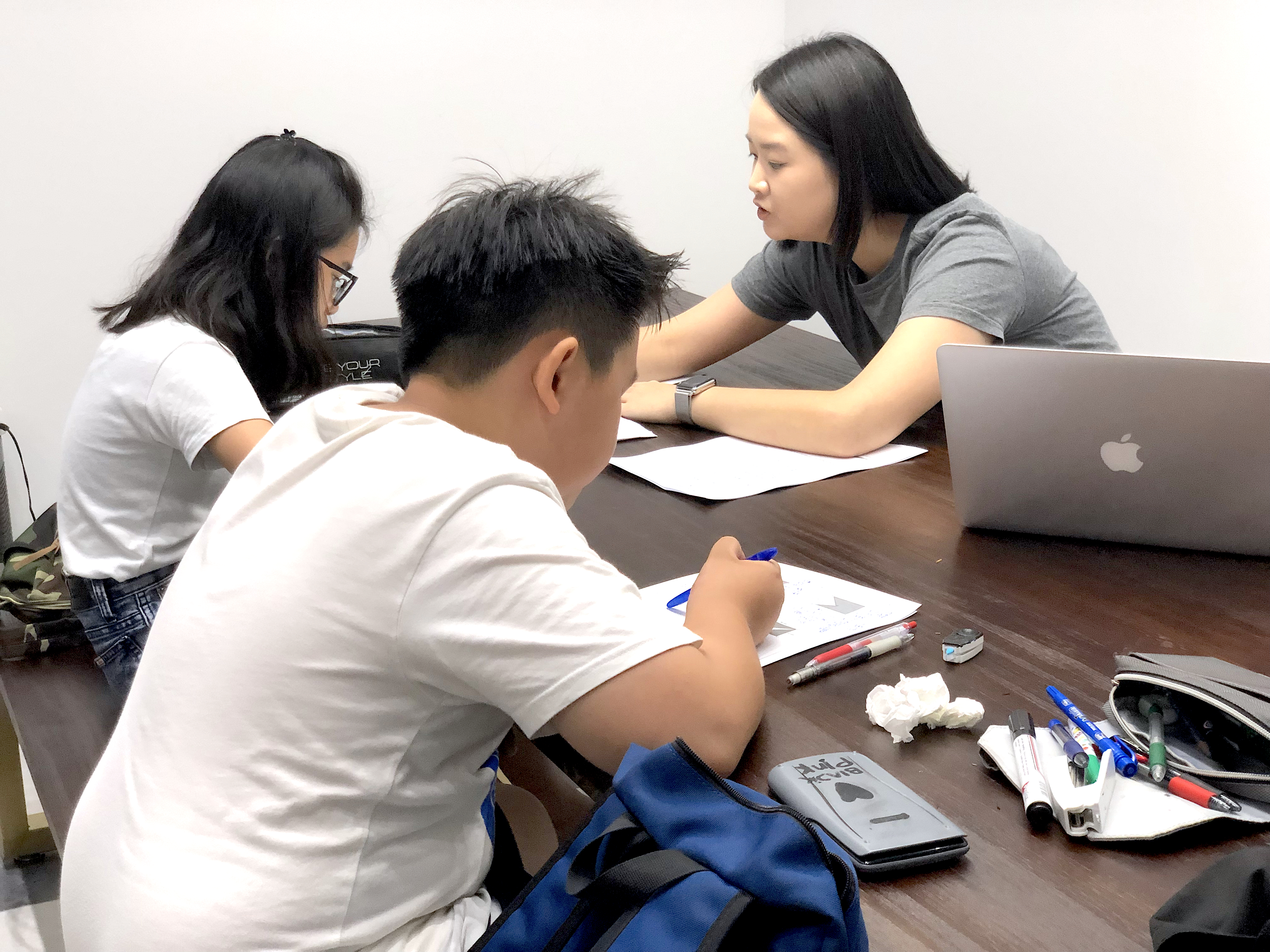













Pri3 Yishun The best Pri 3 English Tuition in Yishun with SEAB MOE PSLE syllabus English. Pri3 Yishun Primary English Tutor for Pri1 Pri2 Pri3 Pri4 Pri5 Pri6 PSLE English Paper 1 and Paper 2.
Call Yuet Ling +65 82226327 for our Pri3 Yishun English classes.


Learn English and make it useful.
Working closely with parents are part of our teaching culture to create the desired effect to get our English students positive changes in their studies. Our Yishun PSLE English tutors teach from scratch, making sure our English students master their language, and we do all the necessary practices from basic easy to complex advanced questions with our students, including past exam papers that helps them to understand and appreciate English as lingua franca in Singapore and use it to further their studies.
Class Culture
At eduKate Yishun, we work hard to have an affirmative class culture that empowers our students to do more, learn more, and develop a love for their own education by creating a class culture with great friends and tutors. Our positive classes also creates a constructive environment that teaches them the relevance of what they study to their everyday lives. With relevance creates the true reason for a proper education. That is our trademark that differentiates our teaching to others, but don’t just take our words for it, let these photos show you how much our passion and love for our Yishun student’s English lessons.





Leave a Reply