
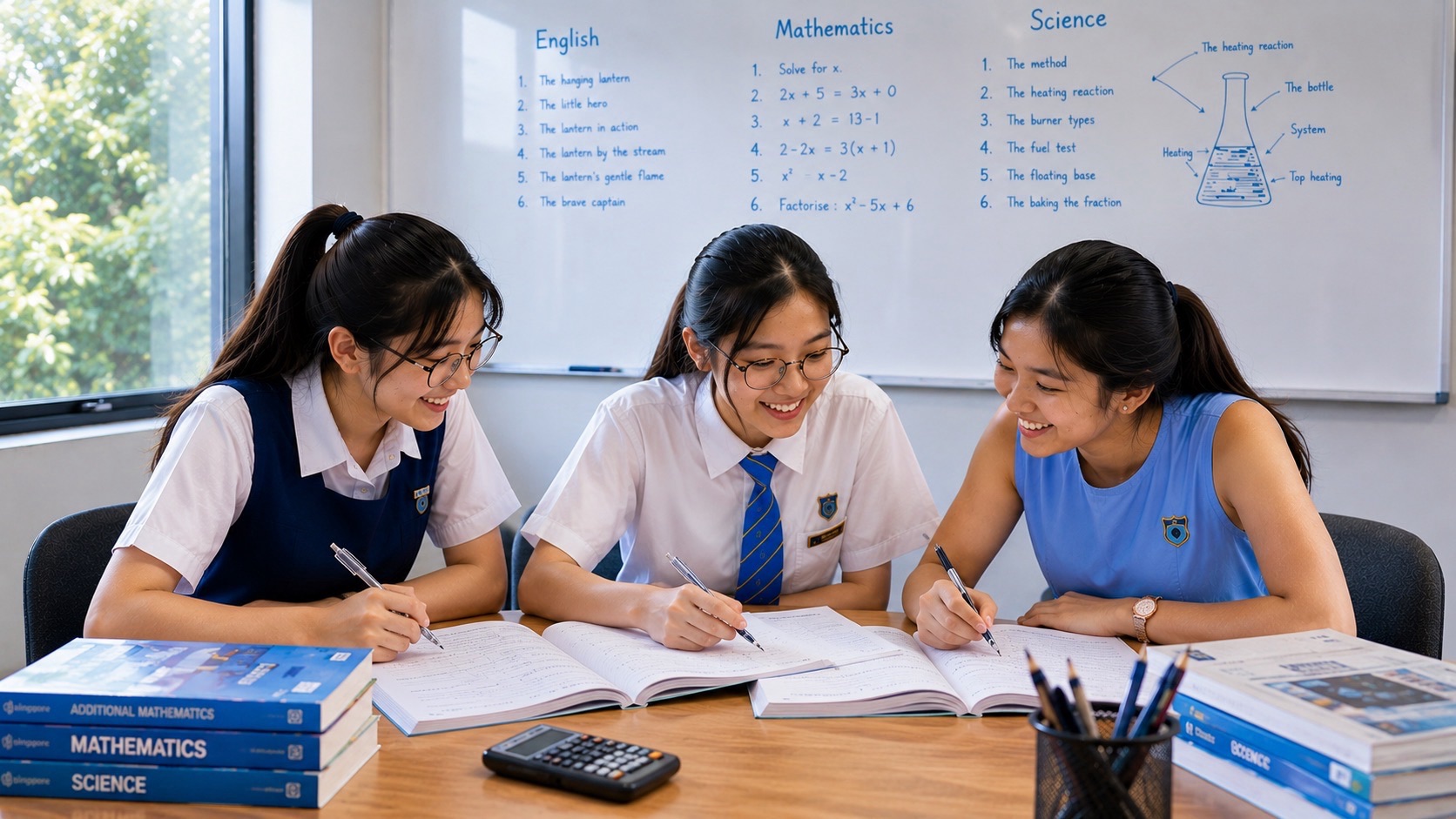
Should parents choose a secondary school according to whether their child wants Junior College, Polytechnic or ITE after PSLE? Consider the child’s interests and likely learning needs, but do not lock a twelve-year-old into a post-secondary institution today. A secondary school should provide eligible Full Subject-Based Banding subjects at appropriate G1, G2 or G3 levels, good core teaching, guidance, CCAs and opportunities to explore. The Singapore-Cambridge Secondary Education Certificate (SEC) begins in 2027, and MOE will introduce a new Post-Secondary Admissions Exercise in 2028. For a pupil entering Secondary 1 in January 2027, final post-secondary criteria may evolve further before graduation, so the sensible choice is a school that builds foundations and keeps suitable future options open.
PSLE 2026 results are released Tuesday, 24 November at 11.00am. The six-school choice form is available from 11.30am that day until Monday, 30 November 2026 at 4.30pm. Yishun families can investigate their eight local mainstream secondary schools plus eligible options elsewhere by actual Posting Group, subject availability and learning fit. This guide compares the JC/MI, Polytechnic, Polytechnic Foundation Programme and ITE routes, explains the importance of individual SEC subject levels and separates official 2028 reforms from uncertain admissions rules the child may face around 2031.
- Do not confuse PG1/PG2/PG3 Secondary 1 posting with later JC, Polytechnic or ITE admission categories.
- SEC starts in 2027 for relevant mainstream graduating cohorts, with subjects at G1, G2 and G3 levels.
- MOE’s new Post-Secondary Admissions Exercise begins in 2028, replacing several previous posting exercises; future rules must be checked again.
- Different post-secondary routes value different subjects, qualifications, interests and programme readiness.
- Ask prospective schools about actual Secondary 3 subject options, academic support and career guidance, not guaranteed destinations.
- Compare eight Yishun schools and reachable alternatives for teaching, CCAs, commute and fit.
- Rank six genuinely desirable eligible Secondary 1 schools and use only correct historical cutoff references.
1. Your child does not need to decide a lifelong career on PSLE results day
The PSLE helps place pupils into secondary programmes suited to their current learning. It is not a university application and should not be treated as a career allocation. A child who enjoys Mathematics at twelve may later discover Literature, design or biomedical Science. Another who struggles with writing may become more confident after years of practice. Parents can use early interests to ask better questions about schools but should not declare that a particular Posting Group permanently determines where the child can study after secondary education.
A sensible first school choice asks whether the child will learn foundational English, Mathematics, Science, Mother Tongue and wider subjects appropriately. It also asks whether the school can help a pupil build study habits, confidence and practical interests. Later post-secondary pathways depend on the child’s actual achievements, selected subjects and rules that apply at that time. A child who develops steadily in a suitable school may discover more options than the family imagined during the first stressful weeks after PSLE.
2. The 2026 PSLE choice timetable comes before future pathway planning
| Official event | Time | Immediate action |
|---|---|---|
| PSLE results released | 24 November 2026, 11.00am | Read total score, four subjects and permitted PG |
| S1 choices open | 24 November 2026, 11.30am | Use eligible school programmes and family preference |
| S1 choices close | 30 November 2026, 4.30pm | Submit six choices in S1 Portal with Singpass |
| Posting results | Tentatively 18 December 2026 | Follow MOE’s later confirmation and reporting information |
SEAB’s official 2026 PSLE results announcement confirms the calendar and advises families to consider school culture, subjects, CCAs and distinctive programmes. It recommends two or three choices with historically less stringent previous cutoffs where suitable. That is the right practical time horizon for November 2026. A future desire to attend Polytechnic does not authorise selecting an ineligible Secondary 1 Posting Group or ignoring a school that would be excellent for the child’s current needs. Parents should complete the actual S1 decision first, with wider pathways in mind but not as guarantees.
3. What SEC changes for families choosing schools in 2026
MOE’s SEC and Full SBB reforms explains that the new Singapore-Cambridge Secondary Education Certificate examination replaces the separate former N- and O-level examination arrangements from 2027 for relevant graduating cohorts. Subjects are examined at their appropriate G1, G2 or G3 level under Full Subject-Based Banding. This is important because a pupil should not be described with an outdated fixed secondary-stream label. The child’s subject profile may include different levels reflecting strengths and readiness, with opportunities to consider changes according to the current criteria.
SEC is a school-leaving qualification framework, not a direct instruction that every student must go to one post-secondary institution. What matters for later admissions is the set of subjects offered, relevant grades and the criteria of the intended course. Parents should ask secondary schools how the child chooses eligible subject combinations and how academic and career education is provided. A school with clear support for the child’s actual learning can be more valuable than one chosen because a distant post-secondary destination sounds prestigious.
4. What MOE announced for the 2028 Post-Secondary Admissions Exercise
MOE 2026 changes to post-secondary admissions sets out the new Post-Secondary Admissions Exercise (PSE) starting in 2028. It replaces older posting arrangements for JC, Millennia Institute, Polytechnic and ITE pathways after the new SEC results are released. It is designed so that eligible pupils can apply to a range of post-secondary routes around the same time after receiving results. Under the announced framework, choice order is introduced as a tie-breaker alongside citizenship and other specified criteria. This reflects a more integrated system rather than assuming pupils must decide among completely unrelated application calendars at Primary 6.
The 2028 PSE reform applies to students graduating and applying at that stage. A child entering Secondary 1 in January 2027 would normally complete four secondary years in 2030 and may apply for post-secondary courses around 2031, subject to their actual education route. Therefore the family must not freeze 2028 criteria as guaranteed 2031 rules. A good school choice prepares pupils to understand changing requirements and select appropriate subjects later. The child should keep learning and interests broad enough to adapt.
5. Junior College and Millennia Institute: academically focused post-secondary routes
MOE Junior College and Millennia Institute information explains that Junior Colleges usually offer a two-year pre-university route towards the Singapore-Cambridge GCE A-level examination, while Millennia Institute provides a three-year route. Pupils considering these options should eventually understand the required language, Mathematics and other subject combinations under the applicable admissions criteria. However, the present PSLE result does not determine their final A-level eligibility. A school that teaches the child’s subjects well and supports steady progress is the real starting point.
A pupil interested in JC might benefit from a secondary school with strong English and Mathematics teaching, suitable G3 subjects and opportunities for Humanities or Sciences, as permitted. But choosing the school with the smallest historic PSLE cutoff is not a substitute for later performance. Parents can ask how schools advise pupils on relevant subject combinations in Secondary 3 and what support is available when a child develops a new interest. A school may be an excellent fit even without a JC on the same campus.
6. Polytechnic: applied learning and academic foundations both matter
MOE Polytechnic education describes diploma education that includes course-based theoretical and practical learning. Polytechnic is not simply an easier or less academic route: different diplomas have demanding entry criteria and substantial subject requirements. A child interested in engineering may need strong Mathematics and Science, while another considering media or business may need appropriate language, creative and analytical skills. Families should ask what each secondary school does to develop these foundations rather than promise admission to a specific diploma at age twelve.
MOE’s 2024 SEC reform announced that from the 2028 Polytechnic Year 1 intake, a G2 subject may be used in a revised ELR2B2 computation, while the remaining four relevant subjects generally continue to be required at G3 under the published arrangements. The announced aggregate threshold also changed to reflect the new calculation. These are specific 2028 policy details, not evidence that one G2 subject guarantees a place in Polytechnic. Course-specific criteria, actual grades and the rules in force when the child graduates remain essential.
7. Polytechnic Foundation Programme: eligibility is not a PSLE promise
The Polytechnic Foundation Programme (PFP) is another possible route for eligible secondary pupils meeting the relevant SEC subject and programme criteria. It should not be described as automatically available to every pupil who enters through PG2, or as a guaranteed choice from a PSLE total. Full Subject-Based Banding recognises subject-specific progress, but later PFP admission depends on actual examination results, eligible combinations, course vacancies and current rules.
Parents can ask secondary schools how they guide pupils who may prefer applied study and whether appropriate G2 or G3 subjects are available according to their strengths. A learner interested in design or technology may discover a Polytechnic diploma goal during Secondary 2 or 3. The family should support that exploration and use official future course information, not teach the child that one Posting Group automatically guarantees a foundation route. The aim of choosing a good secondary school is to provide meaningful development and valid future options.
8. ITE: skills-based and technical learning deserves accurate information
Institute of Technical Education offers Higher Nitec and other technical or work-study training pathways with industry-related skills and progression opportunities. For a child who enjoys practical problem-solving, work with tools, hospitality, healthcare support or digital technology, an ITE pathway may be meaningful. It is not appropriate to frame ITE as a punishment for a disappointing PSLE score. Entry criteria vary by programme and future qualification results, and a pupil may develop different interests and strengths over the secondary years.
MOE’s new PSE plans include ITE admission alongside other post-secondary routes, which can help families make choices based on strengths and interests after actual SEC results. Parents choosing a Secondary 1 school now should ask how teachers support practical learning, literacy, numeracy and career exploration. A technical future still requires dependable habits and clear communication. The appropriate secondary school helps a child become more capable, not merely points them towards one institution because of an early result.
9. The old Express, Normal Academic and Normal Technical labels should not decide 2027 school choice
Families who studied under older secondary streams may recall separate course labels and examination pathways. The current incoming Secondary 1 cohort enters a Full Subject-Based Banding environment where Posting Groups and individual subject levels replace that old fixed categorisation. Parents should learn the correct G1, G2 and G3 subject names and the available subject combinations. It is misleading to tell a PG1 pupil that they are permanently assigned to a single old examination pathway and cannot develop further.
MOE PSLE and Full SBB pathway guide describes how mixed form classes and differentiated subjects can cater for pupils with different strengths. A child may initially study a particular subject at G2 and another at an appropriate level, subject to eligibility. Future subject-level changes and post-secondary admissions have specified criteria; they are not unconditional. A school can help a pupil understand realistic next steps without making promises about a future Polytechnic or JC place years before graduation.
10. Subject levels matter more than a school label
| Topic | What to ask your secondary school | Why it matters later |
|---|---|---|
| English Language | How is reading, writing and precise communication taught? | Language ability is important across many post-secondary routes |
| Mathematics | How are algebra, geometry and reasoning developed at the actual level? | Many courses specify relevant mathematical foundations |
| Science | What subject combinations and practical experiences are available? | Science-related routes can have specific subject needs |
| Mother Tongue | Which languages and higher-level opportunities are offered? | Can matter for language studies and broader eligibility |
| Humanities | What subjects and inquiry skills are taught? | Supports academic breadth and communication |
| Applied programmes | What normal projects teach problem-solving? | Helps pupils explore practical interests |
| CCA and LLP | How are leadership, teamwork and service developed? | Broadens student development without replacing grades |
A child may be interested in science but struggle with formal writing. The family should seek a school that develops both, not assume a science-themed ALP is sufficient preparation for an engineering diploma. Another pupil may enjoy creative media but find mathematical data interesting; different programmes can help them explore the overlap. The school should offer appropriate core teaching and opportunities to learn about the real world. Strong everyday learning is a more dependable foundation than an early guess at a particular future course.
11. Yishun families have eight mainstream secondary schools to examine
The eduKate’s eight Yishun secondary schools identifies Ahmad Ibrahim, Chung Cheng High School (Yishun), Naval Base, Northbrooks, Northland, Orchid Park, Yishun Secondary and Yishun Town. Their distinctive themes include media literacy, food science, art, aerospace, design for older adults, visual and performing arts, and sonic arts. These interests may help a child discover subjects they want to pursue later. They do not guarantee a particular Polytechnic diploma, JC subject combination or ITE course.
A family should compare the actual child’s eligible Posting Group, subject offerings and school support first. A pupil who enjoys engineering may like Northbrooks’ applied aerospace experiences, while one interested in communication may value Ahmad Ibrahim’s inquiry focus. Another may appreciate a balanced curriculum and short commute at a different Yishun school. The programme that motivates the child is useful, but a future post-secondary goal should not override basic eligibility, teaching quality or safe travel.
12. School-specific future guidance is better than predictions
A secondary school’s career guidance should help pupils understand their strengths, interests and the range of available education routes as they mature. Ask when pupils begin to explore subject combinations, how teachers communicate eligibility and whether families receive information about Polytechnic, JC/MI, ITE and other courses. A good answer does not need to know the exact 2031 admissions thresholds. It should explain how pupils learn to plan, seek guidance and make choices using current information when they reach the relevant stage.
The school can also support pupils who change direction. A student who initially expects JC may discover a practical Polytechnic course; another may start with an ITE goal and later pursue additional qualifications through progression routes. The family’s attitude matters: avoid treating one route as a moral victory and another as a failure. Children benefit when adults discuss the subjects, skills and interests relevant to each pathway with accuracy and respect.
13. How to plan without overcommitting at twelve
One practical approach is to distinguish three time horizons. The first is November 2026: secure a suitable and eligible Secondary 1 school. The second is lower secondary: learn which subjects and activities the child genuinely enjoys and what skills require support. The third is upper secondary and post-secondary admissions: use actual grades, subject levels and official requirements to choose realistic courses. This prevents a family’s distant ambition from distorting the immediate posting process.
For example, if a pupil says they want to be a doctor, parents can encourage Science and reading while recognising that the child may change goals. If a pupil wants to be an engineer, focus on mathematical reasoning and problem-solving. If a child is interested in design, seek creative opportunities and communication skills. None of these needs to determine the exact Secondary 1 school or promise a university course. A good school provides strong foundations and exposure rather than a prematurely fixed destination.
14. What if the child wants JC but scores 21 or 22 at PSLE?
A pupil with total 21 or 22 may be offered PG2 or PG3 under ordinary eligibility. The family should examine individual subject results, current learning readiness and actual school options before selecting the permitted group. A desire to attend JC years later does not by itself make PG3 the correct current choice or guarantee eligibility for that route in the future. Subject-specific learning can develop under Full SBB, with changes at appropriate points when the pupil meets criteria.
Parents should ask prospective schools how they support pupils who are strong in Mathematics but need help in English, or vice versa. A sound starting route may build confidence and allow continued progress. Later JC admission requires the relevant examination results and subject requirements under the policy in force when the child applies. The child should be encouraged to study well, not made to believe that a single Posting Group choice has fixed the rest of their life.
15. What if the child hopes for Polytechnic but has a PG1/PG2 option at 25?
A total of 25 may offer PG1 or PG2. This is an immediate decision about the permitted starting curriculum and school route, not a guaranteed Polytechnic course selection. Parents should examine how the child learns and where support is available. A child who enjoys technical work may benefit from applied learning, but academic foundations are still important. The family should distinguish a hands-on interest from the assumption that every hands-on learner belongs in one Posting Group.
The future PFP and Polytechnic Year 1 rules depend on SEC subject levels, qualifications and course-specific requirements. Ask schools how pupils can develop their strengths and which G2/G3 subjects may be offered under the current criteria. The family can keep Polytechnic as a possibility without promising admission. Choosing a school where the child can sustain academic progress is more useful than choosing one that advertises a vocational interest but cannot offer the child’s actual eligible route.
16. What if a child at Score 27 is interested in ITE or technical pathways?
At total 27, ordinary PG1 eligibility requires English and Mathematics each AL7 or better. Parents should verify the official subject results before listing schools. A child can have real strengths in practical design, craft or technology and benefit from a suitable curriculum. Under the current 2026 results instructions, eligible PG1 or PG1/PG2-option pupils interested in hands-on learning may also consider Crest or Spectra through the schools’ separate direct application process. That is not the same as a blanket ordinary S1 school option.
A technical post-secondary interest should be treated constructively. The family can compare mainstream learning with relevant specialised practice-oriented pathways according to the actual criteria and pupil’s wishes. A child may later study at ITE, progress to higher qualifications or pursue a different field. Parents cannot predict the final route from the PSLE score. What they can do is choose an environment with clear teaching, appropriate support and a chance to discover and develop strengths.
17. The strongest numerical PSLE score does not decide every later choice
A pupil with PSLE total 6 or 10 may have many academically selective secondary schools to research and still prefer a Polytechnic diploma later. Strong examination performance does not obligate every child to enter JC. A programme should be chosen for the student’s interests, desired learning style and future qualifications at the relevant stage. Similarly, a child with a less competitive PSLE result may improve significantly and develop unexpected strengths during secondary education.
Parents should not use early scores as forecasts of individual income, happiness or social worth. Good school choice involves recognising the child’s actual learning and supporting sustained growth. Teachers may help pupils understand future subject demands as their results develop. A family that allows its child to explore while remaining realistic about admission criteria can make better decisions than one that treats JC as the only successful outcome.
18. Different post-secondary routes can all involve demanding study
| Possible later route | Type of learning to investigate | Not a guaranteed outcome |
|---|---|---|
| JC / MI | Pre-university subjects, A-level examination, academic depth | Requires actual later eligibility and scores |
| Polytechnic diploma | Applied course knowledge, projects and academic foundations | Has course-specific admissions and vacancies |
| PFP | Foundation route for pupils meeting relevant criteria | Not automatic for all PG2 or G2 pupils |
| ITE Nitec / Higher Nitec | Practical and technical training with further progression options | Depends on applicable qualification and course requirements |
| Arts or specialised institutions | Talent, academic and programme-specific assessments | May have separate application routes |
| IP upper years | Programme-specific A-level, IB or other qualification structure | Not identical to four-year mainstream SEC pathway |
The pathways differ, but they are not simple rankings of educational value. A pupil who excels at hands-on technical learning may be highly motivated by an ITE programme and later develop additional skills. Another may prefer an academically intensive pre-university route. Both can require persistence, communication and thoughtful planning. A child entering Secondary 1 should build those general capacities before feeling responsible for choosing a final destination.
19. School fees and commuting can influence later opportunities
A family may discover a relevant school programme far from Yishun, but the child must travel there daily during the secondary years before any later post-secondary course begins. Long journeys can reduce time for sleep, homework and CCA participation. Costs may include transport, meals, uniforms, materials and selected activities, with financial assistance available for eligible pupils. These practical factors can affect learning now far more than the distance to a Polytechnic the child may or may not attend years later.
Check the actual school address, programme and public transport journey. A school close to a future JC or Polytechnic does not guarantee the child a post-secondary place there or create automatic affiliation for admissions. A parent should not choose a secondary school simply because its postcode resembles a desired future campus. Secondary schooling is a separate educational stage. Focus on current teaching, school culture, subject offers and manageable family logistics.
20. The difference between academic subject eligibility and career interest
A pupil can love computer graphics while struggling with Mathematics, or enjoy practical laboratory work without understanding long written explanations. Future courses may require specific subjects and results, so school counsellors should help the pupil recognise the academic foundations of an interest. A good secondary school can explain how to choose appropriate subjects in Secondary 3 and what improvement is needed. Parents should not claim that enthusiasm alone will meet every later entry requirement.
Conversely, strong grades do not require a child to abandon creative interests. A pupil who takes demanding Science subjects may still enjoy arts and service-learning programmes. The goal is a coherent education, not a career rehearsal in which every lesson is selected for a job ten years away. A school that fosters curiosity and teaches reliable habits may prepare the pupil for a range of futures better than one chosen around a rigid career plan.
21. Ask schools about actual Secondary 3 subject combinations
Many post-secondary paths depend on subjects chosen in upper secondary, so parents may reasonably ask about a school’s typical Secondary 3 options even when the child is only entering Secondary 1. The correct questions are what G2 or G3 Science, Humanities, Mathematics and elective subjects the school currently offers, what eligibility applies and how teachers advise pupils. However, no school should be expected to guarantee an individual pupil a particular 2030 subject combination based on the PSLE total alone.
Subject availability can vary by school, demand, staffing and cohort rules. A child may discover new interests and not yet meet the eventual criteria. Parents should ask how the school communicates options and helps pupils prepare during lower secondary. This is different from assuming every named school offers every desired combination. A genuine opportunity is one that the school can explain accurately, not a line copied from a future-careers infographic.
22. Yishun’s applied-learning themes can help a child explore possibilities
Northbrooks’ aerospace projects may make engineering concepts real. Chung Cheng High (Yishun)’s health and food science themes can connect to research and sustainability. Northland’s ElderTech can teach design for human needs; Naval Base’s art and digital media may spark creative industries; Yishun Secondary’s sonic arts can develop sound and technology interests. These are early experiences, not career admissions promises. A child can enjoy any of them without committing to the corresponding industry.
The family should ask whether these projects are available to all lower-secondary pupils or are selected enrichments, and how they fit normal subject teaching. A school with a sports or community-service LLP might teach leadership and teamwork relevant to any later route. Yishun Town and Ahmad Ibrahim also merit investigation for broader learning opportunities. The best fit depends on the child’s actual interests, the accessible route and daily travel, not on whether one school happens to mention a future Polytechnic course in its brochure.
23. Worked family case: a strong Science pupil interested in engineering
Consider a child at PSLE Score 14 who enjoys engineering and hopes one day to take a Polytechnic diploma. The pupil is ordinarily PG3 eligible but should still compare the exact school’s historic PG3 cutoffs, current learning programmes and travel. Northbrooks aerospace or Northland design themes might be meaningful, but the family also needs strong Mathematics, English and Science teaching. Later Polytechnic admission requires the relevant SEC subject results and official course conditions, not the school’s ALP title.
The child may change their goal and decide to take a pre-university route instead. Good teaching and appropriate upper-secondary subject choices can support that possibility. Parents should encourage genuine curiosity and ask whether the school helps pupils explore multiple routes. A family that selects a school solely because its theme resembles one job may miss a stronger all-round fit. The pupil needs room to grow, and the official S1 Posting rules remain the immediate eligibility gate.
24. Worked family case: a pupil with Score 22 and uncertain goals
A total of 22 may offer PG2 or PG3. The pupil enjoys drawing and is also interested in Science, but has not decided on JC or Polytechnic. The first decision should be the appropriate permitted Posting Group and subject learning demands, with guidance from the primary school. The family can then research schools offering that route and suitable Art, Science and general teaching. The 2028 PSE reform suggests varied later paths, but it does not decide the 2027 pupil’s final route years ahead.
For an option-band child, a lower-pressure start in a particular subject can be useful when foundations are not secure, while another child may thrive under greater challenge. The family should discuss actual English, Mathematics and Science readiness rather than selecting the route with the highest-sounding label. A school where the pupil is motivated and supported can provide the best foundation for future decisions. The child does not need to choose a specific diploma or A-level combination in November 2026.
25. Worked family case: a PG1 pupil interested in hands-on work
A fictional pupil at Score 28 meets the English and Mathematics subject condition for ordinary PG1 eligibility. The family is interested in practice-oriented education because the child likes making things and learning through activity. They can investigate eligible mainstream schools and the separate direct-application routes at Crest or Spectra where relevant, while comparing real teaching, school culture and commute. This is not a promise that a particular specialised school will accept the child or that ITE is the only future pathway.
The pupil may continue to develop academic strengths, confidence and interests over secondary education. Future ITE or other admissions depend on actual qualifications and course rules. Parents can ask whether the school teaches relevant applied skills and supports numeracy and literacy, since those foundations matter in many technical occupations. An educationally appropriate starting point is more useful than trying to force the child into a prestigious route for which they are not eligible or ready.
26. Common family mistakes about post-secondary planning
Assuming PSLE determines the final JC or Polytechnic destination
The PSLE determines current posting eligibility, while later admissions depend on secondary results, subject combinations and then-current requirements.
Parents should confirm the child’s actual route and check current official information before presenting any future pathway as fixed.Using 2028 admissions rules as a guaranteed 2031 policy
The announced PSE reform starts in 2028. A pupil entering Secondary 1 in 2027 should verify the rules when the actual future application year arrives.
Parents should confirm the child’s actual route and check current official information before presenting any future pathway as fixed.Treating Polytechnic as academically effortless
Polytechnic diplomas have specific subject and course demands. Applied learning still requires substantial literacy, numeracy and discipline.
Parents should confirm the child’s actual route and check current official information before presenting any future pathway as fixed.Describing ITE as a failure pathway
ITE provides technical and industry-oriented education and progression opportunities; the fit depends on the learner and course.
Parents should confirm the child’s actual route and check current official information before presenting any future pathway as fixed.Assuming every PG2 pupil automatically enters PFP
PFP has specific later examination, subject and eligibility requirements; Posting Group alone does not confer a place.
Parents should confirm the child’s actual route and check current official information before presenting any future pathway as fixed.Believing the school with the lowest historic cutoff is best for JC
The cutoff is an earlier admissions outcome, not a guarantee of teaching quality or later JC admission.
Parents should confirm the child’s actual route and check current official information before presenting any future pathway as fixed.Buying upper-secondary books years early
Wait for actual subject selection and school material requirements. Premature purchases can be wrong or unnecessarily expensive.
Parents should confirm the child’s actual route and check current official information before presenting any future pathway as fixed.Ignoring the child’s social and practical life
Four years of commuting, CCAs, friendships and wellbeing affect sustained learning more than a speculative future campus location.
Parents should confirm the child’s actual route and check current official information before presenting any future pathway as fixed.27. Parent questions to ask at a secondary school open house
- Which G1, G2 and G3 subject levels are available for the child’s actual route?
- How does the school identify strengths or learning gaps in lower secondary?
- How are subject combinations explained to pupils approaching Secondary 3?
- What support exists for pupils considering JC/MI, Polytechnic, PFP or ITE later?
- How do teachers develop English and Mathematics as foundations across subjects?
- Which applied learning programmes let students explore technical or creative interests?
- What do pupils learn about course choices, not just examination scores?
- How do CCAs and learning-for-life experiences develop leadership and work habits?
- Are the relevant later subjects available at the school or conditional on selection?
- Is the family able to manage the daily route, costs and after-CCA return?
28. A school finder comparison table for future pathways
| Dimension | Evidence for each secondary school | Use |
|---|---|---|
| Actual school entry | Official 2027 route and Posting Group | Hard eligibility condition |
| Core subjects | Current English, Mathematics, Science and language teaching | Foundations for multiple future routes |
| Subject options | What is actually offered in upper secondary and under what conditions | Useful planning, not a 2030 guarantee |
| Applied programmes | Real Sec 1 ALP and other experiences | Interest exploration |
| Academic and career guidance | When and how pupils learn about later routes | Supports informed future decisions |
| School culture | Student support, CCA, social environment | Day-to-day learning fit |
| Transport and cost | Actual Yishun-home commute and expenses | Sustainable school attendance |
| Previous COP | Matching programme and completed intake year | Historical admission reference only |
Do not reduce this information into an invented school score out of 100. Eligibility is a necessary condition; a previous cutoff is historical; programme fit is individual; and travel is practical. A school may be strong in one area and less suitable for this particular child in another. The family can make a thoughtful decision by identifying two or three real priorities and gathering comparable evidence. The child’s future remains open to development and new interests.
29. Frequently asked questions
Does PG3 guarantee that my child can go to JC?
No. Later JC/MI admission depends on the relevant SEC subject results and requirements when the child applies.
Does PG2 automatically mean Polytechnic Foundation Programme?
No. PFP entry depends on eligibility, actual examination results, subject levels, programme capacity and future rules.
Can PG1 pupils later pursue technical qualifications?
Yes, subject to the routes and qualifications available. The pupil’s development and later results matter.
What is replacing the old N- and O-level exams?
The common Singapore-Cambridge Secondary Education Certificate (SEC) begins in 2027 for relevant graduating cohorts.
What is new about post-secondary admissions from 2028?
MOE will introduce a unified PSE for eligible applicants to JC/MI, Polytechnic and ITE after SEC results, replacing previous posting arrangements.
Will the new 2028 PSE rules be exactly the same in 2031?
They should not be treated as an irrevocable prediction. Families must verify the official rules when the pupil actually graduates.
Is Polytechnic a good choice for a student who loves practical Science?
It may be, depending on the eventual diploma, subject eligibility, learning style and the child’s actual interests.
Does a secondary school’s ALP guarantee entry to a Polytechnic diploma?
No. ALP offers learning experiences, not a course place or admissions exemption.
Is JC necessarily better than ITE?
The routes have different structures and goals. Educational success depends on fit, qualifications and the child’s progress, not a simplistic prestige ranking.
Should a P6 child choose Secondary 3 subjects today?
No. The family can research school offerings but actual subject choices and eligibility will depend on later performance and policy.
Can Yishun children choose secondary schools outside the estate?
Yes, through eligible routes where available. Consider real travel and school fit.
When must PSLE 2026 Secondary 1 school choices be submitted?
By 4.30pm Monday 30 November 2026 through the official S1 Portal with Singpass.
30. The final six-choice decision checklist
- Read the official PSLE Score, individual subject results and selected eligible Posting Group.
- Understand SEC and Full SBB without applying outdated fixed stream labels.
- Ask schools about ordinary teaching, student support, current subject offers and career guidance.
- Treat JC, Polytechnic, PFP, ITE and specialised routes as possibilities, not guarantees from PSLE.
- Compare the child’s real interests, meaningful applied programmes, CCAs and a sustainable commute.
- Use previous cutoffs only from the correct school route and intake year; include less stringent options where suitable.
- Rank six schools the child would genuinely attend and submit by 30 November 2026 at 4.30pm.
Official references: SEAB’s official 2026 PSLE results announcement, MOE SchoolFinder, MOE S1 Posting, MOE 2026 changes to post-secondary admissions, MOE’s SEC and Full SBB reforms, MOE PSLE and Full SBB pathway guide, MOE Junior College and Millennia Institute information, MOE Polytechnic education and Institute of Technical Education. Local parent guides: eduKate’s eight Yishun secondary schools, eduKate’s six-school ranking guide and eduKate’s G1 G2 G3 subject-level comparison.
Low Power 4 evidence check — November 2026
A pathway plan that distinguishes published rules from future possibilities
MOE’s 2026 Committee of Supply announcements state that the Post-Secondary Admissions Exercise (PSE) will begin in 2028, following the first SEC examination in 2027. Students using their SEC results can apply to several post-secondary pathways in one exercise, with choice order used as a tie-breaker after citizenship. For a child entering Secondary 1 in 2027, the relevant admissions year may be later. Parents should therefore learn how the 2028 framework works without promising that every detail will remain unchanged for the child’s eventual application.
A useful parent question is: ‘Can this school help my child build enough English, Mathematics, self-management and subject confidence to make several realistic choices later?’ This is more evidence-based than asking which school’s name sounds most associated with JC or polytechnic. SEAB’s SEC guidance confirms that a student receives one certificate recording individual subject levels, G1, G2 and G3. Posting Group is an entry arrangement; it is not a permanent label that by itself determines the final post-secondary destination.
Original three-pupil pathway discussion for a family evening
Consider three fictional Secondary 1 entrants with different interests. Nadia enjoys academic reading and hopes to explore a JC path. Her family asks whether a potential school has rigorous teaching, meaningful subject guidance and opportunities to stretch in areas of strength; it does not assume that PG3 admission guarantees JC. Ravi enjoys designing objects and wants to understand engineering diplomas. His family looks for solid Mathematics and Science foundations alongside applied-learning opportunities and asks schools how subject combinations are advised later. An aerospace or robotics programme alone cannot grant polytechnic admission. Mei thrives when learning is practical and collaborative. Her family considers school wellbeing, accessible support and technical exploration while treating ITE as a credible pathway, not a punishment for a PSLE result.
- For each pupil, write two academic strengths, one learning need and one curiosity worth exploring.
- For each eligible school, ask how it supports a pupil who later changes ambitions between Secondary 1 and Secondary 3.
- Check the school’s actual year-specific subject offerings, not every subject appearing in SEAB’s national syllabus list.
- Record the 2026 S1 options deadline separately from future admission requirements; do not use a future PSE rule to select an ineligible S1 choice.
- Review the shortlist with the child and explain why every ranked school would be acceptable if allocated.
This comparison method does not predict a pupil’s 2030 or 2031 route. It improves the quality of the decision made in November 2026, when the evidence is a real score, six eligible choices and a child’s present learning needs.
Final parent principle: Choose a secondary school that teaches the child well now and gives them the confidence, subject foundations and information to make a genuine post-secondary choice later. At twelve, the most useful plan is not to predict the final institution; it is to build the ability and interest to choose wisely when the time comes.