
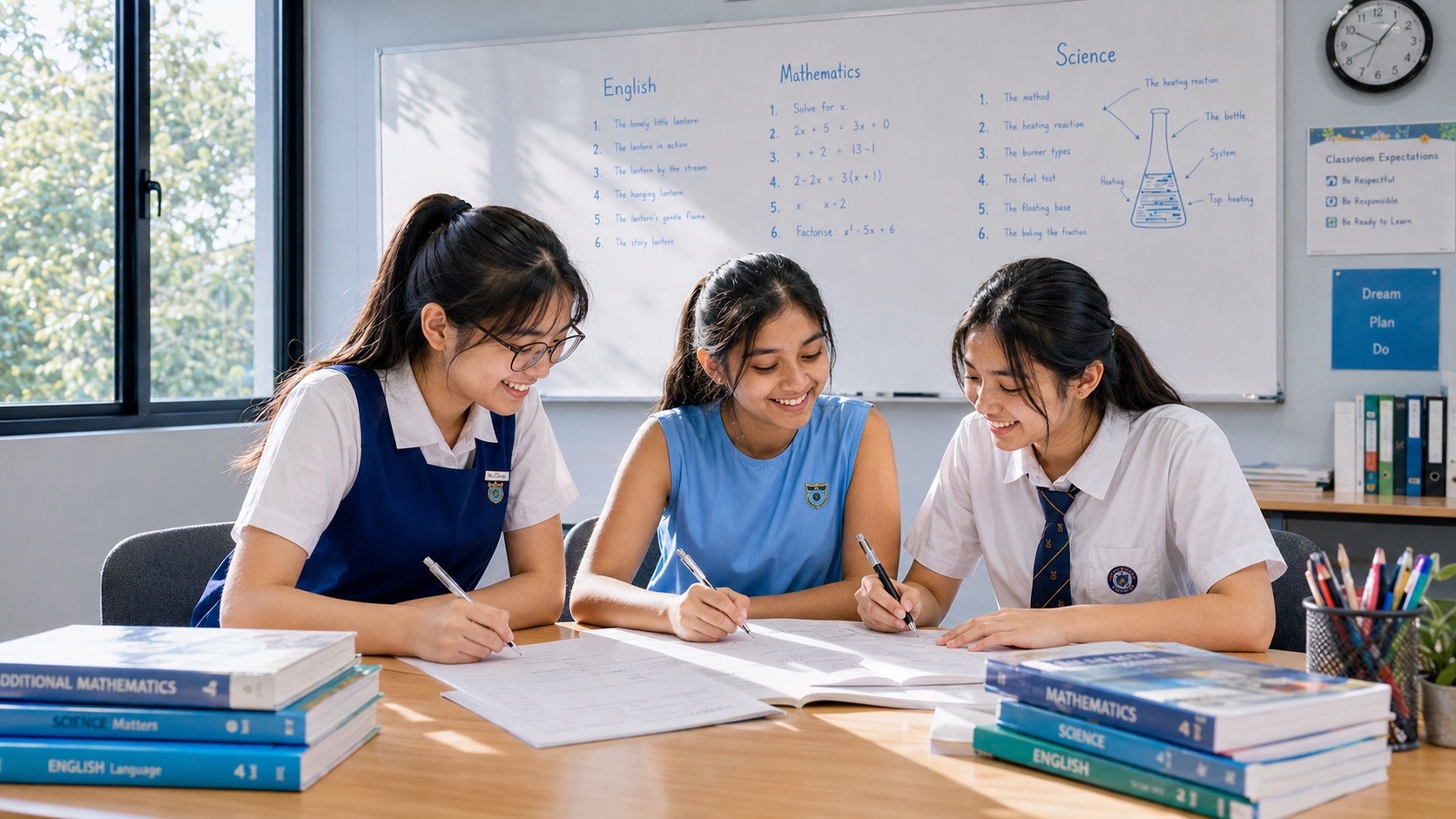
What do ALP and LLP mean when parents choose a secondary school after PSLE? An Applied Learning Programme (ALP) connects classroom knowledge with practical, real-world contexts such as aerospace, food science, digital media or design. A Learning for Life Programme (LLP) helps students develop character, values, leadership, service, arts participation, sportsmanship or outdoor skills. They are two different kinds of distinctive school experiences. In Yishun, Northbrooks’ aerospace learning, Orchid Park’s ARTopia, Naval Base’s art programme and Northland’s ElderTech provide useful ALP examples, while their LLP activities require separate research. Choose a school only after checking the child’s actual eligible Posting Group and normal subject teaching.
For PSLE 2026, results will be released on Tuesday, 24 November at 11.00am. The Secondary 1 choice window opens at 11.30am that day and closes at 4.30pm on Monday, 30 November 2026. Parents can compare ALP and LLP themes through MOE SchoolFinder and current school websites before ranking six eligible preferences. This guide identifies Yishun’s eight mainstream schools, explains broad-based versus selected activities and separates academic admission, CCAs and historic cutoff points so that families do not promise a child an experience or 2027 school place that has not been confirmed.
- ALP focuses on using knowledge in applied contexts; LLP focuses on character, values, leadership and life experiences.
- Neither title alone guarantees a CCA, talent-track placement, specific examination subject or secondary-school admission.
- Research the eight Yishun schools individually, not as one identical programme category.
- Check whether experiences are for all lower-secondary students or selected pupils in later years.
- Confirm the school’s current PG1, PG2 or PG3 route and correct previous-year COP before ranking it.
- Ask what children actually make, investigate, practise, lead or contribute during an ordinary term.
- Submit six genuinely acceptable school choices through the official S1 Portal by 30 November at 4.30pm.
1. Two programme acronyms, two educational purposes
Many parents encounter ALP and LLP during open houses but cannot tell whether either is an examinable subject, a compulsory CCA or a special admission category. The distinction is important. An ALP uses a theme to help pupils connect what they learn in school with the world beyond the textbook. An LLP uses experiences to strengthen character and life skills. Both can enrich the school experience, but neither is a replacement for the core English, Mathematics, Science, Mother Tongue and other curriculum that the child will study at the appropriate subject levels.
MOE’s school distinctive programmes dataset records each school’s ALP and LLP domain and title where the framework applies. That makes it a useful research starting point. However, programmes can evolve, and some independent, autonomous or specialised institutions operate their own distinctive programmes rather than being listed in exactly the same ALP/LLP framework. Parents should use the current SchoolFinder and school’s own information to verify the latest form, cohort access and school type before making claims about what an individual child will receive.
2. The official 2026 PSLE calendar controls the decision
| Event | 2026 date and time | Parent action |
|---|---|---|
| PSLE results | Tuesday 24 November, 11.00am | Read result slip, subject ALs and permitted Posting Group |
| S1 school choices open | Tuesday 24 November, 11.30am | Use SchoolFinder for research and S1 Portal for submission |
| S1 preferences close | Monday 30 November, 4.30pm | Save official submission acknowledgement |
| Posting outcome | Tentatively Friday 18 December | Wait for MOE’s later confirmed date and school instructions |
SEAB’s 17 November 2026 results and S1 posting notice confirms those dates and asks pupils to choose holistically based on needs, strengths, interests, school culture, distinctive programmes, subjects and CCAs. It recommends including two or three schools whose previous cutoffs are less stringent than the child’s PSLE Score within the six preferences, where genuinely suitable. An attractive ALP or LLP may justify placing an eligible school highly, but it does not establish an admission guarantee. A family must complete the real application through MOE S1 Posting; a saved school profile is only research.
3. How to recognise a genuine Applied Learning Programme
An applied learning programme asks pupils to use concepts in a real setting. An aerospace task may involve testing models, recording results, using ratios and explaining the relationship between design and flight. A food science task may involve measuring ingredients, understanding preservation and analysing nutrition or waste. A media literacy project may ask pupils to check a source and explain why some claims are unreliable. These experiences are valuable because they connect abstract learning with observation, problem-solving and clear communication.
A school should be able to explain what students learn from a project, not only show an impressive finished product. Parents can ask what a beginner does, how teachers support children with different subject strengths, whether pupils can revise a failed attempt and what happens if a learner is not selected for a special competition. The best ALP fit depends on the child’s curiosity. A pupil who enjoys craft and technical design may like a different theme from one who prefers stories or social inquiry.
4. How to recognise a Learning for Life Programme
A Learning for Life Programme may use sports, outdoor education, service, performing arts or leadership to develop values, resilience, empathy and responsibility. A student might learn to work with teammates after a loss, plan a community service activity or reflect on an outdoor challenge. The visible activity is only one part of the lesson. Parents should ask what the school hopes pupils will learn about themselves and others, and how teachers support reflection and appropriate behaviour.
A strong LLP is not a scheme that turns every pupil into a competition champion or a student leader with a formal title. Many meaningful contributions are modest: helping a teammate, listening to a peer, managing a practical task or understanding a different community’s needs. Schools should explain which activities are shared by all pupils and which require more commitment or selection. The programme may complement CCAs, but the family should not assume it automatically counts as a particular CCA place.
5. ALP, LLP and CCA are not interchangeable
| Type | Main purpose | Important limitation |
|---|---|---|
| ALP | Real-world application of subject knowledge and skills | A project theme is not always an examination elective |
| LLP | Character, values and lifelong competencies through experiences | A leadership or sports theme does not guarantee a title or team |
| Core CCA | Regular co-curricular activity selected after admission | Auditions, trials or capacity constraints may apply |
| Talent programme / DSA-Sec | Selected development or separate admission according to criteria | Not an automatic benefit from an ALP or LLP title |
| Common curriculum | Broad lower-secondary subjects shared within Full SBB arrangements | Not identical to the school’s distinctive programme brochure |
At an open house, families may see a robotics booth, a school sports team and an engineering project beside one another. Only a detailed explanation reveals whether they represent ALP curriculum, LLP experience, a core CCA or selected enrichment. That distinction matters to a twelve-year-old whose school choice is based on the promise of joining an activity. Parents should ask which parts every pupil will experience, at what year level and with what conditions. A school can be a very good educational fit even if its most advanced demonstration is not open to all new entrants.
6. Ahmad Ibrahim: inquiry, media literacy and outdoor growth
Ahmad Ibrahim Secondary School is associated with Critical Social Inquiry and Media Literacy in the local school programme comparison. This can help pupils learn to evaluate evidence, distinguish facts from claims and communicate a reasoned viewpoint. Parents whose children enjoy current affairs, reading, debate or community questions may find the approach meaningful. Ask what the lower-secondary pupil actually does: research a local issue, compare media sources, interview someone or present evidence? A programme title cannot tell the family how the school’s ordinary English and Humanities lessons are supported.
The school’s outdoor learning and character-development theme offers a different experience. Parents can ask how pupils learn teamwork, manage challenges and reflect on responsible decisions during outdoor activities. Such experiences may support a child who is hesitant to lead in a classroom but confident in a practical group task. Check actual current arrangements and inclusivity rather than assume every activity is identical across cohorts. The child’s academic eligibility and school journey still need separate consideration.
7. Chung Cheng High (Yishun): learning through food and health
Chung Cheng High School (Yishun) has a health and food science applied-learning emphasis, sometimes described through the story of food. This provides a concrete way to connect Science with food production, nutrition, environment, waste and personal choices. A child who enjoys cooking or investigations may find these subjects accessible. Ask how teachers teach measurement, careful observation and explanatory writing rather than only tasting or preparing food. Practical work should build conceptual understanding and responsible habits.
The school also has creative and character-development activities that parents can investigate in its current profile. Check whether these experiences are broad-based or selective, and do not confuse the Yishun campus with Chung Cheng High School (Main), which has a different school identity and historical admission range. A shared heritage does not make programme access or cutoffs interchangeable. The family should verify school code, current Posting Group availability and actual location before ranking the school.
8. Naval Base: Art as a form of thinking and communication
Naval Base Secondary School has an Art Applied Learning Programme with Fine Art, Digital Media, Design and the critical study of art. These strands can help a pupil observe carefully, interpret visual messages and explain a creative decision. A child who enjoys making videos or sketching may appreciate applied learning that extends beyond traditional drawing. Ask how much general Art experience the incoming Secondary 1 cohort receives and which later specialist opportunities involve selection or particular subject requirements.
Its Learning for Life emphasis on character education through sport can develop teamwork, perseverance and respectful competition. A parent should ask what all pupils experience and how values are discussed after activities. A sports-themed LLP is not proof that every child will join a school competition squad or that all equipment and costs are identical. A child who likes both creativity and movement may find the combination appealing, but the family must still check academic teaching, CCA access and the daily journey.
9. Northbrooks: aerospace, outdoor education and the value of mistakes
Northbrooks Secondary School’s aerospace ALP can make Science and Mathematics visible through practical design, engineering, simulation or aviation-themed investigation. A pupil might compare model shapes, collect flight data and learn to refine a prototype. The educational value lies in asking a testable question and explaining the result rather than simply building something impressive. Ask whether all lower-secondary pupils experience the broad programme and which advanced activities, contests or talent pathways require separate selection.
The school’s outdoor character-development theme, associated with adventure and environmental learning, brings different aims: responsibility, resilience, care for the environment and collaboration. Parents can ask how the school prepares pupils for safe outdoor activities and offers appropriate alternatives where support needs exist. A child who is strong at conceptual Mathematics and another who learns best by making things may find different benefits. Neither the applied programme nor the LLP alone measures classroom teaching quality.
10. Northland: ElderTech, design and sporting values
Northland Secondary School’s ElderTech ALP uses technology and human-centred design to consider the needs of older adults. It can connect practical problem-solving with empathy, interviewing, observation and prototype testing. A child who enjoys engineering may also discover that technology is most useful when it solves a genuine human problem. Parents can ask how pupils identify a need, gather evidence and revise an idea after feedback. The distinction between a broad class project and a specialised design opportunity remains important.
Northland’s learning-for-life direction has included sport-related character development. The value is not only physical performance but the way students learn fair play, responsibility and cooperation. Ask the school how students participate when they are beginners or less competitive. A pupil interested in service and design may respond positively to human-centred projects, but the school choice should still reflect subject-level teaching, safe travel and the child’s willingness to attend.
11. Orchid Park: ARTopia and community outreach
Orchid Park Secondary School’s ARTopia Applied Learning Programme exposes pupils to visual and performing arts. Projects can develop artistic expression, collaboration and the ability to discuss creative work. Parents should investigate which workshops and performances involve all lower-secondary pupils and which are selected, particularly where Enhanced Art or advanced opportunities are advertised. A child who enjoys visual art but dislikes performance may still benefit from a wide-ranging introductory programme, provided the school offers appropriate learning experiences.
Its community outreach and service-oriented LLP can give pupils opportunities to consider other people’s needs, take responsibility and contribute. A parent can ask what a normal Secondary 1 pupil does during service learning and how teachers help students reflect on the experience. A school with an arts ALP and service LLP may suit a child who wants to express ideas and contribute, but none of these programme names replaces the school’s actual subject offering, admissions eligibility or CCA selection rules.
12. Yishun Secondary: Sonic Arts and empathy through the arts
Yishun Secondary School’s sonic arts ALP involves music, media and technology. A child might be attracted to recording, arranging, editing sound or collaborating on a creative performance. Ask what everyone in Secondary 1 receives and what deeper engagement or excellence opportunities involve selection. A pupil who likes digital technology but not stage performance may still have a meaningful interest in sound production; the family should not treat the programme as only for pupils with private music lessons.
The school’s LLP direction links empathy, compassion and service with arts experiences. This illustrates how applied learning and learning for life can complement one another without being identical. One focuses on developing skills through sonic arts, while the other aims to use experiences to nurture care and contribution. Parents should ask how this looks during ordinary lessons and school events, rather than assuming a glossy performance proves every pupil will become a musician or formal leader.
13. Yishun Town: an autonomous school’s distinctive provision
Yishun Town Secondary School is listed as autonomous in MOE’s school-type reference. Some autonomous schools have their own distinctive programmes and may not display an ALP or LLP in precisely the same structured dataset as standard government secondary schools. Parents should not infer that an empty ALP field means pupils receive no enrichment, leadership education or applied learning. Instead, visit the current school profile to learn about its actual curriculum, language offerings, student development and other opportunities.
A Yishun family may find Yishun Town a suitable choice because of ordinary subject teaching, school culture, CCA options or practical transport, even if a comparison table has fewer programme acronyms. That is not a defect in the data or evidence of inferior education. Ask what all first-year pupils experience, how the school supports different subject levels and what programmes develop the child’s strengths. A school can offer meaningful education without a headline ALP or LLP label.
14. A clear Yishun eight-school ALP and LLP research matrix
| School | ALP or distinctive applied-learning theme | LLP or character-development theme to verify |
|---|---|---|
| Ahmad Ibrahim | Critical Social Inquiry and Media Literacy | Outdoor learning and character |
| Chung Cheng High (Yishun) | Health/Food Science | Arts and creative expression |
| Naval Base | Fine Art, Design and Digital Media | Character through sports |
| Northbrooks | Aerospace | Outdoor adventure and environment |
| Northland | ElderTech and adaptive ageing | Sports, values and team participation |
| Orchid Park | ARTopia visual and performing arts | Community outreach and service |
| Yishun Secondary | Sonic Arts, Media and Technology | Empathy and service through the arts |
| Yishun Town | Review current autonomous-school programmes | Review current school development programmes |
The matrix combines the local eduKate overview with published school distinctive programme titles. These are research starting points and may change as school curricula evolve. Verify official current details in MOE SchoolFinder and, where useful, inspect the MOE School Distinctive Programmes dataset for the recorded ALP and LLP titles. A local school may update a programme without changing its underlying educational purpose. Parents should not use a third-party headline to promise access to a selected activity or state that all students take one precise lesson sequence.
15. ALP and LLP can appeal to children with very different scores
Posting Groups are admission pathways and are not measures of artistic talent, empathy or practical reasoning. A pupil in PG1 may develop strong creativity in an arts programme, while a PG3 pupil can enjoy outdoor teamwork or community service. A child may be academically secure but hesitant to lead, or socially confident while struggling with a subject. Distinctive programmes can provide opportunities for these strengths to grow alongside the relevant G1, G2 or G3 subject learning.
Parents should avoid describing one ALP as more advanced simply because its school had a lower previous cutoff. Each programme has educational aims, and children may respond differently. A child who loves engineering but fears public speaking might enjoy building and testing before developing presentation skills. A child who loves writing could find media literacy meaningful. The question is not whether the theme makes the school ‘best’; it is whether the child will benefit from the normal learning and support available.
16. Check the actual Posting Group before making a programme shortlist
| Total PSLE Score | General ordinary eligibility | Next question |
|---|---|---|
| 4–20 | PG3 | Does the named school offer the actual PG3 route? |
| 21–22 | PG2 or PG3 option | Which permitted route best fits readiness? |
| 23–24 | PG2 | Are programmes available through the school’s PG2 route? |
| 25 | PG1 or PG2 option | Choose an appropriate permitted route before comparing COPs |
| 26–30 | PG1 with English and Mathematics each AL7 or better | Have both subject conditions been checked? |
| 31–32 or unusual result | Individual pathway guidance | Which official school process applies? |
Full Subject-Based Banding means that pupils in mixed form classes can have different subject-level strengths and appropriate G1/G2/G3 subjects. It does not make all school admission routes interchangeable. A pupil with total 23 should not compare a school’s historical PG3 cutoff and assume a PG2 place is available. Likewise, an ALP’s attractive science experiments do not confer PG3 eligibility on a pupil whose official result permits only PG2. Start with the actual school programme, then compare learning fit.
17. Broad-based learning versus specialist opportunities
One of the most important school-finding questions is how an ALP serves ordinary pupils. A broad-based programme might expose every lower-secondary class to a design project, while an elective track, competition team or special mentorship is limited to pupils with additional interest or aptitude. Parents should ask the school to identify the two parts explicitly. A talent-track photograph cannot be treated as the everyday experience of the majority of students.
The same principle applies to LLP experiences. All pupils may participate in character-education activities, while selected leaders organise larger events or represent the school externally. A child should be able to enjoy the broad programme even without being selected for the most visible roles. Ask what a first-year pupil learns, how teachers assess participation and whether a shy or inexperienced child can contribute meaningfully. Inclusive opportunities can be more valuable than publicity around a few winners.
18. ALP is not a substitute for good Mathematics and English teaching
A programme with aircraft, robotics or media production can make school exciting, but it does not remove the need for strong conceptual teaching. A child who tests a model must still use measurements, calculations and evidence-based writing. A pupil who analyses media may need vocabulary, reading comprehension and careful argument. Parents can ask whether teachers connect the programme to ordinary subject learning, and whether pupils with gaps receive useful support rather than being overwhelmed by complex project tasks.
A programme can also benefit pupils who already excel academically, by giving them unfamiliar problems requiring persistence and collaboration. The ability to revise a design after a failed trial is different from correctly completing a familiar worksheet. Good teaching supports both. Ask how the school handles mistakes and makes learning visible. A family should prefer clear, genuine educational practices to a long list of programme achievements that may involve only a small selected group.
19. LLP does not automatically equal a core CCA
A school may promote outdoor learning through its LLP but still require pupils to select a separate core CCA in sports, arts, uniformed groups or clubs. Character-development experiences and CCA activities can complement one another, but they are not always the same administrative choice. A pupil may enjoy service learning while joining robotics as a CCA, or participate in an arts LLP while choosing a sport. Parents should check the school’s actual participation requirements after posting.
The eduKate Secondary School CCA comparison explains that popular CCAs can involve auditions, trials or capacity constraints. Parents should not rank a school first based on an assumed guarantee of joining its champion team. Instead, ask which activities are open to beginners and whether the child has multiple interests. A sustainable weekly programme should leave enough time for schoolwork and rest. The LLP is part of the school’s wider developmental environment, not proof of a particular CCA allocation.
20. Travel can outweigh a small difference in programme appeal
A family in Khatib might find one Yishun school easy to reach while another requires more walking or a feeder connection. A child in northern Yishun could have a more direct route to a school near Canberra or Sembawang. A distinctive ALP across Singapore might justify a longer journey for a genuinely committed pupil, but the ordinary school week includes early reporting, classes, CCAs and unexpected delays. Parents should measure the actual door-to-gate trip from their home and a realistic return after activities.
The eduKate school journey guide provides a local address and commute-comparison method. Do not use a guessed MRT-to-MRT time as evidence that the full journey is manageable. A child may need to carry projects, sports equipment or a heavier schoolbag, and a late return can affect sleep. A shorter journey to a school with suitable teaching and broad enrichment can be a sound educational choice even if another institution’s programme branding seems more distinctive.
21. Historic cutoffs are evidence about posting, not ALP or LLP quality
The completed 2026 Secondary 1 intake’s PG3 Yishun last-posted scores were recorded as 11 for Chung Cheng High (Yishun), 13 for Yishun Town, 18 for Ahmad Ibrahim, 19 for Naval Base and Orchid Park, 20 for Yishun Secondary, and 22 for Northbrooks and Northland. These describe pupils from PSLE 2025 who entered in January 2026. The current PSLE 2026 cohort seeks Secondary 1 places for January 2027, and the actual last-posted scores for 2027 cannot be known before posting finishes.
A smaller PSLE total represents stronger examination performance. A pupil with PG3 Score 19 has an equal historic boundary at Naval Base and Orchid Park but a numerically more favourable historic comparison with Yishun Secondary, Northbrooks and Northland. That does not prove the latter programmes are easier, poorer or more suitable. It only provides a past admissions comparison for that exact group. School ALP and LLP fit, subject support and student interest still require independent investigation.
22. Worked case: a child who loves making things
A fictional pupil with PG3 Score 17 enjoys building models but finds long English essays difficult. Northbrooks aerospace and Northland ElderTech could be relevant starting points, while other eligible schools may also offer practical learning. The family should ask whether real first-year tasks teach measurement, revision and clear explanation, and how English teachers support the pupil’s writing. A past cutoff that looks favourable does not guarantee 2027 admission or tell the parent how effective the teaching will be.
The parents might discover that a child who likes engineering is also drawn to Northland’s community-centred design because it solves human problems. Another family may prefer Northbrooks’ aviation context. Neither is inherently best. Both preferences can be reasonable when the child genuinely likes the activity, eligibility is verified and the journey is sustainable. A balanced six-school list can include other schools with broad STEM or creative opportunities rather than relying on a single named ALP.
23. Worked case: a child whose strength is art rather than exams
A fictional PG2 pupil with total 23 enjoys drawing and visual storytelling. Naval Base’s Art ALP or Orchid Park’s ARTopia may sound compelling, but the parent must verify the schools’ actual PG2 availability and the correct previous PG2 cutoff rows. The earlier PG3 figures of 19 cannot be used to claim a PG2 place. Ask whether ordinary students can develop the child’s interest without joining an advanced talent programme, and how the school teaches core English and Mathematics at appropriate levels.
A child may also benefit from service or leadership experiences under an LLP that encourage sharing creative work with the community. The parent should not assume every exhibition or performance is compulsory. A school that welcomes beginners and helps pupils practise patiently can be an excellent fit, even if it has fewer awards. The best school choice reflects real accessible learning rather than the prestige of a programme name.
24. Worked case: an outgoing pupil who values community service
A pupil with PG3 Score 13 likes helping people, leading class activities and organising events. They might investigate outdoor character programmes, arts-led service and leadership opportunities across the Yishun schools. A strong aggregate provides certain academic possibilities, but does not tell which LLP would best develop empathy or responsible leadership. Ask whether pupils learn to plan service sensitively and reflect on its effect, rather than simply collect hours for a portfolio.
The family may discover that a community-outreach LLP has more relevance to the child’s interests than a particular STEM theme, or that a school combines both effectively. An eligible school outside Yishun could also be worth considering if a distinctive opportunity matters enough to justify transport. But a strong programme should not require the child to give up needed rest or core learning. Parents can value character development while making an evidence-based admissions choice.
25. Worked case: a pupil in the PG2/PG3 option band
At Score 22, a pupil may have the option of PG2 or PG3. Parents sometimes discover that a favourite ALP school has more stringent past PG3 results than expected and try to compare its PG2 cutoff instead without choosing the route. The correct decision sequence is the opposite: use subject results and readiness to select a permitted Posting Group, then compare only the appropriate school and previous intake row. The ALP does not remove the admissions rule.
An option-band pupil can still be highly talented in applied engineering, language or the arts. The parent should ask the school which elements of its ALP and LLP are available to all incoming pupils and how subject learning can reflect individual strengths. A child may flourish with suitable G2 mathematics plus meaningful practical experiences, or may be ready for more demanding subject learning. The choice must support actual growth, not a label or a historical cutoff comparison alone.
26. The eight-question ALP and LLP open-house interview
- What exactly does a normal Secondary 1 pupil do in the ALP during the first term?
- Which experiences are broad-based and which require selection, talent or additional application?
- How does the project connect to English, Mathematics, Science or other regular subjects?
- What happens when a pupil makes a mistake or struggles with the task?
- What values or 21st Century Competencies are taught through the LLP?
- How can a quiet pupil or beginner participate meaningfully rather than only watch advanced peers?
- What extra time, equipment or expense is involved, and what assistance is available?
- Would the child still want this school if the most visible competition or optional activity were unavailable?
27. A family comparison worksheet without a fake school ranking
| Factor | Parent evidence | What the child should be able to say |
|---|---|---|
| School programme eligibility | Official PG and school profile | I can attend this actual route |
| ALP | Normal Sec 1 project and broad/selective distinction | This is something I want to learn |
| LLP | Actual service, leadership, arts or sports experiences | This could help me grow |
| Core teaching | Subject-level curriculum and support | I understand the lesson expectations |
| CCA | Current roster and selection requirements | I have more than one genuine interest |
| Transport | Door-to-gate and CCA return test | I can manage the journey |
| Historical cutoff | Correct PG and previous intake year | This is only a reference, not a promise |
The worksheet is intentionally not a single numerical league table. Eligibility is a hard requirement, a previous cutoff describes an earlier cohort, and programme fit is personal. One family may value a programme that encourages problem-solving through technology; another may prefer arts, social inquiry or community service. Good school choice is about matching opportunities with the child’s actual interests and needs. A school can teach well without the most elaborate programme title, and an impressive title cannot fix an unsuitable commute.
28. Common questions parents ask
Is ALP the same as a CCA?
No. ALP generally connects curricular learning with a real-world theme; a CCA is a separate regular co-curricular activity with its own allocation arrangements.
Is LLP an examinable SEC subject?
No. LLP is a student-development programme focused on character, values and life skills. It is distinct from examinable SEC subject levels.
Does every secondary school have ALP and LLP listed in the same directory?
Some autonomous, independent or specialised institutions have their own distinctive programme arrangements. Check the current school profile rather than infer no enrichment from a blank dataset field.
Does a school with an aerospace ALP guarantee my child can join an aviation club?
No. Broad-based lower-secondary experience and selected enrichment or CCA are different.
Can a PG1 child benefit from art or service learning?
Yes. Posting Group is not a measure of creative, social or practical talent. Confirm the actual eligible route and programme access.
Are ALP and LLP good predictors of the next year’s school cutoff?
No. Cutoffs are determined by applications and vacancies. Programme popularity may influence preferences, but no precise admissions probability follows.
Can a child enjoy an ALP without prior private tuition?
Broad lower-secondary ALP experiences are designed to connect learning with practice. Check specific selected opportunities and school arrangements for beginners.
Is a service-themed LLP just collecting volunteer hours?
A meaningful LLP should support reflection, responsibility and care. Ask how pupils learn and contribute rather than relying only on hours.
Does an ALP guarantee a place in DSA-Sec?
No. DSA has a separate application and selection process with binding consequences when successful.
Should parents rank the school with the strongest ALP first?
Only if the school is eligible and genuinely the child’s top overall preference after considering teaching, transport, CCAs and support.
How should we compare PG2 and PG3 ALP choices at Score 22?
Choose the permitted Posting Group based on readiness first, then compare schools offering that selected route.
Where can I check current programme details?
Start with MOE SchoolFinder, the official school website and the relevant school office; use past lists as background only.
29. The final six-school ALP and LLP checklist
- Confirm the child’s actual official PSLE Score, four subjects and selected eligible Posting Group.
- Identify two or three activities or learning styles that truly interest the child.
- Research both ALP and LLP independently for each school, including broad-based versus selected experiences.
- Check ordinary subject learning, support, CCA access and the actual commute.
- Use correct previous-year cutoffs as references, including less stringent choices where suitable.
- Rank six eligible schools the child would happily attend even without an advanced programme place.
- Submit through the S1 Portal by 30 November 2026 at 4.30pm and retain confirmation.
Official references: SEAB’s 17 November 2026 results and S1 posting notice, MOE SchoolFinder, MOE S1 Posting, MOE School Distinctive Programmes dataset and MOE Education Conversations overview. Local eduKate resources: eduKate’s Yishun eight-secondary-school overview, eduKate school journey guide, eduKate Secondary School CCA comparison and eduKate’s six-choice ranking guide.
Low Power 4 evidence check — November 2026
School-page verification: ask what each child actually experiences
A distinctive programme’s name is only the beginning of the evidence. In its published aerospace programme, Northbrooks distinguishes a broad-based Tier 1 learning experience for students from more selective Tier 2 activities. A parent should not promise that participation in Tier 1 means automatic entry to an advanced module, flying-related CCA or a later diploma. The programmes have different entry conditions, capacity and purposes. Likewise, Ahmad Ibrahim’s outdoor-learning page presents its LLP as education in character, environmental awareness and personal-social growth, not a national examination subject.
Yishun Secondary’s distinctive-programmes page is particularly useful because it describes both an ALP and LLP in sonic arts and separates broad exposure from further engagement and talent development. This illustrates why a parent should ask what is universal for all Secondary 1 pupils, what is optional, and what requires selection or later commitment. A school can have an excellent signature programme without guaranteeing a child every named activity.
Original three-pupil ALP and LLP fieldwork activity
Use the following fictional group before a school open house. Arun enjoys making paper aircraft, Farah is confident singing but uncertain about technology, and Wei prefers teamwork and caring for the environment. Give each pupil the same three schools’ publicly documented ALP/LLP descriptions. Ask Arun to identify one transferable skill from aerospace work, Farah to find how sonic arts could combine creativity and technical learning, and Wei to explain what the outdoor programme might teach beyond simply spending time outside. Their answers should be evidence-backed, not declarations that a school ‘must be best’.
- Identify one whole-cohort experience and one selected extension on each official programme page; if unclear, ask the school.
- Ask what a pupil actually produces, investigates or reflects upon by the end of Secondary 1.
- Check whether the activity is taught in curriculum time, requires extra hours or is linked to a separate CCA application.
- Ask how a child with learning or mobility needs can access the programme and what adaptations are available.
- Compare the child’s eligible Posting Group, journey time and core learning environment before ranking any school’s programme advantage.
The source descriptions above were checked against school-published material available in November 2026. School offerings and tiers can evolve. Parents should confirm current information at the school’s official website or open house, and should not mistake an eduKate summary for a school endorsement.
Final parent principle: ALP shows how pupils can use knowledge, while LLP helps them grow through experience and contribution. Both can make secondary school meaningful, but neither replaces the need for eligible admission, good core teaching, a supportive community and a sustainable daily journey.