
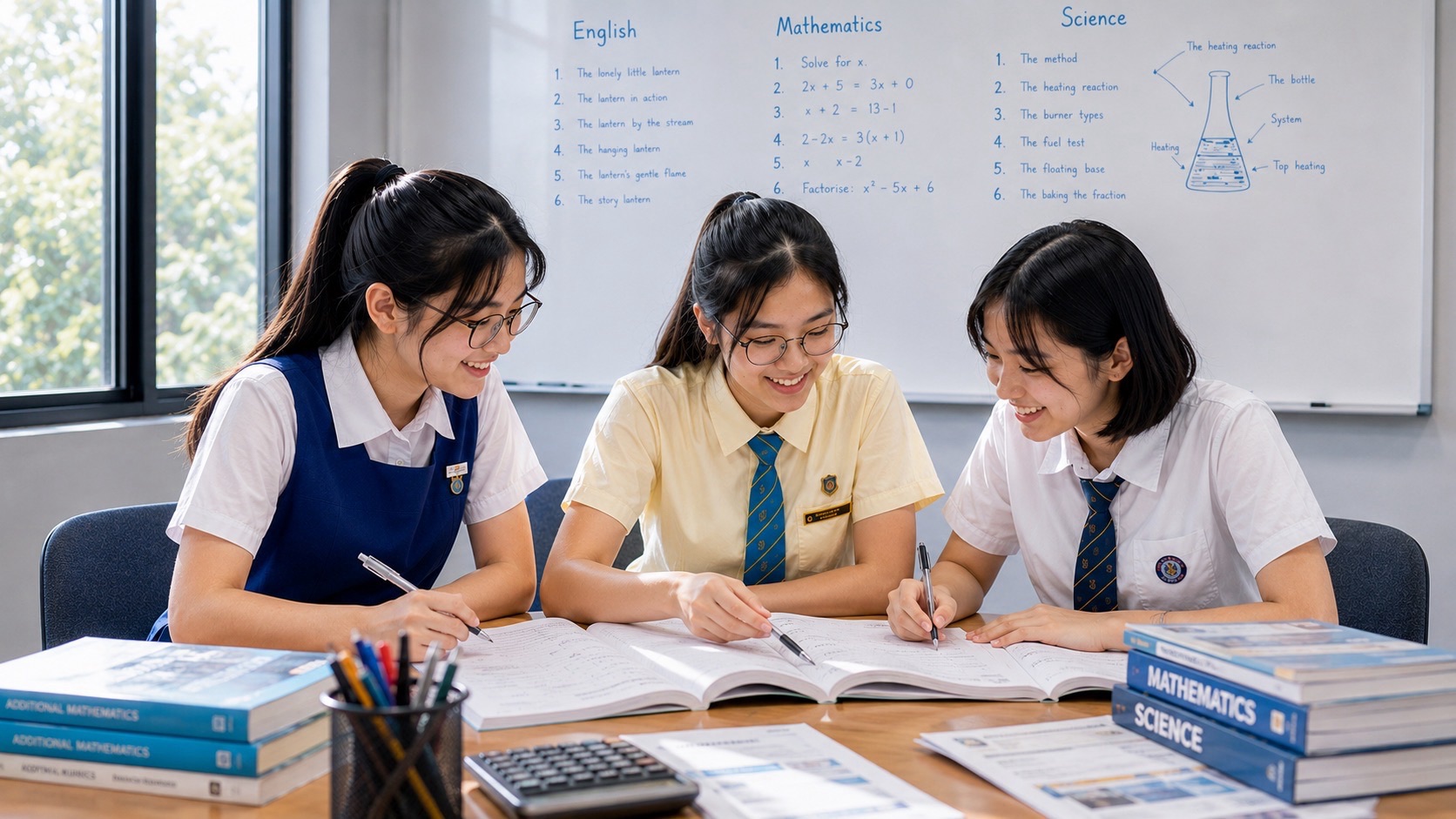
G2 SEC Mathematics Paper 1 asks students to move between short questions, choose the right method and leave enough working to show how they reached an answer. In the 2027 Singapore-Cambridge Secondary Education Certificate syllabus for G2 Mathematics, code K210, Paper 1 lasts two hours and carries 70 marks, or half of the subject assessment. It has about 23 short-answer questions, and students are required to answer all of them. An approved calculator may be used.
For students who entered Secondary 1 through Posting Group 2, check the Mathematics level your school has confirmed for you. Posting Group 2 commonly gives a G2 starting point for most levelled subjects, and the level of a particular subject may change as a student progresses. If you are preparing for K210, start with short, mixed practice that builds three habits. Identify what the question asks for, write the step that connects the information to the answer, and check the units or form before moving on.
- Follow the G2 Mathematics syllabus for your examination year and check the paper instructions on the day.
- Practise moving between Number and Algebra, Geometry and Measurement, and Statistics and Probability.
- Show essential working, even on calculator questions and questions with short answers.
- Separate exact answers from approximations, and keep extra digits until the final step.
- Revisit questions where you chose a sound method but gave the wrong quantity, accuracy or unit.
- Keep one mixed practice set each week so you can see which methods you recognise without a topic heading.
Contents
- Read the Paper 1 requirements before you plan revision
- Read the command and the quantity together
- Make fractions and percentages easy to check
- Keep algebraic choices visible in the working
- Name the angle relation and check the measurement
- Use units to separate length, area and volume
- Choose the statistic or probability the question asks for
- Run a short mixed practice set without topic prompts
- Build pace through accurate restarts
- Questions students and parents can use after practice
Read the Paper 1 requirements before you plan revision
Open the 2027 G2 school-candidate syllabus index and select Mathematics K210. In the official 2027 G2 Mathematics syllabus, read the assessment scheme, notes and subject content together. The scheme tells you what the paper asks you to do. The notes explain conventions such as working, calculators and accuracy. The content shows which ideas you are expected to recognise. Use your own examination year if you are preparing for a later intake.
Paper 1 contains short-answer questions and requires an attempt at every question. Paper 2 uses a different structure with a choice in its Section B. The syllabus also marks certain subject content for testing only in Paper 2 Section B. When scheduling Paper 1 practice by chapter, ask a teacher to help you distinguish those marked portions from the other parts of the topic. A whole chapter may contain both everyday skills and a particular extension that belongs to the other paper.
The same syllabus identifies three broad kinds of mathematical work. Students use standard techniques, solve problems in a variety of contexts, and reason and communicate mathematically. A short question may draw on more than one of those abilities. A student can carry out division accurately and still need to decide which quantity goes in the numerator. A student can use an angle rule and still need to say why it applies. Prepare to make the decision visible in a line or two.
The MOE overview of Full Subject-Based Banding explains how students can take subjects at different levels. For examination planning, use the school’s confirmation of the subject and level you will sit. A friend in the same form class may be using a different Mathematics syllabus. Two worksheets may both say “Secondary Mathematics” and still assume different topics or instructions. The Yishun Secondary School Mathematics content outlines show how a local school distinguishes year levels and subject levels in its teaching plans. Use your school’s current outline for what to study during the term and the applicable SEC syllabus for what can be assessed nationally.
Read the command and the quantity together
Before writing a formula, locate the word that asks you to act and the name of the quantity the answer should describe. A question might ask you to calculate a percentage increase, write an equation, give a reason or express a quantity in standard form. A sound start is to repeat the instruction briefly in your head. Say “original price” or “length in centimetres” before choosing an operation. Keep the full wording in view if it includes a condition.
Consider two instructions about the same figures. A daily count went from 48 to 60. You could be asked to express 48 as a percentage of 60. The calculation is 48 ÷ 60 × 100% = 80%. You could instead be asked for the percentage increase from 48 to 60. That calculation is (60 − 48) ÷ 48 × 100% = 25%. Both use the same pair of values. The words tell you which is the reference and whether the numerator is a value or a change.
Changing form can also be part of the answer. Suppose you are asked to give 0.000684 in standard form. Write 6.84 × 10⁻⁴. The coefficient 6.84 sits between 1 and 10, and 10⁻⁴ brings the value back below 1. If you are instead asked to round the original decimal to two significant figures, the result is 0.00068. Read the requested form at the end because a correct number can be written in a form different from the one asked for.
An expression, an equation and a value each call for a different finish. If a question asks you to simplify 5(2x − 3) − 3(x + 1), the answer is 7x − 18. If it asks you to solve 5(2x − 3) − 3(x + 1) = 3, continue with 7x − 18 = 3 and obtain x = 3. For a question asking for the value at x = 4, substitute and obtain 10. In practice, place these three tasks together once. The contrast shows where the work should end in each case.
Make fractions and percentages easy to check
Suppose a class collected 180 used exercise books. It sends 2/5 of them on Monday and 1/3 of the remainder on Tuesday. How many books are left? Monday’s share is 2/5 × 180 = 72, so the remainder is 108. Tuesday’s share is 1/3 × 108 = 36, so 72 remain at the end of Tuesday. Keep the two appearances of 72 labelled. One describes Monday’s collection and one describes the final quantity.
A common first attempt uses 1/3 × 180 for Tuesday, even though the question says it applies to what remains. Use a bar or a brief label above the number if the reference keeps changing. Test your answer by adding the groups back together. Here 72 + 36 + 72 = 180. The check also catches a student who reports Tuesday’s number sent when the question asks for what is left.
In a reverse percentage problem, an original amount is reduced by 15% to $68. Keeping 85% of the starting amount gives 0.85 × original amount = 68, so the starting amount is 68 ÷ 0.85 = $80. You can verify it with a forward calculation. Fifteen per cent of $80 is $12, and $80 − $12 = $68. Applying a 15% increase to $68 would use a different base and produce a different answer.
Now consider a bag priced at $60. Its price rises by 20%, then drops by 20% of the new price. The two multipliers are 1.20 and 0.80. The resulting price is 60 × 1.20 × 0.80 = $57.60. You could write $72 after the increase and subtract $14.40 after the decrease. This second version makes the two reference amounts visible. To find the overall percentage change, compare the $2.40 fall with the original $60. The final price is 4% lower.
Try a short comparison after either percentage example. Ask someone to explain why the second step requires the new amount or why a reduced price is divided by the retained proportion. If they can name the base without redoing the arithmetic, they understand the choice that controls the answer. When a student says “I always multiply for percentages”, give them a forward question and a reverse question on the same sheet and ask them to label the known quantity first.
Keep algebraic choices visible in the working
To make h the subject of V = (πr²h)/3, first multiply by 3 to get 3V = πr²h. Then divide by πr² to obtain h = 3V/(πr²), where r is nonzero. The denominator is the full product πr². A student who writes 3V/π × r² has produced a different expression. Using brackets when entering the formula into a calculator protects the grouping as well.
You can check a rearrangement with small values. Suppose r = 2 and h = 9. The original formula gives V = 12π. Substituting this into the rearranged formula gives h = 3(12π)/(4π) = 9. One check cannot prove a rearrangement in general, but it can expose a missing multiplier or a denominator grouped incorrectly. Use the equivalent transformations for the proof and the numbers for a quick test.
Consider a different task. Factorise 6x² + x − 2. The cross products 4x and −3x add to x, so (3x + 2)(2x − 1) works. Expanding gives 6x² − 3x + 4x − 2, which matches the original expression. If the instruction is to solve 6x² + x − 2 = 0, follow each factor to its own root. The two answers are x = −2/3 and x = 1/2. The zero-product step belongs to the equation task.
A mixed set might place a sequence question after the factorisation. Suppose the terms are 13, 18, 23 and 28, with a common difference of 5. The nth term is 5n + 8 when the first term is n = 1. Check n = 1 and n = 4. They give 13 and 28 respectively. To decide if 68 is a term, solve 5n + 8 = 68. The result is n = 12, a valid positive whole-number position. If you try 70 instead, n = 12.4, so 70 does not occur in the sequence.
For home revision, ask a student to say what made them choose the method after finishing each example. They may say the question asked for a subject on its own, the quadratic needed factors, or the constant increase pointed to a linear expression. This takes a few seconds and reveals whether the method was chosen deliberately. A student who applies a procedure only when the heading names it will benefit from short sets with several topics in a different order each time.
Name the angle relation and check the measurement
Imagine an isosceles triangle ABC with AB = AC. Angle BAC is 38°. Find angle ABC and state a reason. Angles ABC and ACB are equal because they are opposite the two equal sides. The two base angles add to 180° − 38° = 142°, so each is 71°. The order matters. Writing (180 − 38) ÷ 2 with a brief reason shows both where 180 comes from and why division by two is valid.
Suppose BC is extended past C to D. Find angle ACD. ACB and ACD are adjacent angles on a straight line. Therefore ACD = 180° − 71° = 109°. Another way to check is to add the two opposite interior angles, 38° and 71°. They give the same exterior angle. A correctly labelled sketch is useful even when the exercise is short. It helps you identify which one is outside the triangle and which angle belongs in the sum.
For a regular polygon question, suppose each exterior angle is 30°. One full turn is 360°, and a regular polygon has equal exterior angles. The number of sides is 360° ÷ 30° = 12. If the question asks for each interior angle instead, subtract 30° from 180° to get 150°. A response of 12 is a count of sides, and 150° is an angle. The noun in the instruction tells you which calculation to present.
Try a right-triangle question. A ramp rises 0.56 m over a horizontal distance of 4.3 m. Find its angle to the horizontal. With that angle as θ, the rise is opposite and the horizontal distance is adjacent. Write tan θ = 0.56/4.3. In degree mode, θ = tan⁻¹(0.56/4.3) ≈ 7.420° and the answer rounded to one decimal place is 7.4°. A small angle suits the shallow rise. If the display gives a value near 0.13, check that the calculator is in degree mode and that you are interpreting the result of the inverse function correctly.
When a question calls for a reason, make it specific. “Angles are equal” repeats a relationship. “Base angles are equal because AB = AC” tells the reader why it works here. If two parallel lines are given, check that the angles are in the positions you are naming. A compact reason and a clear calculation often do more than a long paragraph. Practise reading your own working a day later to see if it still makes sense without the explanation you remember saying aloud.
Use units to separate length, area and volume
A rectangular tray measures 18 cm by 12 cm by 5 cm internally and is filled with water to a depth of 3.5 cm. The volume of water is 18 × 12 × 3.5 = 756 cm³. The question gives the full height as well as the current water depth. Multiplying by 5 would calculate the capacity. Write the name of the quantity beside each calculation if you need both. The empty capacity above the water is 18 × 12 × (5 − 3.5) = 324 cm³.
Suppose a rectangular garden is 4 m long and 65 cm wide. Find the area in square metres. Convert 65 cm to 0.65 m so both lengths use metres, then multiply 4 × 0.65 = 2.6 m². To check the result in square centimetres, convert the length to 400 cm and multiply 400 × 65 = 26,000 cm². Since 1 m² is 100 cm × 100 cm = 10,000 cm², the two answers describe the same area.
A circle with diameter 14 cm has radius 7 cm. If the area is requested in terms of π, write A = π × 7² = 49π cm². If an ordinary numerical answer is required with no other accuracy instruction, the calculator value gives approximately 153.938 cm² and 154 cm² to three significant figures. Check the word “diameter” before substituting. For a radius of 14 cm the area would be four times as large, so using diameter directly would create an error much bigger than a rounding difference.
A drawing scale offers another opportunity to state units clearly. A path measures 6.4 cm on a plan whose scale is 1 to 500. The actual length is 6.4 × 500 = 3,200 cm, or 32 m. Check what one centimetre represents. Here 500 cm is 5 m, so multiplying 6.4 by 5 gives the same length directly in metres. If the result is written as 3,200 m, the multiplication may be correct but the unit has not been converted.
Choose the statistic or probability the question asks for
A group records the number of books read by five students in one month as 0, 1, 2, 2 and 10. The mean is 15 ÷ 5 = 3 books. The median is the middle value, 2, and the mode is also 2 because it occurs most often. The value 10 pulls the mean above the median. A question asking for the most common count would be answered with 2 books and a reference to the mode. A question asking for the mean requires the total and division.
Frequency requires a weighted calculation. Suppose six students took 8 minutes, three took 10 minutes and one took 14 minutes. The total waiting time is 6 × 8 + 3 × 10 + 1 × 14 = 92 minutes. There are ten students, so the mean is 9.2 minutes. Adding 8, 10 and 14 and dividing by three treats the three distinct times as equally frequent. A quick reasonableness check is that more than half the students waited 8 minutes, so a result close to 8 is plausible.
For a short probability question, a box contains three red counters, five blue counters and two green counters. Each counter is equally likely to be drawn. The probability of drawing a counter that is not blue is (3 + 2)/10 = 1/2. You could also use 1 − 5/10. If the question changes to “red or green”, the result is the same, because each possible draw belongs to exactly one of the colours and those are the two colours other than blue.
Change the setup by removing one blue counter before the draw starts. The box now contains nine counters. The probability of red is 3/9 = 1/3, while the probability of not blue is 5/9. A student may carry the original total of ten even when they notice that the number of blue counters has changed. Drawing a small note with the updated counts makes the sample space clear. In a short question, that note and a fraction can show the essential decision.
Practise writing a conclusion only as broad as the information allows. If a class’s recorded reading counts have a mean of 3, you can report the mean for those records. That alone gives no claim about how long each student spent reading or what a different class reads. If a summary asks which claim a graph supports, look for the variable, group and time period shown before writing the sentence. This habit works in a short answer about a dataset or a probability.
Run a short mixed practice set without topic prompts
Try these six exercises on a fresh sheet before reading the solutions. Write the line of working that shows how you chose the operation. If you have an answer quickly, check what it represents before ticking it off. These are original practice questions. They demonstrate a way to review short answers and do not predict the paper.
- A club’s spending fell from $84 to $63. Find the percentage decrease.
- Solve 7 − 2(3p − 4) = 27.
- A line passes through (2, 7) and (5, 13). Find its equation in the form y = mx + c.
- Two similar triangles have corresponding sides 6 cm and 15 cm respectively. Another side of the smaller triangle is 8 cm. Find its counterpart on the larger triangle.
- The angles of a quadrilateral are 86°, 97°, 112° and q°. Find q.
- The mean of four numbers is 17. Three numbers are 11, 14 and 19. Find the fourth.
For the percentage decrease, use the original value of 84. The difference is 21, so 21 ÷ 84 × 100% = 25%. For the equation, expand the brackets with the negative multiplier. This gives 7 − 6p + 8 = 27, then −6p = 12 and p = −2. Substitution produces 7 − 2(−6 − 4) = 27, confirming the sign.
The gradient of the line is (13 − 7)/(5 − 2) = 2. Using (2, 7) in y = 2x + c gives 7 = 4 + c, so c = 3 and the equation is y = 2x + 3. Check it at (5, 13). For the similar triangles, the length scale factor from smaller to larger is 15/6 = 2.5, and the requested length is 8 × 2.5 = 20 cm. Both answers change a given relationship into a requested model or length.
A quadrilateral’s interior angles total 360°. Adding the three given angles gives 295°, so q = 65°. For the last question, work back from the mean. The four numbers have total 4 × 17 = 68. The three known numbers total 44, so the fourth is 24. If you divided the three given numbers by three, you would get the mean of a different set. The question tells you which total to reconstruct.
Review the six solutions as a group. If you got the mathematics right but needed a prompt such as “use the original value”, do a new percentage problem tomorrow without a heading. If you selected the method independently and then missed a sign, record the exact point where it happened. For the equation above, the product of −2 and −4 is 8. Writing that step once makes the correction specific enough to reproduce.
Build pace through accurate restarts
A two-hour paper with about 23 questions contains questions of different lengths and demands. Aim to find a sustainable pace in practice. You can move to another question when a start stalls, leave a clear mark in your practice booklet and return with time left. The goal is to attempt every question. In a full timed practice, see whether this approach helps you finish the questions whose methods you already know.
Make a set of three to six unrelated short questions after a school topic review. Start by answering in normal time. Return to the questions where you hesitated and write what caused the delay. You might have needed to recall a relation, reorganise a diagram or recognise the variable named in the last sentence. Practise a similar item with one change, then include that skill in a mixed set on a later day. That sequence tests recognition as well as memory.
Use an approved calculator that you know how to operate. The 2027 K210 syllabus permits an approved model on both papers. Confirm the permitted model and equipment requirements for your sitting through your school and SEAB’s approved-calculator information. Practise entering a fraction with brackets, changing between fractions and decimals, and checking degree mode for angle work. A clear line on the page should show the expression you intended to evaluate even when the machine does the computation.
Read the accuracy instruction before giving the final result. Unless the question states otherwise, the 2027 syllabus specifies three significant figures for non-exact numerical answers and one decimal place for angles in degrees. If a question requires you to show that a result is correct to a stated accuracy, first give it to higher accuracy. Keep unrounded values in intermediate steps. An exact fractional answer such as 7/12 or an answer in terms of π may be appropriate when the question asks for that form.
Parents can support the routine by asking for one short explanation after a set. Let the student pick the question they most want to discuss. Ask how they recognised the method and what they would check if a new example changed the numbers or layout. If reviewing together becomes a long correction session, choose one error for tomorrow. There is value in seeing a small repair survive the next attempt.
Questions students and parents can use after practice
What should I write if I already know the answer?
Show the relationship or calculation that supports it. For example, if a circle’s diameter is 14 cm, writing r = 7 cm and then A = π × 7² tells the reader how you used the diameter. If the question asks for a reason, make the reason refer to the actual information given. Keep routine arithmetic compact and show the decisions someone might otherwise have to guess from the answer alone.
How can I notice the difference between an accuracy error and a method error?
Compare the value before rounding with a correct value. If they agree before the final step, check the requested accuracy and the form of the answer. If they differ earlier, look for the first step where the equations, data or units stopped matching. This makes a correction actionable. A student who rounded too early can practise keeping the full calculator value, while a student who used the wrong reference amount needs a new question about choosing the base.
How do I use school feedback without repeating an entire paper?
Select one question where your approach was sound but something went wrong and one where you did not recognise the method. Ask the teacher which correction would help most in a fresh question. Then prepare two similar examples with changed figures or wording. Solve them on another day without your old working beside you. Record how you recognised the first useful step and whether the final answer matched the command.
Which questions should I check when time is short?
First check for blanks or parts that you intended to return to. Then look for instructions that are easy to overlook, such as “in terms of π”, “in metres” or “give a reason”. A quick substitution can test an equation, and changing the order of a subtraction can clarify the sign of a difference. Save full recalculation for cases where the method or result still looks doubtful. Your checking time is most useful when it tests a decision that could change the answer.
Leave a Reply