
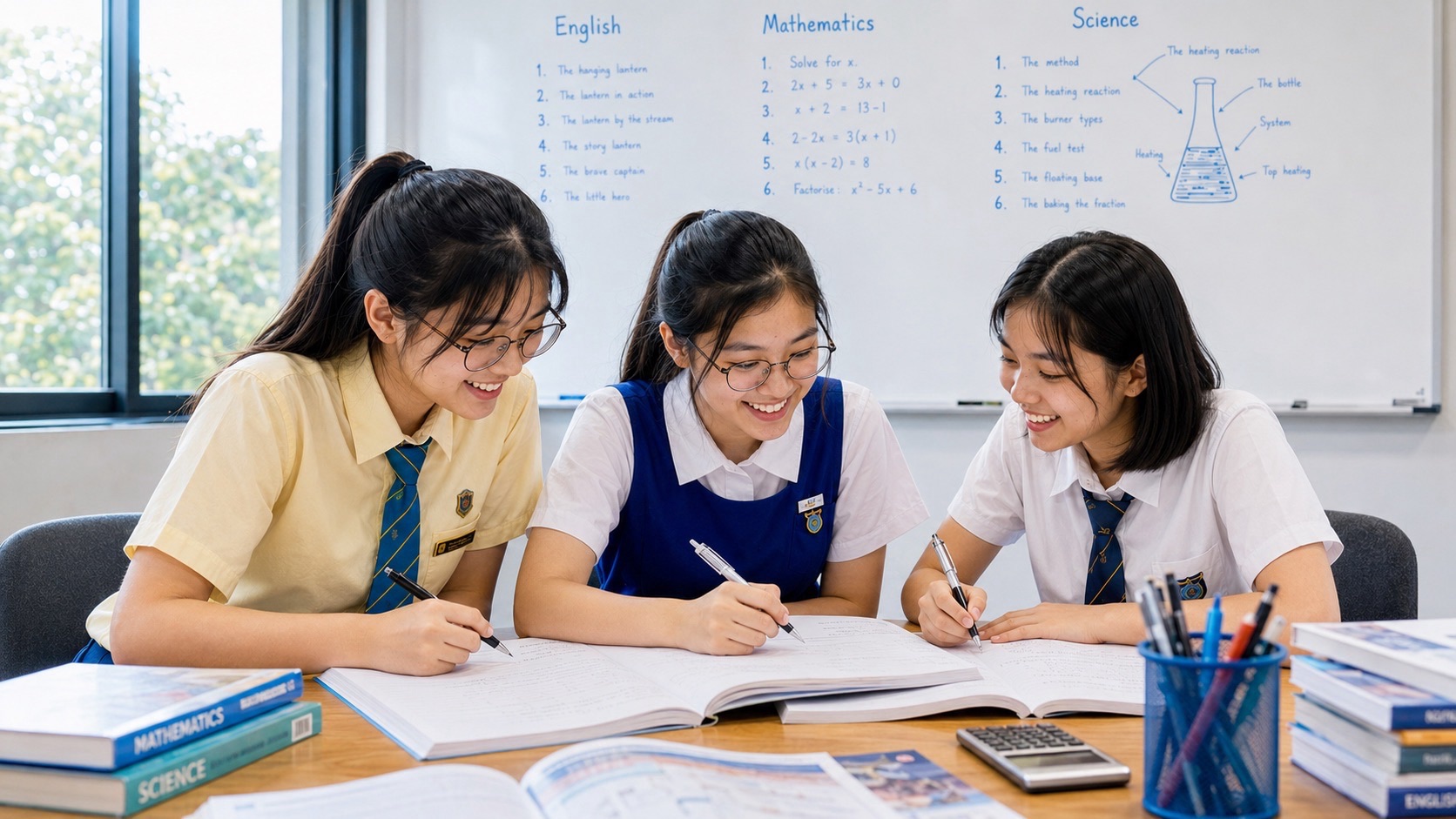
G2 SEC Science structured questions ask students to write short answers, show calculations and use evidence to explain what happened. For students who entered secondary school through PSLE Posting Group 2, start with the Science combination and subject code the school has confirmed. In the 2027 syllabus, each discipline has a 30-mark structured paper beside a 20-mark multiple-choice paper. The two papers share one 75-minute session for that discipline. The structured paper requires all of Section A and one of the two questions in Section B.
Practise the decision each question asks your child to make. A graph question may need two readings and a comparison, while an explanation may need a named scientific idea joined to the result in the question. A route into secondary school gives useful background, and the current Science syllabus is what governs the examination. This guide uses original Physics, Chemistry and Biology exercises so Yishun families can work on the disciplines in their child’s combination, check the reasoning and repeat it on a fresh question.
- Match the syllabus code and examination year to your child’s school entry.
- In the 2027 format, Physics structured is Paper 2, Chemistry structured is Paper 4 and Biology structured is Paper 6.
- In each structured paper, answer every Section A question for 22 marks and one Section B question for 8 marks.
- Check the verb before writing. A description reports a pattern, while an explanation connects the pattern to a scientific reason.
- Write calculations with the quantities, units and intermediate steps the reader needs to follow.
- Use experimental results within their limits and propose improvements that address a specific weakness.
- After correcting one answer, try a variation to check whether the improvement carries over.
Contents
- Confirm which two structured papers apply
- Read the question in a way that changes the answer
- Physics practice with an electrical circuit
- Chemistry practice with chromatography
- Biology practice with transpiration and a fair comparison
- Work through a longer compulsory question
- Choose a Section B question from what you can show
- Build a week of practice you can repeat
- Questions students and parents ask
Confirm which two structured papers apply
The SEAB list of 2027 G2 syllabuses for school candidates gives three G2 Science combinations. K223 is Science (Physics, Chemistry) and includes structured Papers 2 and 4. K224 is Science (Physics, Biology) and includes structured Papers 2 and 6. K225 is Science (Chemistry, Biology) and includes structured Papers 4 and 6. Take the subject code from your school’s confirmation when choosing practice. A friend preparing for another combination may share one discipline with you and study a different second discipline.
The shared 2027 G2 Science syllabus explains which four papers belong to each code. Physics candidates take Papers 1 and 2 together in a 75-minute session. The corresponding pair for Chemistry is Papers 3 and 4, and for Biology it is Papers 5 and 6. Each candidate takes the two sessions for their combination. SEAB advises candidates to spend no more than 30 minutes on the multiple-choice paper in each pair. Use the remaining time for structured work and checking, adjusting your practice based on where you actually lose time.
Each structured paper is worth 30 marks, or 30 per cent of the overall subject result. Section A contains compulsory questions worth 22 marks in total, with 8 marks on its final question. Section B offers two questions, each worth 8 marks, and candidates answer one. The Periodic Table is printed as part of Chemistry Papers 3 and 4 for the two combinations that include Chemistry. In the shared syllabus, the assessed papers are theory papers. The written structured questions can still ask you to interpret investigations, read instruments or evaluate a method.
A national paper format may change between examination years. Check the SEC school-candidate syllabus directory for your year. For a school assessment, follow the instructions issued with that assessment. Before attempting a full timed paper, look at the total number of questions and how the two sections are labelled. On a photocopy or practice handout, check that the pages and any referenced data are present.
Read the question in a way that changes the answer
Put your pencil beside the command word and the quantity or idea it governs. “Describe how the reading changes” asks for the direction or pattern. “Explain why the reading changes” asks for the process or relationship that causes it. “Compare” usually needs both things under discussion and a shared basis of comparison. A student who writes that one line rises gives some information. A student who says which line rises faster over the same interval answers the comparison.
Think about what the question supplies and what you must add. When a question says “using the results”, take a value or feature from the given data and use it in the answer. When it says “using the particle model”, add the relevant particle behaviour to the observation. A single sentence can do both jobs. For instance, if two locations lose different masses of water over the same period, first identify which loses more, then explain a supported cause in the context the question provides. State an assumption when the evidence leaves more than one possible explanation.
For a prediction, name the likely change and justify it from a pattern or principle. If the pattern has only been measured over a small range, keep the prediction within an appropriate range or say why the proposed extrapolation is uncertain. For a suggestion, offer a scientifically reasonable response to the stated problem and specify how it addresses it. “Repeat the readings” is useful for random variation. It addresses a different issue from recalibrating a balance that gives every reading an offset.
Read the marks as a guide to how much work to show, and read the wording to identify the required parts. A question can ask for a result and a reason in one sentence. If you write only the result, go back and finish the reasoning. A more heavily weighted question often combines tasks across several subparts. Clear labels let you and the reader see which evidence or calculation belongs to each part.
Physics practice with an electrical circuit
An original practice question describes three resistor readings. The potential difference is 1.5 V when the current is 0.15 A, 3.0 V when the current is 0.30 A and 4.5 V when the current is 0.45 A. The temperature stays approximately constant. Calculate the resistance at 3.0 V, explain whether the readings are consistent with constant resistance and predict the current at 6.0 V if the relationship continues. These are fictional readings for written practice.
At 3.0 V, use resistance = potential difference ÷ current. The calculation is 3.0 ÷ 0.30 = 10 Ω. The first reading gives 1.5 ÷ 0.15 = 10 Ω. The last gives 4.5 ÷ 0.45 = 10 Ω. The ratios are the same for the three readings, so the data are consistent with constant resistance over that measured range. Showing at least one other ratio makes the conclusion about the whole set more persuasive than presenting the middle calculation alone.
For the prediction, rearrange the relationship to current = potential difference ÷ resistance. At 6.0 V this gives 6.0 ÷ 10 = 0.60 A. Because 6.0 V lies outside the range in the question, add the condition that the resistance remains constant. If you draw a graph, first confirm the requested axes. With voltage on the vertical axis and current on the horizontal axis, the gradient gives the resistance. With the axes reversed, the gradient gives the reciprocal of the resistance. Label both axes and units before interpreting the slope.
For a variation, a second resistor has a potential difference of 3.0 V and a current of 0.20 A. Calculate its resistance and state which resistor has the higher current when both have 3.0 V across them. Its resistance is 3.0 ÷ 0.20 = 15 Ω. At the same potential difference, the first resistor takes 0.30 A compared with 0.20 A for the second. Your answer should keep the comparison at a fixed voltage. Mixing readings taken at different voltages would leave uncertainty about what caused the current difference.
Diagnose the wrong answer before repeating it
Suppose a student writes 0.30 ÷ 3.0 = 0.10 Ω. Their calculation shows that they know which numbers matter. The order of division is reversed. Ask them to name the relationship aloud and write it with symbols before substituting. Then change the question slightly: for a resistor of 12 Ω carrying a current of 0.25 A, find the potential difference. The answer is 12 × 0.25 = 3.0 V. Two related calculations reveal whether the student can choose the arrangement that serves the requested quantity.
Another student may write 10 and leave the unit missing. Ask them what they would say aloud if a classmate asked “ten what?” The unit is part of the scientific answer. Keep intermediate numbers clear and leave enough precision until the final step. The worksheet can also ask which part of the result is measured and which part is derived. The current and voltage are measured quantities in the practice data, whereas the resistance has been calculated from their relationship.
Chemistry practice with chromatography
In an original worksheet, a student places samples from three coloured inks and a mixture on a pencil baseline. The solvent front travels 8.0 cm from the baseline. One spot from the mixture travels 2.0 cm and another travels 6.0 cm. Reference ink A makes one spot at 2.0 cm, ink B makes one at 4.0 cm and ink C makes one at 6.0 cm. Assume each sample is on the same paper in the same solvent. Identify plausible matches and give a reason.
Compare the spot positions directly because all the samples were run together from the same baseline. Reference A made a spot at the same height as the mixture’s lower spot, 2.0 cm. Reference C made a spot at the same height as its upper spot, 6.0 cm. B made a spot between them, at 4.0 cm. The 2027 G2 syllabus requires interpretation and comparison with known samples, and specifies that the use of Rf values is unnecessary. In this exercise there are two visible spots, so report evidence for at least two separated components that can be seen under the conditions used.
A student may write that the ink is definitely made of A and C. The matches support the suggestion. Different substances can sometimes travel the same relative distance in a particular solvent, and an unseen component could be missed. A stronger conclusion says that the two separated components are consistent with the references A and C under the conditions tested. If identity matters, compare them under another suitable set of chromatography conditions. The question may ask for a tentative identification or a limitation, so make it clear which is being given.
For a technique question, explain why the baseline sits above the solvent level at the start. If the samples were submerged, they could dissolve directly into the solvent pool rather than move up the paper from the baseline. If asked why a pencil line is suitable, explain that the marking will stay in place in the school investigation rather than introducing coloured ink that could separate and be confused with sample spots. State how the proposed choice protects the result, using the apparatus the question gives.
Try a second fictional run to test the same kind of reasoning. Two unknown inks are separated on one strip. One makes spots at 3.0 and 7.0 cm, and the other makes spots at 3.0 and 5.0 cm. Name the feature the inks appear to share and the feature that differs. A sensible answer is that both have a component reaching 3.0 cm from the same baseline, while the other spots have different positions. If the strips or solvents differed between the samples, confirm how the readings can be compared before drawing the same conclusion.
Biology practice with transpiration and a fair comparison
An original worksheet shows a class comparing two leafy shoots using bubble movement in a water uptake apparatus. The shoots are similar in leaf area. One is in moving air and the other is in still air. They are tested at the same temperature and light level. The bubble next to the shoot in moving air moves 18 mm in 6 minutes. The bubble next to the other moves 9 mm in 6 minutes. Calculate the rates of bubble movement, compare them and explain a likely reason for the difference.
The moving-air reading gives 18 ÷ 6 = 3 mm per minute. The still-air reading gives 9 ÷ 6 = 1.5 mm per minute. Under the conditions described, the bubble moves twice as fast in moving air. That means the measurements show a higher rate of water uptake in this setup, assuming the capillary bores are the same and the apparatus functions properly. It would be a mistake to report these figures as millilitres of water lost per minute. They describe distance travelled each minute, and the measured quantity is a proxy for the process being investigated.
Water vapour leaves a leaf through the stomata. If air near the leaf is still, water vapour can build up nearby. Moving air can carry it away and maintain a larger water vapour concentration difference between the air spaces inside the leaf and the surrounding air. This can increase the rate at which water vapour diffuses out, leading to faster transpiration under the stated conditions. The explanation connects moving air to the observed difference through an intermediate process. It gives a teacher more to assess than repeating that the fan made the bubble move faster.
Ask what one improvement would strengthen the result. A repeated comparison using several similar pairs of shoots could reveal how consistent the result is and reduce the influence of any one unusual leaf. Keeping similar leaf area helps because a large difference in leaf area could contribute to a difference in water loss. Keeping temperature and light the same makes air movement the planned contrast. If the two capillary bores are different, using matching apparatus or converting movement to volume with valid measurements would address that particular problem. The best response names the actual weakness first.
If the question asks whether the observations prove that wind always increases transpiration, explain the limit. The test compares the two conditions described using a small set of readings. Other factors such as humidity or temperature may change the result in another setting. Some of the water taken up by a shoot can also be used by the plant. The readings provide evidence consistent with a higher transpiration rate in the test condition, rather than a direct measurement of all the water lost from the leaves. A strong answer uses the scale of conclusion the investigation supports.
Progress from naming a process to explaining it
A student might correctly name transpiration, then stop. Ask them to draw three boxes on scrap paper for what changes first, what changes near the leaf and what changes in the measurement. Turn those boxes into one or two sentences. On a fresh example, keep the fan speed the same and change the humidity of the surrounding air. Predict the relative effect of drier air when other factors are held constant. A reasonable prediction is a faster diffusion of water vapour out of the leaf because there is a greater difference in water vapour concentration. Check the new direction carefully instead of carrying over the old description of the fan.
Work through a longer compulsory question
The final question in Section A carries eight marks in the 2027 syllabus. Longer exercises are useful for practising how to keep track of information across several subparts. Here is an original Physics worksheet about a pupil comparing cooling in two cups of warm water in class. The water in both starts at 55 °C. Cup P has a sleeve and Cup Q does not. After 5 minutes P is at 50 °C and Q is at 46 °C. After 10 minutes P is at 46 °C and Q is at 39 °C. Assume equal starting volumes and otherwise equal conditions.
First ask which cup cools more in the first five minutes and by how much. P falls by 55 − 50 = 5 °C. Q falls by 55 − 46 = 9 °C. Q cools more by 4 °C over that interval. Next calculate the average cooling rate of P over all ten minutes. The temperature drop is 55 − 46 = 9 °C, so the average cooling rate is 0.9 °C per minute. For Q the corresponding average is (55 − 39) ÷ 10 = 1.6 °C per minute. If a question asks for temperature change with a sign rather than the magnitude of the cooling rate, give the sign that matches the convention.
Now explain why P remains warmer. The sleeve acts as insulation and reduces the rate of energy transfer from the cup to its surroundings compared with the uncovered cup. That is a mechanism the worksheet conditions support. If the question asks for the effect of the sleeve, report the result using a reading, such as P being 7 °C warmer than Q after ten minutes. An explanation about insulation and a statement comparing temperatures can both be correct. Choose based on the verb.
One final part could ask which interval has the greater average cooling rate for Q. In the first five minutes, the rate is 9 ÷ 5 = 1.8 °C per minute. In the second five minutes, it is (46 − 39) ÷ 5 = 1.4 °C per minute. The first interval has the greater rate. A plausible explanation is that the temperature difference between the water and its surroundings was greater earlier in the observation, assuming room temperature stayed reasonably stable. The data record a change in the average across each interval. They do not establish the exact temperature at every moment between the recorded times.
When you review the four parts, underline where each number comes from. The first part compares equal time intervals, the second gives a rate, the third explains a physical mechanism and the fourth checks how a rate changes. Many families find that a student has one recurring mistake across these tasks. If they always divide by the total elapsed time instead of the specified interval, the next drill can focus just on identifying start and end readings. If the calculation is sound but the explanation weak, practise describing how energy transfer relates to the difference measured.
Choose a Section B question from what you can show
In the 2027 format, Section B offers two 8-mark questions and asks you to select one. Read the two question openings and their subparts before settling. Pay attention to the first action you can take. A Chemistry question with a familiar instrument may still ask about a concept you cannot explain clearly. A question that initially looks unfamiliar may provide measurements you can use confidently. Choose using the visible tasks and the work you can already describe.
Try this decision during homework. Take two same-discipline questions your teacher has approved and give yourself a short reading period. Identify the command words, the required calculation or explanation and which subpart depends on an earlier answer. Select one and complete it. Review whether your initial estimate was accurate. With repeated practice, a student can learn which topics are genuinely secure and which appear familiar only because they recognise the picture or equipment.
Work on keeping the answer ordered once you make the choice. Write any intermediate result with its quantity and unit. If a later part refers to your earlier result, return to your recorded value and check what it represents. Needlessly redoing calculations can use the time intended for explanation and checking. If a difficult part prevents progress, keep any valid first step and move to another subpart where appropriate. Follow the examination’s printed directions on selecting and marking your chosen question.
A family reviewing two alternatives can ask the student to explain why they would choose one before solving either. Write down the reason as an observation about the work, such as “I can interpret the graph but I am uncertain what would count as a fair comparison.” After marking, adjust the plan based on what actually happened. That conversation helps the student decide with evidence from their own work and gives a teacher a useful example if the same difficulty keeps returning.
Build a week of practice you can repeat
A school night may only allow a short piece of work. Pick a structured question from the discipline taught most recently and answer it before looking at a model. Mark the place where you changed approach. It could be where you selected a new region of a graph or where you chose between a description and an explanation. After marking, fix that point and try a variation. A fresh version provides a better check than copying a model answer word for word.
On another day, work through one longer Section A-style exercise with subparts and compare how much time goes on selecting information, performing calculations and checking. Set your own practice target with your teacher or parent. Plan enough time near the end to read your unit labels and confirm which Section B question you have answered. Keep the 75-minute session and the official multiple-choice timing advice in mind when arranging a whole-session rehearsal for your future examination year.
Use a simple correction record. Write the question type, the step that caused trouble and an action you can perform the next time. “Look again at the question” is too broad to demonstrate improvement. “Compare readings over the same time period” or “name the physical quantity before rearranging the formula” gives you a reachable step. On a later question, see whether you notice the same feature without a reminder. Keep one example of a correction that you were able to repeat independently.
Parents can ask for a brief explanation during practice and leave the calculation to the child. Ask the student to point to the evidence they used, then listen for the link between the evidence and their conclusion. If the link remains unclear after two attempts, take that precise question to the teacher. The teacher can use the child’s own work to decide whether the next step is a concept revision, another example at the same level or a different form of practice.
Questions students and parents ask
Do I have to memorise every answer in this guide?
Use the exercises to learn the moves that work when the numbers, context or wording change. The next paper will have its own evidence and its own instructions. Practise writing a formula, using a measured value accurately, comparing like with like and connecting a scientific reason to the observation. Then try a question that asks for the same kind of reasoning in a new situation. If your answer still makes sense without the original wording, you have learned something you can use beyond this page.
Should I read practical skills even though there is no separate practical paper?
Yes. The 2027 syllabus includes experimental skills among the assessment objectives. A theory question may ask you to read a scale, evaluate evidence, recognise a limitation or suggest a better way to gather data. Use what you learn in supervised school work to explain choices in unfamiliar written scenarios. When a question supplies an apparatus you have never seen before, read how it works and use the scientific skills the question calls for. Ask your teacher which examples fit the discipline and level you take.
What should I check after writing a calculation?
Trace the value in your answer back to the line in the question or the axis on the graph. Check the relationship, the order of operations, the time interval and the unit. Ask whether the size and direction of the result make sense. If the question asks for a decision, write a sentence that compares the calculated result with the limit, rather than leaving the calculation on its own. When the response uses an estimate from a supplied graph, be honest about the precision you can read from it.
Leave a Reply