
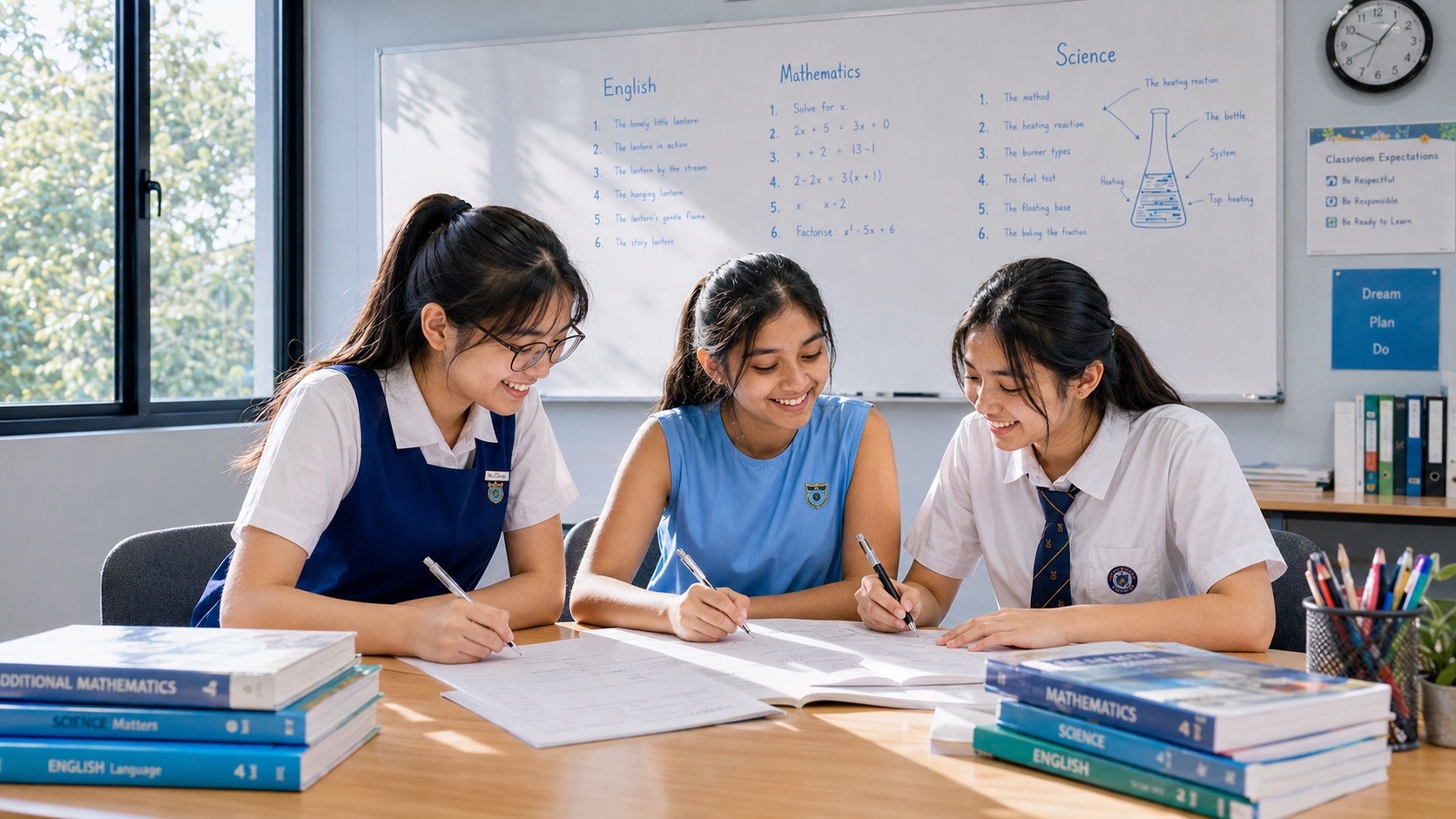
Secondary 4 G3 Science (Chemistry, Biology) is the graduating-year study of a combined Science subject in Singapore. For the 2027 Singapore–Cambridge Secondary Education Certificate (SEC), its syllabus code is K328. Students study chemical substances and reactions alongside cells, living systems and inheritance. Chemistry and Biology contribute to one combined Science result; this is different from taking the two standalone subjects. The course brings together knowledge from upper secondary, including learning completed before Secondary 4.
For parents, the useful question is where your child can explain an idea, apply it and support an answer with evidence. A student may be comfortable with human Biology yet uncertain about chemical equations, or confident in written work but inexperienced at recording laboratory observations. This guide explains the assessment, teaches several important connections through original examples, and shows how to identify the next useful practice task. Examination details follow the 2027 SEAB G3 Science syllabus; study routines are suggestions for families to adapt with their school.
- Subject: G3 Science (Chemistry, Biology), K328, for 2027 SEC school candidates.
- Assessment: a combined multiple-choice paper, separate Chemistry and Biology written papers, and a practical test covering both sciences.
- Learning: connect particles, reactions and quantities with the structures and processes that sustain life.
- Preparation: practise both components, written explanations, calculations, unfamiliar data and laboratory skills.
- Decisions: check the actual subject combination, school advice and requirements for the intended post-secondary intake.
Find your next learning step
Choose the question closest to your family’s needs, or read the chapters in order.
Chapter index
Chapters 1–3: Understand the combination
Chapters 4–6: Connect Chemistry ideas
Chapters 7–9: Understand living processes
Chapters 10–13: Use models and evidence
Chapters 14–15: Plan the next step
CHAPTER 1 OF 15 · Understand the combination
1. Understand what the subject name tells you
Start with the full name on the school subject list. “Science” alone does not identify the component pair, level or examination year. The SEAB 2027 G3 catalogue distinguishes K328 from Science (Physics, Chemistry), K326, and Science (Physics, Biology), K327. It also lists standalone Chemistry and Biology separately. Keeping those identities clear prevents a family from using the wrong paper specification or purchasing a resource with unsuitable coverage.
Under Full Subject-Based Banding, G3 describes the level of this subject. A student’s subjects and their respective levels appear on the SEC. The qualification begins in 2027, as explained in SEAB’s SEC overview. Use that terminology when planning for the 2027 cohort, even if an older assessment book carries an earlier examination name.
Secondary 4 is also a stage of consolidation. A new chapter may depend on an older idea that has become rusty. For example, reaction calculations depend on formulae and balanced equations. Understanding absorption depends on cells, membranes and movement of substances. If the new work feels confusing, check the prerequisite before assuming the whole subject is beyond reach.
A practical first conversation is: “Show me one question you can explain, one you can start, and one where you do not know the first step.” Those three examples reveal more than a broad label such as good or weak at Science. They give a teacher something specific to help repair.
CHAPTER 2 OF 15 · Understand the combination
2. Read the four-paper assessment correctly
K328 candidates take Papers 1, 3, 4 and 5. Paper 2 belongs to the Physics component and is not part of this combination. The table below condenses the official 2027 assessment scheme, pages 6–7.
| Paper | Duration | Marks | Weight |
|---|---|---|---|
| 1: Chemistry and Biology multiple choice | 1 hour | 40 | 20% |
| 3: Chemistry structured and free response | 1 hour 15 minutes | 65 | 32.5% |
| 4: Biology structured and free response | 1 hour 15 minutes | 65 | 32.5% |
| 5: Chemistry and Biology practical | 1 hour 30 minutes | 30 | 15% |
Paper 1 has 40 compulsory questions with approximately equal coverage of the two sciences. In each component written paper, Section A has 55 compulsory marks; Section B requires one of two 10-mark questions. The practical includes one or two compulsory questions for each science. Read the actual paper instructions carefully, especially where a choice is provided.
Use weightings to understand progress
Here is an illustrative calculation, not a grade prediction. Suppose a student earns 30/40, 39/65, 52/65 and 21/30 respectively. The weighted contributions are 15, 19.5, 26 and 10.5 percentage points, giving 71 overall. The calculation is each paper’s fraction multiplied by its weighting.
This pattern suggests a useful discussion: the Chemistry written paper needs closer attention, while Biology performance should be maintained. It does not justify abandoning Chemistry multiple choice or practical work. A component weakness can appear in more than one paper, so organise corrections by concept as well as by paper number.
Do not treat an invented practice percentage as an official grade threshold. School marking, paper difficulty and national assessment are different contexts. The value of a practice result lies in the evidence it provides about what the student can do independently.
CHAPTER 3 OF 15 · Understand the combination
3. Make a useful map of the two sciences
The Chemistry component moves from matter and its structure to reactions, calculations and environmental applications. The Biology component connects cells and biological molecules with human systems, plants, ecosystems and inheritance. The syllabus content maps provide the complete scope; your school determines its teaching sequence.
Use two sheets of paper to make the course visible. On the Chemistry sheet, draw links from particle structure to bonding, then from formulae to equations and quantities. On the Biology sheet, connect cells to exchange surfaces, transport, nutrition and respiration. Add a real question beside each link. A map with examples becomes a learning tool; a colourful list of chapter names may only show that the notes have been organised.
The subjects share useful habits. Both require a distinction between observation and explanation. Both involve quantities, graphs and fair comparisons. Both ask students to apply a model to a situation they have not memorised. However, the terminology still matters: an atom, an ion and a cell are different entities, and a chemical equation is not a diagram of an organ system.
Match resources to K328. A book written for standalone Chemistry or Biology may contain additional content. Ask the teacher to identify which exercises fit the current combined syllabus. For example, the K328 Chemistry specification excludes percentage yield, percentage purity and chromatography Rf calculations. Extra topics should not displace repair of required foundations.
Place a date beside each topic check. “Understood in August” is less useful than “explained without notes this week.” The second statement describes evidence you can act on.
CHAPTER 4 OF 15 · Connect Chemistry ideas
4. Explain substances through particles and structure
Chemistry becomes easier to follow when the student moves between three views: what can be observed, what the particles are doing, and how the situation is represented with symbols. Consider a salt dissolving in water. The solid may disappear from sight, but that does not mean its matter has vanished. The dissolved substance remains present even when individual particles cannot be seen.
Check an ion before drawing its shell arrangement
For an original example, consider a magnesium atom with proton number 12 and nucleon number 24. It contains 12 protons, 12 neutrons and, because it is neutral, 12 electrons. A Mg2+ ion has lost two electrons, so it has 10 electrons. Its nucleus has not changed in this ordinary ion-formation process.
The useful checking question is “What changed to produce the charge?” A student who changes the proton number has changed the identity of the element. A student who adds two electrons to form a positive ion has reversed the relationship between electron loss and charge.
Connect bonding to a property
Solid sodium chloride does not conduct electricity because its ions cannot move freely through the solid lattice. When molten, its ions can move and carry charge. The explanation needs both the charged particles and their mobility. “It contains ions” is incomplete because the solid contains ions too.
Now consider separation. If a mixture contains sand and dissolved salt in water, filtration can remove the insoluble sand. The dissolved salt passes through with the water. Evaporation or crystallisation can then recover salt, depending on the desired result and method. If collecting the water matters, distillation addresses that different purpose.
Parents can ask the student to name the property that makes a separation possible: solubility, particle size relative to a filter, or a difference in boiling behaviour. The method should follow from the property. Repeating “filter it” whenever a question mentions a mixture is not enough.
CHAPTER 5 OF 15 · Connect Chemistry ideas
5. Turn equations into quantities you can check
A chemical equation records a relationship between amounts of substances. Before calculating, make sure the formulae are correct and the equation is balanced. Changing a formula to balance an equation changes the substance; changing a coefficient changes how many units of the substance take part.
A reacting-mass example
Suppose 2.4 g of magnesium reacts completely with excess dilute hydrochloric acid. Use relative atomic masses Mg = 24 and H = 1. The equation is:
Mg + 2HCl → MgCl2 + H2
The amount of magnesium is 2.4 ÷ 24 = 0.100 mol. The equation gives one mole of hydrogen for each mole of magnesium, so 0.100 mol of hydrogen forms. If the question specifies a molar gas volume of 24 dm3 mol−1, its volume is 0.100 × 24 = 2.40 dm3.
The word “excess” matters. It tells us that hydrochloric acid is available beyond the amount needed to react with the magnesium. If both starting quantities were given without that assurance, we would need to check which reactant runs out first. A valid method responds to the information in the question.
A concentration example
A solution has concentration 0.200 mol dm−3 and volume 25.0 cm3. Convert the volume to 0.0250 dm3. The amount of dissolved substance is concentration × volume: 0.200 × 0.0250 = 0.00500 mol. Using 25.0 directly would make the result a thousand times too large.
Write units through the calculation and keep a sensible number of figures until the final answer. A calculator can complete arithmetic, but it cannot decide whether the equation uses a 1:1 or 1:2 ratio. Ask the student to explain that ratio aloud before entering numbers.
When an answer is wrong, separate the causes. Was the formula incorrect, the equation unbalanced, the molar mass wrong, the volume unconverted, or the ratio misread? Practising one example of the exact missing step usually gives more useful feedback than immediately assigning another full page of mixed calculations.
CHAPTER 6 OF 15 · Connect Chemistry ideas
6. Connect reaction patterns, rates and energy
A student can learn reaction families without turning each example into an unrelated fact. An acid reacting with a carbonate can produce a salt, water and carbon dioxide. The observations provide evidence, while the equation identifies substances and their relationships. Gas bubbles alone do not identify the gas; an appropriate test is needed in supervised laboratory work.
For revision, take one familiar reaction and ask three questions: what changed, why did it change, and what evidence supports the explanation? This separates a memorised equation from scientific reasoning. It also helps students avoid writing a conclusion where the question asks for an observation.
Read a rate from data
Imagine a reaction produces 18 cm3 of gas during its first 30 seconds and reaches 30 cm3 after 60 seconds. The average rate over the first interval is 18 ÷ 30 = 0.60 cm3 s−1. Over the next interval, it is (30 − 18) ÷ 30 = 0.40 cm3 s−1. The rate has fallen even though the total collected gas has increased.
This is a valuable graph distinction. Height on a gas-volume graph represents accumulated gas. Steepness represents how quickly that volume changes. A flatter curve can show a slower reaction rather than a smaller total amount at that moment.
Increasing the exposed surface area of a solid can increase reaction rate by making more of the solid available for collisions. It does not automatically increase the final quantity of product when the starting amounts and limiting reactant are unchanged. Rate and final amount answer different questions.
Keep energy language equally precise. An exothermic reaction transfers energy to the surroundings; an endothermic process takes in energy from them. When studying fuels, air quality or organic substances, connect the chemistry to the actual process described. “Environmentally friendly” is too broad to explain a particular emission, resource use or chemical change.
CHAPTER 7 OF 15 · Understand living processes
7. Make cell movement visible through a worked example
Biology explanations often begin with a structure and end with a consequence. A root hair cell has a long extension that increases the surface area available for absorption. A thin exchange surface reduces the distance over which substances must move. Naming a feature is the start; explaining how that feature helps the process completes the answer.
Diffusion concerns net movement down a concentration gradient. Osmosis concerns the net movement of water through a partially permeable membrane, from higher to lower water potential. In a simple comparison of dilute and concentrated solutions, the more dilute solution has the higher water potential. Keep the water and solute movements distinct.
Interpret a change in potato mass
Suppose a potato cylinder has an initial mass of 4.00 g and a final mass of 4.32 g after being placed in a solution. Its mass gain is 0.32 g. The percentage change is (0.32 ÷ 4.00) × 100 = +8.0%. A positive sign communicates the direction of change.
A suitable interpretation is that water entered the potato cells by osmosis because the surrounding solution had a higher water potential than the cell contents. The membrane matters in that explanation. Saying “the potato absorbed the solution” does not identify what moved or why.
Now imagine another cylinder changes from 4.00 g to 3.72 g. Its percentage change is −7.0%. Water has moved out overall under the stated comparison. These are invented teaching figures, not results from a real class experiment.
For a fair comparison, consider starting dimensions, time in solution, temperature and the method of removing surface liquid before weighing. Different starting masses are one reason percentage change can be more informative than comparing gram changes alone. However, a mathematical adjustment cannot repair an experiment in which several relevant conditions changed unpredictably.
During revision, practise the full chain: calculate the change, state its direction, identify the moving substance, then explain the mechanism. This pattern prepares students to interpret unfamiliar data without relying on a remembered answer about one particular vegetable.
CHAPTER 8 OF 15 · Understand living processes
8. Explain enzymes without losing the mechanism
Enzymes connect the two sciences particularly well. They are biological catalysts: they increase the rate of particular reactions without being used up in the overall reaction. Their activity depends on molecular shape and conditions, so the explanation involves both Biology and Chemistry.
For a school-level model, the substrate fits the enzyme’s active site and an enzyme–substrate complex forms. The reaction occurs, products leave, and the enzyme can act again. Specificity means that the shape of the active site matters. A sentence saying only “enzymes break down food” misses the wider principle and may not answer the process being tested.
Read an enzyme investigation carefully
Imagine an investigation in which identical samples reach the same endpoint after 120 seconds at one temperature and 60 seconds at another. Under those controlled conditions, the second sample reaches the endpoint twice as quickly. A rate measure proportional to 1/time would therefore be twice as large. This does not mean that temperature can be increased indefinitely with the same benefit.
As temperature rises within a suitable range, particles have more kinetic energy and successful interactions can occur more frequently. At sufficiently high temperatures, the enzyme’s structure changes so that the active site no longer fits its substrate effectively. This loss of activity is associated with denaturation. Avoid saying that an enzyme “dies”: it is a molecule rather than a living organism.
For pH questions, identify the actual enzyme and conditions provided. Do not assume every enzyme has the same optimum. If a graph peaks at a particular pH, describe that peak using the data and explain that changing conditions can affect the active site and enzyme activity.
A useful revision task is to explain the same graph twice: first in everyday language, then using the precise scientific terms. The everyday version checks understanding; the scientific version checks whether the student can communicate that understanding accurately in an assessed answer.
CHAPTER 9 OF 15 · Understand living processes
9. Connect digestion, transport and respiration
Students sometimes revise human systems as separate diagrams and then struggle when a question follows a substance through the body. Try following glucose instead. Digestion breaks large food molecules into smaller molecules that can be absorbed. Absorbed nutrients enter transport pathways and can reach cells. Cells use glucose in respiration to release energy for cellular activities.
These are related processes, but their names are not interchangeable. Digestion is not absorption. Absorption is not respiration. Ventilation moves air into and out of the lungs, while gas exchange moves gases across an exchange surface. Respiration describes chemical reactions in cells. A question may test whether the student can keep all four ideas separate while explaining how they work together.
Build a structure-to-function answer
Consider why a large surface area helps an exchange organ. A strong answer identifies the feature, the process and the benefit: numerous small exchange structures provide a large total surface area, allowing more exchange at the same time. Add the direction of movement and relevant concentration gradient when the context requires them.
A weaker answer says simply “it is efficient.” Efficient at what? Why? Those two questions help a student replace vague praise with a mechanism. The same approach works for a thin barrier, a good blood supply or a branching transport system.
Use diagrams actively. Cover the labels and redraw the route of a substance with arrows. Then explain where a change occurs and where the substance is merely transported. If a student can label the heart but cannot trace blood through the relevant circuit, more label memorisation will not repair that particular difficulty.
The Biology component also includes infectious disease concepts. Study these as explanations of pathogens, transmission and prevention within the course. When a question supplies a new situation, identify the route of transmission before suggesting how it could be interrupted. An answer should address the stated mechanism rather than list unrelated precautions.
CHAPTER 10 OF 15 · Use models and evidence
10. Follow matter and energy through plants and ecosystems
Photosynthesis and respiration are easier to distinguish when students track substances and energy separately. Photosynthesis uses light energy to build organic substances from carbon dioxide and water. Respiration releases energy from organic substances for cellular processes. Plants carry out respiration as well as photosynthesis; being a producer does not remove their need for energy in living cells.
A useful question is: “What changes when the lights are switched off?” The answer should distinguish the light-dependent availability of photosynthesis from continuing respiration in living tissues. Avoid teaching plants as if they photosynthesise by day and only respire at night.
Interpret a limiting-factor pattern
Imagine a graph where a measure of photosynthesis rises as light intensity increases, then levels off. The initial rise supports the idea that greater light availability increased the rate under those conditions. At the plateau, further increases in light no longer increase the measured rate. Another factor may now limit it.
The graph alone may not identify that factor. Carbon dioxide availability or temperature could be relevant, depending on the investigation. “It must be carbon dioxide” is too certain unless other evidence is supplied. A good answer respects what the data establish and what remains a suggestion.
Transport questions need the same precision. Xylem carries water and mineral ions, while phloem transports assimilates such as sucrose. Explain the named substance and direction in the particular situation rather than using a slogan that treats every movement through a plant as identical.
In ecosystems, track feeding relationships, energy transfer and the cycling of matter. If a question states that a trophic level receives 8,000 kJ and transfers 640 kJ to the next, the transfer is (640 ÷ 8,000) × 100 = 8%. That figure belongs to the supplied example. It is not a universal percentage to insert into every food-chain question.
Parents can ask, “What is being transferred here?” This small question helps distinguish energy, carbon-containing substances and population changes.
CHAPTER 11 OF 15 · Use models and evidence
11. Use inheritance models with clear assumptions
Genetics introduces several closely related terms. For this syllabus, a gene is a sequence of DNA carrying instructions for one polypeptide, a chain of amino acids; it is also a unit of inheritance. Alleles are alternative forms of a gene. A genotype describes the alleles in the model, while a phenotype describes the resulting characteristic. The terms become easier to use when students apply them to one carefully defined example.
Work through a simple cross
Suppose a fictional plant has purple flowers when at least one P allele is present. The p allele produces white flowers only in the pp genotype. Assume simple complete dominance and cross two heterozygous plants, Pp × Pp. Each parent can contribute a P or p allele.
| First parent’s allele | Second parent’s allele | Offspring genotype | Flower colour |
|---|---|---|---|
| P | P | PP | Purple |
| P | p | Pp | Purple |
| p | P | Pp | Purple |
| p | p | pp | White |
The expected genotype ratio is 1 PP : 2 Pp : 1 pp. The expected phenotype ratio is 3 purple : 1 white. Under the model, the probability of white flowers is one quarter. This does not promise that every group of four offspring will contain exactly one white-flowered plant.
Common errors include giving a gamete two alleles for the same gene, confusing a genotype ratio with a phenotype ratio, or assuming a dominant allele must be more common in a population. Check the model’s definitions before drawing the cross.
Human reproduction should be studied with accurate, respectful biological language. Keep processes such as fertilisation and implantation distinct, and connect a structure to its function. Questions about the syllabus belong in an ordinary learning conversation with a teacher; embarrassment should not prevent a student from clarifying a scientific term.
When a problem supplies unfamiliar symbols, rewrite the key in the margin before solving it. The logic of the cross remains useful even when the letters and visible characteristic change.
CHAPTER 12 OF 15 · Use models and evidence
12. Prepare for practical work as evidence gathering
Practical preparation means learning to follow instructions, measure carefully, record honestly and draw conclusions that the observations support. The K328 practical requirements cover both components. They include experimental work and the ability to suggest a modification or extension. Laboratory technique develops through supervised practice; reading a completed answer cannot reproduce every part of that experience.
Separate what happened from what it means
“A blue precipitate formed” is an observation. Identifying a possible ion is an inference from observations and the relevant test. Similarly, recording that a specimen’s mass increased is different from explaining the increase through osmosis. Put the right kind of statement in the right place.
Never alter an observation because it differs from an expected result. Check the instructions, consider possible procedural errors and ask for appropriate assistance during lessons. An unexpected result can reveal something about measurement, contamination or an assumption. Invented data remove the evidence needed to understand the problem.
Make improvements specific
“Be more careful” does not explain how a method improves. If surface water affects the mass of a tissue sample, a consistent blotting procedure addresses a particular source of variation. If a reading depends on eye position, viewing the scale correctly addresses parallax. Repeating measurements can reveal variation, but repeats do not automatically correct a consistently miscalibrated instrument.
For a burette example, an initial reading of 1.20 cm3 and a final reading of 24.65 cm3 give a delivered volume of 23.45 cm3. The final reading is not the delivered volume when the starting reading is non-zero. Keep the original readings as well as the subtraction.
For a biological drawing, draw what is present in the specimen or image supplied. Use clear lines and labels. If a 30 mm drawing represents a 5 mm structure, its magnification is ×6. Compare lengths in the same units before dividing.
Families can support preparation by reviewing laboratory records and asking what each observation establishes. Arrange missed practical work through the school. Reagents, heating and laboratory equipment require the appropriate supervised setting.
CHAPTER 13 OF 15 · Use models and evidence
13. Write answers that connect claims to evidence
A good Science answer is as long as its reasoning requires. Adding every remembered fact can hide the relevant explanation. Begin by identifying the task: a description reports a pattern, an explanation gives a mechanism, and a calculation shows how a quantity follows from the information.
Improve a vague comparison
Suppose a table shows 12 cm3 of gas collected in 20 seconds under condition A and 24 cm3 under condition B. “B is better” does not say what improved. “B produced twice the volume of gas in the same time” describes the evidence. If the question asks why, add the relevant change in conditions and the scientific mechanism.
When comparing two organisms, reactions or methods, keep the basis of comparison consistent. Discuss the same feature on both sides. If you compare one sample’s rate with another sample’s final quantity, the answer may sound scientific while failing to make a valid comparison.
For unfamiliar information, mark what the question gives directly and what you must infer. A new industrial process or invented organism may test familiar reasoning. Read the supplied description before trying to force it into a memorised example.
During multiple-choice review, explain why the selected option fits and why a tempting alternative fails. This is more revealing than recording a letter beside the question. An incorrect alternative may contain one true statement used in the wrong context.
A useful correction has three parts: the mistaken idea, the repaired explanation, and a new question that uses the same principle differently. Copying a model answer completes only a transcription task. Reapplying the idea provides evidence that the correction has become usable knowledge.
CHAPTER 14 OF 15 · Plan the next step
14. Build a balanced routine with visible checkpoints
Plan for both sciences every week, with extra time directed to the current difficulty. The two component written papers have equal weighting, but this does not mean every student needs identical minutes for every topic. A student with secure Biology recall but weak chemical calculations may need a temporary emphasis on equations and quantities while maintaining Biology practice.
One adaptable routine is to begin with a short recall task, work through a carefully selected question, check the explanation, and return to a related question later without notes. The point is to make independent understanding visible. The exact session length should fit the student’s school work, other subjects and capacity.
Diagnose the kind of difficulty
If the student cannot explain the concept even with time, return to teaching and a simpler example. If the explanation is sound but calculations fail, inspect units, ratios and arithmetic. If untimed work succeeds but timed work collapses, practise selection and pacing. If practical records are incomplete, address observation and recording habits in school laboratory work.
Keep an error record small enough to use. Write the question reference, the cause of the error and a check that would prevent it. “Careless” is too general. “Used cm3 with a concentration in mol dm−3” points to a concrete repair.
Use timed papers after enough foundations are in place to learn from them. Review where time was spent, which questions were unfinished and whether the student misread a choice. A completed paper without correction offers less information than a smaller set followed by thoughtful review.
Ask the school for its assessment and practical schedule rather than inventing a family timetable from an older cohort’s dates. Build revision around upcoming learning and leave room to revisit earlier material. Progress can be seen in a clearer explanation, fewer repeated errors and a new question solved without prompting, even before the next large assessment.
CHAPTER 15 OF 15 · Plan the next step
15. Make parent and post-secondary decisions with evidence
Science (Chemistry, Biology) can be discussed in terms of interest, current understanding, workload and future requirements. Avoid judging the combination from its label alone. A student may enjoy both components and learn well through their connections, while another may need support with the language of explanations or the mathematical demands of Chemistry.
Bring specific work to a school discussion. Useful questions include: Which prerequisite is causing the present difficulty? Does the student understand during lessons but struggle independently? Which practical skill needs more supervised practice? What would improvement look like over the next few weeks? These questions lead to actions that can be checked.
If additional support is being considered, ask how it will address the identified difficulty, align with the current syllabus and return the student to independent work. More lessons are not automatically a better fit. A useful explanation should make the next school task more manageable and should leave the student able to show what was learned.
Check entry to an institution and entry to a course separately
For students receiving 2027 SEC results, MOE has announced the Post-Secondary Admissions Exercise (PSE) from 2028. The 2026 MOE announcement describes this common admissions process for JC, Millennia Institute, polytechnics and ITE. Use the current intake information when researching applications.
Admission to an institution and eligibility for a particular subject combination or diploma are separate questions. Check the named programme’s accepted Science subjects, required levels and grades, Mathematics and English requirements, and any additional selection conditions. Do not assume that a combined result counts as two standalone Science subjects, or that one broad statement settles every programme.
Keep a small comparison sheet with the programme, intake year, official link, relevant requirements and any question still to clarify. Ask the school education and career guidance team to help interpret uncertain details. The immediate learning goal remains concrete: strengthen the next concept, produce clearer evidence of understanding and preserve time to investigate suitable options.
Official sources and reading scope
This guide was checked on 16 November 2026 for the 2027 school-candidate syllabus. The examples and suggested routines are original teaching explanations. They are not SEAB examination questions or promises about future results. For the complete requirements and subsequent updates, consult: