
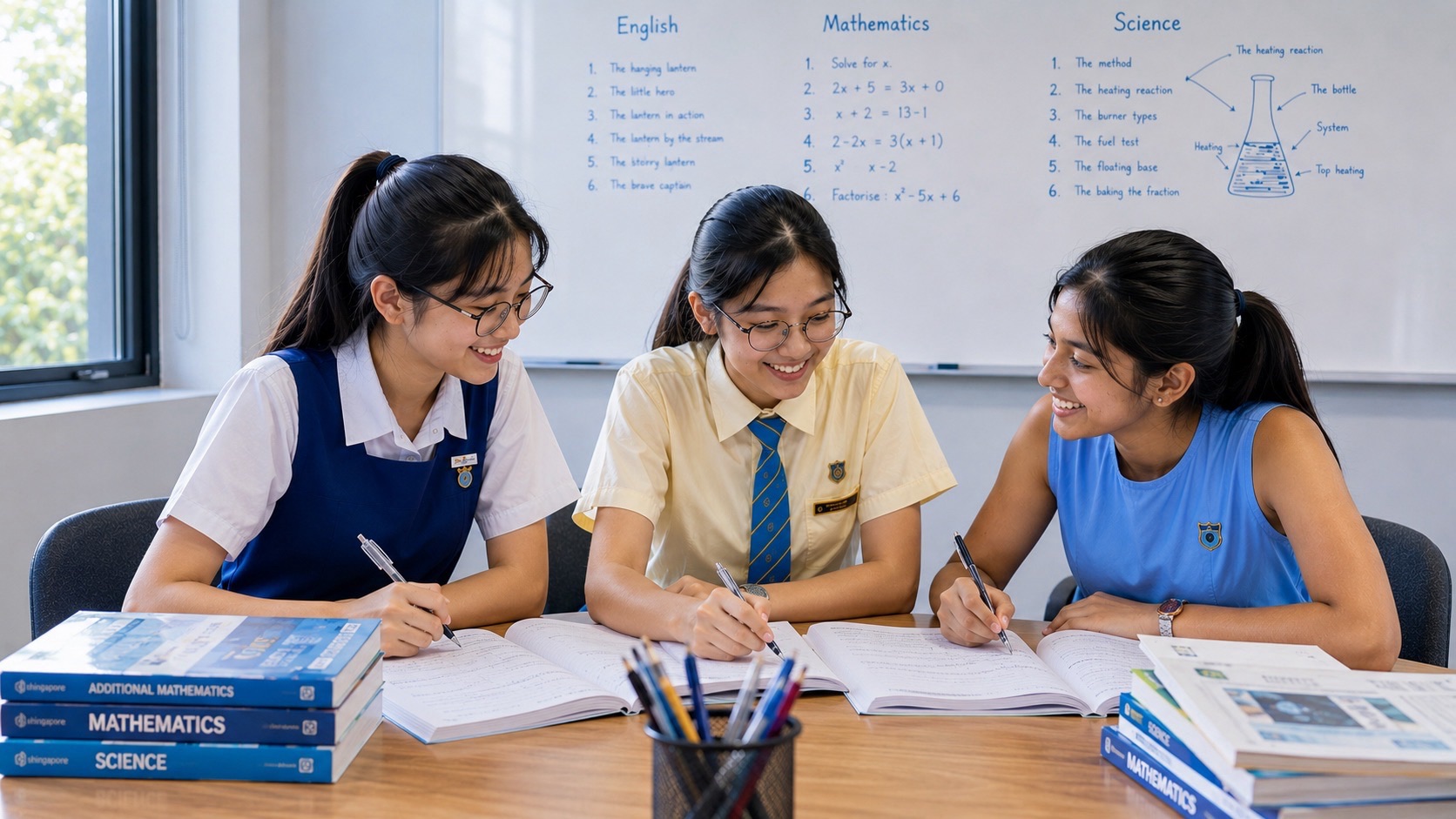
Secondary 2 G1 Science is the second year of learning Science at the General 1 subject level under Full Subject-Based Banding. It helps students explain everyday events, work with measurements and evidence, and connect ideas about machines, the environment and the human body. G1 describes the level of this subject; a child can study other subjects at different levels. The most useful starting point for parents is the school’s current Science outline, a recent piece of marked work and the teacher’s explanation of what the student needs to improve.
Secondary 2 Science assessments are set by schools. The Singapore–Cambridge Secondary Education Certificate (SEC), introduced from 2027, is a later national qualification; its G1 Science syllabus should not be mistaken for a national Secondary 2 examination. This guide explains the lower-secondary learning, offers original practice examples and shows how to discuss progress and future subject choices. Start with the topics actually taught in your child’s class, then use the explanations below to make the next learning step manageable. SEAB explains the SEC and its subject levels here.
- Main purpose: understand scientific ideas and use evidence to explain familiar situations.
- Topic order: schools decide how to organise the lower-secondary course across Secondary 1 and Secondary 2.
- Useful skills: accurate observation, measurement, reading data, drawing diagrams and explaining cause and effect.
- Assessment: follow the school’s stated topics, format and marking guidance.
- Support: repair one identified difficulty, practise it, then check it again independently.
- Next steps: discuss subject-level readiness, bridging and upper-secondary options with the school.
EDUKATE YISHUN · SECONDARY 2 G1
Find your next learning step
Choose the part that answers your question, or read the complete guide below.
CHAPTER 1 OF 15 · UNDERSTAND THE SUBJECT
1. Understand what G1 Science means for your child
A subject level describes the course a student is taking. It does not describe the student’s worth, curiosity or capacity to develop. A student taking G1 Science may be confident in another subject, skilled at making things, or able to give a thoughtful spoken explanation while still finding written answers difficult. Looking closely at the work gives a much more useful picture than attaching a broad label to the child.
Full Subject-Based Banding allows students to take different subjects at different levels. Posting Groups help with entry into secondary school and the initial subject levels; subsequent learning involves subject-specific decisions. The Full SBB explanation from Bukit View Secondary School illustrates these distinctions. For a parent, the practical question is: “What can my child do in Science now, and what would help them do the next part?”
Try listening to your child describe a recent lesson. If they can describe what happened but cannot explain why, work on the scientific connection. If the idea is clear orally but the written answer is incomplete, work on expressing it. If unfamiliar words prevent the student from understanding the question, begin with those words. These are different problems, so they need different responses.
Secondary 2 is also a useful time to build independence. Let the student choose one piece of work to review, identify a question they want to ask and explain a correction in their own words. A parent can provide structure without becoming the person who supplies every answer. The aim is a learner who increasingly knows how to find, use and check help.
CHAPTER 2 OF 15 · UNDERSTAND THE SUBJECT
2. Check the actual Secondary 2 topic sequence
MOE’s lower-secondary G1 Science curriculum brings together laboratory measurement, machines and energy, environmental science, and the body. It includes force, electricity, heat, matter, pollution, cells, food, reproduction and care of the body. The syllabus permits schools to organise the modules in different orders across lower secondary. The MOE G1 Lower Secondary Science syllabus supplies the national curriculum framework; the school outline supplies the sequence your child follows.
For a local example, Yishun Secondary School’s 2026 Secondary 2 G1 outline covers forces and energy, electricity and heat, followed by reproduction and care of the body. Its year-end scope also brings back selected Secondary 1 learning about cells and obtaining energy and nutrients. This example shows why a parent should check both current-year topics and earlier topics included in revision. It is one school’s published plan.
Make a simple personal topic list with three columns: taught, needs practice, and not yet taught. Place a date beside each item. A student may otherwise spend an evening revising a familiar chapter while avoiding the current difficulty, or become worried about material their teacher has not introduced.
Use the teacher’s chapter names when organising worksheets. A downloaded guide may arrange content differently even when the underlying science overlaps. Match the actual idea rather than assuming that “Chapter 4” means the same thing everywhere. Before an assessment, obtain the latest scope and ask whether earlier learning is included. That small administrative check can prevent several hours of poorly directed revision.
CHAPTER 3 OF 15 · EXPLAIN THE PHYSICAL WORLD
3. Make measurements and data meaningful
A measurement contains both a number and a unit. “The strip is 12” leaves the reader uncertain; “the strip is 12 cm long” communicates a usable result. When reviewing a worksheet, ask what quantity was measured, which instrument was used and whether the unit matches the quantity. This builds a habit that helps with tables, graphs and calculations.
Consider a drawn ruler showing an object starting at 2.4 cm and ending at 7.9 cm. Its length is 7.9 − 2.4 = 5.5 cm. A student who writes 7.9 cm has read the endpoint rather than the distance between endpoints. The repair is to mark both positions and explain what the subtraction measures. There is no need to repeat an entire chapter when the error is this specific.
The following invented data can be used for a reading exercise. It represents an object cooling in a room; it is a paper-based example, not instructions to conduct a heating activity.
| Time in minutes | Temperature in °C |
|---|---|
| 0 | 48 |
| 2 | 43 |
| 4 | 39 |
| 6 | 36 |
Ask three questions: What was the temperature after four minutes? How much did it fall in the first two minutes? What overall pattern is visible? The answers are 39°C, a fall of 5°C, and a decrease over the recorded period. The final answer should stay within the evidence; these readings do not establish the temperature after an hour.
When drawing a graph, check the axis labels, units, scale and plotted points before interpreting the pattern. A neatly drawn graph can still be misleading if the scale changes without explanation. Have the student point to the exact reading that supports each statement.
CHAPTER 4 OF 15 · EXPLAIN THE PHYSICAL WORLD
4. Explain forces through observable changes
Forces help us explain changes in movement and changes in shape. Begin with a specific event: a box slides across a tabletop after a push and gradually stops. The moving box experiences friction from the tabletop opposing its motion. A useful explanation connects that force with the slowing of the box.
A common incomplete answer is “It stops because the force is gone.” Ask the student to name the forces acting after the hand stops pushing. This makes room for the idea that the box can continue moving after the push ends, while another force changes its motion. Keep the explanation tied to the situation shown in the question.
For a shape example, imagine stretching an elastic band and then releasing it. The band changes shape while stretched and tends to return towards its original shape when released. A classroom diagram can help the student identify the object, the applied pull and the elastic response. Precise descriptions are more useful than saying only that the band “has force”.
Simple machines offer another useful context. A ramp can reduce the force needed to raise a load by allowing it to move over a longer distance. It does not create energy. When comparing two illustrated ramps, ask what stays the same, such as the height reached and the load, and what changes, such as the slope and distance travelled.
For revision, ask the student to write one sentence naming the force and one sentence describing its effect. Then change the example. If they can transfer the explanation from a sliding box to a moving toy shown in a diagram, their understanding is becoming more flexible. If they repeat words that no longer fit, return to the specific objects and their interactions.
Energy questions become clearer when the student identifies the starting point, the useful outcome and other energy transfers. In an electric fan, electrical energy is transferred into movement of the blades and air, with some energy also transferred as sound and heating. Calling all of the input “movement energy” misses part of the explanation.
Use a drawn energy chain for a battery-powered torch: stored chemical energy in the battery, electrical transfer through the circuit, then light and heating at the lamp. The chain is a way of organising thought. The student should still explain which outcome is useful for the purpose being discussed. Light is useful when the task is seeing in a dark place.
Energy described as wasted has not vanished. It has been transferred in ways that are less useful for the intended task, often spreading into the surroundings. This distinction helps students avoid writing that a machine “uses up all its energy” without explaining what happens to it.
Here is a paper-based comparison. Suppose devices A and B receive the same input energy. If A transfers a larger share into the required movement, A is more efficient for that purpose. The conclusion rests on comparing useful output with the same input. The device’s colour or size alone does not establish its efficiency.
Keep everyday discussions precise. Switching off an unused light reduces the energy supplied to that lamp during the period it is off. It is a clearer claim than saying that one action will solve an entire environmental problem. Encourage the student to explain a modest claim well, with a clear connection between action and effect.
CHAPTER 6 OF 15 · EXPLAIN THE PHYSICAL WORLD
6. Read circuits before memorising circuit answers
For electrical circuits, begin by tracing the conducting path. A simple lamp circuit needs a complete path through the source and components. If a switch opens that path, the lamp in that simple series circuit goes out. Students should be able to trace the route in a diagram and identify the exact break.
Next, distinguish a series arrangement from separate parallel branches. In a series circuit, components lie along one path. In a parallel arrangement, there are branching paths. A useful paper exercise is to shade each complete route with a different pencil colour. This helps a student who sees only a collection of electrical symbols.
Suppose a diagram shows two lamps in separate parallel branches and a switch in only one branch. Opening that branch switch interrupts its path, while the other branch can remain complete. The answer depends on where the switch is placed. “Opening a switch always turns everything off” is too broad.
Current, voltage and resistance name different quantities. Link each word to its role before expecting confident use of the units. A correct unit does not rescue an explanation that confuses the quantities. When the school introduces measurement diagrams, ask why an ammeter is placed in the relevant current path and why a voltmeter measures across a component.
Keep home practice to diagrams, teacher-provided simulations and written reasoning. Practical circuit work should follow the teacher’s instructions with suitable school equipment. Household sockets and appliances are not learning materials to open or modify. The educational objective is to understand circuits and recognise why electrical precautions matter, without turning a revision session into an unsafe practical activity.
CHAPTER 7 OF 15 · EXPLAIN THE PHYSICAL WORLD
7. Separate heat transfer from temperature
Temperature tells us how hot or cold something is. Heat transfer describes energy moving because of a temperature difference, from a region at higher temperature towards one at lower temperature. These ideas are connected, but the words are not interchangeable.
Return to the cooling data earlier in this guide. The object began warmer than its surroundings. As energy transferred to the cooler surroundings, the object’s temperature fell. An answer such as “cold entered the object” gives an inaccurate account of the transfer. Replace it with a sentence that names the warmer object, the cooler surroundings and the direction of energy transfer.
A second useful distinction concerns objects at the same temperature. A small cup of water and a large container of water can have the same temperature while containing different amounts of water. Temperature alone does not tell us the total thermal energy involved. Students can understand this point without being asked to learn an additional formula outside their current lesson.
Many materials expand when heated and contract when cooled. For a drawn example of a metal strip, ask the student to compare its length before and after heating, while keeping the material and initial dimensions clear. The explanation should identify the change the question asks about. It should not claim that every material behaves identically in every situation.
Practise using diagrams and supplied observations. One useful question is: “What evidence would show that this object lost energy to its surroundings?” A falling temperature can support that explanation when the surrounding conditions are specified. The next step is checking the conditions, because a memorised sentence needs a situation in which it is scientifically appropriate.
CHAPTER 8 OF 15 · CONNECT IDEAS AND EVIDENCE
8. Use matter and environmental topics to practise distinctions
Environmental questions often require the student to distinguish processes that look similar. Salt dissolving in water and sand mixing with water produce different situations. In the first, the dissolved salt becomes distributed through the solution. In the second, insoluble particles can remain suspended or settle. Saying that everything has “disappeared” makes later explanations harder.
Consider a written scenario in which muddy water is passed through filter paper. The filter can retain insoluble particles. That observation does not establish that every dissolved substance or microorganism has been removed, or that the water is safe to drink. This is a useful example of matching a conclusion to what the process can actually demonstrate.
Another important distinction is between dissolving faster and dissolving more. If one sample disappears into a liquid sooner, the observation concerns the rate of dissolving. It does not by itself establish the greatest quantity that could dissolve under those conditions. Ask the student which question the investigation was designed to answer.
For pollution, encourage a connected explanation: identify a source, describe what enters the environment, and explain an effect supported by the information given. An illustration of litter entering a waterway provides a different starting point from a table showing a change in air quality. The answer should fit that evidence.
Parents can use photographs, diagrams and school case studies for discussion. Ask: “What can we observe directly, what are we inferring, and what further information would help?” This supports careful reasoning without requiring the family to collect environmental samples or make health claims from an image. It also helps students recognise the limits of a confident-sounding explanation.
CHAPTER 9 OF 15 · CONNECT IDEAS AND EVIDENCE
9. Connect cells, food and body systems
Body topics become easier when students see how the parts work together. Cells are basic units of living organisms. In familiar classroom models, different structures have different functions. Learning a label matters because it helps explain that function, rather than simply filling a blank on a diagram.
Ask the student to compare a typical leaf cell diagram with an animal cell diagram supplied by the teacher. They should use the structures actually shown and the conventions taught in class. Avoid overgeneralising from one model: a drawing of a leaf cell does not mean that every cell in every plant looks identical or contains exactly the same structures.
Food provides substances the body can use. Digestion breaks down large food molecules into smaller substances that can be absorbed. The circulatory system transports absorbed nutrients, while the respiratory system brings in oxygen. Cells use suitable nutrients and oxygen in aerobic respiration, releasing energy for activities. This explanation connects systems rather than treating each chapter as an isolated list.
A useful practice question asks why learning only the name of the stomach gives an incomplete account of how food supports body activities. The answer needs a sequence: processing food, absorbing useful substances, transporting them and using them in cells. The student should use the level of detail taught by the school, adding accuracy before adding length.
Draw a simple set of labelled arrows on paper, then ask the student to explain each arrow aloud. If one arrow cannot be explained, that is the next teaching target. This activity is about scientific relationships. It does not require judging anyone’s body, comparing classmates’ appearance or giving a child a diet or medical plan.
CHAPTER 10 OF 15 · CONNECT IDEAS AND EVIDENCE
10. Discuss reproduction and care of the body respectfully
Reproduction and care of the body appear in the lower-secondary G1 curriculum. A family can approach these topics in the same calm way as other science: use accurate vocabulary, explain the relevant functions and allow sensible questions. Embarrassment does not need to become a barrier to learning.
Start by separating processes that students sometimes blend together. Puberty involves changes associated with developing sexual maturity. Fertilisation is the joining of a sperm cell and an egg cell. Development of an embryo is another stage. A question about one stage should be answered with the information relevant to that stage.
Use the school’s diagrams to practise the relationship between structure and function. A student might recognise a word when reading but struggle to locate the structure in a differently oriented diagram. Ask them to explain their choice and use neighbouring structures as clues. That reasoning is more durable than memorising where a label appeared on one worksheet.
Keep the conversation respectful of privacy. Students do not need to disclose personal experiences, describe classmates or compare bodies in order to understand a scientific diagram. If a question feels awkward to discuss at home, help the student write it clearly so they can raise it with an appropriate teacher.
For revision, use short, factual prompts: identify a structure, state its function, or put stages in order. Correct an inaccurate term without teasing. The purpose is to make understanding accessible and accurate. Individual concerns about health or development belong in an appropriate conversation with a trusted adult and a qualified professional, rather than being settled by an examination worksheet.
CHAPTER 11 OF 15 · CONNECT IDEAS AND EVIDENCE
11. Explain investigations with evidence
An investigation answer should show the connection between a question, the observations collected and the conclusion drawn. Students often know the vocabulary of a fair test but cannot explain why a particular condition should be controlled. Start with the specific comparison.
Imagine a paper scenario comparing how quickly equal amounts of sugar dissolve in equal volumes of water at the same starting temperature. One sample is stirred and the other is not. If the question concerns stirring, the amount and type of sugar, volume of water and starting temperature should be comparable. Otherwise, a difference in dissolving time could have more than one explanation.
This is a reasoning example, not a home experiment instruction. Ask the student to identify the factor changed, the outcome measured and two conditions that should be kept consistent. A strong answer names those things precisely. Writing only “keep everything the same” does not show what the student understands.
Repeating observations can help identify unusual results and check whether a pattern is consistent. An unexpected result should be examined, not silently altered to match a prediction. Possible measurement errors, different conditions and an incomplete explanation can all be considered. A scientific account should remain honest about what was observed.
For an explanation, try this writing sequence: state the conclusion, give the relevant observation, then connect it to the scientific idea. For example: “The object cooled during the recorded period. Its temperature fell from 48°C to 36°C. Energy transferred from the warmer object to its cooler surroundings.” This is a learning aid rather than a fixed national marking formula. Adapt the answer to the actual question and marks available.
The school’s assessment information determines the topics, timing and format for your child. The Yishun Secondary Science outlines, for example, publish year-specific coverage and assessments. A national SEC paper structure should not be imposed on a Secondary 2 school assessment simply because both use the label G1 Science.
When a marked paper comes home, choose a small number of representative errors. Sort them by what went wrong: misunderstood concept, unfamiliar vocabulary, misread diagram, incorrect measurement, incomplete explanation or unanswered task. “Careless” is too vague to tell the student what to practise next.
If the student knew the idea but answered a different question, underline the task word and the object being discussed. If the idea itself was wrong, use a fresh example to rebuild it. If the unit was missing, practise writing complete measurements in several contexts. Each repair should match the evidence in the work.
Ask the student to make a correction with an explanation, then revisit a similar question later without the answer beside it. Copying the teacher’s answer can produce a complete page without showing independent understanding. A delayed check provides better evidence of whether the repair has lasted.
Track a few useful signs across several pieces of work: more complete explanations, fewer repeated misconceptions, accurate units and willingness to attempt unfamiliar contexts. Marks still matter, but these signs show what is changing underneath them. If a pattern remains unclear, bring the specific questions to the teacher. A conversation anchored in actual work is more productive than asking broadly why the child is “bad at Science”.
The following plan is a suggested home routine, not a school requirement. Adjust the time and topics to fit homework, co-curricular activities and the student’s current understanding. A short session with a clear purpose is easier to evaluate than a long session described only as “revision”.
Week one: identify and repair. Select one difficulty from recent work, such as reading a graph or explaining friction. Review one clear explanation and discuss one worked example. Ask the student to complete two similar questions independently. Record what improved and what still needs clarification.
Week two: change the context. Use the same idea in a different diagram or everyday situation. A student who can explain a sliding box can try a different moving object shown on paper. Discuss which scientific idea stays relevant and which details change. This checks understanding beyond remembered wording.
Week three: connect ideas. Combine a small number of skills. Read a temperature table, describe its pattern and explain the energy transfer. The task becomes more demanding because the student must decide which knowledge to use. Give enough support to get started, then step back.
Week four: check and plan again. Revisit the original difficulty without the old answer visible. Compare the new response with the earlier one. Identify the next small target from the school’s current topic list. Preserve successful habits rather than restarting the entire system whenever a new chapter begins.
Between sessions, keep a brief question list for the teacher. Include the exact question, the student’s attempt and the point of uncertainty. This makes help easier to give and encourages the student to take ownership of the conversation.
CHAPTER 14 OF 15 · PLAN THE NEXT STEP
14. Discuss G2 readiness and upper-secondary choices
Moving to a more demanding subject level should be discussed using evidence of learning and the school’s current process. Schools consider readiness and the ability to manage the wider curriculum. Bedok South Secondary School’s current Full SBB guidance explains the role of eligibility and holistic school considerations. A strong result can start a useful discussion, but a single percentage should not be treated as an automatic promise of a level change.
Ask what additional content or skills would need bridging, when a change could take place and how progress would be reviewed. Request examples of the expected work. A student may need help with a wider topic range, longer explanations or greater independence, and those needs are easier to plan for when they are visible.
The lower-secondary G2/G3 Science curriculum is organised differently from G1. The Bukit View Secondary Science curriculum overview distinguishes these structures. Preparation should therefore follow the school’s bridging guidance instead of assuming that completing a harder-looking worksheet covers the difference.
For later national examinations, SEAB lists G1 Science as K123 for the 2027 SEC. That is an examination-year reference. A student in Secondary 2 in 2026 would ordinarily reach Secondary 4 in 2028; a Secondary 2 student in 2027 would ordinarily reach it in 2029. Check the syllabus and subject choices applicable to the child’s own cohort as those details become available.
At the upper-secondary briefing, ask how the available Science options relate to the student’s interests and future courses. Avoid making a long-term decision from a subject name alone. Look at prerequisites, actual school offerings, learning demands and the support available, while continuing to strengthen the present foundations.
My child can explain the lesson aloud but loses written marks. What should we do?
Compare a spoken explanation with the written answer. Often a crucial link disappears during writing. Have the student write the names of the objects first, then the change and the reason. Keep the scientific meaning accurate before working on speed. Ask the teacher for one example showing the level of detail expected.
Should we revise every Secondary 1 chapter again?
Begin with the school’s current assessment scope and the ideas needed for present lessons. Revisit earlier material where it supports the current topic or where an actual gap appears. A targeted review can be more useful than moving through an entire book without checking what the student already understands.
How can I help when I do not remember the Science myself?
You can still ask the student to show the evidence, explain a diagram and identify the exact point of confusion. Use the school materials to check terminology. If an answer remains uncertain, write down the question for the teacher. You do not need to invent an explanation to make the session worthwhile.
What should we take to a parent–teacher discussion?
Bring two or three recent examples, the student’s corrections and a short list of questions about topic priorities, assessment expectations and subject choices. Ask which improvement would make the greatest difference now. Agree on a realistic next step and a time to review it.
What is a useful first action tonight?
Choose one recent question. Let your child explain the task, attempt it and check the answer with the available guidance. End by naming one thing understood more clearly and one question still to ask. That creates a practical starting point for the next lesson without turning the whole evening into a judgement about ability.
Official sources and scope
This independent parent guide was checked on 15 November 2026. The teaching examples and home routine are original illustrations. Schools determine their teaching sequence and school assessment arrangements; consult your child’s latest school information.
- MOE: G1 Lower Secondary Science syllabus, updated April 2024.
- Yishun Secondary School: Science content outlines and 2026 Secondary 2 G1 outline.
- Bukit View Secondary School: Full Subject-Based Banding and Science curriculum overview.
- Bedok South Secondary School: Full SBB guidance.
- SEAB: Secondary Education Certificate and 2027 G1 syllabuses for school candidates.
Leave a Reply