
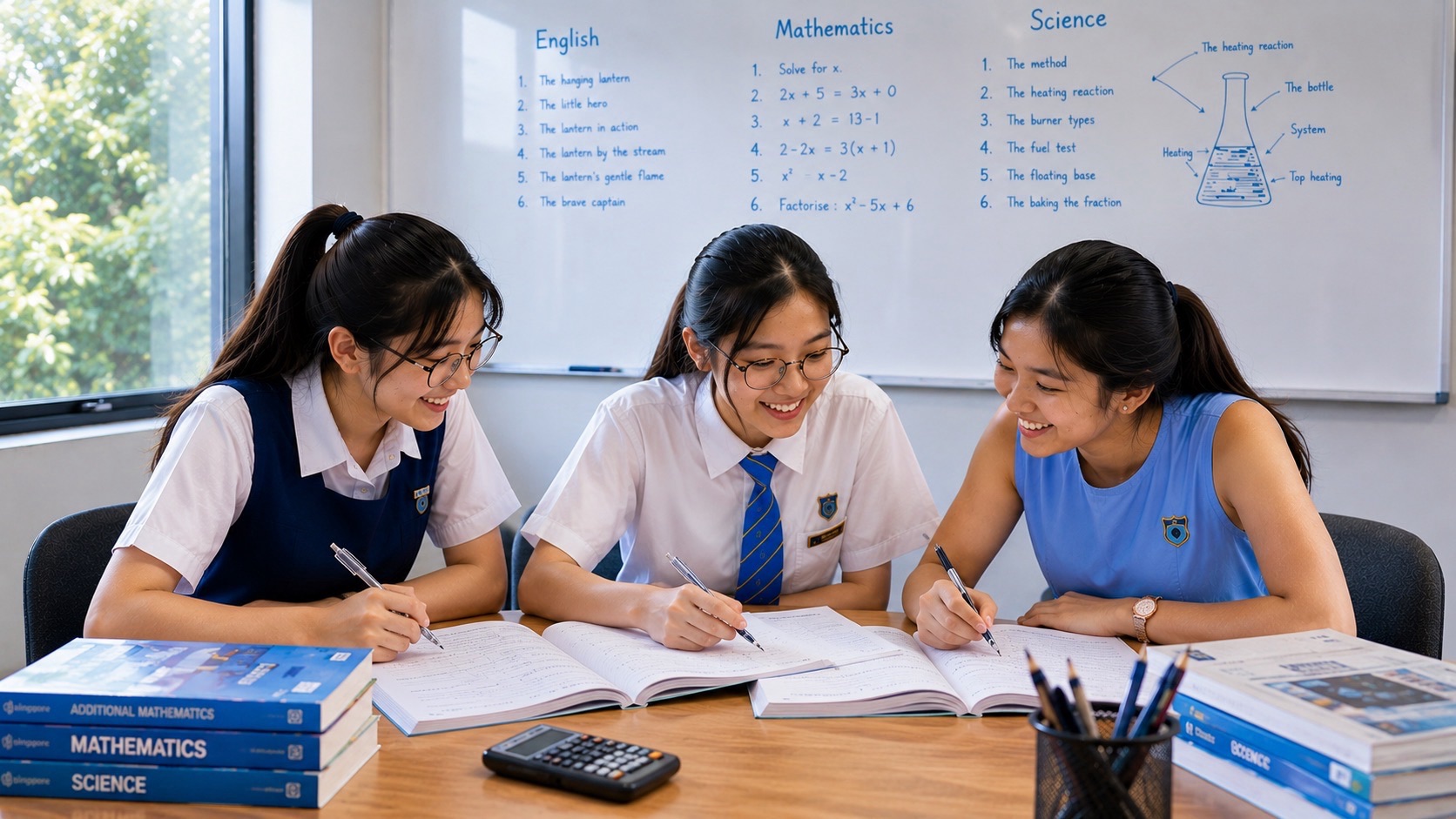
Secondary 2 G1 Mathematics is the second-year Mathematics programme taught at G1 subject level under Singapore’s Full Subject-Based Banding system. It develops the ability to use numbers, algebra, graphs, geometry and data to solve problems and explain decisions. The MOE G1 Mathematics curriculum identifies Secondary Two content, while your child’s school provides the teaching sequence and assessment arrangements. G1 describes the level of this subject; it does not describe the whole child.
For parents, the most useful starting point is the child’s current school outline, a recent marked assignment and one question the child can explain independently. These reveal whether the immediate need is repairing number foundations, understanding a new concept or practising how to apply it. This guide explains the main learning demands through original examples, shows how to support progress without doing the work, and separates Secondary 2 school assessments from the later Singapore-Cambridge Secondary Education Certificate, or SEC.
- Check the Mathematics subject level on the school’s records, rather than assuming it from the student’s Posting Group.
- Expect connected work on proportion, rates, linear algebra and graphs, geometry, measurement, statistics and probability.
- Keep fractions, negative numbers, percentages and units secure because later questions depend on them.
- Use worked examples to learn the reasoning, then attempt a changed question independently.
- Follow the school’s current assessment scope, calculator instructions and accuracy requirements.
- Discuss any proposed G2 Mathematics move with the school using sustained learning evidence and the applicable criteria.
- Match future SEC information to the child’s eventual examination year; Secondary 2 is preparation, not the national examination itself.
EDUKATE YISHUN · SECONDARY 2 G1
Find your next learning step
Choose the part that answers your question, or read the complete guide below.
CHAPTER 1 OF 15 · UNDERSTAND THE FOUNDATIONS
1. Understand what G1 means for your child
A student’s Mathematics level is one part of a subject combination. Under Full Subject-Based Banding, different subjects can be taken at different levels according to the relevant arrangements. Posting Groups guide entry and initial subject levels; they should not become labels for a child’s identity. Bukit View Secondary School’s official Full SBB explanation sets out this distinction.
At home, use precise language: “You are learning Mathematics at G1,” followed by a concrete learning goal. “You are a G1 child” says far more than the information supports. It can obscure a student’s strengths in language, practical work, leadership or a particular mathematical topic.
G1 Mathematics still requires thought. A student may calculate accurately yet misunderstand which quantity a percentage refers to. Another may know a formula but choose the wrong dimension from a diagram. A third may recognise a method but struggle to communicate the steps. These are different learning needs, even when the final marks look similar.
The aim is to make the mathematical relationship visible. Ask the child to name what is known, what must be found and why the proposed operation fits. Listen for the reasoning before correcting the arithmetic. This provides a clearer starting point than asking whether the entire subject is easy or difficult.
Progress also has several forms. It may appear as fewer copied signs, a correct diagram, a better explanation or a successful attempt at a question with unfamiliar wording. Keep the eventual grade in view, but recognise the specific improvements that make reliable performance possible.
CHAPTER 2 OF 15 · UNDERSTAND THE FOUNDATIONS
2. Read the Secondary 2 curriculum as connected skills
The MOE syllabus’s Secondary Two section includes direct and inverse proportion; rates and speed; linear expressions, equations and graphs; geometrical properties and constructions; similarity; Pythagoras’ theorem; prism and cylinder measurement; and data and probability. This is a curriculum map, not a weekly timetable.
| Learning area | A useful question to ask |
|---|---|
| Proportion and rates | What remains constant when another quantity changes? |
| Expressions and equations | What does the letter represent, and is there an equality to solve? |
| Graphs | What do the coordinates and the changes between points mean? |
| Geometry and measurement | Which property or dimension justifies the calculation? |
| Data and probability | What does the information support, and what remains uncertain? |
A local example is Yishun Secondary School’s 2026 Secondary 2 G1 Mathematics outline. It starts with geometrical work, moves into algebra and graphs, and includes applications involving money. That order belongs to that school and year. Families elsewhere should use their own school’s outline; families preparing for 2027 should obtain the new version when available.
Keep a copy beside the exercise book. Mark topics as “needs teaching”, “can do with help” or “can explain independently”. Those descriptions are more useful than a tick that merely says a chapter has been completed.
CHAPTER 3 OF 15 · UNDERSTAND THE FOUNDATIONS
3. Repair the number skills that current work actually needs
A difficulty in algebra may begin with fractions. A difficulty in geometry may begin with unit conversion. Before adding more exercises, look underneath the current error. The aim is a focused repair, so the student can return to the present lesson with greater control.
For example, ask the child to calculate one-half minus one-third. A correct method rewrites the fractions as three-sixths and two-sixths, giving one-sixth. If the child subtracts both numerators and denominators, more complicated algebraic fractions will probably remain confusing until this relationship is understood.
Negative numbers deserve the same attention. Compare −3 + 8, −3 − 8 and −3 × 8. The answers are 5, −11 and −24, but the operations mean different things. A number line can help with addition and subtraction. Multiplication needs an explanation of signed products. Avoid treating every negative sign as the same instruction.
Percentage example: identify the whole
In an invented shopping problem, an item costs $68 after a 15% discount. The paid amount is 85% of the original price. Therefore the original price is 68 ÷ 0.85 = $80. Adding 15% of $68 gives $78.20, which does not reverse the original reduction because it uses a different base.
Ask the student to check: 15% of $80 is $12, and $80 − $12 = $68. This check explains the answer instead of merely confirming a calculator display. It also shows why writing “85% represents $68” can be a valuable first line.
Use a small collection of such questions, selected from errors in current work. Once the foundation is stable, reconnect it immediately to the school topic. For instance, practise a numerical fraction subtraction and then a similar expression containing a letter. The student should see what stayed the same and what changed.
CHAPTER 4 OF 15 · USE NUMBER AND ALGEBRA
4. Understand direct and inverse proportion before choosing a formula
Proportion concerns relationships between quantities. Begin by asking what the situation assumes. Does each additional item cost the same amount? Is a fixed job being shared among equally productive workers? A calculation is meaningful only when its assumptions fit the question.
Direct proportion: a constant amount per item
Suppose five identical notebooks cost $12.50, with no discount or fixed fee. One notebook costs 12.50 ÷ 5 = $2.50. Eight cost 8 × 2.50 = $20. The total cost changes in the same ratio as the number of notebooks because the unit price remains constant.
Now introduce a $3 delivery fee. The cost for eight notebooks becomes $23. Total cost is no longer directly proportional to the number bought, because there is a fixed part. Doubling the notebook quantity does not double that fixed charge. This variation tests understanding more effectively than changing only the numbers.
Inverse proportion: a fixed total shared differently
In an idealised problem, four equally productive workers complete a fixed job in six hours. The work represents 4 × 6 = 24 worker-hours. Eight workers would take 24 ÷ 8 = 3 hours, assuming they can work independently at the same rate. The number of workers and the time have a constant product.
Real jobs may involve waiting, limited equipment or coordination, so this is a model with stated conditions. Students should learn to use the conditions given, rather than assume every situation with “more people” follows inverse proportion.
A helpful check is to predict the direction of change before calculating. More notebooks at a fixed unit price should cost more. More equally productive workers sharing the same divisible job should take less time. If the answer contradicts the prediction, inspect the relationship and the arithmetic.
A rate compares quantities with different units. “Litres per minute” connects volume with time; “dollars per kilogram” connects cost with mass. Read the word “per” carefully because it identifies the denominator. A number without its units may conceal the very relationship the question is testing.
If a tap delivers 18 litres in three minutes at a constant rate, its rate is 18 ÷ 3 = 6 litres per minute. In five minutes it delivers 30 litres. If a question asks for litres per second, convert the time first or convert the rate carefully: 6 ÷ 60 = 0.1 litre per second.
Average speed: use the complete journey
Consider a fictional journey of 6 kilometres in 30 minutes, followed by 9 kilometres in 15 minutes. Total distance is 15 kilometres. Total time is 45 minutes, or 0.75 hour. Average speed is 15 ÷ 0.75 = 20 kilometres per hour.
The two stage speeds are 12 and 36 kilometres per hour. Their simple arithmetic average is 24, which is wrong for this journey because the stages lasted different lengths of time. Returning to total distance divided by total time prevents this mistake.
For a unit conversion, 54 kilometres per hour equals 54,000 metres in 3,600 seconds, giving 15 metres per second. Writing that intermediate relationship explains the familiar division by 3.6. It also helps a student reconstruct the method when memory fails.
At home, ask for an estimate first. Would a walking journey across a neighbourhood reasonably have an average speed of hundreds of kilometres per hour? An unreasonable result may reveal an hours-to-minutes error. Estimation does not replace calculation; it helps the student decide whether the result deserves another look.
CHAPTER 6 OF 15 · USE NUMBER AND ALGEBRA
6. Make expressions and equations mean something
An expression represents a quantity. An equation states that two quantities are equal. Students need this distinction because simplifying an expression and solving an equation are different tasks. There is no value of x to find in 4x + 7 alone unless additional information is supplied.
Collect like terms without losing signs
Simplify 3(2x − 4) − 2(x + 1). Expanding both brackets gives 6x − 12 − 2x − 2. Collecting like terms gives 4x − 14. The minus before the second bracket affects both terms inside it; overlooking that is the common source of the incorrect constant −10.
A numerical check can expose the error. At x = 5, the original expression is 3(10 − 4) − 2(5 + 1) = 18 − 12 = 6. The simplified form also gives 20 − 14 = 6. One successful substitution does not prove every algebraic identity, but a disagreement immediately shows that something needs checking.
Solve by preserving equality
For 4x − 14 = 10, add 14 to both sides to obtain 4x = 24. Divide both sides by 4 to obtain x = 6. Check in the original equation: 4 × 6 − 14 = 10. Each step preserves equality.
This explanation is more dependable than treating terms as objects that jump across an equals sign and change themselves. The student should be able to name the operation applied to both sides, especially when negative numbers or fractions appear.
Translate a short situation
Three identical notebooks and a $2 delivery fee cost $17. Let x be the price of one notebook in dollars. The relationship is 3x + 2 = 17, so 3x = 15 and x = 5. A complete answer states that each notebook costs $5.
To extend the task, ask the child to explain the meaning of 3x, why the delivery fee is added once and what the final value represents. If those explanations are clear, change the context or the position of the unknown. That checks whether the student understands the equation beyond this particular wording.
CHAPTER 7 OF 15 · USE NUMBER AND ALGEBRA
7. Read graphs as relationships, not decorated number lists
A coordinate pair gives an ordered location. In (2, 7), the first coordinate belongs to the horizontal axis and the second to the vertical axis. Students should read the axis labels and scale before plotting or interpreting any point. A neat point on the wrong scale is still incorrect.
Consider y = 3x + 1. When x is 0, 1 and 2, the corresponding y-values are 1, 4 and 7. These give the points (0, 1), (1, 4) and (2, 7). Plotting them makes the constant change visible: each increase of 1 in x produces an increase of 3 in y.
The gradient is the vertical change divided by the horizontal change. Between (0, 1) and (2, 7), it is (7 − 1) ÷ (2 − 0) = 3. The graph crosses the vertical axis at 1 because x = 0 gives y = 1.
For y = 8 − 2x, the gradient is negative. As x increases by 1, y decreases by 2. Ask the student to predict that downward direction before drawing. This connects the equation with the picture and can reveal a sign error early.
Context adds another decision. If x counts whole items, fractional x-values may have no meaning in the situation even though the algebraic line can be drawn continuously. Students should distinguish the mathematical rule from the values that make sense for the problem.
Parents can ask three useful questions: What does this point say? What does the slope tell us? Which part of the graph answers the actual question? These prompts direct attention to meaning without requiring a parent to reproduce the whole lesson.
CHAPTER 8 OF 15 · EXPLORE SHAPES AND DATA
8. Use geometrical properties and constructions carefully
Geometry requires students to connect a visible figure with a justified property. A diagram may suggest that sides are equal or lines are parallel, but the reasoning must use the information given. Encourage the student to mark known lengths, equal angles and right angles before calculating.
If a triangle has angles of 48° and 67°, its third angle is 180° − 48° − 67° = 65°. The explanation names the angle sum of a triangle. A clear reason matters because another question may place the same angles within a larger figure where several different relationships are possible.
Constructions require control of instruments as well as understanding. A perpendicular bisector crosses a line segment at its midpoint and at a right angle. An angle bisector divides an angle into two equal angles. These terms describe different jobs; confusing them can produce a careful construction of the wrong object.
When practising the perpendicular bisector of a segment, keep the compass width equal for arcs centred on the two endpoints. Use a width greater than half the segment so the arcs can intersect above and below it. Joining those intersections gives the required line. Follow the teacher’s conventions for showing construction arcs.
Similarity: match corresponding sides first
Suppose two similar triangles have corresponding sides of 4 centimetres and 10 centimetres. The enlargement factor is 10 ÷ 4 = 2.5. A second side measuring 6 centimetres in the smaller triangle corresponds to 6 × 2.5 = 15 centimetres in the larger one.
The important step is identifying correspondence. Position on the page alone is unreliable because a figure may be rotated or reflected. Mark matching angles and follow the order of vertices. Once correspondence is secure, the proportional calculation becomes much easier to justify.
CHAPTER 9 OF 15 · EXPLORE SHAPES AND DATA
9. Recognise when Pythagoras’ theorem applies
Pythagoras’ theorem connects the side lengths of a right-angled triangle. The side opposite the right angle is the hypotenuse, and it is the longest side. Label that side before substituting values; do not decide which length to square last simply from its position in the picture.
For perpendicular sides of 6 centimetres and 8 centimetres, the hypotenuse c satisfies c² = 6² + 8² = 36 + 64 = 100. Therefore c = 10 centimetres. The positive square root is appropriate because c represents a length.
If the hypotenuse is 13 centimetres and one shorter side is 5 centimetres, the other side b satisfies b² + 25 = 169. Thus b² = 144 and b = 12 centimetres. This time subtraction is needed because the unknown is a shorter side.
The theorem can also test a proposed triangle. For lengths 7, 24 and 25 centimetres, compare the square of the longest side with the sum of the other two squares: 625 = 49 + 576. The equality confirms a right-angled triangle. Merely seeing one long side does not.
Ask the child to explain why the theorem is available in a particular problem. If there is no right angle stated, marked or established, using it needs further justification. This question prevents a familiar formula from being applied indiscriminately to every triangle.
Measurement errors often begin before arithmetic. Length measures a distance, area measures a surface and volume measures space occupied. Their units record the distinction: centimetres, square centimetres and cubic centimetres. Ask what is being measured before choosing a formula.
A rectangular box measuring 8 centimetres by 5 centimetres by 3 centimetres has volume 8 × 5 × 3 = 120 cubic centimetres. Its total surface area is 2(8 × 5 + 8 × 3 + 5 × 3) = 158 square centimetres. One result concerns the space inside; the other concerns all six outside faces.
Cylinders: use the radius, not the diameter
A closed cylinder with radius 3 centimetres and height 10 centimetres has volume π × 3² × 10 = 90π cubic centimetres. Its total surface area is two circular ends plus the curved surface: 2π × 3² + 2π × 3 × 10 = 78π square centimetres.
If the same cylinder is open at the top, one circular face is absent. Its surface area becomes 69π square centimetres. The wording changes what must be counted. Drawing or imagining the separate surfaces helps prevent automatic use of the closed-cylinder formula.
Unit conversions also change with dimension. Since one metre is 100 centimetres, one square metre is 100 × 100 = 10,000 square centimetres. One cubic metre is 100 × 100 × 100 = 1,000,000 cubic centimetres. Multiplying by 100 in all three cases confuses length with area and volume.
For a composite solid, identify the simpler pieces and decide whether a shared face is internal. Internal faces do not belong to the exposed surface area. Encourage a labelled sketch and a short plan before any calculation. The plan often reveals the misunderstanding more clearly than a long sequence of numbers.
CHAPTER 11 OF 15 · EXPLORE SHAPES AND DATA
11. Make sensible statements from data and chance
Data questions require more than reading the highest bar. Start with the variable, units, group represented and scale. For grouped data, check the interval boundaries. A histogram and a bar chart may look similar at first glance, but the intervals and the quantity being displayed need careful interpretation.
Mean, median and mode answer different questions
Consider the invented set 2, 3, 3, 4 and 18. The mean is 30 ÷ 5 = 6. The median is 3, and the mode is also 3. The high value of 18 pulls the mean above the other four observations. Saying “the average is 6” without identifying the measure can hide that feature.
Ask which measure helps answer the question. If the purpose is to describe a typical value in this small, uneven set, the median may communicate something the mean obscures. If the purpose concerns total quantity shared equally, the mean may be useful. The choice needs a reason.
Probability: describe the outcomes clearly
A bag contains three red counters, two blue counters and one yellow counter. If each counter is equally likely to be drawn, the probability of red is 3/6 = 1/2. The probability of not red is also 1/2 because the three remaining counters are blue or yellow.
For a fair six-sided die, the event “a number greater than four” has outcomes 5 and 6, so its probability is 2/6 = 1/3. Listing the outcomes first prevents the student from counting a familiar word or category instead of the actual possibilities.
A probability of one-half does not promise exactly five red draws in ten trials. It describes chance under the stated model. Students should learn to distinguish a probability calculation from a guarantee about a short run of results, just as they distinguish a data pattern from a claim about every individual.
Use the current assessment notice to confirm topics, duration, permitted tools and instructions. A practice paper from elsewhere may cover material taught in a different sequence. A disappointing score on an unsuitable paper gives poor information about readiness for the child’s own assessment.
For illustration, Yishun Secondary’s 2026 outline identifies weighted assessments and an end-of-year examination within its programme. That document establishes its own arrangement; it does not establish identical dates, weights or paper structures for every secondary school.
Prepare in three stages. First, check whether the child understands the taught methods. Second, mix short questions so the child must choose the method. Third, practise under the relevant time conditions. If the first stage is insecure, starting with repeated timed papers may simply repeat the same confusion faster.
During a question, teach a brief reading routine: identify the unknown, mark necessary information, choose a relationship, calculate and interpret. “Interpret” might mean writing the correct units, explaining a comparison or rounding sensibly for the situation. A calculation of 3.2 buses cannot be a final answer when complete buses are required.
Calculator use also needs practice. Know how to enter brackets, fractions and negative values on the permitted device. Keep intermediate precision where appropriate and follow the question’s stated accuracy instruction. Copying a display without checking its meaning can turn a correct calculation into an incorrect response.
After assessment, sort errors by cause: misunderstanding, wrong method, arithmetic, reading or communication. One useful correction that changes the next attempt is more valuable than copying an entire model solution without recognising the original mistake.
CHAPTER 13 OF 15 · STUDY AND REVIEW
13. Build a manageable four-week improvement plan
The following is an adjustable home routine, not a school requirement. Choose two or three short sessions a week around existing homework and commitments. Agree on one priority with the student and, where needed, the teacher. A narrow plan can be reviewed; an instruction to “improve everything” cannot.
Week one: identify the point of difficulty
Select three recent questions. Ask the child to explain the first uncertain step in each. Record whether the obstacle is a concept, notation, a calculation or interpreting the question. Choose one shared cause, such as distributing a negative number across brackets. Practise a few examples with explanation, then reconnect to the original work.
Week two: repeat the idea with changed details
Use fresh questions that retain the same relationship. Change the numbers, the order of information or the context. Allow an initial attempt without prompting. If help is needed, ask a question that directs attention to the relationship rather than naming the operation immediately. Record what the student could do independently.
Week three: choose between methods
Mix the repaired skill with familiar topics. For example, place an equation beside an expression to simplify and a short rate problem. Ask the child to identify what each task requires before starting. This checks whether the method is selected because it fits, rather than because every question on the page looks alike.
Week four: review and decide the next move
Revisit an earlier error using different values. Compare the quality of the explanation and the need for help. If the skill is secure, reduce its practice frequency and select the next priority. If difficulty persists, show the teacher the actual attempts and ask which prerequisite or explanation needs attention.
Keep a short correction record: the original misconception, the repaired rule and one successful independent example. “I forgot” gives little guidance. “I treated the discounted price as the original whole” explains precisely what to check next time.
Parents can protect the routine without taking ownership of the answers. Offer a quiet starting time, help locate the correct materials and acknowledge a thoughtful correction. When the student is stuck, an honest question for the teacher is a productive outcome. It is better than an adult completing the work while the uncertainty remains hidden.
CHAPTER 14 OF 15 · PLAN THE NEXT STEP
14. Discuss G2 readiness and future SEC requirements accurately
A possible move to G2 Mathematics deserves a specific conversation with the school. Orchid Park Secondary School’s official guidance explains that later offers depend on school-based criteria and a holistic assessment of subject performance and overall workload. A single score should not be presented as an automatic national entitlement to change level.
Bring evidence of independent work across several topics. Ask which additional demands the proposed level introduces, when eligibility is reviewed, what bridging is available and how progress will be monitored. Include the student’s view. Enthusiasm matters, but it is most useful when connected to an understanding of the work involved.
A student can be ready for greater mathematical challenge while still needing support with organisation or another subject. Conversely, a high score on familiar exercises may conceal difficulties with unfamiliar questions. The discussion should examine both strengths and support needs instead of deciding from a label.
The SEC begins in 2027, with subjects taken at their respective levels. SEAB lists G1 Mathematics as K110 for the 2027 examination. That terminal examination document is different from a Secondary 2 assessment notice.
Ordinary year-by-year progression places a Secondary 2 student in 2026 in Secondary 4 in 2028; a Secondary 2 student in 2027 ordinarily reaches Secondary 4 in 2029. Check the syllabus for the actual examination year when available, and follow school guidance if the student’s progression differs. Do not treat 2027 paper details as fixed requirements for every younger cohort.
For present decisions, a sensible goal is a confirmed subject plan, a clear account of readiness and a manageable preparation task. Future course requirements should be checked separately against the relevant institution and admission year when they become part of an actual decision.
Does difficulty in Secondary 2 mean starting the whole syllabus again?
Begin with the evidence. If fractions are disrupting algebra, revisit those fraction skills and reconnect them to the current work. If the child understands calculations but misreads graphs, restarting unrelated number topics wastes attention. Ask the teacher to help identify the smallest useful repair.
Should my child finish every question in an assessment book?
Completion is useful only when the work produces understanding. Choose relevant questions, inspect mistakes and try changed examples independently. A small set can reveal a persistent misconception. A large completed set can conceal copying or reliance on prompts. Use the school’s scope to decide what belongs in the practice.
What if my child understands a solution but cannot start alone?
Cover the worked solution and ask the child to identify the unknown and the relationship. Provide only the first necessary cue, then withdraw it on the next question. Compare independent attempts over time. Recognising someone else’s reasoning and producing a solution are different achievements.
How do I help if I have forgotten the Mathematics?
You can still ask the child to explain a diagram, name the units or show where an answer was checked. Use the teacher’s demonstrated method as the reference. If explanations conflict, write down the exact point of confusion for school clarification rather than introducing several competing shortcuts.
What should we do this week?
Obtain the current topic outline, choose one recent error and ask your child to explain the first uncertain step. Agree on a short repair activity and one later independent check. If a subject-level decision is approaching, add the school’s deadline and questions to the plan. This turns a broad concern about Mathematics into a next action the family can actually carry out.
16. Official sources and scope
This independent parent guide was checked on 15 November 2026. Its teaching examples are original illustrations, not examination questions or promises about assessment coverage.
- MOE G1 Mathematics syllabus, Secondary One to Four — curriculum and year-level content.
- Yishun Secondary School Mathematics content outlines — local school and year-specific planning.
- Bukit View Secondary School Full SBB explanation — subject levels and Posting Groups.
- Orchid Park Secondary School guidance on more demanding subjects — school assessment of readiness.
- SEAB SEC overview and 2027 G1 syllabus directory — later national examination context.
Leave a Reply