
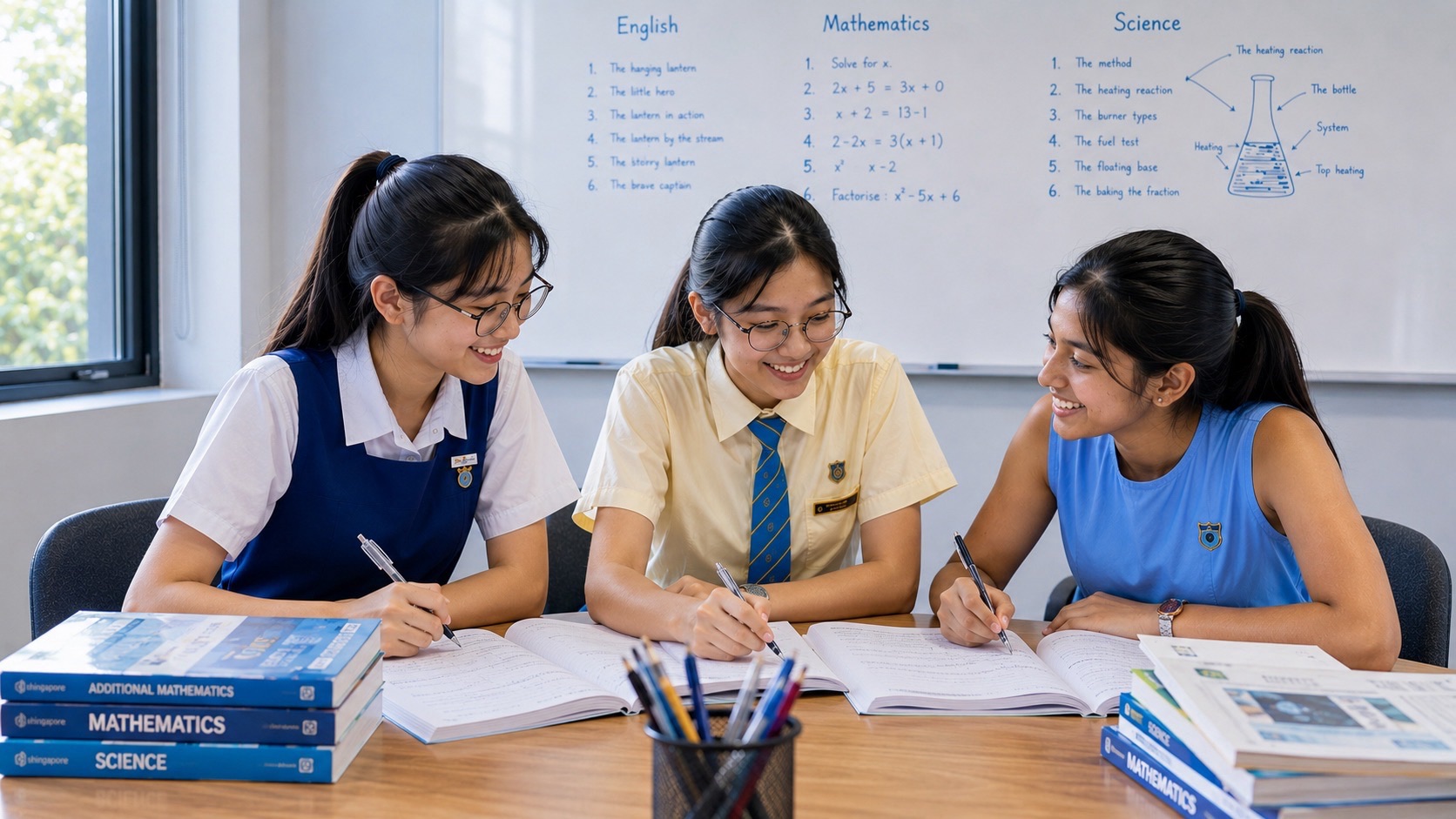
This eduKateYishun page is the Secondary 1 G3 Mathematics subject-level overlay. It supports the transition into more symbolic algebra, functions, graphs, geometry, data and mathematical reasoning at the learner’s actual G3 Mathematics level. The retained Bukit Timah title is historical page identity; it does not establish a current physical branch, class, fee, timetable or vacancy.
G3 is a subject level, not a whole-student label. Use the school’s current sequence and content already taught. For the wider Secondary 1 transition, use Secondary 1 Mathematics | Building the Mathematical Operating System. For specialist Mathematics teaching, use BTT’s Secondary Mathematics Learning Hub.
1. Diagnose before accelerating
A strong Primary-school result does not remove the need for diagnosis, and a weak early Secondary result does not prove the learner lacks ability. Inspect the actual work. A problem may begin in directed numbers, equation formation, graph scale, notation or method selection. Identify the first invalid or missing decision and preserve everything that is already correct.
If a learner succeeds only after someone names the method, record that support. The next changed question should test whether the learner can now supply the first representation independently.
2. Number and algebra must cooperate
If x = −4, then 3x + 5 = −12 + 5 = −7. Brackets around a negative substituted value can prevent sign ambiguity. A learner who handles −12 + 5 correctly but fails after substitution may need notation repair rather than a full signed-number restart.
Estimate before calculator work. 39.7 × 2.9 should be near 40 × 3 = 120. The exact product is 115.13. Magnitude checking gives a second line of evidence against a decimal-entry error.
3. Expressions, equations and structure
Expand 4(x − 3) to 4x − 12. Factor 6x + 18 as 6(x + 3). These transformations reverse one another in simple cases, which makes expansion a useful check on factorisation.
Solve 5x − 8 = 2x + 13. Subtract 2x and add 8 to obtain 3x = 21, so x = 7. Substitute into the original equation: both sides equal 27.
Translate “four more than twice a number is 18” as 2n + 4 = 18, giving n = 7. The phrase describes an order of operations and should not be reduced to keyword hunting.
4. Functions and graphs: one relationship, several forms
For y = 3x − 2, x = 4 gives y = 10. A table of inputs and outputs, plotted coordinates and the equation all describe the same rule. Moving among them deliberately prepares the learner for later function work.
The line through (0, 1) and (3, 10) has gradient 3 and equation y = 3x + 1. It is not directly proportional because it does not pass through the origin. Constant gradient and direct proportion are related but not identical ideas.
Read axes and scale before interpreting a graph. If 0 to 50 spans five equal intervals, each interval is 10. A point at the third interval represents 30.
5. Geometry, measurement and conditions
Use properties only when their conditions are stated or established. A diagram that merely looks isosceles, right-angled or parallel does not supply those facts by appearance alone.
In an isosceles triangle with equal base angles (x + 20)° and vertex angle 40°, 2(x + 20) + 40 = 180, giving x = 50. The actual base angles are 70° each.
A rectangle 9 cm by 7 cm has perimeter 32 cm and area 63 cm². Units expose the difference: centimetres describe length; square centimetres describe area.
6. Statistics and probability: calculation plus interpretation
Six values with mean 9 have total 54. If five known values total 47, the missing value is 7. This is the reverse of finding a mean from a total.
A bag with 2 red, 5 blue and 3 green counters gives P(blue) = 1/2 when each counter is equally likely. P(not blue) = 1/2 as well because five counters are non-blue. Define the event before calculating.
7. Reasoning and checking
Ask why a step is valid, what condition makes it valid and how the result can be checked. Substitution can check an equation solution; expansion can check factorisation; units can challenge a mensuration answer; a graph can check whether a table follows the stated relationship.
A check has boundaries. One numerical substitution can disprove a proposed identity if the two sides disagree, but one agreeing value does not prove equality for all inputs. The learner should know what the check establishes.
8. Six worked G3 recovery cases
Case A · Distribution
3(2x − 5) expands to 6x − 15. Writing 6x − 5 multiplies only one term and changes the expression.
Case B · Equation on both sides
4x + 3 = 2x + 15 gives 2x = 12 and x = 6. Substitution produces 27 on both sides.
Case C · Graph rule
The table x = 0,1,2 and y = 4,7,10 follows y = 3x + 4 under the stated linear pattern. The fixed term is visible at x = 0.
Case D · Area versus perimeter
An 8 by 6 rectangle has area 48 and perimeter 28. The requested quantity should be identified before the formula.
Case E · Mean
Five values have mean 13, so total 65. If four total 52, the fifth is 13.
Case F · Probability complement
If P(red) = 3/10 under the stated sample space, P(not red) = 7/10. The complement must exhaust all alternatives to red.
9. Fresh independent check
Solve 6x − 4 = 20. Expand 2(3x + 5). For y = 4x − 1, find y when x = −2. A rectangle is 11 cm by 4 cm; find its perimeter. Seven values have mean 10 and six known values total 57; find the seventh.
The answers are x = 4; 6x + 10; −9; 30 cm; and 13. Review whether equality, distribution, signed substitution, perimeter and mean-total reconstruction were selected without cues.
10. Secondary 2 handover
Carry forward current strengths, active algebra or representation risks, graph-scale habits, unit checks and the strongest prompt still needed. Use Student Diagnostics when the first failure remains unclear and Recovery Atlas when several learning dependencies are involved.
Secondary 1 route: Main Secondary 1 Mathematics guide · Secondary Mathematics directory.