
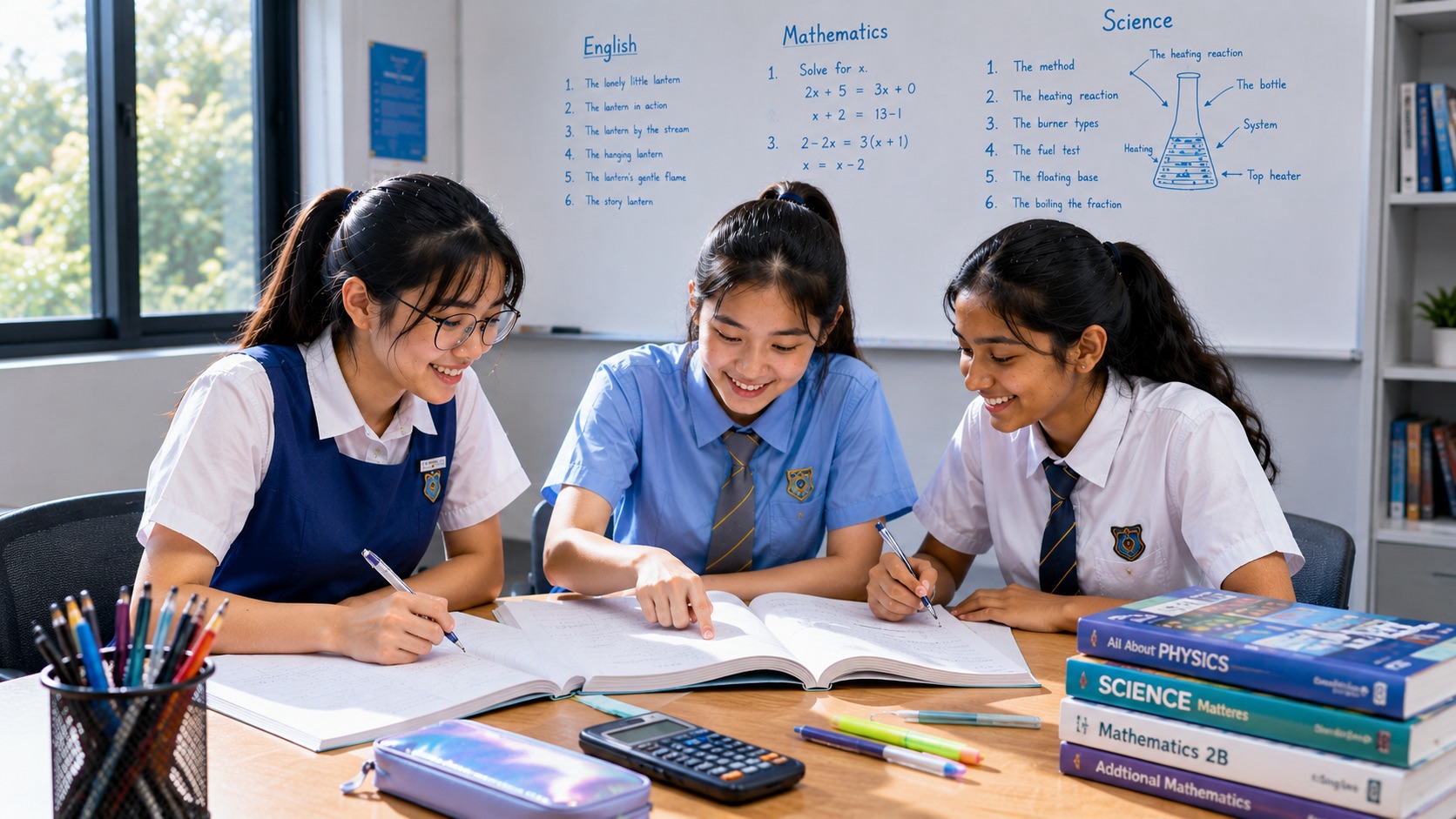
This eduKateYishun page is the Secondary 1 G2 Mathematics subject-level overlay. It helps a learner stabilise number, ratio, algebra, geometry, graph and data relationships at the actual G2 Mathematics level. The retained Bukit Timah title is historical page identity; it does not establish a current physical Bukit Timah branch, class, fee, timetable or vacancy.
Use the learner’s actual school sequence and content already taught. G2 is a subject level, not a description of the whole student. For the broader Secondary 1 transition, use Secondary 1 Mathematics | Building the Mathematical Operating System. For specialist Mathematics teaching, use BTT’s Secondary Mathematics Learning Hub.
1. Begin with the first unsupported step
A wrong answer can contain a correct start. Preserve it. If a learner forms the right equation but loses a sign, the modelling step is secure. If the learner cannot form the equation but solves it once supplied, the active difficulty is translation rather than algebraic manipulation.
Record the strongest cue used. A learner who solves only after “use percentage” is not yet showing independent method selection. A later changed question should remove that cue and test whether the learner now recognises the relationship.
2. Number, ratio and percentage should connect
For A:B = 3:5 and A + B = 64, eight ratio units represent 64, so A = 24 and B = 40. If A alone is 24, dividing by three recovers one ratio unit of 8. The relationship stays the same while the information supplied changes.
A 15% increase means multiplying by 1.15. If $80 increases by 15%, the result is $92. If $92 is known as the final price after a 15% increase, divide by 1.15 to recover $80. Forward and reverse percentage are two directions through the same multiplier relationship.
Estimate before accepting calculator-heavy work. 24.8 × 4.1 should be near 25 × 4 = 100. The exact answer is 101.68. An answer near 1,000 should trigger inspection immediately.
3. Algebra: expressions, equations and substitution
In 5x + 2x − 4, the like terms combine to 7x − 4. In 3(x + 2), multiplication distributes across both terms, giving 3x + 6. Substituting x = 4 into either form should produce the same value.
Solve 4x + 5 = 25 by subtracting 5 and dividing by 4, giving x = 5. Substitution checks the original equation. A “move across” shortcut should remain grounded in preserving equality.
For “three identical books and a $4 bag cost $25”, let b be one book price. Then 3b + 4 = 25 and b = 7. If the learner can solve the equation only after it is supplied, practise constructing the representation rather than adding more routine equation sheets.
4. Graphs and coordinates: interpret the axes first
The points (0, 2), (1, 5), (2, 8) follow the rule y = 3x + 2. The output increases by three for every one-unit increase in x. The fixed starting value of two is visible at x = 0.
Do not confuse constant increase with direct proportion. y = 3x + 2 does not pass through the origin. By contrast, y = 3x does and has constant ratio y/x = 3 for nonzero x.
If an axis rises from 0 to 30 across six equal intervals, each interval is 5. A point at the fourth interval represents 20. Scale reading is part of the mathematics, not a visual afterthought.
5. Geometry and measurement: property before calculation
A rectangle 10 cm by 6 cm has perimeter 32 cm and area 60 cm². Ask what is being measured before choosing a formula. Boundary and surface use the same dimensions but different relationships.
Two adjacent angles on a straight line are (2x + 10)° and (3x + 20)°. Their sum is 180°, so x = 30. The angles are 70° and 110°. The variable value is not automatically the requested angle.
Where right triangles are in scope, identify the hypotenuse before using Pythagoras. Legs 6 and 8 give hypotenuse 10 because 36 + 64 = 100. A diagram that merely looks right-angled is not enough without the stated condition.
6. Statistics and probability: preserve the model
Five values with mean 10 have total 50. If four known values total 41, the fifth is 9. The mean connects to total and count.
A bag with 4 red, 3 blue and 3 green counters gives P(red) = 4/10 when each counter is equally likely. P(not red) = 6/10 = 3/5. Define the event and sample space before forming the fraction.
7. Five worked recovery cases
Case A · Ratio total
A:B = 2:7 and total = 45. Nine ratio units represent 45, so the quantities are 10 and 35.
Case B · Reverse percentage
After a 20% discount, an item costs $48. The price is 80% of the original, so original = 48/0.8 = $60.
Case C · Bracket structure
2(x + 5) = 18 gives x = 4. Writing 2x + 5 = 18 changes the grouped quantity and gives a different equation.
Case D · Graph scale
If four equal intervals represent 0 to 20, each interval is 5. Three intervals above zero represent 15.
Case E · Mean-total relationship
Six values with mean 8 have total 48. If five values total 42, the sixth is 6.
8. Fresh independent check
Solve 3x + 4 = 19. A:B = 4:5 with total 54; find both quantities. Find the perimeter of a 12 cm by 5 cm rectangle. For y = 2x + 3, find y when x = 4. Five values have mean 12 and four known values total 50; find the fifth.
The answers are x = 5; 24 and 30; 34 cm; 11; and 10. Record whether equation balance, total ratio units, perimeter selection, substitution and mean-total reconstruction were independent.
9. Secondary 2 handover
Carry forward secure number and proportional reasoning, current algebra risks, graph-scale habits, measurement units and the strongest prompt still needed. Remove resolved errors from intensive revision. Use Student Diagnostics when the first failure is uncertain and return to fresh work after every repair.
Secondary 1 route: Main Secondary 1 Mathematics guide · Secondary Mathematics directory.