
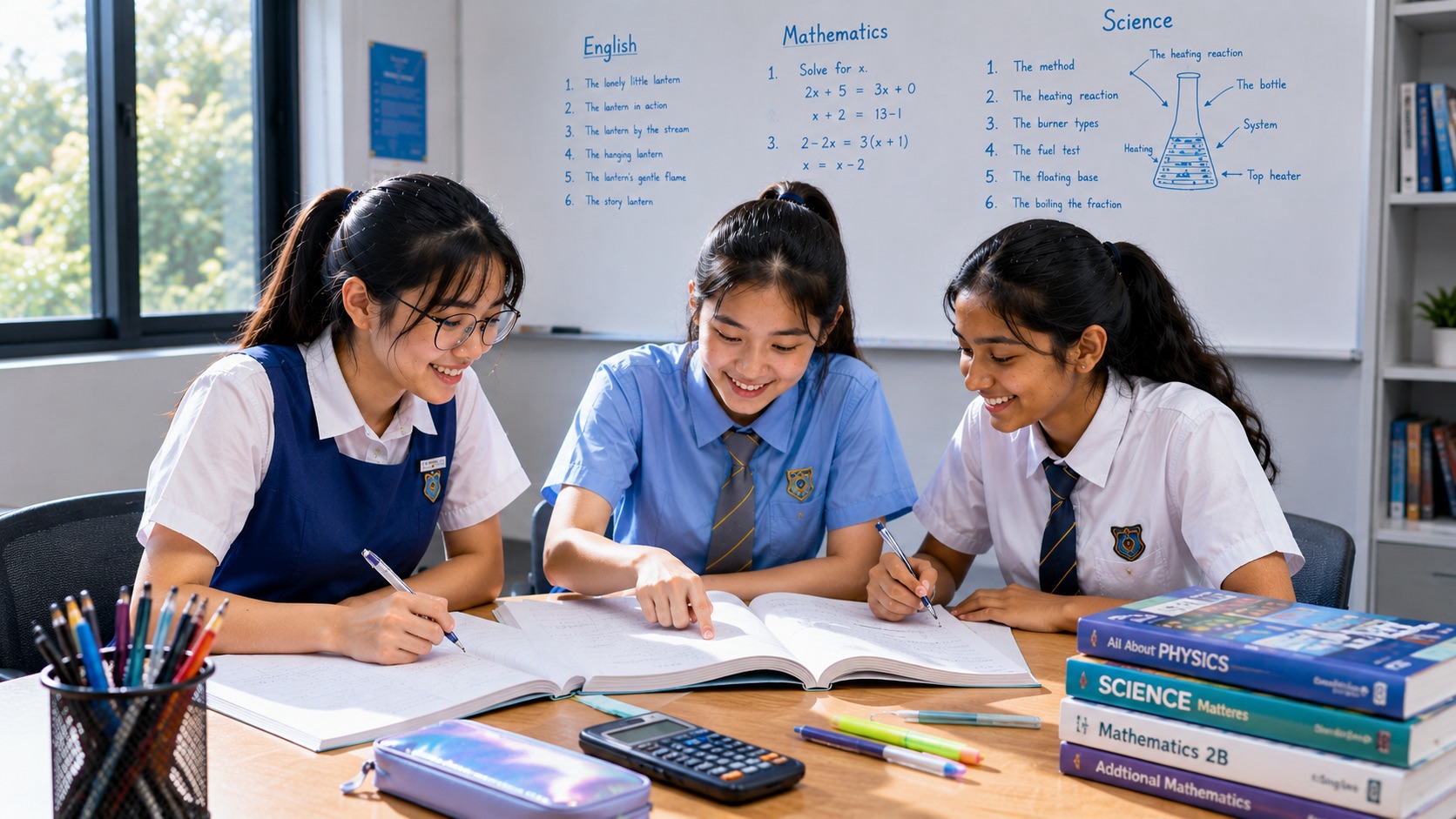
Parents looking for a Secondary 2 English tutor in Yishun are often seeing a familiar pattern: the student understands ordinary conversation but loses marks when a passage becomes dense, an inference needs evidence, editing requires precise grammar, or writing needs a sustained line of thought. Good Secondary 2 English tuition should connect comprehension, vocabulary, grammar, editing, situational writing, continuous writing and oral communication instead of treating them as separate examination tricks.
At this stage, students need stronger reading comprehension, critical thinking, vocabulary in context and writing structure before the upper-secondary years. In our three-student tutorials, the tutor can inspect how each learner reads a question, chooses evidence and constructs an answer. That makes it possible to repair the actual weakness rather than simply assign more pages.
The goal is increasingly independent English: a student who can read closely, decide what a task demands, organise an answer and revise it without waiting for the tutor to supply every next sentence.
Secondary 2 is a consolidation year
Students now need to use the foundations of Secondary 1 with greater precision. Texts become more nuanced, vocabulary less predictable and writing more demanding. The right response is not panic; it is to make the language system more dependable.
Comprehension begins with scope
We teach students to identify what the question is asking before searching for words to copy. A question about why, how, attitude or language effect needs a different response from one asking for a literal detail.
Inference with evidence
Students identify textual clues and explain the reasonable conclusion that follows. An inference is not imagination without boundaries. The passage must support it.
Vocabulary and nuance
We work on meaning, connotation, register, word families and collocation. Students learn why near-synonyms are not always interchangeable and reuse new vocabulary in discussion and writing.
Editing systematically
Agreement, tense, word form, pronouns, prepositions, connectors and sentence boundaries are checked through a repeatable process. Students should know why a correction works.
Situational writing
Role, audience, purpose and context determine tone. Students identify required information, organise it logically and write for a real reader rather than merely filling a format.
Continuous writing
We plan around one central idea and give each paragraph a job. Narrative details should cause or reveal something; expository examples should prove something. Good writing is selective.
Oral communication
Students develop answers with a position, reason, example and connection while remaining responsive to the prompt. The scaffold supports thinking without producing robotic speech.
Three students, visible thinking
Small groups allow comparison of answers and close individual feedback. Students learn that two responses can differ in wording while one is stronger because it is more relevant, precise or better supported.
Remove the scaffold
We model, practise and then change the task. The student must transfer the principle to a fresh passage or writing prompt. That fresh attempt is our evidence that learning has travelled.
Corrections should change future work
We name recurring failures: wrong scope, weak evidence, incomplete explanation, vague vocabulary, grammar or poor organisation. The student then applies the repair to another item.
Reading beyond examination passages
Age-appropriate fiction, journalism and explanatory writing expand world knowledge and expose students to strong sentence structures, arguments and vocabulary. We teach them to notice how writers guide readers.
Preparing for Secondary 3
By the end of Secondary 2, students should read unfamiliar material with more confidence, support interpretations, edit with reasons and organise longer writing with less help. These capabilities make upper-secondary English far less abrupt.
Our Yishun Secondary 2 English tuition is built around that progression. Understand first, support the interpretation, choose language deliberately, organise the response and learn to correct your own work. English becomes much more manageable when students can see what each part of the language is doing.
Continue through Secondary English: Secondary 1–2 article index · Secondary English directory · English Hub · Diagnostics · Examinations · Library
Continue through Secondary 2 English: Yishun Small Group English Tutor Secondary 2 · Secondary 1–2 article index · Secondary English directory · Diagnostics · Examinations · Yishun Tuition Hub · Library