
A Secondary 1 English tutor in Yishun should help students manage the jump from Primary School English to longer reading passages, more precise comprehension, editing, vocabulary, situational writing, continuous writing and oral discussion. The important change is not simply that the work becomes harder. Students are increasingly expected to interpret, organise and justify.
Effective Secondary English tuition commonly develops comprehension strategies, grammar and editing, vocabulary, writing structure and critical thinking. These skills reinforce one another. A student who reads more precisely notices how sentences work; a student who understands sentence structure edits more accurately; a student with stronger vocabulary can both interpret and express finer distinctions.
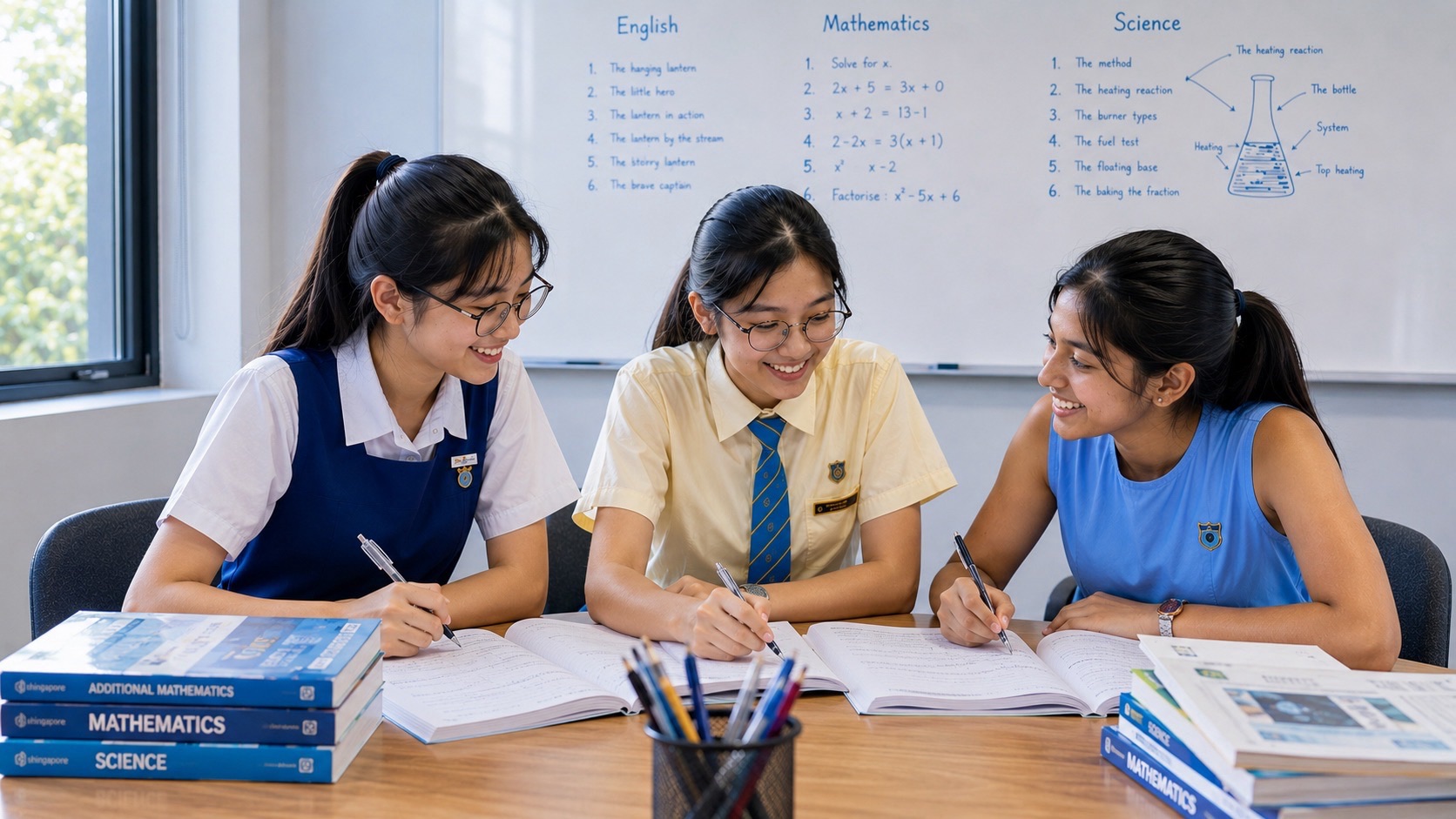
Our three-student tutorials allow the tutor to see how each learner thinks. We can ask for the evidence behind an inference, inspect why a paragraph loses focus or identify the grammar rule behind an editing error. That makes feedback specific rather than generic.
Secondary English is a system
We teach students to see reading, writing, speaking and language accuracy as connected. Examination components are different demonstrations of the same underlying ability: understand meaning and communicate meaning clearly.
Comprehension: answer the question actually asked
Students learn to identify command words, locate evidence and distinguish literal questions from inference or language-use questions. A complete answer must address the required scope, not merely copy a nearby sentence.
Inference with evidence
We use a simple discipline: clue plus reasoning. What does the passage show, and what reasonable conclusion follows? Students learn that an inference is not a guess; it is a conclusion constrained by the text.
Vocabulary: precision over decoration
We teach meaning, nuance, register and collocation. Students compare near-synonyms and examine why writers choose one word rather than another. Vocabulary becomes a tool for accurate thinking.
Editing: diagnose the sentence
Students check agreement, tense, word form, pronouns, prepositions and sentence boundaries systematically. Instead of saying “this sounds wrong”, they learn to explain what grammatical relationship has failed.
Situational writing: audience changes language
Before writing, students establish role, audience, purpose and required content. A message to a friend, formal email or public-facing text should not sound identical. Register is part of meaning.
Continuous writing: build around a central idea
Planning is kept short and functional. Students decide what the piece is really about, sequence the important moments or claims and give each paragraph a job. Strong details are selected because they develop the piece, not because they look impressive.
Oral: think, support, connect
Students practise forming a position, explaining why, adding an example and connecting the example back to the question. This creates developed speech without memorised scripts.
Small-group feedback
Three students can discuss a passage and compare answers while remaining individually accountable. The tutor can challenge one learner’s reasoning, scaffold another and extend a third without losing the common lesson.
Remove the scaffold
We model when necessary, but support gradually disappears. The student eventually faces a fresh passage or writing task without the model beside it. Independence is the test that learning has transferred.
Use errors as data
We classify recurring failures: misunderstanding the question, weak evidence, incomplete explanation, vocabulary imprecision, grammar, organisation or time. Once a pattern is visible, practice can target it directly.
Reading builds the reservoir
Students benefit from reading beyond examination passages. Fiction develops voice and narrative understanding; journalism and explanatory writing build knowledge, argument and informational vocabulary. We teach students to notice what skilled writers are doing.
What parents can notice
Progress appears when a student explains an answer more precisely, edits with reasons, plans writing faster and asks better questions about a text. Marks matter, but these behaviours show that the system underneath the marks is changing.
Our Yishun Secondary 1 English tuition is designed around that system. The learner should become better at reading closely, thinking clearly and expressing meaning accurately. Tuition has done its job when the student no longer needs the tutor to supply every interpretation, opening sentence or correction.
Continue through Secondary 1 English: Yishun English Tuition Sec 1 Tutor · Secondary 1 English Tuition in Yishun · Secondary 1–2 article index · Secondary English directory · Diagnostics · Examinations · Yishun Tuition Hub · Library