
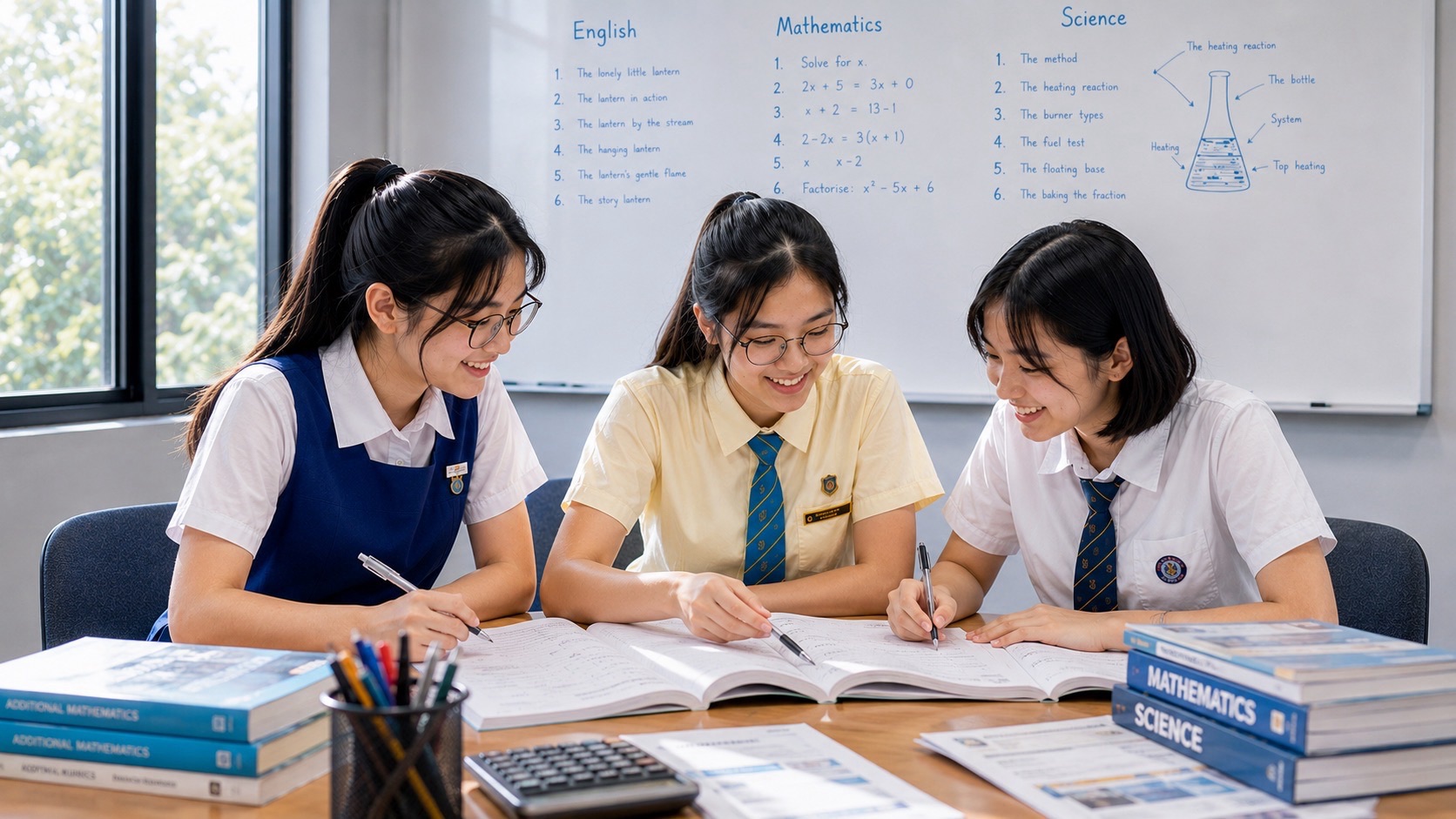
Yishun Mathematics tuition for Sec 1 Maths works best when the subject is treated as a connected roadmap rather than a collection of worksheets. Search terms such as Sec 1 Maths tuition, Secondary 1 Mathematics tuition, algebra, integers, equations, ratio, geometry, graphs, problem solving, small-group tuition and MOE Mathematics syllabus point to the same practical need: students want to know what the new secondary subject is made of and how to become independent inside it.
This guide takes the subject route. Instead of beginning with tuition logistics, it begins with the mathematical journey from arithmetic to algebraic thinking. Numbers become signed and structured. Unknown quantities receive names. Equalities become objects that can be transformed. Diagrams carry reasons. Coordinates locate relationships. Graphs compress change into pictures. Good Secondary Maths tuition in Singapore should help students see that these are not unrelated chapters; they are parts of one language.
For students taking Mathematics at G1, G2 or G3 under Full Subject-Based Banding, depth and assessment requirements differ. The underlying learning habits remain valuable across levels: read precisely, represent clearly, reason from known relationships, show working, check the result and revisit errors until the method can be retrieved without the model answer beside it.
Start with the real learning problem
A Mathematics page is useful only when it helps a family decide what the student should do next. The score matters, but the score is evidence rather than a diagnosis. Two students can both receive 55% and require completely different interventions: one may be missing a concept, while the other understands the Mathematics but loses marks through weak working, poor question reading or time pressure.
This guide therefore works from the student outward. We look at what the student knows, where the working first becomes unstable, how school assessment exposes that weakness, and what kind of practice can turn partial understanding into dependable performance. The aim is not to create dependence on tuition. The aim is to build a student who can eventually diagnose, choose, solve, check and learn with increasing independence.
Quick route for parents and students
Choose the description that is closest to the present situation. The route matters because doing more questions is not automatically the same as fixing the right problem.
- Numbers feel fine but algebra does not — start with the meaning of variables, terms, equivalence and operation rather than memorised movement rules.
- The student makes many negative-sign errors — rebuild signed-number meaning with number lines, opposites and explicit operations.
- Word problems are the main weakness — train representation: define quantities, draw, table, graph or write an equation before calculating.
- The student can follow but cannot remember — use retrieval spacing and interleaving so knowledge remains available after the lesson.
- The student is strong — increase explanation, generalisation and unfamiliar applications rather than simply moving faster.
If several descriptions fit, begin with the earliest broken layer. In Mathematics, later difficulty is often the shadow of an earlier weakness. Repairing the first unstable layer usually gives more leverage than adding another pile of difficult questions at the top.
The Sec 1 Mathematics map
A useful map begins with five territories: number, algebra, proportional reasoning, space and measurement, and data/representation. The borders are porous. Algebra depends on number. Geometry uses algebra. Ratio appears in scale. Graphs depend on coordinates and relationships. Statistics depends on reading representations accurately.
The student’s job during Secondary 1 is not merely to collect procedures from all five territories. It is to learn how to travel between them. That ability to transfer becomes increasingly important each year.
1. Number: the ground beneath algebra
Secondary Mathematics expects students to work confidently with positive and negative numbers, factors, multiples, prime structure, powers, roots, fractions, decimals, approximation and estimation. These may not feel glamorous, but they form the arithmetic engine beneath later symbolic work.
A student who hesitates over negative fractions will carry that hesitation into equations. A student who cannot estimate has no quick defence against calculator-entry errors. A student with weak factor sense will find factorisation less intuitive later. Number is not a chapter to escape; it is infrastructure to strengthen.
2. Signed numbers: understand direction and opposites
Rules for negatives are easy to chant and easy to misuse. We anchor signed numbers to meaning. On a number line, direction matters. The opposite of a number has a geometric relationship to zero. Subtracting a negative can be interpreted before it is simplified into a rule.
Students then practise the notation in increasingly compact forms. The objective is to move from concrete meaning to symbolic fluency without losing the connection between them.
3. Algebraic expressions: letters with jobs
Students meet variables, constants, coefficients, terms and expressions. The vocabulary matters because it helps them describe what they are manipulating. More important, they learn that letters represent quantities and allow a relationship to be stated generally.
We ask students to read algebra aloud in meaning. If 3x means three groups of x, then 3x + 5 has a structure. Like terms can be combined because they refer to the same kind of quantity. Expansion can be seen as distribution rather than a mysterious “rainbow method”.
4. Equivalence: the idea that holds manipulation together
Much of algebra is rewriting without changing meaning. Students need a feel for equivalence: two expressions can look different yet produce the same value; an equation can be transformed while preserving its solution set.
We use substitution and numerical examples as reality checks. If a proposed simplification is correct, it should behave correctly when a sensible value is substituted. This gives students a way to test algebra rather than accepting every line on faith.
5. Equations: a statement of balance
An equation is not simply a signal to “find x”. It states that two expressions are equal. Solving asks for the value or values that make that statement true.
Students learn inverse operations, balance, clear line-by-line working and substitution checks. These habits become a foundation for more complex equations later. We would rather spend an extra five minutes making balance real now than spend five months repairing unexplained shortcuts later.
6. Ratio and rate: compare multiplicatively
Ratio and rate describe relationships between quantities. The key shift is from additive thinking—how much more—to multiplicative thinking—how many times as much, how much per unit, what scale relates these values.
Tables, double number lines and equations can all represent the same relationship. Students practise choosing the representation that makes the next step easiest.
7. Percentage: always ask “percentage of what?”
Percentage becomes much easier when the reference quantity is explicit. Students who rush to multiply by a percentage often lose track of the base, especially in repeated change or reverse-percentage situations.
We teach students to name the original quantity, the change and the new quantity before calculating. A small language habit can prevent a large family of mistakes.
8. Geometry: a picture governed by rules
Geometry asks students to reason with shapes, lines, angles and measurements. The drawing is helpful, but it is not evidence by appearance alone. Parallel lines, angle properties, polygon facts and symmetry give the picture rules.
Students learn to mark what is known, identify what is guaranteed and state reasons. This is the beginning of mathematical argument.
9. Mensuration: measurement, units and scale
Perimeter, area, surface area and volume are connected but distinct. Students need to know what is being measured and therefore what kind of unit the answer should have.
We build estimation into mensuration. If a volume answer is wildly inconsistent with the dimensions, the student should notice before the mark scheme does. A reasonable-answer habit is one of the simplest forms of mathematical quality control.
10. Coordinates: position becomes algebra-friendly
Coordinates give an ordered numerical language for position. Students learn axes, quadrants, scales and ordered pairs, then begin to see how collections of points form relationships.
Accurate plotting matters, but interpretation matters more. A point is not just two numbers in brackets; it tells us where the values of two quantities meet.
11. Graphs: pictures of relationships
Graphs compress many pairs of values into a visual form. Students should be able to read a graph in sentences: as one quantity increases, what happens to the other? Where are key values? What does an intersection represent? What regions are impossible?
This verbal layer prevents graphing from becoming mechanical. It also prepares students for later functional thinking, where the relationship itself becomes the object of study.
12. Data: read before calculating
Tables, charts and statistical summaries reward patience. Students should check labels, units, scales and what each row or bar represents before touching the calculator.
We also ask what a calculated value means in context. An average without interpretation is incomplete understanding. Mathematics communicates about the world; it does not end at the equals sign.
13. Problem solving: represent the unknown situation
An unfamiliar problem becomes easier when it can be represented. Students learn to define a variable, sketch a diagram, organise a table, mark a number line, draw a graph or write an equation. Representation converts a story into a structure that Mathematics can act on.
We praise good first moves, not just final answers. Choosing a useful representation is a genuine mathematical skill and often the difference between staring and starting.
14. Working: make thinking inspectable
Clear working is not merely for the examiner. It is an external memory system. It reduces the number of things the student must hold mentally and makes errors easier to locate.
One logical step per line, sensible alignment, explicit substitutions, labelled diagrams and correct units may feel fussy at first. Later they save time because the solution becomes easier to continue and check.
Stop calling every mistake “careless” in Sec 1
“Careless” is one of the least useful words in a Mathematics diagnosis because it collapses many different causes into one label. A student cannot repair a category that has not been named. We therefore separate mistakes and look for repeated patterns.
- Concept errors: the student does not yet understand the relationship or rule.
- Recall errors: the student once understood but cannot retrieve the fact, formula or method.
- Reading errors: a condition, unit, scale, inequality sign or key phrase is missed.
- Symbol errors: negatives, brackets, indices, equality signs or algebraic notation are mishandled.
- Arithmetic errors: the method is sound but the calculation fails.
- Method-selection errors: a familiar procedure is used on the wrong problem structure.
- Representation errors: the student cannot move reliably between words, diagrams, tables, graphs and equations.
- Time-control errors: the student spends too long early, rushes late or checks inefficiently.
- Presentation errors: the reasoning is difficult to follow, important steps are omitted or units disappear.
In a roadmap article, the key is to connect the error back to the territory it belongs to. A mistake in a graph question may really be a scale-reading problem; a mistake in an equation may be an integer problem. Students should learn to trace errors down to the first broken layer rather than assuming the chapter title is the diagnosis.
Once the pattern is visible, improvement becomes less mysterious. The student can use a specific countermeasure, test whether it works and keep it only if the error rate falls. That is far more useful than promising to “be more careful” next time.
The Sec 1 learning loop: understand, retrieve, apply, explain, correct
A reliable Mathematics lesson is a loop rather than a performance. The tutor explains; the student attempts; the working is inspected; the mistake is classified; the idea is explained again from the correct level; the student attempts a fresh question; and later the concept is retrieved after enough time has passed for forgetting to become possible.
1. Understand the structure
Before speed, the student needs a mental model. What quantities are present? What relationship connects them? Which representation makes that relationship visible: an equation, a diagram, a graph, a table, a ratio, a coordinate pair? This prevents Mathematics from becoming a box of disconnected tricks.
2. Retrieve without the example beside you
Recognition feels comfortable. Retrieval is harder and more honest. We ask students to recall a method after the worked example has disappeared, and later to recall it again when another topic sits beside it. That is how a method becomes available during a real test rather than only during a familiar worksheet.
3. Apply to a changed question
A small change can expose whether the student owns the idea. Change the numbers, reverse the question, hide one quantity, put the same relationship into words or a graph, or combine it with another chapter. Transfer is where understanding becomes useful.
4. Explain the decision
Students are regularly asked: What are you trying to find? Why did you choose this equation? Why is this angle equal? Why is this graph increasing? What tells you that the answer is reasonable? Explanation slows down guessing and exposes fragile reasoning.
5. Correct the error pattern
The corrected answer is not the end. We record what kind of error occurred and what action should prevent it next time. A concept error needs reteaching. A sign error may need layout discipline and slower symbolic handling. A reading error may need annotation. A time-control error needs timed mixed practice. Different causes deserve different repairs.
15. Retrieval: keep the road behind you open
Secondary Mathematics is cumulative. If each new topic pushes the previous one out of memory, the student is building on sand. Retrieval practice keeps older routes open.
A short mixed warm-up can include one algebra question, one ratio question and one geometry fact from previous weeks. The set is small but powerful because the student must recall the method without being told which chapter is active.
16. Interleaving: choose the road yourself
Once a method is reasonably secure, we mix it with others. Interleaving forces the student to decide what kind of problem is present before solving. That judgement is essential in tests and later Mathematics.
We do not mix everything from day one. A new method first needs enough blocked practice for the pattern to become stable. Then the supports are removed.
17. Explanation: if you can say why, you can often recover
Students who memorise a sequence may be helpless when they forget one step. Students who understand the reason can often reconstruct the method. We therefore ask for short explanations: why can these terms combine, why is this operation valid, why is this angle equal, why is the answer too large?
Explanation is not extra decoration for verbal students. It is a tool for making mathematical structure available to memory.
18. Checking: build small quality-control habits
Checking can be designed into the solution. Estimate before calculating. Substitute an equation answer. Re-read a graph scale. Inspect units. Ask whether a negative length makes sense. Compare the final value with the original quantities.
These habits are cheap when taught early and expensive to add under Secondary 4 examination pressure.
19. A Sec 1 weekly practice system
- Day 1: complete the lesson and a short continuation set while the idea is still fresh.
- Day 2 or 3: retrieve two or three key methods without looking at the worked example first.
- Day 4: correct one earlier error from the personal ledger and solve a fresh variant.
- Weekend: attempt a short mixed set covering current and older topics; mark it and note what needs repair.
- Before a school test: increase assessment-style practice only after the core methods are secure.
The schedule is intentionally modest. Consistency creates more memory than a dramatic burst followed by six days of silence.
20. Three learner routes through the roadmap
Catch up
Trace the difficulty to the first unstable territory, repair it, then reconnect to the school topic. Avoid trying to fix the entire past at once.
Keep steady
Use retrieval and mixed practice to stop forgetting. Improve working quality and error diagnosis so performance becomes more predictable.
Move ahead
Deepen explanation, generalisation and unfamiliar applications. Learn more Mathematics by understanding relationships more deeply, not merely by moving to the next textbook sooner.
Why a three-student tutorial can matter in Sec 1 Maths
Mathematics errors are highly specific. A wrong final answer tells us that something happened; it does not tell us what happened. The useful information lives in the working: the line where a negative sign disappeared, the assumption that was not justified, the formula chosen for the wrong shape, the graph scale misread, or the moment a student stopped understanding and began copying a remembered pattern.
A three-student class gives the tutor enough room to inspect those details while keeping the social energy of a small group. Students hear another method, explain their own reasoning, compare approaches and discover that a classmate can reach the same destination by a different valid route. At the same time, there is very little room to remain quietly confused for forty minutes.
- working can be checked while the student is still thinking, not only after the worksheet is complete;
- questions can be adjusted for each student without fragmenting the entire lesson;
- a student can be asked to explain why a method works, revealing hidden misconceptions;
- practice can move from guided to independent at different speeds for different learners;
- older gaps can be repaired without turning the whole class into a generic remedial session;
- stronger students can be extended through unfamiliar applications rather than simply receiving more of the same.
Small-group tuition is therefore not valuable merely because the class number is small. It is valuable when the tutor uses that small number to observe thinking, respond precisely and gradually hand responsibility back to the student.
What a focused 90-minute Sec 1 Maths lesson can look like
The exact sequence changes with the student and the school calendar, but a useful lesson has a rhythm. It reactivates old learning, teaches or repairs one important structure, creates enough supported practice for the idea to settle, and then tests whether the student can use it without the tutor carrying the solution.
- Retrieval warm-up: a short mixed set from earlier topics to test memory and fluency.
- Diagnostic check: one or two questions that reveal the day’s most important weakness.
- Concept explanation: the tutor builds the idea from meaning, notation and worked reasoning.
- Guided practice: the student attempts fresh questions while prompts are still available.
- Independent application: prompts are removed and the student must choose and execute the method.
- Mixed or timed section: current and earlier ideas are combined, with timing added when useful.
- Error review: mistakes are classified and corrected rather than merely crossed out.
- Continuation work: a small, purposeful set is assigned to strengthen the exact lesson rather than create homework volume for its own sake.
There is room for humour and conversation in a serious Mathematics lesson. A calm student thinks better than a frightened one. The standard remains high; the atmosphere does not need to be grim. The best sign of a productive lesson is often that the student begins arguing with the Mathematics instead of avoiding it: “That cannot be right because the value should be smaller.” That sentence is evidence of ownership.
What parents can watch for in Sec 1 Mathematics
Parents do not need to reteach the syllabus at the dining table. The more useful role is to notice patterns in independence, routine and recovery. A student who asks for help on one difficult question is not necessarily struggling. A student who cannot begin any homework without a model answer probably is.
- Which part of the roadmap is creating the current difficulty: number, algebra, proportional reasoning, geometry or representation?
- Can the student explain the first step of a problem before calculating?
- Do old topics remain retrievable after several weeks?
- Is working organised enough that the student can locate the exact error?
- Can the student move between words, diagrams, tables, graphs and equations?
- Is the student checking answers using meaning, not only recalculating?
- Is support gradually reducing as competence grows?
Bring marked school papers, recent worksheets and examples of unfinished homework to a consultation. Do not tidy the evidence. The crossed-out line and abandoned attempt are often more informative than a clean final answer. We are looking for the point where thinking becomes unstable.
Progress should also be discussed in more than one number. Better marks are welcome, but earlier signs can include faster starts, cleaner working, fewer repeated sign errors, more precise questions, better retention from one week to the next and the ability to explain a method without the notes open.
Frequently asked questions
What is the single most important Sec 1 Maths skill?
There is no single chapter that wins, but algebraic and representational fluency are especially high leverage because they connect to so many later topics. Stable number foundations remain necessary underneath them.
Should my child memorise formulas?
Some facts and formulas must be remembered, but memory works best when the student understands what each quantity means and when the formula applies. Blind recall without interpretation is fragile.
Why does my child understand examples but fail word problems?
Examples often reveal the method in advance. Word problems require the student to identify the structure first. Representation—diagram, table, variable or equation—is the bridge.
How can we reduce careless mistakes?
Classify them. Sign errors, reading errors, copying errors and concept errors need different countermeasures. “Be careful” is not a complete strategy.
Is more difficult practice always better?
No. Difficulty is useful only when the student can learn from it. A question that is too far beyond the current foundation may produce guessing rather than growth.
How should a strong Sec 1 student be extended?
Use unfamiliar contexts, multiple representations, explanation, alternative methods and generalisation. Depth creates a better long-term runway than rushing through later chapters superficially.
21. The equals sign: a small symbol worth teaching properly
Many learners carry a Primary-school interpretation of the equals sign as “the answer comes next”. Secondary algebra needs a stronger meaning: the expression on the left and the expression on the right have the same value. This idea supports equation solving, substitution, identity and later algebraic manipulation.
We sometimes write unusual but true statements such as 7 + 3 = 6 + 4 so students see equality as a relationship rather than an instruction. When that idea becomes stable, line-by-line algebra becomes easier to justify.
22. Estimation: the cheapest error detector in Mathematics
Before using a calculator, students can often predict the rough size or sign of an answer. After calculating, the estimate becomes a quality-control check. If a discounted price becomes larger than the original, if a length becomes negative, or if a probability exceeds 1, the student should not need a teacher to say something is wrong.
Estimation is especially powerful because it travels across topics. It improves number sense, percentage, mensuration, graphs and data. A ten-second estimate can protect several marks.
23. Units: meaning attached to numbers
A bare number can be ambiguous. Units tell us what has been measured. Secondary students should become comfortable converting units, attaching square units to area, cubic units to volume and reading compound units such as speed.
We encourage a unit check at the end of every measurement problem. The habit is simple enough to teach in Sec 1 and valuable enough to keep for years.
24. A fresh-question test
After learning a method, we give a fresh question that is similar enough to use the same idea but different enough that the student cannot simply copy the shape of the example. If the student succeeds, we alter another feature. If the student fails, we inspect whether the concept, recall or transfer broke.
This fresh-question test is one of the clearest ways to distinguish “I followed the lesson” from “I can use the Mathematics”. It should become normal, not a special challenge reserved for strong students.
25. The Sec 1 Mathematics operating system
The complete roadmap can be compressed into five verbs: read, represent, reason, calculate, check. Read precisely. Represent the relationship in a useful form. Reason about what must be true. Calculate with disciplined notation. Check the result against meaning.
When students practise those verbs across numbers, algebra, geometry, graphs and data, they build something more useful than a folder of completed worksheets. They build a way to enter unfamiliar Mathematics and begin.
26. Mathematical vocabulary: precision reduces confusion
Words such as term, factor, multiple, coefficient, expression, equation, inequality, gradient, perpendicular and probability are not decorative terminology. They allow students to think and ask questions precisely. “I do not understand this sum” gives little information. “I do not understand why these unlike terms cannot be combined” gives us a place to teach.
Vocabulary is therefore taught inside action. Students use the word while manipulating the object. The language becomes a tool for reasoning rather than a list to memorise separately.
27. Build examples and non-examples
Understanding becomes sharper when students compare what fits a concept with what does not. We can show an expression and an equation side by side, a proportional relationship and a non-proportional one, a valid simplification and an invalid cancellation.
The contrast forces attention to defining features. It is especially helpful for students who have learned by visual pattern and are easily fooled when a question looks familiar but behaves differently.
28. The one-minute explanation
At the end of a lesson, the student chooses one idea and explains it in sixty seconds without notes. The explanation does not need polished language. It needs a coherent relationship: what the idea is, when it is used and one common mistake.
This tiny routine combines retrieval, communication and metacognition. It also tells the tutor what the student thinks the lesson was about, which can be surprisingly revealing.
29. A simple rule for choosing practice
Practice should answer a question about learning. Can the student retrieve the method tomorrow? Can the student recognise it when another topic appears beside it? Can the student explain why it works? Can the student use it when the numbers or representation change?
When practice has a question, the result becomes evidence. When practice is only volume, a completed page may tell us very little. Sec 1 is an excellent time to build the habit of purposeful practice because the learner will need it for many years.
Continue through the eduKateYishun Mathematics library
- Secondary 1 Mathematics — parent transition guide
- Secondary 2 Mathematics — connected reasoning
- Lower Secondary Mathematics for high-progress schools
- Additional Mathematics Hub
Official reference points
- SEAB — 2026 GCE O-Level syllabuses
- SEAB — Singapore-Cambridge Secondary Education Certificate (SEC)
- SEAB — 2027 SEC G3 syllabuses
Sec 1 Maths: build the learner, not just the worksheet
Sec 1 Maths becomes less intimidating when students can see the map. Numbers support algebra. Algebra describes relationships. Diagrams and graphs represent them. Working makes reasoning visible. Checking protects the result. Once those connections are clear, the subject stops looking like a parade of unrelated tricks and begins to behave like a coherent system.
A strong Mathematics programme should eventually make itself less necessary. The student learns how to notice confusion, return to the right foundation, choose a method, write clearly, check intelligently and recover after a mistake. That is the kind of improvement that can survive a change of chapter, teacher, examination and year.
Properly taught kids shine a bright light into the future.
Secondary Mathematics learning route: Continue to the Secondary Mathematics directory · Student Diagnostics. For a current tuition-service decision rather than this free learning guide, use the Yishun Tuition Centre Hub and confirm current arrangements separately.
The Secondary 1 roadmap is complete when the learner can move among number, algebra, proportional reasoning, geometry, graphs and data without experiencing every representation as a new subject. The student can identify the target, select a useful form, work accurately enough to preserve meaning and check personal risks.
For official cohort-specific requirements, use current school guidance and the SEAB SEC syllabus portal. For broader internal routing, use the Yishun Mathematics Tuition & Learning Hub.
Part III · Worked Connections and Roadmap Cases
Worked Route 1 · Negative numbers into algebra
Start with -4+9=5. Then substitute x=-4 into x+9. The same signed-number relationship appears inside algebraic notation. A learner who succeeds on the first and fails on the second needs translation, not more integer arithmetic.
Change to 2x+9 with x=-4. Brackets give 2(-4)+9=1. This route shows how an older skill becomes part of a new one.
Worked Route 2 · Fractions into equations
Solve x/3=8 by multiplying both sides by 3, giving x=24. The equation is algebra, but the inverse relationship is familiar division and multiplication.
Change to x/4+2=9. Subtract 2 then multiply by 4: x=28. This is a direct bridge from fraction thinking into equation solving.
Worked Route 3 · Ratio into algebra
If A:B=2:5 and A=10, scale factor=5, so B=25. Algebraically, B=(5/2)A in this simple relation.
The student does not need to start with algebra, but seeing both forms helps the learner understand that symbolic Mathematics can compress a relationship already known.
Worked Route 4 · Percentage into multiplier
Find 15% of 200: 30. The same proportion can be written 0.15×200. Increase 200 by 15% by using 1.15×200=230.
The distinction between percentage amount and new total becomes visible. The multiplier route prepares later repeated-change work without requiring it prematurely.
Worked Route 5 · Like terms into equations
Simplify 3x+2x to 5x, then solve 3x+2x=25. The equation becomes 5x=25, so x=5.
Classification of like terms is a prerequisite to efficient equation solving. The roadmap should show this dependency explicitly.
Worked Route 6 · Expansion into equation solving
Solve 3(x+4)=24. Divide first to get x+4=8, x=4, or expand to 3x+12=24 and solve. Both are valid.
Comparing the routes teaches method judgement. The student learns to look at structure before applying one fixed recipe.
Worked Route 7 · Coordinates into graph thinking
Point (2,5) can be stored as a table row x=2, y=5. Several points from a rule can be plotted to reveal a relationship.
The learner should see a coordinate not as a drawing command only, but as one pair in a mathematical relationship.
Worked Route 8 · Table into rule
A table x:0,1,2 and y:3,5,7 shows y increasing by 2 for each increase of 1 in x. A suitable simple rule is y=2x+3.
Ask the learner to test the rule against every row. This connects pattern recognition, algebra and graphing.
Worked Route 9 · Geometry into algebra
An isosceles triangle has equal base angles x and a vertex angle 40°. Then 2x+40=180, so x=70°.
The property creates the equation. The learner should identify the geometry relationship before manipulating symbols.
Worked Route 10 · Area into equation
A rectangle has area 48 cm² and length 8 cm. Let width be w. Then 8w=48, so w=6 cm.
This shows that equations can represent measurement relationships, not only abstract letter puzzles.
Worked Route 11 · Mean into reverse reasoning
Four values have mean 9, so their total is 36. If three known values total 25, the missing value is 11.
The reverse relationship prepares the learner for more advanced data problems and reinforces algebraic thinking without requiring formal algebra.
Worked Route 12 · Probability into fractions
A bag has 3 red and 5 blue counters under an equally likely one-draw model. P(red)=3/8.
The denominator is the total number of possible equally likely counter selections, connecting probability to fraction meaning.
Worked Route 13 · Word problem into representation
Five identical packets contain 7 items each. If the target is total, multiplication gives 35. If 35 items are packed 7 each, division finds 5 packets.
The same numbers support different operations depending on the unknown. The roadmap trains target-first reading.
Worked Route 14 · Unit conversion into measurement
2.3 m = 230 cm. The physical length is unchanged while the numerical value changes because the unit becomes smaller.
Ask whether the converted number should become larger or smaller before calculating. This estimation protects direction.
Worked Route 15 · Perimeter and area contrast
A 7 cm by 4 cm rectangle has perimeter 22 cm and area 28 cm².
Use the same figure to make the attribute distinction visible. The student should name boundary or surface before choosing a formula.
Worked Route 16 · Graph scale
A graph has 5 units per small square. A height of 4 small squares above zero represents 20 units.
Change the scale to 10 per square while keeping the drawing the same. Interpretation changes even though appearance does not.
Worked Route 17 · Command-word contrast
Given 4x+2x-3, ‘simplify’ produces 6x-3. Given 4x+2=14, ‘solve’ produces x=3.
The instruction changes the required output. The roadmap should train command words as part of mathematical reading.
Worked Route 18 · Error analysis
A fictional student writes 2(x+5)=2x+5. The first wrong step is incomplete distribution. Correct expansion is 2x+10.
Ask the learner to substitute x=1 into both forms. Original gives 12, wrong form gives 7. A test value can disprove false equivalence.
Worked Route 19 · Estimation
Before calculating 19.8×5.1, estimate about 20×5=100. A result near 101 is plausible; a result near 1000 is not.
Estimation becomes a separate source of evidence and prepares responsible calculator use.
Worked Route 20 · Retrieval
Close notes and write the integer sign rules, one equation example, one ratio scaling example and one geometry property from memory.
Then reopen notes only to repair gaps. Retrieval tells the learner what is actually available.
Case 1 · Good Primary mark, difficult transition
A fictional learner performed strongly in Primary 6 but now hesitates with algebra. The roadmap preserves arithmetic confidence and teaches symbolic translation rather than treating the child as generally weak.
Progress is measured by independent starts on changed algebra questions, not by how quickly the learner memorises terminology.
Case 2 · Weak mark, strong reasoning
Another learner has a low test score but explains problems clearly aloud. Written working is disorganised and units disappear.
The roadmap targets representation and output control while preserving the reasoning strength. A mark does not tell the whole mechanism.
Case 3 · Fast but fragile
A quick learner answers many routine questions correctly but overgeneralises shortcuts. Counterexamples and mixed practice are added.
The student learns conditions rather than only patterns, which creates stronger transfer.
Case 4 · Slow but dependable
A cautious learner is accurate but reconstructs methods slowly. Retrieval and efficient representation are added before stricter timing.
Speed is built from fluency, not from pressure alone.
Case 5 · Dependent on headings
The learner succeeds whenever a worksheet names the topic. Mixed first-line drills remove headings and require method selection.
The learner is ready for the next stage when the relationship can be identified from the question itself.
Roadmap FAQ
Why is Secondary 1 Maths a roadmap rather than a list of chapters?
Because later topics depend on earlier ones. Signed numbers feed algebra, algebra feeds graphs, fractions feed ratio and percentage, and geometry increasingly uses equations. Seeing dependencies makes repair more efficient.
Should every learner follow the roadmap in the same order?
No. Current school teaching and the learner’s dependency map decide the sequence. The roadmap shows connections, not a rigid private syllabus.
How do parents use this page?
Locate the mechanism that matches the child’s current work, try a small number of examples and use the result to decide what support is actually needed.
When is a topic secure?
When it survives delayed mixed work with little or no prompting, not merely when a same-day topical worksheet is correct.
What is the final goal?
A learner who can move through the roadmap independently: identify relationships, choose representations, solve, check and recover.
Final Roadmap Handoff
Before Secondary 2, run a fresh mixed set and record which parts of the roadmap are secure, developing or active repair. Keep the result compact: foundations, risks, checks and support level. The next year should begin from the learner’s current network rather than restarting every chapter.
The best sign that the roadmap has worked is that the learner sees fewer questions as entirely new. A changed problem can be decomposed into known relationships and approached with a familiar start routine.
Part IV · Roadmap Decisions for Independent Learning
A roadmap becomes useful when it helps the learner decide what to do next. These decisions connect diagnosis, practice, maintenance and progression without turning the page into a rigid private syllabus.
Roadmap decision: when to return to number sense
Return when algebraic or proportional work repeatedly fails because the student cannot compare magnitude, handle signed values or estimate. Use short number tasks, then reconnect immediately to the current Secondary problem.
Roadmap decision: when to return to fractions
Return when equations, ratios or probability fail at fraction operations or meaning. Repair the narrow relationship instead of restarting an entire Primary fraction programme.
Roadmap decision: when algebra is ready for mixing
Mix algebra when the student can read notation, classify terms and execute direct transformations accurately. Then place algebra inside geometry, graphs and word problems.
Roadmap decision: when to add graphs
Add graph work when coordinate order, signed numbers and simple input-output relationships are sufficiently stable. Graphs should connect representations, not create a disconnected drawing chapter.
Roadmap decision: when to add timing
Add timing after the learner can recognise and execute methods accurately. Begin with short sections and diagnose where pauses occur.
Roadmap decision: when to reduce models
Reduce bar models, number lines or worked examples when the learner can reconstruct the relationship without them. Keep the tool available when it remains the clearest representation.
Roadmap decision: when to use a calculator
Use according to school expectations once the written mathematical relationship is clear. Estimate first and treat the display as something to interpret, not obey.
Roadmap decision: when to deepen rather than accelerate
If current work is secure, ask for reverse questions, construction, counterexamples and multiple methods before racing into later content.
Roadmap decision: when to simplify a problem
Simplify numbers or context when too many difficulties obscure the target relationship. Restore the original complexity once the mechanism is understood.
Roadmap decision: when to change representation
Change representation when the current one hides the relationship or produces repeated confusion. A table, equation or diagram may expose different aspects of the same mathematics.
Roadmap decision: when to add mixed practice
Add mixed practice after direct execution is stable. Start with methods the learner genuinely confuses, then widen the mix.
Roadmap decision: when to use a delayed retest
Use delayed retesting after a repair that has previously recurred. The original model should be hidden and the surface changed.
Roadmap decision: when to move to maintenance
Move when the learner can retrieve, recognise and apply the method after a delay with minimal support. Keep one occasional prompt.
Roadmap decision: when to reopen a secure topic
Reopen only after repeated mixed evidence shows the topic has become fragile again. One arithmetic slip is not enough to restart an entire chapter.
Roadmap decision: how to use marked school work
Find the first wrong decision and map it back to the roadmap. A geometry error may belong to algebra; a percentage error may belong to fractions or reference control.
Roadmap decision: how to use teacher feedback
Translate comments into one observable next action. ‘Show working’ may mean preserve intermediate state; ‘explain’ may mean connect evidence to a conclusion.
Roadmap decision: how to use revision notes
Keep one relationship, one example, one trap and one check per topic. Add retrieval prompts instead of copying long explanations.
Roadmap decision: how to use an error log
Record recurring mechanisms, not every wrong question. Remove entries when they stop recurring across delayed mixed work.
Roadmap decision: how to ask for help
State the last secure step and the uncertainty. ‘I know this is a ratio but I cannot use the total’ is more useful than ‘I don’t know’.
Roadmap decision: how to compare methods
Ask whether two routes preserve the same relationship and which is clearer or shorter. Valid alternatives should be understood rather than suppressed.
Roadmap decision: how to interpret a low score
Treat it as a sample of performance under particular conditions. Look for patterns in method, execution, time and checking before deciding what needs repair.
Roadmap decision: how to interpret a high score
Check whether the knowledge transfers after a delay and without familiar headings. Strong marks can coexist with narrow familiarity.
Roadmap decision: how to build confidence
Use evidence of changed mechanisms: independent starts, fewer repeated errors and better self-checking. Confidence should reflect what the learner can now control.
Roadmap decision: how to support at home
Protect routine and ask one precise question rather than reteaching every problem. Let the learner use the school/tuition method before introducing alternatives.
Roadmap decision: how to prepare for a test
Retrieve key relationships, complete representative mixed questions, review personal risks and add timing only to skills already understood.
Roadmap decision: how to review a test
Classify the first error, preserve secure topics and choose no more than a few high-value repairs. Schedule fresh retests rather than copying every answer.
Roadmap decision: how to prepare for Secondary 2
Use a mixed readiness audit, then create a one-page handoff of strengths, risks, checking routines and prompt level.
Roadmap decision: what independence looks like
The learner can identify the target, choose a representation, begin without a method cue, interpret the result and ask a precise question if stuck.
Roadmap decision: what mastery looks like
Mastery is dependable use across reasonable variation, not perfection. It includes retrieval, method selection, execution, interpretation and checking.
Roadmap decision: when the roadmap has done its job
The student sees the subject as connected relationships rather than isolated chapters and can use the roadmap internally without needing to read every step explicitly.
A final 30-day Secondary 1 roadmap cycle
Days 1–5: identify two active dependencies and repair them. Days 6–10: reconnect each repair to current school work and retrieve it after a delay. Days 11–15: add mixed recognition and changed representations. Days 16–20: introduce short timing if accuracy is stable.
Days 21–25: analyse one school or centre assessment and update the roadmap. Days 26–30: run the independent readiness audit, move secure skills to maintenance and write the Secondary 2 handoff card. The schedule is illustrative and should bend around school demands.
Final Roadmap Reflection
The strongest change is not that every Secondary 1 question becomes easy. It is that unfamiliar work becomes more navigable. The learner can locate the part of the roadmap that matters, reconstruct a relationship, choose a representation and test the result.
That is how Secondary 1 Mathematics becomes a platform for the rest of secondary school rather than a collection of chapters completed once and forgotten.
Part V · Roadmap Casebook
Roadmap Case A · The chapter is not the problem
A learner repeatedly loses marks in graph questions, but the first wrong step is a signed-number error when substituting negative x-values. The roadmap sends the repair back to integer control, then returns immediately to the graph.
This prevents graph tuition from becoming an expensive way to practise an older sign weakness. High-connectivity prerequisites deserve priority.
Roadmap Case B · The model is doing too much
A student solves every ratio problem after the tutor draws a bar model. The arithmetic is strong, but representation choice is external.
The roadmap next gives a fresh ratio problem and asks the student to choose between bar, table and equation. Independence means selecting the tool, not merely using it correctly once supplied.
Roadmap Case C · The answer is right for the wrong reason
A learner compares 1/4 and 1/6 correctly but says one quarter is larger because four is smaller than six, then applies the same shortcut to 3/4 and 1/2.
The roadmap adds conditions: the denominator comparison shortcut works for unit fractions of the same whole, not every fraction. Counterexamples protect understanding.
Roadmap Case D · The student knows the method but not the command
A learner sees 3x+5x-2 and begins solving for x despite there being no equation. The algebra manipulation is available, but task interpretation is not.
The roadmap uses simplify, solve, evaluate and expand as separate command paths, each paired with an example and non-example.
Roadmap Case E · The student hates mixed practice
Topical work feels easier because the method is given by the heading. Mixed practice feels uncomfortable because selection has become part of the task.
The roadmap introduces mixing gradually and explains that a temporary accuracy drop is diagnostic. The learner is practising recognition, not losing all previous knowledge.
Roadmap Case F · One low mark becomes an identity
A learner says ‘I am bad at Maths’ after a difficult test. The roadmap breaks the paper into method selection, algebra, units, time and checking.
The child discovers that several topics were actually secure and only two mechanisms need active repair. Specificity restores agency.
Roadmap Case G · One high mark hides dependence
A learner scores well on a test after intensive rehearsal, but cannot retrieve the methods two weeks later.
The roadmap adds spaced retrieval and delayed mixed questions. The aim becomes durable access, not one successful performance window.
Roadmap Case H · Geometry looks different
A property is understood on one diagram but lost after rotation. The roadmap returns to markings and reason chains.
The learner practises the invariant property until visual orientation stops controlling recognition.
Roadmap Case I · Working is too compressed
A learner writes a long calculation in one line and loses a negative sign. The roadmap requires one high-risk transformation per line.
Working becomes an error-control system, not a display requirement.
Roadmap Case J · Working is too expanded
Another learner writes every arithmetic micro-step and runs out of time. The roadmap keeps structural lines visible but compresses routine calculations.
Efficiency is improved without removing the checkpoints that protect reasoning.
Roadmap Case K · Parent help competes with school method
A parent introduces a different algebra shortcut during homework. The learner becomes unsure which method to use in school.
The roadmap asks the student to explain the school/tuition method first and compares alternatives only after the original is understood.
Roadmap Case L · A strong student races ahead
The learner finishes routine work early and asks for later-year content. The roadmap first uses construction, counterexamples and reverse problems within current topics.
Depth shows whether the present system is truly flexible before acceleration adds new dependencies.
Roadmap Case M · A weak student is restarted from Primary 1
The learner has a narrow fraction gap but otherwise strong number sense. A full restart wastes strengths and attention.
The roadmap repairs equivalence and operations, then returns to current algebra and ratio. Recovery remains bounded.
Roadmap Case N · The tutor gives the answer too quickly
The learner pauses for several seconds and the tutor immediately supplies the first line. The roadmap introduces deliberate wait time and lighter prompts.
The student gains a chance to generate the start routine internally. Prompt fading becomes part of teaching quality.
Roadmap Case O · The final handoff is too vague
The year ends with ‘Maths improved’. The roadmap replaces this with a current profile: secure equations and ratio, developing graph interpretation, active unit-control risk, checking routine, support level.
Secondary 2 can now begin from evidence rather than a generic restart.
Final Delayed Roadmap Audit
Several days after the last major revision session, give the learner five fresh questions from already-taught content with no headings. Ask for the target, representation and first line before any hint. Record whether each item is independent, lightly prompted, method-cued or model-dependent.
Use that evidence to simplify the roadmap. Independent skills move to maintenance; lightly prompted skills receive spaced retrieval; method-cued skills receive contrast practice; model-dependent skills return to the smallest prerequisite or representation that remains unstable.
The roadmap is successful when it becomes shorter. The learner carries more of it internally, and Secondary 2 begins with a small number of precise active risks rather than a belief that everything must be revised again.
Final Secondary 1 Roadmap Review
The roadmap should end with a learner who can see connections rather than boundaries. Integers are not abandoned when algebra begins; they reappear inside substitution, coordinates and equations. Fractions do not disappear after Primary school; they support ratio, percentage, probability and algebra. Geometry does not sit apart from algebra; angle relationships often generate equations. Graphs do not exist separately from tables and rules; they are another representation of relationships.
This connected view reduces the feeling that every new chapter requires a new personality. The learner can ask which earlier relationship is being reused and what has changed in the representation. That question is often enough to turn unfamiliarity into a manageable translation problem.
How to decide the next repair
Choose the next repair by looking for repeated first errors, not by following the textbook backwards. If three different questions fail because a negative sign disappears, sign control deserves attention. If ratio, percentage and similarity all fail because scaling is additive rather than multiplicative, proportional reasoning is the shared dependency. If correct methods repeatedly end with wrong units, output interpretation is the issue.
The repair should be small enough to teach clearly and broad enough to matter. Once the dependency works in direct practice, return it to current school Mathematics and test whether the connection survives. This keeps remediation relevant and prevents the learner from feeling permanently sent backwards.
How to decide the next extension
Extension should increase thinking demand before it increases syllabus distance. Reverse the unknown. Remove the chapter heading. Rotate the diagram. Change from words to a table. Ask for two valid methods. Require a counterexample to an unsafe rule. Ask the learner to create a question with a given answer.
These extensions reveal whether the present idea is flexible. A student who can construct and critique current Mathematics is developing a stronger base for later acceleration than a student who has merely seen a later chapter once.
How to use the roadmap before an assessment
Before a school assessment, reduce the roadmap to a compact active list. Retrieve the high-connectivity foundations, complete representative mixed questions, review personal error checks and practise one short timed section if methods are stable. Do not attempt to reread every page of every topic.
After the assessment, update the roadmap from the marked evidence. Secure topics stay on maintenance. Active risks are rewritten in mechanism language: “reverse percentage reference”, “negative distribution”, “graph scale”, “unit conversion” or another precise description. The roadmap should become more accurate after every paper.
How to use the roadmap at home
Parents can ask the learner to identify where they are on the roadmap: what relationship is active and what representation will help. Avoid supplying the operation immediately. A question such as “What are you trying to find?” preserves more ownership than “Use division.”
When a problem remains unresolved, record the exact uncertainty for tuition or school. This makes home support calmer and gives the next teacher better evidence. The roadmap should reduce conflict by making the missing step more specific.
How to use the roadmap in a small group
Three students can work on the same mathematical relationship while occupying different points on the roadmap. One may need a number-line representation, another may be ready for symbolic algebra, and a third may need an unfamiliar transfer question. The common relationship keeps discussion coherent while follow-up remains individual.
Discussion should compare reasoning rather than distribute finished answers. Each learner returns to independent work after hearing peers. The exit task shows whether the shared conversation became personal understanding.
Final Secondary 1 Roadmap Handoff
The handoff into Secondary 2 should contain a current map, not a historical archive. Write three secure foundations, two developing relationships, one active repair, one personal checking routine and the strongest prompt still required. Remove old errors once several delayed mixed tasks show that they have stabilised.
The learner should also be able to explain the map. “I am secure with equations and ratio; I still need to check negative signs during expansion; I use a table when proportional relationships feel crowded.” That self-knowledge is part of mathematical independence.
The page therefore ends with a simple destination: fewer questions feel completely new because the learner can place them somewhere on a connected system. Numbers, algebra, geometry, graphs and data become different surfaces over a smaller set of relationships and reasoning habits. That is the Secondary 1 roadmap worth carrying forward.
Final Roadmap Independence Check
Several days after the last major review, choose five fresh questions from already-taught content and remove the topic labels. Require the learner to state the target, choose the representation and write one first mathematical step before any hint. This simple protocol exposes whether the roadmap is being carried internally or still depends on external chapter cues.
Classify each response as independent, lightly prompted, method-cued or model-dependent. A correct answer after a method cue is still useful progress, but it tells the next tutor that method selection remains an active skill. A wrong answer reached through a correct method may need execution repair rather than conceptual reteaching.
Retest the two weakest mechanisms after another delay with changed numbers or representations. Do not show the original correction first. If the learner reconstructs the relationship, move it into maintenance. If the same support remains necessary, return to the relevant prerequisite or representation and rebuild it more explicitly.
Roadmap Maintenance Rule
Once a topic is secure, keep it alive with brief retrieval rather than repeated full worksheets. One equation, one proportional question, one graph-reading item or one geometry reason chain at spaced intervals may be enough. Increase spacing when performance remains dependable and shorten it again only if repeated mixed evidence shows that the skill has become fragile.
This rule protects attention. Secondary Mathematics continues to grow, so successful learning must create room. A roadmap that never moves old topics into maintenance becomes heavier every month and eventually stops being useful.
Closing Roadmap Principle
The strongest Secondary 1 learner is not the one who has memorised the largest number of model solutions. It is the learner who can place an unfamiliar question inside a connected network, identify the relationship, select a representation, carry out the method and test whether the result makes sense.
When those decisions survive changed surface features and delayed retrieval, the roadmap has become more than an article or set of notes. It has become part of the learner’s own mathematical navigation system, ready for Secondary 2.
One-page Secondary 1 Roadmap Summary
Numbers provide magnitude and operations. Fractions, decimals, percentages and ratio provide proportional language. Algebra compresses relationships. Equations express conditions. Coordinates and graphs display relationships visually. Geometry uses properties to deduce new information. Measurement attaches quantities to units. Statistics and probability organise information and uncertainty. Problem solving connects them through representation, method choice and checking.
The learner’s routine is equally connected: retrieve, read, identify the target, choose a representation, perform the transformation, label intermediate values, interpret the result, check it, and recover if the first route fails. These steps do not need to be written every time; they become useful internal habits.
Before Secondary 2 begins, the student should know which parts of this roadmap are secure and which remain active repair. The handoff should stay small enough to guide action. Secure knowledge moves into maintenance, active risks receive targeted practice, and new school content is linked to the strongest available foundation.
That is the final purpose of the roadmap: make Secondary 1 Mathematics easier to navigate because the learner sees how the parts fit together and knows what to do when one connection becomes uncertain.
Use the final weeks of the year to simplify the roadmap further. Keep only the active relationships that still need deliberate attention, one short retrieval deck for secure foundations, and one personal checking card. Remove old prompts when several fresh tasks show that the learner no longer needs them. This makes progress visible because successful learning reduces the amount of external structure required.
A student who can now meet a mixed Secondary 1 task, recognise the relationship, select a representation, work accurately enough to preserve meaning and check the answer has reached the practical end of this roadmap. Future topics can still be difficult, but they will enter a more organised learning system.
The handoff to Secondary 2 is therefore not a promise that every foundation is perfect. It is a current map of what is secure, what is still developing and how the learner knows to repair the next difficulty. That is a stronger starting point than a folder of completed chapters with no clear sense of connection.
One final delayed mixed check should confirm that this connected system survives after the original examples are no longer fresh. If the learner can identify the target, choose the representation and explain one check with little support, move the related skills to maintenance. The roadmap has then become an internal navigation system rather than an external worksheet sequence.
That delayed independence is the final Secondary 1 standard: connected knowledge, deliberate method choice, reliable checking and a learner who can carry the roadmap forward without waiting for every next step to be supplied.
Ready learners recognise relationships, choose methods, check intelligently and recover independently when unfamiliar Mathematics appears.
That is durable mathematical independence.
Part II · Choosing and Using a Secondary 1 Mathematics Tuition Centre
This extended section deepens the page around its own intent: what a Secondary 1 Mathematics tuition centre should diagnose, teach, practise, report and hand back to the learner. It deliberately avoids turning the page into another generic 20,000-word template. Each section addresses a concrete transition or tuition-centre decision.
1. What a Secondary 1 tuition centre should actually diagnose
A Secondary 1 Mathematics tuition centre is useful only if it can tell the difference between a student who has forgotten a Primary-school prerequisite and a student who understands the prerequisite but cannot recognise it inside secondary notation. Those are different teaching problems. A learner may know ratio with bar models yet hesitate when the same multiplicative relationship is written with symbols; another may know the symbols but lose the ratio itself. The first lesson should therefore expose how the learner reads, represents and starts a question before the tutor supplies a method.
A practical baseline can use a handful of questions across signed numbers, fractions, ratio, algebraic notation, equations, coordinates and geometry, chosen only from material the student has already encountered. The tutor records the first unsupported decision: misread sign, missing reference whole, wrong representation, weak arithmetic or uncertainty about the command word. This is more useful than labelling the entire child “weak in Maths”.
For families comparing Yishun Mathematics tuition, ask how the centre uses marked school work, how it records support given during class, and how it decides what to retest later. A centre should be able to describe the next mathematical repair in concrete language rather than simply promise more practice.
2. The Primary 6 to Secondary 1 translation problem
The move from Primary 6 to Secondary 1 is not a clean break. Fractions, ratio, percentage, measurement and problem solving remain active, but secondary Mathematics compresses them into denser symbols and more abstract representations. The learner therefore needs translation rather than replacement: familiar quantitative ideas must become readable in algebra, coordinates, graphs and longer chains of reasoning.
A student who could reason with “three groups of an unknown number” may initially find 3x unfamiliar. The mathematics is not entirely new; the notation is. Likewise, a pupil who could compare changes in a bar model may need help seeing the same comparison inside x+5 or 2x. Strong tuition preserves the known relationship while teaching the new language.
This framing matters psychologically as well as academically. A capable learner who suddenly feels slow can conclude that Secondary Mathematics is beyond them. Showing the continuity between old reasoning and new notation turns the transition into a set of learnable translations.
3. How subject level should change the programme
Singapore’s SEC structure uses subject levels, and SEAB publishes current examination syllabuses separately for G1, G2 and G3. A Secondary 1 programme should therefore follow the student’s actual school level and work rather than assume that one worksheet sequence fits every learner. The same broad habits—careful reading, representation, retrieval, checking—can be taught across levels while question depth and pace differ.
The tuition centre should not use a later cohort’s examination paper as a substitute for the student’s current school scope. A 2027 SEC syllabus can help adults understand the current national structure, but a Secondary 1 student in 2026 will sit a later examination year. School materials and the official documents for that student’s cohort remain the correct source for exact content and assessment requirements.
A useful centre can explain this distinction plainly. It can support a G2 learner without treating G3 worksheets as the automatic definition of challenge, and it can stretch a strong G3 learner through reasoning and transfer before simply racing through untaught later content.
4. Signed numbers as the first stress test
Negative numbers quickly reveal whether a programme teaches meaning or only rules. A student may memorise that a negative times a negative is positive yet still place -8 to the right of -3 on a number line. The two errors come from different representations. Secondary 1 tuition should establish order, direction and opposites before relying on compact sign rules.
Use a number line for comparison, then connect signed arithmetic to algebraic substitution and coordinates. If x=-4, writing 2x+3 as 2(-4)+3 makes the signed value visible. If a point is (-4,3), the same negative four now controls horizontal position. One stable idea is being reused.
When sign errors recur across several chapters, the centre should cluster them. That is a high-value repair because one signed-number routine can improve algebra, graphs and later geometry calculations at the same time.
5. Fractions should not disappear after PSLE
Fractions are often treated as a Primary-school topic that can be left behind. In reality they reappear inside equations, ratios, probability and rates. A Secondary 1 student who has fragile fraction sense may look weak in several new chapters even though the common dependency is old.
A good centre tests the smallest necessary fraction foundation: equivalence, magnitude, common units for addition and subtraction, multiplication/division where already learned, and the meaning of a fraction of a quantity. The numbers can remain simple. Once the relationship is repaired, it should be placed back inside current secondary work immediately.
This avoids the demoralising experience of being sent back through an entire Primary workbook. The message is precise: one prerequisite needs strengthening because it supports what you are learning now.
6. Ratio, percentage and proportional thinking
Ratio and percentage should be taught as related multiplicative ideas. A ratio 3:5 remains equivalent when both quantities are multiplied by the same scale factor; a percentage measures a part or change relative to a reference quantity. Both require the learner to notice what stays proportionally constant.
Contrast additive and multiplicative language. “Five more than x” becomes x+5, while “five times x” becomes 5x. A learner who treats both as the same kind of comparison will later struggle with ratio, scale and algebra. Short contrast tasks are more informative than pages of one method.
Percentage questions also need a visible reference. If a value rises from 80 to 100, the 20 increase is measured against 80, producing 25%. Falling from 100 to 80 uses 100 as the reference, producing 20%. The arithmetic is manageable; the conceptual target is the base quantity.
7. Reading algebra before manipulating algebra
Many Secondary 1 algebra errors begin before any manipulation. The student does not yet read 4x as four times x, x² as x multiplied by itself, or 2(a+3) as two copies of the entire grouped quantity. If notation is opaque, procedures become memorised movements rather than meaningful transformations.
A centre should ask students to read expressions aloud and translate them into plain relationships. Three notebooks at x dollars each cost 3x dollars. Two identical groups containing a+3 items contain 2(a+3). This is not childish; it anchors notation to quantity.
Once the language is understood, simplification, expansion and substitution become easier to diagnose. The tutor can see whether an error is conceptual, symbolic or arithmetic instead of treating everything as one algebra weakness.
8. Like terms and classification
Before a student can combine like terms, they need to classify them. In 4x+3+2x+5, the x-terms belong together and the constants belong together. The result is 6x+8. But in 4x+3+2y+5, x and y represent different variable quantities and cannot be merged.
The same issue becomes more important when powers appear. x² and x are different variable structures. A student who combines them because both contain x has a classification problem, not merely an arithmetic slip.
Use colour or circles temporarily if needed, then remove the scaffold. The goal is for the learner to see term structure at a glance without turning every line into a colouring exercise.
9. Expansion as a whole-group operation
Expansion is often introduced through a slogan: multiply everything inside the bracket. The slogan is useful only if the learner understands why. In 3(x+4), the whole quantity x+4 is being multiplied by three. An area or equal-group model can show that both x and 4 belong to every copy.
A common error, 3x+4, reveals that the multiplier was applied to only the first part. The repair is not ten more identical questions; it is making the grouped structure visible and then fading the representation.
Negative multipliers deserve a separate sign checkpoint. -2(x-5) becomes -2x+10 because each product carries the negative multiplier. Writing the two products separately for a few examples is often cheaper than repeatedly losing signs later.
10. Equation solving as preserving equality
The phrase “move it over and change the sign” can make equations look like a set of arbitrary traffic rules. A more durable model is equality: if x+5=12, subtract five from both sides; if 3x=21, divide both sides by three. Each transformation preserves the same equality while making x easier to see.
Once that reasoning is secure, working can become concise. The centre does not need to forbid efficient notation. It needs to ensure that the learner could reconstruct the method when a less familiar equation appears.
Substitution provides a strong check. If x=7 solves 3x+4=25, replacing x with 7 gives 21+4=25. The check is mathematically related but independent from the sequence of rearrangements.
11. Word problems and variable definition
A student may be excellent at solving an equation once it is written and still freeze in a word problem. That means the translation layer, not the solving layer, needs attention. Tuition should sometimes stop after the equation is formed so the diagnostic target remains visible.
Define the variable in words: let x be the number of tickets, length in centimetres or cost in dollars. Then translate each relationship. “Three dollars more” is additive; “three times as much” is multiplicative. The student should learn to hear the mathematical distinction in ordinary language.
After equation formation becomes secure, restore full solutions. This protects strong manipulation skills while repairing the missing first step.
12. Coordinates and graph language
Coordinates introduce a new visual grammar. The ordered pair (x,y) moves horizontally then vertically. Negative x-values lie left of the y-axis; negative y-values lie below the x-axis. A student who reverses the coordinates is not necessarily weak at graphs; the ordered-pair convention may not yet be automatic.
Use plotting and reading in both directions. Give a coordinate and locate it; point to a position and write its coordinate. Then generate points from a simple rule or table where appropriate.
Graph interpretation should always begin with axes and scale. A rising line means the vertical quantity increases as the horizontal quantity increases in that representation; it does not automatically justify a causal story.
13. Geometry as evidence
Secondary geometry asks learners to use properties rather than recognise familiar pictures. A diagram that looks like a right angle is not enough unless the right angle is marked, stated or deduced. Equal-looking sides are not necessarily equal.
A simple reason chain helps: given fact, property, conclusion. If two sides of a triangle are equal, the opposite angles are equal. If adjacent angles lie on a straight line, they sum to 180 degrees. The reasoning can be concise without being hidden.
Rotate diagrams during practice. If a method disappears when the shape is turned, visual memory may have been carrying more of the recognition than mathematical properties.
14. Perimeter, area and measurement units
The same dimensions can generate different answers because perimeter and area measure different attributes. A rectangle 8 cm by 5 cm has perimeter 26 cm and area 40 cm². A centre should teach the learner to name the target attribute before reaching for a formula.
Unit errors are often method clues. Linear measures use units such as cm, areas use cm², and volumes use cm³ where volume is part of the student’s work. If the expected unit is written before the calculation, it can help the learner notice when the wrong quantity is being computed.
Estimation also belongs here. A classroom floor cannot sensibly have area 30 mm². Mathematical judgement includes knowing when the magnitude and unit contradict the real-world interpretation.
15. Data and averages
Mean, median, mode and range should be connected to what they describe rather than learned as isolated procedures. The mean uses every value through total divided by count. The median uses ordered position. Mode concerns frequency. Range describes the span between maximum and minimum.
A useful bridge is total = mean × count. If five values have mean 8, their total is 40. This reverse relationship prepares students for missing-value problems later and reduces dependence on a one-direction formula.
Use small datasets with an unusual value to show that different summaries respond differently. Statistical understanding begins when the learner can calculate and then say what the result means.
16. Probability foundations
Early probability work is much more reliable when the event and sample space are defined before a fraction is written. If a bag has three red and two blue counters and each is equally likely to be selected, the probability of red is 3/5 because three of the five possible counters are red.
The complement, not red, has probability 2/5. If another colour is added, “not red” includes all non-red outcomes. This distinction becomes important when probability problems grow more complex.
Tables, lists or simple trees should be used because they make the sample space easier to audit, not because every probability question requires the same diagram.
17. What small-group tuition should look like
Small group size is only useful if the teaching process remains individual. Begin with a quiet attempt. One learner may misread the question, another may choose the wrong representation, and a third may solve correctly. A discussion can compare reasoning, but follow-up practice should respond to the different first weak links.
The stronger learner might receive a reverse problem or construction task; another might receive a labelled representation; a third might practise the prerequisite. Everyone remains accountable for a fresh individual exit question.
Parents comparing centres should ask how group teaching handles different errors, not only how many students sit in the room.
18. Homework should produce evidence
Homework should not be an automatic extension of lesson duration. A useful set might include one or two retrieval questions, two or three direct questions on the current repair, and one mixed transfer task. The exact quantity depends on school workload and the learner’s stamina.
If every direct question is correct, continuing with twenty similar items may add little. Change the surface or move the skill into maintenance. If one mechanism repeatedly fails, change the representation or explanation rather than doubling volume.
The next lesson should use the homework as evidence. That closes the loop between teaching, independent work and revision.
19. Retrieval and spacing from the first year
Secondary 1 is an ideal time to build revision habits before examination pressure. Retrieval means attempting to produce a method or fact before reopening the notes. Spacing means returning after a delay rather than concentrating every repetition in one sitting.
A five-minute lesson start can include an integer calculation, an algebraic simplification, one fraction or ratio item and one geometry fact. Secure prompts appear less frequently; fragile ones return sooner.
This creates a study system that grows with the learner instead of being invented suddenly in Secondary 4.
20. Interleaving after understanding
Topical practice is useful while a method is new. Once execution is stable, mix it with nearby methods that students often confuse. Put area beside perimeter, addition of like terms beside unlike terms, ratio scaling beside additive comparison, or equations beside expressions that only need simplifying.
Interleaving makes practice harder because the student must choose. A temporary drop in accuracy is not necessarily evidence that the original learning disappeared; it may expose method-selection weakness.
The centre should explain this to students so mixed practice feels purposeful rather than like a trick.
21. Worked-example fading
A complete worked example can be excellent teaching when the relationship is new. The problem comes when the complete model remains present for every attempt. Students can become fluent at following rather than solving.
Fade support deliberately: complete model, partial model, representation cue, guiding question, then fresh problem with no cue. Record the strongest prompt still required.
A centre that tracks prompt dependence can show progress even before marks change dramatically. Less help needed on fresh work is real evidence of learning.
22. Checking as part of solving
“Check your work” is too vague. Equations can be checked by substitution. Arithmetic can be estimated or reversed. Ratio can be checked by simplifying. Measurement can be checked through units. Geometry can be checked against angle sums or size constraints.
Teach the check while teaching the method. It is easier to build checking into the process than to add it as a final moral instruction after years of unchecked working.
A student should eventually know which questions deserve extra checking because their own error history identifies the risk.
23. A parent decision framework
Parents should ask three things after a period of tuition: what can the learner now do independently, which error mechanism still repeats, and what support is being removed next. These questions encourage evidence rather than vague satisfaction with completed pages.
Current venue, lesson mode, fees and availability should be confirmed directly rather than inferred from a historical page. The educational content here explains what strong Secondary 1 teaching can look like; it does not by itself establish current operational details.
The best centre fit is the one that can explain how its teaching decisions respond to the actual student, not merely recite a standard programme description.
24. The handover into Secondary 2
By the end of Secondary 1, the learner should increasingly understand signed numbers, fraction and ratio relationships, algebraic notation, basic equations, coordinates, graphs, geometry and data at the level actually taught by school. More importantly, the student should have a routine for learning them.
That routine is concise: retrieve old knowledge, read the target, choose a representation, work visibly where risk is high, interpret the answer, check it and return to the first uncertain step when something fails.
Secondary 2 can then extend the system. It should not have to rebuild the very idea of how to learn secondary Mathematics from the beginning.
Original Worked Check Bank
Worked Check 1: Integer order
Order -9, -2, 0, 6. Answer: -9, -2, 0, 6. Use a number line if the signs feel abstract.
Worked Check 2: Integer calculation
Evaluate -5+13-4. Answer: 4. The learner should account for direction rather than just signs as symbols.
Worked Check 3: Fraction equation
Solve x/4=7. Answer: x=28. Multiplication by 4 reverses the division.
Worked Check 4: Ratio forward
A:B=3:5, A=12. Scale factor 4 gives B=20.
Worked Check 5: Ratio reverse
A:B=3:5, B=35. Scale factor 7 gives A=21.
Worked Check 6: Percentage
Find 15% of 80. Answer: 12.
Worked Check 7: Percentage change
A value rises 40 to 50. Increase 10/40=25%.
Worked Check 8: Like terms
Simplify 5x+2+3x-7. Answer: 8x-5.
Worked Check 9: Expansion
Expand 4(x+3). Answer: 4x+12.
Worked Check 10: Negative expansion
Expand -2(x-5). Answer: -2x+10.
Worked Check 11: Substitution
x=-3, evaluate 2x+8. Answer: 2.
Worked Check 12: Equation
Solve 4x+3=27. Answer: x=6.
Worked Check 13: Words to equation
Five more than twice a number is 19. 2x+5=19, so x=7.
Worked Check 14: Coordinate
Describe (-4,3): four left, three up.
Worked Check 15: Rule table
For y=2x+1, x=0,1,2 gives y=1,3,5.
Worked Check 16: Triangle
Angles 50° and 65° give third angle 65°.
Worked Check 17: Rectangle
8 cm by 5 cm: perimeter 26 cm; area 40 cm².
Worked Check 18: Mean
Mean of 4,6,8,10 is 7.
Worked Check 19: Missing total
Five values mean 9, total 45.
Worked Check 20: Probability
3 red and 2 blue equally likely: P(red)=3/5.
Current syllabus note
SEAB currently publishes SEC syllabus information separately by subject level, including G1, G2 and G3 routes for the 2027 examination cycle. A Secondary 1 learner in 2026 belongs to a later examination cohort, so families should use the official syllabus and school instructions for that learner’s actual year when planning long-range examination preparation. See the SEAB SEC syllabus portal.
Final centre-evaluation checklist
Ask whether the centre diagnoses from independent work, distinguishes prerequisites from current-topic difficulty, uses school evidence, tracks prompts, includes delayed retesting, explains how small-group differentiation works, and moves secure topics into maintenance. Ask how current class arrangements are confirmed. A centre should be able to answer these questions in concrete terms.
The final educational standard is equally concrete: the student can enter a Secondary 1 question, understand the target, choose a representation, retrieve the relevant relationship, work with controlled signs and units, check the result, and increasingly recover from uncertainty without waiting for someone else to supply the first step.
Leave a Reply