
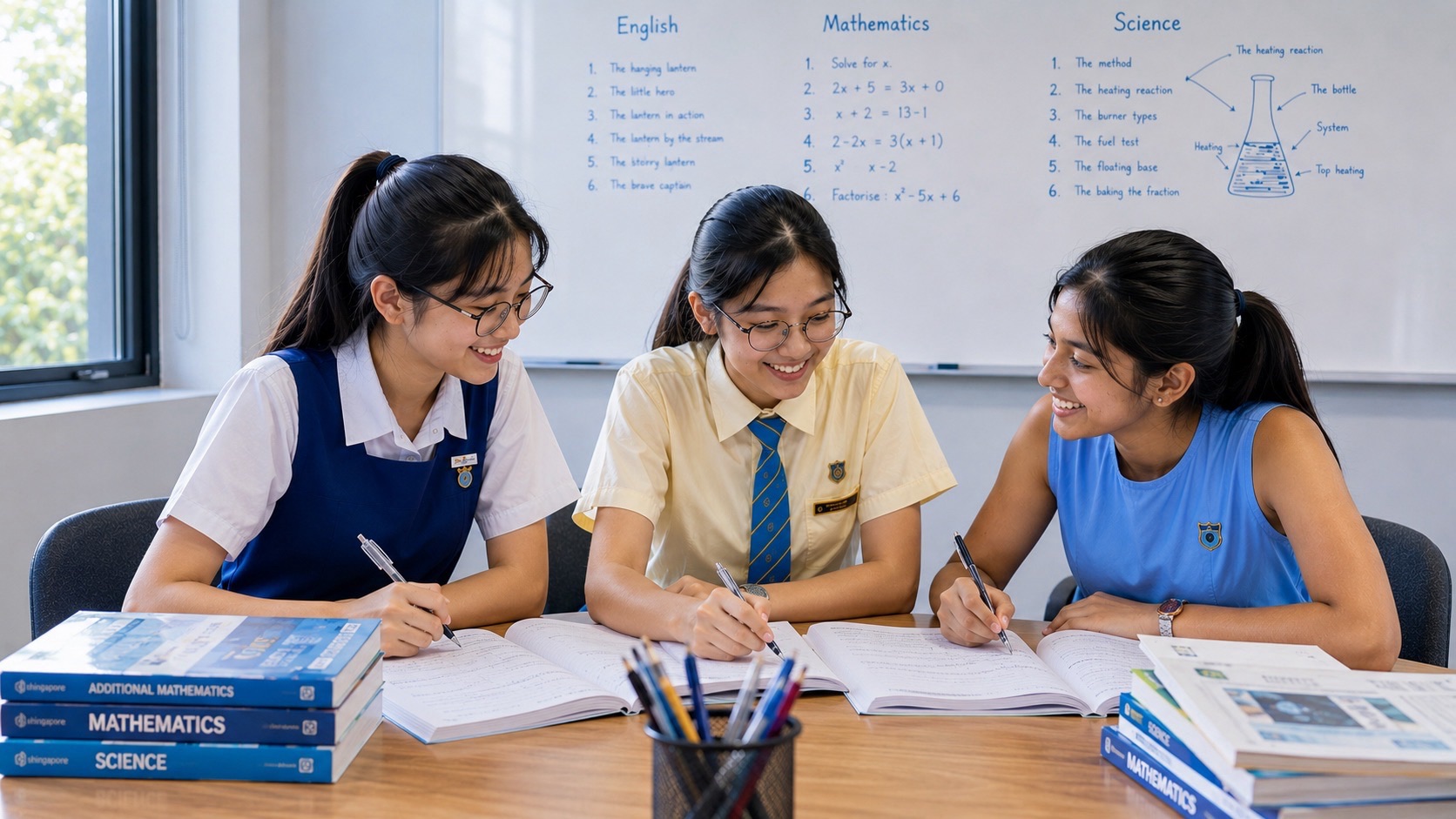
Yishun Mathematics tuition for Secondary 1 should begin with the transition from Primary 6, not with an assumption that the child suddenly needs harder worksheets. Parents searching for Secondary 1 Maths tuition, small-group Maths tuition, algebra tuition, G1 G2 G3 Mathematics, MOE syllabus support, problem solving and a stronger secondary Mathematics foundation are often seeing the same pattern: the student who could handle Primary Mathematics now meets a faster pace, unfamiliar notation and a subject that expects more independent reasoning.
The shift is larger than it first appears. Secondary Mathematics introduces a new symbolic language: negative numbers, variables, expressions, equations, coordinates, graphs and more formal geometric reasoning. Familiar ideas such as fraction, ratio and percentage do not disappear; they become ingredients inside new problems. Good Secondary Maths tuition in Singapore therefore needs to bridge old knowledge into new structures while protecting confidence and building clear working habits.
Under Full Subject-Based Banding, students may take Mathematics at G1, G2 or G3 subject levels according to their pathway and school programme. The labels matter for the syllabus, but the teaching principle is the same: meet the learner at the actual point of readiness, strengthen the missing foundation, and then build forward with enough challenge to create growth without turning every lesson into a rescue operation.
Start with the real learning problem
A Mathematics page is useful only when it helps a family decide what the student should do next. The score matters, but the score is evidence rather than a diagnosis. Two students can both receive 55% and require completely different interventions: one may be missing a concept, while the other understands the Mathematics but loses marks through weak working, poor question reading or time pressure.
This guide therefore works from the student outward. We look at what the student knows, where the working first becomes unstable, how school assessment exposes that weakness, and what kind of practice can turn partial understanding into dependable performance. The aim is not to create dependence on tuition. The aim is to build a student who can eventually diagnose, choose, solve, check and learn with increasing independence.
Quick route for parents and students
Choose the description that is closest to the present situation. The route matters because doing more questions is not automatically the same as fixing the right problem.
- The transition feels too fast — slow the new language down and connect it explicitly to familiar Primary Mathematics.
- Algebra feels like nonsense — teach variables, terms, equivalence and equations as meaning before procedure.
- Homework is taking too long — identify whether the bottleneck is understanding, recall, reading or working organisation.
- Marks are fine but confidence is shaky — build independent starts, retrieval and low-stakes mixed practice before a larger drop occurs.
- The student is already comfortable — extend through reasoning, representation and unfamiliar applications rather than premature upper-secondary drilling.
If several descriptions fit, begin with the earliest broken layer. In Mathematics, later difficulty is often the shadow of an earlier weakness. Repairing the first unstable layer usually gives more leverage than adding another pile of difficult questions at the top.
Why Secondary 1 feels like Mathematics changed language
Primary Mathematics often presents quantities directly. Secondary Mathematics increasingly asks students to represent relationships. Instead of “three groups of seven”, a student may meet 3x. Instead of solving a familiar model problem, the student may need to define an unknown and form an equation. The arithmetic is still underneath, but the surface language has changed.
Students who understand the old ideas can still feel disoriented because they have not yet learned the new grammar. That is why rushing into harder questions can backfire. The efficient move is often to make the representation explicit: what does the letter stand for, what does the equal sign mean, why are two expressions equivalent, what does a coordinate locate, what relationship does a graph show?
Primary 6 knowledge does not vanish at the school gate
Fractions, ratio, percentage, factors, multiples, area, volume and problem-solving remain useful. The challenge is that they are now embedded inside new structures. A weakness that was manageable in Primary 6 can become more expensive when algebra is added.
This is why the first Secondary 1 diagnosis often includes a short look backwards. We are not restarting Primary school. We are checking whether the bridge can carry the new load. If a student repeatedly fails algebraic fractions because ordinary fraction operations are unstable, repairing the ordinary fractions is the fastest route forward.
Full Subject-Based Banding: teach the child, not the label
Mathematics may be taken at G1, G2 or G3 subject levels. Schools determine the student’s programme and sequence, and families should refer to official MOE and SEAB information for current requirements. In tuition, the practical question is what the student can currently do independently and what the next productive challenge should be.
A strong G3 student who loses marks through rushed algebra needs a different lesson from a G3 student who cannot yet control negative numbers. A confident G2 student may be ready for greater depth in a particular area. The subject level gives context; the working gives the diagnosis.
Signed numbers: small symbols, large consequences
Negative numbers cause disproportionate trouble because the same minus sign can represent a negative value, subtraction or part of an algebraic expression. Students who rely on vague rules such as “two negatives make a positive” often apply them in the wrong situation.
We use number lines, direction, opposites and explicit operation language to stabilise meaning. Only then do we build speed. Secure signed-number control pays dividends across algebra, coordinates, graphs and later topics.
Algebra as a language
A variable is not an enemy; it is a placeholder that lets Mathematics describe relationships generally. Students learn the vocabulary—variable, constant, coefficient, term, expression, equation—and then use it while solving rather than memorising definitions for their own sake.
We deliberately contrast expressions and equations because the difference controls what operations make sense. An expression can be simplified. An equation can be solved because it states that two quantities are equal. When students understand the object in front of them, the procedure stops feeling arbitrary.
Equations: balance before shortcuts
The phrase “move it to the other side” may produce correct answers for simple equations, but it hides the reason. We teach equations as balances. If the same valid operation is performed to both sides, equality is preserved.
This foundation survives brackets, fractions and unknowns on both sides. Students also learn to check by substitution, which turns the final answer into something that can be tested rather than trusted blindly.
Ratio, rate and percentage: reconnect familiar ideas
Secondary students often assume a familiar Primary topic must be easy and stop paying attention. Yet rate, ratio and percentage become more formal and can be combined with algebra or real-world contexts.
We reconnect the intuitive understanding to new notation. What is being compared? Is the comparison additive or multiplicative? What is the reference quantity? What does “per” mean here? These questions make the method durable when the wording changes.
Geometry: from shapes to reasons
Primary students may know many geometric facts. Secondary Mathematics increasingly expects those facts to support an argument. Students learn to label diagrams, use notation properly and state why an angle or length relationship holds.
This is a good moment to build the habit of drawing or annotating rather than doing everything mentally. A diagram can reduce working-memory load and make the next step visible.
Coordinates, graphs and data: learn to read representations
The Cartesian plane gives students a new way to locate and compare quantities. Graphs then become a language for relationships. Data displays become evidence to interpret. These topics reward careful reading as much as calculation.
We ask students to describe what they see before performing a procedure. Where is the point? What is the scale? What changes as x increases? What does this bar or line represent? Interpretation prevents a surprising number of avoidable errors.
Stop calling every mistake “careless” in Secondary 1
“Careless” is one of the least useful words in a Mathematics diagnosis because it collapses many different causes into one label. A student cannot repair a category that has not been named. We therefore separate mistakes and look for repeated patterns.
- Concept errors: the student does not yet understand the relationship or rule.
- Recall errors: the student once understood but cannot retrieve the fact, formula or method.
- Reading errors: a condition, unit, scale, inequality sign or key phrase is missed.
- Symbol errors: negatives, brackets, indices, equality signs or algebraic notation are mishandled.
- Arithmetic errors: the method is sound but the calculation fails.
- Method-selection errors: a familiar procedure is used on the wrong problem structure.
- Representation errors: the student cannot move reliably between words, diagrams, tables, graphs and equations.
- Time-control errors: the student spends too long early, rushes late or checks inefficiently.
- Presentation errors: the reasoning is difficult to follow, important steps are omitted or units disappear.
Early secondary is the ideal time to replace the word “careless” with a real error vocabulary. Students can learn that a sign error, reading error and concept error are different events requiring different responses. That habit makes later self-correction much more powerful.
Once the pattern is visible, improvement becomes less mysterious. The student can use a specific countermeasure, test whether it works and keep it only if the error rate falls. That is far more useful than promising to “be more careful” next time.
Why a three-student tutorial can matter in Secondary 1 Mathematics
Mathematics errors are highly specific. A wrong final answer tells us that something happened; it does not tell us what happened. The useful information lives in the working: the line where a negative sign disappeared, the assumption that was not justified, the formula chosen for the wrong shape, the graph scale misread, or the moment a student stopped understanding and began copying a remembered pattern.
A three-student class gives the tutor enough room to inspect those details while keeping the social energy of a small group. Students hear another method, explain their own reasoning, compare approaches and discover that a classmate can reach the same destination by a different valid route. At the same time, there is very little room to remain quietly confused for forty minutes.
- working can be checked while the student is still thinking, not only after the worksheet is complete;
- questions can be adjusted for each student without fragmenting the entire lesson;
- a student can be asked to explain why a method works, revealing hidden misconceptions;
- practice can move from guided to independent at different speeds for different learners;
- older gaps can be repaired without turning the whole class into a generic remedial session;
- stronger students can be extended through unfamiliar applications rather than simply receiving more of the same.
Small-group tuition is therefore not valuable merely because the class number is small. It is valuable when the tutor uses that small number to observe thinking, respond precisely and gradually hand responsibility back to the student.
The Secondary 1 learning loop: understand, retrieve, apply, explain, correct
A reliable Mathematics lesson is a loop rather than a performance. The tutor explains; the student attempts; the working is inspected; the mistake is classified; the idea is explained again from the correct level; the student attempts a fresh question; and later the concept is retrieved after enough time has passed for forgetting to become possible.
1. Understand the structure
Before speed, the student needs a mental model. What quantities are present? What relationship connects them? Which representation makes that relationship visible: an equation, a diagram, a graph, a table, a ratio, a coordinate pair? This prevents Mathematics from becoming a box of disconnected tricks.
2. Retrieve without the example beside you
Recognition feels comfortable. Retrieval is harder and more honest. We ask students to recall a method after the worked example has disappeared, and later to recall it again when another topic sits beside it. That is how a method becomes available during a real test rather than only during a familiar worksheet.
3. Apply to a changed question
A small change can expose whether the student owns the idea. Change the numbers, reverse the question, hide one quantity, put the same relationship into words or a graph, or combine it with another chapter. Transfer is where understanding becomes useful.
4. Explain the decision
Students are regularly asked: What are you trying to find? Why did you choose this equation? Why is this angle equal? Why is this graph increasing? What tells you that the answer is reasonable? Explanation slows down guessing and exposes fragile reasoning.
5. Correct the error pattern
The corrected answer is not the end. We record what kind of error occurred and what action should prevent it next time. A concept error needs reteaching. A sign error may need layout discipline and slower symbolic handling. A reading error may need annotation. A time-control error needs timed mixed practice. Different causes deserve different repairs.
What a focused 90-minute Secondary 1 Mathematics lesson can look like
The exact sequence changes with the student and the school calendar, but a useful lesson has a rhythm. It reactivates old learning, teaches or repairs one important structure, creates enough supported practice for the idea to settle, and then tests whether the student can use it without the tutor carrying the solution.
- Retrieval warm-up: a short mixed set from earlier topics to test memory and fluency.
- Diagnostic check: one or two questions that reveal the day’s most important weakness.
- Concept explanation: the tutor builds the idea from meaning, notation and worked reasoning.
- Guided practice: the student attempts fresh questions while prompts are still available.
- Independent application: prompts are removed and the student must choose and execute the method.
- Mixed or timed section: current and earlier ideas are combined, with timing added when useful.
- Error review: mistakes are classified and corrected rather than merely crossed out.
- Continuation work: a small, purposeful set is assigned to strengthen the exact lesson rather than create homework volume for its own sake.
There is room for humour and conversation in a serious Mathematics lesson. A calm student thinks better than a frightened one. The standard remains high; the atmosphere does not need to be grim. The best sign of a productive lesson is often that the student begins arguing with the Mathematics instead of avoiding it: “That cannot be right because the value should be smaller.” That sentence is evidence of ownership.
Three Secondary 1 pathways
Bridge
The student is finding the transition rough. We connect current Secondary 1 topics to the exact Primary foundations they depend on, then reduce support as the student stabilises.
Stabilise
The student is generally coping but results or confidence move around. We focus on retrieval, working quality, mixed practice and independent starts so the student does not become dependent on examples.
Extend
The student is secure and needs more depth. We use unfamiliar questions, explanation, multiple representations and stronger problem-solving rather than treating acceleration as the only form of challenge.
A parent-friendly first twelve weeks
- Weeks 1–2: observe the transition, collect school evidence and identify whether difficulty is conceptual, procedural or organisational.
- Weeks 3–4: stabilise signed numbers, fractions and the algebra language needed by current school topics.
- Weeks 5–6: strengthen equations, ratio and problem translation while keeping retrieval from earlier lessons alive.
- Weeks 7–8: connect geometry, coordinates, graphs and data to the student’s growing symbolic system.
- Weeks 9–10: introduce more mixed and unfamiliar questions so method selection becomes independent.
- Weeks 11–12: review school assessments, compare error patterns with the starting point and set the next cycle.
When does a Secondary 1 student actually need tuition?
Not every student needs it. A child who follows school confidently, completes work independently, retains learning and asks productive questions may be doing exactly what is required. Additional tuition can become unnecessary load if it merely duplicates school.
Support becomes more useful when the student repeatedly cannot start, old foundations are blocking new topics, school pace is creating a widening gap, corrections do not stick, confidence is collapsing, or the family wants a deliberately small environment for closer inspection and extension.
The goal is independence, not permanent scaffolding
We want prompts to disappear. A tutor may initially ask, “What is the unknown?” Later the student should ask that internally. The tutor may model how to check a sign; later the student should build the check into normal working. A good learning routine migrates from the teacher’s voice into the student’s habits.
That migration is one of the best measures of tuition quality. If the child can only perform when the tutor sits beside the page, the support has not yet become learning.
What parents can watch for in Secondary 1 Mathematics
Parents do not need to reteach the syllabus at the dining table. The more useful role is to notice patterns in independence, routine and recovery. A student who asks for help on one difficult question is not necessarily struggling. A student who cannot begin any homework without a model answer probably is.
- Can the student explain what a variable or equation means, not only perform a memorised move?
- Are negative signs, fractions or ratio causing repeated trouble inside new topics?
- Can homework begin without reopening the worked example for every question?
- Does the student show working clearly enough to find a mistake?
- Are school corrections understood and reattempted, or simply copied?
- Is the child’s confidence changing because of genuine control, or only because the current worksheet is familiar?
- Is the weekly workload sustainable alongside the rest of Secondary 1 life?
Bring marked school papers, recent worksheets and examples of unfinished homework to a consultation. Do not tidy the evidence. The crossed-out line and abandoned attempt are often more informative than a clean final answer. We are looking for the point where thinking becomes unstable.
Progress should also be discussed in more than one number. Better marks are welcome, but earlier signs can include faster starts, cleaner working, fewer repeated sign errors, more precise questions, better retention from one week to the next and the ability to explain a method without the notes open.
Frequently asked questions
My child did well for PSLE Mathematics. Why is Secondary 1 suddenly difficult?
The new challenge is often representation and abstraction rather than raw arithmetic. Students meet variables, signed numbers, equations, formal notation and faster transitions between ideas.
Is algebra the only important Secondary 1 topic?
No. Algebra is central, but stable number skills, ratio, percentage, geometry, coordinates, graphs, data and problem solving all contribute to the foundation.
Should tuition follow the school exactly?
The school sequence matters, especially before assessments. Tuition may still need to repair an earlier skill or pre-teach a concept so the student can access the school lesson more effectively.
How much should a Secondary 1 student study Mathematics at home?
The useful amount depends on school workload and current stability. Short, regular retrieval and thoughtful correction usually beat one large weekly burst.
What if my child is taking G1 or G2 Mathematics rather than G3?
The programme should respect the student’s actual subject level and school syllabus while still building clear reasoning, accuracy, confidence and independence appropriate to that level.
Can tuition prepare a student for Additional Mathematics later?
The best preparation is a strong runway rather than premature A-Math drilling: algebra fluency, numerical accuracy, symbolic confidence, graph sense, clear working and comfort with unfamiliar structures.
A worked transition: from bar model intuition to algebraic representation
A Primary 6 student may be comfortable solving a relationship with a bar model. In Secondary 1, the same relationship might be represented by x and an equation. The correct response is not to declare one method childish and the other advanced. The model contains the relationship; algebra gives the relationship a compact symbolic language.
We can place the two side by side. Let one bar represent x. If three equal bars plus 5 make 26, the equation 3x + 5 = 26 is not a foreign object—it is the same story written differently. Once students see that continuity, algebra feels less like Mathematics has abandoned them and more like Mathematics has given them a faster alphabet.
The first school test should be treated as information
Parents often worry about the first Secondary 1 assessment because it feels like a verdict on whether the transition is going well. A better use is diagnostic. Which questions were left blank? Which mistakes repeat? Did the student misunderstand concepts, or did the paper expose unfamiliar timing and presentation expectations?
The first test gives us a baseline. We should correct it deeply, retest the main weaknesses and then compare the next assessment. Progress is a change in the pattern, not merely one number moving up or down.
Build a homework-start routine
Many students say they “cannot do” homework when the real problem is that they do not know how to begin. We teach a short start routine: read once for the story, read again for quantities and conditions, mark the unknown, choose a representation, write one useful relationship, then calculate.
The routine reduces the emotional size of an unfamiliar question. The student does not need to see the whole solution immediately. They need a good first move. Over time, the routine becomes internal and the blank page loses some of its power.
Confidence should follow evidence
We avoid empty reassurance. “You are good at Maths” may feel nice for a moment but it does not tell a student what to trust. Stronger confidence comes from evidence: “You solved three fresh equations without prompts,” “Your negative-sign errors fell this week,” or “You corrected the graph scale yourself.”
Evidence-based confidence is durable because the student can reproduce the behaviour. It also keeps praise honest. When something is not yet secure, we can say so without drama and identify the next test.
What a good end to Secondary 1 looks like
By the end of the year, the student should be less dependent on topic labels and worked examples. Basic algebra should feel readable, signed numbers should be manageable, diagrams and graphs should be interpretable, and working should be organised enough to inspect.
Most importantly, the student should have a method for learning Mathematics: retrieve, attempt, explain, correct, test again. That method is what allows Secondary 2 and Secondary 3 to become extensions of a system rather than new emergencies.
A fictional family question: “Should we wait for the first failure?”
Imagine a parent noticing that a Secondary 1 child still completes homework but now takes twice as long, repeatedly checks answers online and becomes defensive when asked about algebra. The marks have not collapsed. Should the family wait? The answer depends on evidence, not fear.
A short diagnostic might show that the child understands school examples but cannot start fresh equations independently. That is an early, narrow issue and may be easier to correct now than after several chapters build on it. Equally, the diagnostic might show the student is simply adjusting to a faster school routine and needs organisation rather than tuition. Early attention should improve precision, not create unnecessary intervention.
How to talk about Mathematics at home without turning dinner into tuition
Parents can ask process questions instead of teaching questions: “What part made sense?” “Where did you get stuck?” “What did the teacher’s correction change?” “Can you show me the first step you would try?” These questions keep ownership with the student and reveal whether confusion is specific or general.
Avoid using speed or sibling comparison as the main measure. Secondary Mathematics is a period of cognitive transition. Some students need time to make symbolic ideas stable. The useful comparison is with the student’s own previous working: is reasoning clearer, recall stronger and help less necessary?
The first-year aim: build a calm relationship with not knowing yet
A powerful learner can say, “I do not know this yet, but I can inspect what is given and try a representation.” That sentence is very different from “I am bad at Maths.” Secondary 1 is an ideal time to build the distinction.
We treat confusion as information. The student learns to locate it, ask a precise question and test the repair. This creates responsibility without shame and makes future difficult topics more manageable.
A simple rule for choosing practice
For Secondary 1, the best practice often sits just beyond comfortable recognition. The student should know enough to begin but still need to think. If every question is identical to the example, the child may be copying a pattern. If every question is wildly unfamiliar, the child may only be guessing.
We therefore adjust one feature at a time: change the numbers, reverse the direction, remove a cue, mix in an older topic or ask for an explanation. The aim is a steady transfer of control from the worked example to the student.
What to do after a difficult first test
A difficult first test can feel dramatic because families have little Secondary 1 evidence to compare it with. Resist the urge to label the child. Read the paper slowly. Which marks were lost because the Mathematics was unknown, which because the new notation was mishandled, and which because the student was still learning how to pace and present work in secondary school?
Then correct selectively and retest. If the student can now solve fresh versions independently, the paper has already served its purpose. If the same conceptual error remains, that becomes the next teaching priority. One early score should start an investigation, not end it.
The simplest sign that the transition is working
The clearest improvement is often not a spectacular mark. It is that the student sees an unfamiliar question, pauses, writes something useful and continues. That small act contains several achievements: the language is less frightening, the learner can identify structure, working habits are available and uncertainty no longer causes immediate shutdown.
Secondary 1 tuition should create more of those moments until they become ordinary. The student does not need every question to be easy. The student needs a dependable way to begin.
Continue through the eduKateYishun Mathematics library
- Secondary 1 Maths — deeper subject roadmap
- Secondary 2 Mathematics — connected reasoning
- Lower Secondary Mathematics for high-progress schools
- Additional Mathematics Hub
Official reference points
- SEAB — 2026 GCE O-Level syllabuses
- SEAB — Singapore-Cambridge Secondary Education Certificate (SEC)
- SEAB — 2027 SEC G3 syllabuses
Secondary 1 Mathematics: build the learner, not just the worksheet
Secondary 1 is a beginning, not a verdict. The student is learning a new mathematical language while also adjusting to a new school environment, new teachers and new expectations. A careful programme keeps the difficulty honest but makes the structure visible. Once students can see what Mathematics is asking them to do, confidence has something solid to stand on.
A strong Mathematics programme should eventually make itself less necessary. The student learns how to notice confusion, return to the right foundation, choose a method, write clearly, check intelligently and recover after a mistake. That is the kind of improvement that can survive a change of chapter, teacher, examination and year.
Properly taught kids shine a bright light into the future.
Secondary Mathematics learning route: Continue to the Secondary Mathematics directory · Student Diagnostics. For a current tuition-service decision rather than this free learning guide, use the Yishun Tuition Centre Hub and confirm current arrangements separately.
A good Secondary 1 Mathematics tuition centre should make the learner progressively less dependent on the centre. The student can read new notation, retrieve prerequisites, choose useful representations, work accurately, check personal risks and describe the point of uncertainty without waiting for an adult to organise every step.
For official cohort-specific requirements, use school guidance and the SEAB SEC syllabus portal. For wider eduKateYishun routing, use the Mathematics Tuition & Learning Hub.
Part III · Secondary 1 Centre Diagnostic Casebook
These fictional cases show how similar marks can arise from different mechanisms. They are teaching examples, not testimonials or promises about individual outcomes.
Case 1: strong Primary arithmetic, weak algebra notation
A fictional learner enters Secondary 1 with accurate arithmetic but reads 3x as 3+x. The centre keeps arithmetic on maintenance and targets notation: three groups of x, coefficients, adjacency and substitution. The first fresh test uses 5a and 2(b+1) rather than repeating 3x.
The centre records that the learner needed a verbal translation prompt in the first lesson and no prompt in the delayed retest. That reduction, not the number of completed pages, is the progress signal.
Case 2: negative numbers create sudden confidence loss
A learner who was comfortable in Primary Mathematics becomes hesitant when integers appear. The centre uses number-line order, opposite values and short signed arithmetic before embedding the same values inside algebra and coordinates.
The child sees that the new notation is an extension of number structure rather than proof that everything learned before has disappeared.
Case 3: homework is perfect because a parent supplies the first step
School homework looks strong, but the learner cannot begin similar questions alone. The centre records the hidden support and uses fresh exit tasks without it.
The first goal is not a harder worksheet. It is an independent start: identify the target, choose a representation and write one valid first line.
Case 4: ratio is secure only in bar models
The learner can solve ratio questions when a familiar bar model is provided but struggles when the same relationship appears in a table or equation. The centre preserves the bar as a bridge while adding alternative representations.
A delayed mixed question checks whether the learner can choose the representation rather than wait for the centre to provide one.
Case 5: correct algebra but wrong command word
A learner simplifies when asked to solve, or evaluates when asked to factorise. The mathematics is not necessarily weak; the input parser is.
The centre builds a command-word glossary from actual school tasks and uses contrast questions where the same expression appears under different instructions.
Case 6: graph plotting is accurate but interpretation is vague
The learner can plot points yet says only that a line ‘goes up’. The centre adds axes, units, scale and numerical change to every graph discussion.
The learner eventually explains what changes in y when x changes and connects plotted points to a table or rule where appropriate.
Case 7: geometry depends on familiar orientation
A student handles triangles only when they look like examples in notes. The centre rotates and redraws figures while preserving markings and properties.
The repair focuses on evidence: equal sides, right angles, parallel lines and angle sums. Orientation becomes irrelevant.
Case 8: fast learner loses units
A quick student solves correctly but repeatedly writes cm² for perimeter or omits units. The centre adds a target-unit preview before calculation and a final unit check.
Speed is preserved; only the known risk point gets an extra control step.
Case 9: slow learner reconstructs every method
A careful learner arrives at correct answers but takes too long because basic equations and fraction methods are rebuilt from scratch each time. The centre adds short spaced retrieval rather than stricter timing immediately.
Once retrieval becomes more available, timed sections are reintroduced and the centre measures whether the bottleneck has moved.
Case 10: one poor test triggers a full restart
A family worries after a low mark. The centre compares the marked paper with earlier work and finds that most losses come from two mechanisms: algebraic translation and time.
Secure topics remain on maintenance. The programme repairs only the high-impact weaknesses instead of restarting all Secondary 1 Mathematics.
Case 11: student understands verbally but writing is unclear
The learner can explain a solution aloud but writes disconnected numbers on paper. The centre teaches intermediate labels and one mathematical step per line where needed.
Written working becomes a tool for preserving state and enabling self-checking, not a punishment for mental calculation.
Case 12: student writes too much working
Another learner documents every trivial arithmetic move and loses time. The centre distinguishes high-risk reasoning lines from routine operations.
Working becomes shorter but more informative. The student keeps signs, units and transformations visible while compressing safe arithmetic.
Case 13: percentage reference is unstable
The learner can find 20% of a number but struggles with percentage change. The centre labels original = 100% and contrasts forward, change and reverse questions.
The child learns that percentages are relationships to a reference, not one universal button sequence.
Case 14: fractions disappear inside algebra
The learner handles equations with whole numbers but stalls at x/4=6. The centre briefly revisits inverse relationships with fractions, then returns immediately to algebra.
The prerequisite repair stays bounded and relevant.
Case 15: group discussion hides one student’s weakness
Three students discuss a problem and one supplies the correct method. Everyone copies it. The centre changes the sequence: independent attempt first, discussion second, fresh individual exit third.
Now the tutor can see who learned from the discussion and who still needs direct support.
Case 16: strong student needs deeper challenge
Routine Secondary 1 work is easy. The centre uses counterexamples, construction tasks and multiple methods rather than simply racing ahead.
The learner creates an equation with solution x=5, constructs equivalent ratios and explains when a shortcut fails. Depth grows within current content.
Case 17: anxiety appears only in timed work
Untimed Mathematics is accurate, but strict timing causes blank starts. The centre first uses generous timed sections and teaches a start routine before increasing pressure.
The learner tracks where time is lost and practises a stop-loss rule. Timing becomes a trained condition rather than a threat.
Case 18: calculator use begins too early
The student reaches for a calculator before representing the problem. The centre requires a written expression and estimate first.
Technology now evaluates a plan instead of replacing mathematical modelling.
Case 19: school method and tuition method differ
The learner becomes confused because adults insist on different presentations. The centre maps the two methods, identifies the common mathematics and follows school expectations for submitted work.
Coherence replaces method competition.
Case 20: student cannot ask a precise question
When stuck, the learner says ‘I don’t get it.’ The centre teaches a help protocol: identify the last secure step and name the uncertainty.
Requests become ‘I know the ratio but I don’t know how to use the total.’ This preserves ownership and speeds diagnosis.
Case 21: repeated correction does not stick
The learner understands every correction when shown but repeats the same error the next week. The centre adds delayed retesting and removes the model during the retest.
Retention becomes part of the definition of mastery.
Case 22: secure topics consume too much lesson time
The centre notices that familiar arithmetic dominates because it is easy to teach and easy to complete. Those topics move to five-minute retrieval.
Lesson time is released for algebraic translation, graph interpretation and other active risks.
Case 23: parent wants more worksheets
The centre explains what the current repair is and why a smaller mixed set will provide better evidence. Homework includes retrieval, repair, contrast and transfer.
The family can see that workload is being designed rather than reduced arbitrarily.
Case 24: student is ready for less support
Several fresh tasks show independent starts and accurate checking. The centre removes the usual representation cue and waits longer before intervening.
When performance holds, prompt fading becomes a visible success outcome.
Case 25: Secondary 2 handover is unclear
The year ends with many completed files but no concise summary. The centre builds a one-page handoff of secure foundations, active risks, personal checks and support level.
The next year begins from current evidence rather than a generic restart.
Parent Decision FAQ
How large should a Secondary 1 small group be?
Group size matters less than whether individual thinking is visible and follow-up can be differentiated. A small group should still include individual starts and exit tasks.
Should tuition follow school chapters exactly?
Current school work should stay central, but a blocking prerequisite may need brief repair first. The repair should reconnect to the school topic quickly.
How much should parents expect in the first month?
Expect a clearer learning map, not a guarantee of a particular mark. The centre should identify strengths, active risks and the support still required.
Should a strong student accelerate?
Only when current learning is secure and acceleration has a purpose. Deeper transfer and construction tasks often create more value first.
What if the child is weak in many topics?
Look for common dependencies. Fractions, signs or algebraic translation can make several topics fail at once. Repair high-connectivity weaknesses first.
What if the child is already scoring well?
Use mixed recognition, counterexamples and explanation to test whether the knowledge transfers beyond familiar worksheets.
When should timing start?
After the relevant methods are accurate enough untimed. Then use short timed sections to locate the real bottleneck.
What does independent mean?
The student can identify the task, choose a representation and begin without the tutor naming the method. Independence can still include asking precise questions when genuinely stuck.
How should corrections be done?
Find the first wrong decision, repair it, solve a fresh item and retest after a delay. Copying a correct solution is only one step.
What should parents receive in a progress update?
One stable strength, one active repair, evidence of support level and the next retest. Specificity is more useful than generic praise.
What if school and tuition notation differ?
Use the school’s current conventions for submitted work while explaining the underlying equivalence where methods are both valid.
Should every error go into an error log?
No. Record recurring mechanisms and useful prevention actions. Remove entries once repeated evidence shows the error has stabilised.
How often should secure topics be revised?
Briefly and periodically. Increase spacing when retrieval stays reliable; return them to active repair only if repeated mixed evidence shows fragility.
What should the final Secondary 1 review include?
A mixed readiness audit, current support level, personal checking routines and a concise Secondary 2 handoff.
What is the centre’s final job?
To leave the learner better able to learn Mathematics independently, not simply better at completing work while inside tuition.
A final centre transition audit
At the end of a major cycle, choose six fresh questions from already-taught content with no chapter headings. Record method choice, working, checking and prompt level. Do not score only the final answers. The centre should know whether the learner recognised the topic, needed a representation cue, lost execution accuracy or misinterpreted the final quantity.
Two weak mechanisms should be retested after several days with changed surface forms. If the support level falls, the repair is becoming durable. If the same support remains necessary, redesign the representation or prerequisite repair.
Closing centre principle
A Secondary 1 tuition centre is working well when it gradually has less to organise for the learner. Topic cues fade, models become optional, checking becomes personal and homework becomes more selective. The student still receives challenge and expert feedback, but more of the mathematical engine is now internal.
Part IV · Twenty Worked Secondary 1 Centre Clinics
These original clinics are intended for selective use in a centre setting. They allow a tutor to distinguish direct calculation from method selection, representation and transfer.
Worked Clinic 1 · Signed-number ordering
Order -9, -2, 0 and 6. The answer is -9, -2, 0, 6. Use a number line to show that farther left means smaller. A learner who compares only the visible numerals may reverse the two negatives. The centre should diagnose value-order meaning rather than prescribe more generic arithmetic.
A fresh question -12, -5, 1, 8 should be completed without the original number line. If needed, the student can sketch one independently. The representation is becoming internal when the learner can choose it rather than wait for the tutor to supply it.
Worked Clinic 2 · Integer change
A lift model starts at level 4 and moves down 9 levels, ending at -5 under the stated number-line model. The mathematical relationship is 4-9=-5. The context makes direction visible, but the learner should eventually be able to solve symbolically.
Change the context to a bank balance or temperature only if it helps; do not create dependence on stories. The transfer target is signed-number control when the same arithmetic later appears in algebra or coordinates.
Worked Clinic 3 · Fraction equation
Solve x/3=7. Multiplying both sides by 3 gives x=21. The centre should ask what operation has been applied to x and what inverse operation undoes it.
Change to x/4+2=8. Subtract 2, then multiply by 4 to get x=24. This combines fraction structure with equation control.
Worked Clinic 4 · Ratio scaling
A:B=4:7 and A=20. Scale factor=5, so B=35. The common error is to add 16 to both ratio terms, which does not preserve the relationship.
Reverse the unknown: if B=49, scale factor=7, so A=28. Forward and reverse forms reveal whether the ratio is understood as a multiplicative relationship.
Worked Clinic 5 · Percentage of quantity
Find 30% of 90. Ten percent is 9, so 30% is 27. Decimal method 0.3×90 also gives 27.
Ask which route is easiest mentally and why. The centre should encourage flexible method choice rather than one compulsory procedure.
Worked Clinic 6 · Percentage change
A value rises from 60 to 75. Increase=15. Percentage increase=15/60×100%=25%. The reference is the original value.
A fall from 75 back to 60 is 15/75=20%. Equal absolute change does not imply equal percentage change. The contrast strengthens reference control.
Worked Clinic 7 · Like terms
Simplify 7x+3x-4+9. The result is 10x+5. The x-terms and constants form separate families.
Change 3x to 3y. Now the expression is 7x+3y+5. If the learner still combines x and y, classification remains unstable.
Worked Clinic 8 · Distribution
Expand 5(x+2)=5x+10. The five multiplies the whole bracket.
Change to -3(x-4)=-3x+12. If the sign fails, isolate signed multiplication before repeating expansion.
Worked Clinic 9 · Substitution
If x=-4, evaluate 2x+11. Use brackets: 2(-4)+11=3.
Change to x²+1 when x=-4, giving 17. The brackets protect the negative value during squaring.
Worked Clinic 10 · One-step equation
Solve 6x=42. Divide both sides by 6 to get x=7. Substitute back.
Change to x/6=7, giving x=42. The same numbers form a different relationship.
Worked Clinic 11 · Two-step equation
Solve 4x+5=29. Subtract 5 to get 4x=24, then divide by 4: x=6. Check by substitution.
Change to 4x-5=19; x remains 6. The sign changes the inverse operation even when the answer happens to match.
Worked Clinic 12 · Word to equation
A number increased by 9 is 25. Let x be the number. x+9=25, so x=16.
Change to ‘three times a number is 27’ to create 3x=27, x=9. The learner should identify whether the relationship is additive or multiplicative.
Worked Clinic 13 · Coordinate reading
Point P(-5,2) lies five units left of the y-axis and two units above the x-axis.
Point Q(-5,-2) shares the x-coordinate and lies directly below P. The change isolates vertical sign meaning.
Worked Clinic 14 · Linear rule
For y=3x+1, x=0 gives y=1, x=1 gives 4, x=2 gives 7. The output increases by 3 for every increase of 1 in x.
Ask the learner to create the table first, then plot the points if this is in the current school scheme. Movement among representations builds connected understanding.
Worked Clinic 15 · Triangle angles
A triangle has angles 48° and 72°. The third is 60°. The student should identify the triangle angle sum before arithmetic.
Rotate the diagram and change the numbers. The property should remain available.
Worked Clinic 16 · Isosceles triangle
An isosceles triangle has vertex angle 50°. The two equal base angles share 130°, so each is 65°.
A changed diagram places the vertex at the side of the page. The learner should still use equal sides/equal opposite angles rather than visual position.
Worked Clinic 17 · Perimeter and area
A rectangle measures 10 cm by 6 cm. Perimeter=32 cm; area=60 cm².
Ask which answer describes fencing and which describes covering. The language anchors the formulas to physical attributes.
Worked Clinic 18 · Mean and total
Values 5,7,9,11 have mean 8 because total 32 divided by 4 gives 8.
Reverse: four values with mean 8 must total 32. This reciprocal view supports later missing-value questions.
Worked Clinic 19 · Probability
A bag has 4 red and 6 blue counters under an equally likely one-draw model. P(red)=4/10=2/5.
Add two red counters. The event count and total both change: P(red)=6/12=1/2. The sample space controls the denominator.
Worked Clinic 20 · Mixed independent start
Give one fresh taught problem and require only four lines: target, givens, representation and first mathematical relationship. Do not name the chapter.
This clinic directly measures transition independence. The learner should increasingly produce a viable first step even when the surface looks unfamiliar.
A final four-week centre cycle
Week 1: retest the two most important active risks. Week 2: reconnect them to current school work and change the surface. Week 3: use mixed questions with reduced prompts and modest timing if accuracy is stable. Week 4: run the delayed readiness audit and create the Secondary 2 handoff card.
The centre should be able to explain why each item remains active. When a skill becomes secure, it moves to maintenance. When a new school topic exposes a prerequisite, the map updates. This adaptive cycle is more valuable than a fixed annual worksheet sequence.
Final Secondary 1 centre handoff
The final handoff should be short enough to use: secure foundations, active risks, support level, checking routine and next retest. The student should also be able to explain one of those risks in their own words.
When the learner can start fresh work, choose a representation, perform the method, interpret the answer and check personal risks with substantially less tutor direction, the centre has completed the transition job it was designed to do.
Part V · Centre Decisions and Learner Independence
Parent decision: when the mark falls early in Secondary 1
A drop in the first few tests can reflect new notation, new independence demands, faster pace or an actual prerequisite gap. Compare the marked work before adding more hours. If errors cluster in algebra notation or negative numbers, repair those mechanisms directly. If the student understood but did not finish, time and retrieval need attention instead.
The centre should be able to explain the difference with evidence. A lower mark is important, but it does not by itself tell the family whether the student needs concept teaching, practice design or examination control.
Parent decision: when marks are stable but homework is dependent
Stable school marks can coexist with heavy adult support at home. Ask whether the learner can begin fresh work without the parent identifying the method. A centre can test this with an independent start and a changed exit question.
If support dependence is high, the next programme goal is prompt fading rather than harder content. The mark may already be adequate; the hidden issue is who owns the first decision.
Parent decision: when the learner is already doing well
A strong Secondary 1 learner still benefits from explanation, reverse questions, method comparison and unfamiliar representations. The centre should not fill time with routine repetition simply because the student is ahead.
Extension should deepen structure and transfer. The learner can create counterexamples, construct problems, compare two valid methods or translate one relationship among table, graph and equation.
Centre decision: when to change groups
A group change may be useful when pace, support needs or current topics diverge enough that one shared lesson no longer serves the learners. It should not be triggered by one isolated mark.
Review several sessions of evidence. If one student consistently needs much more foundational repair or far greater extension, regrouping may improve teaching quality. The decision should protect both challenge and psychological safety.
Centre decision: when not to change groups
Different marks do not always require different groups. Two students may share the same mechanism, such as equation translation, even if one has stronger arithmetic. A common lesson can work with differentiated follow-up.
The centre should distinguish score difference from instructional incompatibility. Small-group value comes from flexible follow-up, not from perfect numerical matching.
Centre decision: when to reduce homework
Reduce volume when the learner is accurate, transfer is visible and additional questions produce little new information. Preserve one retrieval and one transfer item for maintenance.
Less volume after mastery is not lower standards. It is efficient allocation of limited attention. The freed time can support current school learning or another active repair.
Centre decision: when to increase homework
Increase practice when a method needs fluency, retrieval remains slow or repeated changed examples reveal unstable transfer. Add only the type of practice that addresses the mechanism.
A student with method-selection weakness needs mixed questions, not twenty more identical topical items. Workload should follow diagnosis.
Centre decision: when to use manipulatives or diagrams
Use concrete or visual models when they expose a relationship the learner cannot yet hold symbolically. Fractions, signed numbers, ratios and geometry can benefit from temporary representations.
Fade the model once the learner can reconstruct the relationship. A representation is successful when it becomes optional, not when the student remains permanently dependent on the centre drawing it.
Centre decision: when to introduce calculator work
Introduce calculator use according to school expectations and only after the mathematical expression is clear. The learner should write the intended calculation and estimate first.
The centre should separate input errors from concept errors. Technology should accelerate correct work without erasing number sense or algebraic reasoning.
Centre decision: when to start timing
Start timing after direct methods are reasonably accurate. Use short sections before full papers. Measure where pauses occur rather than only the final completion time.
Timing should compress a stable process. If accuracy collapses immediately, return to untimed repair or retrieval before increasing pressure again.
Centre decision: when to retest
Retest after enough time has passed that the original model is no longer carrying the answer. A few days is often more informative than immediate repetition for a recurring weakness.
Use changed numbers, wording or diagrams while preserving the same core relationship. The student should recognise the structure rather than the exact question.
Centre decision: when a topic can move to maintenance
Move a topic when direct, mixed and delayed evidence is consistently strong and prompts are minimal. Keep one occasional retrieval item.
If the topic later fails repeatedly, bring it back into active repair. Maintenance is adaptive, not permanent.
Learner habit: beginning unfamiliar work
The learner should develop a standard start: read command, identify target, mark known quantities and units, choose a representation and write one defensible first step.
This routine should become shorter and more automatic over time. It prevents blank-page panic and gives the centre a clear point to diagnose if the start breaks.
Learner habit: writing enough working
Write enough to preserve meaning and expose high-risk transformations. Use labels, units and one algebraic transformation per line when needed.
Do not demand decorative working that adds no control. The student should know why each line is visible.
Learner habit: checking strategically
Choose checks according to risk. Equations can be substituted back; ratio scaling can be simplified; measurement can be checked by unit and magnitude; graph values can be verified against axes.
A personal checking card should remain short. The centre can remove checks from the card when the related error stops recurring.
Learner habit: asking for help precisely
Instead of ‘I don’t know’, the learner identifies the last secure step and the uncertainty: ‘I know the ratio but not how to use the total’ or ‘I know the angle property but cannot form the equation.’
Precise requests preserve ownership and allow the tutor to supply the smallest useful hint.
Learner habit: learning from a correction
After seeing feedback, the learner states what the first wrong decision was, repairs it and solves a fresh question. Later, the same mechanism is retested after a delay.
The goal is not to remember the teacher’s corrected page. It is to change what happens on the next page.
Learner habit: maintaining secure knowledge
Secure topics remain in brief cumulative review. The learner should be able to retrieve them without spending long sessions re-studying them.
This creates room for current school content and active weaknesses while preventing older learning from disappearing.
Learner habit: managing confidence
Confidence grows from accurate self-knowledge. A student should know what they can already do and what still needs work without turning either into a global identity.
The centre can support this by using specific language: ‘Your equation setup is strong; today we are repairing negative distribution.’ Evidence-based confidence is more durable than generic praise.
Learner habit: preparing for Secondary 2
The final transition habit is self-directed review. The student can look at a mixed set, identify where they are uncertain, choose a first repair target and explain one check.
Secondary 2 should begin with a learner who understands not only more Mathematics, but more about how they themselves learn Mathematics.
Final delayed centre audit
Several days after the final teaching cycle, select one algebra question, one proportional problem, one graph or coordinate task, one geometry or measurement item and one data question from content already taught. Remove earlier models and topic headings. Record the student’s first step and support level.
If most questions are started independently and the remaining errors are local, the centre can reduce support and move secure skills into maintenance. If topic recognition still depends on cues, continue mixed first-line practice rather than adding more advanced content. This final audit makes the handoff into Secondary 2 honest and specific.
Final Secondary 1 Centre Review Manual
The centre should end a major learning cycle by comparing three forms of evidence: the student’s earliest independent attempt, a corrected or guided version, and a later fresh task completed with reduced support. These three samples answer different questions. The first reveals the original mechanism. The second shows whether feedback can be used. The third shows whether the learner can retrieve and apply the repair after the model is gone.
Do not compare only the number of correct answers. Compare how the student begins, whether representations are self-selected, how many tutor prompts are needed, whether signs and units remain controlled, and whether checking is purposeful. A learner may still make an arithmetic slip while demonstrating much stronger independence. Conversely, a perfect supported solution can hide continued dependence.
How the centre should respond to improvement
Improvement should make the programme lighter in the repaired area. When a topic survives direct practice, mixed work and delayed retesting, reduce its frequency. Keep it alive with one or two retrieval prompts, but release most practice time for current school learning and the next active risk.
This is an important design principle. A centre that never removes old practice creates an ever-growing workload even when teaching succeeds. A centre that uses maintenance intelligently allows progress to create capacity.
How the centre should respond to persistent difficulty
If the same error returns after several corrections, change the intervention rather than merely increasing repetition. The original explanation may not have exposed the relationship. The prompt may have been doing too much of the thinking. A prerequisite may still be unstable. The representation may be unsuitable for the learner.
Return to the smallest point of failure. Use simpler numbers if necessary, but preserve the mathematical structure. Once the relationship is stable, move quickly back to current Secondary 1 work so the learner sees why the repair matters.
What a successful small group feels like
A useful small group is neither a lecture to three students nor three separate private lessons happening simultaneously. It has shared mathematical questions, individual thinking time, purposeful comparison and differentiated follow-up. Students hear alternative methods but remain responsible for their own final solution.
One learner may need a representation scaffold, another may need a harder transfer question, and another may need to explain a method. The tutor can use one common problem to generate several productive next steps. That is where small-group architecture becomes more than a marketing number.
What parents should stop doing when the centre is working
Parents can gradually stop identifying the chapter for every homework question, supplying the first operation, checking every answer immediately or introducing competing methods. The learner should increasingly carry those decisions.
Home can become a place for routine, retrieval and calm conversation rather than constant correction. Ask what the current target is, what the student will try first and what question remains unclear. This gives the centre better evidence and the learner more ownership.
What students should carry forward
Carry a short internal sequence: read the instruction, name the target, identify quantities and units, choose a representation, apply the relationship, label intermediate values, check the result and ask a precise question when stuck. This sequence should become faster with practice, not longer.
Also carry the idea that a mistake is local until evidence shows otherwise. One wrong line can be repaired. One weak topic can be diagnosed. One disappointing test can be analysed. Secondary Mathematics becomes more manageable when problems are decomposed into decisions rather than turned into global judgements about ability.
Final Secondary 1 Centre Standard
The centre’s deepest output is not a stack of completed worksheets. It is a learner who can begin more work independently, explain more of the reasoning, recover more effectively from error, and require less external organisation. Secure skills stay available through maintenance, while new school content is connected to a stable mathematical foundation.
That is the handover into Secondary 2: stronger Mathematics, clearer self-knowledge and a smaller need for rescue.
Final Centre Independence Check
Several days after the last major lesson, give the learner five fresh questions from already-taught content: one number/algebra item, one proportional problem, one graph or coordinate task, one geometry or measurement question and one data item. Remove earlier notes and chapter headings. The student should state the target and first relationship before receiving any hint.
Record the support honestly. Independent means the learner selected the method without the centre naming it. Light prompt means a question such as “What are you finding?” was enough. Method cue means the tutor identified the representation or chapter. Model-dependent means the learner needed a worked example. These distinctions matter because the final answer can look identical across all four states.
Use the result to simplify the programme. Independent skills move to maintenance. Lightly prompted skills receive spaced mixed retrieval. Method-cued skills receive contrast practice. Model-dependent skills return to the smallest prerequisite or representation that still needs rebuilding.
Final Centre Handoff to Secondary 2
The handoff should fit on one page. List the secure foundations that no longer need intensive tuition, the two or three active risks that still deserve attention, the checking routines that work, the representations the learner can choose confidently and the strongest remaining tutor prompt. Add one date for the next delayed retest so the record becomes actionable rather than descriptive.
For example: secure—signed-number ordering, one- and two-step equations, ratio scaling, basic graph reading; active risks—reverse percentage and multi-step unit control; checking—substitute equation solutions and preview final units; representation strength—tables and equations; support still needed—light cue on unfamiliar geometry diagrams. A record like this gives Secondary 2 a practical starting point.
Parents should also know what no longer needs help. If a topic is secure, stop supervising it intensively. Let the learner retrieve and check independently. Tuition should create room in family life as well as in the lesson plan when a skill becomes dependable.
The Long-Term Centre Principle
A centre should be judged partly by how well it can reduce its own scaffolding. Early in Secondary 1, the tutor may need to translate notation, model representations and ask guiding questions. Later, the learner should increasingly perform those actions internally. The centre remains important for challenge, diagnosis and feedback, but it no longer supplies every first move.
This change is the clearest sign that the transition from Primary to Secondary Mathematics has succeeded. The student has not merely learned harder content. They have learned a more independent way to read, represent, calculate, verify and recover. That is the foundation on which the rest of secondary Mathematics can build.
Final Centre Reflection
Secondary 1 is a transition year, so the centre should expect learning to look uneven while new mathematical language is being installed. A learner may understand proportional reasoning yet struggle to express it algebraically. Another may understand a graph once it is drawn but hesitate to create the table that generates it. These are not contradictions. They are clues about which representation is currently stronger and which needs to be connected next.
The centre’s responsibility is to preserve what already works while building the missing bridge. That means fewer global labels and more precise statements: “ratio scaling is secure; algebraic translation is developing”, or “geometry properties are strong; diagram reading is still dependent on familiar orientation”. Specific language leads to specific teaching.
As the year closes, compare the student’s earliest and latest mixed tasks side by side. Look for changes in the first minute: Does the learner read the target more carefully? Do they label units? Do they choose a representation without being told? Do they write enough working to recover after a mistake? Do they know which check is appropriate? These process changes are the foundation beneath later marks.
The final centre standard is therefore not a perfect score. It is a learner whose Mathematics has become more organised, more inspectable and more independent. Secondary 2 can then add new content without rebuilding the entire learning process from the beginning.
One last test keeps the handoff honest. Several days after the final review, give the learner a short mixed set with no chapter labels and no model answers visible. Ask for the target, the first representation and one checking method. If those decisions are now produced independently across most of the set, the transition support can become lighter. If one decision still depends on a tutor cue, keep that cue visible in the handoff card and retest it later rather than pretending the transition is finished.
This delayed check protects both the learner and the centre from false confidence. It also prevents unnecessary reteaching. Secure foundations remain on maintenance; only genuine active risks continue receiving intensive attention. The result is a clearer Secondary 2 starting point, a more sustainable workload and a student who increasingly understands how to manage their own Mathematics learning.
The centre should therefore finish the year with a smaller, clearer learning map than it started with. Secure topics stay alive through brief retrieval, unresolved mechanisms remain specific, and the learner carries forward a dependable start routine, a small checking system and a more precise way to ask for help. That is the practical bridge from Secondary 1 support into Secondary 2 independence.
When fresh work shows that these habits survive after the original model and tutor prompt have disappeared, the programme has moved beyond supervised success. The learner is beginning to own the mathematical process.
The final standard is simple: understand the task, choose a useful representation, work accurately, check intelligently and recover when the first route fails. Once those decisions are increasingly independent, the centre has completed the most important part of the Secondary 1 transition.
That independence is the centre’s strongest evidence of successful teaching and the learner’s clearest preparation for the Mathematics that follows.
Ready learners carry the system forward with confidence.
Leave a Reply