
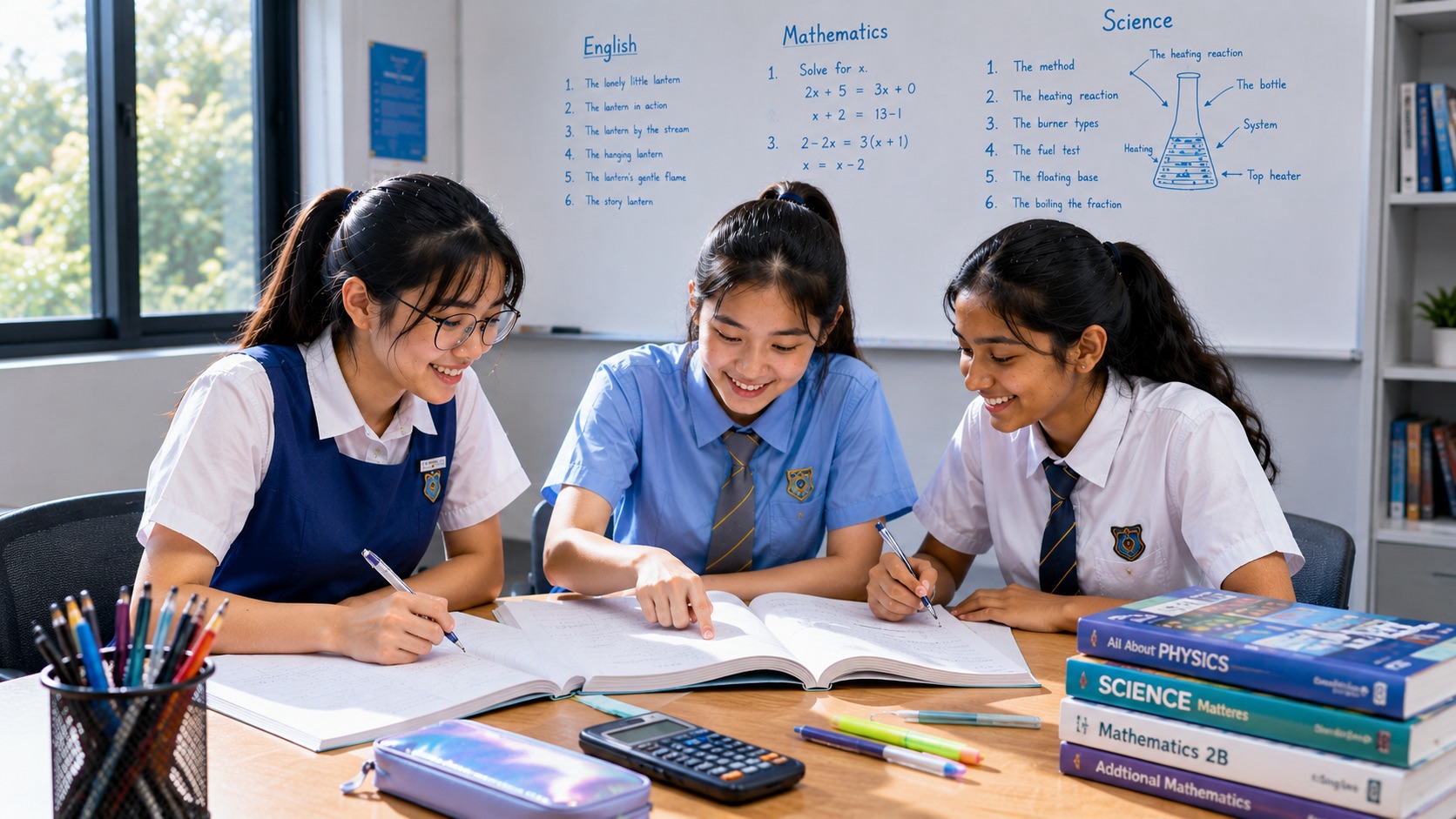
Yishun Secondary 1 English tuition should give a new secondary student a usable weekly system: read closely, retrieve without notes, respond with evidence, write for a purpose, correct the exact error and retest later. The aim is not emergency revision. It is steady control when English tasks become less guided.
This guide is for students who can follow an explanation in class but struggle to begin independently, carry a correction into new work or organise ideas across a paragraph. It uses an original library-book case to connect comprehension, vocabulary, grammar, writing and oral response without pretending that one worksheet represents the whole subject.
Who may benefit from this Secondary 1 English route?
- Students whose answers are sensible but not supported by the passage.
- Learners who record many vocabulary words but cannot use them naturally.
- Writers whose paragraphs contain several ideas without one controlling job.
- Students who correct an error once and repeat it in the next assignment.
- Families looking for a calm routine that the student can gradually own.
Start with the earliest unstable decision. If the student cannot locate relevant evidence, polishing the final sentence will not solve the reading problem. If the idea is clear but the sentence is incomplete, the repair belongs to sentence control.
The weekly English system
- Read: build the situation before answering.
- Retrieve: recall a small set of words or rules without looking.
- Respond: match the answer to the question job.
- Write: complete one purposeful paragraph or short task.
- Correct: name the error and repair the decision that caused it.
- Retest: use the skill later in a changed context.
A weekly cycle is useful only when the tasks connect. The same case can supply evidence for a comprehension answer, language for a message and ideas for an oral discussion. A later case should change the surface details so the student must recognise the method independently.
Original reading case: the book-return trolley
Read the situation
On Tuesday, heavy rain blew through the open side of the school foyer. Asha noticed that a trolley of returned library books had been left near the entrance. The top shelf was dry, but drops had begun to darken the covers on the lower shelf. She did not move the trolley immediately because a handwritten notice said, “Please leave equipment in its assigned place.” Asha found the librarian, explained what she had seen and asked whether the trolley could be shifted. Together, they moved it beside the service desk. Asha then placed a small sign at the entrance asking pupils to dry wet umbrellas before walking towards the library.
Build a literal map first
- Place: the school foyer near the library entrance.
- Problem: rain was reaching books on the lower shelf.
- Constraint: a notice told pupils not to move equipment.
- Decision: Asha asked the librarian before moving the trolley.
- Follow-up: she addressed the source of the problem with a sign.
Worked questions
Question: Why did Asha hesitate before moving the trolley?
Model: She hesitated because the notice instructed pupils to leave equipment in its assigned place. This is a directly supported reason; “she was afraid” would add a feeling the passage does not state.
Question: What does Asha’s decision to find the librarian suggest about her?
Model: It suggests that she was responsible: she wanted to protect the books while respecting the library’s rule. The inference joins two actions. “She likes books” may be possible, but the evidence does not establish it.
Question: How did the sign complement the movement of the trolley?
Model: Moving the trolley protected the books already at risk, while the sign reduced the chance that wet umbrellas would create the same problem again. The answer must compare the two actions, not merely repeat them.
Evidence limit
A careful reader separates what happened, what the action suggests and what remains unknown. Asha consulted the librarian; this supports care and rule-awareness. The passage does not tell us whether the sign worked the next day. Stopping at the evidence limit is a strength, not a lack of imagination.
Vocabulary that survives beyond the notebook
A vocabulary entry should carry enough information for later use. For this case, compare hesitate, consult, prevent and complement. Record a plain meaning, a natural collocation and a new sentence.
- hesitate before acting: pause because a decision is uncertain;
- consult a person: seek advice or permission;
- prevent further damage: stop a possible outcome;
- complement an action: add something that makes the first action more complete.
Retrieval check: close the list and explain why Asha consulted the librarian. Then write a different sentence using prevent. Recognition is the first step; independent production is stronger evidence that the word is becoming usable.
Grammar repair inside the same meaning
Agreement and reference
Weak version: “The trolley of books were near the doors, and it were getting wet.” The head noun is trolley, so a controlled repair is: “The trolley of books was near the doors, and the lower shelf was getting wet.” Replacing the vague pronoun also makes the affected part clear.
Sequence and cause
Weak version: “Asha moved it because she asked the librarian.” The connector creates the wrong relationship. Better: “After Asha asked the librarian for permission, they moved the trolley.” If the purpose matters, add: “They moved it so that the books would remain dry.”
Sentence boundaries
Weak version: “The rain entered the foyer the books were at risk Asha looked for help.” One repair is: “Rain entered the foyer, so the books were at risk. Asha looked for help.” The full stop separates the situation from the response; so makes the cause–result relationship visible.
Writing transfer: a message with a real job
Task: Write a short message to the student librarians explaining the problem and suggesting one practical response. Include what happened, why it matters and what readers should do.
Plan by function
- Open with the immediate situation.
- Give the relevant evidence without retelling every detail.
- Explain the consequence for the books or library users.
- Request one feasible action in a respectful tone.
- End with a clear next step.
Model extract
“During Tuesday’s rain, water reached the lower shelf of the return trolley near the foyer entrance. Some covers had begun to darken, so the trolley was moved beside the service desk with the librarian’s permission. Could the student librarians check that this area remains clear on rainy days and place an umbrella reminder near the entrance?”
The model is concise because every sentence performs a job. It does not exaggerate the damage, accuse another pupil or promise that the solution will work. Ask the student to close the model and write a fresh message about a sports-equipment box left beside an open window.
One-paragraph practice can be enough
A full composition is not required every time. A Secondary 1 student can practise one description, explanation, turning point or recommendation paragraph. The tutor can inspect whether the paragraph has one clear function, whether its evidence develops that function and whether the final sentence closes rather than repeats.
Paragraph repair
Drifting version: “The library was busy. Asha likes helping. Rain can be dangerous. The books were expensive. There was a sign.” The facts do not form a controlled relationship. Repair the paragraph around one proposition: Asha had to protect the books without ignoring a rule. Select only details that develop that tension.
Oral practice: answer, develop, connect
Prompt: Should students always wait for an adult before solving a school problem?
A useful response can begin: “Students should act independently when the action is safe and clearly permitted, but they should seek guidance when a rule, another person’s property or safety is involved.” Develop with the trolley case, then connect to a fresh example such as reporting a spill rather than attempting to repair electrical equipment.
- State a position that answers the question.
- Explain the condition or reason.
- Use one specific example.
- Respond to a follow-up by extending rather than repeating.
How corrections become transferable
- Name the error: unsupported inference, vague reference, wrong connector or paragraph drift.
- Explain the better decision in one sentence.
- Repair the original response.
- Close the model.
- Apply the rule to a new text or writing task.
- Retest after a delay.
Copying a model answer proves that the student can copy it. Transfer is shown when the student makes the same strong decision with new content and less prompting.
Track progress without chasing one score
- The student starts the first reading pass without repeated prompting.
- Evidence is marked before an inference is written.
- Vocabulary reappears naturally in later speaking or writing.
- Paragraphs have more distinct jobs.
- The same grammar errors appear less often.
- A correction survives a delayed, changed task.
No responsible tutor can guarantee a particular grade. A useful record compares repeated decisions across several samples, not one unusually easy or difficult worksheet.
Secondary 1 context in Singapore
Under Full Subject-Based Banding, secondary students take subjects at G1, G2 or G3 according to their learning needs. Families should use the MOE explanation of the secondary school experience for current policy details. This guide was checked against the official source on 2 October 2026; it does not predict a student’s subject level or school placement.
Class and contact guidance
A small-group lesson can make reading decisions visible because each student must explain evidence, attempt a repair and complete an independent transfer. Actual class availability, tutor assignment, timetable and fees may change. This legacy article does not establish a current Yishun class. Use the Yishun Tuition Centre Hub and confirm present arrangements separately.
Frequently asked questions
How much practice should a Secondary 1 student do?
Short, regular reading, retrieval and writing tasks are usually more useful than an occasional pile of undiagnosed work. The right amount is one the student can complete carefully and review honestly.
Should every practice task be a full paper?
No. Full tasks test integration, while focused tasks repair one decision. A sound week uses both at suitable moments.
How do parents know whether corrections are working?
Look for reduced repetition of the same error and successful use in a later task without the model open.
Is difficult vocabulary the main route to better writing?
No. Precise familiar words, clear sentence relationships and purposeful paragraphs are stronger than ambitious words used inaccurately.
Relevant reading
- Secondary 1–2 English article index
- Secondary English directory
- English Learning Hub
- Student Diagnostics Hub
- Examination Performance Hub
- The Library
Properly taught kids shine a bright light into the future.
Leave a Reply