
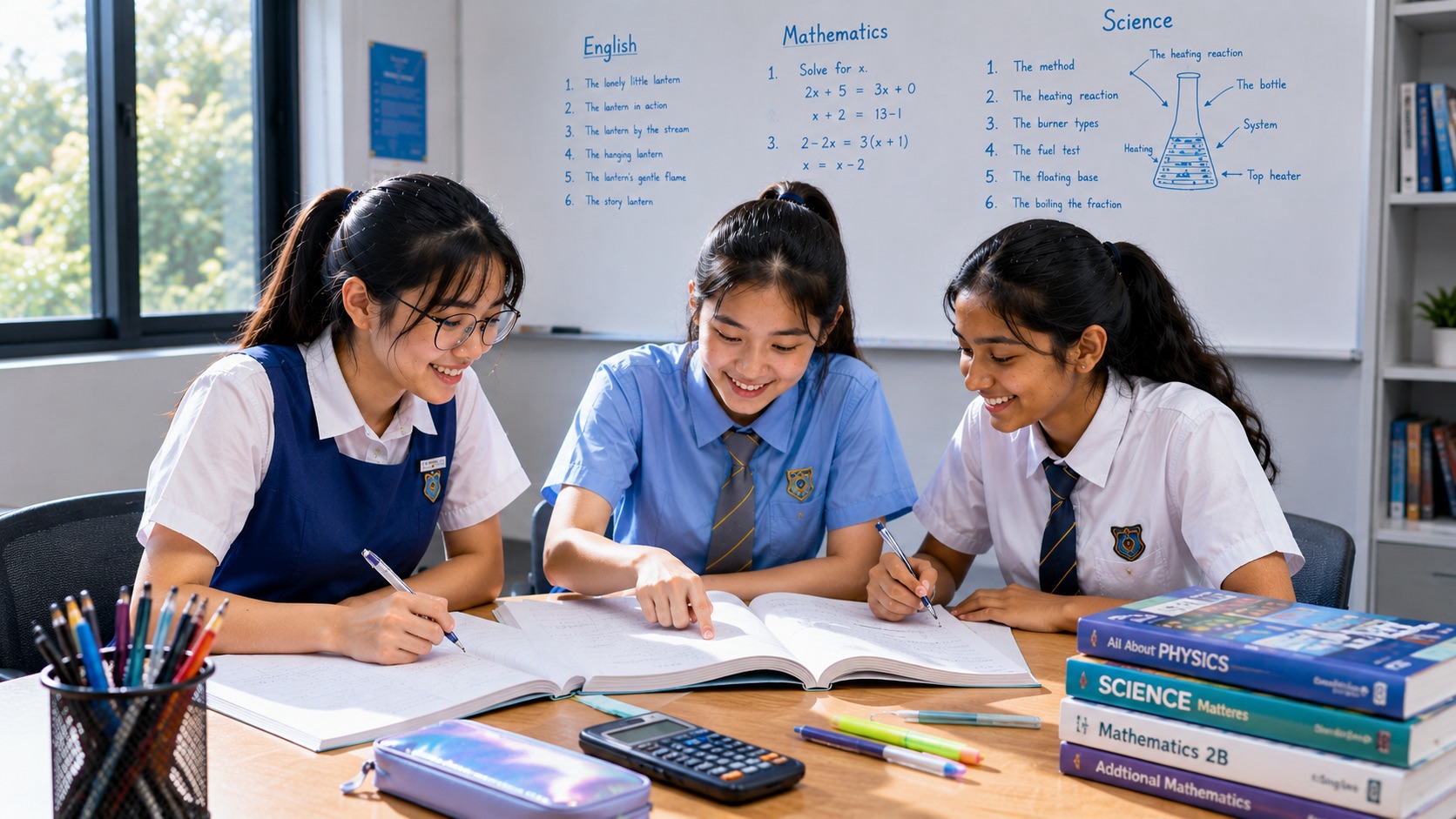
Secondary 2 English often becomes difficult at the point where a student understands the topic but misses a relationship inside the text. A pronoun may refer to a whole idea. A condition may limit a promise. A paragraph may explain a consequence that a copied sentence leaves out.
This guide develops precision with denser texts and carries the same control into summary, vocabulary, editing and purposeful writing. It uses an original account of a games cupboard, worked answers and a separate transfer exercise. The aim is an answer that says exactly what the evidence supports.
All passages, pupils and drafts below are invented teaching examples. They are not school questions, actual student results or claims about a particular school. Follow the student’s current school task instructions for assessed work.
Who This Secondary 2 Precision Guide Suits
The methods are useful when a student can read a passage but cannot consistently show the right meaning in an answer.
- A response gives something relevant but does not answer the command.
- “This” or “they” is linked to the nearest noun rather than the intended reference.
- A summary includes the background and misses the requested actions.
- Paraphrasing changes “may” into “will”, or drops an important condition.
- A paragraph contains several ideas without a clear job.
- Grammar is secure in short drills but unstable in longer writing.
Use one recent piece of work to choose the starting point. If the passage itself is misunderstood, repair reading first. If the meaning is clear aloud but not in writing, work on answer construction. These difficulties should not all receive the same worksheet.
Precision comes before speed
Begin with a short task and enough time to explain a decision. Later, change the passage and introduce the school’s actual time conditions. Repeating an unclear method faster can make the same misunderstanding harder to notice.
Read an Original Text with Several Connected Ideas
The narrator has helped organise a cupboard from which pupils borrow games. Read the whole account before answering individual questions.
The cupboard that looked ready
“I had labelled every shelf before our lunchtime games session. The boxes were easy to find, and I expected borrowing to become effortless. Yet Bea opened a familiar game and found that two counters were missing. A clear label had told her where the box belonged; it had told her nothing about what remained inside.
“Arjun suggested counting the pieces when each game was returned. I objected that this would delay the next borrower. He agreed that checking could take time, but pointed to Bea, who was now searching three other boxes for spare counters. The short check might prevent a longer interruption later. I had noticed the queue at the cupboard and overlooked the waiting at the tables.
“We tried two changes. Each box received a list of its pieces, and borrowers checked the contents against it before returning the game. If something was missing, they recorded the item on a separate card instead of hiding the problem by closing the lid. This made the difficulty visible to the pupil organising the next session; it did not automatically replace the missing piece.
“The labels helped us locate games, while the lists helped us check them. The former saved searching time; the latter made an incomplete return easier to identify. Neither could guarantee that every game would always be ready. The system worked better when pupils reported difficulties and someone followed them up. Order on a shelf was useful, but it was only part of being prepared.”
State the central idea accurately
The narrator learns that locating a game and knowing whether it is complete are different jobs. Labels help with the first; contents lists and reporting help with the second. Follow-up is still needed when pieces are missing.
“Labels are useless” would distort the conclusion. “Every game became complete” would add an outcome the account does not give. The passage preserves the labels’ value while exposing their limit.
Notice the movement between paragraphs
- The opening introduces an expectation and a problem it did not anticipate.
- The second paragraph challenges the narrator’s view of what counts as a delay.
- The third describes the changes and their limits.
- The final paragraph distinguishes the jobs and qualifies the conclusion.
A paragraph map is useful when a question asks how an example changes a view or what the conclusion means. Finding the same keyword is not enough to establish that relationship.
Unpack Dense Sentences Without Losing Their Connections
A longer sentence becomes easier when the student locates its main claim and the relationships attached to it. Read the smaller parts, then rebuild the whole meaning.
Separate two jobs within one sentence
“A clear label had told her where the box belonged; it had told her nothing about what remained inside.”
The first clause concerns location. The second concerns contents. The repeated subject refers to the label, and the semicolon connects two complete, closely related statements.
The contrast is not between a good game and a bad game. It is between information the label supplies and information it does not supply. That distinction explains why the organised cupboard still caused a problem.
Keep a concession attached to the response
“He agreed that checking could take time, but pointed to Bea, who was now searching three other boxes for spare counters.”
Arjun accepts part of the objection: checking takes time. He then provides a reason to consider it worthwhile: missing pieces are already causing another delay. The clause about Bea supplies the evidence for that response.
If a student writes only “Arjun agreed with the narrator”, the concession has swallowed the main argument. If the student writes “checking takes no time”, the answer erases what he acknowledges.
Preserve the condition
“The system worked better when pupils reported difficulties and someone followed them up.”
The improvement depends on reporting and follow-up. The sentence does not say that attaching a list alone repairs a game.
A useful reading check is to ask what would be lost if the condition were removed. Here, the reader would be left with an unjustified promise that paperwork automatically solves the practical problem.
Practise a compact reading method
First locate the main statement. Next identify words showing contrast, cause, condition or qualification. Then explain the full relationship in ordinary language before drafting the answer.
Use annotation only where it helps. Underlining every sentence makes the page busy without making a decision visible.
Resolve References by Meaning as Well as Position
Reference questions can require a noun, an action or a whole earlier idea. The nearest word is a candidate, not an automatic answer.
What does the first “this” mean?
In “I objected that this would delay the next borrower”, “this” refers to counting the pieces when each game was returned. It does not refer to Arjun himself or to the missing counters.
Test a candidate by replacing the reference: “I objected that counting the pieces when each game was returned would delay the next borrower.” The sentence now preserves the intended meaning.
What does “it” refer to in the checking instruction?
“Borrowers checked the contents against it” refers to the list of pieces. The list supplies the standard against which the contents are compared.
Replacing “it” with “the box” would change the process. Looking inside a box is not the same as comparing the contents with an inventory.
Explain “This made the difficulty visible”
The reference points to recording the missing item on a separate card rather than concealing the problem by closing the lid. “A missing piece” names the difficulty, but not the action that makes it visible.
Depending on the question, the answer should include the necessary action and its object: recording which item was missing. Do not copy an entire paragraph when a precise reference will do.
Distinguish “the former” and “the latter”
The passage first mentions labels and then lists. “The former” refers to labels; “the latter” refers to lists. Check those links against their functions: locating games and identifying an incomplete return.
This is more than remembering first and second. The meaning should still fit after substitution. Use both order and sense to verify the answer.
Match the Answer to the Question’s Exact Job
A student can locate a relevant part of the passage and still answer the wrong question. Translate the command into a search job before writing.
Answer a reason with the reason
Question: Why did Arjun consider a return check worthwhile despite the time it could take?
Weak answer: “He suggested counting the pieces when games were returned.” This repeats the suggestion but does not explain why it is worthwhile.
Model answer: “A short check could reveal missing pieces before the next borrower began, potentially preventing the longer interruption Bea experienced while looking for spares.”
The answer preserves possibility through “could” and “potentially”. It does not guarantee that every interruption would disappear.
Give two distinct effects when two are requested
Question: What different benefits did labels and contents lists provide?
Model answer: “Labels helped pupils locate games more quickly, while contents lists made incomplete returns easier to identify.”
“They organised the cupboard and made it tidy” repeats a broad idea and misses the distinction. Two clauses are not necessarily two different points.
Explain a change in understanding
Question: How did Bea’s difficulty challenge the narrator’s original expectation?
The expectation was that easy-to-find boxes would make borrowing effortless. Bea found the box but could not use the game as intended because pieces were missing. Her experience therefore showed that location did not establish readiness.
Write both sides of the change. Naming only the missing counters gives the event without explaining how it challenges the expectation.
Keep inference within its evidence
Bea searches other boxes for spares, which supports the inference that the missing counters disrupted her activity. It does not establish that another pupil deliberately stole them.
The passage gives no cause for their absence. An answer should not introduce blame simply because a problem has occurred.
Select Summary Points with a Clear Scope
Summary requires selection before compression. Decide what the task asks for, collect the relevant points and then express them concisely without changing their meaning.
Use a defined practice task
Task: Summarise what borrowers were expected to do when returning a game under the revised arrangement. Use no more than 45 words for this teaching exercise. This is not an official examination word limit.
The task concerns borrowers’ return actions. Shelf labelling, Bea’s search and the narrator’s original expectation are background. Following up problems is important to the wider system, but the passage assigns that to someone managing the difficulty, rather than making it part of every borrower’s return task.
Collect the actions and condition
- Check the contents against the list before returning the game.
- If something is missing, record which item is absent on a separate card.
- Report the problem rather than conceal it by closing the lid.
The last two points are closely connected. Combine them carefully rather than repeating the same reporting action in two inflated sentences.
A compact model summary
“Before returning a game, borrowers checked its contents against the pieces list. If an item was missing, they identified it on a separate card rather than concealing the problem.”
The summary keeps the return sequence, the condition and the reporting action. It does not tell borrowers to replace the missing item immediately, because the passage does not require that.
Repair a tempting but inaccurate summary
Weak draft: “Borrowers labelled the shelves, counted all games and replaced anything missing, so every box was ready.”
This draft assigns the shelf work to the wrong people, changes checking pieces into counting games, invents replacement and guarantees an outcome. Its length is not the problem. Selection and meaning are.
Repair those decisions before searching for shorter words. A compressed distortion remains a distortion.
Use Vocabulary and Paraphrase to Make Meaning More Exact
Precision involves choosing the right word and preserving the original relationship. A more elaborate expression is not necessarily a better expression.
Compare “locate”, “identify” and “replace”
To locate a box is to find where it is. To identify a missing item is to establish which item is absent. To replace it is to provide another in its place.
The passage shows the first two processes but does not establish that the third occurred. A summary using “replaced” where the text says “recorded” changes the action.
Distinguish a promise from a possibility
Original: “The short check might prevent a longer interruption later.”
Safe paraphrase: “A brief inspection could avoid a more time-consuming disruption afterwards.”
Unsafe paraphrase: “Checking stopped all later delays.” This changes possibility into a reported result and expands one potential interruption into every delay.
Always compare certainty and scope, not just dictionary meanings.
Learn useful words in natural patterns
“Incomplete” fits an incomplete set of pieces. “Effortless” describes something requiring little apparent effort. “Overlooked” means failed to notice or consider in this context; it does not mean watched over carefully.
Try new sentences, such as “The plan overlooked the time needed to pack equipment” and “The incomplete list omitted two required items.” Explain what each word contributes, then retrieve the meaning and pattern later without the model open.
Separate time from cause
“Before returning the game” describes when checking happens. “Because pieces were missing” would explain a cause. “If something was missing” sets a condition.
Replacing one connection with another can produce a grammatical sentence that means something different. Grammar and comprehension are working together here.
Build a Paragraph with One Clear Job
Secondary 2 writing benefits from the same relationship control as reading. Every sentence should develop, support or qualify the paragraph’s main idea.
Give the paragraph a specific purpose
Practice task: Explain why a clear borrowing routine can be useful without assuming that it solves every equipment problem.
The paragraph needs a reason, an explanation and a limit. It does not need a history of the games club or a list of favourite games.
Inspect a drifting draft
Invented draft: “Rules are very important. I enjoy games because they are fun. Labels are colourful and my friend likes chess. Some games have missing pieces. Everyone should follow rules because rules are important.”
The draft circles back to its opening without explaining a mechanism. Its personal details do not develop the required point. Repeating “important” adds emphasis but little reasoning.
A developed model paragraph
“A clear borrowing routine helps users recognise and report equipment problems before they remain hidden for the next person. In the invented cupboard account, comparing the contents with a pieces list makes an incomplete return easier to notice. Recording the missing item then gives the organiser specific information to follow up. The routine does not produce a replacement piece by itself, but it makes the next action clearer. Its value lies in connecting checking with reporting and response, rather than merely making the shelves look orderly.”
Each sentence develops the same job. The example is followed by an explanation of why it matters, and the limitation prevents an exaggerated promise.
Transfer the structure to fresh content
Use a different setting, such as borrowing art materials. Explain the mechanism in your own words: what the check reveals, how reporting helps and what response remains necessary.
Reuse the reasoning, not the cupboard paragraph’s sentences. If the new paragraph depends on remembering its exact wording, the method is not yet secure.
Adjust Writing to Audience and Purpose
The same event can support a practical request, a reflection or a spoken view. Select the information that serves the particular reader or listener.
Write a cooperative request
Practice task: Write to the pupil organising the next games session. Ask for the missing counters to be checked and explain what has already been done.
Possible opening: “Hello Games Coordinator, two counters were missing from the game Bea opened at lunchtime. We recorded the missing items on the separate card. Could you check whether suitable spares are available before the next session?”
The message identifies the problem, records the completed action and requests a next action. It avoids claiming that a named pupil caused the loss. Follow any format and content requirements supplied in the actual task.
Make reflection grow from the event
Invented reflective fragment: “I had congratulated myself on the labelled shelves. When Bea found the right box and still could not begin, I realised I had checked where things belonged without checking whether they could be used.”
The change in understanding is tied to an observed contradiction. A broad ending such as “I learnt never to make mistakes” would be unsupported and unrealistic.
Develop a spoken answer without rambling
Question: “Should borrowers check equipment before returning it?”
Possible response: “A short check is useful because it can reveal a missing item before the next person needs it. I would keep the check clear and manageable, and provide a way to report problems. Checking is less useful if the report is then ignored.”
Follow-up: “What if the borrower is in a hurry?” A considered answer can propose a practical reporting step and acknowledge that a routine should fit the activity. It should respond to the new concern rather than repeat the opening view.
Repair Grammar Inside Meaningful Writing
Use short drills when necessary, then test the same relationship in a paragraph. A correct isolated choice does not always survive the demands of planning and writing.
Find the subject through an interrupting phrase
Draft: “The list of pieces in the two boxes were incomplete.”
Repair: “The list of pieces in the two boxes was incomplete.” The main subject is singular “list”. The plural nouns in the following phrases do not control its verb.
If the intended meaning concerns two separate lists, write “The lists of pieces in the two boxes were incomplete.” Changing the subject may also change the number of objects being described.
Keep the condition and consequence connected
Draft: “If a counter was missing. The borrower recorded it on a card.”
Repair: “If a counter was missing, the borrower recorded it on a card.” The dependent clause introduces the condition and needs the main clause to complete this sentence.
Clarify an ambiguous pronoun
Draft: “Bea spoke to Nadia after she checked the game.”
Both named pupils could be intended. If Bea performed the check, write “After checking the game, Bea spoke to Nadia.” If Nadia checked it, name her explicitly.
Do not guess the intended meaning and silently rewrite it. Establish who did the action, then express it clearly.
Preserve the passage’s time frame
Draft recount: “Arjun suggested a check and points to the other boxes.”
Repair: “Arjun suggested a check and pointed to the other boxes.” The account narrates those past actions. A general recommendation such as “Borrowers check contents before returning a game” has a different purpose and can use the present tense.
The correct tense depends on the job of the sentence, not a rule that every sentence about games must use the same tense.
Try an Independent Task with a Changed Surface
Close the worked answers and read this invented account of a costume cupboard. It tests related skills through different details.
The costume record
“Lena labelled each costume with its size. The labels helped performers choose an outfit, but did not show whether its fastenings worked. When one zip jammed, Omar suggested a check before costumes were put away. Lena worried that this would lengthen packing time. Omar replied that discovering the fault just before a performance could cause a worse delay.
“They added a repair card for each damaged item. If a fastening failed, the person returning the costume described the fault on the card. This helped the organiser know what needed attention; it did not mean that the costume had been repaired.”
- What does “this” refer to in Lena’s objection?
- Explain why Omar considers the check worthwhile.
- State the different jobs of the size label and repair card.
- Summarise only what someone returning a faulty costume is expected to do.
- Repair: “The description of the faults were unclear.”
Check the relationships
Lena objects to checking costumes before putting them away. Omar compares packing time with the possible worse delay of finding a fault immediately before use.
The label helps select a size; the card identifies a fault needing attention. Recording a fault is not equivalent to repairing it. A focused summary should say that the returner describes a failed fastening on the relevant card, without adding the organiser’s later repair work.
In the grammar item, “description” is the singular main subject, so use “was unclear”. A strong independent attempt explains these relationships without simply substituting costume names into memorised cupboard answers.
Teach for Retention and Visible Progress
Keep a short record of the first answer, the missing relationship and the later independent attempt. This shows more than a corrected page alone.
Use a connected practice cycle
Model one decision, let the student explain it, revise the answer and then change the text. On a later occasion, return to the skill without opening the model first.
In a small group, each learner should attempt before comparison. Discuss why one answer is more complete or more precise, then give each student fresh work alone. Peer discussion helps reveal alternatives; independent work shows who can use them.
Keep the active error list small
- Missed condition: preserve “if”, “when” or the equivalent relationship.
- Reference too narrow: test whether the word points to an action or full idea.
- Correct information, wrong job: restate the question’s command before searching.
- Summary drift: exclude background outside the specified scope.
- Paragraph repetition: add the missing mechanism rather than another slogan.
Attach an actual sentence to each cue. “Be more precise” becomes useful when the student can show the detail or relationship previously lost.
Look for changes before drawing conclusions
Progress may include better reference resolution, distinct points in two-part answers, safer paraphrase, clearer paragraph purpose and less prompting during a fresh task.
A successful model-assisted response is a useful stage. It should be followed by independent and later attempts before treating the skill as dependable. These are observation methods, not guaranteed marks or a promised improvement schedule.
Discuss Current Support and Class Fit
Bring a recent comprehension script, summary and uncorrected paragraph when discussing Secondary 2 support. Include the task wording and teacher feedback. Ask where the response first loses precision and what fresh work will check the proposed repair.
Use the English Tuition & Learning Hub for current enquiry routes and the Student Diagnostics Hub to organise the starting evidence. Confirm current venue, availability, fees and class arrangements directly. This retained 2019 guide does not identify a current tutor assignment or school affiliation.
Frequently Asked Questions
Why can a student understand a passage but lose answer marks?
General understanding and answering the exact question are different jobs. Inspect the command, evidence, relationship and written expression separately. A relevant copied line may still omit the requested explanation.
Should every long sentence be broken into short sentences?
Break it down while learning, then reconstruct the relationship. In writing, a longer sentence is useful when it expresses contrast, cause or condition clearly. Length alone is neither a strength nor a weakness.
How should reference questions be checked?
Replace the pronoun or reference phrase with the candidate answer and read the sentence again. Check the intended meaning as well as agreement and position. Sometimes the reference is an action or idea rather than a single noun.
Does better vocabulary mean using harder words?
It means controlling meaning, natural word partners, tone and certainty. “Identify” and “replace” are both ordinary words, but confusing them changes the action. Precision is more useful than decoration.
How can paragraph writing become less repetitive?
Give the paragraph one job. Explain how the point works, use a relevant example and show why it matters. Remove sentences that merely repeat the opening or introduce an unrelated topic.
Should Secondary 2 become constant examination drilling?
Use assessments to locate recurring decisions that need repair. Fresh reading, purposeful writing, vocabulary and independent checking remain important. Introduce timing with the school’s current requirements once the method is reasonably clear.
Relevant Reading and the Next Step
Revisit Secondary 1 primary-to-secondary transition, continue to Secondary 3 upper-secondary judgement, or look ahead to Secondary 4 examination-year control. Use the official SEAB SEC syllabus routes for current cohort and subject requirements.
Begin with one answer that is roughly right. Identify the missing reference, condition, distinct point or explanation. Repair that exact relationship, say why the revision is better and try the same decision on a new passage. That is how Secondary 2 precision becomes a skill the student can carry into denser work.
Continue through Secondary 2 English: Secondary 1–2 article index · Secondary English directory · English by area & school · Diagnostics · Examinations · Library
Leave a Reply