
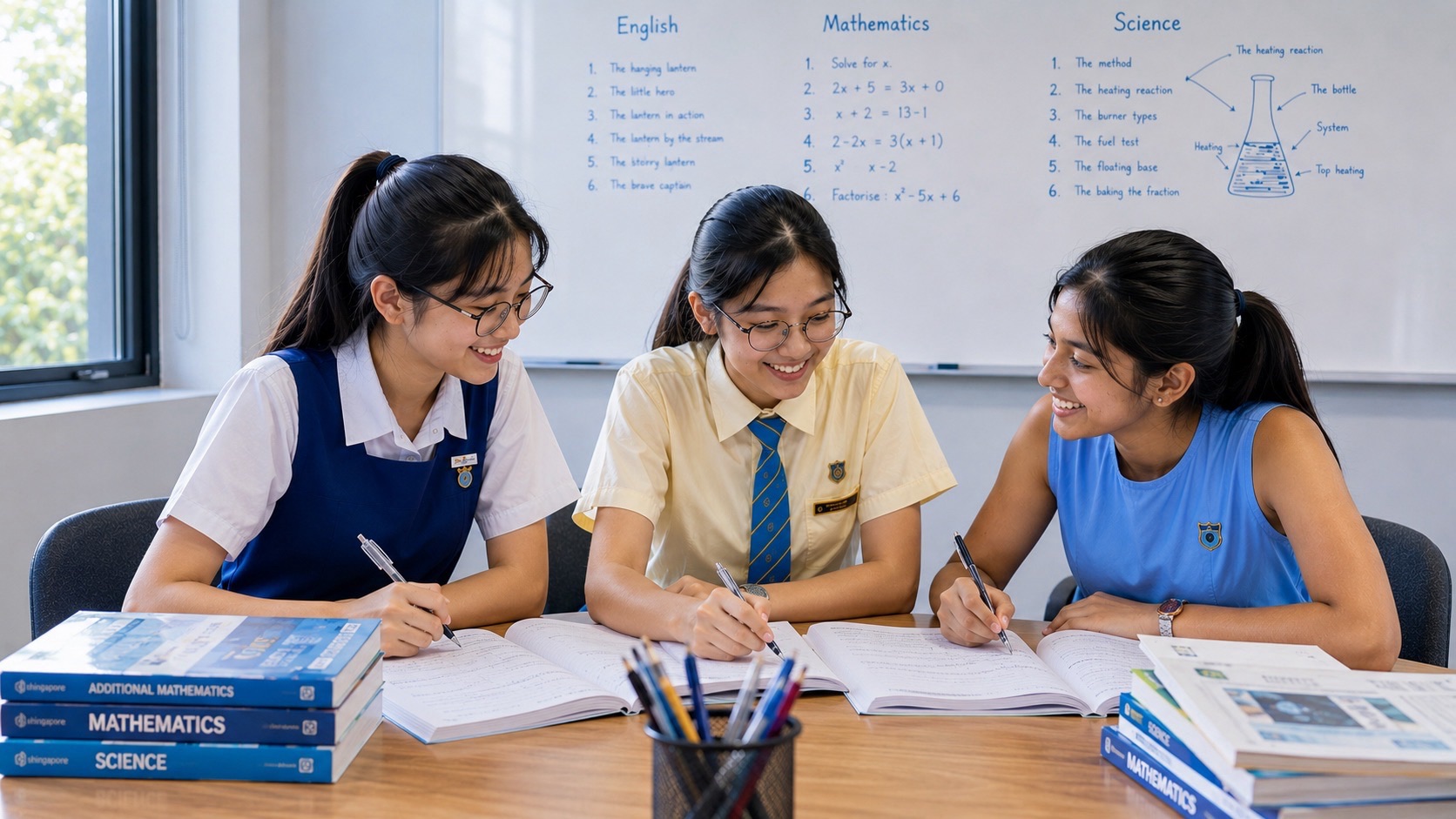
Yishun Small Group Secondary 3 English Tutor should function like a serious writing workshop: students draft, compare, critique, revise and then prove that the lesson survives a fresh prompt. Families searching for Sec 3 English tuition in Yishun, small-group Secondary English tuition, essay writing, argumentative writing, expository writing, situational writing, editing, vocabulary, comprehension or O-Level/SEC preparation often need something more precise than “write more compositions”. They need better revision cycles.
Current Secondary English tuition programmes commonly emphasise essay structure, critical comprehension, current affairs, oral communication, vocabulary, editing, personalised feedback and exam readiness. In a three-student workshop, those strands can meet on the page. One student’s paragraph exposes a structural weakness, another student’s sentence shows a better way to handle contrast, and a third student’s example demonstrates how evidence can be analysed instead of merely named. The tutor then returns every student to an individual rewrite.
Secondary 3 is the ideal year for this because upper-secondary writing is no longer just about producing fluent sentences. Students need paragraph architecture, evidence, relevance, register and control. This page therefore owns the peer-critique → rewrite → fresh-transfer cycle: how a small group can improve actual writing rather than simply increase writing volume.
Writing Improves Through Revision, Not Just Production
Students can write many essays and still repeat the same weaknesses.
If every draft is marked and abandoned, the learner gains feedback but little closure.
Plan → draft → feedback → rewrite → extract lesson → fresh prompt.
The rewrite is where feedback becomes action. The fresh prompt is where action becomes transferable skill.
Why Three Students Help a Writing Workshop
One-to-one feedback is close, but it can make the tutor’s opinion feel like the only standard. A large class offers many samples but limited time for individual revision.
Three students provide a useful middle ground. Each learner can see multiple valid approaches while receiving close feedback.
The group can compare craft rather than rank people.
Silent Draft First
Before critique, every student writes independently.
This matters because peer discussion should improve a draft, not replace the student’s own thinking.
Even a short paragraph is enough to create useful evidence.
Critique the Job, Not the Person
Peer feedback should use questions such as:
- What is this paragraph trying to do?
- Which sentence carries the main point?
- Where does the evidence enter?
- What does the example prove?
- Which sentence repeats?
- What would make the reader clearer?
This keeps critique technical and useful.
Paragraph Architecture
A strong upper-secondary paragraph usually contains a clear relationship among ideas.
For expository writing:
Point → explanation → example → analysis → link.
For argumentative writing, add counterpoint or qualification when useful.
Students can label each sentence by function. Missing jobs become visible immediately.
The “What Does This Prove?” Test
Examples often look impressive while doing little work.
After every example, a peer asks:
What does this prove about your point?
If the writer cannot answer clearly, the paragraph needs more reasoning.
Introduction Workshop
Three students write introductions to the same question.
Compare:
- which defines the issue;
- which answers the actual question;
- which has a usable central proposition;
- which spends too long on generic background.
The goal is not one model introduction. It is functional clarity.
Conclusion Workshop
Conclusions often repeat the introduction mechanically.
Ask whether the conclusion:
- answers the question after the discussion;
- shows qualification or implication;
- avoids introducing an entirely new argument;
- ends decisively without sounding memorised.
Argumentative Writing: Workshop the Counterargument
One student writes the claim. Another writes the strongest counterargument. The third writes the rebuttal or qualification.
Then compare the sequence as a group.
Students learn that a strong argument can acknowledge limits without collapsing.
Expository Writing: Workshop the Mechanism
Many students can state a point but cannot explain how or why it operates.
Peers should ask:
- What causes this?
- Who is affected?
- Under what conditions?
- What is the consequence?
The writer adds the missing mechanism.
Narrative Writing: Workshop the Causal Spine
Pressure → choice → consequence → response → change.
Students can compare plots and remove events that do not contribute to this spine.
Editing the plan before drafting often saves more time than editing pages of unnecessary story later.
Reflective Writing: Workshop the Insight
A reflective piece should not end with a generic moral.
Peers ask:
- What did the narrator believe before?
- What event challenged that belief?
- What does the narrator understand now?
- Is the final insight supported by the story?
Situational Writing: Workshop the Reader
One student acts as the intended recipient and asks whether the message is clear, complete and appropriately toned.
The writer must explain why information is ordered that way.
Audience becomes a real constraint rather than a checklist word.
Sentence-Level Workshop
Students should also learn to revise sentences, not only paragraphs.
Common jobs include:
- remove ambiguity;
- repair tense;
- fix agreement;
- combine repetitive sentences;
- split overloaded sentences;
- replace vague vocabulary;
- improve clause relationships.
Longer Is Not Automatically Better
Sec 3 students sometimes make sentences longer to sound mature.
A sentence earns complexity only when the relationship needs it.
Peer critique can ask whether the same meaning would be clearer in fewer words.
Vocabulary Workshop: Precision Over Prestige
When a student uses an ambitious word, peers ask:
- Does it mean exactly what you intend?
- Does it fit the collocation?
- Does it fit the register?
- Would a simpler word be more accurate?
Strong vocabulary is controlled vocabulary.
Editing Workshop: Use Error Families
| Error family | What to inspect |
|---|---|
| Agreement | True subject and verb |
| Tense | Time sequence across paragraph |
| Reference | Clear pronoun antecedent |
| Sentence boundaries | Fragments and run-ons |
| Register | Audience and purpose |
| Word choice | Meaning, tone, collocation |
Students should explain the correction. Otherwise peer editing can become guesswork.
The Tutor’s Role: Prioritise
A draft may contain twenty weaknesses. The tutor should identify the highest-leverage two or three.
If the essay does not answer the question, polishing commas is not the first priority.
If the structure is sound but grammar repeatedly obscures meaning, language control may deserve the next lesson.
Micro-Conferences
While two students revise, the tutor spends two or three minutes with the third.
One narrow conversation:
- What is the main problem?
- Why did it happen?
- What exact change should be made?
Then the student rewrites immediately.
Rewriting Is Mandatory
Comments without revision are incomplete learning.
The student should be able to show the before-and-after sentence or paragraph and explain the change.
This is especially powerful in small groups because peers can see that writing quality is produced through decisions, not magic.
Fresh Transfer After Rewrite
After improving the original paragraph, give a new prompt requiring the same skill.
If the student can reproduce the improvement without the tutor’s wording, the repair is beginning to transfer.
Build a Personal Writing Ledger
| Recurring issue | Countermeasure | Fresh test |
|---|---|---|
| Example not analysed | Add “This shows…” reasoning | New expository paragraph |
| Topic drift | Paragraph job in margin | New essay plan |
| Tense shifts | Dedicated tense pass | Fresh recount |
The ledger keeps feedback alive between lessons.
Peer Review Should Not Become Proofreading Labour
Peers are not unpaid editors.
Each review should focus on one job. For example: relevance, paragraph structure or sentence clarity.
Narrow review creates better discussion and prevents students from circling random mistakes.
A 90-Minute Sec 3 Writing Workshop
- 10 min: retrieve previous writing target.
- 15 min: analyse one strong model paragraph.
- 20 min: independent writing.
- 15 min: structured peer critique.
- 10 min: tutor micro-conferences.
- 15 min: rewrite.
- 5 min: fresh transfer sentence or paragraph.
Model Writing: Study Craft, Do Not Copy Surface
Models are useful when students ask:
- How is the paragraph organised?
- Where does explanation happen?
- How is evidence introduced?
- How does the writer qualify a claim?
Students should borrow structure and technique, not memorise sentences to force into unrelated topics.
Current Affairs Feeds the Workshop
Expository and argumentative writing improves when students have real material.
Use one reliable article to build vocabulary, knowledge and one evidence-based paragraph.
The writing workshop then tests whether the example is used meaningfully.
Oral Can Precede Writing
If a student cannot explain the idea aloud, writing it clearly may be difficult.
Ask the student to speak the paragraph first: claim, reason, example, implication.
Then write it.
Oral rehearsal can clarify thinking before sentence-level decisions begin.
Worked Case: The Student With Beautiful Introductions
A learner spends disproportionate time on elegant openings while body paragraphs remain thin.
The workshop limits introductions to five minutes and spends most critique on paragraph reasoning.
The essay becomes more balanced.
Worked Case: The Student Who Hates Rewriting
The student believes rewriting means the first draft failed.
The tutor shows three versions of the same paragraph and asks which decisions improved clarity.
Revision becomes normal craft rather than punishment.
Worked Case: The Student Who Accepts Every Peer Comment
A student changes the draft whenever a classmate suggests something.
The new rule: no change without a reason.
The writer must decide whether the feedback improves relevance, clarity, evidence or language.
Ownership remains with the author.
Worked Case: The Strong Writer Who Gives Weak Feedback
A strong student says “this sounds weird” but cannot explain why.
The tutor asks for a category: reference, register, logic, grammar, repetition or word choice.
Giving feedback becomes another form of language analysis.
What Parents Can Watch For
- The student rewrites instead of merely reading comments.
- Paragraphs have clearer purposes.
- Examples receive explanation.
- Vocabulary becomes more natural.
- The student can explain why a sentence was changed.
- Fresh essays repeat fewer old errors.
What Not to Do in a Sec 3 Writing Workshop
- Do not compare students by who writes the longest essay.
- Do not let peer critique become personal judgement.
- Do not mark everything equally.
- Do not accept comments without reasons.
- Do not skip rewriting.
- Do not treat model essays as scripts.
A Twelve-Week Writing Workshop Build
Weeks 1–2: diagnose paragraph structure and recurring language errors.
Weeks 3–4: expository explanation and evidence.
Weeks 5–6: argumentative counterpoints and qualification.
Weeks 7–8: narrative/reflective structure and sentence control.
Weeks 9–10: situational writing, register and timed drafting.
Weeks 11–12: independent full pieces with peer critique reduced and fresh transfer emphasised.
Frequently Asked Questions
Is peer feedback reliable?
It can be useful when tightly structured and supervised. The tutor remains responsible for correcting misconceptions and setting standards.
Should every essay be rewritten?
Not always in full. At minimum, high-value paragraphs and sentences should be revised so feedback becomes action.
Can strong and weak writers learn together?
Yes when they share a central craft job and receive different individual targets.
How do students avoid copying?
Write independently before critique, and use a fresh prompt after revision.
What proves improvement?
The student carries a repaired writing decision into a fresh piece with less prompting.
Continue Through the eduKateYishun English Route
- Yishun Small Group English Tutor Secondary 3 — seminar, debate and oral-to-writing transfer.
- Yishun English Tuition Sec 3 Tutor — current affairs and evidence banks.
- English Tuition Yishun (Sec 3 Tutor) — upper-secondary judgement and comprehension.
The Writing-Workshop Rule
A marked draft is not the finished lesson. The finished lesson is the next independent piece in which the same weakness no longer appears.
Historical Image Archive
The original 2019 image material remains part of this page.


Leave a Reply