
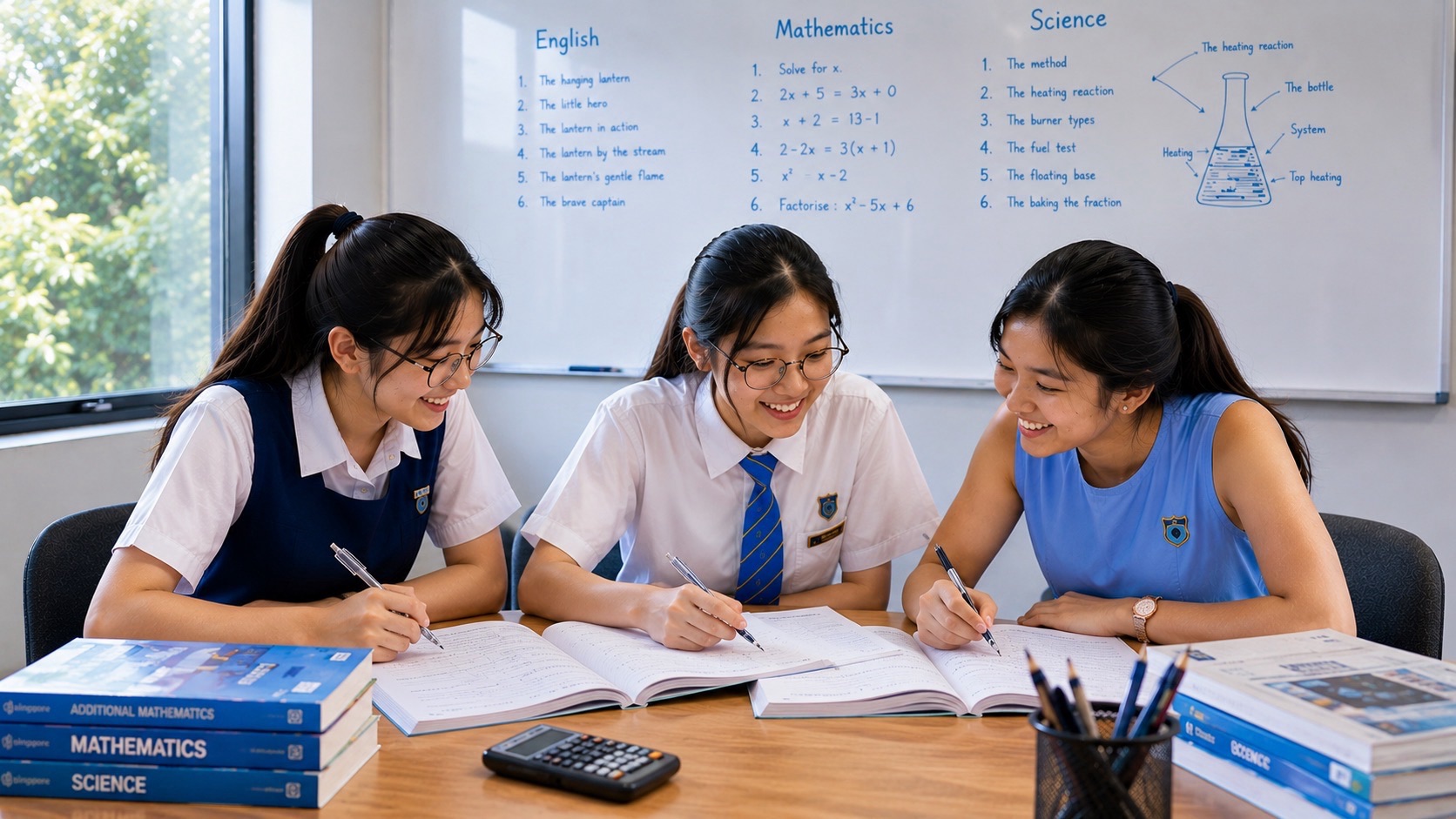
Yishun English Tuition Sec 3 Tutor should help an upper-secondary student turn general knowledge into usable evidence. Families searching for a Sec 3 English tutor in Yishun, Secondary English tuition, expository writing, argumentative writing, comprehension, current affairs, oral communication, situational writing, editing or O-Level/SEC preparation often meet a hidden problem: the student can write grammatically, but ideas become thin when the topic moves beyond familiar school life.
Current Secondary English programmes in Singapore commonly emphasise critical reading, inference, summary, argumentative and discursive writing, current affairs, vocabulary, editing, oral communication and personalised feedback. Those visible components become much stronger when the student owns a small, reliable bank of knowledge. A useful example is not simply a fact remembered from the news. It is evidence attached to an idea the student can explain.
Secondary 3 is the right year to build that bank. Students approaching the 2026 O-Level 1184 route or the 2027 SEC G3 K300 route need more than language technique; they need enough world knowledge to read unfamiliar passages, form defensible opinions and support upper-secondary essays. This page therefore owns one learning job: current affairs, evidence banks and the conversion of knowledge into stronger English reasoning.
Why Good English Can Still Produce Thin Essays
A student may have solid grammar, decent vocabulary and clear handwriting yet struggle with broad topics such as technology, education, health, environment, media, community or work.
The problem is often not English form. It is knowledge.
If the learner has little to say, the essay becomes repetitive. The writer may use polished phrases around a shallow argument.
Sec 3 is where content knowledge begins to matter much more visibly.
Build Knowledge by Theme, Not by Headline
Students do not need to memorise hundreds of current-affairs stories. Organise knowledge around durable themes:
- technology and AI;
- education and youth;
- environment and sustainability;
- health and well-being;
- media and information;
- community and ageing;
- work and future skills;
- sport, arts and culture.
Each new article is stored under an idea rather than as an isolated event.
The Evidence Bank
For each theme, record only a few high-quality examples.
| Theme | Example | What it illustrates | Limit |
|---|---|---|---|
| AI | Use of generative tools in education | Efficiency, access, new learning support | Accuracy, dependency, integrity |
| Environment | Urban greening or transport policy | Collective action and long-term planning | Cost and trade-offs |
| Media | Misinformation during fast-moving events | Need for source checking | Verification can be slow |
The “limit” column prevents simplistic arguments.
An Example Needs a Job
Students often collect famous examples because they sound impressive.
Ask: What does this example prove?
If the student cannot answer in one sentence, the example may not yet be usable.
Evidence becomes valuable only when connected to a claim.
Current Affairs Reading Routine
One substantial article a week can be enough if read deeply.
- Summarise the central development.
- Identify the writer’s main claim.
- Record two pieces of evidence.
- Note one competing perspective.
- Extract five useful words or phrases.
- Write one 120-word response.
This single routine trains comprehension, vocabulary, source judgement and writing.
Source Quality Matters
Students should increasingly ask:
- Who published this?
- When?
- What evidence is used?
- Is the claim opinion, analysis or reported fact?
- What uncertainty remains?
In an AI-rich information environment, polished language is not proof of reliability.
Use Official Sources When the Fact Is Technical
For examination rules, government policy, statistics or institutional information, official sources are useful anchors.
For broader social issues, students can compare credible journalism, research institutions and reputable organisations.
The aim is not to turn teenagers into professional fact-checkers. It is to build the habit of asking where a claim came from.
Reading Current Affairs Improves Comprehension
Background knowledge reduces cognitive load.
A student who already understands basic ideas about climate policy, social media, ageing or AI can enter an unfamiliar passage with more anchors. Vocabulary is easier to infer because the topic has structure.
World knowledge is therefore not an optional extra to English. It supports reading itself.
Vocabulary Should Grow Inside Themes
Theme-based reading naturally creates useful clusters.
Technology: automation, privacy, accessibility, efficiency, regulation, innovation, dependency.
Environment: conservation, emissions, sustainability, biodiversity, mitigation, consumption.
Learning words together creates semantic networks that are easier to retrieve than isolated lists.
From Article to Oral Response
After reading, ask one oral question: “Do the benefits outweigh the risks?” or “Who should be responsible?”
The student prepares a one-minute answer:
Position → reason → example → limitation → conclusion.
The current-affairs example becomes spoken evidence rather than passive knowledge.
From Article to Expository Paragraph
Next, turn the same material into writing.
A useful paragraph sequence:
- State the point.
- Explain the mechanism.
- Introduce the example.
- Analyse what the example shows.
- Connect back to the question.
The student now sees how knowledge enters an essay.
Argumentative Writing Needs Counterevidence
Students become more mature when they can identify evidence that complicates their own position.
If arguing that technology improves learning, they should also recognise distraction, unequal access or unreliable generated information.
Acknowledging a real limitation makes the argument stronger, not weaker.
Build a Small Bank, Not an Encyclopedia
Too many examples create revision overload.
Five themes with two or three flexible examples each can be more useful than fifty memorised headlines.
Choose examples that can travel across questions.
The Transfer Test
An example is truly useful when the student can apply it to more than one topic.
A case about AI might support essays about education, work, creativity, ethics or technology dependence.
Ask the student to list three possible questions where the example could fit.
This turns storage into flexible retrieval.
Do Not Invent Statistics
Students sometimes feel every paragraph needs a number.
It does not.
If the exact statistic cannot be remembered confidently, use a qualitative description or another example. Inaccurate precision weakens credibility.
Good evidence can be a well-understood event, policy, study finding or real-world case.
Current Affairs and Summary Skills
Ask students to summarise one article in 80 words.
The exercise forces selection: central claim, essential evidence and no decorative detail.
This also supports Paper 2 summary habits without requiring examination passages every week.
Current Affairs and Inference
Choose an article with measured language and ask what the writer implies about a policy, institution or trend.
Students must distinguish reported fact from writer attitude.
This supports tone and inference questions.
Current Affairs and Situational Writing
A real issue can be converted into a functional writing task.
Imagine the school is planning a digital-wellness week. Students write an email proposing one activity, using knowledge from a recent article.
The task connects knowledge to audience and purpose.
Current Affairs and Oral Follow-Ups
After a planned response, use questions such as:
- Who might disagree?
- Would this work in Singapore?
- What might change in ten years?
- What is the strongest drawback?
The student must adapt knowledge rather than recite a prepared speech.
A Three-Part Knowledge Notebook
Divide each theme page into:
- What I know — core concepts.
- Evidence — two or three usable examples.
- Questions — tensions or uncertainties.
The question section is important. Mature thinking begins where simple certainty ends.
Knowledge Should Be Updated
Some examples age quickly. Technology and public policy can change.
Every few months, review the evidence bank. Remove examples that are no longer accurate or useful. Keep durable conceptual knowledge.
A 90-Minute Sec 3 Knowledge-Building Lesson
- 10 min: retrieve one previous theme.
- 20 min: close-read one current article.
- 15 min: source and evidence discussion.
- 15 min: vocabulary and summary.
- 20 min: expository or argumentative paragraph.
- 10 min: oral follow-up and feedback.
One source creates several connected language jobs.
Do Not Let Current Affairs Replace Literature and Long Reading
News is useful but not sufficient.
Fiction, biography and long-form nonfiction develop narrative understanding, style, empathy, sustained attention and deeper vocabulary.
A strong Secondary 3 reading diet includes both.
Build Examples From Personal Experience Too
Not every essay needs public policy.
School projects, family experiences, volunteering, sport, travel, work exposure and community observations can be powerful when relevant.
Students should learn to choose the evidence that best fits the question, not automatically the most impressive source.
AI Can Help Generate Questions, Not Evidence
AI can ask a student to consider counterarguments or generate practice prompts. It should not be treated as a source of unverified facts.
Use it after the student has built knowledge from reliable sources.
The Evidence Ledger
| Example | Theme | Supports | Complicates | Source date |
|---|---|---|---|---|
| Example A | Technology | Access and efficiency | Dependency | Current |
| Example B | Environment | Collective action | Cost | Current |
This makes evidence revision manageable.
Worked Case: The Student With Elegant Empty Essays
A learner writes polished introductions and fluent sentences but repeats the same idea in three paragraphs.
The diagnosis is knowledge and reasoning, not vocabulary.
For eight weeks, the student reads one themed article weekly and writes one evidence-based paragraph.
The essays become stronger because there is more to think with.
Worked Case: The Student Who Memorises Headlines
Another student knows many recent events but cannot explain why they matter.
The evidence bank adds a compulsory column: “What does this illustrate?”
Half the stored headlines disappear. The remaining examples become usable.
Worked Case: The Student Who Uses Fake Precision
A student remembers that “a study showed 73%…” but cannot identify the study.
The tutor removes the statistic. The paragraph uses the verified phenomenon qualitatively.
Credibility improves.
Worked Case: The Student Who Avoids Unfamiliar Topics
A learner writes only about school and friendship because broader topics feel intimidating.
We rotate themes systematically. The student learns just enough background to enter each domain.
Unfamiliar topics become less frightening because the world is no longer blank.
What Parents Can Watch For
- The student can discuss one current issue beyond the headline.
- Examples are connected to claims.
- Essays contain fewer generic paragraphs.
- Vocabulary becomes thematic and precise.
- The student can name a counterargument.
- Oral responses use specific evidence.
- The student checks sources rather than repeating viral claims.
What Not to Do
- Do not collect hundreds of examples.
- Do not memorise statistics that cannot be verified.
- Do not treat current affairs as a list of facts.
- Do not use examples without explaining them.
- Do not read only headlines.
- Do not let AI-generated facts enter the evidence bank unverified.
- Do not neglect fiction and long-form reading.
A Twelve-Week Evidence-Bank Build
Weeks 1–2: create themes and baseline writing sample.
Weeks 3–4: technology and education.
Weeks 5–6: environment and health.
Weeks 7–8: media and community.
Weeks 9–10: work, culture and flexible transfer.
Weeks 11–12: mixed essay and oral tasks using the evidence bank without notes.
Frequently Asked Questions
How much current affairs should a Sec 3 student read?
One substantial reliable article a week can be enough if it is processed deeply and connected to writing and oral work.
Should students memorise statistics?
Only when the figure is reliable, memorable and genuinely useful. Otherwise, use a well-understood qualitative example.
What makes an example good?
It is relevant, accurate, explainable and flexible enough to support a clear claim.
Can personal examples be used?
Yes, when they are relevant and analysed properly. Not every argument requires public data.
How does current affairs improve comprehension?
Background knowledge and thematic vocabulary make unfamiliar texts easier to interpret.
Continue Through the eduKateYishun English Route
- English Tuition Yishun (Sec 3 Tutor) — upper-secondary inference and argument.
- Yishun English Tuition Sec 4 Tutor — prelim-to-final repair.
- SEAB 2027 SEC G3 syllabuses.
The Sec 3 Evidence Rule
Do not ask students to memorise more examples. Ask whether each example is accurate, understood and attached to an idea they can explain.
That is how general knowledge becomes English performance.
Historical Image Archive
The original 2019 image material is retained below.


Leave a Reply