
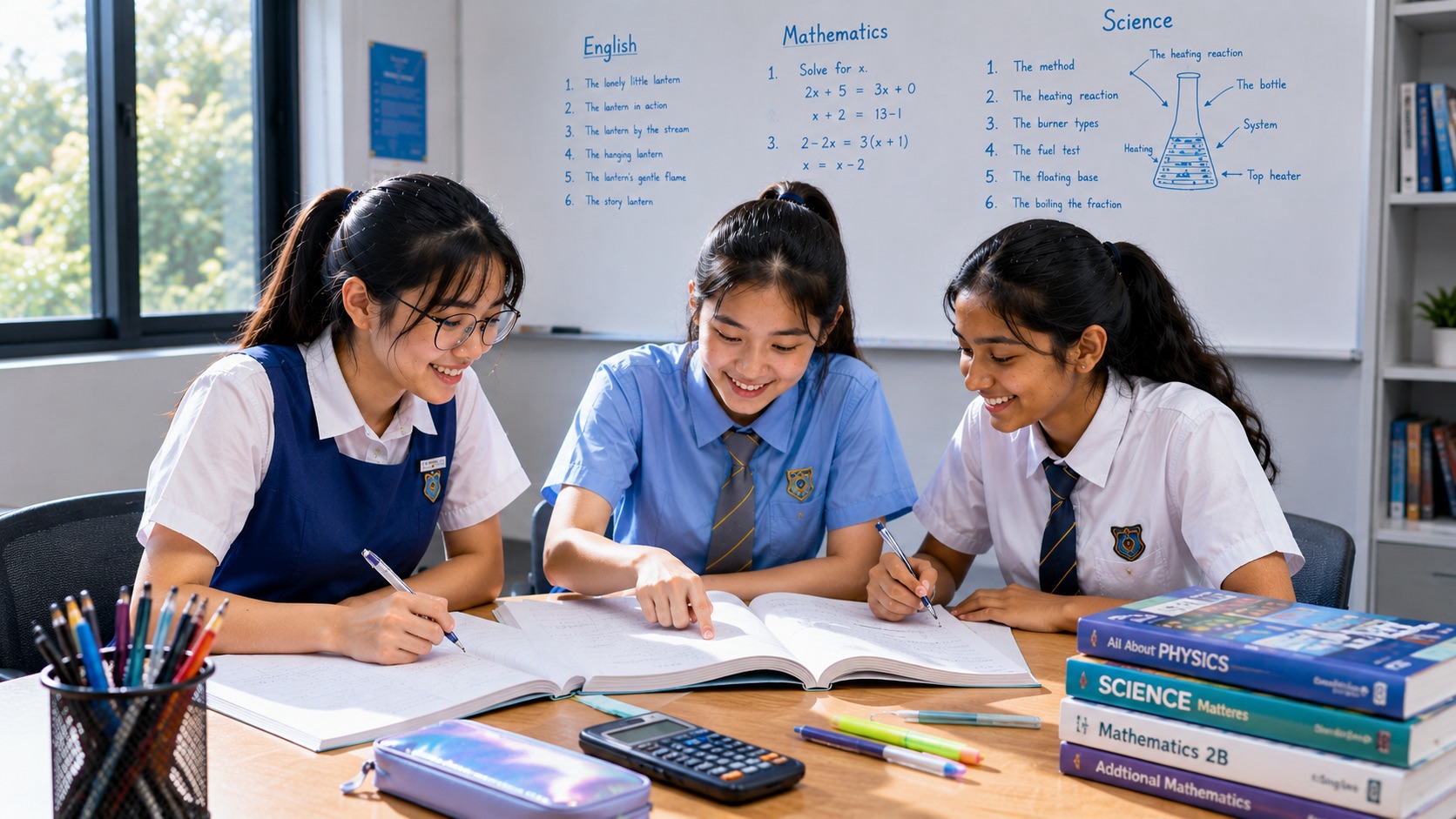
Families searching for a Woodlands English tutor for Secondary 1 are usually trying to solve a transition problem, not simply find a thicker worksheet. Secondary 1 English asks students to read longer texts, infer what is implied, explain answers with evidence, use vocabulary in context and develop organised paragraphs. A useful programme should make those processes visible so that a learner can repeat them independently at school.
Good Woodlands Secondary 1 English tuition should connect comprehension, vocabulary, grammar and writing instead of treating them as four unrelated cupboards. A word learnt from a passage should become available in a sentence; two sound sentences should combine into a more fluent one; a clear sentence should grow into an explanatory paragraph; and every inference should remain anchored to textual evidence. That chain is the practical focus of this guide.
This article is for parents comparing a Sec 1 English tutor in Woodlands and for students adjusting from Primary 6 to lower-secondary English. It provides a calm diagnostic, two worked examples, routines for reading and writing, twelve original tasks with model answers, and a final teaching guide. The aim is not instant polish. It is dependable progress: notice, think, support, revise and try again—with fewer heroic guesses and more useful proof.
Understand what changes in Secondary 1 English
The move to Secondary 1 is not a sudden arrival in a completely different language. Students still read, listen, speak, view, write and represent meaning. However, the texts become denser, instructions demand more precision, and answers increasingly require interpretation rather than simple retrieval. A learner who succeeded by locating one matching phrase in Primary school may now need to connect details across a paragraph, recognise attitude, or explain how a word choice shapes meaning.
Singapore’s Ministry of Education English Language Syllabus 2020 for Secondary G2 and G3 describes language learning across receptive and productive skills and emphasises communication in different contexts. It also includes multiliteracies: students meet meaning through words, images and other modes. At Secondary 1, schools build towards later secondary demands, but lesson order and assessment formats can vary. A tutor should therefore examine the student’s current school work rather than pretend that one generic sequence fits every class.
Full Subject-Based Banding means families should also identify the English subject level the student actually takes instead of relying on an old stream label. The Singapore–Cambridge Secondary Education Certificate begins in 2027, while the Secondary 1 learner of today is still building foundational secondary language habits. The sensible response is neither to ignore examinations nor to make every lesson a miniature national paper. Build transferable reading, speaking and writing control now; match timed practice to the school’s real requirements.
For a wider map of English learning, visit the English Tuition and Learning Hub and the Secondary English Directory. These routes help families place a particular weakness within the larger subject. A comprehension error may begin as a vocabulary problem; a vague composition may begin as weak observation; a grammar slip may be a sentence-boundary problem rather than carelessness.
Start with a transition diagnostic, not a label
“Weak in English” is too broad to guide teaching. In one short session, ask the student to read a 250-word passage, define two words from context, answer one direct and one inferential question, combine two pairs of sentences, and write an explanatory paragraph. Add a brief conversation about a familiar issue. Keep the work uncoached at first. The purpose is to observe decisions, not catch the learner out.
- Reading: Does the student track who, what, when and why across sentences?
- Inference: Can the student join a clue to relevant background knowledge without inventing facts?
- Evidence: Does an answer point to a precise word, action or contrast?
- Vocabulary: Can meaning be inferred from definition, example, contrast, cause or tone?
- Sentence control: Can short ideas be combined without creating fragments or run-ons?
- Paragraph control: Does one main idea develop through explanation and an example?
Record the smallest useful diagnosis. “Inference answers omit the clue” leads to a teachable routine. “Vocabulary is bad” does not. “Paragraphs list reasons without explaining them” points to a missing link between claim and evidence. When the fault is named accurately, practice can be brief and deliberate. When it is named vaguely, students receive more pages and wonder why the same red circles keep returning like loyal but unwanted pets.
Build a reliable reading routine
Secondary readers benefit from reading with a job. Before starting, preview the title, source and question set. During the first read, establish the situation and main movement of the text. During the second, mark only details that help answer a question: a change, a contrast, a repeated image, an unusual action or a word carrying attitude. Highlighting half the page produces a cheerful yellow rectangle, not analysis.
Use a four-step routine: locate, connect, phrase, check. Locate the relevant sentence or section. Connect it to another clue or to the question’s focus. Phrase the response in your own words where required. Check that the answer addresses the command word and does not claim more than the text supports. This routine works for narrative and informational texts because it separates evidence gathering from answer writing.
Command words matter. “State” usually calls for a direct point. “Explain” asks how or why. “What does this suggest?” requires an inference grounded in clues. “How does the writer show?” directs attention to language or technique as well as meaning. Students should underline the command word, circle the subject, and note how many distinct points the question requests. Ten seconds of question reading can save five minutes of answering the question they hoped had been asked.
Treat inference as evidence plus reasoning
An inference is a supported conclusion about something not stated directly. It is not a guess and not a quotation wearing a hat. A practical formula is: clue + what the clue means here = inference. If a character checks the clock three times, packs before being asked and waits beside the door, the text may suggest impatience or eagerness. Which interpretation fits depends on the surrounding situation.
Teach students to rank evidence. A specific action or contrast is usually stronger than a general mood. Two related clues are stronger than one ambiguous detail. The answer must also preserve degree. “Mira was uneasy” is safer than “Mira was terrified” if the only evidence is that she re-read a message and paused before replying. Accurate restraint is a reading skill. Exaggeration may sound dramatic, but it weakens the link to the text.
Worked example 1: move from clue to inference
Read this original extract: “The robotics team had rehearsed the demonstration twice. When the judges approached, Zahin placed both hands behind his back. He answered the first question clearly, but before switching on the machine, he glanced at Mei. She nodded once. Only then did he press the button.”
Question: What does Zahin’s glance at Mei suggest about him at that moment? Support your answer. Model answer: Zahin was seeking reassurance before taking the final step. Although he could answer clearly, he waited for Mei’s nod before activating the machine, showing that her confirmation gave him confidence. Why it works: The answer names a reasonable state, uses the contrast between confident speech and delayed action, and explains the significance of the nod. It does not claim that he was unprepared; the team’s rehearsal argues against that.
A weaker answer would say, “He looked at Mei because he was nervous.” That may be partly true, but it leaves the evidence unused. Another weak answer would copy, “She nodded once.” A quotation is only raw material. The student must state what it reveals and why. Train this by asking, “Which clue earns your conclusion?” If no clue can be named, the inference needs repair.
Learn vocabulary in context rather than as decoration
Vocabulary knowledge has breadth and depth. Breadth means knowing many words; depth means understanding shades of meaning, grammatical behaviour, collocations and appropriate contexts. A student may know that “reluctant” is connected with unwillingness yet still write “he was reluctant of going.” Useful learning includes the pattern “reluctant to do something” and the difference between reluctance, refusal and fear.
When an unfamiliar word appears, first inspect the sentence and its neighbours. Look for a definition, example, contrast, cause, result, synonym or shift in tone. Then predict the word class: noun, verb, adjective or adverb. Substitute a simple meaning and reread. Finally, confirm with a dictionary after the attempt. Context is evidence, not magic; sometimes a passage narrows meaning without revealing every nuance.
Keep a compact vocabulary record with five fields: word, meaning in this passage, useful word family, natural collocation, and an original sentence. For “tentative,” a student might record “uncertain or not final,” “tentatively,” “a tentative plan,” and “We made a tentative plan to meet after training.” Revisiting six well-connected words is usually more valuable than copying twenty definitions that vanish by Friday.
Combine sentences to make relationships clear
Sentence combining is not a contest to build the longest grammatical centipede. Its purpose is to show the relationship between ideas. Coordination gives equal weight: “The hall was crowded, but the volunteers remained calm.” Subordination shows dependence: “Although the hall was crowded, the volunteers remained calm.” A participial phrase can compress related action: “Carrying the labelled boxes, the volunteers moved towards the collection point.”
Choose the connector from the logic. Use “because” for cause, “although” for concession, “when” for time, “if” for condition, “so that” for purpose, and “therefore” for a result across complete statements. Students often select connectors by sound, then accidentally reverse the meaning. Ask them to state the relationship aloud before combining. If they cannot name the relationship, punctuation alone will not rescue it.
Watch three frequent errors. A comma splice joins complete sentences with only a comma. A fragment leaves a dependent clause standing alone, as in “Although the rain stopped.” A dangling modifier points at the wrong subject: “Walking into the library, the posters caught Ana’s attention” makes the posters appear to have legs. Repair meaning first, then punctuation.
Build an explanatory paragraph one move at a time
An explanatory paragraph should answer a focused question, not collect every related fact. A dependable structure is point, evidence or example, explanation, link. The point answers the question. The evidence makes the idea concrete. The explanation shows how the evidence supports the point. The link closes the paragraph or connects it to the wider purpose. The labels are training wheels; natural prose should eventually carry the reader without announcing each part.
Students often stop after evidence. “Reading widely improves vocabulary. For example, students meet words in news reports and stories.” The missing move is why that exposure matters: repeated encounters reveal meaning, collocation and tone, making the words easier to understand and reuse. Add that reasoning and the paragraph begins to teach its reader instead of presenting a fact and strolling away.
Worked example 2: grow notes into an explanatory paragraph
Prompt: Explain one way a new Secondary 1 student can manage a heavier school workload. Notes: record tasks; split work; start earlier; notice problems. Model paragraph: A new Secondary 1 student can manage a heavier workload by planning assignments as a series of small, visible actions. Instead of writing “finish History project,” the student can list research, select evidence, draft two sections, revise and submit. Beginning the first action early reveals missing information while there is still time to ask for help. It also reduces the temptation to complete every stage in one exhausted evening. A simple task list therefore supports both better work and calmer decisions.
The paragraph does more than repeat the notes. It establishes one controlling point, gives a concrete example, explains two consequences, and returns to the main idea. Its vocabulary is precise without being ornamental. “Visible actions” and “reveals missing information” do real explanatory work. A student should imitate the movement of the paragraph, not memorise its wording.
Use a weekly bridge from Primary to Secondary work
A transition routine should be small enough to sustain. On Monday, read a short text and write its main idea in one sentence. On Tuesday, select six useful words and record meaning, collocation and an original sentence. On Wednesday, answer two inference questions with evidence. On Thursday, combine four sentence pairs using different relationships. On Friday, write one explanatory paragraph and revise it. At the weekend, review errors and choose one target for the next week.
Use a compact correction log that records the mistake, its cause and the next action. “Inference wrong” is unhelpful. “I chose a feeling before locating evidence; next time I will underline two actions first” creates a usable repair. “Writing unclear” can become “my example was present but I did not explain its effect; add a because sentence.” Reflection turns corrections into future decisions.
Gradually increase independence. In the first week, a teacher may model the routine aloud. Next, provide prompts. Later, ask the student to choose the strategy and justify it. The goal is not permanent dependence on a worksheet format. It is flexible control: the learner recognises the job, selects a method, checks the result and changes course when the first attempt fails.
Twelve original practice tasks with answers and reasons
Task 1: infer attitude from action
“Nadia read the club notice twice. She photographed it, typed the deadline into her calendar and asked her friend whether beginners were welcome.” What attitude does Nadia show towards joining the club? Model answer: She is interested but cautious about joining. Photographing the notice and saving the deadline show interest, while asking whether beginners are welcome suggests uncertainty about suitability. Rationale: The answer combines several clues and preserves both sides of her response instead of reducing it to excitement alone.
Task 2: distinguish fact from inference
From the sentence “Arun returned the borrowed umbrella dry and neatly folded,” identify one fact and one reasonable inference. Model answer: Fact: the umbrella was returned dry and folded. Inference: Arun probably handled the borrowed item carefully. Rationale: The fact repeats observable information; the inference interprets what the condition of the object suggests. “Arun never used it” would be possible but unsupported because he could have dried it.
Task 3: use contrast to infer vocabulary
“Unlike her brother’s elaborate model, Siti’s design was austere: a plain wooden frame with no decoration.” What does “austere” mean here? Model answer: It means plain and without decoration. Rationale: The contrast marker “unlike” sets “austere” against “elaborate,” and the phrase after the colon provides an example. The meaning concerns appearance here, not harsh behaviour.
Task 4: choose the precise word
Complete the sentence with “glanced,” “stared” or “observed”: “The student scientist carefully ___ the liquid as its colour changed.” Model answer: “Observed.” Rationale: Scientific watching is deliberate and attentive. “Glanced” is too brief, while “stared” may suggest a fixed look without purposeful examination. Precision depends on the context, not on choosing the fanciest option.
Task 5: combine cause and result
Combine: “The footpath was flooded. The organisers moved the activity indoors.” Model answer: “Because the footpath was flooded, the organisers moved the activity indoors.” Rationale: “Because” correctly makes the flood the cause and the move the result. “Although” would suggest an unexpected contrast that the two ideas do not support.
Task 6: combine concession
Combine: “Ken had rehearsed his speech. His hands still trembled at the start.” Model answer: “Although Ken had rehearsed his speech, his hands still trembled at the start.” Rationale: Rehearsal might normally reduce nervousness, so the trembling is unexpected. The concessive connector shows that contrast more precisely than “and.”
Task 7: repair a fragment
Repair: “When the final bell rang. The team was still checking its calculations.” Model answer: “When the final bell rang, the team was still checking its calculations.” Rationale: The “when” clause cannot stand alone because it leaves the reader waiting for the main event. Joining it to the independent clause completes the thought.
Task 8: repair a dangling modifier
Repair: “Cycling past the park, the rain began to fall on Faris.” Model answer: “As Faris cycled past the park, rain began to fall.” Rationale: In the original, the opening phrase grammatically describes “the rain,” making the rain appear to cycle. Naming Faris as the subject restores the intended meaning.
Task 9: support a comprehension answer
“Lena placed the rejected sketch in her folder rather than throwing it away. That evening, she redrew the weakest corner.” What quality does Lena demonstrate? Model answer: She demonstrates perseverance and a willingness to improve. She keeps the rejected sketch and works specifically on its weakest part instead of abandoning the idea. Rationale: The quality is supported by two actions and an explanation of their significance.
Task 10: improve an explanation
Expand this point by adding an example and explanation: “Asking questions can improve learning.” Model answer: “Asking focused questions can improve learning because it exposes the exact point of confusion. For example, a student who asks why a writer repeats an image can learn how repetition develops mood, rather than merely receiving the correct answer. The clarification then becomes a method the student can apply to a new text.” Rationale: The response moves from claim to mechanism, example and transfer.
Task 11: order a paragraph
Arrange these ideas logically: (A) This makes revision more accurate. (B) An error log helps students recognise repeated mistakes. (C) For instance, a learner may notice that evidence is often quoted but not explained. (D) The learner can then practise adding the missing reasoning. Model answer: B, C, D, A. Rationale: The sequence introduces the point, illustrates it, describes the response and states the result.
Task 12: write a complete explanatory paragraph
Prompt: Explain how group discussion can improve understanding when it is managed well. Model answer: “A well-managed group discussion can improve understanding by making students explain their reasoning aloud. When a classmate challenges an interpretation, the speaker must return to the text, select evidence and clarify the link between clue and conclusion. Other students can compare that reasoning with their own and revise weak assumptions. Discussion is therefore useful not because several people are talking, but because evidence and ideas are being tested.” Rationale: The paragraph has one controlling claim, a specific process, consequences and a precise concluding qualification.
Give feedback that produces a second attempt
Feedback should be selective. Marking every possible improvement at once can turn a page into a weather map of approaching storms. Choose one or two high-value targets: perhaps evidence for inference and sentence boundaries. Identify what the student did, explain its effect, and require an immediate revision. “Add the clue that supports ‘reluctant’” is more useful than “elaborate.”
Use comparison. Place the first and revised answers side by side and ask what changed. If the revision merely became longer, it may not be better. A strong change improves precision, support, organisation or fluency. Students should learn that editing is decision-making, not punishment for failing to write perfectly on the first attempt. Professional writers revise; thirteen-year-olds may safely be allowed the same luxury.
Delay some feedback to test transfer. After modelling one inference answer, give a new passage without prompts. After combining sentences with “although,” ask the student to choose a connector for a different relationship. After revising one paragraph, ask for a fresh paragraph on another topic. Success on the original item shows correction; success on a new item shows learning.
Use reading to feed writing without copying
Mentor texts are useful when students study choices rather than borrow sentences. Ask how an opening creates curiosity, how a paragraph moves from general point to concrete detail, or how a writer varies sentence length. Then apply the same principle to a different subject. If a writer reveals worry through repeated checking, a student might reveal impatience through tapping, pacing and unfinished replies—not reproduce the original scene.
Build a bank of techniques with effects and limits. A precise verb can compress action. A sensory detail can establish setting. A short sentence can mark a decisive moment. A contrast can sharpen an argument. None is automatically impressive. The choice must fit purpose, audience and context. Sprinkling similes over every paragraph is not style; it is literary confetti, and someone eventually has to sweep it up.
For explanatory writing, collect knowledge as well as language. Students need facts, examples and distinctions to explain an issue accurately. Short, age-appropriate reading across science, community life, technology, arts and current affairs expands the material available for discussion and writing. Teach source awareness: identify who published the text, when it was updated, what evidence it offers and where uncertainty remains.
Make oral discussion part of the same system
Speaking can rehearse thinking before writing. Give the student thirty seconds to form a claim, one reason and one example. Ask a follow-up that requires qualification: “Is that always true?” or “Which detail supports that?” The student then turns the improved response into a paragraph. This route reduces the blank-page problem because the ideas have already been tested aloud.
Listening matters equally. Ask students to paraphrase a partner’s idea before responding: “You are saying that…, because….” This checks comprehension and encourages respectful disagreement. They can then agree, extend or challenge with evidence. Such discussion practises the same intellectual movement used in comprehension and writing: understand a claim, locate support, judge the connection and respond clearly.
Know what useful Secondary 1 support looks like
A parent can ask practical questions without demanding promises. How is a reading weakness diagnosed? Does the student revise work after feedback? Are vocabulary words revisited in new contexts? Does sentence practice feed into paragraphs? How does the tutor distinguish school-specific work from longer-term skill building? Clear answers should describe learning actions and evidence, not rely only on broad claims such as “comprehensive” or “exam focused.”
Useful support should also preserve the student’s responsibility. A tutor can model, question, select practice and explain feedback, but should not become the person who supplies every idea. Look for a gradual release from demonstration to guided attempt to independent transfer. The student should increasingly be able to say what a task requires, which method was chosen, where an answer may be weak and how to revise it.
Progress evidence can be modest and honest: a cleaner inference chain, fewer comma splices, more precise vocabulary use, or a paragraph that explains rather than lists. Compare similar tasks over time and keep dates. Marks matter, but a single school score may reflect topic, paper difficulty, timing and many other factors. Process evidence helps families see what is changing before turning one test into a grand theory of the child’s future.
A simple monthly portfolio can make this evidence manageable. Keep one reading response, one vocabulary record, one combined-sentence exercise and one explanatory paragraph, each with the student’s first attempt and revision. At the month’s end, ask the learner to identify one improvement and one recurring obstacle. The comparison may show that answers now include evidence but explanations remain thin, or that paragraphs are better organised while sentence endings still drift. Choose the next target from that pattern. This avoids chasing every error at once and gives the student a fair view of growth. Parents can support the routine by asking process questions: “Which clue changed your interpretation?” “Why did you choose that connector?” “What did your revision make clearer?” These questions encourage ownership without completing the work. If progress stalls, return to the diagnostic, reduce the task, model the missing decision and rebuild. A smaller step completed independently is more useful than an impressive answer assembled by several helpful adults.
Frequently asked questions
Is Secondary 1 English simply harder Primary 6 English?
No. There is continuity in reading, writing, listening, speaking and viewing, but secondary tasks demand more sustained interpretation, independence and control. The student often needs to connect clues, explain effects, manage varied text types and develop ideas more fully. The best transition work uses familiar foundations while explicitly teaching the new decisions.
Should a student memorise model essays?
Memorising whole essays is brittle because a new prompt changes purpose, audience and content. Study model writing to identify structure, evidence, sentence movement and word choice. Then apply those principles to fresh topics. Useful imitation transfers a method; copying transfers somebody else’s answer to the wrong question.
How many vocabulary words should be learnt each week?
There is no universal magic number. A manageable set learnt deeply and revisited is better than a long list copied once. Students should know meaning in context, word family, collocation, tone and an original use. Retrieval after several days and use in speaking or writing matter more than the decorative size of the notebook.
Why can a student understand a passage but lose comprehension marks?
Understanding and answer construction are related but distinct. The learner may know the general meaning yet miss the command word, choose evidence that is too broad, copy without explaining, exaggerate an inference or omit a requested point. Analyse the response process before concluding that the student did not understand the text.
Can grammar worksheets improve writing?
They can build awareness and accuracy, but transfer must be taught. After practising a sentence pattern, use it in a paragraph, revise it in authentic writing and retrieve it later. Grammar becomes useful when it helps a writer express relationships clearly, not when correct answers remain trapped on an isolated exercise page.
How soon should examination practice begin?
Students should learn the formats and expectations used by their school, but not every lesson needs to be a timed paper. Early Secondary 1 work should establish reading routines, vocabulary depth, sentence control and paragraph development. Timed practice is most useful after the underlying process is understood; otherwise it rehearses confusion at greater speed.
Teaching Guide
Teach this material as a cycle rather than a lecture. Begin with one unassisted diagnostic task. Name a narrow need, model the decision aloud, guide one attempt, and give a new item for independent transfer. End by asking the student to explain the method in plain language. Save both attempts so that improvement is visible and the next lesson begins from evidence.
A practical six-lesson sequence is: transition diagnostic; vocabulary through context; inference with evidence; sentence combining and boundaries; explanatory paragraph building; integrated reading-to-writing task. Recycle earlier skills in every lesson. The paragraph lesson should still require precise words; the writing lesson should still require reading; the discussion should still require evidence. Integration is the point.
Differentiate by changing support, not by removing thought. Offer clue boxes, sentence stems or a partially completed evidence table, then fade them. For a learner ready to extend, use more ambiguous clues, ask for alternative interpretations, or require a paragraph to qualify its claim. Keep the intellectual job stable: understand, support, explain and revise.
Close each lesson with a two-minute exit check: one thing the learner can now do, one error to watch, and one action to use next time. Share a concise version with the parent when appropriate. The most useful message is not “English improved today.” It is “the student now supports an inference with two linked clues and can repeat the routine independently.” That is a small sentence describing a large step.


Continue through Secondary 1 English: Secondary 1–2 article index · Secondary English directory · English Hub · Diagnostics · Examinations · Yishun Tuition Hub · Library
Leave a Reply