
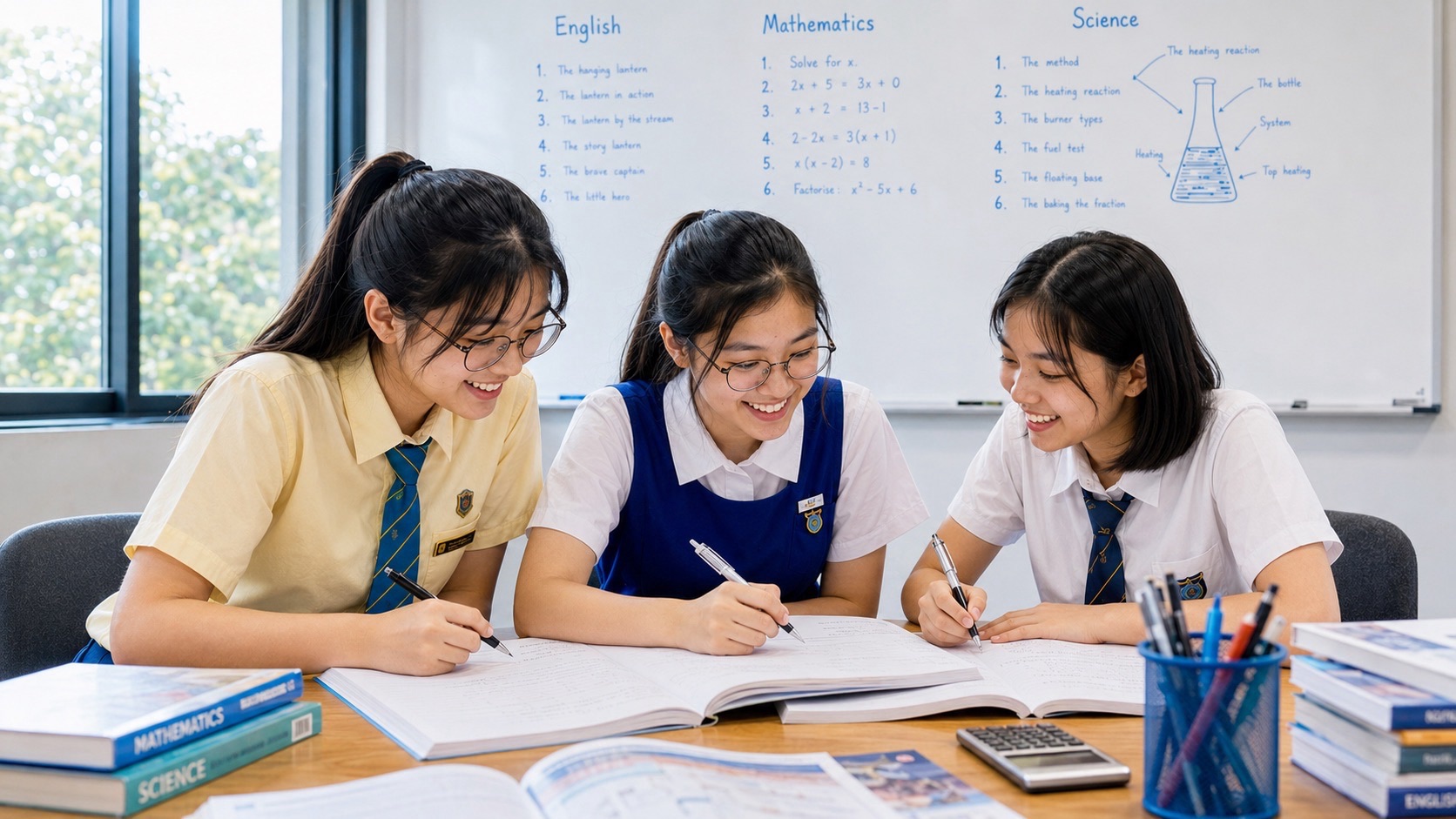
Families searching for a Sec 4 Additional Maths Tutor in Ang Mo Kio, Secondary 4 A-Math tuition or small-group Additional Mathematics lessons are usually trying to stabilise performance before the final examination period. At this stage, the student may already know most of the syllabus. The challenge is whether algebra, quadratics, polynomials, trigonometry, coordinate geometry and calculus can be recalled, selected and executed reliably under time pressure.
Strong Sec 4 A-Math tuition should therefore focus on diagnostic revision, high-transfer algebra repair, mixed-topic practice, timed sections, full-paper strategy, error analysis, recovery skills and checking routines. The tutor should not simply assign more papers. Each paper should produce a clearer picture of what the student needs next.
In a three-student tutorial, revision can remain highly specific. One learner may need factorisation repaired, another may need faster method recognition, and a third may understand the mathematics but make poor paper decisions. The useful loop is Attempt → Diagnose → Repair → Mix → Time → Review → Retest. Secondary 4 is about making that loop increasingly efficient.
Start With an Error Profile, Not a Chapter List
A chapter list tells the student what exists in the syllabus. An error profile tells the student what is actually unstable.
- sign and expansion errors;
- factorisation errors;
- method-recognition errors;
- graph interpretation errors;
- trigonometric identity errors;
- calculus execution errors;
- time-management errors;
- checking failures.
Revision should target the most frequent and expensive patterns first.
Algebraic Control Should Be Maintained Constantly
Even late in the year, algebra remains the highest-transfer skill. Expansion, factorisation, equations, algebraic fractions, indices and rearrangement influence almost every other topic.
Short retrieval in every lesson can keep these skills active without taking over the entire revision programme.
Quadratics Need Fast Representation Choice
The student should know when factorised, completed-square, expanded or graphical form is most useful. Choosing the right representation can shorten the solution and reduce unnecessary manipulation.
Polynomials Need Early Condition Translation
Factor and remainder information should be converted into algebra immediately. The student should learn to recognise when a long-looking question actually contains a compact structural clue.
Trigonometry Needs a Clear Target
Identity questions should be transformed purposefully. Diagram questions should begin with careful labelling. The student should know what is being sought before selecting formulas.
Calculus Needs Both Meaning and Speed
Differentiation and integration should be fluent enough for timed work, but students should still understand the meaning of rate of change and accumulation. Meaning helps them recognise when calculus is the right tool.
Mixed Practice Should Now Be Central
Topical practice still has a role when repairing a weakness. But once that weakness is stable, it should be returned to mixed practice immediately. The final examination will not label the chapter for the student.
Timed Sections Before Full Papers
A student who struggles with timing does not always need more full papers. Timed sections can isolate whether the problem is method recognition, slow algebra or poor decision-making. Once the bottleneck is identified, it can be repaired more efficiently.
Full Papers Should Produce Decisions
After a full paper, ask:
- Which error type cost the most marks?
- Which question consumed disproportionate time?
- Which secure topic became unstable under pressure?
- Which mistake could targeted checking have caught?
- Which correction needs a delayed retest?
The next week’s work should be shaped by those answers.
Recovery Skills Matter
Strong students still encounter difficult questions. A useful recovery routine is:
- Restate the target.
- List the information that is definitely known.
- Identify one relevant relationship.
- Try one defensible route.
- If progress stops, mark the question and move on.
- Return later with fresh attention.
This prevents one difficult item from damaging the rest of the paper.
Checking Should Follow Personal Risk
Generic checking is inefficient. A student who frequently loses signs should check algebraic transitions. A student who miscopies values should compare copied coefficients. A student who misreads the target should re-read the last line of long questions.
A Three-Student Sec 4 A-Math Lesson
- Retrieval: one high-transfer algebraic skill.
- Timed cold question: test recognition under pressure.
- Diagnosis: identify the first weak link.
- Repair: reteach only what is unstable.
- Contrast: compare nearby methods.
- Mixed transfer: integrate the repaired skill.
- Paper strategy: practise timing and recovery.
- Review: update the error profile.
The Final-Year Independence Test
Can the student solve without hints, under realistic timing, after a delay and in a mixed context? Can the student identify likely errors without being told where to look? Can the student recover after a poor first attempt?
How Parents Can Read Sec 4 A-Math Progress
- paper scores become less volatile;
- the same algebraic errors recur less often;
- method recognition becomes faster;
- timing becomes more stable;
- checking catches more personal-risk errors;
- the student needs fewer prompts during corrections.
A Twelve-Week Revision Architecture
Weeks 1–3: Stabilise
Repair high-transfer algebra and the most expensive recurring weaknesses.
Weeks 4–6: Connect
Increase mixed-topic and contrast practice.
Weeks 7–9: Time
Use timed sections and partial papers to train recognition and execution.
Weeks 10–12: Simulate
Use full-paper conditions, review strategically and refine checking.
Strong Students Need Precision
High-performing students can improve through method comparison, efficiency, alternative routes and unfamiliar questions. More volume is not automatically better revision.
Students Who Are Behind Need Priority Control
When time is limited, prioritise algebraic manipulation, factorisation, equations and the topic families that repeatedly cost marks. Not every weakness deserves equal revision time.
Questions Parents Can Ask a Sec 4 Additional Maths Tutor
- How do you decide what my child should repair first?
- How do you use full papers diagnostically?
- How do you train recovery from difficult questions?
- How do you personalise checking routines?
- How do you train method recognition under time pressure?
- How do you reduce prompting as examinations approach?
The Real Goal of a Sec 4 Additional Maths Tutor in Ang Mo Kio
The final goal is examination independence. The student should be able to recognise, select, execute, check and recover without depending on the tutor to supply the next step.
That is stronger preparation than simply completing the largest possible stack of papers. Properly taught kids shine a bright light into the future.
Leave a Reply