
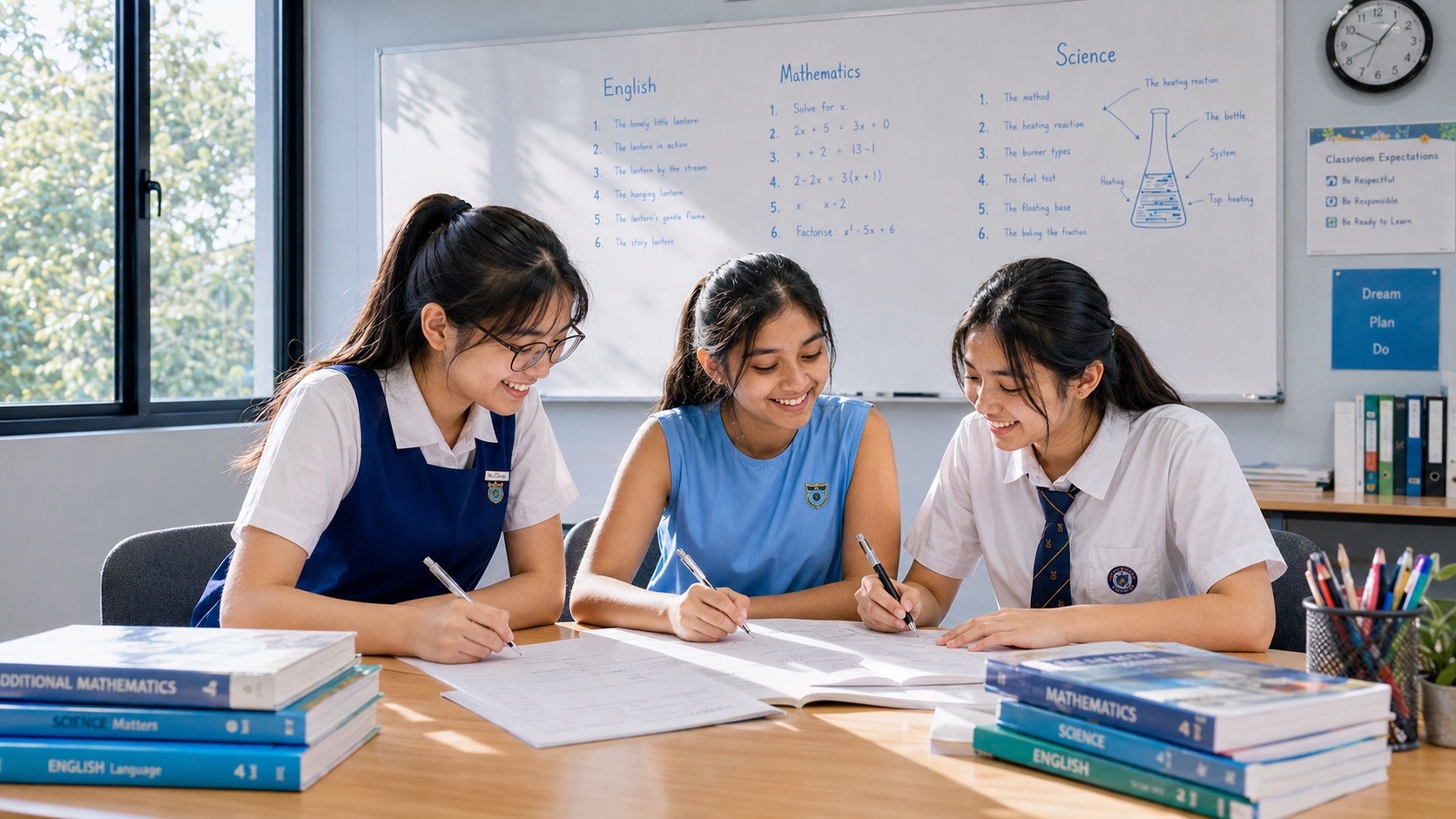
Families searching for an Ang Mo Kio Maths Tuition Centre Sec 4 Additional Maths, a Secondary 4 A-Math tutor or small-group Additional Mathematics tuition should look for a programme that can distinguish teaching from revision. By Secondary 4, many students have already seen most of the syllabus. The real challenge is deciding what needs reteaching, what needs retrieval, what needs timed practice and what needs paper strategy.
Strong final-year A-Math tuition should combine diagnostic assessment, algebra repair, mixed-topic revision, timed sections, full-paper analysis, method recognition, error tracking, checking routines and examination control. A good tuition centre should not simply feed every student the same stack of papers. It should use evidence from each student’s work to decide what happens next.
A three-student class can support this precisely. One student may need factorisation repaired. Another may understand the syllabus but choose methods too slowly. A third may need better time management and checking. The useful final-year loop is Attempt → Diagnose → Repair → Mix → Time → Review → Retest.
What a Strong Sec 4 A-Math Tuition Centre Should Diagnose
- concept gaps;
- algebraic execution errors;
- method-recognition delays;
- graph or diagram interpretation errors;
- calculus or trigonometry fluency gaps;
- timing problems;
- checking failures;
- paper-decision problems.
These categories are more useful than saying the student is simply “weak in A-Math”.
Algebra Is Still the Highest-Transfer Priority
Expansion, factorisation, equations, algebraic fractions, indices and rearrangement support almost every other A-Math topic. If these remain unstable, final-year revision becomes inefficient.
Quadratics Need Fast Representation Choice
Students should move among expanded, factorised, completed-square and graphical forms comfortably. The tuition centre should train students to ask which representation reveals the information they need most quickly.
Polynomials Need Structural Reading
Factor and remainder conditions should be translated into algebra early. Long manipulation should not begin before the student has inspected the structural clues.
Trigonometry Needs a Clear Target
Identity questions should be transformed deliberately rather than randomly. Diagram questions should begin with careful labelling. Purposeful structure reduces unnecessary trial-and-error.
Calculus Needs Fluency Without Losing Meaning
Differentiation and integration should be fast enough for examination conditions but still connected to their meanings: change, gradient, accumulation and recovery. Meaning supports method recognition.
Topical Repair and Mixed Revision Serve Different Jobs
Topical work is useful when a weakness has been identified. Mixed revision is useful when the weakness has been repaired and the student now needs to recognise it independently among other methods.
A strong tuition centre should move back and forth between these modes deliberately rather than use only one.
Timed Sections Can Diagnose Better Than Full Papers
If a student’s main issue is timing, a full paper may be too broad to show the exact cause. Timed sections can reveal whether time is being lost through slow algebra, slow recognition, repeated checking or poor question decisions.
Full Papers Should Produce a New Plan
After a full paper, the student should know:
- which error type cost the most marks;
- which topic became unstable under pressure;
- which question consumed too much time;
- which checking routine failed;
- which correction requires a delayed retest.
If the paper does not change the next week’s work, much of its diagnostic value has been wasted.
Paper Strategy Is Resource Management
The student has limited time and attention. Good examination strategy protects secure marks, avoids spending disproportionate time on one stubborn question and preserves enough time for targeted checking.
Checking Should Follow the Student’s Error Profile
- sign changes;
- copied coefficients;
- incomplete factorisation;
- calculator entries;
- notation;
- final-answer form;
- whether the answer matches the exact question.
Students should check what they are personally most likely to get wrong.
A Three-Student Sec 4 A-Math Lesson
- Retrieval: one high-transfer algebraic skill.
- Timed cold question: observe recognition under pressure.
- Diagnosis: identify the first weak link.
- Repair: reteach only what is unstable.
- Contrast: compare nearby methods.
- Mixed transfer: reintegrate the repaired skill.
- Paper strategy: practise timing and recovery.
- Review: update the error profile.
The Independence Test
Can the student solve without hints, under realistic timing, after a delay and in a mixed context? Can the student identify likely errors independently? Can the student recover after choosing a poor first route?
How Parents Can Judge a Final-Year A-Math Tuition Centre
- Can the tutor explain why the student is losing marks?
- Does the revision plan change after new evidence?
- Are repeated errors tracked?
- Are full papers analysed rather than merely marked?
- Is support reduced over time?
- Does the student become more independent during corrections?
Strong Students Need Precision
High-performing students can improve through alternative methods, unfamiliar problems, efficiency and explanation. Endless repetition of familiar questions may produce less growth than carefully chosen contrast and transfer work.
Students Who Are Behind Need Priority Control
When time is limited, prioritise algebraic manipulation, factorisation, equations and the topic families that repeatedly cost marks. Revision time should follow impact, not symmetry.
Questions Parents Can Ask an A-Math Tuition Centre
- How do you decide what my child should repair first?
- How do you use full papers diagnostically?
- How do you train method recognition?
- How do you track recurring errors?
- How do you personalise checking routines?
- How do you reduce prompting as examinations approach?
The Real Goal of an Ang Mo Kio Maths Tuition Centre for Sec 4 Additional Maths
A strong tuition centre should gradually transfer control from tutor to student. The learner should become more capable of diagnosing, solving, checking and recovering independently.
That independence is the real purpose of final-year revision. Properly taught kids shine a bright light into the future.
Leave a Reply