
Families searching for a Sec 4 Add Maths Tutor in Ang Mo Kio, Secondary 4 Additional Mathematics tuition or final-year A-Math coaching are often looking for help with the part of examination performance that textbooks rarely teach directly: what to do when the paper becomes difficult. A strong student can know the syllabus and still lose control after one unfamiliar question. Final-year tuition should therefore include recovery strategy, time decisions and error control alongside algebra, quadratics, trigonometry and calculus.
Strong Sec 4 A-Math coaching should build method recognition, timed decision-making, recovery routines, targeted checking, mixed-topic resilience, algebraic accuracy and paper control. The goal is not to create a student who never gets stuck. The goal is to create a student who knows what to do when stuck, how long to persist, when to move on and how to return intelligently.
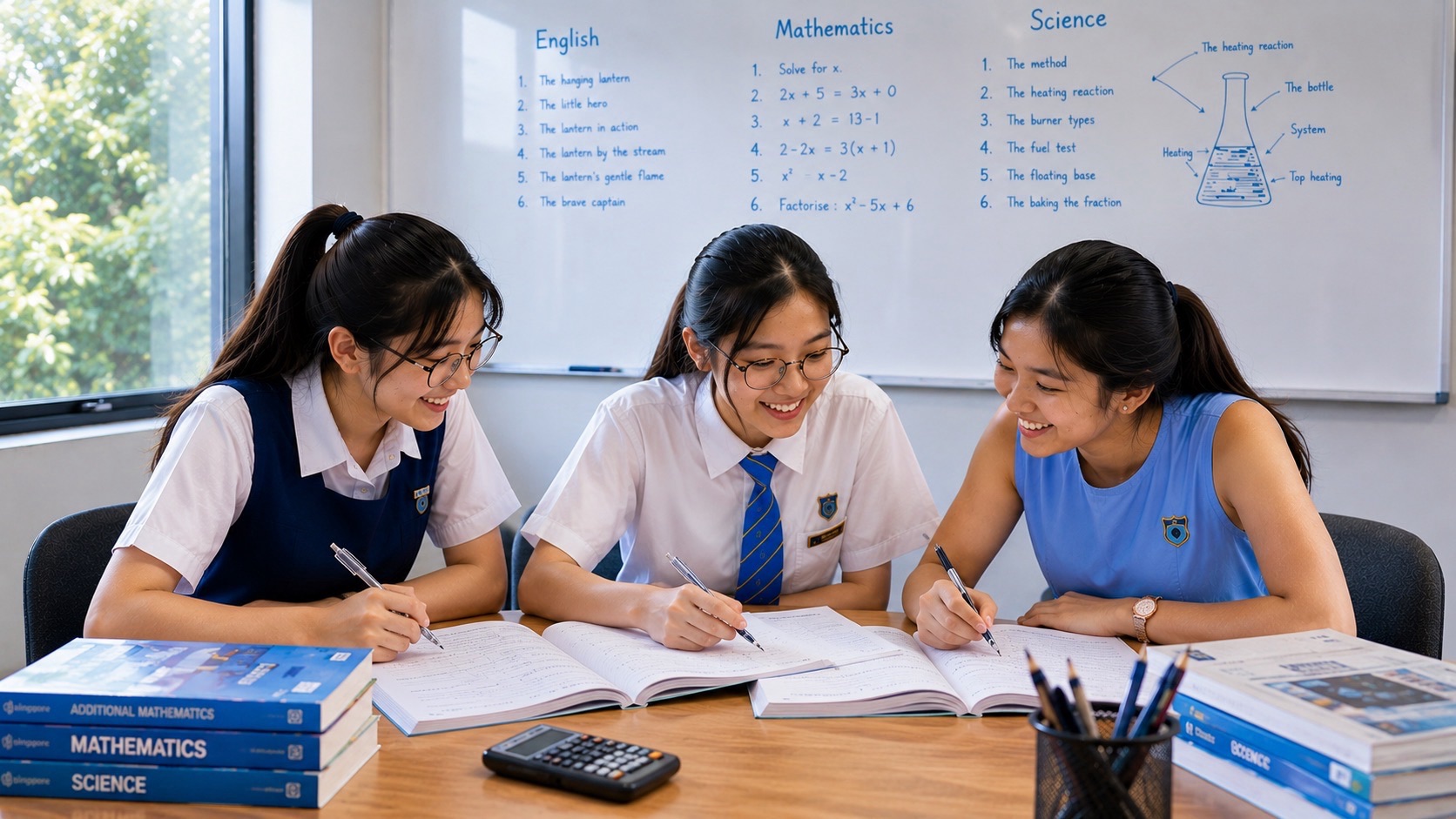
In a three-student tutorial, these examination decisions can be practised explicitly. One student may spend too long trying to rescue a difficult identity, another may abandon questions too quickly, and a third may recover well but fail to leave time for checking. The useful loop is Recognise → Attempt → Evaluate → Recover → Move → Return → Check.
Getting Stuck Is Normal; Staying Stuck Is the Problem
Even strong A-Math students encounter unfamiliar questions. The examination skill is not avoiding all difficulty. It is preventing one difficult question from consuming the time and confidence needed for the rest of the paper.
Build a Recovery Routine
- Restate the exact target.
- Write down what is definitely known.
- Identify the topic relationships that may be relevant.
- Try one defensible route.
- Check whether the route is creating useful progress.
- If progress stops, mark the question and move on.
- Return later with fresh attention.
This routine replaces panic with a sequence of decisions.
Time Limits Should Be Planned Before the Paper
Students should know approximately how much time they are willing to spend before a question becomes strategically expensive. The exact threshold depends on the paper and the student, but the principle is consistent: protect the rest of the paper.
Method Recognition Affects Time More Than Students Realise
A student who knows the correct method but takes two minutes to recognise it is losing examination time before any calculation begins. Contrast practice can reduce this delay by training the features that distinguish one method from another.
Algebraic Fluency Protects Working Memory
Expansion, factorisation, equations and algebraic fractions should be sufficiently fluent that the student can focus on the strategic part of a problem. Slow routine algebra uses attention that may be needed for method recognition and checking.
Quadratics Need a Rapid Structure Scan
Before solving, ask briefly: what form is this in, what information is being requested, and which representation may be most efficient? A short structural scan can prevent long unnecessary manipulation.
Trigonometry Needs Target Awareness
In identity questions, identify the target before transforming. In diagram questions, label the geometry before selecting a formula. This prevents random trial-and-error.
Calculus Questions Need Context Checks
A derivative or integral may be calculated correctly yet still fail to answer the question. Students should interpret what the result means before finalising the answer.
Use Three Passes Through a Paper
Pass 1: Secure
Complete accessible questions and build momentum. Avoid unnecessary battles early.
Pass 2: Return
Revisit marked questions with more available time and fresh attention.
Pass 3: Check
Use remaining time on personal high-risk checks rather than rereading everything equally.
Checking Should Be Risk-Based
- sign changes after expansion;
- copied coefficients;
- factorisation completeness;
- calculator entries;
- notation;
- final-answer interpretation.
The student should know which of these personally deserves the most attention.
Timed Sections Can Train Recovery Better Than Endless Full Papers
A timed section allows the tutor to pause and analyse decisions. Did the student persist too long? Move on too early? Fail to recognise a familiar structure? Use an inefficient method? These decisions can then be retrained before the next full paper.
A Three-Student Sec 4 A-Math Lesson
- Retrieval: one high-transfer prerequisite.
- Timed mixed set: observe method and time decisions.
- Decision review: analyse where time was gained or lost.
- Repair: fix the relevant concept or routine.
- Recovery drill: practise leaving and returning to a difficult question.
- Mixed transfer: repeat under a new context.
- Checking drill: use the personal risk list.
- Review: update the paper strategy.
The Independence Test
Can the student make sensible paper decisions without the tutor? Can the student recognise when to persist, when to move on, how to return and what to check? These are examination skills that should become internal.
How Parents Can Read Progress
- the student spends less time trapped on one question;
- accessible marks are protected more consistently;
- method recognition becomes faster;
- recovery after a difficult question improves;
- checking becomes targeted;
- paper scores become less volatile.
Strong Students Need Better Paper Decisions
High-performing students may know almost all the content. Their next gain may come from reducing strategic errors: choosing a shorter method, leaving a stubborn question earlier, or checking the right risk point at the right time.
Students Who Are Behind Still Need Concept Repair
Paper strategy cannot replace Mathematics. If the student repeatedly cannot start because a concept or algebraic prerequisite is missing, repair that first. Strategy works best when the underlying knowledge is reasonably stable.
Questions Parents Can Ask a Sec 4 Add Maths Tutor
- How do you train recovery from difficult questions?
- How do you decide when my child should move on?
- How do you diagnose slow method recognition?
- How do you personalise checking?
- How do you practise paper strategy without replacing concept teaching?
- How do you reduce tutor prompting during timed work?
The Real Goal of a Sec 4 Add Maths Tutor in Ang Mo Kio
The final goal is not a student who never feels uncertain. It is a student who can manage uncertainty intelligently: recognise, attempt, recover, move, return and check without losing control of the paper.
That kind of examination independence can protect knowledge the student already has and turn it into more reliable performance. Properly taught kids shine a bright light into the future.
Leave a Reply