
Families searching for Sec 4 Add Maths Tuition in Ang Mo Kio, Secondary 4 Additional Mathematics tuition or final-year A-Math revision are usually balancing two very different needs at the same time. Some topics still require teaching. Other topics are already understood but need faster recognition, cleaner execution and more reliable performance under examination conditions. Strong tuition should know which mode is needed at any moment instead of treating every lesson as either “teach more” or “do another paper”.
That distinction creates a useful final-year framework: repair mode and performance mode. Repair mode slows down, isolates the weak concept or algebraic prerequisite, rebuilds it and retests it carefully. Performance mode removes chapter labels, mixes topics, adds timing, trains recovery and tests whether the student can act independently. Sec 4 A-Math revision becomes much more efficient when the tutor moves deliberately between these two modes instead of using the same activity for every problem.
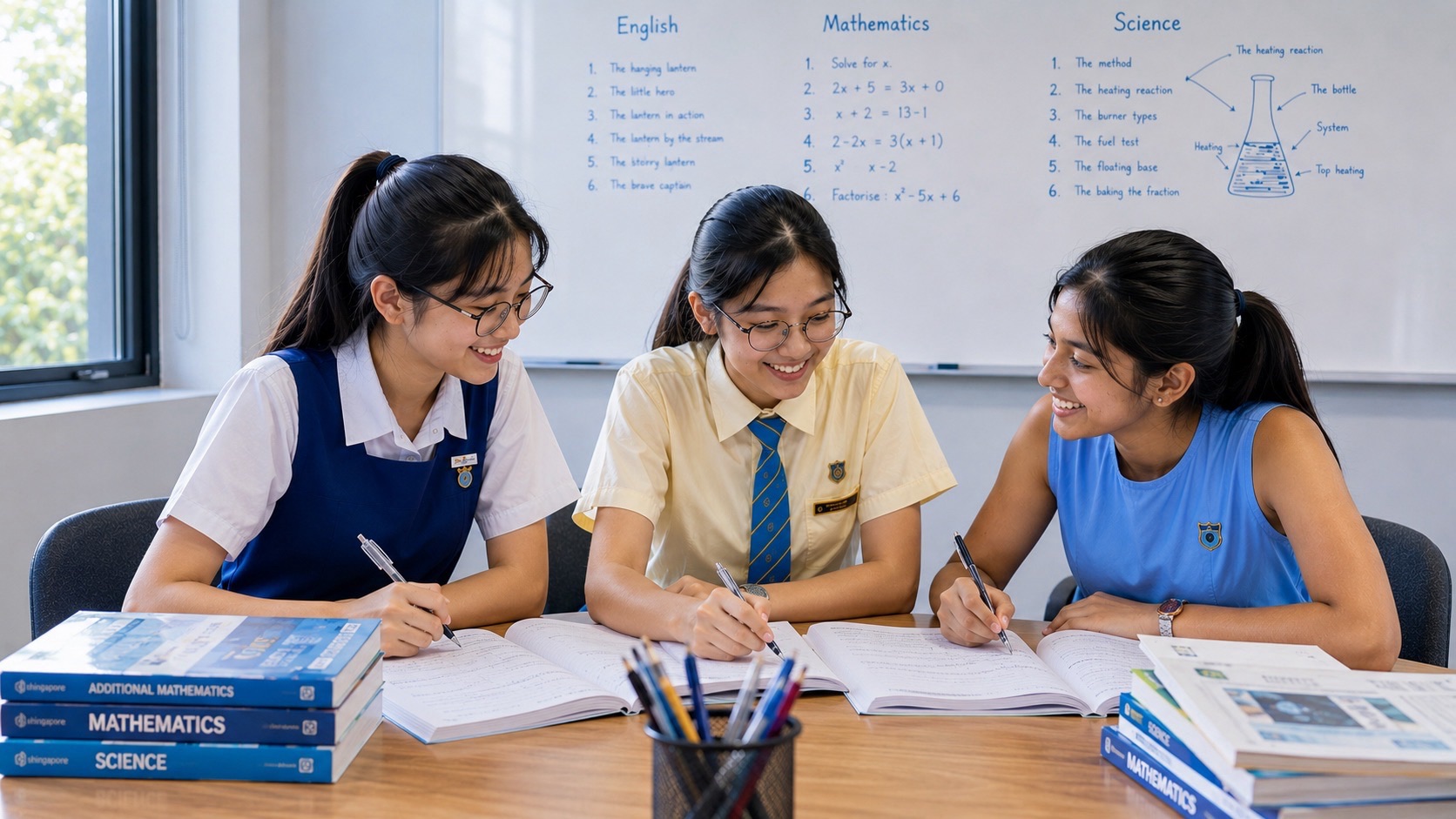
In a three-student tutorial, this can be personalised without losing lesson momentum. One student may spend part of the lesson repairing factorisation. Another may need a timed trigonometry set. A third may need help analysing why full-paper scores are volatile despite apparently strong content knowledge. The shared loop is Diagnose → Decide Mode → Repair or Perform → Retest → Review. The goal is to reduce uncertainty each week.
Final-Year A-Math Has Two Different Jobs
If a method is not understood, timing it does not make it more understood. If a method is already stable, repeatedly reteaching it may waste valuable revision time. The student needs the right kind of work for the current problem.
Repair Mode
Use repair mode when the student cannot explain the method, repeatedly makes the same structural mistake or needs a prerequisite rebuilt. The pace should be slower. Working should be explicit. The tutor should diagnose the first weak link and use carefully chosen examples.
Performance Mode
Use performance mode when the method is understood. Now the focus shifts to recognition, mixed-topic selection, speed, paper decisions, recovery and checking. The tutor should reduce prompts rather than add more explanation.
How to Decide Which Mode a Student Needs
- If the student cannot explain why the method works, use repair mode.
- If the student can explain but cannot start independently, train recognition.
- If the student starts correctly but makes repeated algebraic slips, train execution.
- If the student solves correctly but too slowly, train efficiency and timing.
- If the student performs well topically but poorly on mixed papers, train transfer.
- If the student loses control after one difficult question, train recovery and paper strategy.
Algebra Repair Has the Highest Transfer Value
Expansion, factorisation, equations, algebraic fractions, indices and rearrangement affect many A-Math chapters. A weak algebraic habit can travel into quadratics, polynomials, coordinate geometry, trigonometry and calculus. This makes algebra a high-value repair target throughout the final year.
Quadratics Need Representation Choice
A quadratic can be written in expanded, factorised or completed-square form, and can also be viewed graphically. Each form reveals something different. The skill is not simply knowing all four forms; it is choosing the form that makes the current problem easier.
Polynomials Need Structural Reading Before Manipulation
Polynomial questions often contain conditions that should be translated before any long calculation begins. Factor and remainder relationships can create a much shorter route. A student who starts manipulating immediately may create unnecessary work and more opportunities for error.
Trigonometry Needs a Target
In identity questions, random manipulation is rarely efficient. The student should identify the target form first, inspect the current expression and choose a relationship that moves deliberately toward the target. In diagram questions, the geometry should be labelled before formulas are selected.
Coordinate Geometry Needs Two-Way Translation
Gradient, midpoint, distance and line equations are geometric relationships written algebraically. The student should be able to move from diagram to equation and from equation back to geometric meaning. This becomes especially useful in mixed questions where no chapter label is provided.
Calculus Needs Meaning and Fluency
Differentiation should remain connected to gradient and rate of change. Integration should remain connected to accumulation and recovery. Final-year students need procedural speed, but meaning helps them recognise when calculus is actually relevant.
Repair Mode Needs a Retest
- Immediate near-transfer question.
- Changed-number or changed-wording question.
- Delayed retest after several days.
- Mixed-topic retest without chapter cues.
- Timed retest if the skill is examination-ready.
This prevents a common false positive: the student appears to have mastered the method because the correction is still fresh in memory.
Performance Mode Needs Contrast Practice
Contrast practice trains the boundaries between methods. Put two similar-looking questions together and ask why they require different routes. This is valuable because many final-year mistakes come from choosing a plausible but wrong method.
Mixed Practice Should Remove Chapter Dependence
Once a skill is stable, return it to mixed sets. Examination questions do not announce which chapter is being tested. The student must infer the relevant structure and choose the method independently.
Timed Sections Can Be More Useful Than Full Papers
If the student has a timing problem, a full paper may reveal only the symptom. A timed section can show whether algebra is too slow, recognition is delayed, easy questions are being over-checked or one difficult item is absorbing too much time.
Full Papers Should Produce a Revision Decision
- Which error type cost the most marks?
- Which question consumed disproportionate time?
- Which topic became unstable under pressure?
- Which mistake could a targeted check have caught?
- Which correction needs a delayed retest?
- Which skill is ready to move from repair mode into performance mode?
Recovery Strategy Should Be Practised
- Restate the target.
- Write what is definitely known.
- Identify one relevant relationship.
- Try one defensible route.
- Evaluate whether the route is producing useful progress.
- If progress stops, move on deliberately.
- Return later with fresh attention.
Checking Should Be Personalised
Different students need different checking routines. One student repeatedly loses signs. Another miscopies coefficients. Another forgets to answer the exact final question after completing correct working. The best checking routine targets the student’s known risks rather than scanning everything vaguely.
A 90-Minute Three-Student Sec 4 A-Math Lesson
- 10 minutes: high-transfer algebra retrieval.
- 15 minutes: timed cold question.
- 15 minutes: diagnosis and mode decision.
- 20 minutes: repair or performance training.
- 15 minutes: mixed or contrast practice.
- 10 minutes: recovery and checking routine.
- 5 minutes: independent next-step review.
The Final-Year Independence Test
Can the student identify whether a weakness needs repair or performance practice? Can the student recognise the method without hints, solve under time, recover from a poor route and check known risk points independently? Those are stronger indicators of readiness than the number of papers completed.
How Parents Can Read Progress
- the same error type appears less often;
- method recognition becomes faster;
- corrections survive delayed retesting;
- timed accuracy improves;
- difficult questions no longer derail the paper;
- paper scores become less volatile;
- the student becomes more independent during review.
Strong Students Need More Performance Training
High-performing students often know the content. Their next improvement may come from efficiency, method comparison, recovery skill and targeted checking. More explanation is not always the answer.
Students Who Are Behind Need High-Transfer Repair
When time is limited, prioritise algebraic manipulation, factorisation, equations and the topic families that repeatedly cost marks. Revision time should follow impact rather than the desire to treat every chapter equally.
The Real Goal of Sec 4 Add Maths Tuition in Ang Mo Kio
The final-year goal is not maximum worksheet volume. It is maximum useful control: know what needs repair, know what needs performance practice, choose methods efficiently, manage the paper intelligently and become less dependent on the tutor each week.
That is how revision becomes focused, efficient and reliable. Properly taught kids shine a bright light into the future.
Leave a Reply