

Punggol English Tuition (Secondary 4) should help a student navigate a long examination without allowing one section to steal the time needed by the rest. Families searching for Secondary 4 English tuition in Punggol, Sec 4 English tutor, exam timing, comprehension, summary, situational writing, continuous writing, editing or final-year English preparation often see students who know individual skills but lose marks because pacing decisions are made too late.
Secondary 4 therefore needs paper-navigation checkpoints. The student should enter each section deliberately, monitor whether progress is on track, mark uncertain items for return, and protect enough time for later high-value tasks. This is not a rigid minute-by-minute script. It is a navigation system that detects drift early.
This page owns one learning job: section entry → checkpoint → detect drift → park/return → protect downstream time → final pass. It complements other Sec 4 pages on uncertainty triage, answer economy and stamina. Here, the focus is navigation across the whole paper.
Pacing Problems Often Begin Before Time Runs Out
A student may lose time through:
- overlong early answers;
- repeated rereading;
- perfectionism;
- getting stuck;
- rewriting;
- checking too early.
Section Entry
At the start of a new section:
- read instructions;
- identify task type;
- note approximate workload;
- choose the first move.
Do Not Carry the Previous Section Mentally
Use a reset:
Previous section closed. What is this section asking?
Checkpoints
A checkpoint is a planned moment to ask:
- Am I roughly where I expected to be?
- Did one item consume too much time?
- Is there enough time left for the next major task?
Checkpoints Are Better Than Constant Clock-Watching
Frequent checking can interrupt concentration.
Use a few meaningful checkpoints.
Personal Checkpoints
Different students need different markers.
Build them from timed practice evidence.
Drift Detection
Common signals:
- still on early questions at first checkpoint;
- one answer much longer than others;
- plan time exceeded;
- late section not yet started.
Drift Response
When drift appears:
- stop adding low-value detail;
- finish current answer to minimum completeness;
- park unresolved uncertainty;
- move forward.
Protect Downstream Time
The final section deserves planned time, not whatever remains accidentally.
Leave-and-Return Markers
When parking:
- mark clearly;
- leave a partial note if useful;
- record where to return;
- do not carry the question mentally.
Return Pass
Reserve a return window when possible.
Prioritise:
- red/uncertain questions with plausible recovery;
- missing content;
- known high-risk errors.
Do Not Recheck Green Work First
Start with unresolved or high-risk items.
Navigation and Comprehension
Use paragraph mapping and targeted returns rather than rereading the entire passage for every question.
Navigation and Summary
Complete point selection before spending too long polishing early paraphrases.
Navigation and Situational Writing
Protect:
- task reading;
- content mapping;
- drafting;
- final task-coverage check.
Navigation and Continuous Writing
Use a planning threshold so drafting begins in time.
At mid-draft checkpoint, ensure the story or argument has reached its central development.
Navigation and Editing
Do not leave every correction to the final minute.
Use local quick checks plus a final priority pass.
The Navigation Map
| Checkpoint | Question | If behind |
|---|---|---|
| Section entry | What is the task? | clarify before writing |
| Early checkpoint | Am I spending too long? | stop over-answering |
| Mid-paper | Is downstream time protected? | park low-progress item |
| Final pass | What is highest-risk? | target check |
Use Practice to Build Checkpoints
After each timed paper, compare:
- planned section time;
- actual time;
- where drift began;
- what behaviour caused it.
Do Not Copy Another Student’s Timing Plan
Pacing should reflect:
- reading speed;
- writing speed;
- error patterns;
- confidence behaviour.
Checkpoint Simulations
Practise partial papers with deliberate checkpoint alarms or tutor cues.
Later remove the external cue.
Internal Checkpointing
Eventually the student should notice:
I am behind; I need to simplify and move.
Navigation Under Fatigue
Late in the paper, use simpler rules:
- answer the task directly;
- avoid unnecessary rewriting;
- protect sentence clarity;
- check highest-risk errors.
Navigation Under Uncertainty
Use confidence tagging and attempt thresholds.
One uncertain item should not consume the paper.
The Paper-Navigation Ledger
| Drift point | Cause | New checkpoint rule |
|---|---|---|
| early comprehension | overlong evidence | smallest complete answer |
| writing plan | perfectionism | plan threshold |
| late paper | no return window | protect final pass |
Small-Group Navigation Debrief
Three students can compare:
- where time was lost;
- which checkpoint failed;
- what different rule each needs.
Do not compare speed as status.
A 90-Minute Navigation Lesson
- 10 min: review prior time map.
- 20 min: timed section with checkpoint.
- 10 min: diagnose drift.
- 20 min: second section with park/return.
- 15 min: writing checkpoint drill.
- 10 min: final-pass prioritisation.
- 5 min: update navigation map.
Worked Case: Student Finishes Comprehension but Rushes Writing
Early answers are overlong.
The first checkpoint now tests answer economy and forces movement.
Worked Case: Student Checks Every Answer Twice
Rechecking consumes downstream time.
Green answers receive one method check; amber/red items are marked for return.
Worked Case: Student Reaches Turning Point Too Late
A mid-writing checkpoint is added to protect ending time.
Worked Case: Student Parks but Never Returns
A formal return pass is built into the navigation plan.
What Parents Can Watch For
- The student can describe personal checkpoints.
- Time loss is detected earlier.
- Later sections are less rushed.
- Parking is deliberate rather than panicked.
- Final checking becomes prioritised.
What Not to Do
- Do not watch the clock constantly.
- Do not use identical pacing plans for every student.
- Do not let early perfectionism steal later sections.
- Do not park questions without a return system.
A Twelve-Week Paper-Navigation Build
Weeks 1–2: baseline time map.
Weeks 3–4: section-entry routines.
Weeks 5–6: checkpoints and drift detection.
Weeks 7–8: park-and-return.
Weeks 9–10: full-paper navigation.
Weeks 11–12: independent checkpoints and simplified final map.
Frequently Asked Questions
How many checkpoints should a paper have?
Only enough to detect meaningful drift without constantly interrupting concentration. The exact number should come from practice evidence.
What should students do if behind?
Stop low-value elaboration, complete the current task to minimum sufficiency, park low-progress uncertainty if needed, and protect later high-value work.
Should every question be completed before moving on?
Not always. Strategic leave-and-return can protect the rest of the paper.
What is the independence goal?
A student who can notice pacing drift early and adjust before the clock makes the decision for them.
The Secondary 4 Navigation Rule
Do not wait until time is gone to discover you are behind. Build checkpoints that tell you early enough to change course.
Historical Image Archive
The original image archive remains below as part of this page’s history.



Singapore English tuition with Tutor Yuet Ling. With Singapore school’s requirement for English as a First language, our primary aim in teaching English are highly focussed on tasking English student’s communication skills to be competent as well as to be an effective, accurate and efficient tool to absorb and relay information to others.
English is Singapore’s main language of communication and it is imperative that our student’s English Language skills are on parity with the requirements set forth by the Ministry of Education to study well in school. It is the main skill that will help students to perform consistently across their other subjects as their ability to understand and use English effectively will help them to comprehend what is taught in class and asked in tests.
English Tuition Centre with English tutor of 20 years in the business helping English students to improve their ability to communicate. An improvement of their linguistic competence in both the passive reading/listening and active speaking/writing process of the English Language are part of our course curriculum.
With that in mind, our English classes are geared to teach and train our students to be able to understand the media that they read or hear, and to have the ability to express and communicate their complex thoughts and ideas to others naturally. Any improvements in information absorption and dissemination will automatically translate to cognitive skills and ultimately, help students to do well in their studies.
English should be treated as our native language, to be the main Lingua franca for a cosmopolitan Singapore where over generations, English has been integrated well into our everyday life. As a first language, the focus of our tuition will be to task our Yishun students to learn the skills needed to communicate proficiently for both their studies in school as well as for their everyday life.
Local English Tutor for English tuition are the dependable, trustworthy tutor that delivers the results. Join our English tutorials and have our English Teacher get you on track. Small groups of 3.
increase general knowledge and all necessary skills needed for the PSLE
score maximum marks by understanding the marking scheme of the examination
in a safe, comfortable air con environment with properly equipped classes
by discerning tutors that can detect weaknesses, solve student’s problems during class
by qualified female tutors with experience in improving students for the crucial PSLE
Give us a call at +65 82226327 for more information on our Singapore English classes.










Pri3 Yishun The best Pri 3 English Tuition in Yishun with SEAB MOE PSLE syllabus English. Pri3 Yishun Primary English Tutor for Pri1 Pri2 Pri3 Pri4 Pri5 Pri6 PSLE English Paper 1 and Paper 2.
Call Yuet Ling +65 82226327 for our Pri3 Yishun English classes.


Learn English and make it useful.
Working closely with parents are part of our teaching culture to create the desired effect to get our English students positive changes in their studies. Our Yishun PSLE English tutors teach from scratch, making sure our English students master their language, and we do all the necessary practices from basic easy to complex advanced questions with our students, including past exam papers that helps them to understand and appreciate English as lingua franca in Singapore and use it to further their studies.
Class Culture
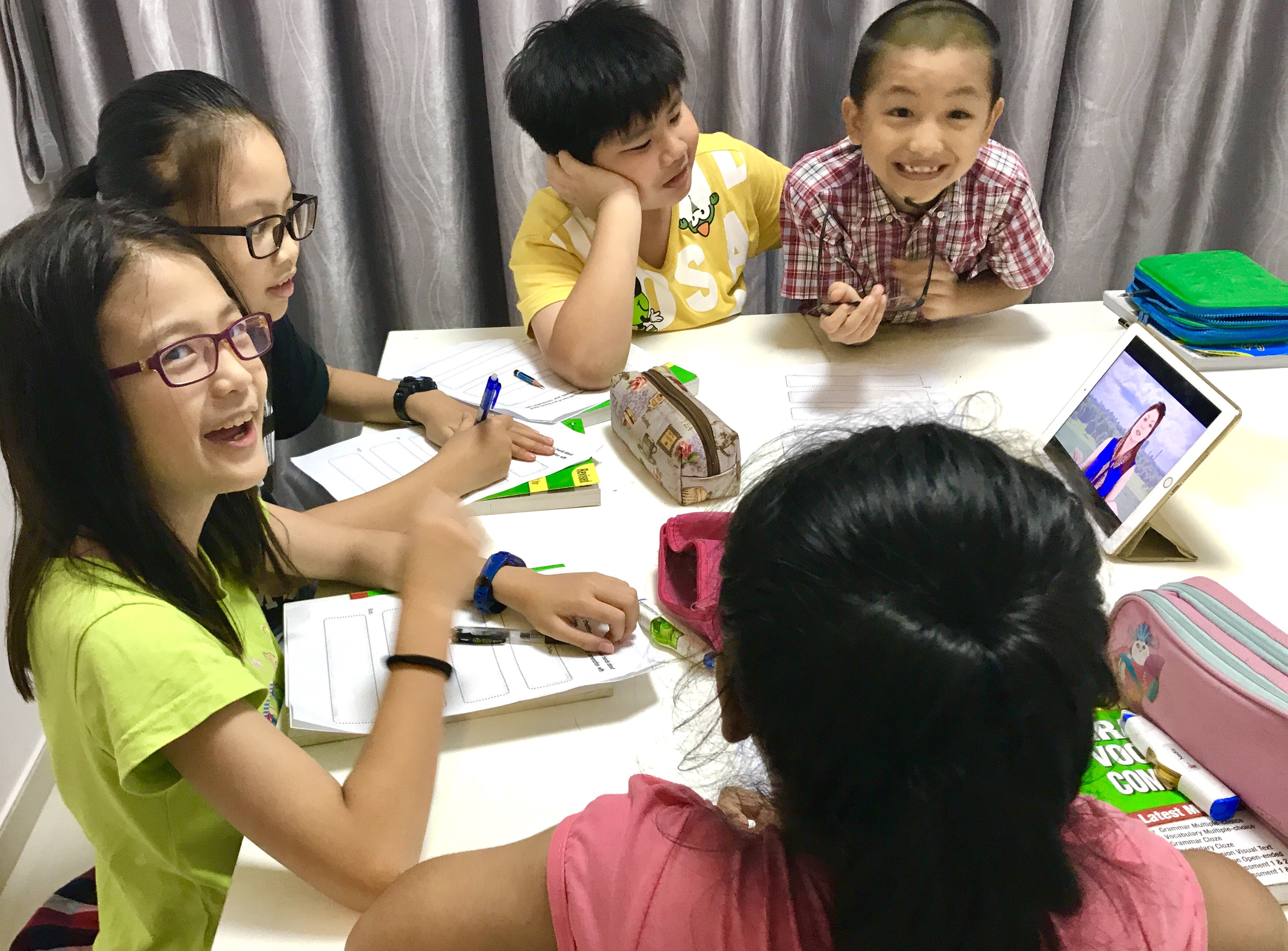
At eduKate Yishun, we work hard to have an affirmative class culture that empowers our students to do more, learn more, and develop a love for their own education by creating a class culture with great friends and tutors. Our positive classes also creates a constructive environment that teaches them the relevance of what they study to their everyday lives. With relevance creates the true reason for a proper education. That is our trademark that differentiates our teaching to others, but don’t just take our words for it, let these photos show you how much our passion and love for our Yishun student’s English lessons.




Leave a Reply