

Punggol English Tuition (Secondary 3) should help a student use examples as evidence rather than decoration. Families searching for Secondary 3 English tuition in Punggol, Sec 3 English tutor, argumentative writing, discursive writing, current affairs, comprehension, oral communication or small-group English tuition often see students collecting many facts and stories but struggling to decide which example fits which argument, whether the example is current enough, or how to explain what it actually proves.
Secondary 3 is therefore a strong year for example-bank governance. Students should learn to select, classify, refresh and deploy examples according to claim, mechanism, scale and limitation. The goal is not to memorise a warehouse of examples. It is to maintain a small, flexible bank of examples that can be retrieved, adapted and explained accurately across different questions.
This page owns one learning job: collect → classify → verify → connect to mechanism → deploy → explain → refresh. It complements other Sec 3 pages on evidence engineering, viewpoint synthesis and argument stress-testing. Here, the focus is the management of examples themselves.
Examples Are Not Arguments
An example supports a claim only when the student explains:
what happened → what mechanism it illustrates → why that mechanism matters to the claim.
Start With Claim Families
Organise examples by useful themes such as:
- education;
- technology;
- environment;
- community;
- health;
- media;
- work and automation.
But do not stop at broad topic labels.
Add Mechanism Labels
The same technology example may illustrate:
- access;
- attention;
- inequality;
- efficiency;
- privacy;
Mechanism labels make examples reusable.
The Example Card
| Field | What to record |
|---|---|
| Example | brief factual description |
| Mechanism | what process it illustrates |
| Useful claims | where it may fit |
| Limitations | what it does not prove |
| Freshness | date/source check if relevant |
Keep the Description Short
The bank is a retrieval system, not a full article archive.
Students should be able to recall the core fact quickly.
Accuracy Before Impressiveness
Do not store examples that are:
- half-remembered;
- unverifiable;
- overstated;
- too vague to explain.
Do Not Invent Statistics
A precise invented number is weaker than an accurate general example.
Example Scale
Ask:
- one person?
- one school?
- one country?
- many contexts?
Claim scope should match example scope.
Example Freshness
Some examples age quickly, especially in technology and current affairs.
Refresh periodically.
Evergreen Examples
Some mechanisms remain useful across years.
Examples involving:
- trade-offs;
- attention;
- incentives;
- access;
- community behaviour;
can remain reusable if the facts stay accurate.
One Example, Several Claims
Good governance means seeing multiple uses.
Example:
A school introduces device-free lesson periods.
Possible mechanisms:
- attention protection;
- behavioural boundaries;
- trade-off between access and distraction.
But Do Not Force the Example
If the mechanism does not fit the question, choose another example.
Claim-First Retrieval
Before opening the example bank, state the claim.
Then ask:
What example best makes this mechanism visible?
Mechanism Before Detail
Weak use:
Here is a famous example.
Strong use:
This example illustrates how repeated interruptions reduce sustained attention.
The Example Deployment Chain
- State claim.
- Name mechanism.
- Give concise example.
- Explain the connection.
- Qualify scope if needed.
Example Overload
One developed example is often better than three undeveloped examples.
When Two Examples Help
Use two when they:
- show the mechanism in different contexts;
- compare outcomes;
- strengthen representativeness.
Counterexamples
Store some examples that challenge common claims.
These help students avoid absolute arguments.
Example Bank for Oral
Oral examples should be easy to explain naturally.
Do not memorise long speeches.
Example Bank for Writing
Writing examples can be more developed but still need concise factual cores.
Example Bank for Comprehension Discussion
Where personal response is appropriate, examples should support rather than replace text-based reasoning.
Refresh Routine
Once a month or term:
- remove inaccurate examples;
- update stale ones;
- add one or two high-utility examples;
- reclassify by mechanism.
Do Not Expand the Bank Forever
A smaller active bank is easier to retrieve.
The Active / Archive Split
Use:
- Active bank: small set of high-utility examples;
- Archive: older or narrower examples.
Retrieval Practice
Give a claim and ask the student to retrieve:
- one supporting example;
- one counterexample;
- one limitation.
Example Comparison
Ask which of two examples is better for a claim and why.
The Example-Bank Ledger
| Example | Mechanism | Best use | Risk |
|---|---|---|---|
| device-free lessons | attention boundary | school technology | not universal |
| remote learning | access/flexibility | education access | depends on connectivity |
Small-Group Example Governance
Three students receive one claim.
Each proposes an example.
The group evaluates:
- relevance;
- accuracy;
- scope;
- mechanism;
- explanation potential.
Do Not Reward the Most Exotic Example
Reward the example that best supports the claim.
A 90-Minute Example-Bank Lesson
- 10 min: retrieve active bank.
- 15 min: classify by mechanism.
- 15 min: verify scope and limitations.
- 20 min: deploy examples in paragraphs.
- 10 min: counterexample drill.
- 15 min: oral retrieval on fresh topics.
- 5 min: refresh bank.
Worked Case: Student Dumps Memorised Example
The example is relevant to the topic but not to the claim.
The tutor requires the mechanism to be stated before the example.
Worked Case: Student Has Too Many Examples
Retrieval becomes slow.
The bank is reduced to a smaller active set with an archive.
Worked Case: Example Is Outdated
The student keeps using a changed policy or technology fact.
Freshness checks are added.
Worked Case: Example Is Accurate but Overgeneralised
The claim is narrowed to match the example’s scale.
What Parents Can Watch For
- The student explains why an example fits.
- Example banks become smaller and better organised.
- Statistics are not invented.
- Examples are refreshed.
- One example can be adapted across several claims.
What Not to Do
- Do not memorise long example scripts.
- Do not collect examples without mechanisms.
- Do not force a favourite example into every topic.
- Do not let old facts remain unchecked.
A Twelve-Week Example-Governance Build
Weeks 1–2: active bank setup.
Weeks 3–4: mechanism labels.
Weeks 5–6: deployment and explanation.
Weeks 7–8: scope and counterexamples.
Weeks 9–10: freshness and archive control.
Weeks 11–12: fast independent retrieval and deployment.
Frequently Asked Questions
How many examples should students memorise?
There is no useful universal number. A smaller, accurate, high-utility active bank is often easier to retrieve and adapt than a huge collection.
What makes an example useful?
It is accurate, relevant, easy to explain and clearly linked to a mechanism.
Why classify by mechanism?
Mechanism labels make one example reusable across different questions.
What is the independence goal?
A student who can choose an example because it fits the claim, not because it is the only example remembered.
The Secondary 3 Example Rule
Do not collect examples to sound informed. Keep examples that make your reasoning easier to prove.
Historical Image Archive
The original image archive remains below as part of this page’s history.



Singapore English tuition with Tutor Yuet Ling. With Singapore school’s requirement for English as a First language, our primary aim in teaching English are highly focussed on tasking English student’s communication skills to be competent as well as to be an effective, accurate and efficient tool to absorb and relay information to others.
English is Singapore’s main language of communication and it is imperative that our student’s English Language skills are on parity with the requirements set forth by the Ministry of Education to study well in school. It is the main skill that will help students to perform consistently across their other subjects as their ability to understand and use English effectively will help them to comprehend what is taught in class and asked in tests.
English Tuition Centre with English tutor of 20 years in the business helping English students to improve their ability to communicate. An improvement of their linguistic competence in both the passive reading/listening and active speaking/writing process of the English Language are part of our course curriculum.
With that in mind, our English classes are geared to teach and train our students to be able to understand the media that they read or hear, and to have the ability to express and communicate their complex thoughts and ideas to others naturally. Any improvements in information absorption and dissemination will automatically translate to cognitive skills and ultimately, help students to do well in their studies.
English should be treated as our native language, to be the main Lingua franca for a cosmopolitan Singapore where over generations, English has been integrated well into our everyday life. As a first language, the focus of our tuition will be to task our Yishun students to learn the skills needed to communicate proficiently for both their studies in school as well as for their everyday life.
Local English Tutor for English tuition are the dependable, trustworthy tutor that delivers the results. Join our English tutorials and have our English Teacher get you on track. Small groups of 3.
increase general knowledge and all necessary skills needed for the PSLE
score maximum marks by understanding the marking scheme of the examination
in a safe, comfortable air con environment with properly equipped classes
by discerning tutors that can detect weaknesses, solve student’s problems during class
by qualified female tutors with experience in improving students for the crucial PSLE
Give us a call at +65 82226327 for more information on our Singapore English classes.













Pri3 Yishun The best Pri 3 English Tuition in Yishun with SEAB MOE PSLE syllabus English. Pri3 Yishun Primary English Tutor for Pri1 Pri2 Pri3 Pri4 Pri5 Pri6 PSLE English Paper 1 and Paper 2.
Call Yuet Ling +65 82226327 for our Pri3 Yishun English classes.


Learn English and make it useful.
Working closely with parents are part of our teaching culture to create the desired effect to get our English students positive changes in their studies. Our Yishun PSLE English tutors teach from scratch, making sure our English students master their language, and we do all the necessary practices from basic easy to complex advanced questions with our students, including past exam papers that helps them to understand and appreciate English as lingua franca in Singapore and use it to further their studies.
Class Culture
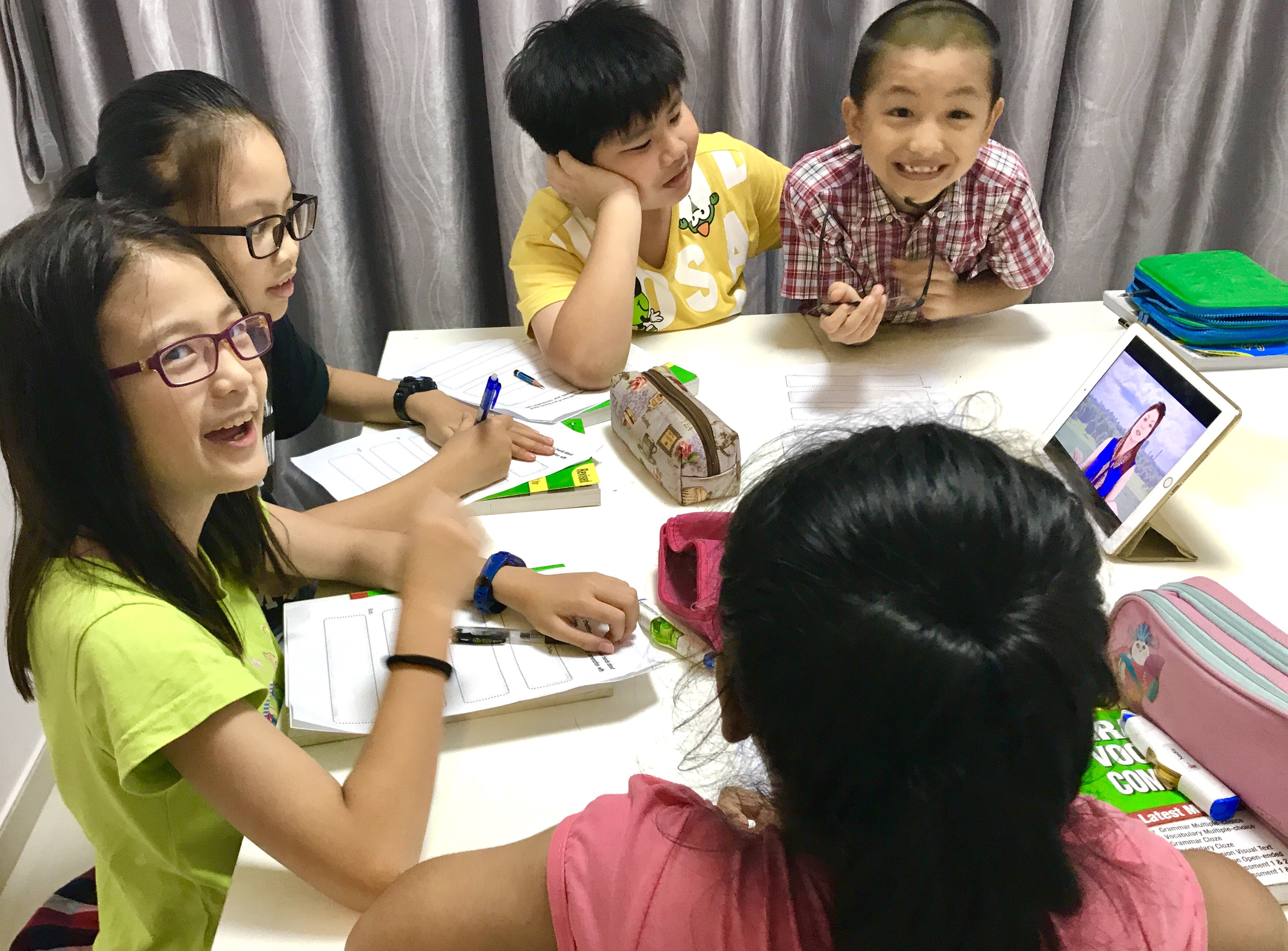
At eduKate Yishun, we work hard to have an affirmative class culture that empowers our students to do more, learn more, and develop a love for their own education by creating a class culture with great friends and tutors. Our positive classes also creates a constructive environment that teaches them the relevance of what they study to their everyday lives. With relevance creates the true reason for a proper education. That is our trademark that differentiates our teaching to others, but don’t just take our words for it, let these photos show you how much our passion and love for our Yishun student’s English lessons.




Leave a Reply