
Locality and ownership note: this retained eduKateYishun Woodlands Primary 6 Science URL is historical search continuity. The Woodlands place-name does not establish a current eduKate branch, class or local service owner; underlying public Science knowledge, evidence and mechanisms belong with eduKateSingapore Science World. eduKateYishun keeps the diagnostic, recovery and return-to-learning layer.
Pri 6 Woodlands Science Tuition is a legacy title that can now serve a focused educational job: explain how Primary 6 Science tuition, Woodlands Science tuition, PSLE Science tuition, exam preparation, open-ended questions, experimental skills, graphs, timing, checking and independent performance should be taught. Families searching for Primary 6 Science tuition in Woodlands, small-group Science tuition or PSLE Science support need more than another stack of full papers. They need a reliable performance system.
Primary 6 is where knowledge must survive mixed topics, unfamiliar applications and time pressure. Strong tuition should therefore shift from teaching isolated content into a disciplined loop: retrieve → select model → use evidence → explain → check → repair → retest → perform independently.
The goal is not perfect confidence on every question. It is controlled execution: the student knows how to start, how to recover when unsure, how to identify the first weak link and how to finish the paper without needing the tutor beside them.
Primary 6 Science should become independent performance
A student is not fully PSLE-ready because they can answer after a hint. The real test is what happens without support.
- Can the student identify the command word alone?
- Can they retrieve the relevant concept without notes?
- Can they choose the correct model without chapter labels?
- Can they use graph, table or diagram evidence?
- Can they write a complete mechanism?
- Can they check the answer before moving on?
Mixed-topic retrieval should dominate revision
Topical revision remains useful for repairing a weak concept. But examination readiness requires the student to decide which concept applies.
- one older-topic MCQ;
- one experiment;
- one graph or table;
- one unfamiliar application;
- one open-ended explanation;
- one delayed retest of a previous error.
Short mixed sets can reveal more than repeatedly doing one entire chapter.
Open-ended answers need answer scope
Primary 6 students often lose marks by writing too little or too much.
- Identify the command word.
- Locate the relevant condition.
- State the scientific process.
- Connect the process to the requested outcome.
- Use the evidence if required.
- Stop when the job is complete.
Precision is often better than length.
MCQ should include confidence, not just answers
A correct answer can still be fragile if it was guessed. During revision, students can tag difficult MCQs as confident, unsure or guessed.
Unsure and guessed correct answers should be reviewed as learning gaps because they may not survive PSLE pressure.
Experiments need a stable skeleton
- What changed?
- What was measured?
- What was controlled?
- What pattern appears?
- What conclusion is supported?
- What weakness or improvement matters?
A stable experimental routine makes unfamiliar apparatus less intimidating.
Graphs need a fixed reading routine
- Read axes.
- Check units.
- Identify the relevant comparison.
- Describe the pattern.
- Notice plateau, anomaly or change in rate.
- Connect to mechanism only after the data is clear.
This protects the student from answering the graph they expected instead of the graph shown.
Timing should be introduced after reasoning stabilises
Speed is useful only when the model is accurate. Timed work should progress gradually.
- untimed accurate reasoning;
- short timed clusters;
- mixed timed sections;
- full-paper simulation;
- post-paper diagnosis.
The goal is controlled pace, not rushed guessing.
The Independence Test
| Capability | Evidence of readiness |
|---|---|
| Reading | Identifies task and conditions without prompting |
| Retrieval | Accesses old concepts without notes |
| Selection | Chooses the relevant scientific model |
| Evidence | Uses data and diagrams accurately |
| Explanation | Builds complete causal chains |
| Checking | Finds likely errors independently |
| Transfer | Handles unfamiliar contexts |
| Retention | Repeats success after delay |
Full papers should be diagnostic
A paper is useful because it reveals patterns under mixed conditions. The post-paper review should classify errors.
- concept gap;
- retrieval gap;
- reading error;
- model-selection error;
- causal-chain gap;
- experiment error;
- data error;
- timing or checking failure.
The next week’s work should follow that diagnosis.
Correction must include delayed retesting
A student who corrects a question immediately has not yet proved mastery. The same error family should return later in a changed context.
Delayed success is stronger evidence that the repair has held.
Unfamiliar questions need a recovery routine
- strip away story details;
- identify what changed;
- find the evidence;
- choose the most plausible model;
- test the model against the conditions;
- move on temporarily if necessary and return later.
Recovery is part of examination skill.
Primary 6 revision should shrink notes, not expand them
As the examination approaches, revision notes should increasingly become compact retrieval cues.
- core concept;
- conditions;
- mechanism;
- common trap;
- one transfer example;
- one question to self-check.
The student should be able to expand the cue into the full model from memory.
Small groups should end in individual performance
Discussion is valuable, but the final test should be independent.
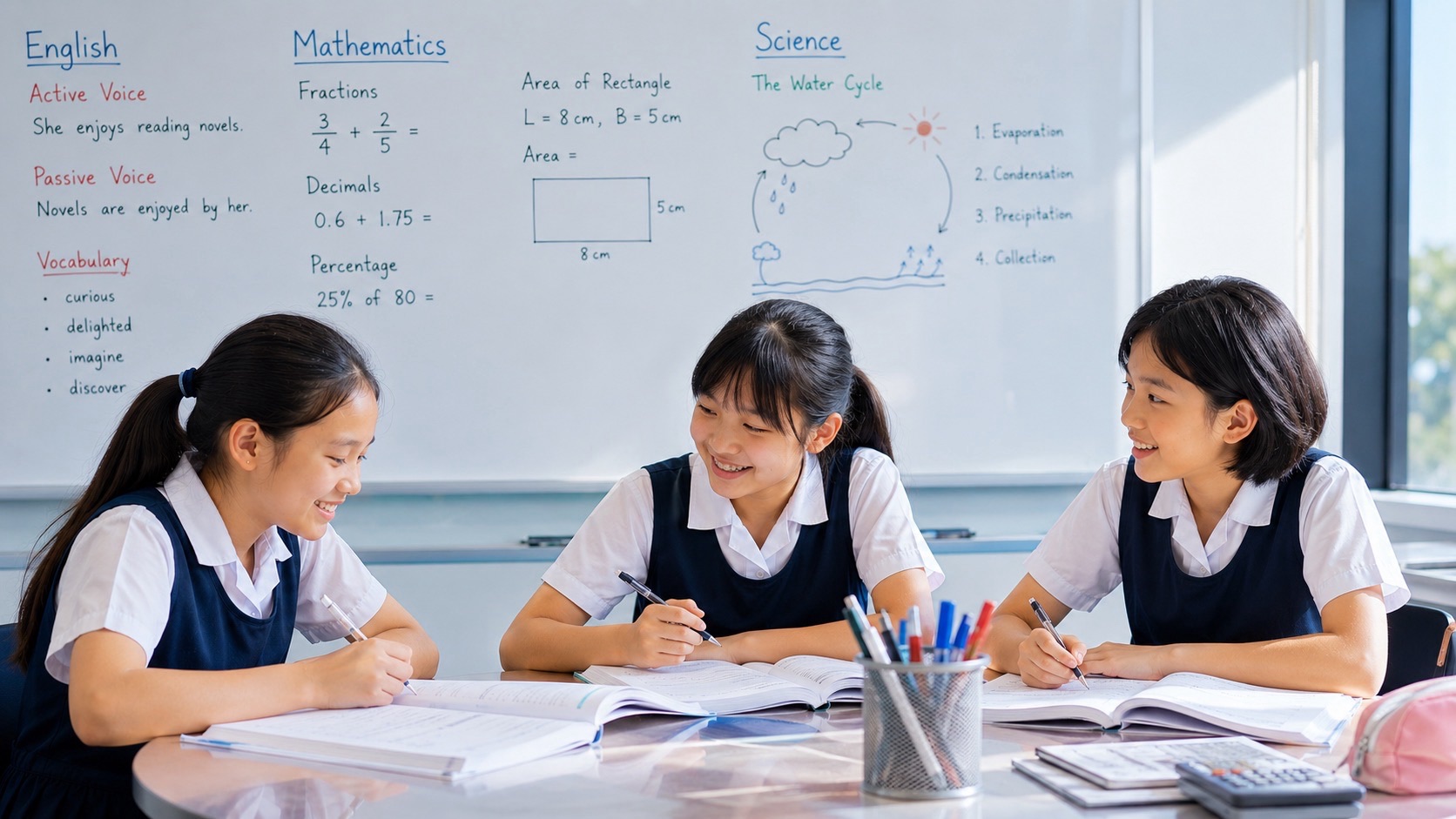
Three students can compare reasoning, challenge evidence and discuss errors. Then each should solve a changed question alone.
What parents should ask about Primary 6 Science tuition
- Are full papers used diagnostically?
- How are open-ended answers repaired?
- Are guesses identified?
- How are experiment and graph routines taught?
- When is timing introduced?
- Are old errors retested after delay?
- How is independence measured?
- What happens when the child meets an unfamiliar question?
What progress looks like
- Mixed-topic retrieval becomes faster.
- Open-ended answers are more complete and concise.
- Experiment reasoning is stable.
- Graphs are interpreted accurately under time pressure.
- Guesses decrease.
- Self-checking improves.
- Delayed retests hold.
- The student performs with fewer prompts.
The deeper purpose of Primary 6 Science tuition
The final year should not make the student permanently dependent on tuition. It should do the opposite.
A PSLE-ready learner can retrieve, select, reason, use evidence, check, recover and transfer independently. The tutor’s job is to make that independence increasingly visible.
That is also the strongest bridge into Secondary Science, where the volume of content increases and the learner must manage more of the system personally.
Leave a Reply