
Locality and ownership note: this retained eduKateYishun Sengkang Primary 3 Science URL is historical search continuity. Present-day Sengkang Primary 3 Science tuition and learner-runtime decisions belong with eduKateSengkang Primary 3 Science; underlying public Science knowledge, evidence and mechanisms belong with eduKateSingapore Science World. eduKateYishun keeps the diagnostic, recovery and return-to-learning layer.
Pri 3 Sengkang Science Tuition is a legacy title that can now serve a focused educational job: explain how Primary 3 Science tuition, Sengkang Science tuition, scientific vocabulary, oral reasoning, diagrams, observation, explanation and early written answers should be taught. Families searching for Primary 3 Science tuition in Sengkang, small-group Science tuition or MOE Science support often see a child who can talk about what they observed but struggles to turn that thought into a clear scientific sentence.
That oral-to-written bridge matters. Primary 3 is often the first time children must convert everyday observations into disciplined Science language. Strong tuition should therefore help students move through see → say → clarify → write → check → say again in a new example. The goal is not sophisticated vocabulary. It is accurate meaning.
Current Primary Science tuition language often emphasises conceptual understanding, precise answering, experiments, graphs and application. Those later skills begin here, with a child learning to describe what happened, explain one relevant reason and write only what the question actually asks.
Primary 3 Science should begin in speech
Before asking a child to write a perfect Science answer, ask them to explain the idea aloud.
- What did you observe?
- What changed?
- What stayed the same?
- Why do you think that happened?
- Which word describes the Science idea?
Speaking reveals whether the child understands the relationship or is merely copying a phrase.
Everyday language can be the first draft
A student may first say, “The cloth took in more water.” That can then be refined into “The cloth absorbed more water.” The scientific word improves precision, but the meaning was built first.
This order matters. If vocabulary comes before understanding, students may use impressive terms in the wrong relationship.
Observation and explanation should sound different
| Science job | Example |
|---|---|
| Observation | The bulb did not light. |
| Inference | The circuit may be incomplete. |
| Explanation | The bulb did not light because the circuit was incomplete, so there was no complete path. |
Primary 3 students do not need long explanations, but they should begin recognising these different jobs.
The “say it, tighten it, write it” routine
- Student says the answer in ordinary language.
- Tutor asks one clarifying question.
- Student replaces vague words with one precise term.
- Student writes the sentence.
- Student checks whether the written sentence still means what they intended.
This routine teaches scientific expression without turning Primary 3 into model-answer memorisation.
Diagrams are excellent speaking prompts
A diagram gives the child something concrete to describe.
- Name the parts.
- Explain what the arrow shows.
- Describe what changed between two pictures.
- Say which part is important to the question.
Once the student can narrate the diagram accurately, writing becomes easier.
Comparison language should be explicit
Students should learn to say “Material A is more flexible than Material B” rather than “Material A is flexible”. The first sentence answers a comparison. The second only describes one object.
- more than;
- less than;
- higher than;
- lower than;
- faster than;
- slower than.
These small words teach relationships.
Simple experiments should include student narration
Before writing anything, ask the child to describe the experiment.
- What did we change?
- What did we observe?
- What stayed similar?
- What result did we get?
- What can we conclude?
The experiment becomes a story with scientific structure.
Primary 3 written answers should be short and complete
A useful answer pattern is:
- answer the question directly;
- add one relevant reason;
- use the scientific word if it improves accuracy;
- stop when the relationship is complete.
Longer is not automatically better.
Reading aloud can reveal weak writing
After writing, ask the child to read the answer aloud. Awkward logic often becomes obvious when heard.
- Did the sentence answer the question?
- Is the subject clear?
- Did “it” refer to the correct object?
- Does the cause really lead to the outcome?
Do not correct every sentence for the child
If the tutor rewrites everything immediately, the child learns to wait. A stronger sequence is to identify the exact weak phrase and ask the student to repair it.
The child should increasingly become the editor of their own Science language.
A Primary 3 oral-to-written checklist
- Can the child explain the idea aloud?
- Can the child distinguish observation from reason?
- Can vague words be replaced with precise words?
- Can comparison be written explicitly?
- Can diagrams be narrated?
- Can the child repair one weak sentence independently?
Small groups make language visible
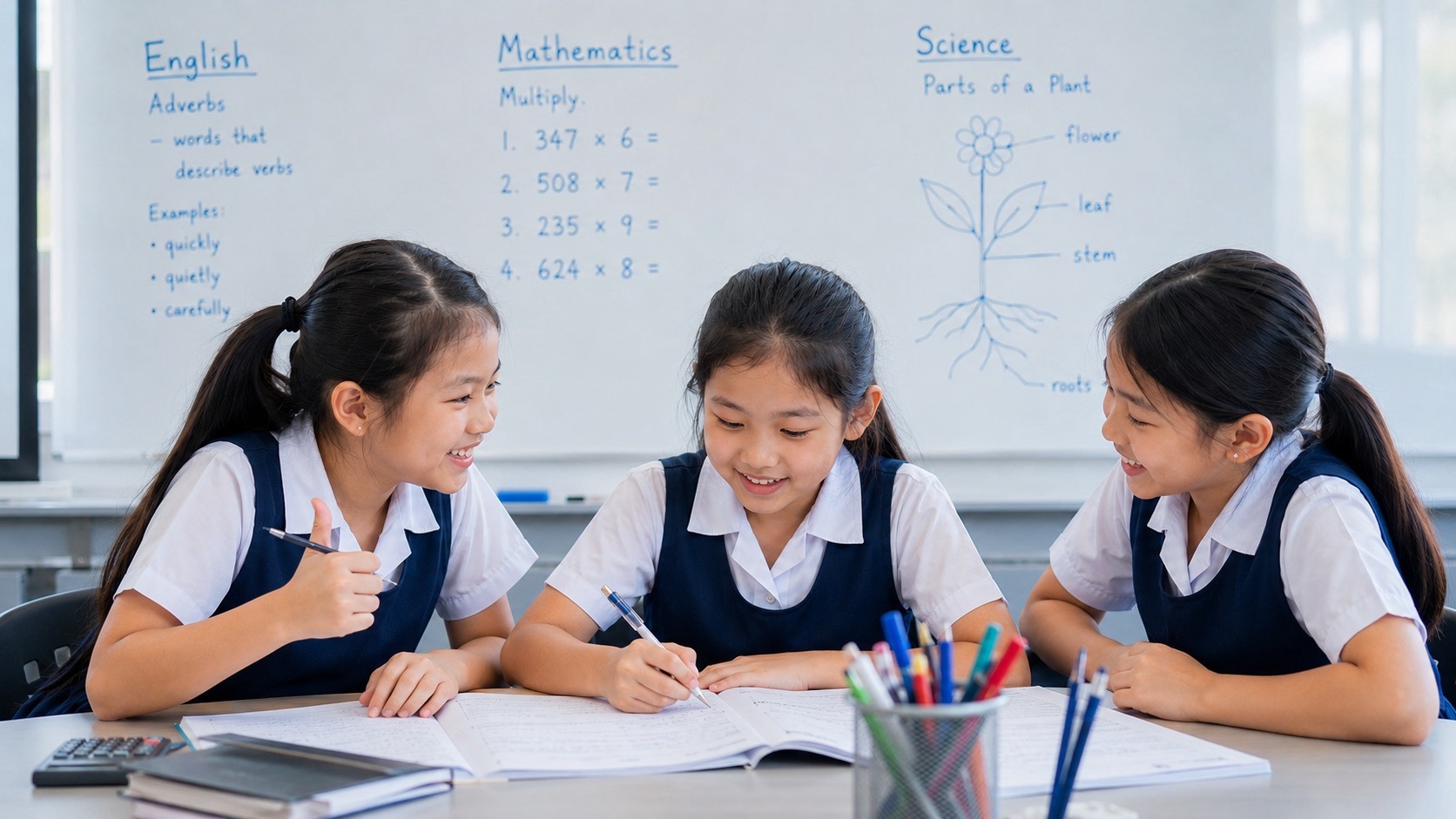
One child can give an everyday-language answer, another can refine the scientific vocabulary and a third can check whether the relationship is complete.
All three then write independently. Discussion helps; individual writing proves transfer.
Homework should alternate speaking and writing
- describe one diagram aloud;
- write one comparison sentence;
- explain one simple cause-and-effect question;
- retrieve one older scientific word and use it in context.
The aim is to make scientific language increasingly natural.
What parents should ask about Primary 3 Science tuition
- Does the tutor ask children to explain ideas aloud?
- Is vocabulary introduced through meaning?
- Do students narrate diagrams?
- Are short written answers repaired rather than replaced?
- Is comparison language taught explicitly?
- How does the tutor reduce prompting over time?
What progress looks like
- Oral explanations become more precise.
- Vague words decrease.
- Written answers match the spoken idea more closely.
- Comparisons mention both sides.
- Diagram descriptions improve.
- The child repairs weak sentences with fewer prompts.
The deeper purpose of Primary 3 scientific language
Science language should help a child think more clearly, not merely sound more advanced. Primary 3 is the right time to build the habit of seeing carefully, saying what is meant and writing the relationship accurately.
That bridge from speech to writing supports Primary 4, Primary 5 and eventually PSLE Science open-ended answering.
Leave a Reply