

New Punggol English Tuition Centre keeps its original 2019 title, but this page is rebuilt around one specific job for families searching for Punggol English tuition centre, new English tuition student, Primary and Secondary English tuition, small-group English tutor, comprehension, vocabulary, grammar, writing, oral communication and examination preparation. A new student’s first month should not be a blur of worksheets. It should reveal how the learner currently reads, writes, explains, checks, asks for help and transfers feedback.
A strong Punggol English tuition centre should therefore run a first-30-days onboarding system. The sequence is baseline → first weak link → class routines → targeted repair → fresh proof → parent checkpoint → personalised operating plan. The goal is not to diagnose every possible weakness immediately. It is to identify the few mechanisms that most affect current performance and build enough evidence to know what should happen next.
This page owns one learning job: how a new student enters the programme and becomes a known learner rather than an anonymous enrolment. It complements the level-specific, small-group, diagnostic and examination pages elsewhere in the estate. Here, the question is operational: what should happen during the first four weeks so tuition begins with evidence, not assumptions?
Why the First 30 Days Matter
The first month creates the tutor’s working model of the student. If that model is vague, lessons become generic. If it is evidence-based, the tutor can decide what to repair, what to maintain and what to build.
Do Not Begin With a Giant Test Battery
A baseline should be broad enough to reveal patterns but light enough that the student is still behaving naturally.
Useful baseline evidence can include:
- one unseen reading passage;
- one short writing task;
- one grammar/editing sample;
- one vocabulary-in-context task;
- one oral response;
- recent schoolwork where available.
Week 1: Baseline and Observation
During the first week, the tutor watches the process as much as the answer.
Observe:
- how instructions are read;
- how quickly evidence is located;
- whether the student guesses or checks;
- how ideas are planned;
- how much prompting is needed;
- what happens after a mistake;
- how the student asks for help.
The Baseline Is Not a Label
Do not conclude “weak in English” or “strong in English”.
Record mechanisms:
inference accurate but overlong; paragraph ideas good but explanation thin; grammar stable untimed; help-seeking vague.
Use Recent School Evidence
Marked schoolwork can reveal:
- teacher expectations;
- recurring comments;
- current assessment conditions;
- transfer gaps;
- component-specific weaknesses.
Do Not Let One School Paper Define the Student
One paper is evidence, not identity. Look for recurrence across several sources.
The First Weak Link
For any visible error, ask where the process first broke.
Example:
wrong inference → question misread → wrong evidence area → wrong answer.
The first repair is task interpretation, not inference wording.
The Diagnostic Chain
task → method → evidence → reasoning → expression → checking.
Find the earliest unstable step.
Week 1 Output: The First Working Profile
| Area | Observed state | Next action |
|---|---|---|
| Reading | main idea stable, inference weak | clue→interpretation repair |
| Writing | ideas strong, paragraphs thin | explanation mechanism |
| Grammar | stable in drills | test in writing |
| Help-seeking | asks too early | attempt threshold |
Week 2: Establish Class Routines
The student now learns how the tutorial itself works.
Core routines may include:
- independent first attempt;
- uncertainty marking;
- error classification;
- targeted repair;
- fresh retest;
- reflection;
- prompt fading.
Independent First Attempt
Before discussion, the student should attempt the task alone.
This preserves diagnostic evidence.
Uncertainty Marking
Use a simple system:
- ✓ confident;
- ? uncertain;
- ! stuck.
The marks are process data, not grades.
Error Classification
Instead of “wrong”, classify:
- task;
- evidence;
- reasoning;
- vocabulary;
- grammar;
- paragraph;
- checking.
Targeted Repair
Use the smallest useful practice.
Examples:
- three inference items;
- one paragraph expansion;
- five mixed grammar sentences;
- one oral follow-up chain.
Fresh Retest
Every repair should be tested on new material.
correction is not proof; fresh transfer is proof.
Week 2 Output: The Student Knows the Runtime
By the end of week two, the student should know:
- why first attempts matter;
- how to mark uncertainty;
- how corrections are classified;
- why fresh retests follow feedback;
- that prompts are expected to fade.
Week 3: Test the First Repair
The tutor now needs evidence that the initial repair survives changed material.
Use:
- new topic;
- new passage;
- different question wording;
- reduced prompting;
- short delay.
Do Not Add Too Many New Targets Yet
The first month is about building a trustworthy profile.
If ten weaknesses are activated at once, the evidence becomes noisy.
Repair / Maintain / Build
Each student should gradually have three lanes:
- Repair: recurring weakness.
- Maintain: stable skill needing light retrieval.
- Build: next capability to develop.
The Three-Lane Table
| Lane | Meaning | Action |
|---|---|---|
| Repair | weak and recurring | teach + fresh proof |
| Maintain | stable | light mixed retrieval |
| Build | next layer | new instruction |
Week 3 Output: Evidence of Transfer
The tutor should be able to say something specific:
The student now identifies one strong clue before inference on fresh passages, but still needs one prompt when two interpretations are plausible.
Week 4: Parent and Student Checkpoint
The end of the first month should produce a clear conversation.
Report:
- what is already stable;
- what is improving;
- what remains time-sensitive;
- what evidence supports the judgement;
- what the next six to twelve weeks will prioritise.
Green / Amber / Time-Sensitive
A useful status language:
- Green: stable and independent;
- Amber: improving but still prompt-dependent;
- Time-sensitive: recurring high-cost issue needing current focus.
Do Not Report Vague Progress
Weak:
English is improving.
Stronger:
Paragraph explanation has improved on fresh work, but tense control still breaks during longer timed writing.
Student Voice at the Checkpoint
The student should answer:
- What are you repairing?
- What have you moved to Maintain?
- What is still difficult?
- What help do you need less often now?
The First 30-Day Dashboard
| Domain | Baseline | Week 4 state | Next step |
|---|---|---|---|
| Inference | guesses | clue-first, one prompt | multi-clue transfer |
| Writing | thin explanation | mechanism added | timed paragraph |
| Grammar | stable drill | fragile writing | edit under load |
Onboarding for Secondary 1
Focus especially on:
- school transition;
- task language;
- longer texts;
- paragraph development;
- independent homework routines.
Onboarding for Secondary 2
Focus especially on:
- transfer;
- self-revision;
- mixed question types;
- cohesion;
- upper-secondary readiness.
Onboarding for Secondary 3
Focus especially on:
- argument;
- evidence weighting;
- summary/compression;
- timing;
- exam runway.
Onboarding for Secondary 4
Focus especially on:
- recent school evidence;
- prelim patterns;
- reliability;
- revision triage;
- timed performance.
Onboarding for Primary Students
Use age-appropriate baselines:
- oral language;
- reading fluency;
- sentence writing;
- question understanding;
- comprehension;
- composition.
Small-Group Onboarding
Three students can share a task while receiving different diagnoses.
One may need evidence selection, one vocabulary precision, one paragraph explanation.
Do Not Use the Same Repair Because the Worksheet Is Shared
The class activity can be common; the learning target can differ.
Same Tutor Continuity
Continuity matters because the tutor can track:
- which prompts were needed;
- which repair failed;
- which skills moved to maintenance;
- which school errors returned.
The First-Month Error Ledger
Keep it small.
Example:
| Pattern | First seen | Repair | Fresh proof |
|---|---|---|---|
| scope | W1 | task paraphrase | W2 ✓ |
| pronoun | W2 | antecedent check | W3 ? |
Do Not Diagnose Personality
A student who is quiet is not automatically weak. A fast student is not automatically independent. Diagnose observable learning behaviour.
Do Not Over-Promise the First Month
The first 30 days should create:
- a clearer profile;
- one or two meaningful repairs;
- class routines;
- initial transfer evidence;
- a credible next plan.
That is more valuable than claiming a dramatic transformation.
Onboarding and Motivation
Students are more motivated when they can see a repair succeed.
Choose at least one target that is important and realistically improvable within the first month.
Onboarding and Confidence
Confidence should be tied to evidence.
Use:
- fresh success;
- reduced prompts;
- better self-checking;
- school transfer.
Onboarding and Parent Expectations
Parents should know that the first month is not about covering the entire syllabus. It is about identifying the operating system that will make later coverage more effective.
Onboarding and Homework
Homework should reveal:
- independent start;
- uncertainty marking;
- time friction;
- transfer from lesson.
Onboarding and Schoolwork
School assignments and tests should be connected to the same diagnostic language rather than treated as emergencies separate from tuition.
Onboarding and Vocabulary
Assess whether vocabulary weakness comes from:
- limited reading;
- weak context inference;
- poor retrieval;
- collocation;
- register.
Onboarding and Writing
Separate:
- idea generation;
- planning;
- paragraph development;
- sentence control;
- editing.
Onboarding and Comprehension
Separate:
- question decoding;
- evidence location;
- inference;
- expression;
- answer economy.
Onboarding and Oral
Observe:
- position clarity;
- reason;
- example;
- follow-up flexibility;
- vocabulary precision.
Onboarding and Grammar
Test both:
- isolated knowledge;
- transfer into writing.
The First-Month Lesson Rhythm
A 90-minute lesson can use:
- 10 min: retrieval from previous lesson.
- 20 min: cold attempt.
- 15 min: diagnosis.
- 20 min: targeted teaching.
- 15 min: fresh transfer.
- 5 min: self-check.
- 5 min: ledger update.
Worked Case: Student Looks Strong Because Work Is Neat
Cold unseen work reveals that the student depends heavily on familiar formats. The onboarding plan targets method recognition, not handwriting or presentation.
Worked Case: Student Looks Weak Because Writing Is Messy
Oral reasoning and comprehension show strong ideas. The first repair targets sentence control and editing rather than lowering content difficulty.
Worked Case: School Marks Are Low but Baseline Is Strong
The tutor investigates timing, task fidelity, examination recovery or school-specific transfer.
Worked Case: Student Knows Grammar but Writes Inaccurately
The first-month profile records grammar transfer under load, not “grammar weak”.
Worked Case: Parent Wants Every Weakness Fixed Immediately
The tutor explains why one or two high-value repairs produce clearer evidence and less overload.
What Parents Can Watch For
- The child can name the current target.
- Feedback becomes more specific.
- Prompts begin to reduce.
- Corrections lead to fresh tasks.
- The parent receives evidence rather than vague claims.
- The first-month plan becomes clearer over time.
What Not to Do
- Do not run a giant diagnostic battery for its own sake.
- Do not label the student globally.
- Do not activate ten repair targets at once.
- Do not treat schoolwork and tuition as separate worlds.
- Do not count corrected originals as final proof.
A 30-Day Onboarding Calendar
Week 1: baseline and first weak link.
Week 2: class routines and first repair.
Week 3: fresh transfer and prompt fading.
Week 4: parent/student checkpoint and next operating plan.
Frequently Asked Questions
What should happen in the first lesson?
A useful baseline, observation of process and one preliminary repair target—not a generic worksheet marathon.
How quickly should a full plan be created?
Enough evidence should be collected first. A working plan can begin immediately and become more precise across the first month.
Why use fresh retests?
They distinguish genuine learning from remembering a correction.
What should parents receive after one month?
A concise evidence-based profile of what is stable, what is improving, what remains active and what the next cycle will prioritise.
What is the independence goal?
A student who understands the class routines, can identify current repair targets and increasingly manages first attempts, help-seeking, corrections and self-checking independently.
The First-30-Days Rule
Do not rush to teach everything. Learn the student first, repair the first weak link, prove the repair, and build the programme from evidence.
Deep Practice: Baseline Without Over-Coaching
During the baseline, the tutor should resist teaching too early. If every hesitation triggers a prompt, the baseline stops showing independent performance. Mark uncertainty and allow the student to continue. Teaching begins after enough evidence has been gathered to identify the first weak link.
Deep Practice: Schoolwork Triangulation
Compare baseline work with one recent school paper and one homework sample. If the same pattern appears in all three, confidence in the diagnosis rises. If they disagree, investigate task conditions before forming a conclusion.
Deep Practice: First-Month Prompt Map
Record the type of support used for each active skill: model, guided question, one cue, self-check, independent. By week four, at least one meaningful skill should show reduced support.
Deep Practice: Student-State Router
At the end of week one, decide whether the student is mainly Lost, Fragile, Developing or Stable on each major skill. The label should describe the current state, not the child. Each state maps to a different amount of scaffolding.
Deep Practice: Parent Checkpoint Script
Use three statements: what we observed, what we repaired, what we will test next. This keeps reporting concise and evidence-based.
Deep Practice: New Student Independence Test
At the end of the month, use a mixed fresh task with no live hints. Compare the result with the baseline. The change in prompt dependence, error patterns and transfer becomes the first genuine progress record.
Onboarding Independence Gate
The onboarding cycle is complete when the student understands the learning routines, the tutor has a stable working profile, the parent has an evidence-based checkpoint, and at least one repair has survived fresh or delayed transfer. Only then should the next cycle expand the build targets.
Final check: after thirty days, every active target should have a reason, a repair rule and a next proof. If any target has none, it is not yet a useful target.
Deep Practice: Baseline Reading Profile
A useful reading baseline should reveal more than whether the student answered correctly. Ask the student to read an unfamiliar passage and explain what they do first. Does the learner preview the text, read linearly, annotate heavily, skip unknown words or reread entire sections? These behaviours are part of the profile.
After reading, ask for the main idea, one evidence detail, one inference and one word understood from context. The combination shows whether the problem lies in decoding, structure, evidence or inference. It also reveals whether the student can explain their own reading process.
Deep Practice: Baseline Writing Profile
Use a short prompt and protect the first attempt. Observe planning time, idea selection, paragraph organisation, sentence control and editing. A student who writes slowly because of weak ideas needs a different repair from a student who writes slowly because of sentence perfectionism.
The tutor should separate content generation, structure, language control and self-checking. This prevents the broad label “weak writing”.
Deep Practice: Baseline Grammar Profile
Test grammar in two contexts: a short mixed exercise and a paragraph the student writes independently. If accuracy is strong in the exercise but weak in writing, the problem is transfer under cognitive load rather than missing rule knowledge.
This distinction matters because reteaching the rule may not solve the real problem. The repair may need editing under load or a personal risk checklist.
Deep Practice: Baseline Vocabulary Profile
Check three things: can the student infer meaning from context, can the student explain connotation or register, and can the student use the word naturally? A learner may know many definitions but still have weak active vocabulary.
The onboarding plan should record whether vocabulary growth needs wider reading, stronger context-clue routines, collocation work or active usage.
Deep Practice: Baseline Oral Profile
Use one familiar prompt and one follow-up. Observe whether the student can take a position, give a reason, provide a specific example and respond when the question changes. Memorised fluency and flexible reasoning are different.
The tutor should also note filler, vague vocabulary, response length and recovery when a word is missing.
Deep Practice: Baseline Help-Seeking Profile
Give one deliberately difficult item and observe what the student does. Does the learner guess, freeze, ask immediately, reread repeatedly or formulate a precise question? Help-seeking behaviour reveals independence habits that ordinary worksheets may hide.
This can become an early repair target because better help-seeking makes every later lesson more efficient.
Deep Practice: Baseline Time Profile
Record where the student spends time. Long completion time may come from rereading, overplanning, weak retrieval, distraction or perfectionism. “Slow” is not a diagnosis.
By week four, repeat one comparable task and compare time with accuracy and prompt level.
Deep Practice: Baseline Confidence Calibration
Ask the student to tag answers Green, Amber or Red. After marking, compare confidence with correctness. Overconfidence and underconfidence both affect help-seeking and checking.
The first-month plan can include confidence calibration when students repeatedly change correct answers or fail to revisit uncertain ones.
Deep Practice: First-Weak-Link Conference
At the end of the first baseline, the tutor should be able to identify one or two high-value patterns. Explain them to the student in plain language. Example: “Your ideas are strong, but your paragraphs stop before explaining why the example proves the point.”
The student should be able to repeat the diagnosis. Ownership begins when the learner can name the target.
Deep Practice: Choosing the First Repair
The first repair should meet four conditions:
- it appears more than once;
- it affects meaningful performance;
- it can be taught clearly;
- it can be retested within the month.
This avoids choosing a dramatic but rare error.
Deep Practice: The First Successful Repair
Early success matters because it shows the student that tuition is diagnostic rather than punitive. Choose a target that is important but tractable. Teach the mechanism, practise it and retest on new material.
The tutor should not manufacture easy success. The retest still needs to be genuine.
Deep Practice: Prompt Map Across Four Weeks
| Week | Support | Student responsibility |
|---|---|---|
| 1 | diagnostic questions | attempt + explain |
| 2 | targeted cues | apply repair |
| 3 | minimal cue | fresh transfer |
| 4 | no live hint | independent proof |
Deep Practice: First-Month Homework Routine
Homework should be small and diagnostic. Require independent attempt, uncertainty marking and one fresh transfer. Do not send home large worksheet packs that hide where the student actually needed help.
Parents can support by asking what the current repair target is and whether the child has tried before asking for assistance.
Deep Practice: First-Month Reading Routine
Use short unseen texts with one consistent reading question: “What is this paragraph doing?” Over four weeks, reduce visible annotation and ask the student to maintain structure mentally.
This gives the tutor evidence about whether the student’s reading control is improving, not merely whether one passage was easy.
Deep Practice: First-Month Writing Routine
Use one short paragraph every week rather than one huge composition only. This makes it easier to isolate paragraph structure, evidence, explanation and grammar. At the end of the month, one longer task can test integration.
Deep Practice: First-Month Vocabulary Routine
Build a small active bank. Every word must move through context, collocation, oral use, written use and delayed retrieval. This creates evidence of activation rather than notebook volume.
Deep Practice: First-Month Grammar Routine
Choose only one or two recurring grammar families. Test them in mixed sentences and then inside writing. The tutor records whether the student detects the error independently.
Deep Practice: First-Month Oral Routine
Use brief weekly responses rather than one isolated oral lesson. Track position clarity, example quality, follow-up flexibility and vocabulary precision.
Deep Practice: Parent Communication in Week 2
A short early update can prevent misunderstanding. Report what has been observed and what is being tested, not a final verdict. Example: “We are seeing strong ideas but weak explanation; this week we are testing whether a point–evidence–explanation routine transfers into fresh writing.”
Deep Practice: Parent Communication in Week 4
The end-of-month update should include:
- baseline pattern;
- repair attempted;
- fresh proof;
- current prompt level;
- next target.
This creates a clear handover into the next cycle.
Deep Practice: Student Reflection in Week 4
Ask the student to finish three sentences:
- I am better at…
- I still need to work on…
- I need less help with…
Compare the student’s reflection with the tutor’s evidence.
Deep Practice: When the First Diagnosis Is Wrong
Sometimes new evidence contradicts the initial profile. A student may appear weak in inference on one passage but perform well on several others. The tutor should revise the diagnosis rather than force the original conclusion.
Good onboarding is flexible because the working profile is a hypothesis tested by evidence.
Deep Practice: When the Student Is Already Strong
Onboarding is still useful. The baseline may show that the student does not need repair in basic skills. The programme can then move quickly into enrichment, complexity, speed, precision or broader transfer.
Strong students should not be held at an artificially low level because the class has a fixed starter curriculum.
Deep Practice: When the Student Is Fragile
If several foundations are unstable, prioritise the one that unlocks others. For example, weak sentence comprehension may need attention before advanced writing. The first month should build confidence through visible repair without hiding the seriousness of the foundation gap.
Deep Practice: When the Student Is Examination-Year
The first month must be compressed. Use recent school evidence, timed tasks and a shorter diagnostic window. Prioritise high-cost weaknesses and reliability. The onboarding principles remain the same, but the calendar is tighter.
Deep Practice: Student-State Routing
Use four temporary states:
- Lost: cannot identify the method.
- Fragile: method appears with prompts.
- Developing: method works on fresh tasks but not consistently.
- Stable: method survives delay and mixed work.
The state describes the skill, not the student.
Deep Practice: Routing Support by State
Lost needs explicit teaching. Fragile needs guided practice and prompt fading. Developing needs fresh transfer and mixing. Stable needs maintenance and harder build targets.
Deep Practice: First-Month Independence Gate
At the end of week four, use one fresh mixed task with no live hints. The student should manage instructions, attempt, uncertainty, help-seeking, correction and self-check. Compare with the first baseline.
The goal is not perfect scores. The goal is more visible ownership.
Deep Practice: Building the 12-Week Plan
The first month should lead into a clear next cycle:
- one active Repair target;
- two Maintain skills;
- one Build target;
- one school-transfer check;
- one independence test date.
This Keeps the Plan Small
A plan with twenty priorities is not a plan.
Deep Practice: Avoiding Onboarding Drift
Do not keep “diagnosing” forever. Once enough evidence exists, move into teaching. The purpose of onboarding is to create direction, not to delay instruction.
Deep Practice: Avoiding Premature Certainty
Do not lock the student into a fixed label after one task. Keep the profile open to revision as fresh evidence arrives.
Deep Practice: Keeping the Student Involved
The student should see the ledger, understand the target and know what fresh proof will count. Hidden diagnostic systems may be efficient for the tutor but do less to build self-regulation.
Deep Practice: Onboarding Across Changing Schools or Teachers
When school expectations differ, use schoolwork as context but keep the underlying language mechanisms stable. A new teacher may use different terminology, yet evidence, paragraph control and task interpretation still matter.
Deep Practice: Onboarding and Internal Motivation
Ask what the student wants English to make easier: school tests, writing, speaking, reading or confidence. Link the first repair to a meaningful outcome where possible. This gives the target personal relevance.
Deep Practice: Onboarding and Reading Interests
Include one text connected to the student’s interests during the first month. This helps reveal reading capacity without low motivation becoming the main confounding factor.
Deep Practice: Onboarding and Challenge Level
If the student succeeds too easily, increase complexity. If the student fails every task, reduce load. The diagnostic value is highest near the edge of current capability.
The First-30-Days Evidence Ledger
| Week | Target | Prompt level | Fresh proof | Status |
|---|---|---|---|---|
| 1 | Inference | 3 | 2/5 | Repair |
| 2 | Inference | 2 | 4/5 | Repair |
| 3 | Inference | 1 | 4/5 | Developing |
| 4 | Inference | 0 | 5/5 | Maintain |
What Mastery of Onboarding Looks Like
Successful onboarding means the tutor knows the student well enough to teach precisely, the student understands the class routines and current targets, and the parent receives evidence-based reporting. It does not mean every weakness is solved.
The first month should leave the programme with direction, not merely information.
The Onboarding Independence Gate
Before declaring onboarding complete, the student should complete a fresh task without live hints, identify uncertainty, use help appropriately if needed, apply one known repair and self-check. The tutor compares this with the first-week baseline and records the change.
When the process is stable, the student moves from “new enrolment” to an active personalised learning cycle.
Final Parent Routing After the First Month
The first-month checkpoint should answer one practical family question: what kind of support does the student need next? Some students need continued repair of a foundational weakness. Some need structured practice to stabilise a method. Some are ready for enrichment. Some need examination-specific performance work. Some mainly need independence routines because the knowledge is already present.
This routing prevents families from assuming that every English problem needs more worksheets. The next cycle should follow the diagnosis, not a generic programme sequence.
Maintenance After Early Success
If one repair succeeds quickly, do not continue teaching it at full intensity simply because it was the first target. Move it to maintenance and test it lightly inside mixed work. This frees time for the next meaningful build.
A good onboarding process therefore creates motion. Skills change lanes as evidence changes.
Handover From Onboarding to the Main Programme
At the end of the first month, the tutor should be able to hand the student into the ongoing programme with a concise record:
- current Repair target;
- current Maintain skills;
- next Build target;
- prompt level;
- school-transfer evidence;
- next independence test.
This record keeps the second month from becoming a reset.
What the Student Should Know About Their Own Plan
The student should be able to say, in simple language, what they are currently improving and what proof will show success. For example: “I am working on explaining evidence. I know it is improving when I can add the explanation on a fresh paragraph without being reminded.”
This is the beginning of learner ownership.
What the Parent Should Know About the Plan
The parent does not need every correction. They need the current mechanism, the evidence and the next step. This keeps communication clear and prevents overload.
The First-30-Days Final Audit
The onboarding cycle is complete only when four things are true: the tutor has a stable working profile, the student understands the learning routines, the parent has an evidence-based checkpoint, and at least one meaningful repair has survived fresh or delayed transfer. If one of those is missing, onboarding is still incomplete.
The purpose of the first month is therefore not to “cover English”. It is to create enough clarity that every later lesson can be more precise, cumulative and independent.
One Final Onboarding Principle
The first month should reduce uncertainty for everyone. The tutor should know what the student needs. The student should know what the current target is. The parent should know what evidence supports the plan. When those three views align, tuition becomes easier to manage because future decisions are based on a shared picture of the learner rather than separate assumptions.
The programme can then become progressively lighter in diagnosis and heavier in independent performance. That transition—from being observed closely to operating confidently—is the real sign that onboarding has done its job.
Final check: every active target leaving onboarding should have one repair rule, one current prompt level and one scheduled next proof. That small discipline keeps the personalised plan measurable and prevents the programme from drifting back into generic worksheet completion.
The onboarding stage is complete when everyone knows what happens next and why.
That shared clarity is the handover from onboarding into the main programme.
Historical Image Archive
The original image archive remains below as part of this page’s history.



Singapore English tuition with Tutor Yuet Ling. With Singapore school’s requirement for English as a First language, our primary aim in teaching English are highly focussed on tasking English student’s communication skills to be competent as well as to be an effective, accurate and efficient tool to absorb and relay information to others.
English is Singapore’s main language of communication and it is imperative that our student’s English Language skills are on parity with the requirements set forth by the Ministry of Education to study well in school. It is the main skill that will help students to perform consistently across their other subjects as their ability to understand and use English effectively will help them to comprehend what is taught in class and asked in tests.
English Tuition Centre with English tutor of 20 years in the business helping English students to improve their ability to communicate. An improvement of their linguistic competence in both the passive reading/listening and active speaking/writing process of the English Language are part of our course curriculum.
With that in mind, our English classes are geared to teach and train our students to be able to understand the media that they read or hear, and to have the ability to express and communicate their complex thoughts and ideas to others naturally. Any improvements in information absorption and dissemination will automatically translate to cognitive skills and ultimately, help students to do well in their studies.
English should be treated as our native language, to be the main Lingua franca for a cosmopolitan Singapore where over generations, English has been integrated well into our everyday life. As a first language, the focus of our tuition will be to task our Yishun students to learn the skills needed to communicate proficiently for both their studies in school as well as for their everyday life.
Local English Tutor for English tuition are the dependable, trustworthy tutor that delivers the results. Join our English tutorials and have our English Teacher get you on track. Small groups of 3.
increase general knowledge and all necessary skills needed for the PSLE
score maximum marks by understanding the marking scheme of the examination
in a safe, comfortable air con environment with properly equipped classes
by discerning tutors that can detect weaknesses, solve student’s problems during class
by qualified female tutors with experience in improving students for the crucial PSLE
Give us a call at +65 82226327 for more information on our Singapore English classes.
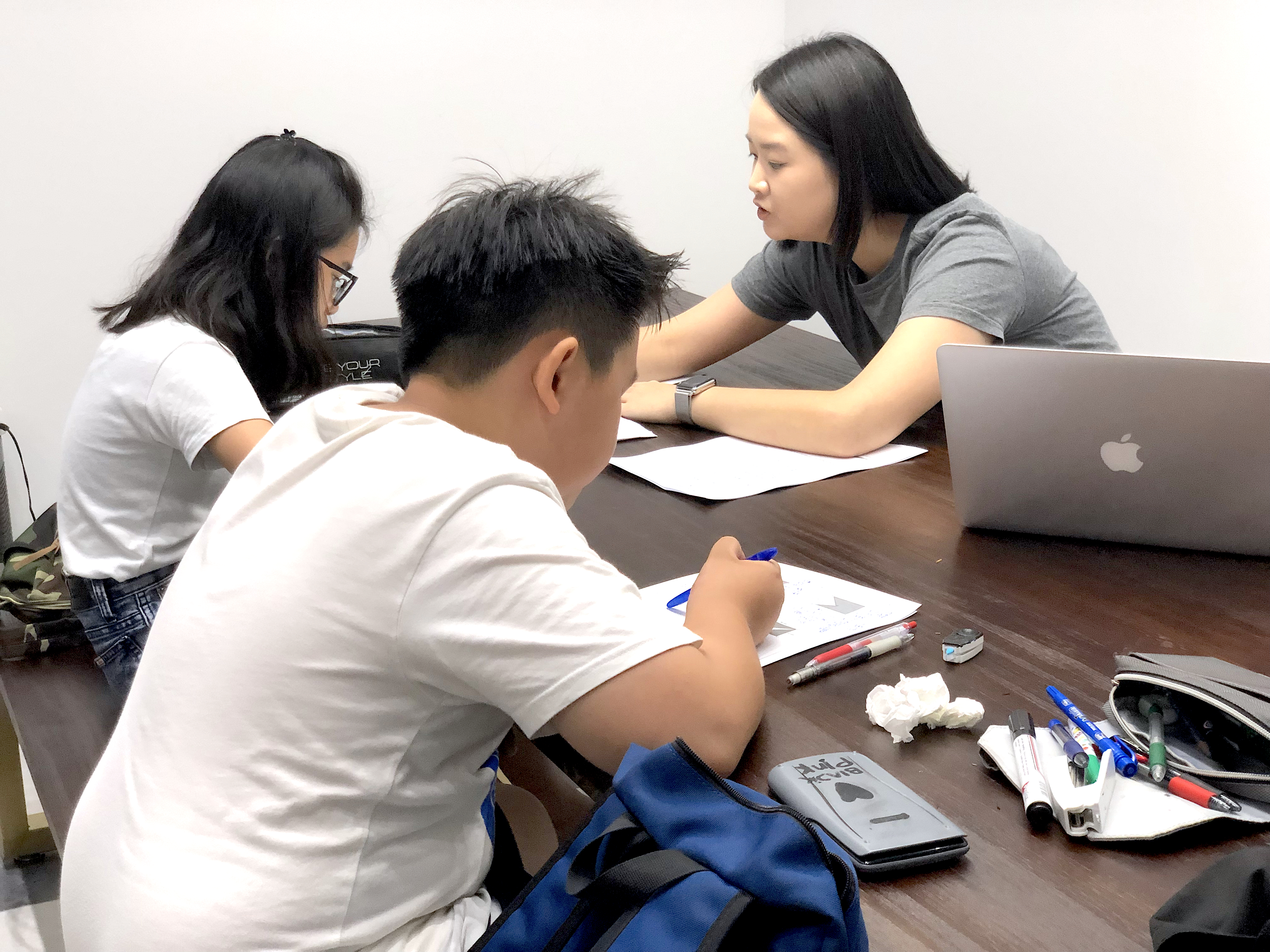














Pri3 Yishun The best Pri 3 English Tuition in Yishun with SEAB MOE PSLE syllabus English. Pri3 Yishun Primary English Tutor for Pri1 Pri2 Pri3 Pri4 Pri5 Pri6 PSLE English Paper 1 and Paper 2.
Call Yuet Ling +65 82226327 for our Pri3 Yishun English classes.


Learn English and make it useful.
Working closely with parents are part of our teaching culture to create the desired effect to get our English students positive changes in their studies. Our Yishun PSLE English tutors teach from scratch, making sure our English students master their language, and we do all the necessary practices from basic easy to complex advanced questions with our students, including past exam papers that helps them to understand and appreciate English as lingua franca in Singapore and use it to further their studies.
Class Culture
At eduKate Yishun, we work hard to have an affirmative class culture that empowers our students to do more, learn more, and develop a love for their own education by creating a class culture with great friends and tutors. Our positive classes also creates a constructive environment that teaches them the relevance of what they study to their everyday lives. With relevance creates the true reason for a proper education. That is our trademark that differentiates our teaching to others, but don’t just take our words for it, let these photos show you how much our passion and love for our Yishun student’s English lessons.





Leave a Reply